









Will AI Take My Job in 2026? What the Data Actually Says
By Irene Holden
Last Updated: January 4th 2026
Key Takeaways
Short answer: No - AI probably won’t “take your job” wholesale in 2026; it’s reshaping tasks and routes rather than collapsing employment, with the World Economic Forum projecting about 92 million jobs displaced but 170 million created (a net +78 million). That said, many roles will change - Goldman Sachs estimates up to 300 million jobs could be affected and McKinsey finds 88% of organizations use AI - so audit your tasks and build basic AI fluency to move toward less-automatable, higher-value work.
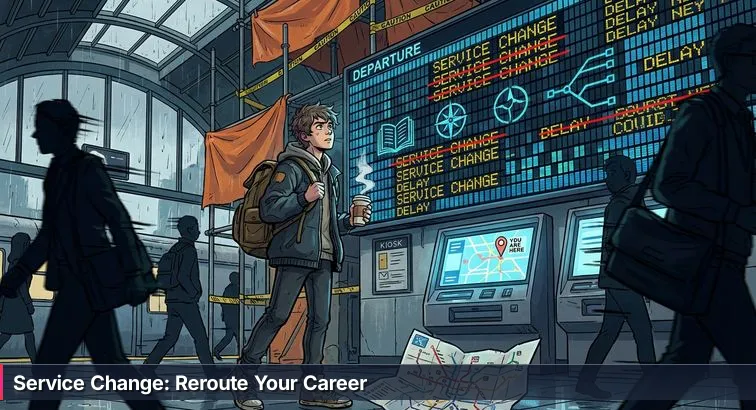
At 7:42 a.m. on a weekday, you walk into your usual station and instantly sense it: the board is cluttered with yellow “SERVICE CHANGE” alerts, your normal line has vanished, and an employee is slapping a fresh “Route Changed” sticker over the old map. The trains are still running, but the mental map you relied on just broke. For a lot of workers, especially in customer service, admin, retail, or early-career tech, that’s exactly what staring at AI headlines feels like right now.
When you scroll through news about “AI taking over jobs,” you’re not really asking whether the system still exists; you’re asking whether your specific route to a stable income and a better role is still in service. Official forecasts from central banks and consultancies are like the printed system map: useful, but abstract. Studies from places like the Federal Reserve Bank of Boston show many workers carry a mix of anxiety and cautious optimism about AI - hopeful about new opportunities, but unsure how to actually reach them.
This guide is your updated map, written for people who don’t have time to become AI researchers but do need to figure out their commute through the job market. We’ll zoom out to what the data really says about AI and employment, then zoom back in to what it means if you’re answering support tickets, working a register, scheduling meetings, or trying to break into tech. Instead of treating every headline like a personal eviction notice, you’ll learn to read it like a system-wide service alert: important context, not the whole story of your career.
Most importantly, we’ll focus on navigation, not trivia. Knowing that “AI is changing work” is like knowing there’s construction somewhere on the line - it doesn’t tell you which platform to stand on tomorrow. So we’ll walk through how to break your job into tasks, spot which “stops” are easiest for AI to run, and find transfer points where a bit of reskilling can move you from a slowing local train to a more resilient or AI-augmented route. Along the way, we’ll connect research from organizations like the Global Skill Development Council to concrete actions you can take in the next 90 days, so you’re not just watching the departure board - you’re choosing your next connection.
In This Guide
- Introduction: the map has changed
- What the 2026 AI job data actually shows
- Why tasks matter more than job titles
- Which roles are most at risk and why
- Industry-by-industry exposure: where your sector stands
- Why 2026 feels different: agents and the job shock debate
- A simple framework to read your personal AI risk
- Where jobs are actually growing: the new express lines
- Four-step transfer plan to move to safer roles
- Upskilling options that don't cost a fortune
- A practical 90-day action plan
- Conclusion: choosing your next move
- Frequently Asked Questions
Hiring trends now favor demonstrable AI literacy and project portfolios - this article explains how to build both.
What the 2026 AI job data actually shows
When you zoom out from the noisy departure board of headlines to the full transit map of the global economy, the picture is more nuanced than “all trains canceled.” The World Economic Forum estimates that between 2025 and 2030, AI and related technologies will displace about 92 million jobs but also create about 170 million new jobs, a net gain of 78 million roles worldwide. On the system map, that looks less like a shutdown and more like major rerouting: some lines closing, new ones being built, and many existing routes changing where they stop and how often they run, as outlined in the WEF’s Future of Jobs Report 2025.
At the same time, several major analyses agree that “exposure” to AI doesn’t automatically translate into mass unemployment. Goldman Sachs estimates that generative AI could affect up to 300 million jobs globally - around 9.1% of workers - yet their economists project only about a 0.5 percentage point increase in unemployment, with many effects expected to be temporary as new roles appear. For someone in a real job, that means your tasks may change a lot even if the total number of people employed in your field doesn’t collapse, a nuance their researchers emphasize in analysis of AI and the global workforce.
Under the hood, adoption is already widespread, but maturity is still low. McKinsey finds that roughly 88% of organizations now use AI in at least one business function, yet only about 1% are truly “AI mature”. They also estimate that up to 30% of current hours worked in the U.S. economy could be automated by 2030, and in a recent survey, 32% of organizations said they expect AI-related workforce reductions within a year. For workers, that looks like tools showing up in email, customer support, and analytics long before companies have fully redesigned jobs or career paths around them.
Global institutions echo the scale of the shift. The International Monetary Fund reports that nearly 40% of jobs worldwide are already influenced by AI, rising to about 60% of roles in advanced economies. Separate labor-market analyses find that in industries most exposed to generative AI, productivity growth has almost quadrupled - from roughly 7% in the 2018-2022 period to about 27% by 2018-2024 - intensifying pressure on employers to “do more with less” staff as AI tools spread.
And yet, when researchers at Yale’s Budget Lab matched AI exposure scores to real employment data, they found no clear, economy-wide relationship so far between AI exposure and changes in employment or unemployment, calling many sweeping job-loss claims “largely speculative” at this stage. In practical terms, the network is being redrawn, but it hasn’t collapsed. Your challenge isn’t to memorize every statistic; it’s to use this data like a system map: to ask whether your particular line is being upgraded, slowed, or rerouted - and what that means for the stops (tasks) you handle every day.
Why tasks matter more than job titles
When people say “AI will take jobs,” it sounds like entire train lines shutting down overnight. In reality, most roles look more like a set of interconnected stops: email here, data entry there, customer calls somewhere in the middle. A 2025 MIT study estimated that currently automatable tasks represent about 11.7% of the U.S. workforce, or roughly $1.2 trillion in wages. That doesn’t mean 11.7% of people vanish; it means big chunks of what they do can now be run by software instead of humans.
Jobs are bundles of tasks, not single lines
Consultancies like McKinsey frame this in terms of “hours that can be automated” rather than whole roles disappearing. Some tasks in your day are routine, rules-based, and done on a computer; others depend on messy human conversations or judgment. When researchers at McKinsey looked across occupations, they found that even in highly exposed fields, only a slice of activities can be fully automated, which is why they talk about redesigning work around AI rather than replacing every worker, as detailed in their analysis of work partnerships between people, agents, and robots. For you, that means your task mix matters more than your job title; two “customer service reps” can face very different risks depending on what they actually do all day.
“Silent compression”: fewer hires, more automation
On the ground, many people aren’t seeing dramatic “AI layoffs” so much as a quiet squeeze. Freelancers and employees report what’s been called “silent compression”: hours of manual effort getting replaced by AI tools, teams staying smaller than they would have in 2019, and job listings quietly expecting you to cover more work with automation. Deloitte’s research, summarized by Gloat, found leaders are about 3.1x more likely to prefer hiring new AI-ready talent over retraining existing staff, a signal that companies would rather bring in people who already know how to work with these tools than retrofit old roles, as discussed in their AI labor market report.
From helpers to agents: why your task list is shifting
For a few years, AI acted like autocomplete on steroids: a helper that suggested replies or drafted first versions. Now it’s moving into “agent” territory - reading inboxes, drafting and sending responses, researching leads, updating CRMs, even triggering follow-up tasks without a human in every loop. Venture investors expect this “year of agents” pattern to accelerate, which means whole workflows - not just single clicks - are getting handed off to systems. The most vulnerable tasks are the ones that are digital, repetitive, and easy to describe in step-by-step instructions.
A quick task-audit you can do this week
To see how this plays out in your own role, treat your job like a route map and label the stops. Take a typical week and list 10-20 tasks you actually perform, then tag each one:
- A = Routine, rules-based, on a computer.
- B = Requires judgment, creativity, or complex communication.
- C = Requires physical presence, hands-on work, or deep trust.
Tasks in category A are the ones AI is most likely to take over or heavily compress; B and C are where you’re hardest to replace. Even a simple audit like this turns abstract AI debates into a concrete map of your own risk - and highlights where a bit of reskilling could shift you toward a safer mix of tasks without throwing out your entire career and starting from a new station.
Which roles are most at risk and why
Across the network of jobs, AI is not hitting every line equally. Some routes are packed with repeatable, on-screen tasks that software can now handle end-to-end; others depend on touch, trust, and judgment in ways current systems still struggle with. Analyses summarized by Nexford University point to roles like data entry clerks, telemarketers, basic customer service reps, and retail cashiers as among the most exposed, while management, creative fields, education, and healthcare sit on far more resilient tracks. The World Economic Forum estimates that up to 85 million jobs could be replaced by automation and AI by 2026, with some retail functions seeing automation of as much as 65% of roles, according to their Future of Jobs projections discussed in Nexford’s synthesis of AI job impacts.
High-risk, highly automatable roles
The most vulnerable jobs are the ones that look like slow local trains: lots of predictable stops, clear scripts, and work entirely on a computer or phone. In practice, that includes people who spend most of their day keying information into systems, following call-center scripts, or scanning and ringing up purchases. A review of replacement risk by Exploding Topics highlights roles such as data entry keyers, telemarketers, and routine customer support agents near the top of AI exposure lists, because their core tasks are repetitive, rules-based, and text-heavy. For workers in these seats, AI doesn’t just “speed you up” - it gives employers a clear business case to run far fewer human shifts once chatbots, IVR systems, and automated checkout mature, a pattern detailed in their overview of jobs most at risk of AI replacement.
Moderate-risk roles being quietly reshaped
One level out from that, you’ll find roles where AI can’t replace the job outright but can chew up many of the routine tasks inside it: paralegals, bookkeepers, accountants, auditors, and some marketing and operations roles. Here, tools already handle first-pass contract review, expense categorization, baseline reports, and simple data analysis. Large employers are experimenting with agents that draft legal memos, assemble financial dashboards, or generate marketing copy before a human ever touches the file. McKinsey and others note that almost one-third of organizations now anticipate AI-driven workforce reductions in the near term, with a particular focus on process-heavy, mid-skill cognitive work. If you’re in this band, the risk is less “my role vanishes” and more “fewer people doing the same work,” unless you move up the value chain into reviewing, orchestrating, and advising instead of just executing checklists.
Augmented and resilient roles - what “risk” actually looks like
On the other end of the spectrum are occupations that are heavily touched by AI but not easily replaced: software developers, radiologists, financial analysts, and a wide range of in-person care and skilled trade roles. Gartner projects that by 2028, essentially 0% of IT work will be done by humans without AI; instead, about 75% will be performed by humans augmented with AI and the remaining 25% by AI alone, a pattern that turns these jobs into high-speed express trains rather than shutting them down. At the same time, WEF data from 2019-2024 shows that occupations with lower AI exposure saw about 65% job growth, while more exposed occupations still managed 38% growth, underscoring that “risky” doesn’t always mean “shrinking,” but it does mean faster change in tasks and expectations.
If you recognize yourself in the high- or moderate-risk clusters, the move now is not to stand on the platform hoping the old train comes back. In the next 6-12 months, you want to start using AI at work where possible, shift from pure “doing” toward reviewing and coordinating, and explore short, focused reskilling paths into adjacent roles - like customer success instead of scripted support, sales development instead of pure telemarketing, or junior technical roles if you discover you enjoy working with the systems themselves. As Geoffrey Hinton put it, “We’re going to see [AI] having the capabilities to replace many, many jobs… it’s already able to replace jobs in call centers, but it’s going to be able to replace many other jobs,” - Geoffrey Hinton, computer scientist, via Fortune. The way to stay on the network is to move toward the parts of your job that AI struggles with, rather than competing head-on with the parts it can already run on its own.
Industry-by-industry exposure: where your sector stands
Sector matters as much as job title. Two people with “analyst” on their badge can face very different levels of AI disruption depending on whether they work in a downtown bank, a hospital system, or a small logistics firm. Aggregated research from groups like National University shows that industries such as information and communication technology, finance, and professional services have the highest share of postings requiring AI skills, while many trades and in-person services still see AI mostly in back-office tooling rather than front-line replacement, as outlined in their overview of AI job statistics and sector impacts.
How the major corridors compare
At a high level, you can think of industries as different corridors on the same rail network. Some are under heavy renovation with express AI projects barreling through; others have slower upgrades where AI shows up as scheduling tools, documentation helpers, or better diagnostics rather than full job automation. The table below summarizes how several big sectors are being reshaped.
| Industry | AI exposure | What’s changing | Example impact |
|---|---|---|---|
| Financial services | Very high | Heavy automation of analysis, reporting, and routine compliance. | Shift toward fraud detection, risk modeling, and AI oversight roles. |
| Technology | Very high | AI built into almost every product and workflow. | Spiking demand for AI skills; traditional entry-level roles under pressure. |
| Manufacturing | High | Robots plus AI for production, quality, and predictive maintenance. | Roughly 2 million roles shifting toward oversight, programming, and maintenance. |
| Healthcare & education | Moderate | AI assists with diagnostics, documentation, and personalization. | Growth in AI-assisted roles, but strong need for human judgment and empathy. |
| Customer service & transport | High | Chatbots, routing algorithms, and agentic AI handle routine interactions. | Fewer basic support and dispatch positions; more complex escalation and customer success work. |
| Lower-AI-exposure sectors | Low | AI mostly used in back-office and planning tools. | Steady growth with incremental efficiency gains, not wholesale role replacement. |
High-exposure corridors: finance, tech, customer service
If you work in financial services, tech, or large-scale customer operations, you’re on one of the busiest AI corridors. Banks and insurers are rolling out models for underwriting, anti-money-laundering checks, and customer triage; software companies are weaving AI into development, testing, and support; call centers are experimenting with agents that can handle entire ticket flows. Labor-market analyses show that in the information and communication technology sector, around 8.8% of job adverts now explicitly require AI skills, the highest share of any major industry. For workers, that means rising expectations: even non-technical roles increasingly assume you can collaborate with AI tools instead of avoiding them.
Moderate and lower exposure: healthcare, education, trades
In healthcare, education, and many public services, AI looks more like a set of assistive tools than a direct substitute. Clinicians get help with imaging analysis and documentation, but still carry ultimate responsibility for decisions. Teachers use recommendation systems and content generators, yet remain central for classroom management, motivation, and adapting to individual students. Skilled trades and on-site repair roles see AI in diagnostics and routing, not in a robot that can actually crawl under a house or troubleshoot a live panel safely. U.S. employment projections that explicitly factor in AI suggest that while some occupations in these sectors may see slower growth, many others continue to expand as demand for human-centric work stays strong, a nuance highlighted in the Bureau of Labor Statistics’ discussion of incorporating AI impacts into employment projections.
For your own route planning, the key question isn’t just “Is my job title exposed?” but “How is my industry trying to use AI?” In high-exposure corridors, the safest platforms are roles that design, supervise, or complement AI systems rather than compete with them on routine tasks. In moderate- and low-exposure sectors, the opportunity is to be the person who brings AI literacy into human-centered work, using tools to handle paperwork and pattern-spotting so you can spend more time on the in-person parts no model can replace.
Why 2026 feels different: agents and the job shock debate
What makes this moment feel so different is not just that AI is in more places, but that it’s starting to run whole routes instead of just suggesting better turns. For a few years, tools acted like copilots: they helped you draft emails, clean up copy, or summarize meetings while you stayed firmly in control. Now, venture investors and founders are pouring money into systems that can take a goal (“follow up with these leads” or “prepare next week’s reports”) and execute most of the steps themselves. As one group of investors put it in their prediction round-up, this is the year AI shifts “from making humans more productive to automating work itself,” a dynamic explored in TechCrunch’s reporting on AI’s coming labor impact.
From copilots to agents running end-to-end workflows
Agentic AI systems don’t just autocomplete a sentence; they can read inputs from multiple systems, make basic decisions, and trigger follow-up actions with minimal supervision. Instead of suggesting a response you approve, an agent might monitor an inbox, prioritize messages, draft replies, log key details in a CRM, and schedule follow-ups. Research syntheses from firms like Deloitte describe how “agentic” pilots are spreading quickly, with a growing share of companies moving from experiments in content generation to pilots where AI handles sequences of tasks across departments. For workers, that feels less like getting a new tool and more like watching whole chunks of your task list quietly migrate to software, even if your job title and department stay the same.
“Job shock” or just another adjustment?
That sharper shift has fueled a debate among experts about whether we’re entering a true “job shock” period or a more familiar adjustment cycle. Some technologists, including Turing Award winner Geoffrey Hinton, have warned that current systems are already capable of replacing “many, many jobs” and will expand far beyond obvious candidates like call centers into a wide range of cognitive work, a concern he raised in interviews about AI’s 2026 trajectory. Others, like labor economists and platform analysts, argue that macroeconomic trends and policy decisions are still bigger drivers of job loss than AI itself, and point out that previous technology waves often produced a turbulent couple of years followed by new categories of work. The disagreement isn’t about whether tasks will be automated - they will - but about how quickly workers and institutions can build new lines and transfer points to absorb the change.
“The complexity here is that many enterprises, despite how ready or not they are to successfully use AI solutions, will say that they are increasing their investments in AI to explain why they are trimming workforces. In reality, AI will become the scapegoat for executives looking to cover for past mistakes.” - Antonia Dean, Partner, Black Operator Ventures
How employers say they’ll change jobs and hiring
Meanwhile, employer surveys make it clear that job descriptions themselves are being rewritten. One widely cited HR survey found that about 37% of companies expect to have replaced some jobs with AI by the end of the year, and another reported that roughly 89% of senior HR leaders believe AI will fundamentally reshape job descriptions and hiring in this same window. Gartner goes further, forecasting that by this point about 50% of organizations will use “AI-free” skills tests during hiring to assess human-only strengths like critical thinking and emotional intelligence - a trend summarized in Korn Ferry’s look at emerging talent acquisition trends. For you, that combination means two things at once: you’ll be expected to show you can work with agents and automation, and you’ll also need clear, AI-independent evidence of the human judgment, communication, and collaboration skills that employers are explicitly trying to measure.
A simple framework to read your personal AI risk
Reading your own risk on the AI “system map” doesn’t require a PhD or a 50-page report. It comes down to a few practical questions about what you actually do all week, how your industry is using AI, and how comfortable you are working with these tools. Researchers tracking AI and labor markets, like those at Yale’s Budget Lab, emphasize that broad exposure scores don’t translate cleanly to individual outcomes and that workers need ways to understand their personal exposure, not just sector averages, a point underscored in their analysis of AI’s impact on the labor market.
1. How much of your week is routine, digital, and rules-based?
Start with your time. Roughly estimate what percentage of your workweek is spent on tasks that are on a computer, follow clear rules or templates, and could be described in step-by-step instructions. If that’s around 70% or more, you’re effectively riding a heavily automated line; if it’s under 30%, your near-term risk is lower. The original framework in this guide suggests tagging tasks as A (routine, digital, rules-based), B (judgment, creativity, complex communication), or C (physical presence or deep trust). The more A you have, the more likely AI is to compress big chunks of your role, even if your job title doesn’t change.
2. How central are trust, touch, and nuance in your work?
Next, ask why people really rely on you. Do they come to you for high-stakes judgment, nuanced conversations, in-person care, or hands-on problem-solving? Or mainly for fast, accurate processing of information? Work that leans heavily on trust, physical presence, or emotional intelligence tends to sit in what many analysts call “human-only zones,” where AI is a tool rather than a replacement. A synthesis of impact reports notes that roles in skilled trades, care, and counseling remain among the least automatable because they blend complex context with physical and interpersonal demands in ways current systems can’t reliably match, a theme highlighted in future-ready-hub’s overview of AI employment impact research.
3. How hard is your industry pushing AI to cut costs?
Then, zoom out from your desk to your sector. Industries like finance, tech, large-scale customer service, logistics, and back-office operations are under strong pressure to automate repetitive cognitive work; others, like many trades, parts of healthcare, and public services, are moving more cautiously. A simple litmus test is to search your industry plus “AI” and see if big players are talking about headcount reduction, agentic AI pilots, or shifting entry-level tasks to automation. If so, even a role that feels “safe” today may see its task mix change quickly as companies reroute more routine stops to software.
4. How AI-fluent are you right now?
Finally, rate your own AI fluency on a 1-5 scale: 1 means you rarely touch these tools; 3 means you use systems like ChatGPT or other assistants weekly to help with work; 5 means you can design workflows where AI does significant portions of the job. Combined with your task and industry profile, this gives a simple self-assessment: high risk if you have 60%+ routine tasks, work in a heavily automating sector, and sit at fluency 1-2; medium risk if you’re at 30-60% routine tasks with moderate exposure and fluency 2-3; lower risk if most of your work is trust/touch/nuance in a less automation-obsessed sector and you’re building toward fluency 3-5.
“No single metric can capture how vulnerable any one worker is to AI; individuals need simple tools to understand their own mix of tasks, skills, and opportunities.” - Future-Ready Hub, A Comprehensive List of AI Employment Impact Reports
Where jobs are actually growing: the new express lines
Even as some familiar routes slow down or close, new express lines are opening for people who can work with AI instead of around it. Across multiple labor analyses, demand for AI-related skills has increased nearly sevenfold in just two years, jumping from about 1 million to 7 million workers in occupations where AI skills are explicitly required. Jobs that call out AI capabilities are growing around 7.5% at a time when overall job postings have fallen by roughly 11.3%, and they carry an average 56% wage premium over similar roles without AI requirements, according to aggregated market data highlighted in SQ Magazine’s AI job creation statistics. For someone in customer service, admin, or early-career tech, that means AI fluency isn’t just a defensive move; it’s a way to jump onto faster-moving tracks.
Fast-growing AI roles you can actually target
Behind those averages are specific titles that barely existed a few years ago and are now hiring aggressively. Recent breakdowns of job postings show roles like AI Engineer growing by about 143%, AI Content Creator by 134.5%, AI Solutions Architect by 109%, and Prompt Engineer / LLM Specialist by 95.5%. Many of these are still open to people who start in adjacent fields - marketing, customer support, project management - as long as they can show hands-on experience using AI tools, not just talking about them. The table below gives a snapshot of where these express lines are headed and how beginners and career-switchers often get on board.
| Role | Recent growth | Core focus | Common entry path |
|---|---|---|---|
| AI Engineer | +143% | Building and integrating AI models into products. | Software dev or Python/ML upskilling. |
| AI Content Creator | +134.5% | Using generative tools for marketing, media, and education. | Copywriting, social media, or design plus AI tools. |
| AI Solutions Architect | +109% | Designing end-to-end AI-powered systems for businesses. | IT, cloud, or systems engineering backgrounds. |
| Prompt Engineer / LLM Specialist | +95.5% | Shaping and evaluating how large language models behave. | Mix of domain expertise, writing, and experimentation with LLMs. |
Where new jobs are clustering by industry
These roles aren’t confined to big tech campuses. In one recent year alone, the healthcare sector added over 640,000 AI-driven roles - from clinical decision support and medical imaging augmentation to operational optimization - while financial services created roughly 470,000 AI-focused jobs in areas like fraud detection, risk modeling, and algorithmic compliance. Design and manufacturing firms are following a similar pattern, using AI to reimagine how they plan, simulate, and operate systems, trends documented in Autodesk’s AI job growth report for design and make industries. For workers, that means AI skills translate into opportunities not just at startups, but in hospitals, banks, logistics providers, and manufacturers that are all standing up new AI teams and “human-in-the-loop” oversight roles.
For beginners and career-switchers, the key is to treat these growth areas as new lines with multiple on-ramps. You don’t have to jump straight into an AI engineer job to benefit. You can become a marketer who runs 10x more experiments using AI, a customer success rep who designs better bot-assisted workflows, or a project manager who specializes in rolling out AI tools responsibly. Each of those paths lets you board an express train without abandoning your existing experience - turning AI from a threat on the departure board into a set of new destinations you can deliberately move toward.
“Jobs requiring AI skills are no longer confined to the tech sector - they’re emerging in every major industry, from healthcare to manufacturing.” - Index.dev Research Team, AI Job Growth Statistics
Four-step transfer plan to move to safer roles
With so many “service change” alerts hitting the job market at once, it’s easy to feel like you’re waiting on a platform that might close. A transfer plan turns that anxiety into motion. Analysts at Goldman Sachs, writing for Marcus, estimate that AI could ultimately displace around 6-7% of the U.S. workforce, but they also note that in past tech shifts, displacement effects typically faded after about two years as new roles emerged and productivity gains translated into different kinds of work, a pattern they detail in their examination of AI’s impact on the global workforce. Other researchers have already counted about 55,000 job cuts directly attributed to AI out of roughly 1.17 million total layoffs in a recent year, according to a synthesis of expert predictions on AI-related job loss. Those numbers are real, but they also show why a structured four-step plan matters: you’re not powerless, and you don’t have to start over from scratch.
Step 1: Audit your current route into tasks
Begin by mapping what you actually do, not just what your title says. Take one typical week and list 10-20 tasks, then tag each as A (routine, digital, rules-based), B (judgment, creativity, complex communication), or C (physical presence or deep trust). Once you see that mix on paper, you can make deliberate choices to shrink the A work and grow B and C over time, either within your current job or in adjacent roles. A simple workflow for this step might look like:
- Write down every recurring task you perform in a week.
- Label each task A, B, or C based on how repeatable and “human” it is.
- Circle the A tasks that are easiest to hand off to AI tools.
- Highlight the B and C tasks you’d like to do more of and could strengthen with training.
Step 2: Lean into human skills AI struggles with
Next, deliberately invest in the parts of your work that models can’t convincingly imitate: critical thinking, clear communication, collaboration, and ethical judgment. Employers and researchers consistently point to these as long-term differentiators, especially as more routine tasks are automated. Practically, this can mean volunteering to lead small projects, running a retrospective on how a process could improve, or presenting to your team about a change you’ve implemented. Each of those activities gives you concrete stories that show you can diagnose problems, align people, and make decisions under uncertainty - skills that stay valuable even as tools change.
Step 3: Build practical AI fluency on the job
Instead of waiting for a formal training program, start using AI where you already are. Treat tools like ChatGPT-style assistants or workplace-approved bots as everyday utilities: have them draft emails you then edit, summarize customer interactions before you respond, propose checklists for recurring tasks, or turn messy notes into clean documentation. The goal isn’t to become an AI engineer overnight; it’s to get comfortable designing simple “AI + you” workflows where the system handles first drafts and repetitive steps, and you handle context, judgment, and final decisions. Over a few months, that experience becomes a portfolio of concrete examples you can describe to managers and hiring teams.
Step 4: Pick your next line: user, pro, or creator
Finally, decide what kind of AI-powered route you want to ride over the next 1-2 years. You can stay in your field as an AI-augmented worker, shift into an AI-aware professional role in a growing area like product or data, or aim to become an AI creator who builds tools and products. Thinking in terms of these three “lines” helps you choose learning goals and timelines that fit your life, rather than chasing whatever headline role is trending this week.
| Pathway | Main goal | Typical timeline | Good fit if you… |
|---|---|---|---|
| AI-augmented worker | Use AI to upgrade your current role. | About 3-6 months of focused practice. | Like your field and want to stay, but make it safer and higher value. |
| AI-aware professional | Move into a growing role reshaped by AI (e.g., product, data, CX). | Roughly 6-12 months of part-time upskilling. | Are open to a title change but want to build on your existing experience. |
| AI creator | Design and build AI-powered tools, apps, or services. | About 9-18 months including coding and product skills. | Enjoy technical problem-solving and are drawn to building things from scratch. |
Upskilling options that don't cost a fortune
Once you’ve decided to change lines, the next question is how to learn the skills you need without blowing up your budget. Employers are openly saying that AI literacy and tech fluency will influence who gets hired and who gets left waiting on the platform; a recent analysis of HR leaders found that a strong majority expect AI to reshape most jobs and hiring criteria in the near term, reinforcing the need for affordable, practical upskilling rather than one-off workshops, a theme highlighted in CNBC’s survey of HR leaders on AI and jobs. The good news is that you don’t need a $10,000+ bootcamp or a full degree to get moving; there’s a spectrum of options with very different price points, time commitments, and levels of structure.
At one end is pure self-study: free YouTube tutorials, documentation, and open courses you stitch together on your own. Massive open online courses (MOOCs) add more structure with low-cost classes but limited personal support. Community colleges and university certificates offer recognized credentials over months or years, usually at moderate tuition. Traditional full-time bootcamps compress everything into a few intense months but often cost five figures. For career switchers juggling jobs and families, that mix of cost and intensity can feel like trying to catch an express train that never stops at your station. That’s where part-time, lower-cost programs come in, offering smaller payments and realistic schedules while still giving you a curriculum, instructors, and a peer group.
| Path | Typical cost | Time commitment | Best for |
|---|---|---|---|
| Self-study | Free to a few hundred dollars | Flexible; entirely self-paced | Highly self-motivated learners who don’t need structure. |
| MOOCs / online courses | Dozens to low hundreds per course | 4-12 weeks per course, flexible | Testing the waters or filling specific knowledge gaps. |
| Community college / university certificates | Thousands to tens of thousands | Months to years, part-time or full-time | Those wanting formal credentials and slower pacing. |
| Traditional full-time bootcamps | Often $10,000+ | Several months, full-time | People who can pause work and afford higher tuition. |
| Nucamp part-time bootcamps | About $2,124-$3,980 | 4-25 weeks, evenings/weekends | Career changers needing affordability, structure, and flexibility. |
Within that last category, Nucamp is designed specifically for beginners and career-switchers who need a realistic way to get onto a new line. Programs range from about $2,124 to $3,980, significantly below typical bootcamp prices, and cover both AI and foundational coding. The AI Essentials for Work bootcamp runs for 15 weeks at around $3,582, focusing on practical AI skills, prompt engineering, and AI-assisted productivity for people who want to upgrade their current roles. The Solo AI Tech Entrepreneur bootcamp lasts 25 weeks at roughly $3,980, aimed at aspiring builders who want to integrate large language models, design AI agents, and learn how to monetize SaaS-style products. For those who want a technical base for software or AI careers, the Back End, SQL and DevOps with Python bootcamp runs 16 weeks at about $2,124, covering Python, SQL, DevOps, and cloud deployment.
On top of these AI-focused paths, Nucamp offers shorter and longer routes: Web Development Fundamentals (4 weeks, about $458), Front End Web and Mobile Development (17 weeks, around $2,124), Full Stack Web and Mobile Development (22 weeks, roughly $2,604), a Cybersecurity Bootcamp (15 weeks, about $2,124), and a comprehensive Complete Software Engineering Path (11 months, approximately $5,644). Outcomes data from independent review platforms report an employment rate near 78%, a graduation rate around 75%, and about 4.5/5 stars on Trustpilot from roughly 398 reviews, with close to 80% of those being five-star ratings. Students frequently highlight the combination of affordability, structured learning, and community - live workshops in over 200 U.S. cities, 1:1 career coaching, portfolio support, mock interviews, and job board access - as the features that made it possible to transfer to a new line without stepping off the network entirely.
A practical 90-day action plan
Ninety days is long enough to change lines without blowing up your whole life. Instead of trying to redesign your entire career in one weekend, you can treat the next three months like a series of short transfers: first understanding your current route, then experimenting with AI in place, then adding structured learning, and finally showing the world what you can now do. Surveys from organizations like Gallup show that AI use at work is rising steadily, but a large share of employees still haven’t turned that exposure into proactive skill-building - this plan is about making that jump in a concrete, low-anxiety way.
Weeks 1-2: Map your current route and risk
In the first two weeks, focus only on clarity. Do a task audit of your job (list what you actually do and tag tasks as routine A, judgment-based B, or hands-on/trust-heavy C), and write a one-page summary of your situation: your current mix of A/B/C tasks, how exposed your industry is, and 2-3 target roles or “lines” you might want to move toward. If you can, have one or two short conversations - with a manager, coworker, or someone in your network - about how AI is already showing up in their work and whether there are internal projects that touch AI you could join. The goal for this phase isn’t change; it’s to stop guessing and see your real map on paper.
Weeks 3-4: Start using AI every workday
The next two weeks are about turning AI from an abstraction into a daily tool. Pick one assistant (something like a workplace-approved chatbot) and commit to using it once per workday on real tasks: drafting or editing an email, summarizing a call, outlining a report, or generating a checklist. Keep a simple log of what you tried, how much time it saved, and what still went wrong. Research on long-run AI impacts from places like the University of Michigan notes that the biggest gains come when humans and AI specialize - machines handle pattern-heavy work, humans handle creativity and judgment - rather than when either side tries to do everything alone, a point explored in their discussion of AI’s impact on work and creativity. These two weeks are your first practice in that kind of collaboration.
Weeks 5-8: Enroll in a path and ship one small project
With a clearer picture of your risk and some hands-on AI practice, weeks 5-8 are the right time to add structure. Choose one learning path that fits your target line and life - this could be a focused online course, a part-time bootcamp, or a community-college class - and block out realistic hours on your calendar (for most working adults, that’s 6-10 hours a week). Aim to “ship” at least one small but tangible project by the end of week 8: an AI-augmented workflow you documented and improved, a simple data or coding project, a case study of how you used AI to cut cycle time at work. That artifact becomes the first tile in a portfolio you can point to when you say, “I know how to use these tools in real situations.”
Weeks 9-12: Reposition yourself and test the market
In the final month, you turn new skills into visible signals. Update your resume and LinkedIn to reflect AI use and the project(s) you’ve completed, rewriting bullets to emphasize outcomes (time saved, quality improved, volume increased) rather than just tools learned. Have at least three conversations: one with your current manager about stretching your responsibilities toward AI-augmented or higher-value tasks; one with someone already in your target role or industry; and one with a recruiter or hiring manager to get feedback on how your new profile lands. Start applying selectively to roles that explicitly mention AI skills or workflows. By the end of 90 days, you won’t have solved everything - but you will have moved off a passive, possibly shrinking platform onto a clearer route with real momentum and evidence you can build on.
Conclusion: choosing your next move
By now, the departure board of AI headlines should look a little less like chaos and a little more like a system map you can read. You’ve seen that some lines are under heavy construction, some new express routes are opening, and many familiar commutes are getting an extra transfer. For beginners in customer service, admin, retail, or early-career tech, the biggest shift isn’t that “everything is changing” - it’s that you can no longer rely on a single, unexamined route to carry you from one year to the next.
The core choice in front of you isn’t whether AI exists or whether it will touch your job. It’s whether you’ll treat it as something happening to you, or as infrastructure you can learn to navigate. Global skills councils and labor researchers are increasingly clear on this point: workers who actively build AI fluency and double down on human strengths see more options, not fewer, even in highly exposed fields, a pattern echoed in the Global Skill Development Council’s analysis of AI’s real trends in the labor market. That doesn’t make the uncertainty disappear, but it does mean your actions over the next year matter more than any single prediction.
If the earlier sections felt like stepping back to study the big map, this is the moment you return to your own platform. You’ve got tools to audit your tasks, gauge your risk, experiment with AI on the job, and pick an upskilling path that fits your life and budget. You don’t need to sprint for the flashiest express; you just need to choose a direction, commit to a manageable pace, and keep collecting small, concrete wins - a workflow you automated, a project you led, a course you finished and turned into a portfolio piece.
Most importantly, remember that switching lines is not the same as starting over. Your past experience, especially with people, processes, and domain knowledge, doesn’t vanish just because the trains are newer. It becomes the context that makes your AI skills valuable. So instead of waiting for the old route to come back, decide on one next move you can make this month - a conversation, a course, a small experiment at work - and take it. In a system being constantly rerouted, the advantage goes to the people who don’t just watch the board, but learn how to navigate it.
Frequently Asked Questions
Will AI take my job in 2026?
Not necessarily - the data points to major rerouting, not a universal shutdown: the World Economic Forum estimates 92 million jobs displaced and 170 million created between 2025-2030 (a net +78 million), while Goldman Sachs says up to 300 million jobs could be affected but projects only a ~0.5 percentage-point rise in unemployment. For most people, tasks will change first; whole-role replacement is concentrated in predictable, routine work.
Which jobs are most at risk in 2026?
The highest risk roles are those made up of routine, on-screen, rules-based tasks - think data-entry clerks, telemarketers, basic customer service reps, and many cashier functions. Analysts warn that up to about 85 million jobs could be replaced by automation by 2026, and some retail tasks may see automation rates as high as ~65%.
How can I tell if my specific job is vulnerable to AI?
Do a quick task audit: list 10-20 things you do in a week and tag each as A (routine/digital), B (judgment/creative), or C (hands-on/trust); if ~70%+ of your time is A-type work your role is more exposed. This matters because studies (e.g., an MIT estimate) find a meaningful share of current tasks are automatable, but individual task mixes - not job titles - predict risk.
Should I wait for my employer to retrain me or retrain on my own?
Don’t wait: employer surveys show many organizations prefer hiring AI-ready talent - leaders are about 3.1x more likely to hire new AI-savvy people than retrain existing staff - and roughly 32-37% of firms expect AI-related workforce changes soon. Use any company training if available, but proactively build practical AI fluency on your own to stay competitive.
Which skills or roles should I target to move onto growing AI-powered lines?
Target roles that work with or design AI - postings requiring AI skills grew about sevenfold (from ~1M to ~7M) and carry an average ~56% wage premium; high-growth titles include AI Engineer (+143%), AI Content Creator (+134.5%), AI Solutions Architect (+109%), and Prompt Engineer (+95.5%). If you’re starting from a nontechnical background, consider paths like becoming an AI-augmented worker (3-6 months), an AI-aware professional (6-12 months), or, if you want to build tools, an AI creator (9-18 months).
Find hands-on entry ramps and salary context for the top DevOps engineer opportunities employers are hiring for now.
Read the AI & Data line overview to learn what AI engineers and data scientists do day to day.
The piece serves as a comprehensive how to on networking and warm outreach for entry-level candidates.
Browse the best high-pay tech employers and compensation signals if salary is your primary filter.
For a quick overview of salary and eligibility, check our Top 10 Tech Internships in 2026 guide.
If you care about return on investment, check the best value CS programs 2026 breakdown.
Compare top bootcamp job placement rates to see how programs report employment.
Bookmark a comprehensive guide to top AI programming languages that pairs languages with concrete starter projects and career paths.
If you’re aiming for web roles, read the ranked full-stack web development path with deployable projects.
This complete guide to time-to-competency for AI roles helped me estimate how long focused study actually takes.
Career-switchers often find the How to Choose Your Tech Career Path in 2026 article a practical roadmap.
This comprehensive guide to monetizing AI-built apps explains pricing, product-market fit, and early customer outreach.
Those leaning toward support work can explore the top help desk jobs no experience required and how to break in quickly.
If you want a step-by-step path, check the complete guide to learning to code that covers project phases and job search.
If you're mapping a career move, read our how to become an AI engineer in the US in 2026 for a realistic timeline.
Evaluating prestige options? Read our top university AI certificates analysis for ROI and prerequisites.
Find a practical step-by-step guide: building an LLM-powered app (AI Engineer) for your portfolio project.
If your priority is learning to review AI output, read our tips in the best tools for learning to inspect AI-generated code section.
For practical tips, learn how to build a 30-day AI experiment around one high-friction task.
If you want a quick comparison, check our best AI skills for 2026 to see demand and pay side-by-side.
Thumbnail description: A creative brief for a cinematic departures board visual where each destination is an AI business idea, warm tones, and clean typography.
For a deep dive into cost and outcomes, read our roundup of the top 10 affordable coding bootcamps with clear value metrics.
Job outcomes are key - read the ranked list of bootcamps with the strongest placement rates to see how schools report results.
Compare outcomes and support in our best part-time web development bootcamps section to find a realistic fit.
Students often ask for a practical comparison for beginners: bootcamp vs degree focused on entry-level roles and portfolios.
If you want the full analysis, check out our Is a Coding Bootcamp Worth It in 2026? for ROI, timelines, and outcomes.
This article offers a top-ranked analysis of job-guarantee bootcamps that peels back marketing claims to show the fine print.
Get the guide to using AI as a tutor, not a crutch for parked-car debugging workflows.
If you want actionable steps, follow the step-by-step plan to increase your web dev pay.
Find the top skills to get hired without a degree and realistic timelines for each role.
If you want to learn how to use AI as a productive sous-chef, check the section on AI literacy and prompts.
The post includes a step-by-step checklist for verifying your AI project before adding it to your portfolio.
Compare the top outcomes-focused AI programs if you care most about placement rates and starting salaries.
Career switchers can follow the top-ranked AI courses for career changers to build portfolio-ready projects.

Irene Holden
Operations Manager
Former Microsoft Education and Learning Futures Group team member, Irene now oversees instructors at Nucamp while writing about everything tech - from careers to coding bootcamps.