









Top 10 Companies Hiring AI Engineers in Germany in 2026
By Irene Holden
Last Updated: April 12th 2026
Too Long; Didn't Read
Amazon and Microsoft top the 2026 list: Amazon for its petabyte-scale retail, logistics and Alexa AI work tied to major AWS investments in Germany, and Microsoft for its Azure OpenAI and Copilot efforts that power enterprise GenAI across German industry. AI engineer roles in Germany now command median pay around €95,000 to €130,000, with over a thousand openings nationwide and heavy big-tech capex concentrating hiring in hubs like Berlin, Munich, Frankfurt and Stuttgart, so pick Amazon or Microsoft if you want scale, pay and direct routes into production GenAI or cloud infrastructure.
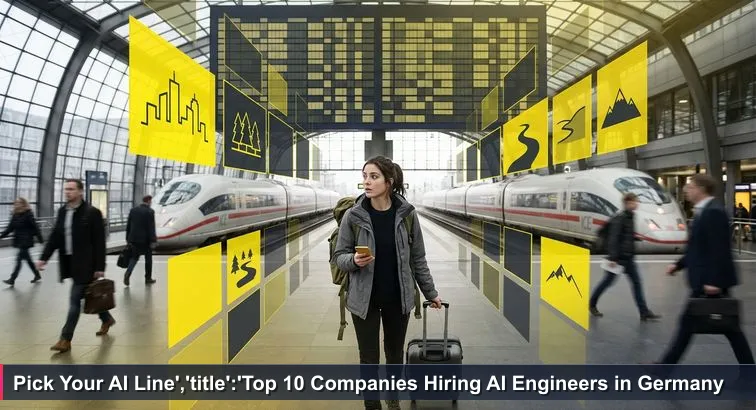
You’re in Berlin Hauptbahnhof, coffee cooling in one hand, suitcase in the other, pinned under the yellow-black departure board. ICEs to Munich, Stuttgart, Frankfurt, Hamburg flicker in and out. On your phone, a “Top 10 AI companies in Germany” article scrolls by while real trains leave every few minutes. It’s the same feeling: too many “right” options, not enough visibility into what your Tuesday will actually look like once you commit.
Germany’s AI market right now is that departure board. Machine learning and AI engineer roles have become the country’s highest-paid individual contributor jobs, with typical medians in the €95,000-€130,000 range. Job boards reliably show four-figure demand: over 1,000+ open roles at any time, with Glassdoor alone listing 1,206 artificial intelligence jobs across Germany in a recent snapshot. Analysts expect AI to add around €80 billion to German GDP, with hiring clustered in Berlin, Munich, Frankfurt and Stuttgart, plus fast-growing pockets in Saxony and the Rhine-Neckar region, according to a briefing on Germany’s AI job market and skills in demand.
At the same time, the tracks beneath you are being upgraded at record speed. Global cloud and chip giants are projected to pour roughly $650 billion into AI infrastructure, from data centers to accelerator chips, with Germany positioned as a key European hub for this build-out, as outlined in analyses of tech giants’ AI capex plans. That spend is already feeding into SAP’s enterprise platforms, Siemens and Bosch’s industrial AI, BMW and Volkswagen’s software-defined vehicles, and Berlin’s startup ecosystem.
This list is your AI departure board. It’s not a verdict on which employer is “best,” but a way to see the main lines on Germany’s network: cloud and GenAI infra, industrial and automotive, finance and insurance, consumer platforms and sovereign EU AI. Ranking is possible only because we simplify to a few dimensions - salary, brand, hype - yet dangerous when we ignore city, language, domain, visa route or how much research vs. product work we actually want.
So instead of asking “What’s #1?”, think in platforms and tracks. The sections that follow are ordered by a mix of:
- Depth and maturity of AI work
- Scale and stability of hiring in Germany
- Career growth potential for ML/AI engineers
Use them as a timetable for Germany’s main AI lines - then choose the platform that matches the journey you actually want to take.
Table of Contents
- Germany’s AI Departure Board
- Amazon
- Microsoft
- SAP
- Siemens
- Bosch
- BMW Group
- Volkswagen Group / CARIAD
- Zalando
- Deutsche Bank
- Allianz
- Choosing Your Platform, Not Just Your Train
- Frequently Asked Questions
This comprehensive guide for Germany AI careers 2026 covers Berlin vs Munich, salaries, and bootcamp options.
Amazon
Think of Amazon as the ICE Sprinter of Germany’s AI ecosystem: fast, tightly scheduled, and touching almost every major hub from Berlin and Munich to Dresden and Tübingen. For AI and ML engineers, that means exposure to high-traffic systems across retail, cloud and logistics rather than a single niche product.
What they build with AI
In Germany, Amazon and AWS teams work on:
- Large-scale recommendation and ranking for retail customers
- Supply-chain forecasting and routing for European logistics networks
- German- and EU-focused Alexa NLP and speech models
- Computer vision for automated fulfillment centers
- Core services on AWS, including SageMaker, Bedrock and Nitro-based infrastructure
Amazon has announced more than €11 billion of new cloud and logistics investment in Germany, positioning AWS data centers and AI services as critical parts of Europe’s digital backbone, according to its German investment overview on About Amazon Europe.
Day-to-day AI work & collaboration
Teams are typically split between Applied Scientists (modelling and experimentation) and Machine Learning Engineers (MLOps, deployment, performance). Day to day, you might:
- Train and evaluate ranking models on petabyte-scale behavioural data
- Productionize models in SageMaker with autoscaling, monitoring and CI/CD
- Embed with retail, Alexa or logistics teams to run A/B tests and tie models to revenue or latency KPIs
- Collaborate with colleagues in the US and UK on shared architectures and libraries
Work is English-first; German mainly matters when you interact with operations or sales stakeholders.
Culture & career paths
Amazon Germany follows the global, metrics-driven Leadership Principles culture: high bar, frequent feedback, and strong ownership. Compensation sits at the top of the local market for AI roles, with junior ML/AI engineers around €70k-€85k, mid-level €90k-€110k, senior €130k-€160k+, and staff/principal often above €200k total compensation, heavily stock-weighted. These levels line up with the upper end of German AI benchmarks reported by the Economic Research Institute’s AI engineer salary data.
If you are comfortable owning services end-to-end and working across time zones, promotion can be fast, and experience with AWS’s internal tooling remains highly valued across the wider German tech ecosystem.
Microsoft
Across Germany’s platforms, Microsoft is the quiet backbone of GenAI: the place where Copilots, LLMs and data platforms for manufacturers, banks and public institutions are actually built and operated. From Munich and Berlin, its engineers help turn abstract “AI strategy” slides into concrete services on Azure for German and wider EU customers.
What they build with AI
German teams work on:
- Azure OpenAI Service integrations for large enterprises in industry, finance and the public sector
- Custom Copilot experiences for domains like manufacturing, finance, and government workflows
- Azure ML tooling and infrastructure for internal and customer-facing data science platforms
- Research collaborations via Microsoft Research on safety, multilingual evaluation and prompt optimization
Analysts tracking cloud capex highlight Microsoft as one of the core companies driving the next wave of global AI infrastructure, with GPUs, model hosting and enterprise LLM services at the centre of its growth plans, as outlined in recent AI investment briefings.
Day-to-day AI work & collaboration
AI engineers in Munich or Berlin usually sit in:
- Product teams embedding AI features into Office, Dynamics, security or developer tools for EU markets
- Customer engineering groups co-designing RAG systems and LLM-based apps with German industrial and financial clients
- Research-adjacent teams focused on evaluation, safety and adaptation to European languages and regulations
Expect heavy use of Azure, Python, C#, PyTorch and vector databases, plus close work with customer legal and compliance teams on topics like the EU AI Act.
Culture & career paths
Microsoft offers some of Germany’s strongest IC compensation bands in AI: junior roles around €75k-€90k, mid-level €100k-€120k, and senior positions commonly in the €140k-€175k+ range including stock and bonuses. Munich tends to pay a further 15-25% premium over Berlin for senior AI roles, reflecting broader patterns documented in German tech salary comparisons by city. Career tracks split between deep technical IC routes (Principal/Partner Engineer) and product or people leadership, all within a largely English-speaking, hybrid-friendly culture.
SAP
Within Germany’s AI network, SAP is the long-distance train for enterprise and industrial workflows: less flashy than consumer apps, but carrying a huge share of global business traffic. Its software is involved in an estimated 80% of world trade in some form, so even small AI features can have outsized impact on how invoices, shipments and HR processes run worldwide.
What they build with AI
SAP’s current AI strategy centres on embedding intelligence directly into its cloud suite rather than offering standalone ML products. That includes:
- Joule, a conversational AI assistant woven through SAP applications
- Predictive analytics in finance, supply chain and manufacturing
- AI-augmented HR flows via SuccessFactors
- Embedded ML near data in SAP HANA and SAP AI Core
This focus on “industrial AI” mirrors Germany’s broader strategy of competing with US and Chinese players by infusing AI into factories, logistics and enterprise software, a direction highlighted in reporting on Germany’s industrial AI push.
Day-to-day AI work & collaboration
AI engineers in Walldorf, Berlin or Munich typically split time between central AI platform teams and product-embedded squads. On a practical level, that means:
- Designing reusable AI services that product teams plug into S/4HANA, Ariba or Concur
- Working with domain experts in finance, logistics and HR to turn process know-how into features and training data
- Deploying to SAP-managed infrastructure across AWS, Azure or GCP with strong multi-tenant and compliance constraints
- Optimising for reliability and governance so one model safely serves thousands of customers
Culture & career paths
Compensation is competitive with Germany’s upper mid-tier AI market: around €65k-€75k for junior AI engineers, €80k-€100k for mid-level, and €110k-€135k for senior roles, sitting comfortably within national benchmarks outlined by WBS Coding School’s analysis of AI engineer salaries in Germany. You typically gain strong work-life balance and benefits compared with US big tech.
Career routes often move between central AI platform groups, domain-focused product teams and cross-cutting architecture roles. For engineers who want their models to be used by thousands of DAX and Mittelstand customers - and to sit at the heart of Europe’s enterprise AI story - SAP offers scale and stability few German employers can match.
Siemens
When AI leaves the browser and hits turbines, trains and scanners, you usually find Siemens. From Munich and Berlin to Erlangen, it is one of Germany’s flagship examples of industrial AI at scale, wiring factories, power grids and hospitals with machine learning instead of just dashboards.
What they build with AI
Siemens’ AI work in Germany spans:
- Digital twins and simulation via platforms like NVIDIA Omniverse and Siemens’ Industrial Edge stack
- The Industrial Copilot, an assistant for factory automation engineers and operators
- Smart grid management and energy forecasting for utilities
- Medical imaging AI at Siemens Healthineers, from reconstruction to triage and anomaly detection
A strategic partnership with NVIDIA aims to create an “Industrial AI operating system” that fuses physics-based simulation with data-driven learning, anchored in Munich’s broader role as a deep-tech hub sometimes called “Germany’s Silicon Valley” for semiconductors and industrial R&D.
Day-to-day AI work & collaboration
AI engineers sit between software and hardcore engineering disciplines. You can expect to:
- Collaborate with mechanical, electrical and control engineers integrating ML into PLCs and industrial controllers
- Train time-series and computer vision models for defect detection, predictive maintenance and process control
- Deploy models onto edge devices with strict latency, safety and reliability constraints
- Support solution engineers tailoring models to specific factories, grids or hospitals
Culture & career paths
Siemens blends research depth with industrial pragmatism. Typical compensation ranges are around €62k-€75k for junior AI engineers, €80k-€100k for mid-level, and €110k-€130k at senior level. Roles often come with long-term stability, strong training budgets and chances to deepen skills in areas like simulation, control theory or safety-critical systems.
Career tracks include deep technical specialization (digital twins, imaging, grid AI), productization roles bridging labs and large deployments, and technical leadership across cross-disciplinary teams where your models increasingly govern real-world machines and infrastructure.
Bosch
Among Germany’s industrial heavyweights, Bosch is the quiet giant of applied AI - its models end up in cars, power tools, factories and smart homes rather than just apps. From Stuttgart and nearby Renningen to Berlin, the Bosch Center for Artificial Intelligence (BCAI) and divisional teams have been tasked with making AI a standard capability across the group.
What they build with AI
Bosch focuses on AI that directly touches hardware and production:
- Manufacturing quality control using computer vision and sensor fusion on production lines
- Predictive maintenance for industrial tools, robots and entire plants
- Automotive perception and sensor fusion for driver-assistance systems
- Smart home and IoT intelligence in appliances, heating and security systems
The company has committed billions of euros to AI-driven manufacturing and product optimisation, including a multi-year programme expected to reach around €2.9 billion by 2026 for AI-based quality improvements across plants, reflecting its status as a leading industrial player among German AI firms highlighted in overviews like expert lists of AI development companies in Germany.
Day-to-day AI work & collaboration
As an AI engineer at Bosch in Stuttgart, Renningen or Berlin you typically:
- Work on rich sensor data (accelerometers, cameras, LiDAR, microphones), often requiring strong signal processing skills
- Implement models in Python and C++, targeting embedded hardware or dedicated accelerators
- Co-design solutions with hardware and safety engineers for automotive and industrial use
- Deploy and monitor systems via the Bosch IoT Suite and major clouds (Azure, AWS)
Culture & career paths
Bosch combines research depth (via BCAI) with massive industrial rollout. Indicative salary bands are around €60k-€72k for junior, €75k-€95k for mid-level and €100k-€125k for senior AI engineers - slightly below cloud big tech, but competitive within Germany’s industrial and automotive sector, as seen in wider AI engineer ranges on platforms like Glassdoor’s Germany salary snapshots.
Career paths span research-oriented roles (publications, patents), platform teams standardising AI across business units, and site-level leadership where you guide how AI is deployed in specific plants or product lines - ideal if you want to see models translate into physical change on factory floors and roads.
BMW Group
On the Munich-Ulm line of Germany’s AI network, BMW is one of the clearest examples of the shift to software-defined, AI-first vehicles. From driver assistance and autonomous functions to production lines and in-car experiences, BMW’s models increasingly decide how cars drive, how plants run, and how customers interact with the brand.
What they build with AI
In Munich and Ulm, BMW’s AI work spans several domains:
- Autonomous driving and ADAS (Level 2-4) with perception, sensor fusion and planning models
- Generative design for lightweight, optimised vehicle components
- Production and logistics optimisation across global plants
- In-car personalisation and voice assistants tuned for different markets and brands
Teams rely heavily on Python, C++, AWS, Kubernetes and NVIDIA platforms for both large-scale training and in-vehicle inference, matching broader German demand for deep learning and MLOps skills highlighted in salary studies such as CareerCheck’s overview of top-paying tech roles.
Day-to-day AI work & collaboration
Daily work depends strongly on your unit:
- In autonomous driving, you work with large perception datasets, simulation environments and real-time constraints on embedded GPUs
- In production AI, you optimise takt times, maintenance schedules and quality KPIs for plants in Europe, China and the US
- You collaborate with vehicle dynamics, safety and hardware teams, plus external chip and sensor suppliers
Candidates report an interview flow that mixes online assessments, coding and architecture rounds tailored to AI engineering roles, as reflected in shared experiences on platforms like r/cscareerquestionsEU.
Culture & career paths
BMW splits its AI workforce between large autonomous driving units and separate Data & AI hubs supporting production and corporate functions. Indicative compensation is around €65k-€78k for junior roles, €85k-€105k for mid-level, and €115k-€140k for senior engineers - solidly in Germany’s upper tier for AI, especially with Munich’s typical salary premium.
Career options range from highly specialised perception/planning/simulation roles to broader leadership across manufacturing analytics or corporate IT, with opportunities to move between brands like BMW, Mini and Rolls-Royce as the software platform matures.
Volkswagen Group / CARIAD
In Wolfsburg, Berlin and Munich, Volkswagen’s software unit CARIAD is the control centre for AI across brands like VW, Audi, Porsche and Škoda. Instead of each marque building its own stack, CARIAD’s mission is to create shared software and AI platforms that can serve millions of vehicles at once.
What they build with AI
From German hubs, CARIAD teams focus on:
- Automated driving and ADAS using NVIDIA DRIVE and custom perception/planning stacks
- In-car voice assistants and personalisation, tuned for different brands and languages
- Digital twin manufacturing for VW Group plants worldwide
- Over-the-air software and AI feature updates across entire vehicle fleets
The core stack combines Python and C++ with Azure-hosted “VW Automotive Cloud”, Docker/Kubernetes and hardware-accelerated inference, matching the broader demand for deep learning and MLOps skills across German employers highlighted in AI role overviews on Built In’s Germany AI job listings.
Day-to-day AI work & collaboration
AI engineers split their time between core platform development and model optimisation for specific programmes:
- Designing and tuning perception, tracking and planning models for deployment on constrained in-car hardware
- Working closely with embedded software teams to meet tight compute and power budgets
- Supporting manufacturing AI efforts around quality, predictive maintenance and logistics
- Balancing standardisation across brands with room for brand-specific experiences and performance profiles
Culture & career paths
CARIAD was created to accelerate Volkswagen’s pivot to software, so it mixes startup-like product teams with classic German automotive structures. Indicative salaries are around €65k-€75k for junior AI engineers, €85k-€105k for mid-level, and €115k-€145k for senior roles. For international candidates, large groups like VW are frequently cited among the enterprises offering structured relocation and visa support for software talent, as discussed in resources such as guides to companies with visa sponsorship in Germany.
Career trajectories include deep technical paths in automotive ML (perception, localisation, planning), platform roles defining shared AI services, and technical leadership bridging car programmes and the central software organisation.
Zalando
In Berlin’s AI ecosystem, Zalando is the archetypal product-led company where models directly move revenue, returns and customer experience. From its headquarters next to the Ringbahn, the company has turned fashion data into one of Europe’s most mature recommendation and experimentation stacks.
What they build with AI
Zalando’s Applied ML teams work on several high-impact domains:
- Personalised ranking and recommendations for fashion discovery across web and mobile
- Size & fit prediction to cut returns and improve satisfaction
- Virtual try-on and computer vision for product understanding and outfit generation
- Demand forecasting and inventory optimisation across European warehouses
The company operates on one of Europe’s largest fashion datasets and is often cited among Germany’s leading AI-driven platforms in overviews of AI-heavy companies and startups in Germany, thanks to its strong MLOps and experimentation culture.
Day-to-day AI work & collaboration
You usually sit in a product-aligned ML team (e.g. Personalisation, Search, Size & Fit) and collaborate closely with:
- Backend engineers integrating models into microservices
- Data engineers maintaining feature pipelines on AWS, Databricks and PySpark
- Product managers and UX on metric definitions and A/B test design
The core stack centres on Python, PyTorch, PySpark, internal ML tooling and robust CI/CD around experimentation KPIs such as CTR, conversion and return rate.
Culture & career paths
Zalando is known for an international, engineering-friendly environment with English as the default language and flexible hybrid work from Berlin. Indicative compensation for AI roles sits around €60k-€75k for junior engineers, €80k-€95k for mid-level, and €110k-€135k for senior positions, attractive given Berlin’s costs relative to southern Germany.
Career development often involves rotating between product domains (search, personalisation, logistics), moving into core ML platform teams, or stepping into staff and principal roles that define experimentation and ML architecture across multiple product groups.
Deutsche Bank
In Frankfurt’s banking district, Deutsche Bank is one of the clearest examples of how AI is reshaping regulated finance. For ML and AI engineers, it offers work at the intersection of fraud, risk and trading, where models must be both high-performing and deeply explainable to auditors and regulators.
What they build with AI
Within a central Data & AI division and business-aligned units, Deutsche Bank applies AI to:
- Fraud detection and real-time transaction monitoring
- KYC and compliance automation (document classification, entity resolution, anomaly detection)
- Algorithmic and quantitative trading support
- Personalised banking and credit risk modelling
The stack leans on Python, Java, Google Cloud Platform (GCP), BigQuery and Vertex AI, similar to many German AI roles listed on platforms like Wellfound’s AI engineer jobs in Germany, which emphasise strong data engineering and cloud ML skills.
Day-to-day AI work & collaboration
Engineers work where data science meets regulation:
- Modelling on large, often imbalanced tabular datasets where fraud and defaults are rare by design
- Building credit risk and fraud models with explainability (LIME, SHAP, monotonic constraints)
- Implementing streaming inference on high-volume transaction data
- Collaborating with quants, risk managers and compliance officers, plus internal model validation and audit teams
Much of the job involves translating EU AI Act requirements and BaFin guidance for “high-risk” systems into concrete documentation, monitoring and governance.
Culture & career paths
Compared with startups, Deutsche Bank offers strong job security, benefits and a more formal environment, especially in Frankfurt HQ. Indicative compensation is around €65k-€80k for junior AI engineers, €85k-€105k for mid-level roles and €115k-€150k for senior positions, placing the bank at the upper end of German AI pay scales in regulated sectors; Glassdoor salary snapshots for AI engineers in Frankfurt show similarly elevated ranges.
Career paths include technical specialisations in model risk and XAI, transitions into quant or risk leadership, and architecture roles defining firm-wide AI platforms - well suited if you prefer structured data, clear rules and tangible impact on the financial system.
Allianz
In Munich and Stuttgart, Allianz is turning one of Germany’s most traditional sectors into a live testbed for AI. Instead of paper-heavy processes and month-long decisions, the group is pushing towards claims, underwriting and customer interactions that are increasingly automated, data-driven and near real time.
What they build with AI
Across its analytics hubs and product teams, Allianz applies AI to:
- Claims automation: NLP over documents and emails, computer vision for damage assessment and fraud hints
- Actuarial modelling with ML, extending classical risk models with richer behavioural and external data
- Customer churn prediction and lifetime value estimation
- Portfolio and risk aggregation analytics on large, multi-country datasets
The tech stack typically combines Python, R, Azure, Databricks and Snowflake, matching the emphasis on cloud ML, data engineering and MLOps that German upskilling providers describe as core in their overviews of top AI skills German learners need.
Day-to-day AI work & collaboration
Your collaboration web is unusually cross-disciplinary for a corporate environment:
- Actuaries with deep domain and regulatory knowledge, whose GLMs and tables you augment with ML
- Business product owners from retail, health and corporate insurance lines
- Data engineers maintaining pipelines from policy, claims and third-party data sources
Typical tasks include building models that can be explained to regulators and actuaries, designing decision systems that mix rules and ML, and rolling out pilots in one country before scaling across regions under different supervisory regimes.
Culture & career paths
Allianz is vocal about becoming an “AI-first” insurer, aiming to automate large portions of claims and underwriting flows while keeping human oversight. For engineers, it offers a blend of stability, structured processes and numeric modelling that will feel familiar if you come from finance or statistics. Resources comparing AI vs. traditional IT careers in Germany frequently point to such roles as both resilient and well-paid.
Indicative salaries for AI engineers are around €60k-€75k at junior level, €78k-€98k for mid-level, and €105k-€130k for senior positions. Career paths range from specialised insurance AI roles that blend actuarial and ML skills, to platform teams standardising ML across business units, to leadership in analytics for specific product lines such as motor, health or corporate risk.
Choosing Your Platform, Not Just Your Train
Back under the yellow-black board at Berlin Hauptbahnhof, the picture looks different once you know where each track leads. Those company names on your phone stop being a flat “Top 10” and start to feel like distinct lines on Germany’s AI network, each with its own speed, risk and scenery.
Across the country, AI and ML engineering has quietly become the top-paid individual-contributor path in tech, and one of the few roles where demand still clearly outstrips supply. Analyses of Germany’s labour market point to AI reshaping more jobs than it replaces, with industrial automation, automotive and services all adding AI roles rather than simply cutting headcount, as discussed in outlooks on AI’s impact on the labour market.
Seen that way, this list is a timetable, not a verdict. The main lines look roughly like this:
- Cloud & GenAI infra - building the platforms others run on
- Enterprise & industrial AI - SAP, Siemens, Bosch and peers wiring factories and workflows
- Automotive & mobility - BMW and Volkswagen/CARIAD pushing software-defined vehicles
- Consumer & digital platforms - Zalando-style product work where models move KPIs weekly
- Regulated finance & insurance - Deutsche Bank and Allianz blending ML with compliance
Layered on top is a fast-growing sovereign and startup ecosystem: LLM players, applied-ML studios and deep-tech ventures from Berlin to “Silicon Saxony”, many of which feature in independent rundowns of leading AI companies in Germany. For some engineers, these smaller trains - with more risk and more ownership - will be a better fit than any DAX40 giant.
So the real question is no longer “Which employer is #1?” but “Which platform matches the journey I actually want?” Physical systems vs. money vs. users; research depth vs. shipping velocity; Berlin’s startup chaos vs. Munich’s salary premium vs. Frankfurt’s finance core. The departure board is crowded. Your task now is to pick a platform, shoulder your backpack, and step onto a train.
Frequently Asked Questions
Which company on the list pays the most for AI engineers in Germany?
Cloud giants like Amazon and Microsoft sit at the top of the pay ladder - Amazon principal/staff roles often exceed €200k total comp, while senior Microsoft AI roles commonly reach €140k-€175k including stock and bonuses; overall 2026 medians for AI engineers in Germany cluster around €95k-€130k.
Which German city should I target if I want the most AI job openings?
Aim for Berlin or Munich first - job boards list 1,000+ AI openings across Germany, with hubs also in Frankfurt and Stuttgart; note Munich typically pays a 15-25% salary premium over Berlin for senior AI roles.
Do I need to speak German to get an AI role at these companies?
Not always - many AI teams (Amazon, Microsoft, Zalando) operate in English and hire international talent, but German is valuable for stakeholder-facing, regulated or enterprise roles (e.g., Deutsche Bank, SAP, public sector) and can widen your options.
What technical skills are hiring managers prioritising in 2026?
Hiring leans heavily on MLOps and cloud infra (AWS/Azure), LLM/RAG experience, PyTorch and Python, plus domain skills like computer vision, time-series, or embedded C++ for automotive and industrial edge deployments.
How should I choose between these companies if I'm early- or mid-career?
Pick by the domain you want to work in (cloud/GenAI, industrial automation, automotive, finance/insurance or consumer platforms), the city lifestyle and whether you prioritise raw pay, research depth or seeing AI deployed in the real world; use the €95k-€130k median and senior >€120k as salary checkpoints while weighing growth and team fit.
Preparing applications? Reference the Top 10 startups hiring junior developers in Germany in 2026 for tailored CV tips by company.
Top 10 jobs in tech for Quereinsteiger in Germany without a degree (2026)
Comprehensive look at Tech Salaries and Cost of Living in Germany (2026)

Irene Holden
Operations Manager
Former Microsoft Education and Learning Futures Group team member, Irene now oversees instructors at Nucamp while writing about everything tech - from careers to coding bootcamps.