









The Complete Guide to Starting an AI Career in Germany in 2026
By Irene Holden
Last Updated: April 12th 2026
Key Takeaways
Yes - you can start an AI career in Germany in 2026, but you must specialise, build production-ready proof of work, and handle language and domain constraints because employers are hiring for people who can ship AI in industry; Germany has over 137,000 unfilled IT roles and AI is set to add more than €80 billion to the economy this year. Expect a realistic 12 to 18 month ramp to land a junior role with starting salaries around €55,000 to €70,000 and a path to senior or specialised MLOps and LLM roles that can pay up to about €150,000, and use flexible, affordable programs like Nucamp’s part-time courses costing roughly two to four thousand euros to build the practical skills while you keep working.
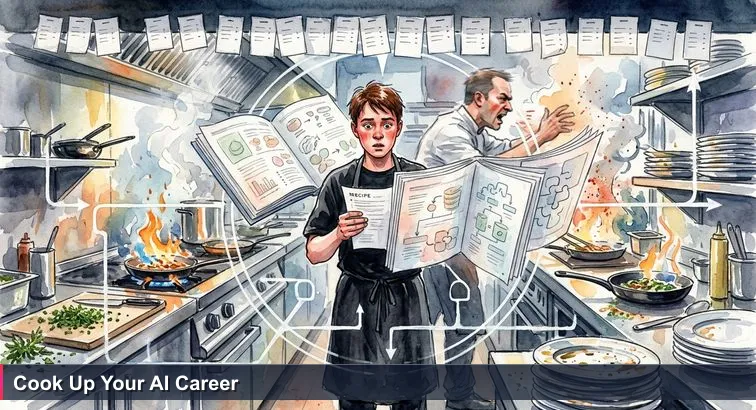
The first thing you notice is the heat. Not from the Berlin summer outside, but from the line of pans in front of you in a cramped Neukölln kitchen, all screaming for attention while a dozen paper tickets dangle accusingly above the pass. Stainless steel counters disappear under half-chopped herbs and dirty plates. The head chef barks in fast Denglisch, and you cling to a neatly printed recipe that suddenly feels useless.
For many people trying to start an AI career in Germany, that’s exactly what the job market feels like. You’ve memorised the “recipes” of Python, linear regression, maybe even transformers. You’ve survived MOOCs, perhaps a generic M.Sc. But when you hit real postings in Berlin, Munich, or Stuttgart - full of domain jargon, “production experience,” and quiet expectations around C1 German or even a PhD - that tidy theoretical world collides with industrial reality.
Meanwhile, the country around you is running a serious AI kitchen. Germany has become one of Europe’s most important AI hubs, with nearly 700 startups, global players like Siemens, SAP, BMW, Bosch and Deutsche Telekom, and a dense research landscape spanning Fraunhofer and Max Planck. Government-backed initiatives highlighted by deutschland.de’s overview of AI opportunities keep pumping money and regulation into the space, ensuring both demand and pressure stay high.
This guide is about learning to operate in that kitchen. We’ll treat AI careers like stations on the line: choosing your station (role and domain), getting your mise en place right (skills, German level, portfolio), understanding your region’s tickets (Berlin vs. Munich vs. Frankfurt), and running real “services” via projects, internships, research groups, or practice-first programs like Nucamp - rather than just collecting certificates.
By the end, you should know not just how to follow a tutorial, but how to cook when it counts inside Germany’s AI ecosystem: under compliance constraints, with real users, in real companies - from Mittelstand factories in Baden-Württemberg to AI startups around Berlin’s Ringbahn.
In This Guide
- Introduction: Enter Germany’s AI Kitchen
- Why Germany’s AI Market Is a Brutal but Golden Opportunity
- Choose Your Station: AI Roles That Actually Exist in Germany
- Mise en Place: Skills German Employers Actually Test
- Choosing Your Ausbildung: University, Research, Bootcamps, or Self-Dir
- Regional Kitchens Across Germany
- Salaries and Career Progression: What to Expect in Germany
- Hard Truths: Language, Visas, and Market Realities
- From Recipe to Real Service: Building Proof of Work
- 18-Month Roadmaps for Three Common Profiles
- How to Apply and Benchmark Offers
- Closing the Loop: From Overwhelmed Cook to Confident AI Operator
- Frequently Asked Questions
For aspiring developers throughout Germany, the German tech training community offers networking opportunities, peer study groups, and career support while courses remain online-flexible to fit around work and life obligations.
Why Germany’s AI Market Is a Brutal but Golden Opportunity
Step back from the heat of that Neukölln kitchen and the numbers look almost unbelievable. According to Germany’s digital industry association Bitkom, as summarised by TSA Bildungsakademie’s analysis of the AI job market, the country entered this year with over 137,000 unfilled IT roles. At the same time, AI is projected to add more than €80 billion to the German economy as automation, analytics, and generative models are rolled out across manufacturing, automotive, healthcare, and finance.
Yet if you scroll through r/cscareerquestionsEU or talk to graduates from TUM, RWTH, or TU Berlin, you hear a very different story: months of unanswered applications, “junior” roles demanding senior-level MLOps, and LLM research posts that quietly expect a PhD in machine learning just to get a call back. Many candidates did everything “right” - MOOCs, Kaggle, even a data science Master’s - only to find German job postings that read like impossible tasting menus.
This contradiction exists because Germany isn’t hunting for people who merely studied AI. It’s hiring for people who can operate AI systems inside regulated, unionised, often safety-critical environments: factories in Baden-Württemberg, banks in Frankfurt, hospital networks in North Rhine-Westphalia. That means dealing with the EU AI Act, GDPR, works councils, legacy SAP landscapes and real-world failure modes - not just Jupyter notebooks.
Demand is particularly fierce in a few “pressure-cooker” areas where Germany is globally competitive:
- Generative AI & LLM integration for copilot-style tools inside large enterprises
- Industrial AI / Industry 4.0 for predictive maintenance, robotics, and quality control
- Security, risk, and fraud across banks, telcos, and insurers
Layer on top a startup scene that now counts nearly 700 AI companies, growing at roughly 35 % year-over-year, and you get a market that is both brutally selective and unusually rich in long-term opportunity - if you can prove you can actually “cook.”
Choose Your Station: AI Roles That Actually Exist in Germany
In any serious kitchen you start by owning one station, not the whole pass. Germany’s AI scene works the same way: instead of being a vague “AI enthusiast,” you pick a clear role, in a clear domain, in a clear city. That focus is what turns scattered tutorials into a hireable profile at companies like BMW in Munich, SAP in Walldorf, or a language-model startup in Kreuzberg.
Most of the hands-on modelling work sits in a few core technical roles:
- Machine Learning Engineer - builds and deploys models into production, often sitting between data science and software engineering; common at Siemens, Bosch, BMW, and Deutsche Telekom.
- Data Scientist - analyses data, prototypes models, and translates findings for business teams; heavily used in banks in Frankfurt, e-commerce players like Zalando, and insurers.
- AI/ML Developer - stitches together APIs, pretrained models, and back-end systems for products, especially in Berlin and Munich startups.
- AI Researcher - designs new algorithms, publishes, and often works in labs at TUM, RWTH Aachen, Max Planck, Fraunhofer or in R&D units of SAP and Volkswagen.
Then come the specialised stations that have grown with generative and industrial AI:
- NLP / LLM Specialist - focuses on chatbots, copilots and document intelligence; many “pure LLM” roles are now so competitive that a PhD in AI is frequently expected just to get an interview.
- Computer Vision Engineer - works on perception for autonomous driving, robotics or medical imaging, anchored around Munich, Stuttgart, and university hospitals.
- Robotics / Industrial AI Engineer - combines control, optimisation, and perception for factories and logistics across Baden-Württemberg and the Ruhrgebiet.
- MLOps Engineer - builds the infrastructure that keeps models running reliably at scale.
Alongside these, a new class of “AI operators” has emerged: AI product managers, AI project leads, ethics and governance specialists, and domain experts (like manufacturing or healthcare professionals) who can wield AI safely under EU AI Act and GDPR constraints. Analyses of hiring patterns, such as Andersen’s IT job market report for Germany, show these hybrid roles gaining ground quickly as companies realise they don’t just need models - they need people who can embed them into real organisations.
To choose your station, you don’t start with a buzzword; you start with job ads. Pick one or two target roles, pull 10-15 postings from German boards, and underline the recurring tools, domains, and language requirements. That list becomes your personal “prep sheet” for the rest of this guide.
Mise en Place: Skills German Employers Actually Test
In a German kitchen, your mise en place decides whether service flows or crashes. In AI hiring, it’s the same: when a Berlin startup hands you a take-home task or BMW runs you through a live technical round, they’re not testing whether you’ve “done a course” - they’re testing whether your skills are organised, reliable, and ready under pressure.
Analyses of in-demand AI skills from providers like WBS Coding School’s AI engineer market report and TSA Bildungsakademie line up almost perfectly on the technical core:
- Python as your main language, plus Pandas, NumPy and basic testing
- SQL for joins, aggregations, and window functions - still the backbone in many German corporates
- Classical ML with scikit-learn, evaluation (ROC, precision/recall), and cross-validation
- Deep learning with PyTorch or TensorFlow, including CNNs and basic transformers
- Foundational MLOps: Git, Docker, simple CI/CD, and REST APIs (FastAPI/Flask)
But German employers increasingly filter on what Forbes calls “human strengths”: critical thinking, collaboration, and clear communication. For Germany specifically, that means the ability to explain models to non-technical stakeholders, write solid documentation, and operate within EU AI Act and GDPR constraints. Domain knowledge is a force multiplier: knowing how a production line in Baden-Württemberg works, or how risk is assessed in Frankfurt, often matters as much as your loss curves. The University of Europe’s overview of AI-proof careers in Germany stresses exactly this hybrid.
Turning that into a plan typically takes around 12-18 months of focused work:
- Months 1-3: Intermediate Python, Git/GitHub, and core SQL; refresh linear algebra and probability.
- Months 4-6: End-to-end ML on tabular data (scikit-learn) plus 2-3 small projects.
- Months 7-9: Deep learning (PyTorch/TensorFlow) and one vision or NLP project, plus basic LLM/RAG usage.
- Months 10-12: Containerise a project with Docker, expose it via an API, and deploy to cloud.
- Months 13-18: Pick a domain, build 2-3 production-style projects, and, if you’re staying long-term, push your German toward at least B2 German for many roles.
Choosing Your Ausbildung: University, Research, Bootcamps, or Self-Dir
When someone in Germany asks “Welche Ausbildung machst du?”, they’re really asking which long-term track you’re betting your career on. For AI, that usually means choosing between a classic university degree, a research path, a practice-first bootcamp, or a structured self-taught route. The right choice depends less on which is “best” and more on your age, budget, visa situation, and how quickly you need to start earning in euros.
University degrees: deep roots, slower ramp-up
Public universities like TUM, RWTH Aachen, TU Berlin and KIT offer low-tuition Bachelor’s and Master’s programs in AI, data science, and informatics. An overview by Expatrio counts 39+ English-taught AI Master’s programs in Germany, with most taking two years and giving you student access to Werkstudent jobs and research groups. This path is ideal if you’re early-career, want solid theory, or may later aim for leadership or a PhD, especially in comparison to faster, narrower routes.
Research institutes and PhD tracks
Institutions like Fraunhofer, Max Planck, Helmholtz centres, CISPA and Forschungszentrum Jülich sit at the heart of German AI research. Postdoc listings compiled by CareeraidHub show openings in areas such as molecular machine learning, trustworthy ML, and neural rendering, almost always requiring a completed PhD plus publications. This path suits those who enjoy papers, conferences, and long-term research agendas more than shipping features every sprint.
Bootcamps and practice-first programs
Intensive schools such as WBS Coding School or neue fische often run three-to-six-month AI or data programs, frequently full-time and priced around or above €10,000. In contrast, Nucamp delivers online, part-time bootcamps across 200+ German cities, with AI-relevant programs like “Back End, SQL & DevOps with Python” (16 weeks, €1,955), “AI Essentials for Work” (15 weeks, €3,300) and “Solo AI Tech Entrepreneur” (25 weeks, €3,660). Reported outcomes include roughly 78 % employment, 75 % graduation, and a 4.5/5 rating on Trustpilot, making this route attractive for career changers who must keep working while they retrain.
Self-directed but not directionless
Finally, some practitioners stitch together MOOCs, textbooks, and open-source work. This can be viable, especially if you already work in tech, but only if you impose structure on yourself: a clear 12-18-month plan, external markers (competitions, certificates, GitHub), and feedback from peers or mentors. Mixing self-study with a shorter program or university module can give you both flexibility and credibility.
| Path | Typical duration | Typical direct cost | Best suited for |
|---|---|---|---|
| University (B.Sc./M.Sc.) | 2-5 years | Low tuition; living costs only | Early-career, theory, long-term growth |
| Research (PhD/Postdoc) | 3-6+ years | Usually funded stipend/salary | Research-focused, academic/industrial labs |
| Bootcamps (incl. Nucamp) | 3-6 months | €1,955-€10,000+ | Career changers needing practice and speed |
| Structured self-study | 12-18+ months | Low; mainly time and materials | Self-motivated, already in tech or related field |
Whichever Ausbildung you choose, treat it as your main line on the stove. Supplement it, yes, but don’t keep switching burners; commit long enough for employers to see a coherent story. A concise comparison of German AI study paths is available via Expatrio’s guide to AI Master’s programs, which is a useful benchmark when weighing depth, duration, and cost against bootcamps and self-study.
Regional Kitchens Across Germany
Geographically, Germany’s AI kitchen is split across several hot spots, each with its own menu, language habits, and expectations. Understanding the difference between a product team in Berlin-Mitte and a robotics group in Munich or a risk unit in Frankfurt is the difference between sending your CV to the right “station” and burning time in the wrong one.
Berlin is the loud, experimental corner of the line: AI startups, scale-ups, and digital units of outfits like Zalando and Delivery Hero mix generative AI, recommendation systems, and growth analytics. English is common in tech teams, and roles often blend software engineering with applied ML. Job boards such as The Homebase’s AI job listings show a steady stream of Berlin openings for ML engineers, data scientists, and AI product roles, many tied to SaaS tools and internal copilots.
Further south, Munich and Stuttgart feel more like precision-engineering stations. Munich’s ecosystem revolves around BMW, Siemens, Allianz and a dense robotics and embedded-systems scene, with strong demand for computer vision, autonomous driving, and simulation. In Stuttgart and wider Baden-Württemberg, Bosch, Mercedes-Benz, Porsche and hundreds of Mittelstand suppliers focus on Industry 4.0: predictive maintenance, quality control, and shop-floor automation. Here, German is more often a requirement, and an engineering background can count as much as a pure CS degree.
To the west, Frankfurt and the Ruhrgebiet cook a different kind of AI. Frankfurt’s banks, insurers and the ECB lean heavily on tabular data, explainable models, fraud detection and regulatory tech. The Ruhr area (Cologne, Düsseldorf, Essen, Dortmund, Aachen) mixes logistics, industrial AI, and marketing analytics, with RWTH Aachen feeding in technical talent. A survey of regional postings on sites like Vacansier’s data science and AI jobs overview highlights how consistently these hubs hire for data-heavy, compliance-aware roles.
When you choose where to live, you’re also choosing your most likely stack: Berlin for product-heavy GenAI and e-commerce; Munich/Stuttgart for robotics and manufacturing; Frankfurt/Ruhr for finance and industrial analytics. Align your portfolio with the dishes that region actually serves.
Salaries and Career Progression: What to Expect in Germany
Salaries are one of the clearest signals that Germany’s AI kitchen is serious. Across the country, junior AI and ML professionals typically start around €55,000-€70,000 gross, mid-level engineers and data scientists with three to five years’ experience move into the €70,000-€90,000 band, and senior profiles often land between €90,000-€120,000+. Specialist roles in areas like MLOps or large language model operations can reach or exceed €130,000-€150,000 at major players or well-funded scale-ups. These bands line up closely with independent breakdowns such as DigitalDefynd’s report on AI salaries in Germany, which compares multiple sources.
Location and employer type add their own seasoning. Munich and Frankfurt usually sit at the top of the range, thanks to high-margin sectors like automotive and finance; Berlin pays slightly less on average but often compensates with equity and a denser startup scene. Smaller cities and much of the Mittelstand may offer lower base pay but more stability and lower rents. Glassdoor and Levels.fyi data for machine learning roles in Berlin and Munich consistently show senior packages clustering in the high five-figure to low six-figure range, especially at companies like BMW, Siemens, SAP, or Allianz.
Career progression tends to follow a recognisable rhythm if you keep shipping value:
- Years 0-1.5: Learn intensively, build projects, perhaps secure a Werkstudent or junior data role.
- Years 1.5-3: First full-time AI-heavy position; you own small features or models.
- Years 3-5: Mid-level; you design components, mentor juniors, and negotiate into the €70k-€90k bracket.
- Years 5+: Senior/lead engineer, staff data scientist, or AI product lead, often breaking €90k and beyond.
Remember that German offers are quoted as gross yearly salary. After income tax and mandatory social contributions (health insurance, pension, unemployment, long-term care), many professionals take home roughly 55-65 % of their gross, depending on Bundesland, marital status, and church tax. When comparing roles across Berlin, Munich, Amsterdam or Dublin, always benchmark not just the top-line number but also cost of living, remote options, and whether the company supports further training, conference travel, or part-time study toward a Master’s or PhD.
Hard Truths: Language, Visas, and Market Realities
Every kitchen has its unglamorous side, and in Germany’s AI world that means language barriers, visa rules, and a market that is both hungry and unforgiving. None of this shows up in a Coursera syllabus, but it drives who actually gets to stand at the stove in Berlin, Munich, Stuttgart or Frankfurt.
The first hard filter is German. In many Mittelstand manufacturers, insurers, and public-sector IT shops, fluent or near-fluent German (often C1) is effectively non-negotiable, even for deeply technical roles. Candidates on r/cscareerquestionsEU routinely report being auto-rejected once recruiters notice “B1” on the CV. Berlin and a slice of Munich’s tech scene are friendlier to English-only engineers, but even there, serious career progression often means being able to discuss trade-offs, risks, and compliance in German with stakeholders and works councils.
For non-EU citizens, visas add another layer. The EU Blue Card and Germany’s skilled-worker routes are designed for exactly the kind of high-demand profiles AI produces, and typical ML/AI salaries comfortably clear the required thresholds. Large employers like SAP, Siemens, BMW or Deutsche Telekom regularly sponsor, but smaller firms may shy away from paperwork or be unfamiliar with the process. Once you are in, strong employee protections, co-determination and generous social security contributions shape everyday life: you gain stability, but hiring managers can be cautious, because firing is harder than in many other countries.
Then there’s the hype hangover. Pure LLM and foundation-model research roles are saturated; labs and deep-tech startups often expect a PhD plus publications to even read your email. At the same time, many corporates are still in “pilot purgatory,” running proofs-of-concept while outsourcing riskier work to consultants instead of hiring full internal teams. A LinkedIn analysis of AI labor trends notes that employers increasingly reward “people who can operationalise AI” rather than those who just know the theory.
The implication is uncomfortable but useful: if you want a durable place on the line, you need a language plan, a visa strategy if you’re non-EU, and a bias toward applied roles where you can show you’ve shipped under German and EU constraints - not just another certificate saying you’ve read the recipe.
From Recipe to Real Service: Building Proof of Work
In the Neukölln kitchen, nobody cares that you’ve read a cookbook; they care whether you can send plates over the pass when the tickets stack up. German employers are similar: degrees and certificates get you into the applicant pile, but interviews and offers hinge on one thing - evidence that you’ve already cooked something resembling the dishes on their menu.
A strong portfolio in Germany is not ten disconnected Kaggle notebooks. It’s a small set of serious, production-like projects that mirror real use cases in Berlin, Munich, Stuttgart or Frankfurt. If you’re aiming at automotive or robotics, that might be sensor time-series or computer vision for defects; if you’re targeting fintech, think risk scoring and fraud detection; for Berlin SaaS, maybe a GenAI-powered internal tool. Bootcamps and schools that work closely with employers, such as those highlighted in Neue Fische’s overview of AI courses and certifications, increasingly design capstones around exactly these patterns.
For each project, treat it like a mini-service in a restaurant, not a classroom exercise. At minimum it should:
- Start from a clear business-style problem statement, not just “I tried model X on dataset Y”.
- Use realistic, preferably European or German data (or at least constraints like GDPR and the EU AI Act).
- Include solid evaluation, basic tests, and deployment via an API or simple UI.
- Live in a clean GitHub repo, with a README and, ideally, a short demo video or hosted app.
The final step is repetition under pressure. Present your work at a local meetup, defend trade-offs to a friend acting as “product owner”, or walk a recruiter through your repo. Each repetition moves you one step further from “I followed a recipe once” and closer to “I can handle service when the orders start flying.” In the German AI kitchen, that’s what hiring managers remember.
18-Month Roadmaps for Three Common Profiles
Knowing that you need “18-36 months” is abstract; seeing what 18 focused months look like for someone like you is actionable. These sample roadmaps are not rigid recipes, but they show how to move from scattered tutorials to a coherent story that makes sense to German employers, whether you’re studying at a state university, changing careers from a non-tech job, or finishing a PhD at home and eyeing TUM or RWTH. For deeper background on academic paths, the overview of top AI universities on Studying-in-Germany.org is a useful complement.
Profile A - German Bachelor student (CS/engineering) aiming for ML roles
Over 18 months, your priority is to turn compulsory modules into portfolio pieces and industry contacts:
- Months 1-6: Focus on core ML courses, join or start a university ML club, and grab a Werkstudent role in Berlin or Munich if possible.
- Months 7-12: Choose deep learning/MLOps electives, ship 2-3 serious projects on GitHub, and present once at a local meetup.
- Months 13-18: Write a thesis aligned with an industry partner, apply broadly to junior ML/DS roles, and prepare for coding + case interviews.
Profile B - Non-EU career changer in Germany using a bootcamp
You may already work with data but lack production skills. Here, a structured, part-time program plus deliberate self-study becomes your engine:
- Months 1-6: Complete a back-end / DevOps focused bootcamp such as Nucamp’s Python and SQL track while consolidating B1→B2 German.
- Months 7-12: Add an AI-focused program (for example Nucamp’s AI Essentials or Solo AI Tech Entrepreneur) and build 2 portfolio projects tied to your current domain.
- Months 13-18: Target hybrid roles (analytics engineer, AI-enabled data analyst) in Berlin or Frankfurt, leveraging both domain experience and new tech skills.
Profile C - International PhD student targeting German research
If you’re close to defending, you need to treat Germany’s institutes like specific stations:
- Months 1-6: Map your work to 5-10 groups at TUM, RWTH, Max Planck, Fraunhofer or Helmholtz, and align your final experiments accordingly.
- Months 7-12: Submit papers, apply for postdocs 6-9 months before defence, and reach at least A2-B1 German for everyday life and lab integration.
- Months 13-18: Start your postdoc or research scientist role and decide whether you’re on a long-term academic path or planning an industry pivot.
How to Apply and Benchmark Offers
By the time you hit “Apply” on a Berlin job posting, most of the work should already be done. German hiring tends to be process-heavy: structured CV screening, automated filters, multiple interview rounds, and careful checks around visa status and salary bands. Treat it less like firing off random applications and more like running a disciplined experiment.
A practical way to start is to build your own mini “job market dataset” for your target role and city. Over one or two evenings, save 15-20 relevant postings from boards like StepStone, Honeypot or Indeed and:
- Highlight recurring tools, methods, and language requirements.
- Note patterns in responsibilities (research vs. product vs. operations).
- Extract must-haves into a skills backlog and nice-to-haves into a “later” list.
- Rewrite your CV (Lebenslauf) so each bullet demonstrates one of those must-haves in action.
For Germany, your application pack usually means a tight, two-page CV, a short but specific cover letter, and links to GitHub and portfolio projects relevant to that employer’s “menu.” Guides such as VirtualAssistantPlus’s overview of IT careers in Germany underline how often recruiters skim for concrete evidence of production work, not just degree titles or buzzwords. If you need visa sponsorship, state clearly that you qualify for skilled-worker or Blue Card schemes and are already in the EU, if that’s the case.
Once offers arrive, benchmarking is about far more than the base number. Check independent compensation data for your role and city using tools like SalaryExpert’s breakdown of machine learning engineer pay, then compare scope of responsibility, seniority level, and benefits. In Germany, pay attention to annual gross vs. monthly payments, any 13th-month salary or bonus, pension contributions, training budgets, and remote-work flexibility. Finally, remember the cultural context: negotiating is expected, but usually done once, calmly and with data, not through Silicon Valley-style brinkmanship.
Closing the Loop: From Overwhelmed Cook to Confident AI Operator
By now, that first night in the Neukölln kitchen should feel different. You can still picture the heat, the Denglisch orders, the recipe sheet in your hand - but you also know why it failed you. In Germany’s AI world, the same thing happens to people who stack courses and certificates but never pick a station, never tighten their mise en place, and never run real “services” in Berlin offices, Stuttgart factories, or Munich labs.
Making the switch from overwhelmed cook to confident AI operator is less about genius and more about discipline. You chose a station - ML engineer, data scientist, AI product manager, or something niche like industrial vision. You stocked your bench with the right skills, not all skills. You picked a kitchen that fits, whether that’s Berlin’s startup chaos, Bavaria’s automotive precision, or Frankfurt’s regulated finance, and you practised on projects and internships until shipping under EU constraints felt normal, not exotic.
German employers are increasingly explicit that this blend of technical fluency and human strengths is what they hire for. Analyses of workplace trends, such as Forbes’ look at AI-powered teams, stress that critical thinking, collaboration and accountability are rising in value as AI spreads. In Germany that gets an extra twist: you’re not just coding, you’re negotiating with works councils, documenting for auditors, and designing systems that respect the EU AI Act and GDPR from day one.
The opportunity is that you don’t have to do this alone. You can plug into university ecosystems, Fraunhofer or Max Planck projects, or practice-first communities and bootcamps that connect directly to industry. At the same time, Germany’s industrial backbone is busy rewiring itself around AI, from Siemens’ factories to Volkswagen’s crash labs, as reported in DW’s coverage of industrial AI. They are not looking for people who have just read the recipe - they need people who can step onto the line, read the tickets, and cook.
If you keep that kitchen in mind - station, mise en place, tickets, service - your next step is clear. Pick your role and region, sketch your 18-month roadmap, commit to a language and learning plan, and build proof of work that looks like the problems German teams actually face. The next time a posting drops into your inbox like a fresh order, you won’t freeze. You’ll already be in motion.
Frequently Asked Questions
How can I realistically start an AI career in Germany in 2026?
Start by choosing one clear "station" (e.g., ML engineer, MLOps, NLP or AI operator) and follow a 12-18 month roadmap that combines Python, SQL, ML, cloud deployment and 3-5 production-like projects. With over 137,000 unfilled IT roles and AI projected to add roughly €80 billion in 2026, specialising and showing proof-of-work is the fastest way to get interviews.
Do I need a PhD or a Master’s to land AI jobs in Germany?
Not for most applied industry roles - many German employers hire ML engineers and MLOps specialists based on portfolio and domain experience rather than advanced degrees. However, pure research and many LLM-research positions still commonly expect a PhD and publications, especially at Max Planck, Fraunhofer and top university labs.
How important is German language skill for getting AI roles in Berlin, Munich or Stuttgart?
It depends on the region and employer: Berlin startups and international teams often work in English, but SMEs and industrial hubs like Stuttgart or many Munich teams frequently require high German (C1); candidates with only B1-B2 report being filtered out, so aim for B2 within months and learn domain-specific vocabulary.
What should my AI portfolio include to appeal to German employers?
Build 3-5 production-like projects aligned to your target city and industry (e.g., a RAG-based support chatbot for Berlin e-commerce, time-series predictive maintenance for Munich/Stuttgart, or an explainable credit-risk model for Frankfurt). For each project include a business problem, data and limitations, chosen models and metrics, a deployed demo (API/UI) and clear documentation or a short demo video.
Is a bootcamp like Nucamp a viable path compared with university degrees in Germany?
Yes - for career changers and working professionals, bootcamps can be realistic: Nucamp programmes cost roughly €1,955-€3,660 versus many competitors at €8,000-€12,000+, offer part-time schedules and report outcomes around a 78% employment rate. Universities remain best for deep theory, research access and PhD pathways, so choose based on your timeline and whether you target industry or research roles.
Top-ranked free tech training at libraries, makerspaces and VHS across Germany
Top 10 tech apprenticeships, internships and entry-level jobs in Germany in 2026
Follow our tutorial on becoming an AI Engineer in Germany in 2026 with Nucamp-aligned bootcamp recommendations.
If you want to learn how to fund tech training in Germany in 2026 - Bildungsgutschein, BAföG, and employer options - start here.
Ranking of the best tech coworking spaces and incubators across Germany (2026)

Irene Holden
Operations Manager
Former Microsoft Education and Learning Futures Group team member, Irene now oversees instructors at Nucamp while writing about everything tech - from careers to coding bootcamps.