









How to Pay for Tech Training in Germany in 2026: Scholarships, Grants & Government Programs
By Irene Holden
Last Updated: April 12th 2026
Key Takeaways
Use Germany’s public funding first - if you qualify the Bildungsgutschein and Jobcenter can cover 100 percent of tuition for AZAV-certified courses, BAföG pays about €934 per month for students, and Aufstiegs-BAföG can grant up to €15,000 for advanced vocational training, while the Qualifizierungschancengesetz co-funds 25 to 100 percent for employed people. Then stack smaller pots like state Weiterbildungsbonus payments of €500 to €2,000, scholarships, employer training budgets and affordable bootcamps (many Nucamp paths cost roughly €1,955 to €3,660) or instalment/ISA options, and start by checking AZAV status and booking an Agentur für Arbeit or HR appointment to lock the best route - especially handy in Berlin’s vibrant AI and startup ecosystem.
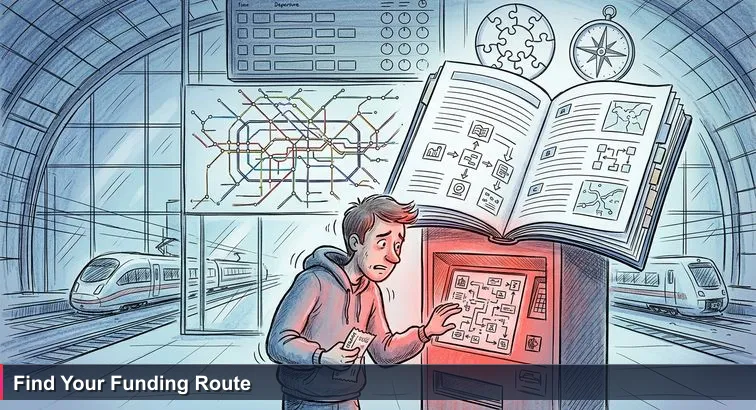
It’s 22:47 in Berlin Hauptbahnhof. The red Deutsche Bahn machine hums in front of you, the screen crammed with options - Deutschlandticket, VBB-Umweltkarte, Länder-Ticket, BC-Tarif - while the departure board over Track 12 ticks down the last three minutes to the only train that gets you home tonight. The network map above your head proves the system is brilliant; your sweaty palm clutching a useless old ticket proves that brilliance doesn’t help if you don’t know which option applies to you.
Funding tech training in Germany feels exactly like that moment. Everyone around you seems to “know” about Bildungsgutschein, BAföG, Aufstiegs-BAföG, state Weiterbildungsboni and a dozen scholarships. You hear that people are getting entire data or AI bootcamps - sometimes €8,000-€15,000 of tuition - covered. Yet when you try to work out which “ticket” fits your situation (unemployed in Berlin, employed engineer in Stuttgart, international student in Aachen), the options blur together just like that glowing DB menu.
Germany’s network is generous - but only if you read the map
Under the High-Tech Agenda, the federal government openly treats AI as a key technology, and research institutes like ZEW note that German companies have never spent more on innovation. Forecasts point to around 1% economic growth and roughly a 4% annual increase in IT-sector demand, even in a cautious market. In response, Germany is pouring money into human capital - via employment agencies, social insurance, state funds, foundations, and employer budgets.
From vending machine panic to planned connections
The catch is that these programmes aren’t a shopping list, they’re a network. Your departure station (ALG I, Arbeitnehmer:in, Student:in, BFD, Reha) and your destination (AI engineer in Berlin, data analyst in Munich, cloud dev in Hamburg) determine whether your first line is Bildungsgutschein, Qualifizierungschancengesetz, BAföG, employer funding, or private options. This guide is your network map: it decodes the acronyms, shows you which “tickets” are valid in which zones, and traces real routes - from your current status into Germany’s AI and tech roles - so you don’t miss the last train.
In This Guide
- Introduction: Why funding tech training in Germany feels like a ticket
- Key concepts and the AZAV ‘fare zone’ you must know
- Decision tree to pick the right funding line
- Government and social insurance funding explained
- Scholarships and foundation grants that actually pay months of rent
- Employer and institutional funding you can unlock at work
- Bootcamp financing and a Nucamp case study
- Stacking funding and practical examples
- Application calendar and reusable documentation checklist
- Sample routes from Berlin Hauptbahnhof to tech jobs
- Common pitfalls and how to avoid them
- Action plan for your next 30 days
- Frequently Asked Questions
This comprehensive guide for Germany AI careers 2026 covers Berlin vs Munich, salaries, and bootcamp options.
Key concepts and the AZAV ‘fare zone’ you must know
Before you start “buying tickets”, you need to understand what the big signs in this system actually mean. In German funding-speak, terms like Bildungsgutschein, BAföG or Qualifizierungschancengesetz aren’t buzzwords; they’re specific legal instruments with different rules, target groups, and caps.
Three layers of money in the system
Most tech learners in Germany are tapping into one or more of these layers:
- Federal programmes: Bildungsgutschein for jobseekers, BAföG for students, Aufstiegs-BAföG for advanced vocational training, and the Qualifizierungschancengesetz for upskilling employees. For example, summaries by providers like StackFuel note that small companies under 50 staff can have up to 100% of training costs covered via the Qualification Opportunities Act.
- State & EU funds: Bildungsscheck and Weiterbildungsbonus schemes co-financed by the European Social Fund (ESF), often adding €500-€2,000 on top of other support.
- Private & employer money: Corporate training budgets, foundation scholarships, bootcamp instalment plans and loans.
AZAV: the hidden fare zone rule
The most important “fare zone” concept is AZAV (Akkreditierungs- und Zulassungsverordnung Arbeitsförderung). If a course or provider is not AZAV-certified, employment agencies usually cannot pay for it with a Bildungsgutschein or similar vouchers. Guides like the education voucher explainer by WBS Coding School hammer this home: AZAV is the quality seal that unlocks federal money for retraining.
Status, language and “employability”
Three factors decide which line you can board first:
- Your status: unemployed on ALG I or Bürgergeld, employed, in Ausbildung, student, veteran, or in medical rehabilitation.
- Your language level: caseworkers often expect around B2 German for complex IT retraining, even when the course is taught in English.
- Your labour-market story: you must show that the training leads to realistic jobs - for BAföG-funded degrees, official portals mention monthly support up to €934, but only if your study path is recognised as leading into the labour market.
Once you see these as system rules rather than random favour, the map starts to make sense, and you can plan your route instead of guessing at the ticket machine.
Decision tree to pick the right funding line
At the ticket machine, you never start by reading every tariff condition; you start by asking where you are and where you’re going. The German funding system works the same way. Before you drown in PDFs, answer two questions: what is my legal status in the system right now? and what kind of training am I actually trying to do?
Step 1: What is your main status in Germany?
Your status determines which “line” you can board first:
- Unemployed / at risk (ALG I, Bürgergeld): your express line is the Bildungsgutschein via Agentur für Arbeit or Jobcenter; detailed playbooks from providers like Turing College show how to argue for tech retraining.
- Employed, job changing through digitalisation: look first at the Qualifizierungschancengesetz, where your employer and the state co-finance upskilling.
- In or after Ausbildung: advanced routes like Meister:in, Techniker:in or spezialiserte IT-Fortbildungen point you towards Aufstiegs-BAföG.
- Studying or about to study: your base ticket is BAföG, with add-ons like Deutschlandstipendium and foundation scholarships; official portals such as Studienwahl explain the mechanics.
- Health-related career change: vocational rehabilitation via Leistungen zur Teilhabe am Arbeitsleben from Deutsche Rentenversicherung.
- Bundeswehr active or veteran: the Berufsförderungsdienst is your primary hub.
- None of the above: you start on employer budgets, state bonuses, and private/bootcamp financing.
Step 2: What kind of training are you boarding?
Different “vehicles” pair with different funds:
- Bootcamps & intensive courses: Bildungsgutschein (if AZAV), Jobcenter funds, Qualifizierungschancengesetz, state bonuses, employer money, or affordable options like online bootcamps.
- University degrees: BAföG, Deutschlandstipendium, DAAD (for internationals), political and trade-union foundations.
- Advanced vocational qualifications: Aufstiegs-BAföG plus occasional state premiums.
- Short part-time upskilling: Qualifizierungschancengesetz, Bildungsurlaub, employer budget, small scholarships.
Step 3: Choose a main line and a backup
Your goal is not to use every programme; it’s to identify one primary public line that fits your status, then a backup: employer support, state bonuses, or a lower-cost bootcamp if public money falls through. Once those two are clear, the map stops feeling like chaos and starts to look like a set of planned connections into Germany’s AI and tech jobs.
Government and social insurance funding explained
When people say “Germany pays for retraining,” they’re mostly talking about a tight cluster of federal and social-insurance programmes. These are the S-Bahn and RE lines of the system: if you qualify, they move you a long way towards a new role in data, cloud, or AI without wrecking your finances.
Job-market tools: vouchers and upskilling laws
The flagship for career changers is the Bildungsgutschein from the employment agency. If you’re unemployed or about to lose your job, it can cover the full tuition of an AZAV-certified bootcamp or retraining course, often in the €5,000-€25,000 range, while your ALG I or Bürgergeld continues. A sibling instrument, the Qualifizierungschancengesetz, targets people who are still employed but whose jobs are threatened by digitalisation; analyses like StackFuel’s overview of the Qualification Opportunities Act funding describe how the state reimburses a significant share of course fees and even part of your salary while you learn.
If you already have an Ausbildung and want to move into higher-responsibility tech roles (for example industrial IT or advanced Fachinformatiker profiles), Aufstiegs-BAföG steps in. According to the EU’s CEDEFOP database on upgrading training assistance, it can support course and exam fees up to €15,000, with roughly half as a grant and the rest as a low-interest loan, a large part of which can be waived if you pass.
Students, health-related career changers, and soldiers
For university pathways into AI, data science or computer science, classic BAföG combines a monthly stipend with an interest-free loan, capped so you never repay more than €10,010 regardless of how much support you received. If health problems force you out of your current occupation, Leistungen zur Teilhabe am Arbeitsleben from Deutsche Rentenversicherung can finance retraining in tech, including tuition, materials, travel and a monthly Übergangsgeld often in the €966-€1,300+ band plus training bonuses of about €150.
Finally, if you’re serving in the Bundeswehr, the Berufsförderungsdienst acts almost like a long-distance ICE ticket: while you’re still on duty, it can pay civilian tuition for cyber, networking or software training, so that when you step onto the Berlin or Munich tech market, you arrive with current skills rather than starting again from zero.
Scholarships and foundation grants that actually pay months of rent
Once you’ve grabbed the basic “ticket” like BAföG or a job-seeker voucher, the next level is funding that doesn’t just pay tuition, but actually covers rent and groceries while you focus on AI or data. In Germany, that usually means scholarships and foundations putting €300-€1,000+ per month directly into your account.
Deutschlandstipendium: €300/month on top of everything else
The most widely accessible add-on is the Deutschlandstipendium. Universities like TU Berlin describe how selected students receive €300 per month for at least two semesters, co-funded by the state and private sponsors. It’s not means-tested, so you can combine it with BAföG or part-time work. For AI and CS students, emphasising your contribution to Germany’s digital transformation is key; according to TU Berlin’s call for applications, academic potential and engagement both matter.
DAAD and research tracks for international and HPC-focused paths
If you’re coming from abroad for an AI or data Master’s, or moving into research-heavy ML and high-performance computing, the German Academic Exchange Service (DAAD) and the National High Performance Computing (NHR) programme can turn a precarious move into a funded one. DAAD’s EPOS schemes list monthly stipends of around €992 for graduates and €1,400 for doctoral candidates, while the NHR scholarship for HPC-oriented PhDs offers about €2,200 per month plus workshops and access to top-tier clusters.
Political, trade-union and sector foundations
Beyond these, Germany’s party-linked and union foundations behave like long-distance passes for your entire study route. The Hans-Böckler-Stiftung, Heinrich-Böll-Stiftung, Konrad-Adenauer-Stiftung, Rosa-Luxemburg-Stiftung and Stiftung der Deutschen Wirtschaft typically fund students with monthly support in the €800-€1,000+ range, often for years, if you can show both solid grades and social or political engagement.
Portals such as the European Funding Guide’s overview of scholarships in Germany make clear that hundreds of these grants exist, many explicitly open to computer science, data science and AI students. If you’re prepared to write a thoughtful application that links your ML work to democracy, labour rights or sustainability, these foundations can literally underwrite your Berlin or Munich life while you build deep technical skills.
Employer and institutional funding you can unlock at work
For many people already working in Germany, the most overlooked “line” on the funding map runs through their own HR department. Corporates from SAP and Siemens to Deutsche Telekom, Bosch, Volkswagen, BMW, Allianz and Berlin players like Zalando routinely budget €2,000-€10,000 per employee per year for external courses, certifications and degrees - money that often expires quietly at year’s end if nobody claims it.
How big employers quietly fund tech upskilling
Typical patterns in DAX and large Mittelstand companies include:
- Annual training budgets for external certifications (AWS, Azure, data engineering, cybersecurity, Scrum).
- Internal academies covering cloud, AI, analytics and modern software practices at zero direct cost to you.
- Support for part-time Master’s in computer science, data science or business analytics, sometimes up to €8,000-€12,000 per year.
US-based analyses on employer-paid bootcamps, like Career Karma’s guide to getting your coding bootcamp funded by your employer, mirror what German engineers quietly do at SAP, Telekom or Siemens: pitch a specific bootcamp or AI course as a solution to a concrete business problem, not just as personal development.
Paid time to learn: Bildungsurlaub and internal “learning time”
On top of cash, many German states grant employees a legal right to 5 days of paid Bildungsurlaub per year (except Bavaria and Saxony). Some tech and digital literacy seminars qualify, including courses on AI’s impact on work and society; details are collected on federal portals such as the Bundesverwaltung’s continuing education page. Large employers often add internal “learning days” on top - Telekom, for example, has dedicated annual hours for training on its internal academies.
University and research institutions as hidden sponsors
If you’re studying or considering a Master’s in AI, data or informatics, universities and research institutes in Berlin, Munich or Aachen can also be de facto funders. Hiwi and research assistant roles in labs at TU Berlin, Fraunhofer or Max Planck typically pay €12-€18 per hour while giving you hands-on experience with real-world datasets and models - effectively paying you to skill up rather than the other way round.
Bootcamp financing and a Nucamp case study
Even in a country that loves subsidies, not every high-quality coding or AI course fits into the AZAV “fare zone”. Many international and Berlin-based bootcamps still sit outside voucher schemes, with price tags of €8,000-€15,000 (and some AI programmes higher), which forces you to think creatively about financing if the Jobcenter won’t pay.
Across Germany, learners typically piece things together from bootcamp instalment plans, income share agreements, employer contributions and private education loans. Overviews like BestColleges’ guide to bootcamp financial aid describe the pattern: low or zero upfront fees in exchange for higher payments once you’re working, or short-term, interest-free payment plans that keep monthly costs manageable while you re-skill.
| Program | Duration | Tuition (approx.) | Primary Focus |
|---|---|---|---|
| Back End, SQL and DevOps with Python | 16 weeks | €1,955 | Python, SQL, DevOps, cloud deployment |
| AI Essentials for Work | 15 weeks | €3,300 | Applied workplace AI, prompt engineering, productivity |
| Solo AI Tech Entrepreneur | 25 weeks | €3,660 | AI product building, LLMs, agents, SaaS monetisation |
This is where Nucamp changes the equation for Germany-based learners. With core AI and backend programmes in roughly the €1,955-€3,660 band, flexible monthly payments, and outcomes like about 78% employment and a 75% graduation rate, it undercuts many local competitors that charge €10,000+ while still maintaining strong learner satisfaction (Trustpilot around 4.5/5 from roughly 398 reviews, about 80% of them five-star).
In practice, that means you can often cover an entire Nucamp path by combining a modest state Weiterbildungsbonus, a small employer contribution and an instalment plan, instead of signing a large ISA or multi-year loan. For many people in Berlin, Hamburg or the Ruhrgebiet, that’s the difference between “maybe later” and actually getting onto the AI and data “train” this year.
Stacking funding and practical examples
Once you understand the main lines, the real optimisation game is stacking them. Very few people fund a tech career switch with a single programme; most combine 2-3 sources so that public money, employer budgets and affordable tuition do the heavy lifting, and only a small slice comes from your own pocket.
Example 1: Berlin marketing specialist adding AI skills
Imagine you’re a full-time marketer in Berlin who wants to use AI at work rather than become a full-time engineer. You choose an applied AI course costing €3,300. A realistic stack could look like this:
- State-level Weiterbildungsbonus or Bildungsscheck covers €1,000.
- Your employer taps its training budget for another €1,000, arguing that AI automation will improve campaign ROI.
- You finance the remaining €1,300 via the provider’s instalment plan over 6 months (~€217/month).
Guides like Nucamp’s overview of scholarships and funding for coding bootcamps in Germany show that this kind of small, multi-source stack is increasingly common among employed learners.
Example 2: Munich engineer pivoting into backend & ML
Now take an automotive engineer near Munich who wants to move into backend and ML-oriented work. They pick a 16-week backend/Python programme priced at €1,955. A different stack:
- The employer applies under the Qualifizierungschancengesetz to reclaim 50% of the tuition (~€978) because the role is affected by digitalisation.
- The engineer covers the remaining ~€977 with savings or a short 6-month instalment (~€163/month).
Example 3: Jobseeker combining voucher and scholarship
Consider a jobseeker in NRW targeting data roles. They secure a Bildungsgutschein that pays 100% of an AZAV-accredited data bootcamp. On top of that, they win a small private scholarship of €300/month for 6 months from a local foundation, which effectively tops up their Bürgergeld so they can focus fully on the course.
In all three cases, the key move is the same: lock in the biggest non-repayable source first (voucher, state grant, employer money), then use employer-friendly instalments or modest self-funding to close the gap instead of reaching straight for large private loans.
Application calendar and reusable documentation checklist
German bureaucracy moves on its own rhythm, and each programme runs on a different timetable. Treating this like a connection plan rather than a last-minute dash at the ticket machine makes the difference between starting your AI bootcamp this autumn or waiting another year.
| Programme / Funding Type | When to apply before start | Typical decision time |
|---|---|---|
| Bildungsgutschein / Jobcenter training | 8-12 weeks | 2-4 weeks |
| Qualifizierungschancengesetz | 8-12 weeks (employer + BA) | 3-6 weeks |
| Aufstiegs-BAföG | 8-10 weeks | 4-8 weeks |
| BAföG (university) | 12-16 weeks before semester | 6-12 weeks |
| Deutschlandstipendium | Typically 3-6 months before funding year | 6-12 weeks |
| Political / foundation scholarships | 4-12 months before studies | 2-6 months |
| State bonuses (Bildungsscheck, etc.) | 4-8 weeks | 2-4 weeks |
| DRV LTA rehabilitation | 12-16 weeks | 4-12 weeks |
| BFD (Bundeswehr) | 6-12 months before discharge | 4-8 weeks |
| Employer training budget | 4-8 weeks | 2-4 weeks |
| Bootcamp instalments / ISAs | 2-6 weeks | 3-10 days |
| Private loans (Deutsche Bildung, KfW) | 4-8 weeks | 2-6 weeks |
A good rule is to start with the slowest, most valuable lines first: federal programmes, then foundations and state bonuses, and only afterwards bootcamp financing or loans. Overviews of German further-education funding, such as MIQR’s guide to continuing education promotion, underline how varied these lead times are across instruments and Bundesländer.
To avoid repeatedly hunting documents, assemble a reusable digital folder. At minimum, you’ll need proof of identity and residence (passport or Personalausweis plus Meldebescheinigung), education and work history (CV, certificates, contracts or recent payslips), and financial data (tax returns, BAföG-style income evidence, sometimes bank statements). Every funding body will also ask for details of the training programme: official cost breakdown, curriculum, start and end dates, and AZAV certificate where relevant.
For higher-stakes applications like foundation scholarships or larger loans, add a polished motivation letter explaining your tech or AI pivot and, where helpful, short reference letters from employers or lecturers. Once you have this “application kit” ready, moving between BAföG, a state Bildungsscheck and even a private education loan from providers listed by institutions such as FH Potsdam’s student financing overview becomes a matter of hours rather than weeks.
Sample routes from Berlin Hauptbahnhof to tech jobs
Standing again in front of that glowing machine at Berlin Hauptbahnhof, it helps to see concrete journeys instead of abstract lines. Here are four realistic “routes” Germans and internationals actually take into tech and AI roles, with the funding combinations that make them viable.
Route A: Unemployed in Berlin → Junior Data Analyst
You’re on ALG I in Berlin with a humanities degree, aiming for a data role at a company like Zalando or a local startup. Your route:
- Use job ads and labour-market reports to show your caseworker strong demand for junior data roles in Berlin’s ecosystem.
- Apply for a Bildungsgutschein to fund an AZAV-accredited data or analytics bootcamp end-to-end.
- Layer in free meetups and online practice to build a portfolio that speaks to Berlin’s startup culture.
Route B: Automotive engineer near Munich → Backend/ML engineer
You’re a mechanical engineer in Bavaria watching vehicle software eat more of the value chain. You don’t want to quit your job to reskill:
- With your manager, apply under the Qualifizierungschancengesetz for co-funded backend/Python training aligned with your team’s digital projects.
- Take an evening/weekend-friendly online bootcamp in backend and data foundations, paying only the part your employer doesn’t reclaim.
- Target internal roles on autonomous driving, simulations or data platforms at BMW or suppliers.
Route C: International student → AI Master’s → ML role in Germany
You move to Aachen or Munich for an English-taught AI or data-science Master’s:
- Secure a DAAD or similar scholarship for monthly living costs, then add smaller awards like Deutschlandstipendium if possible.
- Work as a student assistant in an ML lab to finance part of your rent and get hands-on research experience.
- Complement theory with a practical AI product course; overviews like expert picks of AI bootcamps in Germany show options in Berlin, Hamburg and beyond.
Route D: Refugee in NRW → Entry-level dev / smart manufacturing
You’re a recognised refugee on Bürgergeld in North Rhine-Westphalia, strong in logic but new to German bureaucracy:
- Start with free or low-cost digital-integration courses, plus German up to at least B1/B2.
- Use Jobcenter support and, where possible, a Bildungsgutschein to fund AZAV-accredited web development or IT support training.
- Alternatively, target an Industry 4.0 Ausbildung with reported starting salaries above €3,800-€4,000 per month in smart manufacturing, as highlighted by vocational portals.
Common pitfalls and how to avoid them
Even with a good map, it’s easy to trip over the same bureaucratic stones. Across Berlin, Munich and Hamburg you hear the same stories: rejected vouchers, missed deadlines, expensive bootcamps that turn out not to be fundable. Most of these setbacks come down to a handful of avoidable mistakes.
1. Ignoring AZAV until it’s too late
Many learners pick a glossy bootcamp first and only later discover that the provider has no AZAV accreditation, which means an employment agency simply cannot attach a Bildungsgutschein to it. Guides like StartSteps’ walkthrough of the Bildungsgutschein process stress this as step one, not an afterthought. Always verify the AZAV status in KURSNET or via the accreditor before you fall in love with a curriculum.
- Check AZAV before booking any Beratungstermin.
- Print or save the accreditation proof for your caseworker.
- Have a plan B course that is also AZAV-certified.
2. No labour-market story, just “I like coding”
Caseworkers and scholarship panels don’t fund hobbies; they fund employability. Coverage of the Qualifizierungschancengesetz on portals like IamExpat underlines that public money is meant to prepare you for concrete roles in a changing labour market. Turn your wish into a case by bringing printed job ads, salary ranges and a short explanation of how the course closes the gap between your CV and those postings.
3. Underestimating language and lead times
Another common trap is assuming you can sort funding “next month”. In reality, getting BAföG, a Bildungsgutschein or a foundation scholarship approved often involves multiple appointments, missing documents and waiting periods. If your German is shaky, the process stretches even further because you’re deciphering forms as you go. Build in buffer, get help translating key terms, and treat every deadline as earlier than it looks.
4. Skipping employer money and jumping straight into debt
Finally, many mid-career changers go from “I want an AI bootcamp” straight to private loans or ISAs without ever asking HR what’s available. In a German context, that can mean walking past several thousand euros of training budget and paid Bildungsurlaub each year. Before you sign anything long-term, exhaust internal learning platforms, certification budgets and co-funding options with your manager; loans and high-cost ISAs should be the night bus, not your first choice from the ticket machine.
Action plan for your next 30 days
The next 30 days are not about “solving your whole career”; they’re about choosing a route and reserving your seat. If you treat this like planning a trip from Berlin Hbf rather than vaguely “wanting to travel more”, you can move from overwhelm to concrete applications.
Start by answering three questions on paper: What is my status today (ALG I, employed, student, etc.)? What specific role am I aiming for (data analyst, backend developer, AI product builder)? When do I realistically want to start learning (month and year)? That gives you coordinates for the map.
- Days 1-7: Build your “application kit”. Collect ID and Meldebescheinigung, CV, certificates, payslips or ALG notice, and a one-page description of your target role plus 3-5 matching job ads.
- Days 5-14: Book one appointment: Agentur für Arbeit/Jobcenter if you’re unemployed, or HR if you’re employed. Put the date in your calendar and prepare a short pitch linking your target role, skills gap, and chosen training.
- Days 10-20: Shortlist 2-3 programmes: at least one AZAV-certified option for vouchers, and one affordable backup such as an online bootcamp. For example, Nucamp’s Python backend, AI Essentials and Solo AI Tech Entrepreneur paths sit in the roughly €1,955-€3,660 range, with flexible monthly payments and outcomes around 78% employment and a 75% graduation rate.
- Days 15-25: Submit at least one major funding application (Bildungsgutschein, BAföG, Qualifizierungschancengesetz or a state bonus). Use your kit so each new form takes minutes, not hours.
- Days 20-30: Decide on a plan B if public money is delayed: a smaller state grant plus employer budget and an instalment plan instead of large private loans. Resources like Nucamp’s overview of German bootcamp funding options can help you combine these pieces intelligently.
By the end of these 30 days, your goal is simple and concrete: one realistic training programme chosen, at least one funding route in motion, and a clear backup path that doesn’t depend on wishful thinking or high-interest debt.
Frequently Asked Questions
Can I get a tech bootcamp fully funded in Germany in 2026?
Yes - if you qualify for a Bildungsgutschein or Jobcenter funding and the course is AZAV-certified, the agency can cover 100% of tuition (many bootcamps range €5,000-€25,000). Other full-cover routes include Deutsche Rentenversicherung (LTA) for health-related retraining and the Bundeswehr’s BFD for service members.
I'm employed - what public funding can help me upskill without quitting my job?
Look at the Qualifizierungschancengesetz, which can co-fund 25-100% of training costs depending on company size, and ask HR about your annual Weiterbildungsbudget (many firms offer €2,000-€10,000/year). Also check state Weiterbildungsbonus or Bildungsurlaub for paid study time and small grants (€500-€2,000).
As an international student starting an AI Master in Germany, which scholarships or work options actually reduce living costs?
Apply for DAAD programmes (Master stipends around €992/month in 2026) and your university’s Deutschlandstipendium (€300/month); combine those with student assistant roles in AI labs that typically pay €12-€18/hour. BAföG may apply in limited cases, but non-EU eligibility varies, so check DAAD and your uni early.
How can I avoid big loans for a mid-priced course like Nucamp’s €3,300 AI Essentials?
Stack smaller sources: a state Weiterbildungsbonus (€500-€1,500) + employer contribution (€1,000 typical) + the bootcamp’s instalment plan for the remainder; that often keeps private loans unnecessary. If public help is blocked, consider ISAs as a last resort but compare total caps and repayment terms first.
What's the single fastest action I should take this week to start securing funding?
Book a Gespräch with Agentur für Arbeit or your Jobcenter (or HR if employed) and bring 1-2 AZAV course brochures plus relevant job ads to show labour-market fit; Bildungsgutschein decisions typically need 8-12 weeks lead time. Verifying AZAV status via KURSNET before the meeting saves time and prevents automatic rejections.
Top 10 tech internships and apprenticeships in Germany for AI careers (2026)
If you’re choosing training in Berlin or beyond, this guide to the best AI bootcamps in Germany (Top 10, 2026) is a helpful starting point.
Comprehensive look at AI Meetups and Networking Events in Germany for 2026
Find the best tech companies in Germany for pay and practical tips on RSUs, VSOPs, and German taxes.
Preparing applications? Reference the Top 10 startups hiring junior developers in Germany in 2026 for tailored CV tips by company.

Irene Holden
Operations Manager
Former Microsoft Education and Learning Futures Group team member, Irene now oversees instructors at Nucamp while writing about everything tech - from careers to coding bootcamps.