









Is Germany a Good Country for a Tech Career in 2026?
By Irene Holden
Last Updated: April 12th 2026
Quick Explanation
Yes - Germany is a good country for a tech career in 2026 because specialist demand in AI, cloud, cybersecurity and industrial automation is growing fast even as the wider economy stalls, giving practical, well-funded routes into industry and research. There are roughly 137,000 unfilled IT jobs, German AI startups raised over €2 billion in the first half of 2025 and federal AI funding sits around €5 billion, while new immigration measures like the Opportunity Card and eased Blue Card rules make relocation materially easier for international talent.
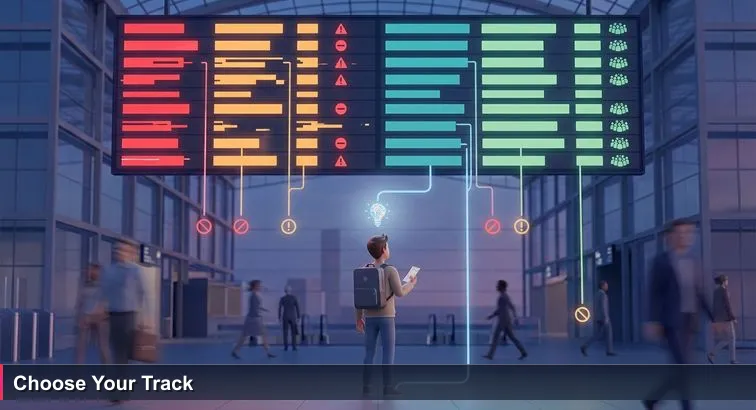
The scene under the departure board in Berlin Hauptbahnhof captures how Germany’s tech market feels right now: some lines are blinking “Cancelled”, others “Overcrowded”, and you’re holding a ticket that simply says “Germany - Tech Career, 2026” with no platform number printed.
News headlines talk about a “sick man of Europe” and hiring freezes. At the same time, labour market data shows a country officially listing IT and engineering as bottleneck professions, with over 160 shortage occupations nationwide and employers struggling to fill specialist roles, as summarised in Germany’s shortage occupation overview.
This paradox is what makes the market so confusing from the outside. Is Germany a land of opportunity for AI engineers and data scientists, or a place where developers send out 70+ applications before getting traction? Recruiters describe a “talent crisis” where traditional employers are cautious, but demand for AI, cybersecurity and cloud skills is still rising faster than the available talent pool, according to Andersen’s IT job market analysis.
The catch is that there is no single “German tech market”. There are parallel lines: Berlin’s English-first startups, Munich’s deeptech and automotive AI, Stuttgart’s robotics and Mittelstand, Frankfurt’s fintech, plus countless industrial players spread across smaller cities. Each runs on its own schedule and requires a different “ticket”: specific skills, language levels, and visa options.
This explainer matters because if you treat Germany as one big, uniform destination, you end up queueing at the wrong platform. Read the timetable correctly, though, and that anonymous “Tech Career, 2026” ticket can become a deliberate route into AI and advanced tech at the heart of Europe.
What We Cover
- Under the departure board: why this explainer matters
- What is Germany’s tech market in 2026?
- Why Germany matters for AI and tech careers
- How the German tech market actually works
- Who Germany is best for - and who should think twice
- Your ticket: the skills, language and visa you need
- How Germany compares to other European tech hubs
- Should you board the Germany train? A decision framework and next-step
- Common Questions
This comprehensive guide for Germany AI careers 2026 covers Berlin vs Munich, salaries, and bootcamp options.
What is Germany’s tech market in 2026?
On paper, Germany’s tech economy looks like a contradiction. Macroeconomic forecasts show GDP barely moving - around +0.4% growth - yet the country’s IT sector is projected to expand by about €33.3 billion between 2025 and 2029, according to an analysis of the German IT market from Yahoo Finance.
At the same time, labour data points to roughly 137,000 unfilled IT positions and more than 1.7 million vacancies overall across the economy. IT and engineering are formally listed as shortage occupations, which is why they appear prominently in official “bottleneck professions” lists. In simple terms: some employers are freezing general headcount, while others can’t hire AI, cloud, or security specialists fast enough.
Beneath those numbers, an AI wave is reshaping the landscape. The appliedAI Institute mapped more than €2 billion in funding for German AI startups in just the first half of 2025, showing a rapidly thickening ecosystem of language models, industrial AI platforms, and sector-specific tools across the country, as documented in the German AI startup landscape report.
Well-known players illustrate this shift: DeepL, founded in Cologne, is scaling globally with a New York tech hub and a potential US IPO; Celonis in Munich continues to dominate process mining and enterprise AI; Aleph Alpha in Heidelberg anchors Germany’s push for “sovereign AI” infrastructure for government and industry.
Layered on top of private capital is a thick band of public investment. Germany’s National AI Strategy directs around €5 billion of federal funding into AI research and startups, while the High-Tech Strategy aims for R&D spending of 3.5% of GDP by 2030. That mix of slow headline GDP and aggressive tech and AI spending is what makes the market feel “dual-speed” from the inside.
Why Germany matters for AI and tech careers
When you zoom in under the headlines, Germany starts to look less like a “slow” market and more like Europe’s biggest laboratory for applied AI. This is where robots on factory lines, smart grids, connected cars and hospital systems all need engineers who can turn models into working products.
Industry 4.0 as an AI playground
Germany’s manufacturing, automotive and logistics sectors are pouring money into Industry 4.0: sensors on machines, computer vision on production lines, digital twins of whole plants. A dense research network - from Fraunhofer and Max Planck to TUM, RWTH Aachen, TU Berlin and KIT - feeds talent and ideas straight into companies like Siemens, Bosch, BMW and Volkswagen.
On the policy side, the federal government’s AI Strategy backs this shift with multi-year programmes to embed AI in industry, healthcare and public administration, documented in the European Commission’s overview of Germany’s national AI strategy. For AI and ML professionals, that means unusual access to real-world, high-impact datasets and problems.
Visas that actually unlock careers
Germany also stands out for how easy it is to get in - and stay - if you’re a specialist. The Skilled Immigration Act and the new Opportunity Card created flexible routes for non-EU tech workers, with around 11,500 Opportunity Cards issued within the first year. For shortage occupations like IT and engineering, the EU Blue Card salary threshold sits at about €45,934 per year, making it accessible even for mid-level roles.
Quality of life at European scale
For many engineers, the appeal is the mix of serious work and liveable cities. Developer cost-of-living analyses using Numbeo data show Berlin to be roughly 14% cheaper than Munich, while Munich salaries often run higher and can yield better savings for seniors, as summarised in Euro Top Tech’s comparison of European tech hubs. Add in public healthcare, strong tenant protections and free or low-cost education, and Germany becomes a compelling base if you want an AI career in the EU without sacrificing stability.
How the German tech market actually works
Once you’re past the headlines, Germany’s tech scene feels less like a single market and more like a timetable of different lines. Generalist web developers often crowd at one platform, while specialists in AI, cloud, data and cybersecurity quietly board trains with plenty of seats. Hiring reports describe this as a “paradoxical talent crisis”: some teams freezing headcount, others struggling to hire fast enough.
These opportunities are spread unevenly across the country. Berlin’s startup platforms look very different from Munich’s deeptech tracks or Stuttgart’s robotics lines. The Berlin Tech Ecosystem Report 2025 even shows Europe’s highest Seed-to-Series-A conversion rate at about 37%, while an analysis of German fundraising found Bavaria overtook Berlin in 2024 startup funding, with roughly €2.3 billion vs. €2.2 billion.
| Region | Core focus | Notable data point | Typical language reality |
|---|---|---|---|
| Berlin | Startups, fintech, B2C/B2B SaaS | ≈37% Seed→Series A conversion | Many teams truly English-first |
| Munich / Bavaria | Deeptech, AI, automotive, semiconductors | Startup funding ≈€2.3 billion in 2024 | More German-preferred, especially corporates |
| Stuttgart | Robotics, automotive suppliers, industrial IoT | Regional R&D spend ≈€13 million/day | German usually essential on the shop floor |
| Frankfurt / Hamburg | Fintech, banking IT, gaming, media, logistics | ECB and major banks (Frankfurt); Google HQ (Hamburg) | English in some teams, German for progression |
Compensation adds another layer of “dual speed”. Community salary datasets show 2024 tech pay jumping by roughly 7% before flattening, with juniors around €43,000-€75,000, mid-levels €65,000-€90,000, seniors €80,000-€130,000+, and SRE/infrastructure leads near €101,000 median, according to aggregated figures discussed in German tech salary deep-dives. Career advisors commonly cite 2026 ranges like €70,000-€110,000+ for cloud architects, €60,000-€100,000+ for software, cybersecurity or AI specialists, and €45,000-€55,000 for entry-level IT. The trains are moving - but which one you can board depends heavily on your stack, seniority and city.
Who Germany is best for - and who should think twice
Standing under that departure board, it helps to know which tickets are actually valid. Germany in 2026 is not equally good for every tech profile; it strongly favours some combinations of experience, stack and risk appetite, and is punishing for others. Think of this section as a quick “fit check” before you commit to a platform.
Early-career engineers and CS graduates
Germany works well if you have a CS or STEM degree and around 1-3 years of experience, are happy with mid-range pay in exchange for structured training, and can invest 1-2 years into reaching B1/B2 German. Graduate schemes at SAP, Siemens, BMW or Mittelstand firms, often highlighted in overviews of IT job opportunities in Germany, give you a stable entry plus a clear path to long-term residency. It’s a weaker fit if you expect hyper-fast promotions, remote-only work or Silicon Valley starting salaries.
Senior engineers and AI/ML specialists
With 6+ years experience and depth in cloud, SRE, data engineering, embedded systems or enterprise platforms, Germany’s trains open up: Munich for automotive AI and deeptech, Berlin for senior product roles, Stuttgart and the Rhine-Ruhr for industrial software. AI/ML engineers who enjoy applied work in factories, logistics, energy or healthcare find rich problems, especially around “sovereign AI” and process automation. But if your sole goal is FAANG-level total compensation or frontier model research at OpenAI/DeepMind scale, other hubs will serve you better.
Product leaders and founders
Product managers and tech leads do best when they combine domain expertise with strong communication in both English and German; many serious PM roles still require German for stakeholder-heavy work, a pattern noted in guides to the “real” German tech market. Founders and indie AI builders benefit from Berlin’s and Munich’s funding and industry access, but have to stomach heavier bureaucracy and employee protections. If you refuse to learn any German, need ultra-fast, informal hiring cycles, or only care about consumer social apps, Germany is likely the wrong train for now.
Your ticket: the skills, language and visa you need
If the German tech market is a maze of platforms, your “ticket” is a combination of three things: what you can build, which languages you can work in, and how you’re allowed to stay. Generalist web development alone increasingly feels like the overcrowded regional train; the tickets that open doors are specialisation, German skills, and the right residence permit.
Germany rewards people who can point to a clear, scarce specialism rather than “I code a bit of everything”. That might mean AI/ML, data engineering, MLOps, cloud/SRE, cybersecurity, or a mix of software plus deep domain knowledge in areas like manufacturing, logistics or healthcare.
| Ticket type | What it proves | Strong options for Germany | Where it matters most |
|---|---|---|---|
| Skills | You can solve high-value problems | AI/ML, data eng, MLOps, cloud/SRE, cybersecurity, embedded/robotics | Industry 4.0, automotive, fintech, green tech |
| Language | You can operate inside teams and with customers | English for Berlin; B1/B2 German for Munich, Stuttgart, Mittelstand | Career progression, leadership, customer-facing work |
| Visa / status | You’re legally easy to hire | EU Blue Card, Skilled Worker Visa, Opportunity Card | All non-EU roles, especially corporates and public sector |
Visa rules are more flexible than many expect: for non-regulated IT roles, experienced developers can qualify with as little as 2+ years of relevant work, even without a degree, under Germany’s updated Skilled Immigration Act, explained in detail on LearnGermanOnline’s overview of the new law. Thousands of Opportunity Cards now let you live in Germany while you look for work, effectively turning the country into your job-search base.
On the skills side, you don’t need another university degree to switch tracks into AI or cloud. Affordable, focused bootcamps like Nucamp offer online programmes such as Back End, SQL and DevOps with Python (16 weeks, about €1,955), AI Essentials for Work (15 weeks, about €3,300), and the Solo AI Tech Entrepreneur path (25 weeks, about €3,660). With a reported employment rate near 78%, graduation around 75%, and an average 4.5/5 rating from hundreds of reviews, they’re designed to get you to “hireable” faster than traditional study, which aligns with what many engineers weigh when deciding if it’s worth relocating for German roles, as discussed in relocation guides for software engineers.
A realistic route for a career-changer might look like this:
- Year 0-0.5: Reach A2/B1 German and complete a backend/cloud-focused bootcamp.
- Year 0.5-1.5: Use Blue Card or Skilled Worker pathways to land a first role in Germany and grow to B1/B2 German.
- Year 1.5+: Add targeted AI programmes and pivot into AI-heavy roles or launch an AI product for local industries.
How Germany compares to other European tech hubs
Looking across Europe’s departure boards, Germany isn’t the only train you could board for a tech or AI career. London, Zurich, Amsterdam, Copenhagen and others all promise high-impact roles, different mixes of salary, language, and immigration friction.
Germany vs. London and the UK
For pure earning potential, London’s big tech and finance ecosystem still sets some of Europe’s highest ceilings. At the same time, post-Brexit immigration rules make long-term residency harder to secure for many non-Europeans. By contrast, Germany couples solid though not top-of-continent salaries with comparatively open routes like the Skilled Immigration Act, EU Blue Card and Opportunity Card. It’s one reason international rankings of tech investment repeatedly list Germany alongside the UK as a leading European destination for capital, as noted in a cross-country comparison of the best countries for tech investment.
Germany vs. Switzerland
Switzerland is the ICE train for compensation: extremely high gross salaries, lower effective tax, and strong banking and pharma sectors. The trade-offs are strict quotas, tougher immigration for many passports, and a much smaller overall tech market. Germany typically offers lower net pay, but a far bigger range of employers from SAP, Siemens and BMW to hundreds of AI startups and Mittelstand firms, plus clearer paths to permanent residency and EU-wide mobility.
Germany vs. Amsterdam, Paris and the Nordics
Dutch and Nordic capitals are famously English-first and socially progressive, with vibrant but smaller tech scenes. If you never want to learn another language, Amsterdam or Stockholm can feel easier day to day. Germany sits between those cultures and London: more language friction, but a much larger internal market and a unique concentration of industrial and automotive AI work. Analyses of Europe’s best cities for international professionals consistently put Berlin and Munich alongside Amsterdam and Copenhagen as attractive choices, with Berlin in particular highlighted for its combination of startup energy and relative affordability in guides to the best cities in Germany for tech workers.
So the choice isn’t “Germany or bust”. If you’re optimising purely for cash and already have access to London or Zurich, other routes may win. If you care about applied AI in industry, long-term EU residency, and a dense landscape of research institutes and manufacturers to collaborate with, Germany’s train is unusually well-routed.
Should you board the Germany train? A decision framework and next-step
Back under the departure board in Berlin Hauptbahnhof, you now know more than when you walked in. You’ve seen that some lines are genuinely delayed, others are crowded but moving, and a few niche routes are surprisingly empty. The real question is no longer “Is Germany good or bad for tech?” but “Is my profile aligned with the trains that are actually running?”
A simple way to decide is to look at three dimensions: your skills, your tolerance for bureaucracy and language learning, and what you want from the next 5-10 years. Hiring specialists describing Germany’s 2026 market talk about a slowdown for generic roles but persistent demand in AI, cloud and cybersecurity, especially for candidates willing to learn German and navigate longer interview cycles, as outlined in analyses of what to expect from tech hiring in Germany.
If you want a concrete checklist before you “board”, ask yourself:
- Do my skills map to a clear shortage area (AI/ML, data, cloud/SRE, cybersecurity, embedded/robotics)?
- Am I ready to reach at least B1/B2 German within 1-2 years, especially if I aim beyond Berlin?
- Can I live with structured, sometimes slow hiring processes in exchange for stability and residency paths?
- Does an EU base with strong social protections matter more to me than absolute top-end salary?
If most answers are “yes”, the Germany train is worth boarding. The next step is to turn that into a plan: pick a city-sector combination, identify one target specialisation, and decide how you’ll close your skill gaps. For many, that means layering focused, affordable training on top of their existing background - for example, using Nucamp’s 16-week Back End, SQL and DevOps with Python bootcamp (about €1,955) to get cloud-ready, then adding a 15-week AI Essentials for Work programme (€3,300) or the 25-week Solo AI Tech Entrepreneur path (€3,660) to move into applied AI. With employment outcomes around 78% and a 4.5/5 average rating, that kind of structured route can turn a vague “Tech Career, 2026” ticket into a validated boarding pass for Germany’s AI and advanced tech lines.
Common Questions
Is Germany a good country for a tech career in 2026?
Yes - but with caveats: Germany is booming in applied AI, cloud, cybersecurity and green tech, with roughly 137,000 unfilled IT roles and an IT market expected to grow by about €33.3 billion by 2029. Success depends on choosing the right city and specialisation (AI, MLOps, data, embedded), learning some German for many roles, and navigating relatively structured hiring processes.
How hard is it to get a work visa for tech roles in Germany?
Relatively straightforward compared with the US: recent Skilled Immigration reforms and the 2024 Opportunity Card (about 11,500 issued in year one) make entry easier, and the EU Blue Card threshold for shortage occupations is around €45,934 in 2026. For many non-regulated IT roles you can qualify with 2+ years’ experience even without a local degree, but individual employers still matter.
Do I need to speak German to build a tech career here?
Not always - many Berlin startups and product-led teams operate primarily in English - but German becomes important for career progression, management, and roles in Munich, Stuttgart and the Mittelstand. A realistic goal is reaching B1-B2 within 1-2 years to unlock the widest set of roles and higher pay.
Which German cities should I target for AI jobs and higher pay?
Target Berlin for product-led AI startups and a more English-friendly scene, Munich/Bavaria for deeptech, automotive AI and higher median salaries, Stuttgart for robotics and industrial AI, and Frankfurt for fintech and security roles. Senior AI and senior engineering pay typically ranges €80k-€130k+ (SRE/infrastructure medians near €101k), but city costs vary - Berlin is ~14% cheaper than Munich on living costs.
Will a bootcamp help me get a tech or AI job in Germany?
Yes - if you choose a focused program, build portfolio projects relevant to German employers, and combine it with language learning; Germany values practical cloud, MLOps and domain-specific skills. Affordable options like Nucamp (programs roughly €1,955-€3,660) map directly to shortage areas and report employment outcomes around 78%, making them a pragmatic route into entry and mid-level roles.
Top 10 free tech learning hubs in Germany’s libraries and community centres
Use this how to tutorial for AI engineers in Germany (2026) to build a German-ready portfolio and deployment skills.
See which firms made the cut in our best-paying tech employers in Germany list and how equity versus base breaks down.

Irene Holden
Operations Manager
Former Microsoft Education and Learning Futures Group team member, Irene now oversees instructors at Nucamp while writing about everything tech - from careers to coding bootcamps.