









Cost of Living vs Tech Salaries in Germany in 2026: Can You Actually Afford It?
By Irene Holden
Last Updated: April 12th 2026
Key Takeaways
Yes - you can afford a comfortable life on a German tech salary in 2026 if you match city and housing to your level: entry at €55,000 gross nets about €2,900 to €3,000 per month, a mid salary of €85,000 nets about €4,100 to €4,300, and a senior €120,000 nets roughly €5,600 to €5,800. The real limiter is rent, with central Munich or prime Berlin 1-beds eating 40 to 50 percent of those nets, while WG rooms, the €63 Deutschlandticket, or living in value cities like Leipzig or Dresden let you save - plus Berlin’s deep AI ecosystem and research institutions give strong career upside without necessarily blowing your budget.
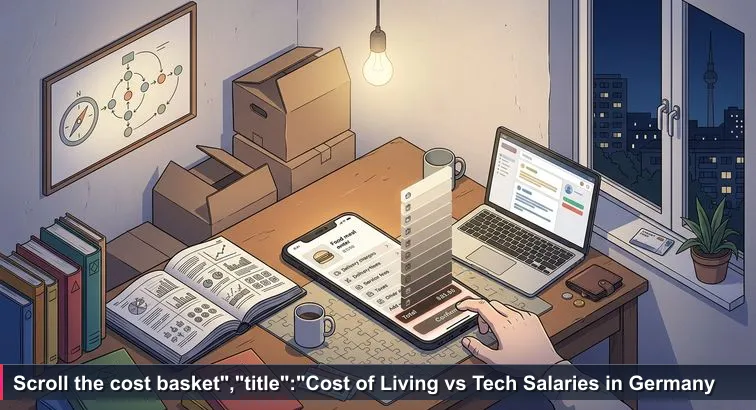
You’re standing in a too-small Berlin kitchen under a bare bulb, half-unpacked boxes still leaning against the wall. On the table, your phone glows with a Lieferando order: the kebab that used to be €11.90 is still there, but beneath it a quiet stack has grown - service fee, delivery charge, “inflation surcharge”, tip - until the total reads €25.40. Your thumb hovers over “Order now”, suddenly tense.
Next to it, your laptop screen shows a different kind of number: a recruiter’s email offering €65,000 gross for a developer role in Berlin. Maybe you’ve seen other figures thrown around for Germany’s tech scene - “€55,000 starting salary”, “€85,000 for experienced backend”, “€120,000+ for senior ML in Munich” - backed up by salary overviews and hiring reports for roles at companies like SAP, Siemens, Zalando or one of the big research players. Analyses such as Tribe.xyz’s outlook on tech hiring in Germany show mid-range developer pay sitting in that band, with Munich often paying 10-15% more.
The contradiction hits in that kitchen: if you’re “well paid” on paper, why are you hesitating over a €25 kebab? Between the shiny Brutto and the life you actually live sit income tax, social contributions, Warmmiete, and the slow grind of prices. Economic institutes now expect growth of about 0.6% and inflation around 2.8%, according to recent forecasts reported by Reuters on Germany’s outlook. At the same time, Germany still has a structural shortage of roughly 137,000 IT workers, as highlighted by Jobbatical’s tech talent shortage analysis.
This guide takes that Lieferando moment seriously. A German tech salary is a basket, not a single number. Just like you scroll past the base meal to see the delivery fees, you need to scroll every line of your monthly budget - taxes, rent, transport, food, learning - by city and career stage. Over the next sections, we’ll unpack what “comfortable” really means on entry, mid, and senior salaries in Berlin, Munich, Frankfurt, Hamburg, Leipzig and Dresden, and help you learn a new reflex: never look at an offer here without mentally expanding the basket until you see what’s left after everything is in the cart.
In This Guide
- Introduction: the Lieferando moment and the real question
- Why gross salary is misleading in Germany
- What ‘living comfortably’ actually means here
- The three cost drivers that make or break budgets
- Taxes and healthcare in one page
- Entry-level realities: survival, WGs, and where you can thrive
- Mid-level living: where comfort becomes normal
- Senior roles: comfortable but not automatically wealthy
- Where to live by city and career stage
- Employer perks that change the math
- Training without blowing the budget: why Nucamp fits
- Germany compared to other European hubs
- A practical checklist to evaluate any German offer
- Final verdict: can you live comfortably in Germany in 2026
- Frequently Asked Questions
This comprehensive guide for Germany AI careers 2026 covers Berlin vs Munich, salaries, and bootcamp options.
Why gross salary is misleading in Germany
The number in your offer letter is pure fantasy until you run it through the German payroll machine. “€55,000 starting salary”, “€85,000 for experienced backend engineer”, “€120,000+ for senior ML in Munich” all sound impressive, and salary guides like Robert Half or Tribe.xyz back up those ranges for 2026. But every one of those figures is Brutto - the sticker price before the fiscal equivalent of delivery fees and service charges hit your payslip.
Between gross and what actually lands in your account, several big items come off the top: progressive income tax that climbs towards a 42-45% marginal rate for high earners, plus mandatory social contributions of roughly 20-21% of your gross. Those social charges bundle pension at 9.3%, unemployment insurance around 1.3%, long-term care close to 1.8%, and your half of statutory health insurance at roughly 7-8%, as broken down in expat payroll guides such as Expatica’s overview of German deductions.
Once those are applied (Tax Class I, no children, public insurance, no church tax), the headline shrinks fast. A typical entry tech offer of €55,000 gross turns into roughly €2,900-€3,000 net per month. A mid-level role at €85,000 yields around €4,100-€4,300 net. Even a senior package of €120,000 translates to about €5,600-€5,800 net. Community “reality checks” often describe losing around 35-45% of gross to tax and social insurance before rent or groceries even appear, a pattern echoed in cost-of-living breakdowns like Live in Germany’s salary examples.
The misleading part isn’t that Germany underpays; it’s that gross compresses very different realities into one number. Two offers €10k apart can end up just €300-€400 apart in your pocket, while your rent can swing by €500 depending on city and neighbourhood. Until you mentally convert every Brutto into Netto and set it next to Warmmiete, the basket total on your German life is as opaque as that Lieferando surcharge column.
What ‘living comfortably’ actually means here
Before you can judge any German tech offer, you need a concrete picture of what “comfortable” means in everyday terms. In Berlin, Munich or Hamburg, most developers describe it less as rooftop-terrace glamour and more as a steady, low-anxiety baseline: rent paid without panic, some buffer for back payments, and enough left at month’s end to make real choices. Cost-of-living guides like IamExpat’s 2026 overview of household budgets put a typical single-person monthly spend well above basic rent once utilities, food and insurance are included.
In this guide, “living comfortably” for a single tech worker roughly means:
- Stable housing: you can cover Warmmiete and annual utility reconciliations without raiding savings.
- No high-interest debt: credit cards are for convenience, not survival.
- Consistent saving: at least 10-20% of your net, or around €300-€500 per month as a minimum target for singles.
- Some discretionary life: eating out, culture, and a few trips within Europe each year.
- A learning budget: money for courses, conferences, or a bootcamp to keep your skills moving.
By contrast, you’re in “just surviving” territory when:
- Rent forces you into any WG that says yes, or into very long commutes.
- Savings don’t grow from month to month, or vanish with every Nachzahlung or dentist bill.
- Eating out, travel, and further education feel like guilty luxuries.
Think of your salary as a life basket: comfort is not having the biggest basket, it’s having room left after the essentials. Studies comparing German rents and everyday costs, such as uhomes’ breakdown of Berlin living expenses, show how quickly housing, transport and food can crowd that basket. The rest of this guide assumes “comfortable” means meeting your needs, enjoying a modest urban lifestyle, and still pushing a meaningful slice of your monthly Netto into savings or career growth.
The three cost drivers that make or break budgets
Once your Netto lands, three line items decide whether that number feels generous or tight: housing, transport, and food. Everything else is noise compared to how much of your monthly basket these three quietly consume. In Germany, rent is especially unforgiving in tech hubs, where a Berlin or Munich 1-bed can swallow 40-50% of an entry-level engineer’s net if you insist on living alone.
Housing costs are built around Kaltmiete (base rent) plus Nebenkosten (building costs like water, trash and heating estimates). Together they form your Warmmiete - the amount that actually leaves your account each month. Electricity and internet are usually on top. In 1-bed apartments across the big hubs, that Warmmiete routinely runs from four-figure “manageable” to “what was I thinking?”, with data aggregators such as Relocate.me’s Frankfurt breakdown showing similar patterns across cities.
Transport is the second big lever. The Deutschlandticket at €63 per month gives you local and regional public transport nationwide, a bargain compared with owning a car. By contrast, car ownership quickly climbs to around €400-€600 per month once you add fuel, insurance, tax, maintenance and parking - a reality spelt out in consumer banking guides like N26’s analysis of car ownership costs in Germany. With petrol hovering near €2.13 per litre, “just having a car” is an expensive lifestyle choice.
Food rounds out the trio. A single person cooking mostly at home can keep groceries around €250-€300 per month at discounters, or €300-€400 with more REWE/Edeka and organic options. Add 2-3 casual meals out per week at €12-€18 each, plus an occasional mid-range dinner at €35-€60 per person, and another €150-€250 quietly disappears.
| Cost driver | Typical monthly spend | Low-end scenario | High-end scenario |
|---|---|---|---|
| Housing | €700-€1,200 | WG room in major hub | 1-bed in central Berlin/Munich at €1,500-€2,300+ Warmmiete |
| Transport | €63-€120 | Deutschlandticket only | Car ownership at €400-€600 including fuel and insurance |
| Food | €350-€650 | Groceries ~€250-€300, minimal eating out | Groceries ~€400 plus regular eating out and delivery |
Taxes and healthcare in one page
The first time you open a German payslip, it feels like scrolling through a very long cart: line after line quietly shaving down the number your contract promised. To understand what you really earn, you only need a handful of those lines, but you need to know them well enough to turn any Brutto into usable Netto.
Germany runs a progressive income tax, starting at 0% and climbing into the low forties for higher earners, plus a small “solidarity surcharge” on the tax itself. On top of that sit the big social-insurance pillars: pension, health, unemployment and long-term care. Together, employee social contributions take a bit over a fifth of your gross pay, with your employer paying a similar share again. A worked example from Taxes for Expats’ Germany guide shows a €60,000 salary turning into roughly €3,900 net per month once these deductions are applied.
In practice, almost every salaried developer will see some version of the following on their payslip:
- Einkommensteuer - income tax, progressively rising with your salary.
- Sozialversicherungen - mandatory pension, health, unemployment and long-term care insurance.
- Solidaritätszuschlag - a small surcharge on your income tax if you earn above a modest threshold.
- Kirchensteuer - church tax, about 8-9% of your income tax, but only if you’re officially registered with a church.
The health-insurance part is where Germany quietly shines. If you’re in the statutory system (Gesetzliche Krankenversicherung, GKV), your contribution is a fixed percentage of income, split 50/50 with your employer and already baked into social charges. In return, GP visits, hospital stays and most medications are heavily subsidised; you usually pay only €5-€10 per prescription and about €10 per day in hospital, capped annually, as outlined in many expat healthcare explainers like upGrad’s cost-of-living guide for Frankfurt.
For most AI and software professionals on standard contracts, public health insurance is the default and financially sensible choice. Private plans become an option once you earn above the insurance threshold, but their age-based premiums and future uncertainty mean that, unless you plan to stay long term and never return to GKV, sticking with the statutory system keeps your life basket simpler: one predictable deduction, near-universal coverage, and no surprise medical bills lurking at the bottom of your monthly total.
Entry-level realities: survival, WGs, and where you can thrive
Early-career in Germany usually means a “junior” badge but very adult bills. Entry-level in software or AI tends to sit around €50,000-€60,000 gross for backend and full-stack roles, €55,000-€65,000 in data/ML, and €45,000-€55,000 in QA or support. On a reference salary of €55,000, you land at roughly €2,900-€3,000 net per month (Tax Class I, GKV), which many Berliners on forums like r/askberliners’ budgeting threads call the thin line between “OK” and “ouch”.
In Berlin, that Netto goes farthest if you accept a WG. In a Kreuzberg shared flat, a realistic room at €700 Warmmiete plus utilities and basics brings monthly spend to about €1,723, leaving roughly €1,200 surplus from €2,950 net. That supports a social life, occasional Lieferando, and some savings. Try to live alone in a modest Neukölln 1-bed at around €1,250 Warmmiete, and your total jumps to roughly €1,971, with surplus shrinking towards €980. As cost-of-living guides like Settle in Berlin’s rent breakdown stress, annual utility back-payments can easily erase that margin.
Munich on the same €55k is harsher. A central Schwabing 1-bed at €1,800-€2,600 Warmmiete is basically off-limits. In a WG with a room around €950 Warmmiete, total monthly costs land near €1,958 and leave just under €1,000 spare. It works, but you’re sharing your thirties with flatmates and competing with 30-60 people per viewing for the privilege.
Leipzig or Dresden flip the script. A decent central 1-bed at roughly €850 Warmmiete plus living costs comes to around €1,611 per month, leaving about €1,300 from the same €2,950 net. That’s the first time an entry-level salary buys solo living, a normal social life, and meaningful savings - especially powerful if you can work remotely for a Berlin or Munich employer while paying Saxony rents.
Mid-level living: where comfort becomes normal
Somewhere between your fourth and seventh year in the industry, life starts to feel less like survival mode. Mid-career backend, cloud and applied ML roles in Germany typically land between €70,000-€90,000 gross, with many engineers in Berlin and Munich on packages around €85,000. That translates to roughly €4,100-€4,300 net per month (Tax Class I, GKV) - numbers that line up well with comparative breakdowns like the EU Developer Salaries 2026 analysis.
In Berlin, this is exactly where living alone in a good neighbourhood becomes normal, not aspirational. On a Kreuzberg 1-bed at around €1,350 Warmmiete, plus electricity and internet (~€110), groceries (~€320), eating out (~€220), public transport (~€63), and modest extras (phone €30, gym €40, learning €80, misc €200, Rundfunkbeitrag €18.36), your monthly total sits near €3,031. With a €4,200-ish net, that leaves roughly €1,150 surplus - enough to save or invest €600-€800 a month while still travelling and saying “yes” to meetups and dinners.
Munich with the same salary still bites harder, but the numbers finally work. Swap in a Giesing 1-bed at around €1,700 Warmmiete, plus slightly higher utilities (~€120), groceries (~€340), eating out (~€250), phone (€30), gym (€50), misc (€220), public broadcasting (€18.36), and a local pass or the nationwide public-transport offer discussed in DW’s coverage of the Deutschlandticket. Your core spend lands around €2,791 per month, leaving roughly €1,400 breathing room. The trade-off is obvious: outer districts instead of Altstadt/Schwabing, but no longer living in a WG unless you want to.
The real mid-level power move is remote or hybrid from a cheaper city. Keep that Berlin or Munich salary but live in Leipzig on a decent 1-bed (~€850 Warmmiete). Add utilities and internet (~€100), groceries (~€300), eating out (~€220), transport (~€63), phone (€30), hobbies (~€70), misc (€200), and broadcasting (€18.36). Your core lifestyle totals about €1,851 a month. Against a mid-level net near €4,200, that’s roughly €2,350 surplus - enough to build an investment habit, fund regular travel, or buy yourself the freedom to choose more interesting AI/ML problems over the absolute top-paying job.
Senior roles: comfortable but not automatically wealthy
By the time you hit senior in Germany - leading squads, owning ML pipelines, or steering cloud platforms - your payslip finally looks like it belongs to the adults’ table. Senior AI, ML and high-responsibility backend roles commonly land around €110,000-€130,000 gross, sometimes higher in Munich or Stuttgart. That lines up with broader engineering figures; one international salary roundup cites average engineer pay in Germany at roughly €92,765, with senior specialists above that band, as noted in igmGuru’s European salary comparison.
On a reference package of €120,000, your net typically lands around €5,600-€5,800 per month (single, GKV). In Munich’s Schwabing, a good 1.5-2 room flat at roughly €2,200 Warmmiete plus utilities and internet (~€140), higher-quality groceries (~€380), regular dinners and bars (~€350), a Deutschlandticket (~€63), phone (~€40), public broadcasting (€18.36), gym or wellness (~€80), travel fund (~€300) and hobbies (~€300) brings your monthly core to about €3,871. That still leaves roughly €1,800 surplus - undeniably comfortable, but you’re also watching around 40% of your Netto disappear into rent.
Add a second tech income and the picture changes fast. Imagine Frankfurt, where you’re a senior ML engineer on €120,000 and your partner is mid-level on €90,000. Together you clear roughly €11,000 net per month. A family-sized 3-room place in Sachsenhausen at about €1,900 Warmmiete, plus utilities and internet (~€200), groceries (~€600), eating out (~€350), Kita top-up (~€150), transport passes (~€180), phones (~€60), kids’ activities (~€100), gym (~€80), insurance and household (~€400), and a travel fund (~€500) totals around €4,538. You still have in the neighbourhood of €6,400 each month to invest, overpay a mortgage, or fund career breaks.
The real leverage appears when you detach senior income from big-city rents. Keep that €120,000 gross but live in Leipzig on a solid 1-bed at about €850 Warmmiete. Even if you upgrade everything - groceries (~€350), eating out (~€250), transport (~€63), phone (~€40), hobbies and culture (~€250), travel (~€400), broadcasting and odds and ends (~€450) - your core lifestyle still sits near €2,650. With a net around €5,700, you’re saving or investing roughly €3,000 per month, over €36,000 a year, while living very well. That’s where the conversation shifts from “Can I afford Berlin?” to “How long until I can walk away for a PhD, a startup, or a year in a Max Planck lab?”, a trade-off many engineers weigh when comparing Germany’s stability to higher-salary but higher-burn environments in places like the US, as debated in threads such as Alvin Foo’s Germany-USA cost-of-living comparison.
Where to live by city and career stage
Choosing where to put your life basket is almost as important as how big it is. The same €75k gross can feel wildly different in a Kreuzberg WG, a Giesing 1-bed, or a remote setup in Leipzig. Germany’s tech map isn’t one market; it’s a set of overlapping micro-economies with very different housing pressures and career upsides.
For AI and software engineers, Berlin usually offers the best ecosystem-to-cost ratio. You get a dense startup and research scene around TU Berlin, Humboldt, Fraunhofer and Max Planck, plus employers like Zalando and Deutsche Telekom. Roughly speaking:
- Entry-level: WGs in Neukölln, Wedding, Lichtenberg; solo living mostly in outer rings.
- Mid-level: 1-bed flats in Kreuzberg, Schöneberg, Moabit become realistic, with room for savings.
- Senior: Comfortable in prime districts (Mitte, Prenzlauer Berg) without sacrificing all your surplus.
Munich flips the equation: higher salaries but a harsher housing market. It’s ideal if you want industrial or automotive AI with Siemens, BMW, or Infineon, yet each stage shifts you further out:
- Entry-level: WGs or long S-Bahn commutes are the norm, not the exception.
- Mid-level: Solo 1-beds in districts like Giesing or Pasing, central living still a stretch.
- Senior: At last, a decent flat in Schwabing or near the Isar without constant money anxiety.
Second-tier hubs add their own logic. Frankfurt trades higher rents for finance and cloud roles around AWS and Deutsche Börse; Hamburg and Cologne offer slightly softer housing plus strong media, logistics and telecom scenes. Cost comparisons, such as the cross-country AI salary study from Interexy’s look at EU developer rates, regularly show Germany paying less than the US but balancing it with better social benefits and, outside Munich, milder housing costs.
Then there are the value plays: Leipzig and Dresden. Tech ecosystems are smaller but growing (think Infineon and microelectronics in Saxony), and rents can sit far below Berlin or Munich. Pair a big-hub remote contract with a Saxony address, and suddenly your basket has space for aggressive saving, sabbaticals, or even early experiments as a solo AI founder. Fast, affordable rail and the nationwide public-transport pass described on the Deutschlandticket overview help you tap into Berlin or Munich’s meetups without having to pay their square-metre prices every month.
Employer perks that change the math
Salary is only half the story of what an employer really pays you in Germany. The rest hides in perks: relocation help, transport subsidies, remote-work flexibility and learning budgets that can move your monthly basket by hundreds of euros without changing the headline Brutto. For international hires, especially in AI and software, these extras often determine whether Berlin, Munich or Frankfurt feel merely survivable or genuinely comfortable.
Relocation is the first big lever. It’s common for larger players like SAP, Siemens, Deutsche Telekom, Bosch or Zalando to offer one-time relocation packages in the €2,000-€5,000 range, sometimes more at senior levels. That can cover flights, movers, initial visa costs and 1-3 months of temporary housing while you fight through WG-Gesucht. Guides aimed at movers, such as Movebuddha’s breakdown of countries that subsidise relocation, confirm that Germany sits in a small club of states where both government and employers routinely co-fund skilled-worker moves.
Once you’ve arrived, ongoing benefits quietly reshape your monthly math. Common tech perks include:
- Public transport subsidies: many firms reimburse the nationwide public-transport pass or a city Monatskarte, effectively handing you back €60-€100 per month.
- Remote and hybrid policies: 2-5 home-office days per week let you live in cheaper districts or cities like Leipzig while still drawing Berlin or Munich salaries.
- Learning budgets: annual allowances of €500-€2,000 for courses, conferences or bootcamps, which can turn expensive AI upskilling into a low- or no-cost decision.
On top of that, some corporates offer subsidised canteens, company housing cooperatives, or rental stipends that effectively knock another €100-€400 off your monthly Warmmiete. Taken together, these perks can rival a €5,000-€10,000 salary bump in impact. It’s why expat-focused outlets like The Local’s coverage of working in Germany consistently tell new arrivals to look beyond Brutto and ask pointed questions about relocation, transport and training support before they sign.
Training without blowing the budget: why Nucamp fits
When you start pricing serious AI or backend education, the numbers can feel like another Lieferando shock: glossy European bootcamps quoting €10,000+ up front, pitched at markets where developers routinely clear Silicon Valley salaries. In Berlin or Munich, where even mid-level engineers watch rent and taxes eat into their Netto, dropping five figures on a single course can mean postponing savings, taking on debt, or saying no to training altogether.
Nucamp is built for a different reality. Its online, community-driven bootcamps run in more than 200 cities and deliberately keep tuition in a range that fits normal German tech pay. Core programs like Back End, SQL and DevOps with Python (16 weeks, €1,955), AI Essentials for Work (15 weeks, around €3,300) and the Solo AI Tech Entrepreneur track (25 weeks, about €3,660) are all designed to be payable via monthly instalments, not life-changing lump sums.
| Program | Duration | Tuition (approx.) | Primary focus |
|---|---|---|---|
| Back End, SQL and DevOps with Python | 16 weeks | €1,955 | Python, databases, DevOps and cloud foundations for AI/ML careers |
| AI Essentials for Work | 15 weeks | €3,300 | Practical AI tools, prompt engineering and AI-assisted productivity |
| Solo AI Tech Entrepreneur | 25 weeks | €3,660 | Building and monetising AI products, LLM integration, AI agents |
Crucially, those prices come with solid outcomes: an employment rate around 78%, graduation near 75%, and a Trustpilot score of 4.5/5 from roughly 398 reviews, about 80% of them five-star. Many students explicitly highlight affordability, structure and the ability to learn alongside a full-time job as the reasons they could upskill at all.
For a junior developer taking home roughly three thousand euros a month or a mid-level engineer just above four, a ~€2k-€3.5k bootcamp spread across several months is something you can fund from surplus, not credit. In a labour market where Germany still faces a large structural shortage of skilled IT workers, as outlined in Jobbatical’s analysis of the tech talent gap, that kind of targeted, affordable training can be the difference between treading water on a generic dev salary and stepping into higher-paid AI, ML or platform roles much sooner.
Germany compared to other European hubs
Stack Germany’s tech hubs against London, Amsterdam, Zurich or Paris and the first thing you notice is rent. A central 1-bed in Berlin typically runs around €1,100-€1,500 Warmmiete, while Munich often sits closer to €1,350-€1,800+. Amsterdam frequently asks €1,400-€2,000 for something comparable, London Zone 1 comes in more like €1,750-€2,900 (usually without heating included), Zurich hits roughly €2,350-€3,400, and central Paris hovers near €1,000-€1,500. Once you factor in utilities and the way German leases bundle building costs into Warmmiete, Germany usually lands cheaper than London or Zurich, and competitive with Amsterdam and Paris outside the absolute hotspots.
On the tax side, Germany looks heavier at first glance. Between income tax and social contributions, a typical tech worker parts with roughly 35-45% of gross pay. But that figure also includes your pension, unemployment insurance and statutory health coverage. By contrast, lower tax countries like the UK or Netherlands often expect you to self-insure more risks or pay privately for services Germans take for granted. Everyday expenses such as transport and fuel also matter; with petrol around €2.13 per litre, according to recent data on Germany’s average fuel prices, running a car in London or Zurich quickly becomes even more punishing than in Berlin or Munich.
Where Germany really holds its own is the trade-off between net pay, housing costs and social safety. You’ll almost always take home less on a German salary slip than you would in Zurich, and often slightly less than in London or Amsterdam. Yet once you subtract rent and factor in healthcare that’s already paid for via your Sozialabgaben, the disposable income gap narrows. Many AI and software engineers find that a mid-level salary in Berlin or Hamburg buys more stability and less housing stress than similar roles in London’s or Amsterdam’s cores.
For someone serious about an AI or ML career, that balance matters. Germany gives you access to the EU market, strong research ecosystems around Fraunhofer, Max Planck and top technical universities, and big employers like SAP, Siemens and BMW - without demanding Swiss-level rents or UK-style precarity in return. It may not maximise your after-tax cash, but it often maximises something subtler: the ability to grow your skills and network in a major tech hub while still saving, sleeping, and occasionally hitting “Order now” without your stomach dropping.
A practical checklist to evaluate any German offer
By the time you’re staring at an offer email and a rental listing side by side, you need something more concrete than vibes. A simple checklist helps you strip away recruiter gloss and see whether this role in Berlin, Munich or Leipzig will actually fund the life you want, not just the job title you like.
Start by turning the headline into something real, then layer in the big-ticket items that define your month:
- Convert gross to net. Use a German Brutto-Netto calculator with your tax class, health-insurance type and no church tax unless you’re registered. Ignore any offer until you’ve written down the monthly net on paper.
- Pick a realistic housing scenario. Decide up front: WG or solo, central or outer ring, big hub or cheaper city. Then plug in actual Warmmiete numbers from current listings, not wishful thinking.
- Add the predictable essentials. On top of rent, estimate utilities and internet, groceries, a monthly transit pass, the broadcasting fee, phone, and a modest amount for clothes and basics. If you’re tempted by a car, remember that community estimates on sites like Quora’s discussions of German car costs put full ownership well into the “serious hobby” category, not an incidental extra.
- Check your savings rate. Subtract that monthly total from your net and see what’s left. If you can’t reliably put aside at least 10-20% of your take-home without stress, you’re not in “comfortable” territory yet.
- Tune the levers before you walk away. Try swapping centre for outer ring, solo for WG, big hub for second-tier city, or building a remote/hybrid setup. Then think about how quickly affordable upskilling could move you to the next salary band and change the whole equation.
Run every German offer through this lens and you’ll catch the hidden fees in your life basket before you checkout: too much rent, an unnecessary car, or an “amazing” role that secretly leaves no room for savings, learning, or the occasional guilt-free Lieferando night.
Final verdict: can you live comfortably in Germany in 2026
Stepping back from all the scenarios, the pattern is clear: you can live comfortably on a tech salary in Germany, but only if you treat your offer like that Lieferando basket and read every line. Entry-level roles in big hubs will cover a WG room, public transport and a modest social life; true comfort at that stage usually means sharing, choosing cheaper districts, or starting out in value cities like Leipzig or Dresden. That matches what many newcomers report in broader cost-of-living breakdowns for the region, such as comparisons of Central European tech incomes and expenses.
By mid-career, the numbers finally tilt in your favour. A solid developer or ML engineer salary in Berlin, Hamburg or Cologne can support your own 1-bed flat, regular eating out, travel and a healthy savings rate, especially if you skip car ownership and lean on the nationwide public-transport pass. In Munich and Frankfurt, the same pay still works, but only if you’re selective about neighbourhoods and square metres. Remote or hybrid setups are the real unlock here: earn a big-hub salary while paying second-tier rents, and you move from “comfortable” into “option-rich”.
At senior level, Germany delivers the lifestyle its reputation promises: stable, family-friendly, and financially secure rather than flashy. Dual-tech households in particular can save aggressively while living well, even in Munich or Frankfurt, thanks to the combination of decent salaries, social insurance and subsidised childcare. That stability is one reason engineers weighing long-term moves often see Germany as the place to build deep expertise rather than chase the absolute peak salary, a contrast highlighted in cross-country career comparisons like analyses of German engineering careers over a decade.
The through-line is that strategy beats raw numbers. Where you live, whether you share, how you commute, and how deliberately you upskill into higher-paying AI/ML or platform roles matter as much as the initial Brutto in your contract. Treat your German offer like that late-night Lieferando order: scroll all the way down, swap or remove items until the total leaves room for savings, sanity and the chance to grow. Do that, and Germany’s mix of tech opportunity, research depth and social safety can support not just a job, but a sustainable, interesting life.
Frequently Asked Questions
Can I actually live comfortably in Germany on a tech salary in 2026?
Yes - but it depends on salary level and city: entry-level €50k-€60k (≈€2,900-€3,000 net/month) often requires a WG or outer-district living in Munich/Berlin, mid-level €70k-€90k (≈€4,100 net) lets you live alone and save, and senior €110k-€130k (≈€5,600 net) is comfortable even in central Munich or with a family.
What will eat the biggest chunk of my tech salary in Germany?
Housing is the largest driver - Warmmiete can consume 40-50% of net for juniors in central Munich/Berlin (1-bed in Munich €1,800-€2,600, Berlin Mitte €1,500-€2,300), whereas a WG room or living in Leipzig/Dresden (€700-€1,100 for a 1-bed) dramatically reduces that share.
Is it realistic to live alone on €55,000 gross in Berlin or Munich?
In Berlin it’s possible in outer districts or with tight budgeting, but many juniors choose a WG (rooms €600-€850 in Kreuzberg/Neukölln). In Munich a solo central 1-bed is usually unaffordable on €55k - WG rooms (€850-€1,200) or long commutes are the common route.
Will working remote or moving to Leipzig/Dresden make a big difference?
Yes - remote work on a Berlin/Munich salary greatly boosts purchasing power: for example, an €85k gross role (~€4,200 net) plus Leipzig 1-bed rent (~€850) can leave €2,000+ monthly surplus, enabling heavy savings or faster career moves.
Should I pay €10k+ for a bootcamp or choose a cheaper option like Nucamp to boost my AI/ML career?
A budget-friendly, part-time program like Nucamp (€1,955-€3,660) often fits German budgets better than €10k+ intensive courses - it’s affordable on entry/mid salaries and Nucamp reports around a 78% employment rate, making it a practical upskilling route without large loans or long unpaid leave.
If you want to learn how to fund tech training in Germany in 2026 - Bildungsgutschein, BAföG, and employer options - start here.
For insights on junior-friendly hiring signals, read the top startups hiring junior developers in Germany (Top 10) article.
For a shortlist tailored to funding realities and visa contexts, consult the best AI bootcamps in Germany in 2026 roundup.
Top 10 tech internships and apprenticeships in Germany for AI careers (2026)
Find the best tech companies in Germany for pay and practical tips on RSUs, VSOPs, and German taxes.

Irene Holden
Operations Manager
Former Microsoft Education and Learning Futures Group team member, Irene now oversees instructors at Nucamp while writing about everything tech - from careers to coding bootcamps.