









AI Salaries in Micronesia in 2026: What to Expect by Role and Experience
By Irene Holden
Last Updated: April 14th 2026
Key Takeaways
In 2026, AI salaries in Micronesia vary dramatically based on whether you work locally or remotely, with remote roles offering far higher pay. For example, a Mid-Level AI Engineer can earn around $50,000 in local government roles but over $140,000 in global remote positions, leveraging the region's low tax environment and remote-work opportunities. This dual market means you can achieve Silicon Valley-level compensation while living and contributing to close-knit island communities like those in Pohnpei or Chuuk.
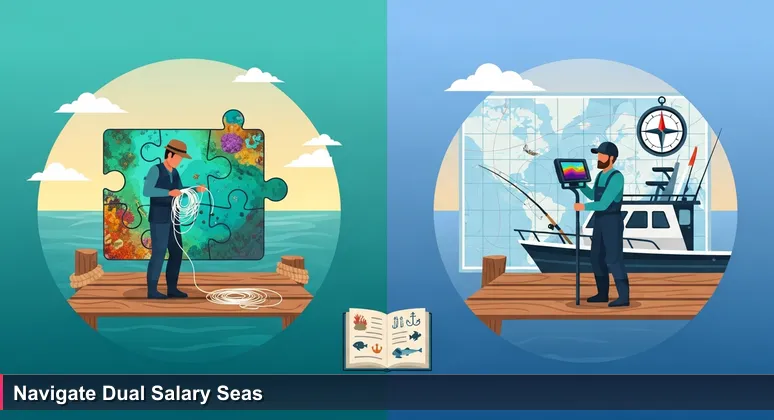
Two fishermen stand on the same Pohnpei dock at dawn, preparing for vastly different voyages in the same ocean. This image captures the essential choice for an AI professional in our islands today: do you cast your line in the familiar, local waters or set a course for the deep, global market? Your skills are the vessel, and your compensation depends entirely on which economic sea you choose to sail.
The local market, anchored by public-sector budgets and community-focused projects, offers stability and direct impact. The global market, accessed through remote work with international firms, offers financial premiums that can transform your economic future. This isn't about leaving home; it's about leveraging your location as a strategic base of operations in a world where AI skills are among the hardest to find.
As the World Economic Forum notes, AI is creating new categories of work and redesigning how value is created globally. For Micronesians, this means unprecedented access to over 1.3 million global "new collar" AI job listings without having to uproot from our close-knit island communities. The journey begins by understanding the two distinct maps laid before you.
In This Guide
- Set Sail on Your AI Career in Micronesia
- The Dual Market: Local Scale vs. Global Premium
- AI Salary Benchmarks for 2026
- Employer Tiers and Compensation in Micronesia
- How Micronesia Stacks Up Regionally
- Maximizing Your Take-Home Pay
- Mastering Salary Negotiations in Micronesia
- Charting Your AI Career Path in 2026
- Frequently Asked Questions
This guide to AI careers in the Federated States of Micronesia covers everything from skills to funding.
The Dual Market: Local Scale vs. Global Premium
The most critical rule to internalize is that your title matters less than who signs your paycheck. An "AI/ML Engineer" can mean two fundamentally different professions here, separated by an ocean of capital and compensation philosophy.
In our local market, your advanced skills are often categorized within broader government frameworks. A public posting for an Information Technology System Specialist at a national department, for example, aligns with standardized PL pay scales, typically offering between $23,500 and $30,000 annually. This is the economic reality of public-sector work, where community impact and stability are the primary value propositions.
Contrast this with the global premium accessible from your home in Kolonia or Weno. International organizations with a regional presence, like the Asian Development Bank, operate on a different financial planet. Their 2026 international staff salary structure shows technical specialists can earn from $114,500 to over $200,400. This represents a 5x to 8x multiplier for similar technical expertise, funded by international capital rather than national budgets.
The practical implication is clear: the highest-paying AI job in Micronesia is not located here physically. It is a remote role, where your location becomes a neutral factor and your skill is the product. This dual market isn't a limitation but a map, showing you precisely where to deploy your talent for maximum return.
AI Salary Benchmarks for 2026
To navigate effectively, you need precise charts. The following table synthesizes 2026 benchmarks, showing the dramatic divergence between local public-sector scales, regional multinational roles, and the global remote market for key AI specializations.
| Role & Experience | Local Market / Gov't (FSM) | Regional Multinational | Global Remote / Int'l Org |
|---|---|---|---|
| AI/ML Engineer (Mid-Level) | $45,000 - $75,000 | $65,000 - $95,000 | $140,000 - $210,000 |
| Data Scientist (Senior) | $70,000 - $100,000 | $85,000 - $115,000 | $180,000 - $280,000 |
| MLOps Engineer (Junior) | $28,000 - $42,000 | $48,000 - $70,000 | $100,000 - $150,000 |
These figures illustrate a core truth: specialization commands a premium everywhere, but the multiplier is staggering when you access global capital. Experts from KORE1's 2026 salary guide emphasize that companies are paying for engineers who can build production-ready systems, not just theoretical knowledge, which drives these high global bands.
Consider a practical example: an MLOps Engineer from Chuuk with five years' experience might earn $52,000 with a state enterprise. By securing a remote position with a U.S.-based AI startup, they could target over $180,000 - a life-changing increase while continuing to live and contribute to their home island. This isn't a hypothetical gap; it's the operational reality of the dual market.
Employer Tiers and Compensation in Micronesia
Your potential earnings are dictated by the tier of employer you work for. Understanding these four distinct categories is essential for setting realistic expectations and negotiating effectively.
Tier 1: National/State Government & Public Enterprises
This includes the FSM National Government, state governments, and entities like the FSM Telecommunications Corporation. Compensation is fixed to standardized government pay scales (PL-36, PL-38). The value proposition here is unparalleled stability and direct community impact, not financial upside, with technical salaries typically capping below $75,000.
Tier 2: Regional Multinationals & Development Orgs
Organizations like the Asian Development Bank or USAID offer both "Local Staff" and "International Staff" contracts. The ADB Field Office Local Staff salary structure shows a range from $22,400 to $146,500. Securing an "International Staff" contract is the highest-paying localized path, often including relocation allowances and potential tax advantages under Host Country Agreements.
Tier 3: Local Startups, NGOs & Consulting Firms
These are resource-constrained but mission-driven. Mid-level technical roles at local NGOs, for instance, typically pay between $18,000 and $38,000. The value comes from hands-on leadership experience and shaping our nascent tech ecosystem. View compensation here as a stipend for building an impactful portfolio.
Tier 4: Remote-First Global Companies
This is your vessel to global capital. Working for a U.S. or Singapore-based tech firm from Pohnpei aligns your pay with international benchmarks. As highlighted in global guides, these roles often include performance bonuses and stock options. A critical note for Micronesia: equity in distant startups is often illiquid here; prioritize a strong base salary unless you deeply understand and believe in the company's potential.
How Micronesia Stacks Up Regionally
To negotiate effectively, you must understand where your local offer stands on the broader Pacific map. The compensation for a Mid-Level AI Engineer varies dramatically based on the economic waters of each hub.
| Location | Mid-Level AI Total Comp (USD) | Key Market Notes for Micronesians |
|---|---|---|
| Micronesia (Local Market) | $35,000 - $55,000 | Public-sector dominated; very low cost of living. |
| Manila, Philippines | $40,000 - $75,000 | Major BPO and remote tech hub; competitive for regional roles. |
| Guam (US Pacific) | $65,000 - $110,000 | US federal and military rates apply; higher cost of living. |
| Honolulu, Hawaii | $110,000 - $165,000 | US domestic market with very high cost of living. |
| Singapore | $95,000 - $180,000 | Top-tier global hub with massive equity upside. |
This comparison reveals strategic insights. An offer of $50,000 from a regional organization for a remote role based in Pohnpei is competitive when adjusted for our cost of living, especially compared to Guam's market. However, a $90,000 offer from a U.S. company is a below-market global rate that warrants negotiation.
The data shows that while our local public-sector salaries are lower, our favorable cost of living and tax environment create a powerful advantage. When targeting remote roles, your benchmark should shift toward hubs like Singapore or Honolulu, not our immediate neighborhood. This regional context is your compass for evaluating true opportunity.
Maximizing Your Take-Home Pay
Your gross salary is only half the story. In Micronesia, your net income is powerfully shaped by our nation's favorable tax environment and specific exemptions that can significantly boost take-home pay, especially for those accessing the global premium.
The FSM operates a simple, relatively low income tax structure. The first $11,000 of taxable income is taxed at 6%, with earnings above that taxed at 10%. There are no state-level income taxes. Both employer and employee also contribute 7.5% of taxable wages to social security, for a total contribution of 15%, as outlined by the FSM Social Security Administration.
A critical financial advantage exists for professionals working with certain international organizations. Employees of entities like the UN or the Asian Development Bank on international contracts may be exempt from local income taxes under Host Country Agreements. This exemption can increase take-home pay by 10-15% compared to a grossly similar salary from a local employer.
Consider this practical calculation: A $70,000 salary from a local employer might result in take-home pay of approximately $58,000 after FSM tax and social security. The same $70,000 salary from an international organization with a tax exemption could yield a take-home pay of over $64,000. This stark difference underscores why the tier of your employer is as important as the salary number itself when planning your financial future from our islands.
Mastering Salary Negotiations in Micronesia
Negotiating your AI salary in Micronesia isn't a one-size-fits-all process; it's a tailored strategy that depends entirely on which employer tier you're engaging with. Your leverage and the negotiable terms shift dramatically between the structured public sector and the fluid global market.
When dealing with Local Government or Public Enterprises, the base salary is typically fixed to the PL scale. Your focus should be on step increments, qualification allowances, or professional development funds. A practical script could be: "Given my certification in machine learning, could this role be classified at the PL-38 step 3 instead of step 1?" Since higher base pay is often off the table, negotiate for concrete benefits like training budgets or clearer promotion pathways.
For Regional Multinationals like ADB or USAID, the most critical distinction is your contract classification. Always clarify whether a position is on the local staff or international staff salary scale. You can reference public documents, stating: "My understanding is that an Applied Scientist role at the IS-4 level has a range of $X to $Y," using the ADB international staff salary structure as your benchmark. If the base is fixed, negotiate for additional allowances like education grants or housing support.
With Remote-First Global Companies, your strategy aligns with global tech norms: focus on base salary first, then equity. For early-stage startups, equity is a high-risk, high-reward component. However, as experts note, in Micronesia where liquidity events are rare, it's wise to prioritize a strong base salary unless you deeply understand the equity terms. Frame your island location as a strategic advantage: "Working from Pohnpei provides deep focus periods aligned with U.S. time zones and exceptional stability." This turns your remote setting into a value proposition, not a compromise.
Charting Your AI Career Path in 2026
Your career map in 2026 presents two clear navigation routes, each requiring different preparations and offering distinct rewards. The choice isn't permanent, but your starting direction shapes your initial voyage.
Path A: The Local Anchor
This route focuses on stability and direct community impact within our islands. Target roles include IT Specialist, Data Analyst, or Project Manager within the FSM National Government, state entities, or development banks. Progression means climbing the established PL scale and seeking positions funded by Compact sector grants or climate adaptation projects, which may have enhanced budgets for technical expertise. Programs like the AI Essentials for Work bootcamp are ideal here, providing the practical AI skills to modernize government services, fisheries data, or tourism operations from within.
Path B: The Remote Vessel
This is your course to global capital. Target roles are AI/ML Engineer, MLOps Specialist, or NLP Engineer for companies based in the U.S., Australia, or Singapore. Progression often involves strategic job changes every few years to maximize salary growth. Building a public portfolio on GitHub is crucial. For this path, intensive training like the 25-week Solo AI Tech Entrepreneur Bootcamp is key, teaching you to build production-ready AI systems and products that meet global market demand, all from your home island.
The final verdict remains: the highest-paying AI job in Micronesia is accessed remotely from your home in Kolonia, Weno, or Colonia. Your unique advantage is the ability to build a world-class career while contributing to your island community, leveraging our favorable tax environment and stable USD economy. Whether you choose to anchor locally or sail a remote vessel, navigate with the understanding that your skills are globally valuable. Price them accordingly, and use your earnings to build bridges between these two economic waters. The ocean is vast, and your vessel is ready.
Frequently Asked Questions
What are the expected AI salary ranges in Micronesia for 2026, and how do they vary by role?
Salaries in Micronesia split into local and remote markets: for example, a junior AI/ML engineer might earn $25,000-$40,000 locally but $90,000-$135,000 remotely, while MLOps roles command premiums, with seniors targeting over $200,000 globally. The key is whether you're anchored in public-sector scales or sailing in international waters, leveraging roles like Data Scientist or AI Engineer as detailed in the article's tables.
How much more can I earn by working remotely for an AI job compared to a local position in Micronesia?
Remote roles often pay significantly more; for instance, a senior MLOps engineer from Chuuk could see a 246% increase from $52,000 locally to $180,000 remotely. This gap highlights the global premium accessible from Micronesia's remote-work-friendly ecosystem, where your location becomes neutral and skills drive compensation.
What are the best-paying employers for AI professionals in Micronesia, like government or international agencies?
International organizations like the Asian Development Bank offer the highest local pay, with salaries up to $200,400 for technical roles, while remote-first global companies can exceed $350,000. In contrast, FSM government jobs cap around $75,000, so targeting Tier 2 or Tier 4 employers maximizes earnings, especially with tax exemptions for some international contracts.
How does experience level impact AI salaries in Micronesia, and is it worth gaining more years?
Experience boosts salaries substantially: mid-level AI engineers in Micronesia can earn $45,000-$75,000 locally or $140,000-$210,000 remotely, with senior roles reaching over $350,000 globally. Investing in skills pays off, especially in remote roles where job-hopping every 2-3 years aligns with global benchmarks for faster growth.
Are there any unique advantages for AI workers in Micronesia, such as tax benefits or community support?
Yes, Micronesia offers a low tax environment with rates up to 10% and possible exemptions for international workers, increasing take-home pay - e.g., a $70,000 salary might net over $64,000. Plus, the close-knit communities in Pohnpei or Chuuk provide stability, while Compact funding and regional development programs foster a growing tech ecosystem for local impact.
For a comprehensive list of no-cost tech education in Micronesia, see this resource.
In 2026, paying for tech training in Micronesia has new opportunities.
Find out where to get the best AI engineering jobs in Micronesia for career growth in the region.
Explore tech careers in Micronesia without a college degree and learn how to leverage local opportunities.
Access valuable resources with the women in tech groups across Pohnpei, Chuuk, Yap, and Kosrae for 2026.

Irene Holden
Operations Manager
Former Microsoft Education and Learning Futures Group team member, Irene now oversees instructors at Nucamp while writing about everything tech - from careers to coding bootcamps.