









Top 10 Tech Apprenticeships, Internships and Entry-Level Jobs in Japan in 2026
By Irene Holden
Last Updated: April 6th 2026
Too Long; Didn't Read
If you want the fastest, most reliable routes into Japan’s tech scene in 2026, prioritize Nucamp’s AI and coding bootcamps as the best launchpad for career changers and the Google Japan Apprenticeship as the highest-value corporate bridge because Nucamp combines affordable, Japan-focused training and career services with strong placement while Google offers structured on-the-job experience with clear conversion potential. Nucamp reports about a 78 percent employment rate and tuition from roughly ¥297,000 to ¥557,000, and Google’s apprenticeships run 12 to 24 months with monthly pay commonly between ¥220,000 and ¥500,000 and frequent conversions into full-time roles that pay five to eight million yen or more, with Microsoft Leap, Mercari BUILD, Woven by Toyota, HENNGE, Rakuten TECH Camp, NTT DATA, CyberAgent and Fujitsu as other excellent options depending on your JLPT level and risk tolerance.
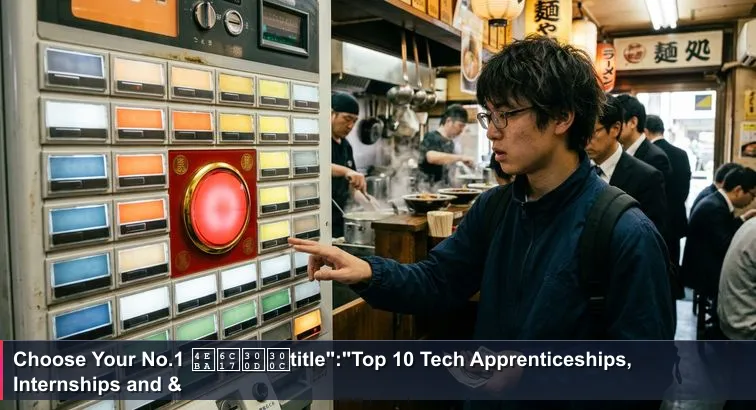
You’re standing in front of a ramen ticket machine in Shibuya, coins sweating in your palm. Steam crowds the tiny shop, bowls clatter in the background, and a salaryman shifts his weight impatiently behind you. Forty buttons glow: a few shout “No.1 人気” and “店長おすすめ,” the rest sit quietly, no stickers, no reassurance. You know that what’s “No.1” for the office worker behind you might not be right for you - but the pressure to just hit the shiny button is real.
Japan’s tech scene in Tokyo, Osaka, and Fukuoka feels exactly like that machine. Between global apprenticeships at Google and Microsoft, mobility internships at Woven by Toyota, SaaS-focused programs at HENNGE, and structured graduate tracks at NTT DATA or Fujitsu, there are dozens of glowing options, each promising to be the safest or fastest path into AI and software. Career changers scroll “Top 10” lists the same way hungry students scan the top row of the ticket machine, hoping someone else’s ranking will save them from choosing wrong.
Under the steam and noise, though, the market has shifted. The AI divide is now explicit: juniors are expected to produce AI-assisted output that used to require mid-level engineers. Analysts and creators like Kei Fujikawa talk openly about a trimodal pay structure: ~¥3-4M at traditional domestic firms, ~¥5-7M at global players, and ¥8M+ at top startups and finance for those who wield AI tools effectively, a pattern echoed in this grounded guide to breaking into Japan’s tech industry.
To navigate that reality, this article focuses on three main entry routes into Japan’s AI and software ecosystem centered around hubs like Shibuya, Otemachi, Umeda, and Tenjin:
- Apprenticeships: earn-while-learning for 3-24 months with close mentorship and a safer ramp-up.
- Internships: 4 weeks-3 months, crucial signal for students and early-career talent.
- Entry-level jobs (shinsotsu and mid-career junior): full salary and benefits, with productivity expectations from day one.
This Top 10 is a menu, not a podium. Programs sit in different “broths” - gaishikei giants, domestic jisha-kaihatsu, AI startups, government-backed routes - with toppings like mentorship intensity, language requirements, and pay. Your personal “No.1 人気” depends on factors such as JLPT level, background (student, ALT, working professional), risk tolerance, and willingness to invest in reskilling through options like Nucamp and METI- or Hello Work-supported training. By the end, the goal isn’t to crown a universal winner, but to help you press the button that fits who you are right now.
Table of Contents
- Introduction
- Nucamp
- Google Japan Apprenticeship
- Microsoft Leap Apprenticeship
- Mercari BUILD
- Woven by Toyota
- HENNGE Global Internship Program
- Rakuten TECH Camp
- NTT DATA Global Graduate Program
- CyberAgent Engineering Bootcamp
- Fujitsu Graduate Program
- Choosing Your Best Path
- Frequently Asked Questions
Read our Complete Guide to Starting an AI Career in Japan to plan your 2026 job search.
Nucamp
On a Tokyo salary, the difference between a ¥300,000 bowl and a ¥1,400,000 bowl is enormous - and that’s roughly the gap between Nucamp and many traditional coding bootcamps in Japan. Nucamp positions itself as a low-cost, structured launchpad into AI and software roles, with tuition starting around ¥297,000 and topping out near ¥557,000, versus the ¥1,400,000+ price tags often reported for in-person schools in Tokyo. For ALTs in Saitama, office workers in Osaka, or freelancers in Fukuoka, its part-time, online model means you can upskill without quitting your job or moving to Shibuya.
Programs & Pricing at a Glance
| Program | Duration | Approx. Tuition | Main Focus |
|---|---|---|---|
| Solo AI Tech Entrepreneur | 25 weeks | ¥557,000 | AI products, LLMs, AI agents, SaaS |
| AI Essentials for Work | 15 weeks | ¥501,000 | Prompt engineering, AI productivity |
| Back End, SQL & DevOps with Python | 16 weeks | ¥297,000 | Python, SQL, cloud & DevOps basics |
Outcomes, Community, and Signal
For a sub-¥600k investment, Nucamp reports an employment rate around 78%, a graduation rate near 75%, and a Trustpilot score of 4.5/5 from roughly 398 reviews, about 80% of them five-star. That combination of affordability and outcomes compares favourably with many Japan-based schools described in Japan Dev’s breakdown of coding bootcamps, where students often face higher tuition and similar entry-level starting salaries.
Why It Works in Tokyo, Osaka, and Fukuoka
Nucamp’s community model - local meetups in Tokyo, Osaka, Nagoya, and Fukuoka plus online support - matters in a market where networking and referrals are crucial for landing junior roles at Rakuten, SoftBank, CyberAgent, or English-friendly startups. The curriculum deliberately pushes you to build deployable portfolio pieces (e.g., a small marketplace, a Japanese-language dashboard, or a LINE-style chat app) and pair them with certifications like AWS Cloud Practitioner, aligning with advice from Japan-focused engineers who stress broad full-stack and cloud knowledge for breaking into the market.
Crucially, acceptance into Nucamp is relatively open: the real filter is who finishes with 3-5 Japan-relevant projects and the confidence to aim for positions on sites like Japan Dev’s junior job board. For many career changers, that combination of low tuition, AI-focused content, and structured career support turns Nucamp into a practical first “bowl” before reaching for elite apprenticeships or shinsotsu schemes.
Google Japan Apprenticeship
Among the glowing “No.1 人気” buttons, the Google Japan Apprenticeship is one of the brightest. It’s a 12-24 month earn-while-you-learn program based mainly in Tokyo, blending structured training with real project work in tracks like Software Engineering, Data Analytics, and UX Design. Recent announcements on Google’s apprenticeship channels on LinkedIn highlight that apprentices join real product teams and receive dedicated mentors, rather than being parked in a classroom for a year.
Compensation, Structure, and Timing
The apprenticeship is paid, with monthly compensation typically estimated around ¥220,000-¥500,000 depending on track and background. For many students in Tokyo or Kansai, that’s enough to cover living costs while building a top-tier brand on your CV. The structure usually combines several weeks of intensive instruction with on-the-job rotations under senior engineers or analysts, plus career workshops and community events.
Applications for the Japan intake have historically closed around September for the following year’s start. That aligns awkwardly - but powerfully - with Japan’s shinsotsu cycle: if you plan ahead, you can use the apprenticeship as either a bridge into Google or as a launchpad into other gaishikei and AI-focused firms in Marunouchi, Shibuya, or Shinagawa.
Who Thrives - and How to Stand Out
Google targets candidates with a Bachelor’s degree (any major for non-engineering tracks, CS or related for software) and <1 year of relevant experience. In practice, that often means:
- CS or information science students at Japanese universities
- Self-taught or bootcamp grads with strong portfolios
- Career changers who can already ship basic apps or analyses
Offer rates are widely believed to be in the single digits. To compete, you’ll want 2-3 polished GitHub projects using cloud (preferably GCP but AWS is fine), readable tests, and documentation; a data notebook analyzing Japanese datasets if you’re data-track; or bilingual UX case studies for design. Apply by late summer, rehearse behavioral questions and simple system design, and use university career centers or alumni networks to secure referrals into this high-impact Tokyo apprenticeship.
Microsoft Leap Apprenticeship
Where Google’s apprenticeship feels like a long, structured course, Microsoft’s Leap program lands more like an intense mini-bootcamp bolted directly onto a real job. The Japan cohort of Microsoft Leap runs for 16 weeks, combining roughly 4 weeks of focused instruction with 12 weeks embedded in product teams such as Azure or Xbox. Globally, Leap is explicitly positioned as a pathway for “untapped talent” - bootcamp grads, self-taught developers, and career changers - similar in spirit to programs highlighted by initiatives like the IBM Apprenticeship Program, but adapted to Microsoft’s stack and culture.
Compensation for the Japan cohort is estimated around ¥1,500,000 total for the 16 weeks, roughly ¥90,000-¥100,000 per week equivalent. That makes it financially viable for people already living around Tokyo, Kanagawa, or Chiba who can pause or downshift other work during the program. Applications typically open 3-4 months before each intake, and there are often about three cohorts per year, so timing your portfolio and JLPT study around these windows is critical.
Leap is selective, with community reports pointing to low double-digit acceptance at best. Ideal candidates usually have:
- 6-12 months of consistent coding (bootcamp, self-study, or personal projects)
- One primary language solidly under control (often Python, C#, or TypeScript)
- Basic familiarity with cloud, Git, and unit testing
In practical terms, you want at least one “production-style” app deployed to Azure with CI/CD, logs, and a README that explains trade-offs clearly. Interviews emphasize clean, maintainable code and collaboration more than “LeetCode hard,” echoing broader advice from Japan-focused engineers who note that Tier 2 gaishikei and enterprise teams care deeply about teamwork and long-term maintainability.
For Tokyo-based career changers - say, an ALT in Suginami who has completed Nucamp’s Back End/SQL track or a self-taught dev in Osaka with several GitHub repos - Leap can be the bridge from “I can code” to “I’ve shipped features inside a global-scale product,” opening doors not just at Microsoft Japan but also at partner consultancies and Azure-heavy corporate IT teams.
Mercari BUILD
Compared to the giant, glossy “No.1 人気” buttons of Google or Microsoft, Mercari’s BUILD program is more like the chef’s special scribbled on the corner of the menu: easy to miss, but incredibly targeted. BUILD is a hybrid of short-term training and internship designed for non-CS students and underrepresented groups who already have basic coding skills but lack a traditional pedigree. You join a 2-week intensive training bootcamp covering web development, Git, Python or Go, and Docker, then move into a 2-3 month paid internship on real Mercari teams in Tokyo.
The financial structure reflects that split. Training is typically unpaid, but the internship pays roughly ¥5,000-¥30,000 per day. Some Winter 2025 participants reported total compensation around ¥800,000 per month, a level that makes it competitive even against global programs. A popular breakdown in the YouTube video “How I got selected in Build@Mercari” describes intensive 1:1 support from Mercari engineers and meaningful project ownership despite the short duration.
BUILD is tailored for:
- Non-CS undergrads or recent grads studying in Japan
- Adults with under three years of experience who have already learned basic web development
- Candidates aiming for modern, product-focused roles in Mercari-style marketplaces rather than pure SIer work
Applications usually open around December-January for spring or summer cohorts, with acceptance rates likely in the low-to-mid double digits for strong applicants. To stand out, you should arrive with a small but polished “mini-Mercari”: a marketplace clone where users can list items, search, log in, and perhaps upload photos, built in Python or Go with a modern frontend and deployed to the cloud.
What Mercari looks for isn’t perfection but curiosity, collaboration, and evidence that you can learn quickly inside a codebase. A clear README in English (and simple Japanese, if possible), clean Git history, and thoughtful commit messages can speak as loudly as your tech stack. For many students in Tokyo or Kansai, BUILD becomes a realistic, well-supported stepping stone into full-time engineering in Japan’s jisha-kaihatsu product ecosystem.
Woven by Toyota
If Google and Microsoft are the flashy “No.1 人気” buttons, Woven by Toyota’s internship is the rare seasonal限定 bowl: limited seats, rich ingredients, and people lining up around the block. Based in Tokyo and run by Woven by Toyota and Toyota Connected, the software-focused internship drops you into projects around automated driving, mobility platforms, and the experimental Woven City.
Fully Funded, Deeply Technical
The program typically runs for about 3 months, and for many candidates it is effectively fully funded: round-trip airfare, 3 months of free accommodation in the Tokyo area, a competitive hourly wage, and a commuter pass. An official announcement shared via an Instagram reel about the Woven Global Internship highlights two cohorts (June and August), early deadlines, and the expectation that strong interns may receive full-time offers before graduation.
Technical expectations are clear: you’re expected to be comfortable in at least one of Python, C++, Go, or Rust, and to care about robotics, embedded systems, mapping, or large-scale backend services. For overseas applicants, you generally need to be enrolled in a Master’s or PhD and already hold a Bachelor’s degree; undergrads studying in Japan can often apply directly. English is usually sufficient for technical roles, which makes this a rare top-tier option for non-Japanese speakers.
Who Gets In - and How
This is Olympic-level competitive. Successful candidates often show:
- A robotics or autonomous-driving style project (e.g., path planning in a simulated city, ROS-based control, or perception pipelines using ML)
- Evidence of strong math/ML fundamentals, such as research projects or serious Kaggle work with time-series or sensor data
- Clean, well-documented C++ or Python codebases rather than just coursework
For students in Tokyo, Osaka, or abroad who are serious about mobility and AI, Woven’s internship isn’t just a line on the CV; it’s immersion in Japan’s most ambitious software-meets-hardware lab, with a direct bridge into high-impact roles at Toyota’s evolving tech ecosystem.
HENNGE Global Internship Program
Walk uphill from Shibuya Station at lunch and you’ll pass HENNGE’s offices tucked among other SaaS and ad-tech players. Inside, the HENNGE Global Internship Program (GIP) runs like a concentrated taste of Tokyo startup life: 4-6 weeks in a small, fast-moving team, building real features in either a Front-End (TypeScript/React) or Full-Stack (Python/Go/AWS) track. The official GIP description emphasizes that no Japanese is required, and that the program is designed as a deliberate pipeline into full-time engineering roles at HENNGE.
Unlike some research-style internships, GIP is hands-on from week one. You’re expected to commit full-time in Shibuya, work alongside experienced engineers, and ship production-quality code. The internship is paid, with commuter support and, for some cohorts, help with accommodation - enough to make a short stay in central Tokyo realistic for students coming from Kansai, Kyushu, or overseas. According to the GIP information page, multiple intakes run through the year, but summer cohorts usually require applications by around February-April.
The program works best for three groups:
- International students in Japan who want their first Shibuya-based SaaS experience
- Candidates abroad who can relocate short-term and are comfortable working in English
- Career changers who already know web basics and want to prove they can operate in a modern cloud stack
Selection starts with an online coding challenge and technical screening that quietly eliminates many applicants. To clear that gate, you’ll want 1-2 portfolio projects that mirror HENNGE’s world: a small React app with robust authentication, or a backend in Go or Python deploying to AWS with tests and logging. Writing a brief design or postmortem article on Qiita or a personal blog about topics like SSO, OAuth, or multi-tenant SaaS can also signal that you understand HENNGE’s domain beyond the code.
For those aiming at English-friendly roles in Tokyo’s startup ecosystem, a successful run through GIP is a strong signal: “I can ship, I can collaborate, and I can handle production-grade TypeScript, Go, and AWS in a Shibuya office,” which Japanese employers increasingly treat as proof you can contribute from day one.
Rakuten TECH Camp
Step away from Shibuya’s startups and into Rakuten’s crimson HQ in Tokyo, and you’ll find a very different kind of bowl: Rakuten TECH Camp, a structured trainee program that drops students into the heart of a massive e-commerce platform. According to the official TECH Camp description on Rakuten’s graduate careers site, participants work on full-stack projects tied to real Rakuten services, learning how large-scale systems are built and maintained.
The numbers are straightforward but attractive: pay is around ¥2,000 per hour, which works out to roughly ¥320,000 per month at full-time hours. The program typically runs 1-3 months between July and October, and applications usually close in early summer (around May-June). That timing makes it perfect for students at universities in Kanto or Kansai who want a serious tech experience that still fits the Japanese academic calendar.
TECH Camp is best suited for:
- Bachelor’s, Master’s, or PhD students enrolled in Japan
- Candidates with intermediate web development skills
- Those with JLPT N1 or close, since much day-to-day communication and documentation is in Japanese
Inside the program, you can expect stacks like PHP/Laravel, Vue.js, and cloud services, all framed around Rakuten’s e-commerce domain. That means dealing with product catalogs, payments, search, and performance issues at a scale few student projects can simulate. For many, TECH Camp functions as a de facto long interview; strong performers are often fast-tracked into new graduate hiring for the following April intake.
To improve your odds, build an e-commerce prototype before applying: catalog, cart, checkout flow, basic admin screens, and at least minimal performance considerations (indexes, caching). Document it clearly in Japanese, practice explaining trade-offs, and be ready to talk about how you use tools like GitHub Copilot or ChatGPT to work faster while keeping code quality high - an increasingly important signal even at traditional jisha-kaihatsu giants like Rakuten.
NTT DATA Global Graduate Program
For many readers aiming at stability plus international exposure, the NTT DATA Global Graduate Program is less a flashy “limited edition” bowl and more the reliable house special. It’s a structured entry-level route into IT consulting and systems engineering, with starting salaries around ¥4,000,000-¥7,000,000 depending on role and location. According to the program overview on NTT DATA’s graduate recruitment page, new hires spend roughly 20% of their time in deep-dive training, then rotate into long-term client projects across industries.
Unlike narrow “code-only” schemes, this track targets generalists: Bachelor’s or Master’s graduates from any major, typically with less than three years’ work experience. Many participants move into roles involving SAP, large-scale system integration, and cloud migration for enterprise and public-sector clients. For candidates in Tokyo, Osaka, Nagoya, or Fukuoka, that means direct access to transformation projects at banks, manufacturers, and government agencies rather than just startup-style products.
The program operates as permanent employment from day one, not a short internship. Applications for the 2026 intake closed around June of the previous year; the 2027 cycle is expected to open around March, mirroring Japan’s shinsotsu rhythm. For international candidates, it’s one of the more visa-friendly large employers, especially if you already hold a relevant degree and some Japanese ability (N2 or better is a practical target for consulting-facing roles).
To become competitive, think like a client-focused generalist rather than a pure hacker:
- Build at least one “business app” project: an internal dashboard, reporting tool, or simple workflow system with clear requirements and documentation.
- Cover the full stack: a basic frontend, backend API, relational database, and one major cloud provider.
- Add certifications such as AWS Cloud Practitioner or entry-level Java credentials to signal readiness for enterprise environments.
NTT DATA recruiters consistently emphasize communication, teamwork, and an interest in digital transformation. If you can show you understand both code and business value, this graduate program becomes a powerful, relatively low-risk way to enter Japan’s enterprise AI and DX ecosystem.
CyberAgent Engineering Bootcamp
In Shibuya’s scramble between ad agencies, game studios, and streaming platforms, CyberAgent’s Engineering Bootcamp is the bowl for people who want to be thrown straight into the deep fryer. You’re not an intern or apprentice here: you’re hired as a full-time junior engineer, then pushed through an intensive internal bootcamp where you work on high-traffic systems that power advertising, games, and media services used across Japan.
Compensation reflects that expectation. Junior engineers typically start around ¥350,000-¥450,000 per month in a permanent role, putting you above many traditional shinsotsu tracks from day one. Recruitment is officially year-round, but many offers line up with the common April and October entry cycles. The bootcamp-style onboarding then compresses what might be a year of slow ramp-up into a focused period where you learn CyberAgent’s stacks - often Go or Node.js on the backend and TypeScript on the frontend, with real production traffic as your teacher.
This path fits a specific profile: strong juniors with concrete projects who want to live in the intersection of ad-tech, games, and media. Day-to-day life is fast-paced and Shibuya-centric, with teams mixing Japanese and English, standups moving quickly, and deployment pipelines constantly humming. For career changers, the emphasis on “potential plus portfolio” over formal pedigree echoes advice in resources like the Jump To IT guide on transferable skills, which highlights how non-traditional backgrounds can convert into engineering careers when backed by real code.
To earn a spot, you’ll want to demonstrate that you care about performance and scale, not just CRUD:
- Build a real-time analytics or ad-dashboard clone in Go or Node.js with a TypeScript frontend, deployed to a cloud service.
- Implement caching, pagination, and asynchronous processing; show you’ve thought about throughput and latency.
- Practice whiteboard and pair-programming interviews so you can communicate clearly under pressure.
- Show up at Go, React, or game-dev meetups around Shibuya via platforms like connpass; CyberAgent engineers frequently speak and scout there.
For those who want to skip the long apprenticeship phase and dive straight into Japan’s high-traffic internet infrastructure, the CyberAgent Engineering Bootcamp is one of the most direct - and demanding - routes available.
Fujitsu Graduate Program
Not every path into Japan’s AI and DX world involves flashy startups or gaishikei giants. The Fujitsu Graduate Program is a classic domestic option: a 12-month structured route into roles across sustainable manufacturing, AI, security, and enterprise IT, followed by permanent placement in a specific business unit. Fujitsu’s own reporting describes a blend of on-the-job learning with about 47 hours per year of formal education, signalling a long-term investment in training rather than a short internship-style trial.
Entry-level salaries sit around ¥3,000,000-¥4,000,000 annually, squarely in the traditional domestic band. Intakes usually start in April or October, with recruitment running year-round but peaking from March to June for the following April, in line with Japan’s shinsotsu calendar. Unlike some highly brand-conscious employers, Fujitsu is comparatively flexible on university pedigree and places more weight on attitude, communication, and willingness to grow.
This track suits three main profiles:
- New graduates who prioritize stability, benefits, and a clear corporate ladder
- Early-career professionals pivoting into IT from adjacent roles
- Candidates outside Tokyo’s top universities who want a major-name employer
To raise your odds, angle your portfolio toward digital transformation. Fujitsu’s core business is modernizing legacy systems for government and enterprise clients, so build at least one project that replaces an Excel- or email-based workflow with a small web app or dashboard. Document requirements, business impact, and how you would roll it out across a conservative organization.
You can strengthen this with public training support: METI-backed digital initiatives and Hello Work’s IT courses can cover up to 70% of approved bootcamp tuition and, for unemployed learners, sometimes provide around ¥100,000 per month in living support, as highlighted in explanations of the METI AI & Tech Talent programs. Pair that with JLPT N2+, evidence of teamwork, and openness to rotations across Japan, and the Fujitsu Graduate Program becomes a pragmatic entry into large-scale, AI-adjacent work.
Choosing Your Best Path
Standing at that ramen machine, you eventually stop asking “What’s No.1?” and start asking “What do I need today?” Choosing between apprenticeships, internships, and entry-level roles in Japan’s AI ecosystem works the same way: the right bowl depends on your hunger, budget, and timing, not someone else’s ranking.
A practical way to filter the menu is by where you are now:
- Apprenticeships (Google, Microsoft Leap, Mercari BUILD, Rakuten): best if you have skills but no track record. Expect 3-24 months of paid learning plus real work, with highly competitive selection.
- Internships (Woven, HENNGE, Sony, METI schemes): ideal if you’re a student or in structured study; usually 4 weeks-3 months and powerful signals for later shinsotsu or mid-career roles.
- Entry-level jobs (NTT DATA, CyberAgent, Fujitsu, SoftBank): full salary from day one, but you’re expected to ship quickly, often with AI-assisted productivity as baseline.
Whatever you choose, back-plan at least a year. Most summer internships and elite apprenticeships close applications 3-6 months before start; major shinsotsu hiring peaks March-June for the following April. Create a 12-month calendar with your target programs and work backwards from their deadlines.
- Months 1-3 - Foundations: Pick a main track (web, data/ML, or AI productivity), one language (Python or TypeScript), Git, and databases. A structured bootcamp helps you avoid “tutorial hell.”
- Months 3-6 - Portfolio & Cloud: Build 3-4 deployable projects with Japanese context - e.g., a small marketplace, LINE-style chat, or data project on local open data - and deploy to AWS/GCP.
- Months 6-9 - Interviews & Language: Practice clean, readable solutions to common coding problems, and push your Japanese toward JLPT N2 if you’re targeting domestic giants.
Finally, don’t choose alone. Read candid discussions like this Reddit thread on entry-level tech paths in Japan, and cross-check salary expectations with communities such as r/JapanFinance’s Tokyo tech market posts. Use this Top 10 list as a tasting map: pick one stretch option, one stable domestic route, and one startup-style choice, then iterate as you grow.
Frequently Asked Questions
Which apprenticeship, internship, or entry-level job is best for me in Japan in 2026?
It depends on your JLPT level, background and risk tolerance: apprenticeships (3-24 months) suit career changers, internships (4 weeks-3 months) suit students, and shinsotsu/entry roles give immediate salary and benefits. For many Tokyo-area career changers I recommend starting with a structured, low-cost launchpad like Nucamp (tuition ¥297k-¥557k) to build a Japan-relevant portfolio before targeting elite apprenticeships.
Should I focus my job search on Tokyo, Osaka, or Fukuoka?
Prioritise Tokyo for the largest selection and proximity to major employers (Rakuten, Google Japan, SoftBank, RIKEN), but consider Osaka and Fukuoka for lower living costs and growing startup scenes; many candidates start in Tokyo for networking and then consider regional moves. Expect salary tiers to vary - roughly ¥3-4M at traditional domestic firms, ¥5-7M at global players, and ¥8M+ for standout roles in finance/startups.
When should I start preparing and applying for these programs in Japan?
Begin 6-9 months before your target intake: spend months 1-3 on foundations, months 3-6 building 3-4 portfolio projects and cloud deployments, and months 6-9 on interview practice and language prep. Apply Dec-April for summer internships, March-June for shinsotsu (April starts), and be ready 3-6 months ahead for apprenticeship cohorts.
How can I improve my chances for elite apprenticeships like Google, Microsoft Leap, or Woven?
Focus on 2-3 production-quality projects deployed to AWS/GCP, earn a cloud certification (e.g., AWS Cloud Practitioner), and prepare bilingual case studies or Japan-specific data analyses; these programs are very competitive (often single-digit acceptance rates). Also target multiple programs, use university career centres or bootcamp career services for referrals, and time applications according to each intake window.
Are bootcamps like Nucamp worth the investment for getting into Japan's tech jobs?
Yes - Nucamp reports an employment rate around 78% with tuition between ¥297k-¥557k, making it a cost-effective alternative to many Japan bootcamps priced at ¥1.4M+; its part-time schedules, Japan meetups and career coaching help candidates convert skills into offers. Completing 3-5 Japan-relevant projects and pairing the bootcamp with an AWS/GCP cert significantly increases hireability in Tokyo employers.
Before applying, read our analysis of the top AI bootcamps in Japan 2026 to understand selectivity and expected salaries in Tokyo.
Best free tech stations: libraries & community centers across Tokyo, Osaka, Fukuoka (Top 10, 2026)
Campus recruiters are using the best AI startups to watch in Japan 2026 list to target graduates skilled in ML and robotics.
Complete guide: AI salaries in Japan (2026) - net pay, taxes, and employer differences
Comprehensive AI Meetups guide for Networking Events in Japan 2026

Irene Holden
Operations Manager
Former Microsoft Education and Learning Futures Group team member, Irene now oversees instructors at Nucamp while writing about everything tech - from careers to coding bootcamps.