









This Month's Latest Tech News in the US - January 31st 2026 Edition
By Irene Holden
Last Updated: March 4th 2026
Key Takeaways
- Big Four plan $475 billion in AI capex for 2026, forcing a shift to ROI over hype.
- Agentic AI adoption surged 920% year-over-year in January, marking rapid developer uptake into production.
- Coinbase disclosed an insider-bribery breach that may cost Coinbase up to $400 million.
- Federal agencies face post-quantum cryptography migration within a 2026-2030 compliance window.
- On-device small models cut cloud costs by about 70% in enterprise pilots, easing AI operating expenses.
- Venture investors poured $2.8 billion into agentic AI startups in the recent funding cycle.
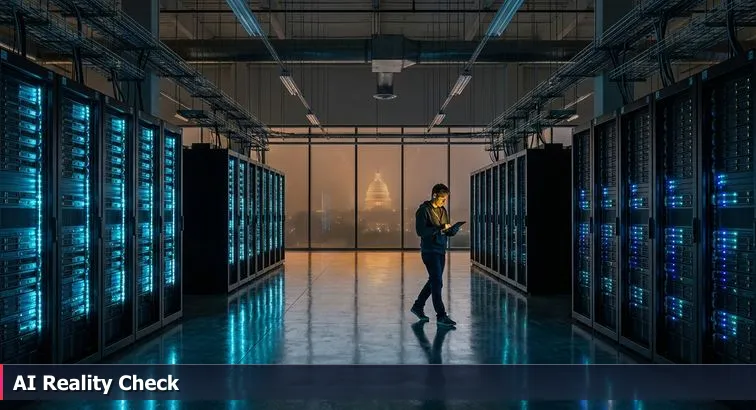
Big Tech entered 2026 with spending plans that looked more like industrial policy than typical IT budgets. The “Big Four” cloud platforms - Microsoft, Amazon, Alphabet, and Meta - were projected to pour around $475 billion into AI-related capital expenditures in 2026, up from roughly $230 billion in 2024, according to analyses of hyperscale build-outs such as StartUs Insights’ 2026 industry trends. Much of that money was earmarked for data centers, custom chips, and high-speed networking.
Markets started asking for receipts
January earnings calls made clear that investors were no longer satisfied with AI as a narrative. Microsoft reported Azure revenue up 39% year-over-year in its latest quarter, but analysts on Wall Street homed in on whether AI demand was finally catching up to supply - easing GPU shortages but threatening margins. Meta, Amazon, and Alphabet leaned heavily on AI assistants, ad formats, and developer tools, yet analysts increasingly questioned how much of that spend was generating incremental profit versus simply defending existing lines of business.
“Big Tech earnings land with 2026’s AI winners still in question.” - Bloomberg News, on January earnings season
From blank checks to unit economics
The tone across coverage, including Bloomberg’s analysis of Big Tech earnings, shifted from celebrating aggressive AI capex to parsing the payback period. Investor Jason Lemkin, reacting to Capital One’s $5.15 billion acquisition of Brex, argued that “half the internet is calling it a failure because the number wasn’t huge… That’s the price of hubristic fundraising,” a remark that resonated with AI observers watching sky-high valuations collide with balance-sheet reality.
What it meant on the ground
For workers, the spending plans still translated into strong demand for cloud and infrastructure talent - data center engineers, AI ops specialists, and high-performance networking roles - but with more emphasis on cost efficiency. For founders, January’s message was darker: startups merely reselling GPU-heavy AI capacity were already competing with hyperscalers whose investment plans ran into the hundreds of billions. The emerging test for 2026 was not who could spend the most on AI, but who could show sustainable unit economics.
| Company | January AI storyline | Investor focus | Practical impact |
|---|---|---|---|
| Microsoft | Azure AI driving 39% YoY growth | AI demand vs. margin pressure | Continued hiring in cloud and AI infra |
| Amazon | AI-infused AWS and ad products | Monetizing AI beyond experiments | Push to tie AI directly to revenue lift |
| Alphabet | AI across search, YouTube, and cloud | Defending core ad business with AI | Focus on efficiency and ad yield |
| Meta | Generative AI for engagement and ads | Return on heavy AI and metaverse capex | Pressure to turn AI usage into profit |
In This Update
- Big Tech's $475B AI reality check
- Shift to on-device AI and small language models
- Coinbase insider breach and the new cyber risk landscape
- Trump tech agenda, Apple reshoring, and AI governance
- Apple CarPlay Ultra and OpenAI’s Safety Evaluations Hub
- Funding, IPO prospects, and market winners in chips and storage
- AI at work: real deployments, UX wins, and the training gap
- Nucamp bootcamps for AI, cybersecurity, and full-stack careers
- What January’s tech shifts mean for workers, founders, and hiring
- Stay competitive in the AI era with Nucamp's practical AI training for professionals.
Shift to on-device AI and small language models
January’s AI headlines were not just about bigger models, but about making them cheaper, faster, and closer to the user. Developer adoption of agentic AI frameworks - systems that can autonomously plan and execute multi-step tasks - was up 920% year-over-year, signaling a shift from simple chatbots to workflow automation that has to justify its cloud bill.
Agentic AI meets cost pressure
As these autonomous systems spread into support desks, finance ops, and logistics, their economics came under scrutiny. Venture firms continued to back the category, with roughly $2.8 billion in funding flowing into agentic AI startups over the recent cycle, according to Crunchbase’s 2026 tech trends review. But enterprises experimenting with always-on AI agents reported that GPU-heavy architectures quickly ran into budget limits, pushing teams toward more efficient models.
Small models and on-device inference
That pressure supercharged interest in Small Language Models (SLMs) and on-device inference. New Qualcomm NPUs delivering around 45 TOPS (trillions of operations per second) enabled surprisingly capable models to run directly on phones and laptops. Early pilots suggested that moving suitable workloads to SLMs on user devices could trim cloud AI spend by roughly 70%, especially for repetitive, latency-sensitive tasks like summarization and classification.
| Approach | Typical latency | Cloud cost impact | Data control |
|---|---|---|---|
| Cloud frontier LLM | Higher, network-dependent | Highest, GPU intensive | Data leaves device |
| Cloud SLM | Moderate | Lower, smaller models | Centralized processing |
| On-device SLM | Low, offline capable | ~70% savings potential | Data stays local |
UX and trust over raw size
Commentators argued that this hardware and model shift put user experience at the center. In a widely cited column, CMSWire’s Eric Karofsky wrote that the next leap “isn’t bigger models - it’s better interactions shaped by tone, trust, and intentional design,” arguing that 2026 would be the year UX rewrote AI’s rules. His piece in CMSWire’s digital experience coverage reflected a growing consensus that reliability and cost control now mattered more than leaderboard scores.
“The next leap isn’t bigger models - it’s better interactions shaped by tone, trust, and intentional design.” - Eric Karofsky, Columnist, CMSWire
Coinbase insider breach and the new cyber risk landscape
Security, not glossy product launches, delivered one of January’s sharpest shocks. Crypto exchange Coinbase disclosed a major insider-driven breach in which employees were allegedly bribed to hand over access to internal tools, forcing the company to warn of up to $400 million in potential compensation costs. In an unusually aggressive response, Coinbase put up a $20 million bounty to help dismantle the cybercrime ring, as highlighted in The Automated Daily’s January 31 tech recap.
The incident fit a broader pattern of mounting cyber risk. Early-2026 surveys indicated that about 72% of organizations believed their cyber exposure had increased, with ransomware and insider threats topping the list. The proliferation of AI tools cut both ways: defenders gained better anomaly detection and faster incident response, while attackers automated phishing, credential-stuffing, and social engineering at scale, making it easier to turn a single compromised employee into a multimillion-dollar event.
Washington’s response focused less on specific breaches and more on hardening the cryptographic foundations of federal systems. Agencies were ordered to begin migrating to post-quantum cryptography, with a compliance window running from 2026-2030. That mandate set off a multi-year race to inventory vulnerable systems, swap out algorithms, and coordinate with every vendor touching federal networks, a challenge that tech policy watchers following Reuters’ enterprise security coverage noted would be far easier for large incumbents than for small contractors.
| Security issue | Primary risk | Who’s advantaged | Practical response |
|---|---|---|---|
| Insider breaches | Abuse of privileged access | Big firms with mature HR and monitoring | Zero-trust, granular access controls, audits |
| Ransomware | Operational shutdown, extortion | Vendors selling backup and recovery tools | Regular backups, segmentation, recovery drills |
| PQC mandates | Future decryption of stored data | Large integrators handling complex migrations | Crypto inventory, phased algorithm upgrades |
For engineers and founders, January’s message was blunt: security had become core infrastructure. Understanding insider-threat models, modern identity and access management, and upcoming cryptographic standards was no longer optional, especially for anyone hoping to sell into finance or government in an era where a single breach could erase years of growth.
Trump tech agenda, Apple reshoring, and AI governance
In Washington, tech policy moved from background noise to a core part of the AI story in January. President Donald Trump publicly pushed Apple CEO Tim Cook to shift iPhone production from India back to the United States, even as Apple expanded products like CarPlay Ultra with new automotive partners, detailed in Apple’s mid-month announcements on its official newsroom site. The reshoring pressure came on top of ongoing tariff talks and existing efforts to diversify away from China.
Reshoring by rhetoric or by incentives
Apple’s gradual move from China to India had already required years of planning and billions in capital. Forcing a rapid pivot to U.S. manufacturing risked higher device prices, potential delays, and an uneven playing field if competitors were not subject to similar political scrutiny. Market-oriented analysts argued that tax and regulatory relief would be a more durable way to attract advanced manufacturing than case-by-case pressure from the White House.
| Policy lever | Stated goal | Primary beneficiaries | Risk to smaller firms |
|---|---|---|---|
| Public reshoring pressure | Bring jobs and supply chains onshore | Large firms with cash to retool factories | Higher costs, harder global sourcing |
| AI governance tools | Audit and control AI systems | Compliance vendors, mega-cap buyers | Complexity may deter adoption |
| Scaled-back data rules | Limit regulatory burden on data use | Startups and data-driven platforms | Ongoing uncertainty about future rules |
AI governance and data rules in flux
Alongside industrial policy, the business of AI oversight grew rapidly. North America accounted for roughly 33.2% of the emerging AI governance market, as enterprises bought tooling to manage models across their lifecycle for compliance and audit. Federal agencies moved ahead with post-quantum cryptography mandates and early AI governance frameworks, even as critics warned that intricate checklists could entrench incumbents that can afford large compliance teams.
One sign of restraint came from financial regulators. The Consumer Financial Protection Bureau quietly backed away from plans to sharply tighten rules on U.S. data brokers, a shift flagged in coverage compiled by Techmeme’s policy news feed. At the same time, reports that the federal government had cancelled more than 1,400 scientific research grants raised concerns that political decision-making could ripple through long-term innovation funding.
“The fate of humanity must never be left to the ‘black box’ of an algorithm.” - António Guterres, Secretary-General, United Nations
Apple CarPlay Ultra and OpenAI’s Safety Evaluations Hub
Apple spent January pushing deeper into the dashboard. Its new CarPlay Ultra experience began rolling out to Aston Martin vehicles in North America, extending CarPlay from infotainment into instrument clusters, climate controls, and car settings. The move put Apple squarely in the race to define the interface of the “software-defined car,” a theme that dominated auto and mobility demos at events like CES 2026 in Las Vegas, where U.S. consumer tech revenue for 2026 was projected at around $565 billion.
The car as an app platform
CarPlay Ultra’s launch signaled that the fight for in-car real estate is no longer just about music apps. For developers, it opened the door to richer integrations spanning navigation, diagnostics, and personalized media. For automakers, it sharpened an existing dilemma: embrace Apple’s polished ecosystem and risk ceding more of the customer relationship, or invest heavily in proprietary UX that may struggle to match smartphone-grade expectations.
OpenAI’s Safety Evaluations Hub
On the AI side, OpenAI used January to address mounting pressure over model safety and transparency. The company announced a new Safety Evaluations Hub, designed to publish test results and scores on harmful-content benchmarks, giving enterprises and policymakers more visibility into how its models behave under stress. Rather than waiting for prescriptive rules, OpenAI effectively offered a disclosure framework that large buyers can plug into their own risk and compliance processes.
| Platform | Domain | Primary users | Strategic goal |
|---|---|---|---|
| CarPlay Ultra | Automotive UX | Drivers, app developers, automakers | Own the in-car experience layer |
| Safety Evaluations Hub | AI risk and compliance | Enterprises, regulators, researchers | Build trust and pre-empt heavy regulation |
Some policy advocates still argued that voluntary transparency is no substitute for binding rules, while business-focused commentators in outlets like Fortune’s technology coverage noted that reputational and customer pressure were already pushing leading AI firms toward more rigorous self-audit. For now, both Apple and OpenAI bet that controlling key interfaces - the dashboard and the safety dashboard alike - will translate into long-term leverage.
Funding, IPO prospects, and market winners in chips and storage
Public and private markets spent January trying to sort durable AI value from another bubble. IPO chatter swirled around potential 2026 listings for OpenAI, SpaceX, and Databricks, but bankers and founders alike acknowledged that volatility had cooled the “anything AI” rush. Coverage of 2026 tech and startup trends noted growing skepticism that conventional SaaS alone could carry an IPO, with investors gravitating toward deeper infrastructure and AI-native platforms instead.
A cautious IPO window
Deal trackers reported strong late-stage interest in data infrastructure, security, and AI tooling, but many companies that might have gone public a year earlier remained on the sidelines. The bar for listing shifted from headline growth to demonstrable profitability and differentiated technology. Founders were warned that “humdrum SaaS offerings” would struggle in a market suddenly focused on cash flow and competitive moats rather than pure revenue multiples.
Chips, storage, and data platforms lead
Equity performance told a similar story. Over the prior year, Western Digital (WDC) returned about 363.48%, Micron (MU) gained 253.10%, and Seagate (STX) rose 238.90%, according to performance data compiled in NerdWallet’s list of best-performing tech stocks. Palantir (PLTR) posted a 133.04% one-year gain and was reportedly up more than 600% over the year in some trackers, underscoring how markets rewarded companies selling storage, memory, and data intelligence rather than consumer-facing apps.
| Company | 1-year return | AI role | Segment |
|---|---|---|---|
| Western Digital | 363.48% | High-capacity drives for AI data | Storage hardware |
| Micron | 253.10% | DRAM/HBM for AI workloads | Memory |
| Seagate | 238.90% | Enterprise and hyperscale storage | Storage hardware |
| Palantir | 133.04% | AI-powered data analytics | Software platform |
Nvidia’s challengers and market discipline
At the same time, analysts warned that even today’s chip leaders were not invincible. Commentators cited startups like Spectral, which claimed new processing architectures that could outperform GPUs at lower cost, potentially challenging Nvidia’s position if their technology proved out. A European business roundup of companies to watch in 2026 argued that such challengers demonstrated how “outsized profits attract competition,” with market forces, not regulation, likely to impose price discipline on AI compute over time, a theme echoed in EuropeanBusinessMagazine’s list of 2026 innovation leaders.
Analysts at TechNewsWorld warned that Nvidia’s dominance could be a “$5 Trillion House of Cards,” highlighting new processors that “beat GPUs at lower cost.” - TechNewsWorld, quoted in “10 Quotes on Tech You Couldn’t Miss - January 2026”
AI at work: real deployments, UX wins, and the training gap
Across corporate America, January’s AI story played out less in demos and more in day-to-day workflows. A Deloitte US survey on enterprise AI reported that about 66% of organizations were already seeing “significant gains in productivity and efficiency” from AI deployments, underscoring that the technology had moved beyond pilots into operations, according to Deloitte’s State of AI in the Enterprise report.
From pilots to production
Starbucks became a high-profile example of this shift. Its AI “Ordering Companion” successfully translated complex TikTok-style custom drink orders in a GeekWire field test, and the chain posted its first U.S. transaction growth in two years, which executives partly linked to better digital experiences. In the data stack, OpenAI and Snowflake signed a $200 million deal to embed advanced models directly into Snowflake’s platform, making generative AI a built-in feature rather than a bolt-on. Socially, the rise of “Moltbook,” a network where AI agents interact with each other, and a contentious Roblox age-verification rollout highlighted how UX and trust questions followed AI into consumer spaces.
Productivity gains, job fears
Global institutions continued to flag the tension between efficiency and employment. The World Economic Forum estimated in 2025 that roughly 41% of employers were planning workforce reductions due to AI, even as the International Labour Organization argued that new roles combining human judgment with machine capabilities were likely to emerge. The net effect in January was a widening training gap: companies were adopting AI faster than workers were being reskilled to design, supervise, and interpret these systems.
| Stakeholder | Main AI impact | Key concern | Near-term opportunity |
|---|---|---|---|
| Employers | Higher productivity, new services | Skills shortage, governance | Upskilling programs, AI-native roles |
| Workers | Task automation, new tools | Job displacement, pay pressure | Training in AI, data, and security |
| Educators | New teaching aids, analytics | Underinvestment in human staff | Blending human teaching with AI support |
“We believe that it is a mistake to argue that we need to invest more in AI technologies rather than investing in teachers. Education is fundamentally a social, human and cultural experience and not a technical download.” - Shafika Isaacs, Head of Technology and AI in Education, UNESCO, via UN News
Nucamp bootcamps for AI, cybersecurity, and full-stack careers
For workers looking to turn January’s AI and security shocks into opportunity, one concrete path was structured upskilling. Nucamp, an online coding bootcamp, positioned itself squarely at that intersection with programs in full-stack development, back-end/DevOps, cybersecurity, and solo AI entrepreneurship, marketed as among the most affordable options in the industry. Tuition for its flagship tracks ranged from $2,124 to $3,980, with part-time formats designed for people already working full-time.
Bootcamps aligned with 2026’s hot roles
Nucamp’s catalog included a 22-week Full Stack Web and Mobile Development bootcamp priced at $2,604, a 16-week Back End, SQL and DevOps with Python course at $2,124, a 15-week Cybersecurity Fundamentals program at $2,124, and a 25-week Solo AI Tech Entrepreneur Bootcamp at $3,980. Each track combined online content with small live cohorts and built-in career services, details the company highlighted on its official Nucamp program page.
| Program | Duration | Tuition | Primary focus |
|---|---|---|---|
| Full Stack Web & Mobile | 22 weeks | $2,604 | Front-end and back-end app development |
| Back End, SQL & DevOps | 16 weeks | $2,124 | APIs, databases, deployment pipelines |
| Cybersecurity Fundamentals | 15 weeks | $2,124 | Security concepts, tools, and best practices |
| Solo AI Tech Entrepreneur | 25 weeks | $3,980 | Building and launching AI-based products |
Part-time formats and live instruction
All of Nucamp’s programs ran on a flexible, part-time schedule of roughly 10-20 hours per week, aiming at career changers and upskillers who could not pause their income. Instruction mixed self-paced study with small live sessions, a model that contrasted with massive open online courses at a time when tech observers, including January’s roundup by Styletech’s news digest, were emphasizing hands-on AI and security skills as key to employability.
“AI can manage data transfer, but it cannot manage human development.” - Shafika Isaacs, Head of Technology and AI in Education, UNESCO, via UN News
For a labor market wrestling with automation and talent shortages, Nucamp’s bet was that relatively low-cost, time-bounded programs could give individuals leverage without waiting for government retraining schemes. Whether that model scales, or remains a niche alternative to traditional degrees, became one of 2026’s more practical questions for workers trying to ride the AI wave rather than be swamped by it.
What January’s tech shifts mean for workers, founders, and hiring
By the end of January, the AI boom looked less like a gold rush and more like a set of hard choices for employers and employees. Massive infrastructure bets, rising security spend, and political crosswinds pushed companies to prioritize projects that clearly improved productivity or reduced risk. Hiring managers told investors they were looking for people who could ship AI-powered features that users trust, not just prototype with the latest model, a theme echoed in Crunchbase’s review of 2026 startup trends.
For workers, the signal was straightforward but uncomfortable: AI was becoming embedded in core tools and workflows, so literacy in automation, data, and security was turning into a baseline requirement rather than a specialist niche. At the same time, organizations struggled to find engineers and product leaders who understood both the technology and its cost, compliance, and UX implications. That gap created room for mid-career transitions into roles like AI product management, MLOps, and security-focused engineering.
| Group | Key shift in January | Main risk | Practical move |
|---|---|---|---|
| Workers | AI woven into everyday tools | Skills falling behind automation | Targeted upskilling in AI, data, security |
| Founders | Investors demand clear ROI | Building features Big Tech can copy | Focus on niche workflows, strong unit economics |
| Hiring teams | Need AI-savvy, security-aware staff | Shortage of hands-on experience | Prioritize portfolios over credentials |
Founders, meanwhile, faced a tougher fundraising and hiring climate. Capital still flowed to AI, but backers increasingly favored ventures with clear infrastructure advantages or integration into mission-critical systems. That pushed startups to recruit talent comfortable navigating regulation and security requirements without depending on regulators to hobble larger rivals.
“The winners of 2026 will be those who invest systemically in infrastructure like hyperscale AI data centers rather than just adopting products.” - Josh Steinberg, Technology Analyst, LinkedIn
Across the ecosystem, January’s underlying message was that durable advantage would come from combining technical fluency, cost discipline, and trust-building with users. For individuals and teams willing to adapt quickly, that shift looked less like a threat and more like a roadmap for where the most resilient jobs and companies would emerge.
-
Bellevue January 2026 tech news: paradox of AI investment and a tech jobs bust
-
Latest Raleigh tech update on biotech jobs, BuildOps relocation, and AI trends
-
Explore our announcement: Jobless AI boom in San Francisco detailing policy impacts and hiring trends.
-
January 31st 2026 Boston tech roundup - recap of medtech megadeals, AI startups, and workforce trends
-
Catch this breaking Pittsburgh tech news about the SELF DRIVE Act and local robotics deals.

Irene Holden
Operations Manager
Former Microsoft Education and Learning Futures Group team member, Irene now oversees instructors at Nucamp while writing about everything tech - from careers to coding bootcamps.