









This Month's Latest Tech News in Pittsburgh, PA - January 31st 2026 Edition
By Irene Holden
Last Updated: February 2nd 2026
Key Takeaways
- SELF DRIVE Act raises AV exemption cap to 90,000 vehicles per year, boosting Pittsburgh's fleet growth prospects.
- Waymo plans robotaxi service in Pittsburgh, aiming to field over 2,000 vehicles by late 2026.
- Pittsburgh startups raised $1.48 billion, according to Technical.ly's VC analysis.
- Skild AI reached a $14 billion valuation in January after closing a headline funding deal.
- Bakery Square now hosts more than 21 AI companies on the 'AI Avenue' corridor linking CMU, Pitt, the Strip District.
- Governor Shapiro requested $113 million for statewide innovation in the FY 2025-2026 budget to spur commercialization.
Federal cap jump rewrote AV math
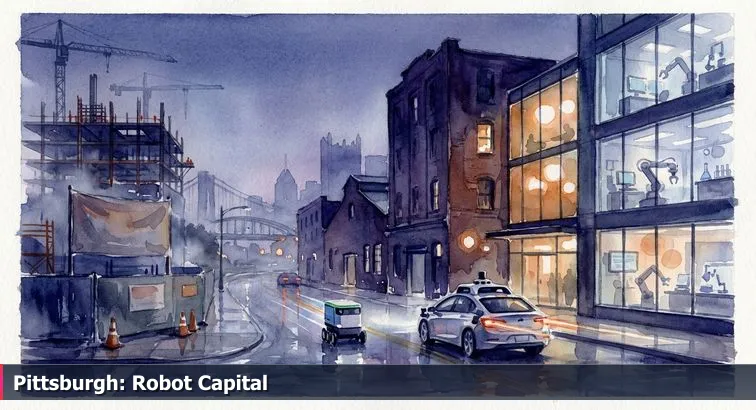
In late January, Congress introduced the SELF DRIVE Act of 2026, a federal autonomous vehicle bill that would raise the cap on safety-rule exemptions to 90,000 AVs per year. Those exemptions determine how many self-driving cars and trucks can operate on public roads without meeting every regulation written for human drivers, a bottleneck that has kept most fleets in pilot mode. For Pittsburgh, where AVs are now a daily sight along the Allegheny, the proposal marked a shift from experimental projects to the prospect of scaled, revenue-generating deployments.
Aurora’s push from Robotics Row
Pittsburgh-based Aurora Innovation, headquartered along the city’s so-called Robotics Row, had been one of the most visible advocates for a higher federal cap and clearer rules. Company leaders repeatedly described 2026 as the year federal AV standards needed to be finalized, a theme echoed in regional coverage that tracked Aurora’s policy work and test operations from the Strip District to interstate freight routes. Local startup reporters noted that Aurora’s lobbying helped put Pittsburgh in the room for national AV debates, rather than leaving decisions to coastal legislators and automakers, as outlined by Pittsburgh Startup News’ January policy roundup.
Implications for Pittsburgh’s AV workforce
If Congress ultimately passed a bill close to the current draft, AV operators based in the city would have headroom to justify larger test and commercial fleets anchored here. That would mean more hiring in safety engineering, perception, simulation, and regulatory compliance, plus knock-on demand for mapping, fleet operations, and maintenance roles that draw on Western Pennsylvania’s transportation and manufacturing talent base.
The trade-off, local executives acknowledged in January, is that a big federal framework almost guarantees more paperwork and slower iteration. For Pittsburgh’s AV ecosystem - which has thrived on rapid experimentation - the challenge will be to treat Washington’s rules as a floor for safety, not a ceiling on innovation, and to ensure smaller startups are not boxed out by compliance costs that only the largest incumbents can absorb.
In This Update
- SELF DRIVE Act, Aurora, and Pittsburgh’s AV push
- Waymo’s robotaxis plan for Pittsburgh
- CES 2026: Robotics Row goes to Las Vegas
- Humanoids and simulation: Fauna, Applied Intuition, and Skild AI
- Bakery Square’s AI Avenue and Pittsburgh’s AI corridor
- Powering AI: Meta, Beaver Valley nuclear, and data center energy
- NovoLINC and liquid cooling for the AI boom
- CMU’s Learnvia: scaling AI in education
- Pitt’s $53.5M musculoskeletal gift and commercialization push
- Trivedi Institute for Space and Global Biomedicine
- Shapiro’s $113M innovation package, agtech, and CODE PA
- Hiring, office moves, and downtown recovery: Excelitas and S&T Bank
- Voices from the ecosystem: manufacturing, diversification, and city IT
- What it means for workers and founders: practical next steps
Find the breaking tech news update summarizing AI spending, Coinbase's insider breach, and what it means for tech workers.
Waymo’s robotaxis plan for Pittsburgh
Robotaxis move from hypotheticals to timelines
Waymo spent January positioning Pittsburgh as one of the next U.S. cities to get commercial robotaxi service, alongside Philadelphia, Baltimore, Detroit, Dallas, Houston and others. Investor analyses projected that the Alphabet-owned company would field more than 2,000 autonomous vehicles by late 2026 and target roughly 1 million weekly rides by year’s end, according to coverage of Waymo’s 2026 robotaxi expansion plans. For a city that already sees Aurora trucks on the Turnpike, the prospect of consumer-facing robotaxis raised both competitive and regulatory stakes.
Pittsburgh as a contested AV beachhead
Local reporting in the Pittsburgh Post-Gazette’s coverage of driverless taxis underscored that Waymo would not be entering a greenfield market. Instead, it would be testing side-by-side with Aurora and university spinouts, all vying for curb space, mapping access and consumer trust. For engineers, safety operators, and fleet techs, multiple operators promised more job options and better leverage on pay and working conditions, but also a faster pace of deployment than a single-anchor market.
City rules and shared infrastructure
City and county officials, who had already been grappling with AV testing rules, suddenly faced a more complex question: how to standardize permits, data-sharing expectations and pickup zones so different fleets could coexist. Planners hinted in January that they would look to other Waymo markets for best practices, but Pittsburgh’s dense riverfront and hills make it a tougher proving ground than some Sun Belt metros.
| City | Region | Key AV players | Local angle |
|---|---|---|---|
| Pittsburgh | Appalachia | Waymo, Aurora, CMU spinoffs | Robotics Row, complex terrain, university labs |
| Philadelphia | Mid-Atlantic | Waymo, logistics pilots | Dense urban grid, East Coast freight links |
| Detroit | Midwest | Waymo, legacy automakers | OEM partnerships, manufacturing base |
CES 2026: Robotics Row goes to Las Vegas
Robotics Row took its show on the road
Early January’s CES 2026 in Las Vegas gave Pittsburgh’s “Robotics Row” a global stage, with local firms demonstrating what the region now calls physical AI - robots, AVs and infrastructure that generate revenue, not just demos. The Pittsburgh Technology Council described “dozens of Pittsburgh companies” on the floor, highlighting that this was the city’s third consecutive year with a coordinated presence at the world’s biggest consumer tech show, according to its Pittsburgh Takes Over CES 2026 recap.
Robots, sensors, and wireless power
Local exhibitors spanned the physical AI stack. Aurora and other AV players showed off autonomous driving platforms; Bucket Robotics focused on industrial and specialty robots; Carnegie Robotics demonstrated perception-heavy autonomous systems; and Powercast highlighted wireless power gear for embedded devices. A region-led panel on “building sustainable data centers” emphasized that Pittsburgh’s role now extends beyond robots to the power and cooling infrastructure that keeps AI workloads running.
From buzzwords to applied AI
Investors and corporate buyers who met Pittsburgh teams at CES were notably less interested in generic “AI” branding and more focused on deployment metrics: number of units shipped, contracts signed, and payback periods. That matched national commentary that 2026 would be defined by practical AI, not new model launches, as covered in industry overviews like HQSoftware’s survey of 2026 AI developments. For Pittsburgh founders, the message was clear: pairing AI with hard assets - vehicles, sensors, cooling systems - is now a competitive advantage.
Pittsburgh’s export pitch
Back home, leaders pointed out that the same robotics and autonomy tools showcased in Las Vegas are already deployed at sites like Pittsburgh International Airport, where a multi-year automation push is turning the facility into a “smart airport,” as detailed in a January feature on investment in technology at PIT. Rather than selling city-only pilots, Pittsburgh companies left CES pitching exportable products that can plug into logistics hubs, factories, and data centers worldwide.
| Segment | Example company | CES 2026 focus | Pittsburgh base |
|---|---|---|---|
| Autonomous vehicles | Aurora | Self-driving trucks and software | Strip District |
| Industrial robotics | Bucket Robotics | Robots for harsh environments | Robotics Row |
| Sensing & autonomy | Carnegie Robotics | Perception systems for robots | Lawrenceville |
| Wireless power | Powercast | Powering low-energy devices | North Shore |
Humanoids and simulation: Fauna, Applied Intuition, and Skild AI
January’s most forward-looking moves in Pittsburgh’s robotics scene came from companies trying to turn physical AI into a platform business. Local startup Fauna began hand-delivering its humanoid robot developer kit, Sprout, while simulation specialist Applied Intuition opened a Pittsburgh office and Skild AI closed a SoftBank- and Nvidia-backed deal that valued it at $14 billion. Together, they signaled a shift from one-off robots to shared “brains” and tooling for fleets of machines.
Fauna’s Sprout arrived as a full-stack humanoid platform aimed at developers in homes and offices, with the company positioning itself as the first U.S. firm to actually ship a humanoid developer kit rather than just videos. By targeting a developer ecosystem, Fauna was openly competing with Chinese humanoid platforms for mindshare and app libraries, using Pittsburgh’s robotics talent and cost advantages as leverage.
On the tooling side, Applied Intuition, whose mission is to be “building physical AI that moves the world,” expanded into the city to accelerate work on aerial autonomy and robotics simulation. Its software lets AV and robot teams run millions of virtual miles before touching real streets or factory floors, a safety-first approach detailed in the company’s own overview of its simulation platform for AVs and robots.
“Applied Intuition provides the tools and infrastructure to safely develop and deploy autonomous systems at scale.” - Company mission statement, Applied Intuition
Skild AI rounded out the month by securing a $1.4 billion deal with SoftBank and Nvidia, giving it that $14 billion valuation and cementing its pitch as a “universal brain” that can run across many robot hardware platforms. For Pittsburgh’s workforce, these capital-intensive bets created durable demand for:
- Controls, perception, and reinforcement learning engineers
- QA and safety specialists for physical systems
- Simulation, digital twin, and MLOps roles tightly tied to hardware
Regional promoters have already begun folding these companies into the broader story of the city’s AI corridor, highlighting them in the Pittsburgh Region’s AI industry overview as examples of how local research is turning into exportable robotics platforms.
Bakery Square’s AI Avenue and Pittsburgh’s AI corridor
On Pittsburgh’s East End, a one-mile stretch running through Bakery Square quietly lived up to its new nickname: AI Avenue. Regional data showed more than 21 AI companies clustered around the former Nabisco plant, including Nvidia’s AI Tech Community hub, making the corridor one of the densest concentrations of AI talent between New York and Chicago. Coverage from outlets like Technical.ly Pittsburgh’s running tech beat framed the area as a proving ground for AI-first startups and satellite offices from larger firms.
What distinguished AI Avenue in January was less its branding and more its connectivity. Shuttle and bus links tied Bakery Square directly into CMU and Pitt labs in Oakland and robotics and AV firms in the Strip District, turning the corridor into a daily commute pattern for machine learning engineers, data scientists, and product managers. For many workers, it became realistic to switch jobs - from a university spinout to a growth-stage startup to a Big Tech lab - without changing neighborhoods.
Real estate watchers noted that the AI corridor’s momentum also showed up in leasing. Class A office and flex lab space in and around Bakery Square continued to fill up, even as older stock downtown lagged, a split that paralleled reporting in the Pittsburgh Business Journal’s technology coverage on where new tech tenants were choosing to land.
For founders, the takeaway was straightforward: proximity matters. Being within walking distance of peers, corporate innovation teams, and academic labs made it easier to recruit, schedule customer pilots, and tap specialized talent - advantages that are hard to replicate in more diffuse suburban office parks.
| Node | Primary focus | Typical employers | Worker takeaway |
|---|---|---|---|
| Bakery Square / AI Avenue | Core AI, cloud, product teams | AI startups, Nvidia hub, enterprise labs | Dense networking, rapid job mobility |
| Strip District | Robotics, AV, hardware | Aurora, robotics firms, advanced manufacturing | Hands-on physical AI and fleet operations |
| Oakland | Research and spinouts | CMU, Pitt, medtech and edtech spinoffs | Access to labs, students, and grant-funded projects |
Powering AI: Meta, Beaver Valley nuclear, and data center energy
While robots and AVs grabbed most of January’s headlines, the quiet enabler of Pittsburgh’s AI boom sat 35 miles up the Ohio River. Meta’s decision to fund an expansion of the Beaver Valley nuclear plant turned a legacy power station into a cornerstone for future AI-heavy data centers and cloud infrastructure. For Western Pennsylvania, it was a concrete sign that hyperscalers were willing to bet long-term on local, 24/7 low-carbon power rather than chasing short-term incentives in other states.
Regional reporting tied the Beaver Valley move to a broader realization: AI clusters are now as dependent on reliable megawatts as on PhDs. Editorials on how AI is changing the job hunt noted that decisions about data center siting and nuclear-backed capacity were no longer abstract utility questions but community debates in river towns like Springdale. Residents and local officials weighed tax revenue and tech jobs against concerns over transmission lines, water use, and long-term oversight.
For Pittsburgh’s tech workers, the skills gap was clear. Building and operating AI-scale infrastructure requires engineers who understand grid constraints, substation design, and cooling as well as Kubernetes. Roles in site selection, energy markets, and reliability engineering increasingly sat alongside more traditional SRE and DevOps postings, with employers looking for candidates who could translate between utility planners and cloud architects.
The upside, especially from a pro-growth perspective, is that nuclear-backed data centers can anchor decades of high-value work without the carbon footprint of gas peakers. The risk is that if permitting or political pressure chokes off projects like Beaver Valley’s expansion, Pittsburgh’s AI ambitions could hit a physical ceiling long before the talent pipeline does.
NovoLINC and liquid cooling for the AI boom
On the infrastructure front, CMU spinout NovoLINC quietly raised a $10.2 million seed round in January to commercialize liquid cooling technology for data centers. The company is targeting overheating in dense AI clusters, where racks packed with GPUs and accelerators are outstripping what traditional air cooling can handle. Pittsburgh Startup News reported that NovoLINC’s focus is squarely on the “plumbing” of AI: keeping high-density compute running reliably as demand for inference and training workloads spikes.
NovoLINC’s pitch landed in a month when policymakers were also talking infrastructure. State officials touted that recent technology modernization had already brought Pennsylvania about $37 million in savings, according to a GovTech report on statewide IT upgrades. While that initiative was aimed at government systems, it underscored how quickly power, cooling, and facility efficiency have become core to any serious digital strategy.
For Pittsburgh engineers, the NovoLINC deal was a reminder that not every high-growth job sits in pure software. Thermal, mechanical, and electrical specialists are now central to the AI boom, working alongside ML teams to design manifolds, cold plates, and control systems that can safely support multi-megawatt server halls. Those skills map naturally onto the region’s industrial base, giving hardware-minded talent a clearer path into cutting-edge AI work.
State-level innovation programs could also amplify this niche. Governor Josh Shapiro’s proposed $113 million innovation package, including a $50 million PA Innovation Program, was designed to support commercialization and matching grants for exactly the kind of deep-tech hardware NovoLINC represents, as outlined in SSTI’s analysis of the budget request. Used carefully, that kind of capital can accelerate deployment of more efficient cooling across AI data centers without waiting for new regulations to force retrofits.
| Cooling approach | Typical use | Pros | Challenges |
|---|---|---|---|
| Air cooling | Traditional data centers | Simple, well-understood | Struggles with dense AI racks |
| Direct liquid cooling | High-density AI clusters | Higher efficiency, more capacity | Complex plumbing, design expertise |
| Immersion cooling | Specialized deployments | Max heat removal | Hardware compatibility, serviceability |
CMU’s Learnvia: scaling AI in education
From campus tool to national platform
By the end of January, Carnegie Mellon University had signaled that its AI ambitions extended well beyond campus. On January 29, 2026, CMU launched Learnvia, a platform designed to use AI to “catalyze student success” by personalizing learning and connecting students with resources across institutions. The university framed Learnvia as a way to export decades of learning science research to partners nationwide, according to its official launch announcement.
“Learnvia will catalyze student success by making our learning science research available at scale.” - Carnegie Mellon University Learnvia launch announcement
New roles for Pittsburgh talent
For the city’s edtech and data science community, Learnvia created a new layer of demand: AI product managers who understand curricula, content engineers who can translate course materials into machine-readable formats, and privacy experts who can navigate FERPA and state-level data rules. Because CMU explicitly invited other universities and school systems to plug in, much of that work is likely to be based in Pittsburgh even as the platform serves students around the country.
Commercial and policy implications
Learnvia also underscored a business model shift. Rather than spinning out yet another standalone app, CMU positioned the platform as infrastructure that startups and service providers could build on - licensing tools, analytics, and courseware integrations. Local commentators at the Pittsburgh Technology Council’s “Future of AI in 2026” forum noted that education is becoming one of the most visible use cases for AI, but warned that questions around bias, transparency, and student surveillance will follow the technology into classrooms.
For now, Learnvia gives Pittsburgh a national reference project in AI-driven education - one rooted in research, but with clear commercial and workforce implications for the region.
Pitt’s $53.5M musculoskeletal gift and commercialization push
Big gift with commercialization in mind
Mid-month, the University of Pittsburgh doubled down on turning research into products. On January 21, 2026, the Orland Bethel Family Foundation committed an additional $53.5 million to Pitt’s Musculoskeletal Research Center, with funding explicitly tied to commercialization through the university’s Pitt.INC initiative. The package was structured not just to support basic science but to move therapies, devices, and diagnostics into the market faster, according to the University Times’ report on the donation.
“The new $53.5 million donation will help bring musculoskeletal breakthroughs more quickly to patients and markets.” - University Times coverage of the Orland Bethel Family Foundation gift
From lab bench to FDA pathway
Pitt.INC’s role is to turn university intellectual property into startups and licensing deals, and the musculoskeletal gift put that model front and center. Instead of treating commercialization as an afterthought, the program bakes in support for IP protection, prototyping, and early regulatory strategy. Health sciences leadership framed the effort as part of a broader push to make Pittsburgh a magnet for translational medicine, building on existing strengths in orthopedics and rehabilitation detailed on Pitt Health Sciences’ news site.
What it means for Oakland researchers
For engineers and scientists in Oakland, the immediate impact is more funding, but the longer-term shift is cultural. New industry-postdoc hybrid roles, startup fellowships, and milestone-based grants are likely to reward teams that can navigate both the lab and the FDA. That, in turn, should increase local demand for product-minded biomedical engineers, clinical trial designers, and regulatory specialists who can turn musculoskeletal innovations into reimbursable therapies rather than papers that never leave campus.
Trivedi Institute for Space and Global Biomedicine
Pitt closed January by looking up - literally. On January 29, 2026, the university formally launched the $25 million Trivedi Institute for Space and Global Biomedicine, a new center dedicated to studying how space environments affect human health and using those findings to tackle diseases on Earth. The institute is led by retired NASA astronaut Kate Rubins, whose experience conducting biology experiments in orbit gives Pittsburgh a high-profile bridge between the International Space Station and Oakland’s medical campus.
“We’re pushing boundaries at the intersection of space, health and possibilities.” - Joan Gabel, Chancellor, University of Pittsburgh
Local coverage emphasized that the Trivedi Institute would bring together biologists, clinicians, and engineers to work on problems like bone density loss, radiation exposure, and immune changes under microgravity. That multidisciplinary approach fits a broader regional pattern, where AI and data science are increasingly woven into every research domain - from robotics to medicine - as highlighted in analyses of Pittsburgh’s AI future and research ecosystem.
For Pittsburgh’s tech workforce, the institute opened new lanes beyond traditional hospital or software roles. Data scientists and AI specialists now have opportunities in bioinformatics, space physiology, and radiation modeling, often in partnership with aerospace and defense contractors that already source talent from the region. Hardware-minded engineers, meanwhile, can work on sensors, lab-on-chip devices, and monitoring systems designed to function in orbit and then spin back down into commercial healthcare products.
The Trivedi launch also reinforced a strategic narrative: that Pittsburgh’s edge lies in niche, exportable expertise - space biomedicine in this case - rather than trying to recreate Silicon Valley. Whether those bets pay off will depend on how quickly the institute can convert its research into therapies, diagnostics, and commercial partnerships anchored in the city.
Shapiro’s $113M innovation package, agtech, and CODE PA
In his FY 2025-2026 budget request, Governor Josh Shapiro put forward a proposed $113 million innovation package aimed squarely at R&D-heavy regions like Pittsburgh. The centerpiece is a $50 million “PA Innovation Program,” with $30 million earmarked for life sciences commercialization and $20 million for large-scale matching grants designed to pull in federal and private dollars, according to analysis from SSTI’s breakdown of the Shapiro proposal. For robotics and medtech founders, that matching structure could reduce capital risk without forcing them to give up equity or control.
A parallel push in agriculture aimed to ensure rural Pennsylvania shares in the tech upside. The state opened the second round of a $10 million Agriculture Innovation Grant Program on February 2, 2026, following $2.2 million in research grants announced in late January to help farmers adopt new technology, as detailed in the Department of Agriculture’s release on keeping Pennsylvania agriculture growing with research investments. For Pittsburgh-area startups working on computer vision, IoT sensors, or supply-chain software, those grants represent a subsidized path into a large but traditionally under-digitized market.
On the digital government side, the same budget lifted funding for CODE PA by 40%, to $11.5 million, and added $10 million for cybersecurity to counter AI-driven threats. State officials also pointed to roughly $37 million in savings from recent IT modernization efforts, arguing that smarter infrastructure can shrink government footprints rather than expand them. That creates new contract opportunities for Pittsburgh consultancies in cloud migration, threat detection, and user experience, even as some worry the state could eventually try to build too much in-house.
For founders, the strategic play is to treat these programs as accelerants, not lifelines. Well-run Pittsburgh companies can use state matching funds to de-risk ambitious projects in life sciences, agtech, and cybersecurity - provided they keep product roadmaps anchored in paying customers rather than grant cycles and political timelines.
| Program | Amount | Primary focus | Key risk/opportunity |
|---|---|---|---|
| PA Innovation Program | $50M | Life sciences and large-scale R&D matching | Can crowd in private capital, but may favor incumbents |
| Agriculture Innovation Grants | $10M | On-farm tech adoption and research | Opens rural markets to Pittsburgh agtech startups |
| CODE PA & Cybersecurity | $21.5M total | IT modernization and threat defense | Creates contracts, but risks state overbuild of software |
Hiring, office moves, and downtown recovery: Excelitas and S&T Bank
Hiring signals for Pittsburgh’s tech-adjacent economy were hard to miss in January. Photonics and sensor manufacturer Excelitas Technologies chose the Strip District for its new corporate headquarters, with state officials saying the move would create at least 250 jobs in the city. The relocation followed coordination with Pennsylvania’s economic development team and underscored how advanced manufacturing employers now see Robotics Row and nearby blocks as the default place to recruit engineers, technicians, and corporate staff, according to the Department of Community & Economic Development’s announcement on Excelitas relocating its HQ to Pittsburgh.
Financial services followed suit. On January 29, S&T Bank disclosed plans for a new full-service branch and expanded office at One North Shore Center, positioned as a hub for both retail customers and commercial clients in the corridor between downtown and the Strip. The bank cast the North Shore build-out as a bet on the region’s growth companies and their employees, outlining how the site would host business bankers and back-office staff in a statement carried by its January press release.
Those announcements landed as new market reports showed downtown Pittsburgh’s office sector slowly recovering, driven by demand for modern, amenity-rich Class A space and conversions of older properties into housing or mixed-use. Tech-heavy firms and their suppliers continued to favor the Strip District and North Shore for lab-ready and flex offices, while downtown landlords that invested in upgrades saw more tours and lease activity than peers relying on pre-pandemic layouts.
For job seekers, the pattern was clear: non-tech firms that rely on technology - banks, photonics manufacturers, advanced logistics players - are planting roots in the same neighborhoods as AI and robotics companies. That clustering increases the odds that a software engineer, data analyst, or product manager can build an entire career inside a few riverfront districts, even if they move in and out of pure tech roles.
| Employer | Sector | Location | Pittsburgh impact |
|---|---|---|---|
| Excelitas Technologies | Photonics & sensors | Strip District HQ | 250+ new jobs, advanced manufacturing anchor |
| S&T Bank | Financial services | North Shore branch & office | Expanded banking, commercial support for tech corridor |
| Class A office landlords | Commercial real estate | Downtown & riverfront | Benefiting from clustered tech and growth tenants |
Voices from the ecosystem: manufacturing, diversification, and city IT
Across Western Pennsylvania’s tech circles, January ended with a mix of confidence and realism. Regional “Strike Team” member Mike Doyle pushed back on fears that AI could become Pittsburgh’s new single point of failure, stressing in local coverage that the region’s economy is broad enough that “there’s never going to be one company that can send Pittsburgh into a recession.” That message resonated with founders who see robotics and AI as growth engines, not the whole story.
Manufacturing leaders put numbers behind that optimism. At a late-January event in Johnstown, Catalyst Connection CEO Petra Mitchell told attendees that roughly 70% of manufacturers had already adopted or planned to adopt AI within five years, and that manufacturing jobs in the Johnstown metro grew about 12% over the past decade, according to the Altoona Mirror’s report on the AI presentation.
“AI technology adoption is redefining competitiveness and productivity within manufacturing industries, with 70% of manufacturers already adopting - or planning to adopt - AI within the next five years.” - Petra Mitchell, President & CEO, Catalyst Connection
Executives like JWF Industries’ David Scott and Mission Critical Solutions’ Darin Mauzy framed AI as a competitive edge, not a job killer: faster bidding, fewer errors, and the need to “come back to the table in a few months to relearn how to capitalize off of it,” as Mauzy put it. Their message to machinists and welders was blunt: AI plus robotics will reshape work, but firms that move quickly can grow headcount and wages.
City government sat in a different place on the curve. Outgoing CIO Heidi Norman was candid in interviews about gaps between municipal systems and what local startups could deliver, even as other public entities, like the Allegheny County Airport Authority, invested in smart infrastructure showcased on Blue Sky PIT’s look at airport technology upgrades. For civic-minded engineers and vendors, that lag is less a frustration than an opening to modernize services through contracts and partnerships rather than a bigger city bureaucracy.
| Segment | AI adoption stage | Main opportunity | Key constraint |
|---|---|---|---|
| Manufacturing | Scaling pilots into production | Boost productivity, add higher-skill jobs | Workforce upskilling, capital for upgrades |
| Tech startups | Core to products and services | Exportable AI and robotics platforms | Regulatory uncertainty, fundraising cycles |
| City government | Early modernization | Public-private IT projects, cost savings | Legacy systems, procurement bottlenecks |
What it means for workers and founders: practical next steps
For engineers and data scientists
Workers who wanted to stay ahead of January’s curve increasingly treated physical AI as a career bet: roles that blend software with robots, vehicles, data centers, or medical devices. Hiring managers signaled that experience in simulation, safety, and deployment carried more weight than just another model-tuning project. That often meant getting closer to hardware teams and regulated environments instead of pure web apps.
For founders
Entrepreneurs watching the month’s deals and grants leaned into applied problems: logistics, industrial automation, cooling, energy, and specialized health. Investor commentary around the new robotics mega-deals stressed traction over theory; founders were urged to show pilots, contracts, and integration plans rather than slideware, a theme echoed in forecasts from robotics-focused investor newsletters. Smart teams treated state programs as matching capital for work already pulled by customers, not as the main source of demand.
For nontechnical and mid-career talent
Product ops, regulatory strategy, sales engineering, and customer success roles became attractive entry points into AI-heavy firms. Experience in sectors like manufacturing, finance, education, or healthcare paired well with a working understanding of data privacy and compliance. Many local professionals used meetups and cross-sector events to move laterally into tech-adjacent jobs without starting from scratch.
Across all groups, one pattern stood out: workers who understood how AI tied into business models, infrastructure, and policy were better positioned than specialists focused narrowly on code. Regional analysts tracking the labor market argued that this mix of domain depth and technical literacy would be the defining skill set for the next phase of Pittsburgh’s transition, a view reinforced by economic briefings from organizations such as the Economy League’s 2026 outlook.
For a breaking NYC AI news brief on Micron’s megafab and Empire AI investments, see our coverage.
Columbus tech update: Intel, Anduril, and VC tax changes - Jan 2026
Bookmark this long-tail San Francisco AI jobs and funding news (Jan 2026) for readers tracking the city’s tech shift.
Breaking Boston tech update - M&A, IPO activity, and talent migration in Greater Boston
This month’s latest tech news in Atlanta: Silicon Peach fintech and tax debate

Irene Holden
Operations Manager
Former Microsoft Education and Learning Futures Group team member, Irene now oversees instructors at Nucamp while writing about everything tech - from careers to coding bootcamps.