









This Month's Latest Tech News in Austin, TX - February 28th 2026 Edition
By Irene Holden
Last Updated: March 4th 2026
Key Takeaways
- AMD and Meta finalized an AI chip partnership reportedly worth up to $100 billion, cementing Austin’s chip hub role.
- OpenAI and SoftBank committed $1 billion to a data center campus in Milam County northeast of Austin.
- Apptronik raised $520 million in a Series A-X extension, marking February’s biggest Austin robotics round.
- The 71 largest tech employers in Austin account for more than 117,800 workers, showing structural scale.
- S.B. 2206 replaced the R&D sales tax exemption with a permanent Franchise Tax Credit effective January 1, 2026.
- TRAIGA created a 36-month AI regulatory sandbox with strict penalties for discriminatory or harmful AI outcomes.
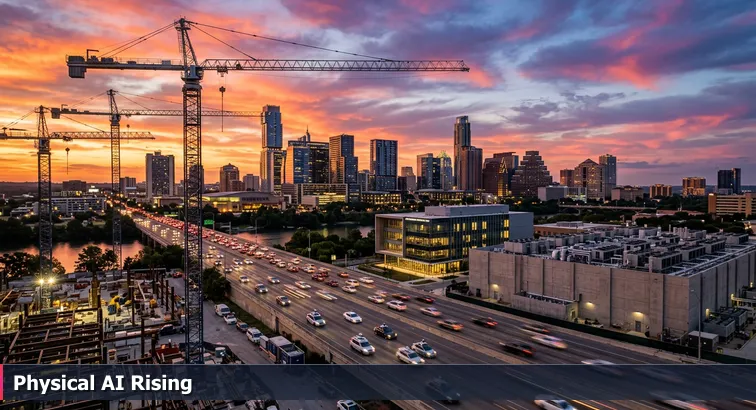
February closed with Austin’s tech sector looking fundamentally different than it did even a year ago. Instead of another spike in consumer apps and cloud software, the month’s biggest moves clustered around robots, chips, defense systems, and the power and data infrastructure that make large-scale AI possible.
This pivot followed several years of whiplash: a pandemic-era hiring surge in SaaS, followed by 2023-25 layoffs and stalled headcount at some of the city’s marquee software employers. While those cuts continued at the margins in February, the center of gravity shifted toward long-horizon bets in semiconductors, advanced manufacturing, and AI-heavy infrastructure across Central Texas.
Those capital-intensive plays are harder to unwind than a product pivot. They require land, power, and regulatory certainty - areas where Texas has tried to distinguish itself. One recent analysis found that Texas tech GDP grew about 7.79%, more than double New York City’s rate, underscoring how investment has been tilting toward lower-cost, pro-growth regions that can support fabs, data centers, and testing facilities at scale.
State moves like a permanent R&D-focused Franchise Tax Credit and the new AI “regulatory sandbox” reinforced that message in February, signaling that lawmakers intend to punish clear harms from AI without preemptively banning new use cases. For founders and larger employers, that combination of light-touch oversight and predictable incentives made Austin a logical place to anchor the “physical AI” side of their roadmaps.
- Robotics labs and industrial corridors building humanoid and warehouse robots
- Defense-tech firms working on autonomous systems and edge AI
- Semiconductor and advanced manufacturing sites supporting AI hardware
- Energy and data-center projects extending Austin’s footprint into surrounding counties
In This Update
- Austin’s February Pivot: Physical AI Comes to the Fore
- AMD & Meta chip deal and OpenAI’s 1.2GW data campus
- Apptronik’s $520M Raise: Humanoid Robotics Goes Big
- NODA AI, Equal Parts & BrainCheck: February funding winners
- Jobs and Hiring: Waymo tests, layoffs, and AI hiring hotspots
- Relocations and Expansions: NinjaOne, Apple, and MP Materials
- Texas Policy Wins: S.B. 2206 Franchise Credit and TRAIGA sandbox
- Expert Takeaways: AI as an industrial inflection and identity risk
- Migration and Culture: The "Exodus" Myth and neighborhood shifts
- What to Watch Next: TXSE, Nasdaq Texas, SXSW, and 2026 questions
This latest AI and US tech news story breaks down capital, jobs, and policy shaping the industry.
AMD & Meta chip deal and OpenAI’s 1.2GW data campus
At the infrastructure layer, two February announcements effectively redrew the AI map around Central Texas. AMD and Meta finalized an AI chip partnership reportedly worth up to $100 billion, positioning Austin not just as a design outpost but as a core node in the global semiconductor race. AMD already employed thousands across the region, and a deal of this scale pointed to long-term investment in AI accelerators, software stacks, and verification teams rooted in Central Texas rather than coastal hubs.
In parallel, OpenAI and SoftBank committed $1 billion to SB Energy to operate a 1.2 GW data center campus in Milam County, northeast of Austin. That project joined a wave of new facilities that has Texas on track to become the world’s top data center market by 2030, according to Data Center Knowledge’s February development roundup. For Austin, Milam County effectively extended the metro’s AI footprint along the I-35 and SH-130 corridors.
Rounding out the stack, state officials confirmed that Austin landed the headquarters of a major nuclear energy company. Recent entries in the Texas governor’s project announcements log highlighted a cluster of energy and advanced manufacturing deals in Central Texas, aimed at keeping fabs and data centers powered even as AI workloads surge.
- Chip design, verification, and low-level runtime engineering tied to AMD’s next-generation AI parts
- Data center reliability, physical security, and network operations for hyperscale campuses
- Power systems, grid-integration, and energy-aware compute roles at utilities and nuclear startups
- Site-planning and civil engineering jobs around Milam County’s emerging data center corridor
Apptronik’s $520M Raise: Humanoid Robotics Goes Big
The single most eye-catching funding headline in February belonged to Austin-based Apptronik. The humanoid robotics company closed a $520 million Series A-X extension, bringing its total venture capital to nearly $1 billion with backing from Google, Mercedes-Benz, and other strategic investors. According to the Austin Business Journal’s February funding wrap, the round was one of the largest single raises ever for a Central Texas startup.
Unlike pure software plays, Apptronik is betting on full-stack humanoid robotics: perception, motion planning, simulation, and ruggedized hardware built under one roof. The company has been testing its systems in logistics and manufacturing environments, aiming to automate repetitive, physically demanding work that has been hard to staff in Central Texas warehouses and factories.
For engineers and operators, that translated into a wave of new hiring in February across robotics perception, control, and integration. Apptronik and its peers sought candidates comfortable working at the intersection of real-time control software, embedded systems, and cloud-based orchestration rather than just web stacks.
- Robot perception roles focused on vision, LiDAR, and sensor fusion pipelines
- Motion-planning and controls engineers with experience in C++/Rust and real-time OSs
- Simulation and digital-twin specialists using tools like ROS and Isaac to validate behavior
- Field deployment and integration staff who can make robots work in existing warehouses and plants
These jobs clustered in North Austin and along industrial stretches of I-35 and SH-130, where companies can lease lab and warehouse space more easily than downtown. Local recruiters on platforms like Built In Austin noted that robotics firms were increasingly willing to hire ex-SaaS talent with strong systems skills, provided candidates were ready to work hands-on with hardware and safety constraints.
NODA AI, Equal Parts & BrainCheck: February funding winners
Beyond humanoid robots, February’s funding tape in Austin highlighted a trio of “applied AI” plays turning regulated sectors into growth markets. NODA AI, Equal Parts, and BrainCheck each closed new rounds, underscoring investor confidence that insurance, defense, and healthcare are where AI can move real revenue rather than just user metrics.
Deal trackers such as Austin Startup Meetup’s funding logs showed that, while the number of rounds remained modest, check sizes for these vertical-AI startups continued to climb. In contrast to consumer apps, these companies leaned on domain expertise, compliance, and hard-to-replicate datasets to justify their valuations.
| Company | Focus | Round | Amount Raised |
|---|---|---|---|
| NODA AI | Autonomous machine control for defense | Series A | $25 million |
| Equal Parts | AI-powered insurance platform and agency roll-up | Growth round | $23 million |
| BrainCheck | AI-assisted cognitive health and diagnostics | Series A | $13 million |
For job seekers, the signal was clear: these companies hired hybrids. NODA AI looked for machine-learning engineers comfortable with constrained compute and defense workflows. Equal Parts emphasized product and data talent with insurance operations experience. BrainCheck prioritized clinicians-turned-product managers and data scientists fluent in cognitive testing standards.
Crucially, all three operated in spaces where incumbents are large, slow, and data-rich. That made them attractive landing spots for laid-off SaaS workers who could bring modern engineering practices into highly regulated environments - without leaving Central Texas or its comparatively light regulatory touch on AI development.
Jobs and Hiring: Waymo tests, layoffs, and AI hiring hotspots
On the ground in Austin’s job market, February felt like two economies at once. The 71 largest tech employers still represented more than 117,800 workers, and tech occupations in the region had grown 5.4% in 2025. Yet early 2026 hiring data and recruiter feedback pointed to a split between companies adding headcount and those quietly trimming.
Sector breakdowns from firms like Frontline Source Group’s Austin hiring report showed strength where AI meets the physical world, even as traditional software cooled. Nationwide, industry observers estimated around 29,500 tech-sector layoffs in the opening weeks of 2026, with Austin absorbing its share, primarily in overextended SaaS and big-platform teams.
- Hiring aggressively: robotics manufacturers, defense-tech contractors, energy and semiconductor firms, and data center operators
- Treading water: mid-size B2B SaaS vendors and some IT services providers
- Cutting or freezing: ad-tech, consumer apps, and large coastal-headquartered firms that over-hired in 2020-2022
Alphabet’s Waymo added a visible symbol of this shift when it began testing autonomous vehicles on Austin highways and launched fully driverless robotaxis in Dallas in late February. Job postings tied to that rollout focused less on drivers and more on operations specialists, safety and compliance staff, and engineers working on mapping, telemetry, and on-the-ground autonomy testing.
For workers, LinkedIn commentary on early-2026 tech layoffs echoed what Austin recruiters were seeing locally: demand had not disappeared, but it had shifted. Laid-off SaaS engineers were most competitive when they framed their skills around reliability, data pipelines, and security - capabilities that translate directly into roles at robotics labs, energy startups, defense integrators, and the growing ring of data centers around Central Texas.
Relocations and Expansions: NinjaOne, Apple, and MP Materials
Relocation and expansion news in February underlined how Central Texas fits into a broader, statewide industrial build-out. In Austin proper, IT management vendor NinjaOne, autonomous maritime startup Saronic, and launch provider Firefly Aerospace all committed to new headcount, while manufacturing and materials projects in Houston and North Texas added rungs to an in-state career ladder for hardware and operations talent.
Regional group Opportunity Austin’s relocations and expansions log tracked these moves as part of a strategy to diversify beyond pure software into defense, aerospace, and advanced manufacturing. For engineers and operators, the message was that you no longer had to leave Texas - or even the I-35 corridor - to move from SaaS into factory-floor automation, rare-earth supply chains, or space systems.
| Company | Region | Project Focus | Scale |
|---|---|---|---|
| NinjaOne | Austin | IT management software expansion | ~300 new jobs |
| Saronic | Austin | Autonomous maritime / defense HQ growth | ~150 new jobs |
| Firefly Aerospace | Greater Austin | Launch and space systems build-out | ~50 new jobs |
| Apple | Northwest Harris County | U.S. Mac mini production and Advanced Manufacturing Center | 20,000 sq. ft. facility; footprint doubled |
| MP Materials | Northlake (DFW) | Rare-earth magnet manufacturing campus | $1.25 billion investment; >1,500 jobs expected |
For Austin workers, these announcements mattered less as isolated wins and more as proof that Texas was building an end-to-end industrial base: from software and autonomy in Austin to electronics manufacturing near Houston and critical-materials processing in North Texas. That breadth gave mid-career engineers, supply-chain managers, and technicians more options to stay within the state’s lighter regulatory environment while moving up the value chain.
It also subtly shifted bargaining power. With multiple Texas metros courting similar talent, experienced developers and operators in Austin entered performance reviews and offer negotiations knowing they had credible alternatives within a few hours’ drive, not just on the coasts.
Texas Policy Wins: S.B. 2206 Franchise Credit and TRAIGA sandbox
In the background of February’s big funding rounds, Texas’ policy environment quietly shifted in ways that founders and hiring managers said would matter for years. On January 1, 2026, S.B. 2206 took effect, replacing the state’s R&D sales tax exemption with a permanent Franchise Tax Credit aimed squarely at high-burn, innovation-heavy companies.
Tax advisors at firms like MGO CPA noted that the new structure is generally easier for early-stage and pre-revenue startups to monetize, because it offsets franchise tax instead of relying on sales-tax exposure that many young companies don’t yet have. Analysts at Doeren Mayhew similarly highlighted that its permanence gives founders more planning certainty when modeling multi-year hiring and R&D ramps.
On the regulatory side, the Texas Responsible AI Governance Act (TRAIGA) also went live on January 1. The law created a 36-month “regulatory sandbox” for AI systems while reserving strict penalties for discriminatory or clearly harmful outcomes in areas like lending, housing, and employment. A detailed breakdown from Baker Botts emphasized that TRAIGA focuses on documented harms rather than speculative risks.
- Encourages supervised experimentation instead of preemptive bans on whole categories of AI
- Targets enforcement at provable harms such as discriminatory models or safety failures
- Provides clearer guardrails than many federal proposals or EU-style “risk tiers”
For Austin’s startups and corporate labs, the combination of S.B. 2206 and TRAIGA signaled a consistent message in February: build here, move fast on new AI and robotics products, and expect the state to punish abuse rather than innovation itself. That alignment between tax policy and regulation helped explain why capital-intensive AI projects increasingly chose Central Texas over more restrictive coastal jurisdictions.
Expert Takeaways: AI as an industrial inflection and identity risk
Commentary from February’s events suggested that Austin’s AI boom is part of a deeper industrial shift, not just another software cycle. At the AI Impact Summit 2026, Anupam Govil, chairman of the U.S.-India Chamber of Commerce, described AI as the “third major technological inflection point” after the internet and mobile eras. In an analysis of that summit, The American Bazaar reported that speakers repeatedly cited Texas’ mix of power capacity, land, and pro-business regulation as reasons advanced AI work was clustering in the state.
That framing resonated locally because it matched what Austin was seeing on the ground: capital flowing into chips, data centers, and robotics labs rather than just new SaaS logos downtown. Panelists argued that these physical-AI investments were sticky; once a region committed to fabs, rare-earth processing, and 1+ GW data campuses, the jobs and supplier networks around them were far harder to dislodge than a remote software team.
Security experts, meanwhile, warned that the same agentic AI driving industrial automation was reshaping cyber risk. In a February analysis of SentinelOne’s platform strategy, The Futurum Group highlighted CTO Jeff Reed’s view that identity risk had moved beyond logins and passwords.
“Identity risk no longer begins and ends at authentication... attackers are increasingly operating within authorized workflows,” including those involving autonomous AI agents. - Jeff Reed, Chief Technology Officer, SentinelOne
For Austin engineers and security teams, that pointed to new career tracks built around AI governance, identity-aware security, and monitoring of autonomous agents inside business processes. With more local companies deploying robots, defense systems, and AI copilots into production, experts argued that the region’s next wave of high-impact jobs would sit where industrial AI, safety, and identity protection intersect.
Migration and Culture: The "Exodus" Myth and neighborhood shifts
Despite regular talk of an “Austin exodus” on social media, February’s numbers told a different story. Regional economic developers pointed to venture investment into local startups rising roughly 244% compared with 2024, even as a few big-name employers trimmed headcount. Coverage in the Austin American-Statesman’s tech section echoed that split picture: some downtown offices looked quieter, but founders and investors were still signing new leases and lab space around the metro.
Local leaders stressed that what was changing wasn’t whether Austin had a tech sector, but where it lived and how it felt. One longtime organizer summed it up bluntly in February: Austin tech “is not a social club. It is a serious community in the global tech scene,” arguing that the ecosystem needed to focus on outcomes rather than hype. That mindset showed up in a steady calendar of meetups, from AI and robotics to defense-tech happy hours, that increasingly convened in North Austin and the suburbs rather than just downtown bars.
- Downtown and East Austin: denser, pricier, dominated by hybrid offices, coworking, and AI-focused events
- The Domain / North Austin corridor: growing clusters of HQs, labs, and light-industrial space for robotics and hardware
- Suburban rings like Round Rock, Pflugerville, Buda, and Kyle: popular with remote workers and families seeking space and more predictable commutes
Experts interviewed by MySA in a February deep dive noted that, while some companies pulled back, Austin continued to attract California transplants and returning Texans with its lack of state income tax, lighter-touch regulation, and outdoor-oriented culture. For many of the city’s roughly 7,693 tech companies, employee reviews highlighted flexible or hybrid schedules and access to trails, parks, and Barton Springs as key retention tools.
The upshot for workers was nuanced. Rents and traffic still felt intense, but the cooling in pure software hiring took a bit of pressure off, even as physical-AI and infrastructure bets spread opportunity beyond a few downtown towers. Rather than an exodus, February looked more like a reshuffling - of neighborhoods, employers, and expectations about what an Austin tech career could look like in 2026.
What to Watch Next: TXSE, Nasdaq Texas, SXSW, and 2026 questions
As February ended, attention in Austin’s tech community turned toward how new capital-market and cultural platforms could reinforce the state’s physical-AI ambitions. The proposed Texas Stock Exchange (TXSE), based in Dallas and targeting a 2026 launch, aimed to give high-growth Texas companies a listing venue closer to home, with backers pitching it as a more entrepreneur-friendly alternative to coastal exchanges.
Nasdaq signaled a similar bet with plans for a new Texas dual-listing venue in 2026, a move detailed by FOX 4 Dallas. If both TXSE and Nasdaq’s Texas presence move forward on schedule, founders and early employees in Austin could see more IPO and secondary options that don’t require relocating leadership or courting a New York or Bay Area investor base.
On the cultural side, SXSW 2026 was already shaping up as a stress test for Austin’s new identity. With AI framed as a “third industrial inflection,” local organizers expected the festival to lean heavily into robotics, defense tech, and AI infrastructure panels. Groups like the Austin Forum on Technology & Society, which announced new leadership in February, were using events and programming to position Austin as a serious, outcomes-focused hub rather than just a festival city, according to updates on the Austin Forum’s news page.
- Can physical-AI hiring in robotics, defense, and energy absorb ongoing software layoffs?
- Will housing, land, and grid constraints slow data-center and manufacturing projects around Central Texas?
- As federal AI rules evolve, can Texas maintain a light-touch, harm-focused approach without triggering preemption or political backlash?
Those questions will shape how durable February’s momentum proves to be. For now, Austin enters the rest of 2026 with an unusually aligned stack: infrastructure money flowing in, state policy signaling “build here,” and new capital-market and cultural platforms that could keep more of the AI value chain rooted in Texas.
This Washington, DC tech update explains how the $901B defense budget and new AI accountability rules intersect.
February 2026 NYC tech news - jobs, funding, and New York’s AI safety legislation
Overview: This Month's Latest Tech News in San Francisco, CA - funding, layoffs, and reskilling tips for 2026.
Catch the February 2026 Columbus tech roundup on AI factories, defense manufacturing, and the new capital-gains deduction.
Read the Bellevue tech news update: AI boom, layoffs, and tax risks (Feb 28, 2026) for full context.

Irene Holden
Operations Manager
Former Microsoft Education and Learning Futures Group team member, Irene now oversees instructors at Nucamp while writing about everything tech - from careers to coding bootcamps.