









This Month's Latest Tech News in Columbus, OH - February 28th 2026 Edition
By Irene Holden
Last Updated: March 4th 2026
Key Takeaways
- Anduril will ship its first autonomous jets from Arsenal-1 in spring 2026, signaling local defense production.
- Meta secured a 20-year nuclear power deal to feed its Prometheus AI supercluster in Ohio.
- Intel’s $28 billion Ohio One fab project is on track for late-2026 completion on schedule.
- Honda acquired the Jeffersonville EV battery plant for $2.85 billion to increase its operational flexibility in Ohio.
- Ohio allows a 100% capital-gains deduction on investments in Ohio businesses starting with the 2026 tax year.
- Ohio State University reported $1.68 billion in annual R&D spending, boosting the local startup pipeline.
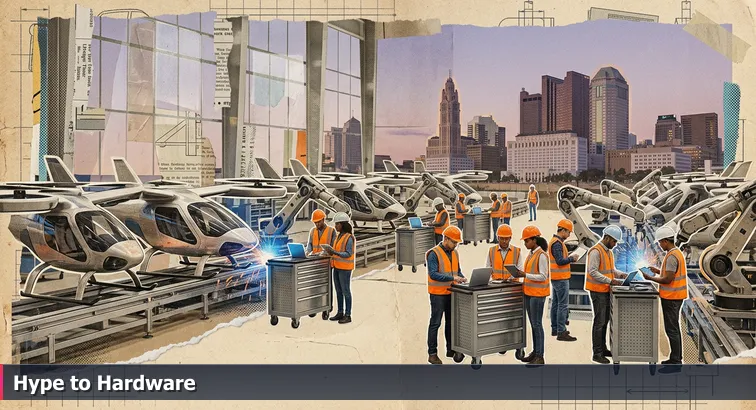
Defense AI moved from talking point to production line in Columbus this month, as Anduril Industries began finalizing the first batch of autonomous jets at its new Arsenal-1 plant. Regional economic-development reporting, compiled by Ohio Tech News’ defense and AI coverage, indicated that shipping was slated to begin in spring 2026, marking one of the first times frontline autonomous air systems were built at scale in Central Ohio rather than on the coasts.
Arsenal-1 anchored high-skill roles across embedded autonomy, secure software, and advanced test engineering. Anduril executives repeatedly cast Ohio’s part in explicitly historical terms, with one leader arguing that the company’s expansion here showed how the state could help rebuild the nation’s “arsenal of democracy.” That framing resonated with local officials eager to see national-security work reshored without turning Columbus into a branch-office outpost.
On the industrial side of defense, Columbus-based Path Robotics extended that same AI arc into shipbuilding. In February, the startup signed a memorandum of understanding with HII, the nation’s largest military shipbuilder, to deploy autonomous welding systems inside Navy shipyards - the company’s second defense-oriented agreement in a single week, according to the February roundup, “You need to be paying attention to Ohio tech: February 2026.”
Those deployments created demand for engineers who could bridge code and metal, not just tweak models in the cloud. Local hiring focused on robotics and controls specialists, applied machine-learning practitioners who understood welding and quality assurance, and field engineers willing to split time between Columbus shops and coastal shipyards. For Central Ohio technologists, it was the clearest evidence yet that defense AI had become a commuter-distance career path rather than a distant Beltway or Silicon Valley story.
In This Update
- Anduril and Path Robotics: Defense AI Comes to Columbus
- Meta’s Prometheus: 20-Year Nuclear Deal for an Ohio AI Hub
- Intel’s Ohio One fabs: Semiconductor momentum returns
- Honda’s Jeffersonville buyout: EV battery manufacturing scales
- Eagle Wireless raises Series B to shore up domestic modules
- Rev1 at The Peninsula: Downtown Columbus’ new innovation hub
- The O.H.I.O. Fund and Hyperframe: State capital driving relocations
- OSU’s $1.68B R&D and Third Frontier awards fueling spinouts
- 100% Ohio capital-gains deduction: A new investor incentive
- Vertiv and the rise of ‘AI factories’ in Columbus
- Startup climate, notable exits, and a jobs playbook for workers
This latest AI and US tech news story breaks down capital, jobs, and policy shaping the industry.
Meta’s Prometheus: 20-Year Nuclear Deal for an Ohio AI Hub
Meta’s long-rumored “Prometheus” AI supercluster in Central Ohio moved closer to reality in February, when the company quietly locked in a 20-year power purchase agreement for nuclear generation from Ohio plants. Local economic-development officials said the deal effectively guaranteed baseload power for some of the most energy-intensive AI workloads planned anywhere in the Midwest, shifting Columbus from generic data-center host to a durable AI infrastructure hub.
Unlike many coastal projects that leaned heavily on subsidies for intermittent renewables, Prometheus was structured around firm nuclear supply. That approach appealed to business groups who worried about grid reliability and escalating mandates. At the same time, it aligned with a broader statewide narrative that 2026 would be the year AI left the lab and hit regulated industries. As OhioX organizers put it in advance of their State of Tech 2026 event at the Ohio Statehouse, this phase was about execution, not experiments.
“2026 is the year AI gets real… its real impact won't come from the technology itself - but from how organizations deploy it.” - OhioX leaders, in remarks highlighted by regional ecosystem coverage
For Central Ohio workers, the nuclear-backed cluster translated into concrete hiring plans. Data-center operators were already scoping out roles in power systems engineering, high-density cooling, and site reliability for GPU farms, mirroring the kind of “AI factory” infrastructure plays seen in Vertiv’s recent push to industrialize deployment using digital twins, outlined in its announcement carried by Morningstar’s coverage of Vertiv’s AI strategy.
The bigger question for policymakers was whether Prometheus would anchor a broader cluster of AI-adjacent suppliers and startups in Columbus or remain a single hyperscale outpost. With a two-decade nuclear commitment on the books, Meta signaled it was betting on the former - and doing so in a way that leaned more on private capital and long-term contracts than on short-term political favors.
Intel’s Ohio One fabs: Semiconductor momentum returns
Intel’s massive bet on Central Ohio edged back into the fast lane this month as executives signaled that chip demand had begun to outstrip available manufacturing capacity. After a high-profile slowdown in 2024, when Intel told the Wall Street Journal it was delaying a $20 billion Ohio project amid a weaker market, the tone in early 2026 turned markedly more optimistic.
The company’s “Ohio One” complex in New Albany, now framed as a $28 billion multi-fab investment, remained on track for a late-2026 completion, according to local reporting. NBC4 noted that Intel leadership saw “sudden demand” for foundry services as an upside for Ohio, with state officials arguing that the shift positioned the region to benefit from reshoring and national-security concerns around advanced semiconductors, as outlined in NBC4’s analysis of Intel in Ohio.
On the ground, that optimism translated into continued construction activity through 2026 across the Dublin-New Albany corridor and early planning for technical hiring once tool installation ramped up. Intel and its contractors prepared to staff up in:
- Process engineers focused on leading-edge nodes and yield optimization
- Equipment technicians maintaining lithography, deposition, and metrology tools
- Automation, facilities, and EDA/verification talent to keep fabs running at high utilization
For Central Ohio, the project tied local fortunes to a strategic, globally traded industry rather than another back-office operation. Business advocates pointed out that, although federal incentives helped catalyze the build, the long-term viability of Ohio One would depend on Intel winning customers in a competitive market - an outcome more consistent with a durable, private-sector growth story than a short-lived subsidy bubble.
Honda’s Jeffersonville buyout: EV battery manufacturing scales
EV manufacturing in Ohio moved from blueprint to balance sheet in February, as construction of the 2-million-square-foot Honda/LG Energy Solution battery plant in Jeffersonville neared completion and Honda moved to take full ownership of the facility’s physical assets. In a deal first reported by Reuters’ coverage of LG Energy Solution’s asset sale, Honda agreed to buy the building and related infrastructure from the joint venture for about $2.85 billion.
Local outlets emphasized that the transaction was not a retreat from electrification, but a sign of long-term commitment. As the Dayton Daily News explained in its reporting on the buyout, LG Energy Solution would continue to play a role through technology and know-how, while Honda gained full control over the plant’s hard assets and future configuration.
For Ohio, that shift mattered less as an accounting nuance and more as a strategic bet. With Honda already operating legacy plants in Marysville and East Liberty, the Jeffersonville site effectively extended a contiguous mobility corridor for both internal-combustion and EV platforms. Owning the building outright gave Honda the ability to retool lines, adjust product mix, or expand capacity without renegotiating with a landlord-style joint venture.
- Greater operational flexibility to adapt to volatile EV demand
- Clearer governance and decision-making for future investments
- A stronger anchor for suppliers and logistics firms eyeing Central Ohio
For engineers and technicians within commuting range of Columbus, the message was straightforward: EV battery production here was no longer a pilot project. It was becoming a core part of Honda’s North American manufacturing footprint, with career paths in advanced manufacturing, automation, and battery systems likely to expand as the plant moved into full operation.
Eagle Wireless raises Series B to shore up domestic modules
While most headlines focused on megaprojects around Columbus, a quieter hardware play in northeast Ohio underscored the state’s role in shoring up critical telecom supply chains. Solon-based Eagle Wireless closed a $30 million Series B round in February, including $25 million from The O.H.I.O. Fund, to scale U.S. production of cellular modules as an alternative to Chinese-made components.
The raise positioned Eagle Wireless as a domestic supplier for LTE and 5G modules at a moment when federal policymakers were scrutinizing overseas vendors and network security. Rather than relying on mandates or bans, Ohio’s approach leaned on capital formation: the state-backed but privately leveraged O.H.I.O. Fund co-invested alongside other backers, similar to how Ohio’s Technology Validation and Start-up Fund has co-funded commercialization projects detailed on the Ohio Development Department’s TVSF awards page.
For Columbus, the immediate jobs were in the Cleveland area, but the strategic upside ran statewide. A robust in-state module manufacturer opened the door for Central Ohio companies building:
- Industrial and logistics IoT platforms that need secure, long-lived connectivity
- OEM hardware from smart agriculture to construction equipment
- Defense-adjacent systems where trusted communications components are non-negotiable
Founders and product teams in Columbus’ growing hardware and IoT scene - many spotlighted in Columbus Business First’s technology coverage - now had a potential Ohio-based partner instead of defaulting to offshore module vendors. For a region betting on “boring but critical” infrastructure, Eagle Wireless’ Series B reinforced the idea that Ohio can compete in strategic components through investment and execution, not just regulation and import restrictions.
Rev1 at The Peninsula: Downtown Columbus’ new innovation hub
On the downtown riverfront, Rev1 Ventures quietly gave Columbus a visible tech flagship in February by opening its new innovation center at The Peninsula. The 43,000-square-foot facility brought startup offices, “Scaleup Suites,” and lab-capable space under one roof, turning what had been a construction zone into a functioning launchpad for founders who wanted to stay in downtown Columbus instead of decamping to suburban office parks.
The hub was designed as a connector as much as a workspace. Within walking distance of city and state government, it offered early-stage companies direct access to policymakers, corporate innovation teams, and capital. Up the river, Ohio State’s labs and tech-transfer offices were ramping up commercialization efforts supported by targeted grants like the Technology Validation and Start-up Fund, highlighted in OSU’s own coverage of state awards for early-stage technologies. That pipeline of university spinouts increasingly looked to Rev1 as their first real “home” off campus.
- Move-in-ready offices for software and AI startups graduating from accelerators
- Lab and high-bay space for hardware, biotech, and advanced manufacturing teams
- Co-located meeting rooms where investors, mentors, and corporate partners could work with founders
For workers, the impact was tangible. Engineers from large employers in the city core now had a short walk to meet with emerging startups after work, rather than a 30-40 minute drive to a distant business park. Founders featured in Columbus Business First’s “Startups to Watch” series and in local ecosystem posts on platforms like LinkedIn’s Ohio tech community began to talk about The Peninsula as a place where they could scale headcount without abandoning the urban fabric that helped them recruit talent in the first place.
In a month dominated by billion-dollar plants and national brands, Rev1 at The Peninsula was the clearest signal that Columbus was also investing in its own founder class - using real estate, not regulation, to cluster innovation in the heart of the city.
The O.H.I.O. Fund and Hyperframe: State capital driving relocations
State-aligned capital turned into a relocation tool in February as The O.H.I.O. Fund crossed the $356 million mark and used that war chest to pull California-based manufacturing startup Hyperframe to Columbus. The move was highlighted in Ohio Tech News’ February ecosystem roundup, “You need to be paying attention to Ohio tech: February 2026.”, which framed Hyperframe’s decision as evidence that Ohio could now compete for coastal hardware talent on more than just cost of living.
Unlike traditional subsidy packages built around tax abatements and one-off grants, The O.H.I.O. Fund operated as a state-backed, privately leveraged investment pool. It co-invested alongside venture firms, aiming to “crowd in” private capital rather than replace it. In practical terms, that meant Hyperframe received growth financing conditioned on building a real presence and workforce in Central Ohio, not on meeting politicized targets or bending its product roadmap to government preferences.
- Co-investment with private VCs instead of state-only checks
- Clear requirements for jobs and operations in Ohio
- Sector-agnostic support, with a tilt toward hardware and advanced manufacturing
Observers connected the fund’s activity to a broader push to make Columbus “America’s startup capital,” a phrase popularized in an in-depth analysis of the region’s ambitions published by Ohio Tech News’ look at a $100 million local bet on startups. For right-leaning business advocates, the O.H.I.O. Fund model offered a more market-friendly alternative to industrial policy: the state took equity risk alongside entrepreneurs, then largely got out of their way.
For founders weighing where to scale manufacturing-heavy startups, Hyperframe’s relocation sent a clear message. If you’re willing to put down roots in Columbus, the capital stack can now include serious state-aligned money without the usual tangle of red tape and micromanagement that often accompanies big-ticket incentives elsewhere.
OSU’s $1.68B R&D and Third Frontier awards fueling spinouts
Ohio State’s research enterprise quietly hit a new gear in early 2026. The university reported $1.68 billion in annual R&D expenditures, a 6% year-over-year increase driven heavily by industry partnerships in mobility and space systems. Campus leaders pointed to deeper ties with Honda and space ventures like Starlab as evidence that sponsored projects were tilting toward commercially relevant AI, manufacturing, and aerospace rather than pure theory.
On the state side, the Ohio Third Frontier Commission backed that momentum with $1.8 million in Technology Validation and Start-up Fund (TVSF) awards spread across nine organizations. Two Central Ohio efforts stood out: PantroniX in Columbus, which received roughly $200,000 to commercialize advanced mass-spectrometry hardware licensed from OSU, and Tactical Triage Technologies in Powell, awarded $200,000 to build VR-based mass-casualty training tools for first responders. Those checks targeted the “valley of death” between lab prototype and investable startup.
The pipeline was already producing tangible companies. DNA Nanobots, an OSU spinout based in Columbus, raised $3.5 million to develop a “DNA origami” gene-therapy delivery platform, turning campus IP into a venture-backed bet on programmable biology. University officials framed such deals as proof that record research spending was translating into private capital and jobs, not just journal articles.
- More funded lab positions for grad students, postdocs, and research engineers
- Founder and early-employee roles at spinouts anchored in OSU intellectual property
- Commercialization and product-management careers for staff who can bridge academia and industry
OSU president Ted Carter summarized the strategy by saying Ohio was making “comprehensive, bold statements” in AI and advanced technology - statements backed by industry partners from automakers like Honda, whose regional EV investments are detailed on the Honda-LG Energy Solution joint venture site, to defense and space firms. For Columbus’ university district, it added up to a rare combination: a major research engine, targeted state grants, and a growing roster of startups built to leave campus and hire locally.
100% Ohio capital-gains deduction: A new investor incentive
Starting with the 2026 tax year, Ohio quietly gave investors a powerful new reason to back local companies: a 100% deduction on state income tax for capital gains from qualifying investments in Ohio-based businesses. The policy, dubbed the Venture Capital Gains Deduction, effectively erased state tax on successful exits for angels and funds that put money to work inside the state’s borders.
A detailed breakdown from regional analysts in a deep-dive on Ohio’s 2026 venture capital gains deduction emphasized that the incentive was structured as a standing rule, not a bespoke deal: there were no industry carve-outs, political litmus tests, or case-by-case negotiations. Any qualifying Ohio business could, in principle, deliver tax-free state gains to its backers.
For Columbus specifically, the change mattered in several concrete ways:
- An angel investing $100,000 in a downtown AI startup or a Rev1-backed hardware company at The Peninsula could exit with zero Ohio income tax on the upside, assuming the firm met in-state criteria.
- Out-of-state funds weighing whether to open a Columbus office could now model higher after-tax returns versus deals in high-tax coastal markets.
- Founders pitching seed and Series A rounds had a new recruiting tool when courting coastal capital.
Pro-market advocates saw the deduction as a cleaner alternative to grant-driven industrial policy: the state set broad rules and let investors decide which teams and technologies deserved backing. Commentators who had chronicled the region’s bid to become “America’s startup capital” on platforms like Ohio Tech News’ statewide tech coverage argued that, paired with funds like The O.H.I.O. Fund and OSU’s growing spinout pipeline, the tax change could meaningfully tilt capital flows toward Columbus without the bureaucracy that comes with picking individual winners.
Vertiv and the rise of ‘AI factories’ in Columbus
Columbus-based Vertiv spent February turning the abstract notion of “AI infrastructure” into something closer to a factory model. The company announced a push to industrialize AI deployments through a digitally orchestrated platform that uses a Digital Twin of entire data-center sites, enabling customers to simulate power, cooling, and rack layouts before a single GPU server arrived on the loading dock. The strategy, detailed in Vertiv’s AI deployment release carried on Morningstar’s coverage of its collaboration with Hut 8, positioned the company as a key supplier to so-called “AI factories.”
By standardizing high-density designs and orchestration, Vertiv aimed to cut both deployment time and risk for customers racing to stand up GPU clusters. Instead of bespoke one-off builds, the company promoted repeatable architectures that could be rolled out across multiple sites - an approach that resonated with hyperscalers and regional players alike who were scrambling to manage exploding power and cooling requirements.
On the talent front, those AI factories translated into a broad set of roles anchored in Central Ohio:
- Electrical and mechanical engineers working on liquid cooling, busways, and backup systems for dense racks
- Software developers building monitoring, orchestration, and automation layers for hybrid environments
- Infra-focused SRE and emerging MLOps specialists who understood both GPUs and the physical plant beneath them
For Columbus technologists, Vertiv’s shift underscored a broader regional pattern: the real AI boom was not in chatbots, but in the nuts-and-bolts systems that kept large models powered, cooled, and online. As Meta’s Prometheus cluster and other data-center projects ramped, Vertiv’s home-city workforce increasingly found itself at the center of a global competition to build reliable, scalable AI infrastructure.
Startup climate, notable exits, and a jobs playbook for workers
February’s headlines confirmed what many founders had been saying quietly for months: Columbus’ startup scene was more execution-focused than hype-driven. Capital flowed into companies digitizing unglamorous workflows, from Cleveland-based CHAMP Titles’ work modernizing DMV title processing to Trailhead Biosystems’ robotic cell production, both highlighted in regional coverage of high-growth Midwest firms. Local founders featured in Columbus Business First’s 2026 “Startups to Watch” lists repeatedly pointed to ex-JPMorgan and Nationwide technologists as a key talent source.
The exit environment also showed signs of maturity. In Cincinnati, industrial IoT platform Losant was acquired by SUSE, with plans to open-source the product so manufacturers and integrators could keep building on it. That kind of “quiet win” fit a pattern documented in statewide recaps on Ohio Tech News’ ongoing coverage of exits and acquisitions: build infrastructure software, sell to a global player, recycle capital into the next wave of startups.
For workers, the question on February 28 wasn’t whether Columbus had a startup scene - it was how to navigate it. Opportunities clustered by domain, not just by zip code:
| Segment | What Moved in Feb 2026 | Roles to Target | How to Plug In |
|---|---|---|---|
| Industrial & Defense SaaS | Defense-adjacent automation, shipyard and factory tools scaling | Product engineers, controls/ML, integration specialists | Follow industrial-focused meetups and defense-tech cohorts |
| Fintech & Govtech | Title digitization, B2B compliance and payments platforms maturing | Backend devs, security, workflow design | Network via alumni from large banks and insurers |
| Bio & Medtech | Cell manufacturing and gene-therapy tooling drawing new capital | Data scientists, lab automation, QA | Engage with OSU spinouts and hospital innovation teams |
| AI Infrastructure | Data-center and “AI factory” build-outs accelerating | SRE, MLOps, infra-focused software | Target roles at regional operators and their startup partners |
Across those segments, the throughline for February was clear: the best jobs skewed toward builders who could pair domain knowledge with pragmatic, revenue-conscious engineering rather than chase the flashiest consumer app ideas.
Don’t miss this latest Bellevue AI news covering Temporal’s funding, Amazon cuts, and proposed income taxes.
For a timely Washington, DC tech news update on VC flows and federal AI rules, see the February 28th edition.
Read the This Month's Latest Tech News in Miami, FL roundup for a February 28th, 2026 perspective on Palantir, funding, and policy.
Latest Austin tech announcement February 2026 covering OpenAI/SoftBank data center and nuclear HQ move
New York City tech update (Feb 28, 2026): fintech, AI money, and regulatory shifts

Irene Holden
Operations Manager
Former Microsoft Education and Learning Futures Group team member, Irene now oversees instructors at Nucamp while writing about everything tech - from careers to coding bootcamps.