









This Month's Latest Tech News in Miami, FL - February 28th 2026 Edition
By Irene Holden
Last Updated: March 4th 2026
Key Takeaways
- Palantir relocated its headquarters to Miami-Dade on Feb 17, 2026, anchoring defense-AI hiring in Aventura.
- Ubicquia raised $106 million on Feb 24, 2026 to scale AI-driven smart infrastructure in Fort Lauderdale.
- Median advertised tech salary in South Florida is about $107,000, signaling strong demand for AI plus infrastructure skills.
- House Bill 183 would let the CFO allocate up to 10% of select public funds into Bitcoin or Bitcoin ETFs.
- MIAX reported a 25.4% year-over-year increase in average daily trading volume in Feb 2026.
Palantir Technologies’ headquarters relocation became official on February 17, 2026, when the defense-AI firm designated its new base in Aventura, shifting its corporate center from Denver to Miami-Dade. The move followed years of Florida work, including contracts with U.S. Central Command in Tampa, and was confirmed in coverage such as TechBuzz’s report on Palantir’s Miami relocation.
Why Palantir Chose Miami-Dade
Executives and local business leaders pointed to a familiar set of advantages: zero state income tax, a more predictable regulatory climate than coastal blue states, and a fast-maturing venture scene stretching from Brickell to West Palm Beach. With a market value around $40 billion, Palantir instantly became one of South Florida’s most valuable tech employers, reinforcing Miami’s bid to be a long-term alternative to California and New York for defense and data-intensive firms.
"Palantir’s decision strengthens Florida’s brand nationally and globally."
- Mark Wilson, CEO, Florida Chamber of Commerce, commenting on the HQ move
Defense AI Comes to Aventura
Palantir’s software was already embedded in U.S. and allied operations before the move. By late February, it had been credited with supplying real-time data for Operation Epic Fury and playing a “key role” in recent U.S.-Israeli strikes on Iranian targets, according to photo-driven analysis in the Daytona Beach News-Journal. Retired U.S. Army Brig. Gen. Ernie Audino argued that Palantir’s systems helped commanders “act quicker than the enemy can,” underscoring why the firm’s presence matters to Pentagon planners.
Protests and Privacy Pushback
The HQ opening also drew protests in Aventura. Activists gathered outside the new office criticized Palantir’s work with immigration, policing, and foreign military campaigns, warning of expanded “surveillance” capabilities in local government. The Miami Herald’s coverage of the demonstrations quoted organizers saying the relocation should be a “warning” for Miami about hosting powerful wartime and law-enforcement tools. That tension between a pro-business welcome and civil-liberties skepticism is likely to shape how South Florida’s defense-AI cluster evolves from here.
In This Update
- Palantir’s HQ Move to Aventura and the Defense-AI Play
- Miami’s Tech Month at a Glance
- Ubicquia’s $106M Round and South Florida’s AI-Infrastructure Wave
- House Bill 183 and Miami’s Shift to Institution-Grade Crypto
- Florida Venture Capital Conference, Pitch Day, and New VC Models
- Jobs and Pay: Miami’s Fast-Filling, High-Paying AI-Proof Roles
- Nucamp and Practical Upskilling Paths for Miami Tech Workers
- SB 1076, Workforce Grants, and Florida’s Semiconductor Ambitions
- Wynwood, Brickell, and Miami’s Maturing Tech Community
- How to Position Yourself for Miami’s ‘Execution Era’
This latest AI and US tech news story breaks down capital, jobs, and policy shaping the industry.
Miami’s Tech Month at a Glance
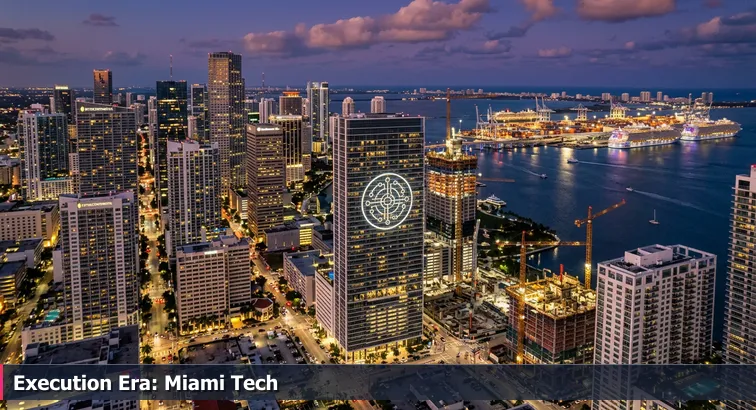
Across February, South Florida’s tech story shifted from slogans to numbers. Palantir’s headquarters move to Aventura, a proposed Florida Bitcoin reserve, nine-figure funding rounds, and a tight labor market all pointed toward an ecosystem entering what founders described as an “execution era” built around defense, fintech, and applied AI.
From Hype Cycle to Execution Playbook
In the span of a few weeks, Miami-Dade and its neighbors saw a major defense-AI contractor plant its HQ flag in Aventura, Florida lawmakers float a plan to let the state allocate up to 10% of certain public funds into Bitcoin and related ETFs, and South Florida startups in infrastructure and AI close nine-figure raises. Local coverage on South Florida’s technology beat at the Business Journals underscored how quickly the region’s mix of defense, fintech, and enterprise AI has deepened.
What Changed on the Ground
Labor-market data showed the shift most clearly. The median advertised tech salary in South Florida reached roughly $107,000, up 18.5% since early 2024, with roles filled in just 22 days on average. Employers accelerated hiring in:
- Cloud architecture and large-scale infrastructure
- Cybersecurity and incident response
- Data engineering and observability
Companies explicitly branded many of these roles as “AI-proof” - positions that design, secure, or operate the systems AI runs on, rather than competing with it.
Policy Tailwinds in the Background
Layered on top were new and proposed incentives, including expanded R&D tax credits and workforce programs aimed at cybersecurity and advanced manufacturing. Together with Florida’s zero state income tax and comparatively light regulatory touch, those policies signaled that February’s activity was not a one-off spike, but part of a deliberate strategy to make Miami and South Florida a durable, institutionally backed alternative to more heavily regulated coastal hubs.
Ubicquia’s $106M Round and South Florida’s AI-Infrastructure Wave
Funding flows in February showed that Miami’s tech story increasingly ran through the power grid, streets, and back-office pipes, not just consumer apps. The standout deal was Ubicquia’s $106 million raise, a Fort Lauderdale-based smart infrastructure company that closed its round over February 23-24 to scale AI-enabled platforms for streetlighting, traffic management, and public-safety infrastructure across U.S. cities.
Smart Infrastructure as the New AI Beachhead
Ubicquia’s model - embedding sensors and analytics into existing urban hardware - fit a broader South Florida pattern: AI stitched into physical infrastructure rather than speculative products. Local coverage on Refresh Miami’s funding and expansion roundups highlighted how utilities and municipalities were increasingly turning to companies like Ubicquia to cut energy costs, improve reliability, and layer in computer vision for safety and traffic optimization.
- Ubicquia - $106M for AI-enabled streetlighting and smart-city platforms
- FirmPilot - $22M on February 26 for AI tools serving law firms
- Neural Earth - $9M on February 25 for climate-risk analytics
- $100M loan secured by a South Florida operator to scale infrastructure-heavy operations
- $6.5M round for a real-estate AI startup expanding across the region
Legal, Climate, and Real Estate AI Join the Wave
FirmPilot’s bet on AI-native legal workflows and Neural Earth’s focus on turning environmental risk into real-time data for insurers and lenders showed investors backing vertical-specific, revenue-driven AI. The nine-figure loan and the real-estate AI raise added financial infrastructure and property analytics to the mix, while accounting platform Xendoo’s acquisition of Botkeeper’s assets in early March pointed to consolidation around pragmatic, SMB-focused automation.
A Corridor of Applied AI from Miami to West Palm
Corporate commitments beyond Miami-Dade reinforced this infrastructure wave. ServiceNow deepened its AI talent hub in West Palm Beach, a major defense-tech firm established its maritime division headquarters there by February 20, and a long-standing biotech company prepared a Broward County expansion in early March. Together, those moves suggested that the region’s AI story now stretched from Aventura through Fort Lauderdale to West Palm, anchored in tangible systems - logistics, utilities, and labs - rather than hype cycles.
House Bill 183 and Miami’s Shift to Institution-Grade Crypto
Florida’s crypto experiment moved from conference talk to proposed statute in February, when lawmakers introduced House Bill 183. The bill would authorize the state’s Chief Financial Officer to allocate up to 10% of select public funds - including the General Revenue and Budget Stabilization funds - into Bitcoin and regulated Bitcoin ETFs, signaling that Tallahassee was willing to test digital assets as part of an official reserve strategy.
What HB 183 Actually Proposed
Reporting on Florida’s revived Bitcoin reserve push noted that the language was deliberately cautious. As detailed in Bitcoin Magazine’s coverage of HB 183, the measure would not force the CFO to buy Bitcoin; it would simply permit exposure within a defined slice of state funds and only through approved, custodial channels.
- Treat Bitcoin as a long-term reserve asset, alongside traditional instruments
- Use Bitcoin ETFs to simplify custody, reporting, and compliance
- Flag Florida as the most openly crypto-positive large U.S. state
From Beach-Token Hype to Institutional Crypto
On the ground in Miami, the policy shift tracked with a different mix of crypto companies in Brickell. Firms such as Cypator and Maple Finance targeted “institutional-grade tokenization” - KYC’d, compliant platforms serving banks, funds, and corporates rather than retail speculators. And on February 20, Nakamoto Inc. (NAKA) closed its acquisition of BTC Inc. and UTXO Management, creating a combined media-and-asset-management player built around Bitcoin’s institutionalization, a deal noted in follow-up analysis on Yahoo Finance’s look at Florida’s crypto strategy.
Risk, Reward, and a State-Level Stress Test
Critics worried that tying as much as a tenth of critical public funds to a volatile asset class could amplify fiscal risk during downturns. Backers countered that limiting exposure, routing it through ETFs, and leaving timing to the CFO’s discretion kept the experiment within prudent bounds. For Miami’s fintech founders and crypto infrastructure teams, HB 183 read as an invitation: build for regulated capital, not just the next bull run.
Florida Venture Capital Conference, Pitch Day, and New VC Models
Investor conversations in February revolved around discipline rather than euphoria. At the Florida Venture Capital Conference on February 25, 2026, managing partner Brian Model described today’s environment as a “divided” market where AI-native startups with clear value propositions still raised substantial rounds, while everyone else faced tougher questions on margins, burn, and customer traction. Conference coverage from regional outlets emphasized that founders outside the AI-first narrative now had to demonstrate “profitability and runway discipline” to get term sheets.
Florida-Israel Pitch Day and Cross-Border Deal Flow
Earlier in the month, on February 4, FloridaCommerce, SelectFlorida, and the Florida-Israel Business Accelerator hosted the second Florida-Israel Pitch Day in Tallahassee. The event brought seven advanced Israeli tech firms in front of state agencies, corporates, and investors, with a focus on sectors where Florida is leaning in hardest.
- Cybersecurity
- Defense and dual-use technologies
- Ag-tech and water technologies
- Advanced manufacturing and health tech
According to the official recap on FloridaCommerce’s news center, many of these companies framed Miami and South Florida as their default U.S. base, citing flight connectivity, bilingual talent, and growing access to capital. A complementary analysis on Florida Inno’s report on the pitch day noted that state leaders saw the event as part of a broader effort to position Florida as a global tech bridge.
Integrated Capital and a Maturing Ecosystem
Venture models themselves continued to evolve. Erick Gavin joined Edin Capital as a General Partner to build an “Integrated Capital” strategy in South Florida, blending equity, credit, and hands-on support for later-stage founders. Meanwhile, Miami climbed to 22nd place globally in Startup Genome’s latest ecosystem rankings, a signal that more ex-Silicon Valley and New York investors were now writing checks from Brickell and Wynwood. For founders, February reinforced that capital was available locally - but increasingly reserved for AI-native or revenue-resilient businesses that could survive a tougher underwriting lens.
Jobs and Pay: Miami’s Fast-Filling, High-Paying AI-Proof Roles
While headlines focused on HQ moves and funding, February’s data on hiring showed how quickly Miami’s tech economy had tightened. Local reports described a market where advertised salaries were high, roles were being filled faster than in most other occupations, and employers were competing hardest for people who could architect, secure, and scale the systems that AI depends on.
What Employers Actually Hired For
Analyses of South Florida postings by groups like MiamiTechWorks found companies prioritizing what hiring managers called “AI-proof” roles: jobs that are difficult to automate because they require systems thinking, security judgment, or deep infrastructure expertise. These roles cut across industries, from banks in Brickell to logistics operators near the airport and healthcare systems in Broward.
- Cloud and distributed systems engineers who can design resilient, multi-region architectures
- Cybersecurity analysts and incident responders to lock down fintech, health, and exchange platforms
- Data engineers and platform specialists focused on ETL, warehousing, and observability
- Systems integrators who can connect legacy stacks to modern AI services safely
AI Readiness as a Leadership Mandate
Local experts quoted in ecosystem coverage argued that by 2026, AI literacy was no longer a bonus skill but an expectation. A national AnitaB.org tech job market report for 2026 echoed that theme, noting that boards increasingly treated AI strategy as a core executive responsibility rather than an R&D experiment. In South Florida, that translated into CTOs and VPs of Engineering seeking candidates who could both automate routine work and harden critical infrastructure.
For workers on the ground, the message was straightforward: candidates who could pair solid software fundamentals with cloud, security, and data-infra experience had leverage. Recruiters reported that experienced engineers and security professionals were often entertaining multiple offers, and that even mid-career professionals from non-tech sectors could pivot into higher-paying roles if they could demonstrate hands-on skills with modern stacks rather than just certificates.
Nucamp and Practical Upskilling Paths for Miami Tech Workers
For Miami tech workers watching salaries climb and job postings tilt toward cloud, security, and data roles, February underscored a practical question: how to retool quickly without stepping out of the workforce. Alongside university initiatives, part-time bootcamps like Nucamp’s online coding programs offered one of the more accessible on-ramps for career changers and mid-career professionals across South Florida.
Nucamp positioned itself as a low-debt alternative to traditional programs: tuition for core tracks ranged from $2,124 to $3,980, with schedules designed around 10-20 hours per week. That format mattered in a market where many aspiring engineers and security analysts were working full-time in hospitality, logistics, or banking while trying to pivot into higher-paying tech roles. Small cohorts with live instruction and included career services also aimed to close a gap local employers often cited: candidates with certificates but little evidence of hands-on project work.
The most relevant Nucamp offerings for Miami’s “AI-proof” hiring patterns were concentrated in four tracks:
| Program | Duration (weeks) | Tuition (USD) | Best Fit |
|---|---|---|---|
| Cybersecurity Fundamentals | 15 | $2,124 | IT/help-desk staff moving into SOC or security analyst roles |
| Back End, SQL and DevOps with Python | 16 | $2,124 | Analysts and junior devs targeting data-heavy backend or infra work |
| Full Stack Web and Mobile Development | 22 | $2,604 | Career switchers aiming at product-focused startup roles |
| Solo AI Tech Entrepreneur Bootcamp | 25 | $3,980 | Domain experts who want to build and launch AI-driven products |
In practice, that meant a help-desk technician in a Brickell bank could use the cybersecurity track to step into compliance-heavy roles at exchanges or defense contractors, while a real-estate analyst in Doral might take the backend/SQL program to join one of the region’s new property-analytics startups. For founders and hiring managers, these kinds of targeted, portfolio-driven programs expanded the local pool of candidates ready to work on real systems rather than just theory.
SB 1076, Workforce Grants, and Florida’s Semiconductor Ambitions
Policy moves in Tallahassee during February underscored Florida’s bid to be a low-friction home for R&D-heavy companies. Senate Bill 1076 (2026) proposed raising the statewide cap on the state’s Research and Development Tax Credit, allowing more firms to offset corporate income tax with qualified R&D spending. According to the official analysis on the Florida Senate’s SB 1076 bill page, the goal was to expand access beyond a small pool of early filers.
R&D Credits Aimed at Builders
For Miami-based software and hardware startups - whether working on defense AI, chip-design tools, or smart-city infrastructure - the proposed expansion translated to a lower after-tax cost of experimentation. If enacted, SB 1076 would particularly benefit firms that can document substantial in-house development, encouraging founders to keep engineering teams in South Florida rather than shifting them to other states.
- Reducing the effective cost of prototyping new products and features
- Rewarding companies that invest in internal engineering rather than pure outsourcing
- Strengthening the case for locating R&D hubs in Miami, Fort Lauderdale, and West Palm
Workforce Grants for Tech-Enabled Manufacturing
Complementing tax incentives, Florida’s Manufacturers’ Workforce Development Grant Program targeted small manufacturers adopting advanced equipment and upgrading cybersecurity. The bill analysis for related legislation such as SB 528 highlighted support for training on new machinery and explicit funding for cyber defenses, a direct boost to industrial and logistics clusters in places like Hialeah, Doral, and northern Broward.
Semiconductors and a Statewide Tech Corridor
Florida’s semiconductor ambitions also came into focus. The Florida Semiconductor Summit, held in Orlando from February 23-25, 2026, spotlighted Osceola County’s NeoCity as a microelectronics hub, while the Florida Semiconductor Institute recognized work by the University of South Florida’s engineering college. Tampa Bay logged five consecutive years of more than 10 million square feet of industrial absorption, and Jacksonville AI firm NLP Logix shifted from experimentation to enterprise-wide deployment. For Miami, those developments meant a growing in-state market for chip, logistics, and AI solutions - often accessible via hybrid or remote roles anchored in South Florida’s higher-paying tech economy.
Wynwood, Brickell, and Miami’s Maturing Tech Community
On the sidewalks between Wynwood’s warehouses and Brickell’s glass towers, Miami’s tech scene in February looked less like a transient boom and more like a community settling in. After-work meetups, founder circles, and Spanish-and-English networking events drew operators from fintech desks in Brickell, AI startups in Wynwood, and bootstrapped founders from Little Havana and Doral into the same rooms.
Local organizers leaned into that blend of culture and code. Groups highlighted in ecosystem coverage ran hands-on coding nights, small-group founder sessions, and events like “Cafecito & Pastelitos,” launched by Saif Ishoof and his team at Lab22C, that explicitly rejected pitch-deck theater in favor of long-term relationships. South Florida Tech Hub promoted a steady calendar of these gatherings, using channels like its regional community feed on Instagram to connect newcomers with user groups, hack nights, and hiring managers.
Geographically, the center of gravity continued to run along a Wynwood-Brickell axis. Wynwood’s art spaces and flexible lofts hosted early-stage AI, climate, and logistics founders, while Brickell’s high-rises concentrated the lawyers, bankers, and scale-up executives who could finance and formalize their ideas. Operators described a daily flow: product and engineering discussions in Wynwood coworking spaces by day, then investor and customer conversations over Brickell coffees or rooftop events in the evening.
That buzz, however, coexisted with sharper debates over what kind of tech hub Miami wanted to be. Protests around Palantir’s Aventura headquarters opening brought privacy and foreign-policy concerns into local streets and city commission meetings. In a widely shared piece, Prism Reports framed the relocation as “a victory in Denver and a warning in Miami,” arguing that hosting powerful surveillance and targeting platforms demanded stronger civic oversight.
For many Miami technologists, the net effect was clarifying rather than chilling. The city’s comparative advantage remained its speed, openness to experimentation, and mix of cultures. The emerging challenge, as community leaders saw it in February, was to preserve that pro-innovation edge while taking seriously the residents raising questions about how AI, defense tools, and data infrastructure would actually be used in their neighborhoods.
How to Position Yourself for Miami’s ‘Execution Era’
Looking ahead from February 28, 2026, Miami’s tech community faced a practical question: how to turn a month of big headlines into durable careers, companies, and returns. With defense AI, institutional crypto, and infrastructure startups taking the lead, the people who benefited most were those who aligned their own moves with where capital and policy were actually flowing.
For tech workers and job seekers, the playbook centered on specialization around AI rather than inside it. Roles that designed cloud architectures, secured financial and healthcare systems, or built data pipelines were in highest demand. Upskilling paths ranged from university certificates to focused bootcamps and community courses; local coverage on Refresh Miami’s education and workforce reporting highlighted a steady rise in part-time programs tailored to working adults. The candidates who advanced fastest tended to bring a small portfolio of shipped projects or open-source contributions, not just course completions.
For founders, February reinforced that “AI-native and revenue-serious” was more than a slogan. Investors wanted products that embedded AI into clear workflows in defense, fintech, logistics, or professional services, backed by disciplined unit economics. Savvy teams also worked closely with advisors to tap emerging state tools - such as expanded R&D credits or manufacturing workforce grants - rather than relying solely on equity raises. As several speakers at recent venture events put it, the bar had moved from “can you raise?” to “can you get paid?”
For investors, the opportunity lay in being physically present and thesis-driven. Spending time in Brickell and Wynwood gave earlier access to founders than waiting for decks to arrive from the coasts, while scanning statewide clusters - in semiconductors, logistics, and enterprise AI - opened differentiated bets under the same pro-business umbrella. Analyses on outlets like South Florida’s technology pages at the Business Journals suggested that volatility around defense and crypto policy would likely create entry points for patient capital.
Across all three groups, the through line was the same: Miami’s “execution era” rewarded those who could move quickly, build for real customers, and navigate a policy environment that favored experimentation over restriction.
This month’s latest tech news in Atlanta, GA (Feb 28, 2026) - private capital and jobs update
Breaking: NYC tech snapshot - Runway, Vestwell, Talkiatry mega-rounds and Albany AI rules
Bookmark this Detroit tech news update for insights on Nucamp pathways and local workforce shifts in 2026.
Austin tech news February 28th 2026 update on $1.5B funding and data center investments
Boston tech and biotech update - agentic AI, biomanufacturing, and Route 128 moves

Irene Holden
Operations Manager
Former Microsoft Education and Learning Futures Group team member, Irene now oversees instructors at Nucamp while writing about everything tech - from careers to coding bootcamps.