









This Month's Latest Tech News in San Francisco, CA - February 28th 2026 Edition
By Irene Holden
Last Updated: March 4th 2026
Key Takeaways
- OpenAI closed a $110B commitment round, valuing it at about $840B in late February 2026.
- Block cut about 40% of its workforce, roughly 4,000 roles, in late February 2026.
- Anthropic raised about $30B, valuing it above the combined market caps of Salesforce and Uber in February 2026.
- San Francisco office vacancy rate dipped to about 30.5% in early 2026 per Avison Young.
- SB 238 requires employers to disclose workplace surveillance tools by Feb 1, 2026, affecting mid-size and large tech firms.
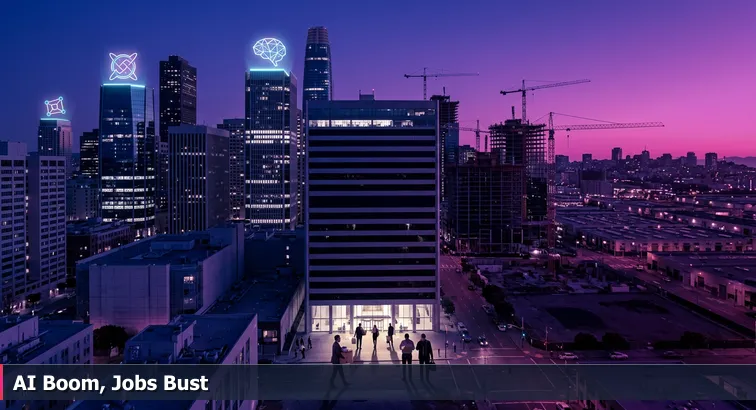
San Francisco ended February with a striking contradiction: the city sat at the center of the global AI race even as local tech workers absorbed what the San Francisco Examiner described as a “jobless AI boom,” with tech jobs plateauing despite surging valuations and new data center build-outs across the region. That label captured the mood in SoMa and South Bay office parks as capital records fell while hiring managers froze reqs.
On the capital side, a handful of AI “primes” pulled in sums more commonly associated with national budgets. OpenAI reportedly secured a commitment round of about $110 billion, driving its post-money valuation to roughly $840 billion. Anthropic raised around $30 billion, a level that Bay Area business press noted eclipsed the combined market caps of Salesforce and Uber. Waymo kicked off the month with a $16 billion mega-round on February 2 to fund robotaxi expansion, while infrastructure players from Cerebras Systems to SambaNova closed additional billion-dollar-plus deals. Super Micro Computer extended the physical footprint of this boom, buying roughly 115,000 square feet in North San Jose for AI server manufacturing and offices.
Across the same weeks, the pink slips stacked up. Block (Square/Cash App) shocked the city by announcing layoffs of about 40% of its workforce - roughly 4,000 roles - explicitly tying the cuts to AI-driven efficiencies. Amazon filed WARN notices to eliminate 769 Bay Area jobs (666 in Santa Clara County, 103 in San Francisco), while Meta disclosed another 102 local layoffs in Menlo Park and Sunnyvale, largely in Reality Labs. Salesforce warned that as many as 4,000 roles could be at risk as it rolls out AI agents in support and sales, and Pinterest cut more than 100 Bay Area jobs as it pivoted toward “AI-proficient talent.”
The result, as chronicled in the Examiner’s analysis of San Francisco’s AI boom and tech jobs plateau, was a split-screen economy: record AI capex coursing through a few hyperscale winners and infrastructure vendors, even as mid-career engineers, product managers, and operations staff across SoMa, Mission Bay, Palo Alto, and Sunnyvale faced thinner job boards and severance letters citing “AI redundancy.” For many Bay Area households, February’s AI headlines translated less into opportunity than into pressure to retrain or relocate.
In This Update
- Record AI funding versus real Bay Area job losses
- OpenAI, Anthropic, and Waymo mega-rounds reshaping the market
- Intel, Cerebras, SambaNova, and the AI hardware build-out
- Agentic and embodied AI: ElevenLabs, Bedrock Robotics, and Farcast
- Block, Amazon, Meta, Salesforce: who’s cutting roles and why
- Y Combinator, YC alumni, and pockets of aggressive hiring
- Office comeback: Salesforce, RTO trends, and the new commute
- Nucamp: affordable part-time reskilling for displaced workers
- BUILD Act: Mayor Lurie’s transfer-tax cut to unlock development
- California AI and labor rules: SB 238, AB 2013, and wage hikes
- Ethan Agarwal vs. Ro Khanna: the billionaire tax political flashpoint
- Anthropic and OpenAI under pressure: safety, defense, and markets
- Model theft and distillation attacks: the new IP risk landscape
- What to watch next and how to position your career in 2026
This latest AI and US tech news story breaks down capital, jobs, and policy shaping the industry.
OpenAI, Anthropic, and Waymo mega-rounds reshaping the market
While February’s headlines fixated on layoffs, three San Francisco-anchored giants quietly rewrote the funding playbook for the AI era, concentrating unprecedented financial firepower in a handful of “AI primes.” OpenAI, Anthropic, and Waymo each came out of the month with war chests sized less like traditional venture rounds and more like sovereign infrastructure budgets, signaling that AI would be built around a few hyperscale platforms rather than a broad field of equals.
OpenAI’s latest commitment round effectively turned the company into a long-term sink for GPU and cloud capex. Reporting from TechCrunch on the billion-dollar infrastructure deals indicated that Nvidia alone expected to contribute an enormous volume of in-kind compute over the coming years, tying OpenAI’s roadmap tightly to the chipmaker’s data center pipeline and cementing San Francisco’s role as the software brain of that stack.
Anthropic’s raise, meanwhile, pushed the firm into the same valuation conversation as legacy Bay Area stalwarts despite having a fraction of their headcount. Local business coverage emphasized that its market value now rivaled - and by some estimates exceeded - the combined capitalization of Salesforce and Uber, underscoring how quickly capital had rotated out of mature SaaS and ride-hailing into foundation model bets. That shift came even as Anthropic faced scrutiny over how its safety-first brand would coexist with mounting demand from defense and surveillance customers.
Waymo’s early-February mega-round positioned the Alphabet subsidiary as the capital-intensive spearhead of “embodied AI” in the region. Analysts projected that the cash would fund an aggressive rollout of robotaxis across downtown San Francisco, San Jose, Los Angeles, and selected overseas cities over the next 18-24 months, deepening the city’s experiment with autonomous mobility. As the San Francisco Business Times’ week-in-AI recap noted, the common thread was clear: these bets required staggering capex, but relatively lean teams, reinforcing a market structure where a few local winners wielded outsized influence over jobs, suppliers, and regulators.
Intel, Cerebras, SambaNova, and the AI hardware build-out
Behind February’s record software valuations, a quieter story played out in labs and light-industrial parks from North San Jose to Sherman, Texas: the AI boom depended on an aggressive build-out of chips, optics, and servers. While San Francisco model labs grabbed headlines, South Bay hardware players and out-of-state fabs bore the cost and complexity of keeping that compute flowing.
South Bay-based Cerebras Systems closed roughly $1 billion in Series H funding on February 3-4, doubling down on its wafer-scale processors aimed squarely at foundation model training. Its neighbor SambaNova secured about $350 million plus a new partnership with Intel, tying its roadmap to next-generation accelerators and data center build-outs. Both companies exemplified a capital-intensive, low-headcount reality: vast sums poured into specialized silicon with only modest additions to local payrolls.
On the systems side, Super Micro Computer continued its rapid expansion, adding new office and manufacturing space in North San Jose to assemble the high-density AI servers now powering OpenAI- and Anthropic-scale clusters. Local coverage of Super Micro’s move in the Mercury News’ report on San Jose’s tech economy underscored how industrial corridors long written off as legacy are being retooled for liquid-cooled racks and just-in-time GPU supply.
Chipmakers stressed that bandwidth, not just raw compute, would define the next phase. In a Bloomberg Technology interview, an Intel executive argued that “as we move forward, we see a massive ramp in the amount of data center connections will be based on light and optical photonics,” calling photonics “incredibly power efficient” at higher data rates. Intel said it was effectively doubling its photonics capacity, including new laser work in Sherman, Texas, to feed AI data centers from Santa Clara to Phoenix, according to the Bloomberg segment on AI infrastructure spending.
The net effect for the Bay Area was clear: AI’s software crown jewels remained in San Francisco, but the physical build-out stretched across lower-cost regions, leaving local workers more exposed to model-driven disruption than to the manufacturing and construction jobs created by the boom.
Agentic and embodied AI: ElevenLabs, Bedrock Robotics, and Farcast
Beyond the giant model labs, February’s AI story in the Bay Area also ran through a new class of “agentic” and embodied startups that automate work end-to-end rather than just generating content. Voice AI firm ElevenLabs, construction-focused Bedrock Robotics, and satellite-adjacent Farcast all advanced plans that brought AI deeper into call centers, job sites, and communications networks tied into San Francisco’s tech economy.
ElevenLabs, which has major investors and operations connected to the Bay Area ecosystem, closed a $500 million Series D at roughly an $11 billion valuation for its ElevenAgents platform, giving enterprises plug-and-play voice agents for support and internal workflows. Industry roundups in International Banker’s 2026 tech trends report flagged “agentic AI” as one of the year’s defining themes, noting that a single deployed agent can handle volumes once requiring dozens of human reps.
San Francisco-based Bedrock Robotics pushed AI directly into the physical economy, raising about $270 million Series B funding on February 4 to deploy autonomous construction equipment. That model typically trades a larger pool of on-site operators for a smaller cadre of higher-paid robotics technicians, field engineers, and remote supervisors - a boon for specialized talent, but a clear signal that some traditional roles on Bay Area and national job sites will shrink.
“All the advantages you had become anchors holding you back from doing the right thing.” - Bret Taylor, former Co-CEO, Salesforce
Taylor’s February remark, captured in a VC commentary on key tech quotes, resonated as AI-native companies like Farcast emerged with lean, automation-first org charts. Highlighted among Via Satellite’s “10 hottest companies in satellite for 2026,” Farcast’s flat-panel antennas support high-throughput links for edge AI in defense, maritime, and remote operations. Together, these agentic and embodied players illustrated how AI is beginning to replace not only screen work, but also physical and coordination tasks - compressing labor needs overall while opening a premium tier of robotics, ML, and systems-integration roles for those able to retrain into them.
Block, Amazon, Meta, Salesforce: who’s cutting roles and why
Inside the Bay Area’s biggest employers, February’s AI story landed hardest on payroll. Even as revenue held up, leadership teams at Block, Amazon, Meta, and Salesforce moved to shrink headcount, telling investors they could use AI tools to do more with fewer people. For mid-career staff in San Francisco and the Peninsula, “AI efficiency” shifted from an abstract buzzword to the line item that justified their job being automated away.
Block’s late-month cuts were the most dramatic locally, wiping out thousands of roles across Square, Cash App, and corporate operations. In WARN filings and internal memos, executives pointed to automation of fraud review, customer support, and back-office workflows as justification. A February recap from Computerworld’s 2026 tech layoff timeline grouped Block with a broader wave of “AI-fueled” reductions that hit Bay Area fintech and SaaS firms despite healthy balance sheets.
Amazon followed a more incremental path, notifying state regulators that hundreds of Bay Area jobs in Santa Clara County and San Francisco would disappear by late April. Those cuts landed in corporate and operations units that had spent the last two years rolling out machine-learning driven forecasting, logistics, and internal tooling - exactly the areas where managers now argued they could support the same output with a leaner team.
Meta’s February moves underlined how quickly strategy was shifting away from the metaverse and toward AI and wearables. The company filed plans for additional Peninsula layoffs, largely in Reality Labs, after already reducing that division’s staff and cutting 318 Menlo Park jobs in a previous round. A spokesperson told the Times of India’s tech desk that Meta would “reinvest the savings to support the growth of wearables,” while CEO Mark Zuckerberg has signaled plans to pour more than $115 billion into AI tooling to make teams “leaner and more productive.”
Salesforce, for its part, warned staff that thousands of positions - particularly in customer support and lower-value sales roles - were vulnerable as the company pilots AI agents to triage tickets and qualify leads. Together with Pinterest’s pivot toward “AI-proficient talent,” the pattern was consistent: large Bay Area incumbents used February to reset cost structures and signal to Wall Street that every non-differentiated function was now fair game for automation.
Y Combinator, YC alumni, and pockets of aggressive hiring
Amid the layoffs and hiring freezes at brand-name employers, a different story ran through San Francisco’s seed and growth ecosystem in February: select AI-native startups and Y Combinator alumni quietly accelerated hiring, especially for engineers who can ship product around large models rather than just consume them.
Y Combinator closed applications for its Spring 2026 batch on February 9, with the program scheduled to convene in April at its San Francisco campus. That timing meant dozens of pre- and post-YC teams were already recruiting locally to hit the ground running. YC’s own directory of Bay Area startups actively hiring showed roles across HR-tech, analytics, robotics, and AI infrastructure, from payroll platforms to lab-grown biology, concentrated in neighborhoods like SoMa and the Mission, according to the Y Combinator Bay Area hiring board.
On the fintech and AI side, February’s funding tape pointed to where headcount growth was most likely:
- Veritus, a San Francisco startup building AI voice agents for lending, raised $10.1 million in seed capital.
- Anchorage Digital secured $100 million from Tether at a $4.2 billion valuation to expand crypto custody and infrastructure.
- Kana, founded by veterans of Rapt and Krux, emerged from stealth with $15 million to build customizable AI marketing agents.
- Generative video company Runway drew a new round valuing it at about $5.3 billion, positioning it to selectively add research and go-to-market talent.
As FintechFutures’ February funding roundup noted, these companies were not hiring thousands, but they were making targeted senior and mid-level additions in AI engineering, security, and sales engineering.
The result for Bay Area workers was a sharply split market. Senior AI researchers, infra engineers, and robotics specialists could still command multiple offers from YC-stage and Series B companies. By contrast, generalist web developers, adtech operators, and non-technical roles saw fewer openings and steeper competition, pushing many to consider upskilling or accepting smaller equity-heavy packages at earlier-stage, AI-first startups.
Office comeback: Salesforce, RTO trends, and the new commute
By late February, downtown San Francisco’s recovery remained fragile but tangible. Despite headline layoffs, office towers in SoMa and the Financial District saw more badges at turnstiles as AI firms and cloud incumbents quietly expanded footprints. Commercial real estate analysis cited by Avison Young showed the city’s office vacancy rate edging down to about 30.5% in early 2026, helped by more than 5 million square feet of space leased by AI and tech companies across SoMa, the Financial District, and Mission Bay, according to an office recovery report.
Return-to-office policies hardened alongside that uptick. KPMG’s 2026 perspectives on the local market found that roughly 79% of San Francisco employers were increasing in-office requirements, reversing the fully remote norms of 2021-23. Salesforce went further, shifting many teams to a four-day-a-week schedule at Salesforce Tower and nearby buildings, a move closely watched by other downtown anchors, as outlined in KPMG’s San Francisco insights.
The new hybrid patterns reshaped daily life as much as company culture. Commutes clustered around Tuesday through Thursday, when Caltrain and BART cars leaving the Peninsula and East Bay were noticeably fuller. Around Salesforce Tower, the Transbay Terminal, and the Second/Third Street corridors, surviving coffee shops and lunch spots reported steadier weekday business after years of whiplash.
In the South Bay, North San Jose and Santa Clara’s light-industrial strips felt the same pull as Super Micro and other AI hardware players added staff on-site. For workers, the message was clear: even in a “jobless AI boom,” employers with the leverage to demand in-person collaboration were using it, leaving many laid-off or remote-first tech employees weighing whether to accept longer commutes, move closer to downtown, or chase fully remote roles outside the Bay Area altogether.
Nucamp: affordable part-time reskilling for displaced workers
For San Francisco tech workers who lost roles in February’s “jobless AI boom,” the most immediate question was how to become employable again without blowing through savings. One practical, market-driven option has been Nucamp, an online bootcamp that focuses on part-time, affordable training for people pivoting into software, cloud, cybersecurity, and AI-adjacent work.
Nucamp’s programs are structured around roughly 10-20 hours per week, allowing laid-off engineers, ops staff, or support leads to retrain while consulting or job-hunting. Tuition sits well below most Bay Area bootcamps, with core tracks priced in the low thousands rather than five figures, and cohorts are taught live in small groups instead of via self-paced videos.
| Program | Duration (weeks) | Tuition (USD) | Weekly Time |
|---|---|---|---|
| Full Stack Web & Mobile Development | 22 | $2,604 | 10-20 hours |
| Back End, SQL & DevOps with Python | 16 | $2,124 | 10-20 hours |
| Cybersecurity Fundamentals | 15 | $2,124 | 10-20 hours |
| Solo AI Tech Entrepreneur Bootcamp | 25 | $3,980 | 10-20 hours |
In practice, that means a former Block operations analyst could use the Back End, SQL & DevOps track to move into data-heavy backend roles at fintechs, while a SaaS support lead facing AI agents could pivot through Cybersecurity Fundamentals into compliance or security analyst positions at AI labs. For senior PMs or would-be founders, the Solo AI Tech Entrepreneur Bootcamp offers a way to prototype products on top of large language models without needing a dedicated engineering co-founder.
Because Nucamp operates fully online, Bay Area workers can enroll without relocating or waiting for new state programs. Full program details and start dates were available on the official Nucamp bootcamp catalog, which many February layoff cohorts quietly circulated in Slack channels as they weighed whether to double down on tech or exit the industry altogether.
BUILD Act: Mayor Lurie’s transfer-tax cut to unlock development
In a month dominated by AI mega-rounds and layoffs, San Francisco’s most consequential policy move for tech and real estate quietly came on February 27, when newly installed Mayor Daniel Lurie proposed the BUILD Act. The measure would cut the city’s transfer tax in half on property sales above $10 million, a direct attempt to thaw a market where high transaction costs have helped keep major office and housing projects stuck on the sidelines.
Supporters argue the city’s current transfer tax - among the highest in the nation on large deals - has turned downtown office towers and development sites into “stranded assets.” A breakdown from civic group GrowSF on the proposed BUILD Act transfer-tax cut framed the bill as a way to “unfreeze” stalled SoMa and waterfront projects, accelerate office-to-residential conversions, and make it financially viable to reposition aging buildings for AI labs and modern tech offices.
For the AI sector, lower transfer taxes would reduce friction for everything from distressed office sales to new lab and data-heavy builds near transit. Developers courting anchor tenants like OpenAI-scale labs or robotics firms could rework capital stacks, potentially making San Francisco more competitive with lower-tax markets such as Austin or Miami that have been luring founders away.
Critics, including some progressive supervisors and housing advocates, have questioned whether the cut would amount to a windfall for landlords without firm guarantees of affordability or tenant protections. They warn it could shrink near-term revenue for city services already under pressure. As the San Francisco Chronicle’s political coverage noted, the debate has become a proxy for a larger question: should City Hall prioritize tax relief to spur growth, or lean on high earners and property owners to backfill budget gaps in an uncertain AI transition?
California AI and labor rules: SB 238, AB 2013, and wage hikes
Even as capital flooded into San Francisco’s AI labs in February, California’s regulatory tide moved the other way, adding new compliance layers for employers and startups. Several laws shifted from theory to enforcement this month, forcing Bay Area founders to think as much about legal exposure as model quality.
By February 1, 2026, SB 238 required employers to disclose all workplace surveillance tools to the state - explicitly including AI-driven monitoring and productivity systems. That swept in everything from keystroke trackers to call-center analytics used by mid-size and large tech employers in San Francisco. Legal analysts at JD Supra’s overview of new California AI laws noted that companies must inventory and justify a sprawling array of tools, adding overhead for HR and compliance teams that early-stage startups rarely have.
For AI builders, AB 2013 introduced its own headaches by mandating disclosure of key details about the datasets used to train and fine-tune generative models. San Francisco teams experimenting with domain-specific LLMs on scraped web data or sensitive internal corpora now faced the risk that transparency requirements could expose IP strategy or invite lawsuits, even as regulators framed the law as a transparency and consumer-protection win.
At the same time, California’s statewide minimum wage rose to about $16.90 per hour in 2026, lifting pay for cafeteria workers, janitorial staff, security, and nearby retail that support major tech campuses. An ABC10 explainer on new state laws highlighted the wage increase alongside other worker protections.
Supporters argued these measures protected privacy and ensured AI developed in California met higher ethical standards. But many Bay Area founders privately warned that the combination of dataset rules, surveillance reporting, and higher baseline labor costs would nudge the next wave of AI companies to put their core entities - and future hiring - outside the state, while keeping only a thin research presence in San Francisco for talent access.
Ethan Agarwal vs. Ro Khanna: the billionaire tax political flashpoint
Political fault lines in Silicon Valley sharpened in February when tech entrepreneur Ethan Agarwal formally launched a challenge to Rep. Ro Khanna, turning a traditionally safe Democratic seat into an unexpected referendum on how hard California should lean on its wealthiest residents. The race quickly centered on a proposed “billionaire tax” and broader efforts to tax high earners and capital gains, with Agarwal casting himself as a pro-growth alternative for founders and senior engineers who feel increasingly targeted by Sacramento and Washington.
Khanna, a prominent voice on progressive economic policy, has backed measures to raise taxes on ultra-wealthy investors and large platforms, arguing that outsized tech fortunes should do more to finance social programs and safety nets. Agarwal has countered that rhetoric by warning of a slow-motion capital and talent flight, as senior engineers and founders quietly move to Nevada, Texas, or Florida to avoid future hikes on income and unrealized gains. Reporting in the San Francisco Chronicle described the contest as a test of Silicon Valley’s patience with the Democratic establishment’s tax agenda.
For Bay Area tech workers, the stakes go beyond billionaires. A more aggressive wealth-tax regime would hit not only unicorn founders but also employees with substantial equity in companies like OpenAI-adjacent startups, fintechs, and AI infrastructure vendors. The prospect of higher state and federal burdens is already being weighed alongside compensation and remote options when workers decide whether to plant long-term roots in San Francisco or relocate.
This political clash unfolded against a backdrop of widespread tech layoffs and mounting concern over the region’s competitiveness. A February roundup from the SF Bay Area Times’ analysis of regional tech layoffs underscored how fragile confidence had become: thousands of job cuts, soaring AI valuations, and rising housing and tax costs. In that environment, Agarwal’s message that California risks “taxing away” its AI edge resonated with some donors and mid-career professionals, while Khanna’s allies argued that sustainable growth requires asking more from those who have benefited most from the boom.
Anthropic and OpenAI under pressure: safety, defense, and markets
Debates over AI safety in San Francisco shifted from abstract ethics to urgent business questions in February, as Anthropic and OpenAI navigated rising pressure from governments and large enterprises. Both companies now command private valuations in the hundreds of billions, yet they were pulled between earlier pledges of caution and the realities of defense, surveillance, and high-stakes commercial work.
Anthropic, long branded as the “safety-first” lab, faced scrutiny after reporting suggested it was relaxing some internal guardrails to stay competitive. A widely discussed TechCrunch analysis argued the company had built a “trap” for itself by promising unusually strict safety standards, only to find that major customers - including defense and security agencies - wanted more capable systems, faster. Bloomberg commentators echoed that tension in late-February segments, noting investor expectations that Anthropic match rivals on performance even if it meant revisiting earlier commitments.
OpenAI confronted similar crosswinds. As it expanded enterprise offerings and explored defense and intelligence contracts, the company found itself juggling Washington’s appetite for powerful models with California’s growing list of AI constraints. National-security clients pushed for cutting-edge planning and analysis tools, while state rules such as dataset-disclosure mandates raised questions about how transparent frontier labs could be without exposing sensitive training pipelines.
Local coverage in the San Francisco Business Times’ week-in-AI column framed the moment as a stress test for the region’s AI leadership: move too cautiously and risk ceding ground to overseas competitors, or move too aggressively and invite regulatory or political backlash at home. For Bay Area workers, that translated into growing demand for policy, safety, and red-team roles inside these labs - and a front-row view of how much compromise is required when AI safety ideals collide with trillion-dollar markets and national-security imperatives.
Model theft and distillation attacks: the new IP risk landscape
Concerns about AI safety in February did not stop at hallucinations or bias. For labs and startups clustered around San Francisco, a growing worry was that the frontier models they were spending trillions of dollars collectively to build could be quietly copied by rivals abroad through so-called distillation attacks. Rather than stealing weights outright, these attacks aim to reconstruct a powerful model’s behavior by systematically querying it and training a replica on the responses.
Analysts writing for Morningstar’s MarketWatch desk warned that Chinese and other foreign competitors might effectively “steal America’s AI brain” by extracting and reproducing the capabilities of closed-source systems, even without direct access to proprietary code or training runs. Their February piece on whether China could simply clone U.S. models underscored that the stakes were not merely commercial: whoever controls the most capable frontier models could gain leverage in finance, cyber operations, and information warfare, according to the Morningstar analysis of AI model theft risks.
For Bay Area companies, this shifted security from a compliance checkbox to a strategic imperative. Protecting training data, fine-tuning pipelines, and API endpoints became as central as guarding source code was in earlier tech cycles. Enterprises that had rushed to integrate SF-based models into products now had to consider whether their own usage patterns could leak sensitive prompts, proprietary workflows, or customer data that might be folded back into a competitor’s clone.
The new IP risk landscape also changed hiring priorities. Cybersecurity specialists, red-teamers, and ML engineers with experience in model watermarking or abuse detection suddenly found themselves in demand at both foundation-model labs and downstream startups. In a month when many tech workers were reading layoff notices, the message from the AI security front was stark: roles that defend model integrity and data pipelines were becoming some of the most resilient jobs in the Bay Area’s evolving stack.
What to watch next and how to position your career in 2026
Over the next 6-12 months, a few signals will tell Bay Area workers whether this “jobless AI boom” stabilizes or deepens: how aggressively large employers replace roles with automation, which AI-native startups add meaningful headcount instead of just funding, and whether San Francisco’s office recovery continues or stalls. Watching earnings calls, WARN notices, and leasing activity will matter as much as headline valuations when you’re deciding whether to double down on the region or hedge with remote options.
Positioning your career in this environment starts with skills, not slogans. First, get genuinely AI-literate: that means being able to prototype with APIs, understand model limits, and integrate tools into real workflows. Second, specialize near the value chain’s choke points - data engineering, infrastructure, security, and compliance around AI are where demand is tightest. Third, treat every role as a stepping stone; prioritize jobs that expose you to frontier systems, even if title or cash is modest, because that experience compounds faster than incremental compensation.
For engineers and PMs tempted to build rather than join, San Francisco’s accelerator pipeline is still a powerful on-ramp. Programs like the Spring 2026 Y Combinator batch, profiled in resources such as Startup Researcher’s overview of YC opportunities, or evening-friendly cohorts from Founder Institute, give small teams access to capital, mentorship, and a local network of AI partners and early adopters. Manufacturing- and robotics-focused tracks listed by sites like Incubator List’s guide to top accelerators are increasingly relevant as embodied AI spreads into logistics, hardware, and construction.
The broader lesson from February is that generic “tech jobs” are fading, but opportunity hasn’t disappeared - it has narrowed. Workers who treat 2026 as a platform transition, aggressively upgrade into AI-adjacent specialties, and stay clear-eyed about policy and tax risk will be best positioned to ride San Francisco’s next upswing, whether as senior operators inside leaner orgs or as founders of the AI-first companies that follow.
February 2026 Boston tech update - $922M VC, biotech growth, and AI hires
Our February roundup is a breaking Detroit tech update about Ford’s EV strategy shift and the software-defined vehicle push.
Explore this breaking Pittsburgh tech news on AV testing permits, accelerator funding, and local VC activity.
Latest Atlanta tech update: job growth, $200M aerospace bet, and AI supercomputer plans
Follow the This Month's Latest Tech News in Raleigh, NC - February 28th 2026 Edition for insights on careers, startups, and policy in the Triangle.

Irene Holden
Operations Manager
Former Microsoft Education and Learning Futures Group team member, Irene now oversees instructors at Nucamp while writing about everything tech - from careers to coding bootcamps.