









This Month's Latest Tech News in Raleigh, NC - February 28th 2026 Edition
By Irene Holden
Last Updated: March 4th 2026
Key Takeaways
- North Carolina ranked #1 nationally in tech occupation growth, signaling sustained hiring momentum for Triangle workers.
- Microsoft confirmed plans for a 1,350-acre data center campus at the Person County Mega Park.
- About 60% of North Carolina tech jobs are identified as heavily impacted by AI automation.
- Chatham, Gates, and Canton enacted 12-month moratoria on new data center and crypto-mining projects.
- Fujifilm Diosynth opened a $3.2 billion cell culture facility in Holly Springs, the largest in North America.
- DG Matrix raised a $60 million Series A to scale energy-infrastructure technology in the Triangle.
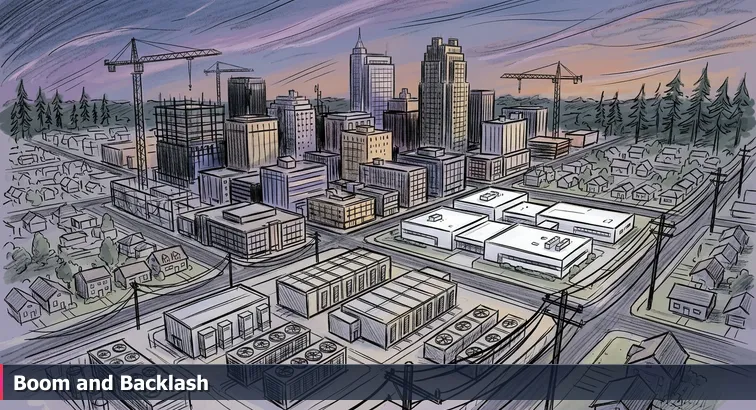
By Feb. 28, the Research Triangle’s tech economy was in rare territory: locking in multi-billion-dollar projects while simultaneously confronting visible backlash against the AI-driven future those projects enable.
On the upside, North Carolina’s tech sector had just been ranked #1 nationally in tech occupation growth from 2019-2024 and #1 for women’s representation in tech, with women making up over 37% of the tech workforce, according to the 2026 State of the Technology Industry Report summarized by NC TECH and outlets such as National Today’s industry breakdown. Those rankings capped a multi-year strategy of pairing low taxes with university-driven innovation.
That strategy paid off again in February. Microsoft moved ahead with plans for a massive data center campus at Person County Mega Park, and life-sciences heavyweights including Fujifilm Diosynth, Genentech, and Novartis continued building out what has become one of the most capital-intensive biomanufacturing corridors in the country. In 2025 alone, North Carolina booked nearly $4 billion in life-sciences investments, much of it concentrated in and around Raleigh-Durham, according to the NC Biotech Center’s investment tally.
Yet the same month brought clear signs of strain. County-level moratoria on new data centers, organized opposition in Apex, and a growing chorus of residents worried about noise, power use, and emissions showed that not every community was eager to host the infrastructure that makes large-scale AI possible. At the same time, local employers openly acknowledged that automation was shrinking their hiring plans, and early-career technologists reported that landing an entry-level role felt markedly tougher than just two years ago.
Together, February’s headlines underscored a high-class problem with real stakes: the Triangle remained one of the best places in the United States to build a tech or life-sciences career, but the on-ramp was getting steeper - and local decisions on AI, land use, and infrastructure were starting to matter as much as the marketing slogans that brought investors here in the first place.
In This Update
- February at a Glance: Record investment, real tension
- NC TECH 2026 report: Why the Triangle still leads nationally
- Microsoft’s Person County data center and biopharma megaprojects
- AI’s labor shock: automation, hiring compression, and the barbell jobs
- Data centers vs. communities: moratoria, noise concerns, and power use
- Startups & VC: Applied AI, energy tech, and deeptech funding in the TR
- University commercialization: NCInnovation, NC State, and UNC spinouts
- Community colleges modernize the pipeline: Durham Tech and Wake Tech
- Politics and AI: PAC spending, election tech, and the regulatory risk
- Statewide signals: Charlotte fintech, manufacturing deals, and cloud s
- What it means for your career or startup in the Triangle
This latest AI and US tech news story breaks down capital, jobs, and policy shaping the industry.
NC TECH 2026 report: Why the Triangle still leads nationally
Released in mid-February, the 2026 State of the Technology Industry Report from NC TECH reaffirmed why the Triangle continued to punch above its weight nationally, even as AI turbulence grew louder.
The report showed North Carolina ranked:
- #1 in tech occupation growth nationally from 2019-2024
- #1 in women’s representation in tech, with women making up over 37% of the tech workforce
- #1 in effective business tax rates and #4 in overall business climate
- #11 in venture capital investment per gross state product and #5 in university R&D in science and technology
NC TECH also underscored how central tech workers had become to the broader economy: every new tech job in North Carolina supported an additional 2.24 jobs across other sectors. Between 2019 and 2024, the state’s tech workforce expanded by roughly 19%, according to coverage of the report from WRAL’s analysis of NC’s tech staying power.
Economist Ted Abernathy, managing partner at Economic Leadership LLC, argued that this performance was no accident but the result of a deliberate mix of private capital and light-touch policy.
“The combination of investment, research, and an increasingly diverse workforce has created a foundation for long-term competitiveness in North Carolina.” - Ted Abernathy, Managing Partner, Economic Leadership LLC
At NC TECH’s “Outlook for Tech” event in Charlotte on Feb. 12, executives from Honeywell, Duke Energy, and other employers used the new data as a jumping-off point to debate AI, workforce gaps, and infrastructure needs, positioning the Triangle as the state’s innovation bellwether. Event materials from NC TECH’s Outlook for Tech launch highlighted the same formula workers see on the ground: competitive taxes, deep university pipelines, and a maturing venture ecosystem that still favors builders.
Microsoft’s Person County data center and biopharma megaprojects
Across February, a handful of mega-projects quietly redrew the Triangle’s economic map, tying Raleigh-Durham’s future even more tightly to cloud infrastructure and advanced biomanufacturing.
On the tech side, Microsoft advanced plans for a 1,350-acre data center campus at the Person County Mega Park, just north of the Triangle. The project, detailed by the Raleigh News & Observer’s report on Microsoft’s new data center site, followed more than $1 billion in prior Microsoft investments across North Carolina and positioned Person County as a key node in the company’s global AI and cloud network.
Biopharma investment ran just as hot. Fujifilm Diosynth Biotechnologies formally opened the first phase of its $3.2 billion cell culture facility in Holly Springs, which regional analysts described as the largest of its kind in North America. In the same town, Genentech said in January it would more than double its original commitment to a total of $2 billion, increasing its hiring plans to 500 roles in advanced manufacturing and support.
| Company | Location | Investment | Jobs / Timeline |
|---|---|---|---|
| Microsoft | Person County Mega Park | 1,350-acre data center campus | Long-term AI/cloud infrastructure buildout |
| Fujifilm Diosynth | Holly Springs | $3.2 billion | Largest North American cell culture site |
| Genentech | Holly Springs | $2 billion | 500 jobs planned |
| Novartis | Durham & Wake counties | $771 million | 700 jobs by 2030 |
Novartis added another anchor, announcing a $771 million expansion in Durham and Wake counties expected to create 700 new advanced pharmaceutical manufacturing jobs by 2030, according to the county’s official release on the Novartis North Carolina expansion.
For Triangle workers, these bets translated into demand for power and process engineers, automation specialists, and data-savvy manufacturing talent. For policymakers, they raised more complicated questions: whether the region could deliver the land, grid capacity, and predictable permitting these projects require without igniting the kind of local backlash that was already emerging around data centers elsewhere in the state.
AI’s labor shock: automation, hiring compression, and the barbell jobs
In February, AI stopped being an abstract talking point and started showing up directly in the Triangle’s job stats. A detailed analysis from Business North Carolina’s “NC Trend: AI portends a ‘highly disruptive’ future” reported that roughly 60% of current tech jobs in North Carolina had been identified as highly exposed to AI-driven automation.
Economist Laura Ullrich, who studied the data, said the strain was most visible at the bottom of the ladder, where recent grads and career changers were competing with tools that could now draft code, summarize documents, and handle basic analysis.
“I don’t think there’s any question that if you’re searching for an entry-level job... it’s a lot harder right now than it was two years ago.” - Laura Ullrich, Economist, Indeed (via Business North Carolina)
The impact was already tangible in the Triangle. One local software firm told economic-development officials it would fall short of a 450-job hiring pledge, explicitly citing AI productivity gains as a reason it no longer needed the planned headcount. Instead of a simple “no jobs” story, the region drifted toward a barbell market: growth in highly skilled roles tied to AI, cloud infrastructure, and advanced manufacturing on one end, and pressure on routine entry-level and mid-skill roles on the other.
For engineers and data scientists in Raleigh-Durham, February’s message was blunt: adapt with AI or be shaped by it. Workers who embraced tools as leverage - automating their own workflows, moving closer to infrastructure, security, or deep domain problems, and avoiding roles dominated by repetitive ticket work - were better positioned to stay on the growth side of the barbell as employers quietly rewrote their hiring plans for the AI era.
Data centers vs. communities: moratoria, noise concerns, and power use
While Microsoft and other cloud providers moved ahead with major builds, February also exposed how divided North Carolina communities were over hosting the data centers that power AI. Several local governments around the Triangle opted for time-outs, even as others rolled out incentives.
Reporting from Axios Raleigh on growing data center opposition documented how Chatham County, Gates County, and the town of Canton each passed 12-month moratoria on new data centers and crypto-mining projects. Local officials said they were responding to resident concerns over land use, noise, and grid strain, but also pointed to state laws that sharply limit permanent “downzoning” to block such facilities outright.
Closer to Raleigh, the town of Apex became an emblem of neighborhood pushback. Residents questioned a proposed roughly 190-acre, 300-megawatt data center, citing the prospect of round-the-clock diesel backup generators, emissions, and industrial-scale equipment near homes. An ABC11 I-Team investigation into Triangle data centers detailed how those concerns were reshaping local politics, with Mayor Jacques Gilbert and town leaders fielding pressure from both residents and developers.
Not every county hit the brakes. Richmond County moved in the opposite direction, offering incentives for Amazon’s planned $10 billion data center campus near Rockingham, while the existing T5 facility in Kings Mountain, near Charlotte, remained the state’s largest, consuming as much electricity as all residential usage in Durham County. Those examples underscored how data centers had already become a statewide power-industry player, not just a Triangle issue.
For investors and employers, the emerging picture was a classic free-market dilemma: project economics depended on cheap, reliable power and predictable permitting, but a patchwork of county-level moratoria and neighborhood fights introduced new risk. For Triangle tech workers, that uncertainty ultimately threatened to show up in higher cloud costs, slower capacity growth, or the quiet decision to place the next high-wage facility in a more welcoming state.
Startups & VC: Applied AI, energy tech, and deeptech funding in the TR
Startup and venture activity in Raleigh-Durham stayed busy in February, even as headlines focused on megaprojects. Local founders continued to close meaningful rounds, particularly where AI meets hard infrastructure and industrial workflows.
Energy-tech company DG Matrix led the pack with a $60 million Series A to scale its grid and energy-infrastructure platform, a deal that sat squarely in the “AI plus critical infrastructure” thesis highlighted in Hypepotamus’ Southeast funding roundup. Industrial automation startup Cloneable, based in Raleigh, secured $4.7 million to automate field work for frontline industrial teams, while Morrisville-based NALA Membranes closed over $10 million to commercialize advanced water-purification membranes.
| Company / Fund | Focus | Capital Raised / Target | Triangle Angle |
|---|---|---|---|
| DG Matrix | Energy infrastructure & AI | $60M Series A | Raleigh-based, grid-scale systems |
| Cloneable | Industrial field-work automation | $4.7M | Raleigh startup serving industrial ops |
| NALA Membranes | Water purification membranes | $10M+ | Morrisville deeptech manufacturer |
| Cofounders Capital | Early-stage AI ventures | $50M+ target fund | Cary-based, NC-focused AI fund |
| NC Tweener Fund | Scaling NC startups | $4M NC IDEA partnership | Expanded from Triangle to statewide |
According to Triangle Business Journal’s rundown of February raises, six Triangle startups together brought in $24 million before even counting DG Matrix’s separate mega-round, underscoring that the ecosystem could still support both seed checks and larger institutional rounds.
On the fund side, Cary-based Cofounders Capital began raising a $50M+ vehicle explicitly targeting North Carolina AI companies, while the NC Tweener Fund struck a $4 million partnership with NC IDEA to go statewide. Med-tech company Expanding Innovations added another signal of confidence in the region, launching its Enabling Technologies Division in the Research Triangle to build sensor-based, real-time diagnostic tools that integrate with robotics - pulling yet more engineering and product roles into the local orbit.
University commercialization: NCInnovation, NC State, and UNC spinouts
Even as private capital drove headlines in February, the Triangle’s long-term edge still ran through its universities and their ability to turn lab work into companies. That engine was visible in the first wave of projects backed by NCInnovation, the statewide commercialization nonprofit funded late last year.
In December, NCInnovation approved $10 million to support 13 applied-research projects across 11 UNC System campuses, with funds starting to flow into 2026. The program specifically targeted technologies in areas like advanced materials, energy, and health, tying grants to commercialization milestones rather than traditional academic metrics. Project details published by NCInnovation’s first funding announcement emphasized licensing potential, spinout formation, and in-state job creation.
NC State illustrated what that pipeline looks like in practice. In January, three campus-affiliated startups - Clearsens, VibraPower, and Onda Vision Technologies - took university-developed energy and digital health technologies to CES 2026 in Las Vegas, showcasing how engineering research in Raleigh can become exportable products rather than just journal articles. Those teams joined a growing roster of Wolfpack-linked ventures working in power electronics, sensing, and medical diagnostics.
UNC-Chapel Hill, meanwhile, continued to show the macro impact of years of similar work. A recent analysis found UNC-affiliated startups now generate $7.96 billion in yearly economic impact, with 79% of those companies based in North Carolina. Many sit within a short drive of downtown Raleigh and Durham, feeding talent and leadership into the region’s health-tech, software, and device ecosystems.
For founders and investors, February’s message from campus was straightforward: the Triangle’s deal flow is not just inbound relocations and corporate expansions. It is also a steady stream of homegrown IP - pre-vetted by NCInnovation, NC State, and UNC - that is increasingly structured from day one to live and hire in North Carolina rather than leaving for coastal hubs.
Community colleges modernize the pipeline: Durham Tech and Wake Tech
Below the radar of billion-dollar headlines, February also showed how community colleges were quietly modernizing the Triangle’s talent pipeline, especially for tech-adjacent health roles that are hard to automate or offshore.
In Hillsborough, Durham Technical Community College broke ground on a 14,000-square-foot expansion of its Orange County campus to grow Allied Health and Emergency Medical Services programs. The project, outlined in Durham Tech’s expansion announcement, will add new labs, classrooms, and simulation spaces designed to plug graduates directly into the region’s hospitals, clinics, and biopharma facilities.
In Raleigh, Wake Tech reached a milestone on the Perry Family Simulation Hospital at its Perry Health Sciences Campus when the final beam went up on Feb. 26. The facility is part of the “Wake III Partnership” with Wake County and WakeMed and will support multi-disciplinary simulation training for nurses, EMTs, respiratory therapists, and other health professionals, according to local coverage of the Wake Tech health campus expansion.
For tech workers and job seekers, these projects mattered in two ways:
- They expanded the pool of health and lab professionals who are comfortable with simulation tools, digital diagnostics, and data-rich workflows, making it easier for health-tech and med-device companies to hire locally.
- They offered shorter, employer-aligned pathways into stable careers for residents who might not pursue a four-year CS degree but still want to work alongside advanced technology.
- They helped keep the region’s wage ladder broad, ensuring growth was not limited to AI researchers and software engineers.
Staffing and consulting firms such as Actalent have already reported strong demand in the Triangle for people who combine domain skills with “initiative, understanding of the problem, and ability to be creative.” Community-college programs that embed simulation, equipment, and real-world scenarios into the curriculum are increasingly where that blend is being built.
Politics and AI: PAC spending, election tech, and the regulatory risk
By late February, AI had firmly crossed from a technical topic into a political one in North Carolina, with Raleigh-Durham squarely in the crosshairs. An AI-backed political action committee began spending in key races, drawing scrutiny from watchdogs who worried that the same firms building large language models and data-center infrastructure could soon shape the rules governing them.
At the same time, the North Carolina Board of Elections chose a vendor for new election-technology upgrades, a routine procurement that nonetheless underscored how much critical civic infrastructure now runs on software, cloud services, and cybersecurity tools. Coverage from News From The States on the Board’s tech decision noted concerns about resilience, transparency, and long-term maintenance - issues familiar to any Triangle CTO.
Business groups and technologists spent February trying to frame the debate before it hardened into regulation. At NC TECH’s “Outlook for Tech” launch, executives from large employers used the state’s strong performance in the 2026 industry report as an argument for preserving a predictable, pro-growth environment. The report’s release, summarized by The Ledger News’ overview of North Carolina’s 2026 tech profile, became a backdrop for frank panels on AI oversight, data-center politics, and workforce disruption.
- Local moratoria on data centers risk becoming a de facto new regulatory layer in a state that has thrived on light-touch rules.
- AI-focused PAC activity raises questions about who will write - and possibly benefit from - future AI and data-privacy statutes.
- Election-tech upgrades highlight how failures in public systems could quickly sour voters on digital transformation more broadly.
For founders and employers in the Triangle, February’s developments were a warning shot. The state’s business-friendly reputation remained intact, but the combination of county-level activism and AI-centered politics signaled that regulatory risk was no longer a West Coast problem. Staying ahead now meant engaging in policy conversations early, not waiting for a patchwork of rules to arrive after investment decisions had already been made.
Statewide signals: Charlotte fintech, manufacturing deals, and cloud s
Signals from the rest of North Carolina in February suggested that Raleigh-Durham’s tech story was increasingly part of a broader statewide play, not an isolated cluster. Charlotte, the manufacturing corridor, and smaller metros all sent their own growth cues that Triangle workers and founders could not ignore.
In the Queen City, large financial institutions continued to deepen their footprint. JPMorgan Chase confirmed plans to open five new branches in the Charlotte area in 2026, reinforcing the region’s status as a major East Coast banking hub and implying steady demand for software, cybersecurity, and data talent across the state. A North Carolina manufacturer, based outside the Triangle, also secured a high-profile deal to supply EV-related components to Kia, underscoring how advanced manufacturing and automotive supply chains were becoming another durable tech-adjacent employer base. A broader North Carolina market update for February 2026 pointed to financial expansion, tech growth, and workforce investment as reinforcing trends.
Cloud and AI infrastructure followed a similar statewide pattern. Beyond Person County and the Triangle, large data centers in the foothills and Sandhills continued to expand, with hyperscale and colocation providers quietly building out capacity near major transmission lines rather than dense downtowns. The T5 facility near Kings Mountain, west of Charlotte, remained the flagship example of how these sites were increasingly tied to North Carolina’s energy grid as much as its office parks.
For Raleigh-Durham technologists, those moves translated into more options without necessarily relocating. Fintech teams in Charlotte, EV suppliers along the I-85 corridor, and cloud operators in rural counties all increasingly hired remote or hybrid workers based in the Triangle. As one regional investor noted in the Southeast Roundup for February 2026, North Carolina’s edge was becoming its internal talent fluidity: engineers and product teams could plug into multiple regional growth stories while staying anchored in Raleigh-Durham’s startup and research ecosystem.
- Charlotte’s banking buildout opened new fintech and risk-analytics roles.
- EV manufacturing wins created steady demand for automation and OT skills.
- Statewide cloud buildouts diversified infrastructure careers beyond the Triangle.
What it means for your career or startup in the Triangle
Taken together, February’s news left Triangle workers and founders with a concrete to-do list, not just big-picture talking points. The region’s tech and life-sciences expansion was real, but so were AI-driven hiring shifts and emerging political risks around infrastructure.
If you write software or work with data in Raleigh-Durham:
- Treat AI and automation as part of your core toolkit. Show you can use code assistants and analytics to increase throughput, not just talk about them.
- Move closer to problems that are harder to fully automate: reliability, security, integrations with physical systems, and domain-heavy work in sectors like health, energy, or manufacturing.
- Look beyond pure web apps. Roles that touch operations technology, embedded systems, or field equipment will stay in demand as local industry digitizes.
If you are early in your career or trying to pivot into tech, short, targeted programs can be a faster on-ramp than another general degree. Community-college certificates in networking, cloud operations, health IT, or advanced manufacturing tie directly into local employers, and civic projects such as Raleigh’s award-winning “Ask Raleigh” service platform show that city and county IT teams are also modernizing their stacks, creating additional entry points into the ecosystem. Details on that CRM upgrade are in the city’s Best of North Carolina Technology Award announcement.
For founders and executives, the playbook remained familiar but more urgent. North Carolina still offers a competitive tax and regulatory climate, but county-level moratoria and AI politics add friction for infrastructure-heavy plans. Engaging early with local officials, designing leaner hiring models that assume AI-boosted productivity, and building around the region’s research and community-college pipelines will matter more than ever. Firms that can combine that local talent with the creativity and problem-solving emphasized by engineering partners such as Actalent’s Triangle practice are best positioned to ride, rather than resist, the next wave.
Our February roundup is a breaking Detroit tech update about Ford’s EV strategy shift and the software-defined vehicle push.
New York City tech update (Feb 28, 2026): fintech, AI money, and regulatory shifts
For a regional perspective, our latest DMV tech news update covers funding, hiring, and policy signals for 2026.
Don't miss the latest San Francisco tech news announcement on agentic AI, infrastructure, and the jobs outlook.
Breaking Boston VC news: February 2026 $922M roundup and ecosystem analysis

Irene Holden
Operations Manager
Former Microsoft Education and Learning Futures Group team member, Irene now oversees instructors at Nucamp while writing about everything tech - from careers to coding bootcamps.