









This Month's Latest Tech News in Columbus, OH - January 31st 2026 Edition
By Irene Holden
Last Updated: February 2nd 2026
Key Takeaways
- Columbus ranks among the fastest-growing U.S. tech hubs with 133 data centers supporting AI workloads.
- Intel pushed first fab production at its 'Ohio One' campus to 2030, shifting hiring toward construction-phase roles.
- Anduril aims to begin Arsenal One jet production in second quarter 2026, scaling manufacturing in Rickenbacker.
- The O.H.I.O. Fund reached $356 million in committed capital, deploying private returns-driven investment in Ohio.
- Ohio enacted a 100% state tax deduction on capital gains from investments in Ohio-based businesses.
- Ohio's TechCred program exhausted much of its budget mid-fiscal year after paying up to $2,000 per employee.
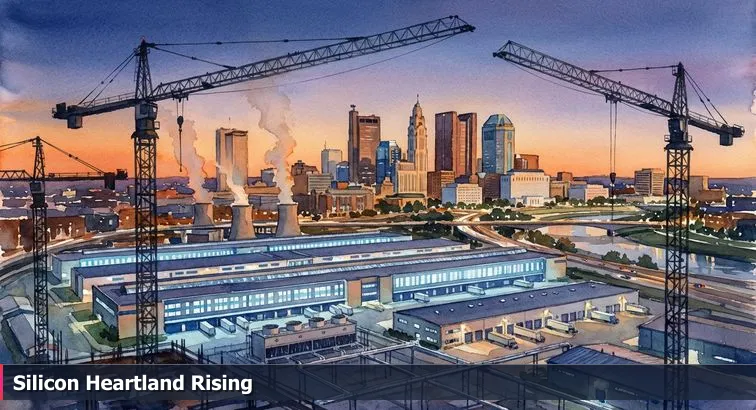
January 2026 marked a turning point for Columbus’ tech economy, as Ohio’s new venture-capital gains tax break took effect just as private investors crossed key milestones and hyperscale projects accelerated. Intel’s planned $28 billion “Ohio One” semiconductor campus in New Albany, Anduril’s autonomous jet factory near Rickenbacker, a proposed 1.2-gigawatt nuclear-powered AI campus in southern Ohio, and a data center cluster for Meta, Google, and AWS that now tops 130 facilities statewide all underscored how far the “Silicon Heartland” buildout had progressed.
On the capital side, a statewide venture-capital gains deduction quietly went live on January 1, while Columbus-based The O.H.I.O. Fund reported crossing $356 million in committed capital and lured California construction-tech startup Hyperframe to move manufacturing to the region. Those moves came alongside fresh funds and growth rounds in Cleveland and Columbus, signaling that private, returns-driven money was beginning to match the scale of public incentives that defined earlier phases of Ohio’s tech strategy.
This acceleration built on two decades of groundwork: Ohio’s $2.3 billion Third Frontier program and JobsOhio’s recruitment campaigns that helped land Intel’s 2022 “Ohio One” announcement. What changed in January was the mix - larger private funds, a broad-based tax preference for capital gains, and a wave of AI, defense, and aerospace projects that put Columbus on the same radar as coastal hubs highlighted in MIT’s “Breakthrough Technologies” coverage of Ohio’s innovation economy, as noted by legal analysts at KJK.
“Skilled workers needed as tech booms in central Ohio.” - Headline, Yahoo News
For tech workers, founders, and investors, the stakes have risen. Instead of asking whether Columbus can attract a few marquee tenants, the question at the end of January was whether this combination of tax policy, permanent capital, and hyperscale infrastructure could sustain a tight labor market and turn Central Ohio into a durable, market-driven alternative to higher-cost coastal tech metros.
In This Update
- Columbus Tech Hits a New Gear - January 2026
- Data Centers and AI Infrastructure in Columbus
- Intel’s Ohio One Semiconductor Campus
- Anduril’s Arsenal-1 Autonomous Jet Campus
- Oklo and Meta’s 1.2 GW Nuclear AI Campus
- Joby Aviation and Ohio’s Advanced Air Mobility Push
- Downtown Columbus: Fintech, Insurtech, and Startups
- Dublin Corridor and Suburban Cloud Operations
- The O.H.I.O. Fund and Fresh VC Capital in Ohio
- Ohio’s New Venture-Capital Capital-Gains Deduction
- Skills You Need and Practical Upskilling Paths
- Policy Shift: JobsOhio, Third Frontier, and the Playbook
- What This Means for Workers, Founders, and Investors
Find the breaking tech news update summarizing AI spending, Coinbase's insider breach, and what it means for tech workers.
Data Centers and AI Infrastructure in Columbus
Behind the marquee announcements, Central Ohio’s data center boom did much of the heavy lifting in January. Across the state, more than 133 data centers now power cloud and AI workloads for Meta, Google, and Amazon Web Services, with the Columbus area emerging as the operational core, according to LinkedIn data cited by The Columbus Dispatch.
These facilities translated into steady openings for data center technicians, facilities engineers, network and cloud operations staff, and cybersecurity and compliance professionals. Many of these roles favored industry certifications and hands-on experience over four-year computer science degrees, giving electricians, HVAC specialists, and help desk staff realistic paths into higher-paying infrastructure work.
| Role | Typical background | Example employer | Training path |
|---|---|---|---|
| Data Center Technician | Field service or trades | Hyperscale operators in Dublin corridor | 2-year tech program, CompTIA certificates |
| Network / Cloud Ops Engineer | IT support, sysadmin | Cloud teams supporting AWS or Google Cloud | AWS/Azure certs, Linux admin training |
| Cybersecurity Analyst | Help desk, junior IT | Financial institutions and insurers | Security+ or equivalent cyber bootcamp |
| Site Reliability Engineer (SRE) | Mid-level dev or ops | AI and data-platform teams | DevOps, monitoring, scripting skills |
“1 Ohio city a major tech employment hub, LinkedIn says.” - Headline, The Columbus Dispatch
With the Columbus Region’s cost of living roughly 10% below the national average, as noted in the area’s technology and innovation profile, these infrastructure jobs offered attractive real wages. For local technologists, January underscored that the fastest-growing opportunities sat close to the racks: keeping AI-era data centers powered, patched, and online around the clock.
Intel’s Ohio One Semiconductor Campus
Intel’s planned $28 billion “Ohio One” semiconductor campus in New Albany remained the single biggest bet on Central Ohio’s tech future in January, even as the timeline shifted. Intel confirmed that production at the first fab has been pushed back to 2030 as the company recalibrated its foundry roadmap in a volatile chip market. The announcement contributed to a roughly 12% slide in Intel’s share price after soft guidance, according to reporting in Columbus Business First.
Speaking to analysts, Intel CFO David Zinsner described current chip supply as “hand-to-mouth,” underscoring why the company is pacing new capacity even as it pursues U.S.-based fabs aimed at foundry customers like Nvidia and Qualcomm. Local leaders continued to treat Ohio One as a long-term anchor rather than an immediate jobs surge.
“Supply is hand-to-mouth… we need to be very disciplined about how we phase in new capacity.” - David Zinsner, CFO, Intel, via Columbus Business First
On the ground, construction advanced and vendor contracts flowed, creating near-term work in trades, civil engineering, and industrial IT. Intel also hired Ted Geer, a former One Columbus executive, as its top Ohio lobbyist to manage state-level relations as the project moves through permitting and incentive negotiations, a sign the company expects to be embedded in Ohio politics for decades.
| Job type | Project phase | Likely timing | Key skills |
|---|---|---|---|
| Construction & vendor trades | Site prep / build | Now-late 2020s | Electrical, mechanical, safety compliance |
| Automation & IT/OT specialists | Tool install / ramp | Late 2020s | PLC, industrial networking, SCADA |
| Fab technicians & process engineers | High-volume manufacturing | 2030 onward | Semiconductor processes, cleanroom ops |
For Ohio workers, the practical takeaway at month’s end was to cash in on construction and supplier demand now, while building transferable skills in automation, DevOps, and cybersecurity that can bridge into chip manufacturing roles later. As one local TV analysis noted, Ohio could still “benefit from sudden demand for Intel semiconductor manufacturing” if the market tightens again, positioning New Albany as a swing producer in the next cycle, according to coverage from WOWK.
Anduril’s Arsenal-1 Autonomous Jet Campus
South of downtown, Anduril Industries spent January turning its defense ambitions into steel and concrete. The company’s 500-acre Arsenal-1 campus near Rickenbacker International Airport is designed as a “software-defined” factory to build its YFQ-44A autonomous fighter jets, with first aircraft still slated for Q2 2026 production. By 2030, the site is projected to support about 4,000 direct jobs, positioning it as potentially the largest single employment project in Ohio history, according to Ohio Tech News.
Anduril reported that it had already hired its first 50 Ohio-based employees, with another 25 technical production leads returning from training at the company’s California facilities. Those early hires span software and systems engineering, advanced manufacturing technicians, and test operations - a mix that reflects how much of the plant’s competitive edge will come from code, not just metal.
| Role area | Example positions | Typical background | Primary focus |
|---|---|---|---|
| Software & systems | Autonomy engineer, systems integrator | Embedded systems, robotics, AI | Flight autonomy, mission systems |
| Advanced manufacturing | Manufacturing technician, process engineer | Mechatronics, industrial automation | Assembly lines, robotics, quality |
| Test & evaluation | Flight test tech, range operator | Aerospace, instrumentation | Ground and flight testing |
| Security & logistics | Facility security, supply planner | Defense, logistics, compliance | Export controls, materials flow |
For Central Ohio, Arsenal-1 signaled that defense tech is no longer confined to coastal bases or Beltway contractors. Anduril’s own description of Arsenal-1 as a “hyperscale manufacturing facility” underscored its national ambitions, while the choice of Columbus highlighted the region’s logistics network and labor pool, as detailed in the company’s Arsenal-1 announcement.
Oklo and Meta’s 1.2 GW Nuclear AI Campus
While most headlines focused on chips and jets, energy quietly became the new bottleneck for Ohio’s AI ambitions in January. Advanced fission company Oklo and Meta proposed a 1.2-gigawatt nuclear campus in Pike County to power next-generation AI training facilities, using small modular reactors to deliver dedicated baseload power to hyperscale compute.
If approved, the project would be one of the most aggressive attempts yet to pair small modular reactors with large-scale AI infrastructure, signaling that in the AI era, reliable electricity - not land - is the scarce input. Most construction and operations jobs would sit in southern Ohio, but security, data infrastructure, and reliability roles are likely to concentrate in Columbus, where cloud and enterprise teams already support Big Tech data centers.
| Model | Power source | Key advantage | Primary risk |
|---|---|---|---|
| Traditional AI data center | Regional grid mix | Faster permitting, mature model | Price volatility, grid congestion |
| Nuclear AI campus (Oklo/Meta) | Dedicated SMR baseload | Stable long-term power, low carbon | Regulatory scrutiny, public acceptance |
State economic-development officials spent the month pitching Ohio as a place where this kind of energy-heavy project can actually get built, highlighting at CES 2026 that the state can move advanced technologies from concept to scale quickly.
“Ohio shows the tech world how ideas move to reality faster.” - JobsOhio CES 2026 recap
For Columbus engineers and operators, the Oklo-Meta plan pointed to a coming wave of roles at the intersection of nuclear, AI, and grid reliability - from safety and regulatory compliance to AI workload orchestration - if regulators and local stakeholders ultimately sign off on the project, as framed in JobsOhio’s broader push to link energy, AI, and advanced manufacturing in its recent innovation initiatives.
Joby Aviation and Ohio’s Advanced Air Mobility Push
In the skies over Ohio, advanced air mobility moved from concept slides to factory floor plans in January. Joby Aviation closed on a second manufacturing facility in the Dayton area for $61.5 million, more than doubling its Ohio footprint to over 700,000 square feet. The company said operations at the new site would begin in 2026, with plans to reach production of four electric aircraft per month by 2027, according to deal coverage in PitchBook’s January 6, 2026 newsletter.
The Dayton hub, which began building propeller blades in late 2025, anchors a broader statewide air-mobility push that increasingly touches Columbus. At the National Advanced Air Mobility Center of Excellence in Springfield, BETA Technologies has been testing electric aircraft for medical cargo routes linking Indianapolis, Columbus, and Akron, while also installing charging infrastructure across Ohio and Michigan and partnering with Sinclair Community College on workforce training.
| Company | Ohio hub | Primary focus | 2026 milestone |
|---|---|---|---|
| Joby Aviation | Dayton region | eVTOL manufacturing | Second plant, 700k+ sq. ft., ramp to 4 aircraft/month |
| BETA Technologies | Springfield / statewide | Electric aircraft & charging | Medical cargo test routes and charging network buildout |
| Aurrigo | Greater Cincinnati | Autonomous airport vehicles | New R&D hub at CVG for ground operations tech |
“Ohio’s deep history in aerospace and its strong manufacturing base make it uniquely positioned to lead in the next generation of flight.” - JobsOhio statement on advanced air mobility
For Columbus technologists, these projects created demand chains that ran straight back to the city: avionics and embedded software roles, simulation and digital-twin development, and manufacturing-IT positions supporting suppliers. Universities were already aligning; the University of Cincinnati’s first student-led satellite launch with NASA underscored that Ohio’s aerospace pipeline is widening beyond legacy primes, as highlighted in UC’s January 30 mission announcement.
Downtown Columbus: Fintech, Insurtech, and Startups
Downtown Columbus leaned further into its role as the region’s white-collar tech core in January. Wells Fargo continued ramping up a new technology hub in the city, planning to hire more than 350 professionals focused on AI-powered personalization, data, and cybersecurity work. Insurance giant The Hartford also opened a new technology office, adding engineering and analytics roles tied to its digital transformation, according to the company’s January 6 expansion announcement.
Those corporate moves landed just as a new wave of founders put down roots downtown. Startups like Kaya AI, which builds AI “agents” for construction supply chains, and Speculo Group, whose assistant “Remi” is used by thousands of real estate agents, joined a growing cluster of fintech, insurtech, and SaaS companies stretching from the core business district to the Peninsula near Ohio State. Many of these teams now see Columbus as a base to sell nationally while tapping a steadier talent pool and lower operating costs than coastal hubs.
| Player | Sector | Downtown footprint | Primary focus |
|---|---|---|---|
| Wells Fargo | Fintech / banking | Growing tech hub | AI personalization, cybersecurity, data |
| The Hartford | Insurtech | New tech office | Digital claims, analytics, automation |
| Kaya AI & peers | Startups | Downtown & Peninsula | Applied AI for construction and real estate |
“Columbus is still in its early development as a tech hub, but the flywheel is turning.” - Carrie Ghose, Senior Reporter, Columbus Business First
Local observers noted that this mix of national finance brands and homegrown startups was exactly what Columbus lacked a decade ago. As one regional roundup from Purpose Jobs’ 2026 Ohio tech companies list put it, the city is now producing repeat founders and attracting out-of-state operators who might previously have defaulted to Austin or Denver. For engineers and product managers eyeing career moves, downtown Columbus increasingly looked like the place where financial services, AI, and entrepreneurship intersected on a daily basis.
Dublin Corridor and Suburban Cloud Operations
To the northwest of downtown, the Dublin corridor and neighboring suburbs continued to function as the hardware backbone of Columbus’ tech economy in January. Large campuses for Meta, Amazon Web Services, and Google turned office parks and former farmland into dense pockets of cloud infrastructure, drawing IT operations, network engineering, and facilities teams that keep AI-era workloads running around the clock.
These sites were far more than rows of anonymous server racks. Each campus supported 24/7 operations centers, on-site network and hardware specialists, and layered subcontractor networks in electrical, mechanical, and physical security. For technicians coming out of help desk roles, the corridor offered a clear path into higher-paying work in incident response, capacity planning, and site reliability.
| Submarket | Primary tech role | Typical employers | Career trajectory |
|---|---|---|---|
| Dublin corridor | Data center & cloud ops | Meta, AWS, Google vendors | Technician → SRE / reliability engineer |
| New Albany | Hyperscale & semiconductor-adjacent | Cloud campuses, fab suppliers | Industrial IT → automation / OT specialist |
| Hilliard / suburban west | Enterprise IT & managed services | Regional MSPs, corporate IT hubs | Support analyst → cloud engineer / security |
National labor data reflected the same pattern. Roles like cloud engineer and cybersecurity analyst ranked among the fastest-growing tech jobs of 2026, according to a January feature on emerging AI-era careers from Mashable, and the Dublin corridor absorbed a disproportionate share of that demand in Ohio.
For suburban professionals, the appeal was straightforward: shorter commutes than downtown, exposure to hyperscale systems rarely found in smaller markets, and a ladder from hands-on infrastructure work into higher-level design, automation, and reliability roles. Local development rankings like Clutch’s list of top software developers in Ohio suggested a growing ecosystem of vendors and service firms ready to plug into those same campuses, reinforcing the corridor’s status as Columbus’ cloud operations spine.
The O.H.I.O. Fund and Fresh VC Capital in Ohio
Private capital, not just subsidies, did much of the work in January as The O.H.I.O. Fund solidified its role as Columbus’ flagship investor. Launched in 2024 to plug what it calls a multi-billion-dollar funding gap, the fund reported $356 million in committed capital, about $196 million already deployed across 30 companies and real estate projects, and more than $75 million in returns. Roughly one-third of its capital goes to real estate, one-third to growth equity, and one-third to later-stage venture deals, including its 30th investment that brought California construction-tech startup Hyperframe’s manufacturing operations to Columbus.
North across I-71, Cleveland-based JumpStart Ventures added fresh fuel of its own. The firm closed nearly $25 million for its NEXT Fund III, with plans to back around 15 early-stage Ohio tech startups, according to coverage in Cleveland.com’s report on JumpStart’s funding closure. That momentum helped support sizable rounds like Champ Titles’ recent Series B, reinforcing that Ohio’s venture story is increasingly statewide, even if Central Ohio currently gets most of the headlines.
| Investor | Capital base | Primary focus | Notable January 2026 move |
|---|---|---|---|
| The O.H.I.O. Fund | $356M committed | Real estate, growth equity, later-stage VC | 30th deal; Hyperframe relocation to Columbus |
| JumpStart Ventures (NEXT Fund III) | ~$25M fund | Early-stage Ohio tech startups | Fund close to back ~15 companies |
| JobsOhio Ventures | State-backed evergreen | Strategic co-investments in Ohio companies | Co-invested alongside O.H.I.O. Fund in Hyperframe |
“Hyperframe's decision to relocate here not only accelerates innovation in construction, but it also strengthens a growing ecosystem of companies redefining how America builds.” - Mark Kvamme, CEO, The O.H.I.O. Fund (via Ohio Tech News)
Legal and economic analysts noted that these funds were arriving just as Ohio’s new venture-capital gains deduction took effect, creating a friendlier after-tax environment for LPs and angels. Commentaries on Ohio’s inclusion in MIT’s 2026 “Breakthrough Technologies” list argued that the state is shifting from grant-driven tech policy to a more rules-based, pro-capital regime, with Columbus emerging as a natural hub for Midwest deal flow, as explored in JDSupra’s analysis of Ohio innovation.
Ohio’s New Venture-Capital Capital-Gains Deduction
Ohio’s venture-capital gains tax deduction quietly became law on January 1, reshaping the math for investors looking at Columbus and the rest of the state. Under the new rules, investors receive a 100% state tax deduction on capital gains from investments in Ohio-based businesses, and a 50% deduction on gains passed through from certified Ohio-based venture capital funds, according to an analysis by Ohio Tech News.
The policy marked a deliberate shift away from purely project-by-project subsidies toward a rules-based, pro-capital regime. Instead of picking individual winners, lawmakers effectively lowered the hurdle rate for any investor willing to keep companies and funds rooted in Ohio. For angels and LPs, that translated into better after-tax outcomes on successful exits and a stronger case for backing local startups over comparable deals in higher-tax states.
| Policy tool | How it works | Pros for investors | Key risks |
|---|---|---|---|
| VC gains deduction (2026) | 100%/50% deduction on eligible gains | Improves after-tax returns, broad-based | Could be revised by future legislatures |
| Project-specific tax credits | Negotiated incentives for major deals | Large support for marquee projects | Less predictable, favors big incumbents |
| Grant programs | Non-dilutive funds to firms or incubators | Lower capital needs for startups | Budget-dependent, bureaucratic |
Economists and attorneys watching the change argued that if the deduction remains intact through multiple administrations, it could do more to lock in a self-sustaining venture ecosystem than any single factory announcement. The open question at the end of January was whether political leaders would treat the deduction as a long-term pillar of Ohio’s competitiveness or as another incentive subject to repeal once the budget tightens.
Skills You Need and Practical Upskilling Paths
By the end of January, the limiting factor in Columbus’ tech boom was less the number of projects and more the number of people who could staff them. Local reporting highlighted that central Ohio employers, from data centers to banks, were struggling to hire enough mid-level infrastructure, cloud, and cybersecurity talent even as new roles opened across the region.
Ohio’s TechCred program helped but couldn’t keep up. The initiative reimburses employers up to $2,000 per employee for short-term tech credentials, and state coverage indicated the 2026 budget was largely exhausted mid-fiscal year after a surge of applications from Central Ohio manufacturers, logistics firms, and IT departments. That underscored a hard reality for workers: waiting on public subsidies alone is risky in a market moving this quickly.
Against that backdrop, flexible, part-time bootcamps emerged as a practical bridge for adults already working full-time. Nucamp’s coding bootcamp programs stood out in January conversations because they combine small cohorts and live instruction with tuition well below many national peers, while still including career services such as resume coaching and interview prep.
| Path | Typical duration | Approx. cost | Best suited for |
|---|---|---|---|
| Four-year CS degree | 4 years full-time | Five-figure tuition | Students early in their careers |
| Community/technical college | 1-2 years | Lower tuition, more scheduling limits | Those seeking broad foundational training |
| Nucamp bootcamps | 15-25 weeks, part-time | $2,124-$3,980 | Working adults pivoting into tech roles |
| Corporate training | Short internal courses | Employer-funded | Employees already in tech roles |
Nucamp’s options aligned closely with Columbus’ hottest openings. The Full Stack Web and Mobile Development program (22 weeks, $2,604) mapped to roles at banks and insurers building internal tools. The Back End, SQL and DevOps with Python track (16 weeks, $2,124) matched data center and cloud automation needs. A Cybersecurity Fundamentals bootcamp (15 weeks, $2,124) spoke directly to growing security analyst demand, while the Solo AI Tech Entrepreneur Bootcamp (25 weeks, $3,980) appealed to founders eyeing AI products for construction, logistics, or manufacturing.
For workers, the playbook was straightforward: a data center support specialist in Dublin could complete the back-end and DevOps track and credibly apply for junior SRE roles; a help desk technician at a downtown bank could finish the cybersecurity program and move into security operations. In a market where projects like Intel, Anduril, and Meta are raising the bar, January made clear that those willing to invest 10-20 hours a week in structured upskilling will have the most leverage as Central Ohio’s tech salaries and expectations rise.
Policy Shift: JobsOhio, Third Frontier, and the Playbook
Policy crosscurrents defined January for Ohio’s tech strategy. As construction cranes rose over Intel and Anduril sites, state leaders grappled with whether to keep leaning on legacy grant programs or double down on broader, market-driven incentives and JobsOhio-style dealmaking for the next wave of AI and manufacturing projects.
Third Frontier at a crossroads
Created two decades ago to seed a tech ecosystem that barely existed, the Third Frontier program is now set to have its fate decided by the next governor. Reporting from Columbus business outlets noted that Rev1 Ventures administers much of the Central Ohio portfolio, meaning any phase-down could reduce early-stage grants, incubator funding, and university-linked commercialization support just as startup activity is picking up.
“Third Frontier program’s future to be decided by next Ohio governor.” - Columbus Business First headline
Founders and investors spent January weighing whether this uncertainty matters as much as it once did. With permanent capital vehicles like The O.H.I.O. Fund and JumpStart’s latest venture pool now active, many saw Third Frontier as helpful but no longer the only lifeline for early-stage innovation.
JobsOhio and a new playbook
In contrast, JobsOhio showed no signs of slowing its recruitment model. The organization used its first dedicated “Manufacturing Track” at CES 2026 to pitch Ohio as a place where energy-intensive AI, aviation, and automation projects can scale faster than in coastal states, while local coverage on sites like Columbus Underground highlighted how that strategy is reshaping communities near Rickenbacker and Dayton.
At the same time, companies rolling out generative AI in Ohio were urged by industry analysts to focus on governance and testing before scaling, a theme echoed in workplace-tech commentary from Allwork.Space’s guidance on gen-AI deployments. Taken together, January’s signals pointed toward a hybrid playbook: less reliance on discretionary grants, more emphasis on predictable tax policy, aggressive but targeted recruitment, and a growing expectation that firms self-regulate as they deploy AI and advanced manufacturing in the state.
What This Means for Workers, Founders, and Investors
For workers
For engineers, analysts, and career-changers, January’s message was that Central Ohio now rewards skills tied to AI-era infrastructure more than narrow point tools. Cloud operations, cybersecurity, and data engineering roles were among the most sought-after positions nationally, a trend echoed in coverage of fast-growing tech jobs from outlets like Mashable’s 2026 job rankings. In Columbus, those skills translate directly into work across data centers, banks, insurers, and advanced manufacturers.
The practical play is to stack portable credentials rather than chase a single employer: cloud certs, security training, and hands-on automation experience that can move with you between finance, defense tech, and industrial IT. Workers who treat upskilling as an ongoing habit rather than a one-time pivot will be best positioned as projects ramp and political winds inevitably shift.
For founders
Founders building in Ohio now operate in a different environment than even a few years ago. A deeper bench of local capital, from multi-stage funds to corporate venture arms, has made it easier to headquarter in Columbus and sell nationally. Lists of top Ohio tech companies from platforms like Purpose Jobs’ 2026 rankings increasingly feature firms that started local and stayed local, rather than treating the state as a temporary stopover.
The advantage for entrepreneurs is clear: a lower-cost base, a friendlier tax climate for eventual exits, and direct access to customers in construction, logistics, insurance, and manufacturing - sectors now hungry for software and automation.
For investors
Investors looking at Columbus at the end of January could see the outlines of a durable, market-driven hub: institutional buyers investing heavily in AI and hardware, a maturing startup pipeline, and a state signaling that patient capital will be rewarded. The remaining questions - about workforce depth and long-term policy stability - are real, but for those willing to underwrite them, Central Ohio is no longer a speculative bet so much as an emerging core market in the Midwest tech map.
Check this San Francisco AI boom update for insights on layoffs and startup megadeals.
Deep dive: Chicago tech January 2026 edition - jobs, M&A, and the Bloch Quantum effort
Check our Miami, FL tech news update on policy, HQ moves, and the statewide tech corridor.
Silicon Peach update: EKKO HQ, Science Square milestone, and Georgia tax policy news
Policy watchers can find a timely Washington, DC tech breaking analysis on the Trump Tech Force and federal CIO priorities.

Irene Holden
Operations Manager
Former Microsoft Education and Learning Futures Group team member, Irene now oversees instructors at Nucamp while writing about everything tech - from careers to coding bootcamps.