









AI Salaries in Taiwan in 2026: What to Expect by Role and Experience
By Irene Holden
Last Updated: April 25th 2026
Key Takeaways
AI professionals in Taiwan earn an average of NT$1.93 million in 2026, a 56% premium over general software engineers, with top global companies like Google and NVIDIA offering over NT$4 million for senior roles. But the real compensation story is in bonuses and profit-sharing - at TSMC and MediaTek, total packages often exceed double the base. For those who negotiate the full bundle, principal engineers at semiconductor firms can earn NT$5 million or more annually.
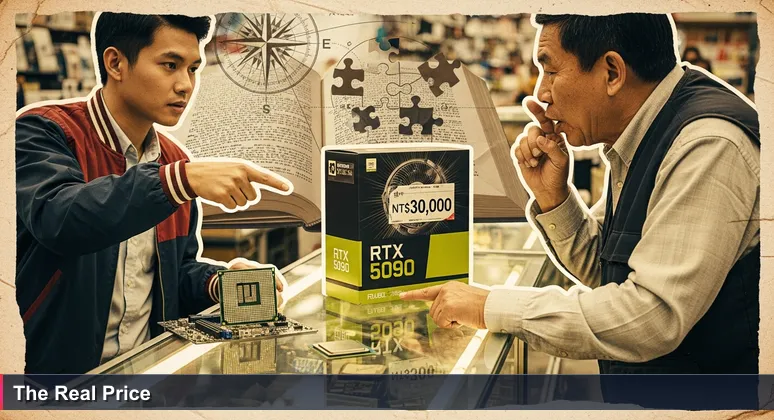
The RTX 5090 on the counter at Guanghua Digital Plaza has a sticker price of NT$30,000 - but the vendor is already shaking his head before you even ask. "If you bundle the motherboard and CPU, I can do NT$25,000." He taps the glass. "That's the real price."
Most AI professionals in Taiwan approach salary negotiations the same way: they see the base number and walk away. In a market where semiconductor giants like TSMC and MediaTek bake profit-sharing into total compensation that can double base pay, the professionals who earn the most aren't the ones with the highest initial offer - they're the ones who learned how to ask for the bundle. According to the Taiwan Tech Salary Negotiation Guide, understanding this stack is the single highest-leverage skill in the market.
The headline number tells the story: the average AI engineer in Taiwan earns NT$1,928,995 annually versus NT$877,500 for general software engineers - a 56% wage premium that's held steady through 2026. Yet 90% of employers planning salary increments are targeting only 3-6% increases, while 36% of tech professionals anticipate growth exceeding that mark, per Robert Walters Taiwan's 2026 hiring guide. That gap - between what employers plan to offer and what professionals expect - is the same dynamic as the Guanghua sticker.
The professionals who walk into every offer conversation asking about the whole system - base salary, year-end bonuses, profit-sharing multipliers, RSUs, and performance multipliers - are the ones who consistently earn above market. The sticker is for people who don't know the real price is always negotiable.
In This Guide
- The Sticker Price
- The 56% Premium: Why AI Roles Pay More
- Salary Bands for Every AI Role in 2026
- How Job Titles Affect Your Pay
- What Top Employers Really Pay
- Taiwan vs Other Asian Tech Hubs
- Decoding the Bundle: Bonuses, RSUs, and Profit-Sharing
- Negotiation Scripts That Work
- Tax Tips for High Earners
- Emerging High-Value AI Roles in 2026
- Insider Secrets from TSMC, MediaTek, and Google
- The 5-Question Framework to Evaluate Any Offer
- Frequently Asked Questions
Taiwan's AI industry is booming in 2026 - this guide tells you everything you need to know to get started.
The 56% Premium: Why AI Roles Pay More
The headline number is startling: the average AI engineer in Taiwan earns NT$1,928,995 annually compared to NT$877,500 for general software engineers - a 56% wage premium that has held steady across the 2024-2026 hiring cycles, according to SalaryExpert's AI engineer compensation data. This gap exists because global demand for AI hardware integration concentrates in Taiwan's semiconductor corridor between Taipei and Hsinchu, creating a talent bottleneck local employers can't fill fast enough.
Yet the market is moving faster than most employers' plans. 90% of Taiwan employers planning salary increments in 2026 target only 3-6% increases, while 36% of tech professionals anticipate pay growth exceeding that mark, per Robert Walters Taiwan's 2026 hiring guide. That gap - between what employers plan to offer and what professionals expect - mirrors the Guanghua sticker dynamic exactly: the listed price isn't the real price, and the professionals who know how to negotiate the hidden components come out ahead.
"Taiwan's AI market is uniquely defined by the chips and infrastructure that make global AI possible - not just models and applications," notes the Morgan Philips 2026 AI Talent Salary Report. This hardware-AI integration story means professionals who position themselves within it - understanding both model development and semiconductor architecture - command premiums far beyond what base salary stickers suggest. The 56% gap isn't a ceiling; it's the starting point for those who know how to haggle the bundle.
Salary Bands for Every AI Role in 2026
Forget averages - real compensation in Taiwan's AI market varies dramatically by role and experience. The table below reflects total compensation (base + typical bonus + equity/profit-sharing) for professionals in Taipei and Hsinchu; roles outside these metro areas typically carry a 15-20% discount. This data synthesizes findings from ERI Economic Research Institute's applied scientist survey and Levels.fyi's Taiwan ML/AI data.
| Role | Entry (0-2 yrs) | Mid (3-5 yrs) | Senior (5-8 yrs) | Principal (8+ yrs) |
|---|---|---|---|---|
| AI Researcher / Applied Scientist | NT$1.28M - NT$1.6M | NT$1.6M - NT$2.2M | NT$2.2M - NT$3.2M | NT$3.2M - NT$5.5M+ |
| ML Engineer | NT$1.1M - NT$1.5M | NT$1.5M - NT$2.2M | NT$2.2M - NT$3.0M | NT$3.0M - NT$4.5M+ |
| AI Engineer / Data Scientist | NT$900K - NT$1.3M | NT$1.3M - NT$1.85M | NT$1.85M - NT$2.6M | NT$2.6M - NT$4.0M |
| MLOps Engineer | NT$1.05M - NT$1.4M | NT$1.4M - NT$2.0M | NT$2.0M - NT$2.8M | NT$2.8M - NT$4.2M |
Three patterns stand out. First, AI Researchers and Applied Scientists command the highest premiums - 15-25% above standard engineering - because companies compete for candidates with top-tier publication records from NTU, NYCU, or international programs. Second, MLOps Engineers have seen the fastest salary growth since 2024, climbing 10-15% above general software engineering averages as more companies move models from notebooks to production. Third, entry-level salaries are compressing; the floor for new graduates has settled at roughly NT$800K-NT$1.0M, while mid-level roles have expanded upward - a classic sign of a maturing market where junior supply has caught up but experienced professionals remain scarce.
How Job Titles Affect Your Pay
One of the hardest parts of evaluating an AI job offer in Taiwan is title inconsistency. A "Senior Engineer" at one firm might be L4, while the same title at another maps to L5 - and that distinction can mean leaving NT$500K-NT$1M on the table. The table below shows how major levels align across Taiwan's key AI employers.
| Level | Global Equivalent | Years XP | MediaTek / TSMC | Google Taiwan | Startup (Appier, AI Labs) |
|---|---|---|---|---|---|
| L3 | Junior / Entry | 0-2 | Engineer (JG31) | L3 | ML Engineer |
| L4 | Mid-Level | 3-5 | Senior Engineer (JG32) | L4 | Senior ML Engineer |
| L5 | Senior / Staff | 5-8 | Principal Engineer (JG33) | L5 | Staff Engineer |
| L6/L7 | Principal / Sr. Staff | 8+ | Technical Manager (JG34-35) | L6+ | Head of AI / CTO-adjacent |
This mapping matters because compensation jumps sharply between levels. According to Levels.fyi's machine learning engineer salary database, median total compensation for L5 in Taipei is roughly NT$2.8M, while L4 median sits at NT$1.9M - a gap driven entirely by title-to-level alignment, not skill.
If a Taipei startup offers you a "Senior ML Engineer" title, ask how that maps to their internal leveling. At many local startups, "Senior" is really L4 - which caps your earning potential compared to a true L5 at a semiconductor firm. The ShareUHaCK Taiwan tech salary guide emphasizes that professionals who understand these mappings routinely negotiate for level adjustments that unlock 20-40% higher total comp. The title on your offer letter isn't just a label - it's the key to which compensation band you fall into.
What Top Employers Really Pay
The bundle varies dramatically by employer type. Understanding these tiers is the difference between accepting a sticker price and negotiating the real package. Here's what Taiwan's major AI employers actually pay.
- Global Multinationals (Google, Microsoft, AWS, NVIDIA) - Highest base salaries with significant RSUs. A Google L5 ML Engineer in Taipei can earn over NT$4M total compensation, with roughly 20-30% in stock. NVIDIA has reportedly offered up to NT$5.5M annually to attract senior engineers in Taiwan, according to Levels.fyi's Taiwan ML/AI compensation data. The typical structure: competitive base (NT$2.0M-NT$2.8M at L5), 10-20% annual bonus, and four-year RSU vesting where the real money sits.
- Semiconductor Leaders (TSMC, MediaTek, NovaTek) - Moderate base salaries offset by massive profit-sharing that often doubles annual compensation. As the ShareUHaCK Taiwan tech salary guide details, a TSMC JG31 (entry-level) with NT$62,400 monthly base can reach NT$2.0-2.5M in year-three total comp through year-end bonuses and profit-sharing. MediaTek's top earners can exceed NT$5M, though base pay may be only half of that.
- Local Tech & High-Growth Startups (Appier, Taiwan AI Labs, Emerging Taipei AI Startups) - Competitive bases in the NT$1.2M-NT$2.0M range for mid-level roles, plus stock options instead of RSUs. Taipei's startup scene is growing faster than its talent pool, according to KiTalent's analysis of Taipei's startup ecosystem, meaning early-stage companies increasingly pay premiums for experienced AI engineers. The trade-off: options are worthless without an exit, but several Taipei-based AI startups have seen valuations triple since 2024.
Taiwan vs Other Asian Tech Hubs
For mid-to-senior ML roles, Taiwan's AI salaries remain competitive in East Asia but trail Singapore and Tokyo in absolute USD terms. The 2026 picture shows Taipei median total compensation at NT$1.9M, compared to Singapore at roughly S$120K (NT$2.8M), Tokyo at ¥10M (NT$2.1M), and Shenzhen at CN¥650K (NT$2.9M), per data from wage.is's Singapore versus Taiwan comparison and the Robert Half China technology salary guide.
The gap between Taipei and Shenzhen (roughly 35%) is narrowing as Taiwan's semiconductor ecosystem expands. For a senior ML engineer, the premium for working in Shenzhen used to be 50%+; now it's closer to 20%, once you account for exchange rate volatility. Meanwhile, Tokyo's strong robotics and IoT demand keeps salaries stable, but central Tokyo's cost of living erodes much of the headline advantage.
The practical takeaway: don't just multiply by exchange rates. Singapore's tax is lower - roughly 7-15% effective for mid-level earners versus 12-20% in Taiwan - so the take-home difference is smaller than headline numbers suggest. And Taiwan's lower housing costs (NT$25,000-NT$40,000 for a decent Taipei apartment versus S$2,500-S$3,500 for a comparable Singapore flat) further narrow the gap. The real price of any offer includes where you live - and in that equation, Taipei holds its own against any Asian tech hub.
Decoding the Bundle: Bonuses, RSUs, and Profit-Sharing
Understanding how compensation components work is what separates professionals who earn market rate from those who leave money on the table. Here's how the bundle breaks down at major Taiwan AI employers:
- Year-end bonuses are universal. At TSMC and MediaTek, the typical bonus is 2 months of base salary, with profit-sharing adding another 3-8 months depending on company performance. At Google Taiwan, year-end bonuses range from 5-20% of base, with potential performance multipliers that can push it higher.
- RSUs are standard at global multinationals. Typical vesting is 4-year with a 1-year cliff - 25% vests at the one-year mark, then monthly or quarterly thereafter. Although Taiwan's RSU grants at global companies are typically 30-50% lower than equivalent US grants, the growth potential is significant - NVIDIA's stock appreciation since 2024 has turned many Taipei-based engineers' RSUs into the majority of their total comp.
- Stock options are the standard at startups. Options give you the right to buy shares at a fixed price, typically vesting over 4 years with a 1-year cliff and a 90-day exercise window after leaving. At startups like Appier or Taiwan AI Labs, the strike price and liquidity preference structure are critical variables to evaluate.
- Signing bonuses exist at all tiers but require negotiation. For L4+ roles, a signing bonus of NT$200K-NT$800K is normal at global companies. At semiconductor firms, signing bonuses are less common but can be replaced with guaranteed first-year profit-sharing top-ups. The ERI Economic Research Institute's AI engineer data confirms that professionals who negotiate signing bonuses see an average 12% higher first-year total comp.
The key insight: base salary is just the entry point. The profit-sharing pool at semiconductor firms fluctuates with company performance, but in a strong year, it can add 50-100% to your base. At global companies, RSUs are the biggest variable - a 20% higher grant can be worth NT$1M+ over four years. The bundle is where real compensation lives, and it's always negotiable.
Negotiation Scripts That Work
Walk into every offer conversation with a Guanghua mindset - assume the sticker is a starting point, then ask for the system. These three scripts target the specific compensation levers that unlock hidden value at each Taiwan employer type. The ShareUHaCK Taiwan tech salary negotiation guide confirms that candidates who ask structured questions about the bundle consistently achieve 12-20% higher first-year total comp.
- At a semiconductor firm (TSMC, MediaTek): "I understand the base is NT$1.8M. Can you walk me through the profit-sharing history for the past two years and the year-end bonus multiplier? I'm trying to understand the real total comp range." This works because most candidates only negotiate base. Asking about profit-sharing history signals you understand the total structure and won't be surprised later - making recruiters more willing to adjust the base upward.
- At a global company (Google, Microsoft, AWS): "The base is competitive. Can we talk about the RSU grant size and vesting schedule? I'd like to understand what the year-3 and year-4 total comp picture looks like, including refresher grants." RSUs are the biggest variable in total comp at these companies. A 20% higher RSU grant can be worth NT$1M+ over four years, yet most candidates negotiate base and bonus but leave equity on the table.
- At a startup: "I'm excited about the equity opportunity. Can you share the current valuation, the option pool size, and the strike price? I'd also like to understand the liquidity preference structure and whether there's a secondary market for early employees." Options are only valuable if the company exits. By asking about valuation and liquidity, you demonstrate real understanding of startup compensation - founders respect this and are more likely to offer a higher option grant or lower strike price.
The professionals who use these scripts - who treat salary as a negotiable bundle rather than a fixed sticker - are the ones earning NT$3M+ in a market where the average settles for NT$1.9M. As the Morgan Philips 2026 AI Talent Salary Report notes, Taiwan's market rewards those who understand its unique structure - and that starts with asking the right questions.
Tax Tips for High Earners
Taiwan's tax system is progressive, but for AI professionals earning NT$1.9M-NT$5M, the effective rate remains manageable. At NT$1.5M total compensation, the effective tax rate is approximately 10-12%, yielding take-home of NT$1.32M-NT$1.35M. At NT$4.0M, that rate climbs to 22-25%, with take-home around NT$3.0M-NT$3.12M. At NT$6.0M, the effective rate reaches 28-32%, leaving roughly NT$4.08M-NT$4.32M. These figures assume standard deductions and resident alien tax status, per Taiwan's progressive brackets.
For professionals arriving from overseas, a crucial window exists: the first 183 days in a calendar year are taxed at a flat 18% on employment income. That's significantly lower than the effective rate most senior engineers pay, making short-term assignments or careful relocation timing a real tax advantage. As Robert Walters Taiwan's 2026 hiring guide notes, compensation planning that accounts for tax timing is becoming a key differentiator in how experienced professionals evaluate offers.
The most overlooked tax trap involves RSUs. In Taiwan, RSUs are taxed as income at vesting based on the market value of shares at that moment. This means you owe tax on vested RSUs even if you don't sell the underlying shares. The practical move: set aside 20-30% of each vesting event's value to cover the tax bill. Professionals who fail to plan for this often face an unexpected cash crunch in March. The ShareUHaCK Taiwan salary negotiation guide emphasizes that understanding RSU taxation is part of negotiating the real bundle - because tax liability directly affects take-home, and that's the number that actually pays your rent.
Emerging High-Value AI Roles in 2026
The global push to put AI models into production has created premium niches beyond traditional ML engineering. According to HeroHunt.ai's data on fastest-growing AI roles, three specialized roles now command significant 20-30% premiums over standard data scientist positions.
- AI governance specialists bridge technical ML knowledge with legal and compliance credentials. Taiwan's AI Basic Act, enacted in January 2026, has created sudden demand for professionals who can navigate regulatory frameworks while understanding model behavior. Mid-level roles in this category command typical total compensation of NT$2.0M-NT$3.2M, significantly above standard data science tracks.
- AI hardware integration engineers sit at the intersection of ML model optimization and semiconductor design. Professionals who understand both PyTorch/TensorFlow and chip architecture - particularly at TSMC and MediaTek - command premiums of 20-30% over pure software ML engineers. Senior roles reach NT$3.5M+, reflecting the unique value of Taiwan's semiconductor ecosystem. As one Reddit discussion about Taiwan tech careers noted, the hardware-software integration skill set is "the most underrated leverage point" in the local market (r/Taipei community insights).
- Edge AI deployment specialists focus on optimizing and deploying models on resource-constrained hardware for factory automation. As Taiwan's manufacturing sector - Foxconn, Pegatron, Wistron - pushes AI to the edge, engineers who can bridge the gap between cloud-trained models and on-device inference are in high demand. Mid-level roles pay NT$1.8M-NT$2.5M, with the market expanding rapidly.
These roles share a common thread: they reward professionals who understand the full stack, from model development to hardware constraints to regulatory requirements. As the Morgan Philips 2026 AI Talent Salary Report notes, Taiwan's unique position as the world's semiconductor backbone means the highest premiums go to those who can integrate AI across the hardware-software boundary - not just build models, but deploy them where the chips live.
Insider Secrets from TSMC, MediaTek, and Google
The vendor at Guanghua only whispers the real price to customers who ask the right questions. In Taiwan's AI job market, that insider knowledge means understanding which levers to pull at which company. The ShareUHaCK Taiwan tech salary negotiation guide breaks down the specifics company by company.
At TSMC, the real leverage isn't base salary - it's the job grade and profit-sharing multiplier. A JG33 (Principal Engineer) with a NT$78K monthly base can easily out-earn a JG32 with a NT$85K base when profit-sharing hits. A JG31 (entry-level) with NT$62,400 monthly base reaches NT$2.0-2.5M in year-three total comp. The negotiation play: ask about grade and profit-sharing history, not base. At MediaTek, R&D talent bonuses are often tied to patent filings and conference publications. Mid-level engineers with publication records can negotiate for the "R&D premium" tier, which adds 15-25% to the standard bonus pool.
At Google Taiwan, the key variable is RSU grant size versus refresher structure. L5 engineers who negotiate for a higher initial grant (instead of relying on future refresher grants) often come out ahead because the grant vests regardless of stock price fluctuations. As the Morgan Philips 2026 AI Talent Salary Report notes, Taiwan's AI market is uniquely defined by "the chips and infrastructure that make global AI possible" - and the professionals who position themselves as part of that story command the highest premiums. John Winter, Country Manager of Robert Walters Taiwan, captures the 2026 dynamic precisely: talent strategies are defined by "focus rather than scale," with salary growth concentrated on professionals who can convert expertise into "measurable business outcomes" (Robert Walters Taiwan 2026 hiring guide).
The 5-Question Framework to Evaluate Any Offer
Before you sign any offer, channel your inner Guanghua negotiator and ask five specific questions about the bundle. The professionals who consistently earn NT$3M+ in a market where the average settles for NT$1.9M don't accept the first number - they evaluate the whole system. The ShareUHaCK Taiwan tech salary negotiation guide confirms that this structured approach unlocks the hidden value most candidates miss.
- What's the base, and what's the bundle? List every compensation component: base salary, guaranteed bonus, variable bonus, profit-sharing, RSUs, options, signing bonus, performance multipliers. Calculate total comp for year 1 through year 4 - the cliff matters.
- What's the vesting cliff? If RSUs or options have a 1-year cliff, your year-1 total comp might be significantly lower than years 2-4. Plan your cash flow accordingly.
- What's the refresher structure? Do you get additional RSU grants annually? At what size? This is the difference between a job where total comp stays flat and one where it grows year over year.
- What's the profit-sharing track record? At semiconductor firms, look at the past 2-3 years of payouts. If the company is coming off a high year, the next payout might be lower - budget conservatively.
- What's the exit path for equity? At startups, can you sell options before an IPO? Is there a secondary market? Do you have to exercise immediately upon leaving? The Morgan Philips 2026 AI Talent Salary Report emphasizes that understanding equity liquidity is the single most overlooked element in evaluating startup offers.
The professionals who ask these questions - who treat salary as a negotiable bundle rather than a fixed sticker - are the ones who earn NT$3M+ in a market where the average professional settles for NT$1.9M. The real price is available to anyone who knows how to ask for the system, not just the sticker.
Frequently Asked Questions
What's the average AI engineer salary in Taiwan in 2026?
The average total compensation for an AI engineer in Taiwan is NT$1,928,995 annually, which is 56% higher than the average software engineer's NT$877,500. However, top earners at companies like TSMC, MediaTek, or Google can reach NT$3-5.5M, especially when you factor in profit-sharing and RSUs.
How do AI salaries compare across company types in Taiwan?
Global multinationals like Google and NVIDIA offer the highest base salaries and RSUs, with L5 ML engineers earning over NT$4M. Semiconductor leaders like TSMC and MediaTek have lower bases but massive profit-sharing that can double total comp - some MediaTek top earners exceed NT$5M. Startups like Appier offer competitive bases (NT$1.2-2M) plus stock options, which can be life-changing if the company exits.
Which AI roles pay the most in Taiwan right now?
AI Researchers and Applied Scientists command the highest premiums, with principal-level roles reaching NT$5.5M+. MLOps Engineers have seen the fastest salary growth (10-15% above general software engineering), while niche roles like AI governance specialists and hardware integration engineers pay 20-30% more than standard data scientist positions, with typical TC of NT$2.0-3.2M.
How much should I negotiate beyond the base salary in Taiwan?
Always negotiate the total bundle - RSUs, profit-sharing, and signing bonuses can add millions. At TSMC, a JG33 engineer with a NT$78K base can out-earn a JG32 with NT$85K base due to profit-sharing. For global companies, ask for a higher RSU grant (a 20% increase can be worth NT$1M+ over four years). Signing bonuses of NT$200K-800K are common for L4+ roles.
How do Taiwan AI salaries compare to Singapore or Tokyo?
Taipei's median AI salary of NT$1.9M trails Singapore (NT$2.8M equivalent) and Shenzhen (NT$2.9M), but is competitive with Tokyo (NT$2.1M). However, Taiwan's lower housing costs (NT$25-40K for a decent apartment vs. S$2.5-3.5K in Singapore) and moderate taxes (12-20% effective) narrow the gap significantly.
Find out which sectors are hiring cybersecurity talent in Taiwan in 2026.
For a comprehensive list of top industries hiring AI talent in Taiwan beyond big tech in 2026, check out this guide.
Learn about the best-paying companies in Taiwan for engineers and how to negotiate offers effectively.
Find your ideal path with our 2026 Taiwan tech apprenticeship and internship ranking.
If you want to learn to deploy AI systems in Taiwan's tech industry, read this tutorial.

Irene Holden
Operations Manager
Former Microsoft Education and Learning Futures Group team member, Irene now oversees instructors at Nucamp while writing about everything tech - from careers to coding bootcamps.