









Is Bangladesh a Good Country for a Tech Career in 2026?
By Irene Holden
Last Updated: April 9th 2026
Quick Explanation
Yes - Bangladesh can be a strong place for a tech career in 2026 if you pick the right track and specialise in high-value areas like AI/ML, fintech, DevOps, or cybersecurity, because demand is shifting from generic junior roles to specialised talent. The country’s ICT exports reached about $1.9 billion by 2024, freelancing tops over one million people, mid-level local engineers commonly earn between ৳50,000 and ৳100,000 per month, and remote international roles average roughly $41,465 a year - often three to five times local pay - while Dhaka and Chattogram’s Hi-Tech Parks and major employers create clear pathways to senior and remote opportunities.
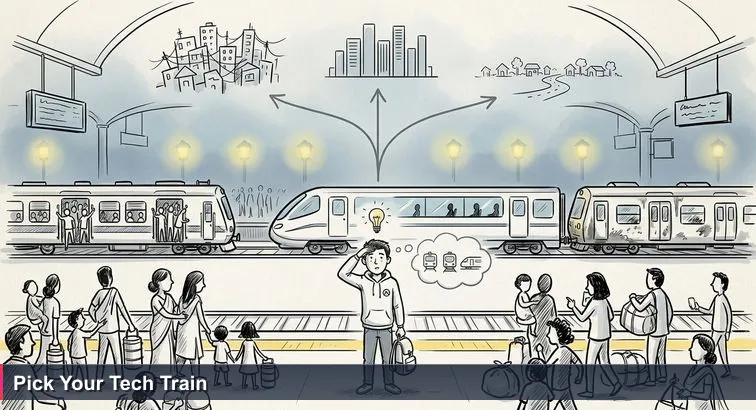
You’re at Kamalapur just before sunrise, shoulder-to-shoulder with strangers, tinny announcements bouncing off the metal roof. Three trains are hissing in front of you: one overflowing with people hanging off the doors, one sleek intercity with empty seats, one old coach with dirty windows. You can’t properly hear where any of them are going, but they’re all about to leave.
For a junior in Bangladesh staring at the tech world, it feels exactly like that. Parents, seniors, YouTube gurus keep shouting versions of the same thing: “Tech is the future, bhai, just learn to code.” Friends talk about cousins pulling in six-figure BDT from remote jobs while others grind for ৳20,000 in cramped offices. Meanwhile, over 1 million Bangladeshis are already freelancing online, turning the whole gig economy into its own kind of packed platform, as described in analyses of Bangladesh’s freelancing boom.
From where you’re standing, though, all the compartments blur into one vague “IT sector.” Nobody at the station is calmly explaining that each train leads to a very different destination:
- Low-paid local jobs in crowded software firms and BPOs
- Higher-growth roles in AI, fintech, and cybersecurity at places like bKash or TigerIT
- Freelancing and agency-building for overseas clients
- Fully remote roles paying in USD for US/EU/ASEAN companies
The crowd around you doesn’t help. Seniors say, “Just get on any train, they’re all going east.” In reality, some tracks loop endlessly around low-level maintenance work; others are express lines toward leadership roles, product building, or remote-first careers. Without a map, even smart people end up in the wrong compartment - moving fast, but not toward the life they wanted.
This explainer is meant to be that missing station map: showing what each “train” really is, why Bangladesh’s tech station is so crowded now, and how you can choose - and later, switch - to the track that fits your goals instead of just following the rush.
What We Cover
- Standing at the station: what choosing a tech path feels like
- What does a tech career in Bangladesh look like in 2026?
- Why is 2026 an inflection point for Bangladesh tech?
- Local product and service companies: the stable intercity
- Outsourcing and IT services: learning on global projects
- Startups and scaleups: high-risk, high-learning lanes
- Freelancing and agencies: the DIY route to global clients
- Fully remote international roles: the first-class cabin from home
- Money and growth: salaries, cost of living, and career stages
- Where to be: Dhaka, Chattogram, or moving abroad
- Practical roadmap: choose your train and prepare to ride it
- Verdict: is Bangladesh a good country for a tech career in 2026?
- Common Questions
Students and bootcamp graduates should consult the complete AI career guide for Bangladesh (2026) for salary bands and role mapping.
What does a tech career in Bangladesh look like in 2026?
From the outside, “working in tech” here sounds like one thing. Up close, a Bangladeshi tech career in 2026 really means using software, data, or digital tools to solve problems in exchange for enough money to live decently in Dhaka, Chattogram, or wherever you call home. That can mean anything from debugging a payment API for a telco to fine-tuning an AI model for a European client.
Because of that, what we call “the tech sector” is actually several parallel tracks:
- Local salaried roles at telcos (Grameenphone, Robi, Banglalink), fintechs like bKash and Nagad, big tech firms such as Brain Station 23 or TigerIT, and large NGOs and banks.
- IT/ITES outsourcing where you sit in Dhaka but build and maintain software for foreign clients through firms like Enosis, Vivasoft, or Nascenia, part of a broader ICT export base that industry reviews put at roughly $1.9 billion, growing about 13.54% year-on-year according to Business Inspection BD’s export analysis.
- Product startups such as Pathao, ShopUp, Chaldal, iFarmer, or Shikho, where you work on fast-changing products and sometimes get equity.
- Freelancing and agencies, serving global clients directly from your laptop.
- Fully remote international roles, where you’re on a US/EU/Singapore payroll while physically based in Bangladesh, often paying several times a typical local salary for the same experience level.
Each of these feels very different day to day. A developer at a telco might spend months stabilizing a massive legacy system used by millions, while someone at an export-focused firm like those highlighted by Enosis’s overview of Bangladesh outsourcing could switch between three foreign clients in a year.
So when you say “I want a tech career in Bangladesh,” you’re not choosing a single job. You’re choosing a track: which problems you’ll solve, who your users are, what currency you’ll be paid in, and how high your ceiling can realistically go.
Why is 2026 an inflection point for Bangladesh tech?
What makes this moment feel like an inflection point is that the “cheap outsourcing” train is no longer the only, or even the main, story. Bangladesh’s ICT exports are still rising - different estimates put them between $724.6 million and about $1.9 billion, growing roughly in the high single to low double digits every year - but the fastest growth is now in niches like AI-enabled software, which saw exports jump by around 54% in early FY 2025-26 as global companies rushed to adopt automation.
On the ground, three big shifts are happening at once:
- The old low-cost web/app development work is under price pressure and often automated by AI tools.
- Specialized domains - AI/ML, DevOps/Cloud, cybersecurity, and fintech architecture - are suddenly short of talent.
- Government pushes like Smart Bangladesh 2041, new Hi-Tech Parks, and a national GPU cloud at the data center are pouring fuel on anything related to data and AI.
Industry engineers writing on platforms like DEV Community’s Bangladesh software industry guide describe a market “flooded with juniors but starving for seniors,” especially in AI/ML, Blockchain, and DevOps. That’s why the same city can hold underpaid freshers on ৳20,000 and peers earning several lakhs remotely - they’re simply riding different parts of the pyramid.
This pressure is also reshaping how people learn. Instead of only university CS degrees or random YouTube playlists, more Bangladeshis are choosing structured upskilling in high-value areas. Affordable bootcamps like Nucamp now offer focused tracks such as Back End, SQL and DevOps with Python over 16 weeks for about ৳227,000, or AI-focused programs up to ৳426,000, far below many international bootcamps that charge the equivalent of ৳1,000,000+. That mix of rising demand and more targeted training is what makes this feel less like business as usual, and more like the tracks at Kamalapur quietly splitting.
Local product and service companies: the stable intercity
On our Kamalapur map, local product and service companies are the “stable intercity” trains. They don’t move as wildly as startups or remote gigs, but they usually get you somewhere solid: big telcos like Grameenphone, Robi, Banglalink; fintechs such as bKash and Nagad; large NGOs and banks like BRAC, City Bank, DBBL; and homegrown tech houses including Brain Station 23, DataSoft, TigerIT, BJIT, and Kaz Software.
These organisations build and run the systems Bangladesh actually lives on: mobile money, telco billing, identity, logistics, banking backends. The domestic IT market around them is estimated at roughly $8.88 billion, fuelled by fintech, e-governance, and enterprise software, as outlined in overviews of Bangladesh’s tech horizon beyond 2025. At places like Samsung R&D Bangladesh or Optimizely’s Dhaka office, engineers work on products used far beyond our borders.
The upside of this track is structure and scale. You get HR processes, defined teams, and exposure to real-world constraints: millions of users, strict uptime, compliance. Mid-level engineers can often reach the ৳50,000-৳100,000 range, while strong seniors at top firms may earn the equivalent of ৳1,000,000-৳2,000,000+ per year with benefits. You also build deep domain expertise in telco, fintech, or large-scale systems that later translates well to leadership or remote roles.
The catch is competition and bureaucracy. Breaking into a Grameenphone, bKash, or Brain Station 23 is tough; tests and interviews are serious, and juniors can still start as low as ৳20,000-৳30,000, which barely covers a modest Dhaka life. Inside, change can be slow: multiple approvals, legacy code, stakeholder politics.
If your long-term goal is to become an architect, engineering manager, or product leader in Bangladesh’s core digital infrastructure, this “intercity” is often the right first train: not glamorous every day, but steady, respected, and pointed squarely at the heart of the local economy.
Outsourcing and IT services: learning on global projects
If the local product companies are intercity trains running inside Bangladesh, outsourcing and IT services firms are the “export local” line: you board in Dhaka or Chattogram, but most of the work is headed to Europe, North America, or the Gulf. Names you’ll hear a lot include Brain Station 23, Vivasoft, Enosis Solutions, Nascenia, Nextzen, and MySoft, many of which are highlighted in recent rankings of software firms and IT startups on sites like Vivasoft’s overview of top IT companies.
Day to day, you might be building a React dashboard for a Scandinavian energy company, maintaining a .NET insurance system for a US client, or deploying cloud infrastructure on AWS for a Singaporean startup. Bangladesh’s outsourcing exports alone reached around $900 million in just the first half of 2025, and these firms are a big part of that pipeline. The code might never be used here, but your seat is firmly in Dhaka, often on Gulshan or Banani office floors.
- Fast exposure to agile processes, code reviews, and production deployments that match global standards
- Chance to work with modern stacks (React, Node, Python, cloud) instead of only legacy systems
- Constant interaction with foreign PMs and engineering leads, which forces your English and communication to improve
- A natural springboard toward direct remote roles once you’ve shipped a few serious projects
The flip side is intensity. Client deadlines, late-evening stand-ups, and shifting requirements can mean long weeks. Some firms still lack clear promotion paths; you might feel like you’re growing technically but not in title or pay as quickly as you’d expect.
This train makes the most sense if your goal is to “learn on someone else’s dime”: absorb global practices, harden your technical skills, and then either climb internally into senior roles or jump tracks later into remote work, product companies, or your own agency.
Startups and scaleups: high-risk, high-learning lanes
On the Kamalapur platform, startups and scaleups are the slightly chaotic coaches where people are standing in the corridors, music is playing from someone’s Bluetooth speaker, and nobody is quite sure when the train will stop next - but the view out the window changes fast. In Bangladesh, these are companies like Pathao in logistics and ride-sharing, ShopUp in SME commerce and financing, Chaldal in grocery and supply chain, iFarmer in agri-finance, and Shikho in edtech, along with newer faces tracked in lists of “rising tech CEOs” by outlets such as SD Asia.
What makes this lane unique is the learning velocity. One month you’re wiring up a payment gateway, the next you’re shipping an internal dashboard, talking to customer support, and sitting in a product meeting about why users in Mymensingh are dropping off at step three of onboarding. You see the whole product, not just one microservice. In sectors like fintech and logistics - highlighted as core to Bangladesh’s digital push in analyses from The Fintech Times - that experience compounds quickly.
The upside can be big: faster promotions, a chance at employee stock options (ESOPs), and meaningful ownership over features that affect millions of users. For engineers or data folks who dream of founding their own products later, this is like a live MBA in product-market fit and execution.
The risk side is just as real. Funding can stall, burn rates can burn you, and “pivot” might mean rebuilding half the stack over a few brutal sprints. Processes are often immature; you’ll see bugs go to production, roadmaps change overnight, and sometimes, friends being laid off when runway shortens.
This train suits people who are comfortable with ambiguity, crave responsibility early, and see themselves not just as coders but as builders. If you want to understand how tech, business, and users intersect in Bangladesh’s emerging digital economy, a few years in these high-learning coaches can be priceless - even if the ride is bumpy.
Freelancing and agencies: the DIY route to global clients
On our station map, freelancing is the train with no fixed schedule. There’s no ticket checker, no guaranteed seat, and definitely no free tea - but if you can navigate it, you decide where it goes. In Bangladesh, that often means logging into Upwork, Fiverr, or direct Slack workspaces from a rented room in Mirpur, Cumilla, or Sylhet, serving clients in time zones you’ve only seen on World Clock.
Most people start at the very bottom: logo touch-ups, WordPress tweaks, basic data entry. It’s common to underbid just to land those first reviews. But for the serious few, the path doesn’t stop at “solo freelancer.” A growing number are formalising teams, renting small offices, and turning into micro-agencies that hire designers, developers, and VAs locally. A detailed feature in The Business Standard on Bangladeshi freelancers building agencies describes how some of these founders now compete directly with established IT firms for overseas contracts.
- Control: you choose your niche, clients, and pricing.
- Global exposure: from your laptop in Dhaka or Chattogram, you learn how businesses in the US, EU, or Middle East actually run.
- Scalability: if you can standardise your services, you can grow from “just me” to a team of 5, 10, or more.
The trade-offs are heavy. There’s no base salary, so one bad month can wipe out your savings. You become your own sales team, support desk, finance department, and HR. Late-night Zoom calls, payment disputes, platform bans, and learning to navigate international payments and local tax rules all become part of the job.
This DIY route is best for people who are naturally entrepreneurial, comfortable with risk, and willing to invest just as much energy into communication and business systems as into code or design. If the idea of building your own small studio - instead of squeezing into someone else’s cubicle - excites you, this might be your train, even if it doesn’t come with a fixed timetable.
Fully remote international roles: the first-class cabin from home
For many Bangladeshi developers, the real dream train isn’t leaving Kamalapur at all. It’s the one where you sit at home in Dhaka or Chattogram, open your laptop, and join a stand-up with teammates in Berlin, Singapore, or San Francisco - while your bank account fills in dollars. That’s what fully remote international roles feel like: a kind of first-class cabin bolted onto your existing life.
These roles are typically with product companies or well-funded startups abroad, hiring directly or through platforms. They lean heavily on high-leverage skills: AI/ML, DevOps/Cloud (AWS, Azure, GCP), full-stack web (React with Node or Python), data engineering, and cybersecurity. Surveys of Bangladeshi remote engineers put average pay around $41,465 per year - roughly ৳410,000 per month - often several times what a similar role pays locally, as suggested by comparisons in the Bangladesh software engineer salary benchmarks.
- You’re exposed to world-class engineering practices and product culture.
- You can live where your family is, not where the office is.
- If you manage expenses, your savings rate can jump dramatically.
The hiring bar, however, is real. Companies expect you to be productive from day one: solid CS fundamentals, clean code, familiarity with modern tooling, and strong spoken and written English. You’ll be filtered through online coding tests, portfolio reviews, and multiple interview rounds; a weak GitHub or a CV full of toy projects usually doesn’t survive the first screen.
Time zones and isolation add their own taxes: late-night calls, few local colleagues, and the constant need for self-management. This route makes the most sense once you’ve already spent a few years shipping serious work - often in outsourcing firms or strong local product teams - so that when you finally board this “first-class cabin,” you’re not just enjoying the seat, you’re able to keep it.
Money and growth: salaries, cost of living, and career stages
Once you’ve picked a train, the next question is simple but brutal: does it pay enough to survive Dhaka or Chattogram, and how fast can you move up? Local surveys and community reports suggest a “decent” single life in Dhaka costs around ৳50,000-৳55,000 per month (shared flat, basic outings), while a small family needs roughly ৳70,000-৳80,000. Rent alone in Gulshan or Banani can hit ৳80,000-৳100,000+, according to breakdowns of the city’s housing market and living costs on platforms like Quora’s Dhaka cost-of-living discussions.
Against that, here’s how typical tech salaries stack up in 2025-2026, plus what similar experience can fetch in remote roles:
| Role Level | Local Monthly (BDT) | Remote Potential (USD/month) | Notes |
|---|---|---|---|
| Junior Engineer | ৳20,000 - ৳45,000 | $1,000 - $3,000 | Often can’t fully self-fund Dhaka life without support |
| Mid-Level Engineer | ৳50,000 - ৳100,000 | $3,500 - $6,000 | Comfortable locally; remote pay is ~3-5x higher |
| Senior Engineer | ৳100,000 - ৳220,000+ | $5,000 - $10,000+ | Top local firms and multinationals pay at the upper end |
| Jr Product Manager | ৳30,000 - ৳75,000 | Up to $15,000+ | Senior PM roles at US-linked firms can reach six figures annually |
Meanwhile, regional comparisons show that an average mid-level engineer in Indian metros might earn around $9,500-$14,000 a year, versus roughly $5,100-$8,200 in Bangladesh, based on salary aggregations and cross-country analyses from sites like Datamites’ Bangladesh IT market overview. In other words, our cost of living is lower, but so are most local paychecks.
Career-wise, the pattern many follow is a three-stage climb. The first 0-3 years are survival mode: any role that gives real production experience. From about 3-6 years, you’re aiming for solid mid-level positions or a first remote break. After 6+ years, the gap widens sharply between those who stay generic and those who specialise into AI/ML, cloud, security, or product leadership; that’s where titles like senior engineer, architect, or lead PM start to align with both a comfortable life and serious savings.
Where to be: Dhaka, Chattogram, or moving abroad
Location is its own career decision. Even if all your work happens inside a laptop, whether you base yourself in Dhaka, Chattogram, or outside Bangladesh quietly shapes your salary range, stress levels, and the kinds of opportunities that ever cross your path.
Dhaka is still the main junction. Most telcos, banks, fintechs, and large software firms keep their headquarters and engineering cores here. Industry bodies like BASIS, which represents over 4,500+ IT/ITES firms, run many of their flagship events in the capital, and a huge share of the country’s 20,000+ IT graduates flows into Dhaka’s offices each year. Lists of leading software companies, such as Nascenia’s roundup of top Bangladeshi firms, read almost like a map of Dhaka neighbourhoods. The trade-off: dense traffic, polluted air, and steep rents in central areas compared to outlying zones.
Chattogram, by contrast, is a slower, quieter train. It has a smaller, more logistics- and port-focused tech scene, but also shorter commutes and more breathable days. Salaries are often lower than Dhaka for equivalent roles, yet housing and daily expenses tend to drop too, so your overall lifestyle can feel more balanced. For remote workers and freelancers, the city’s mix of urban amenities and relative calm can be a strong base.
Then there’s the question of crossing borders. For many mid- and senior-level engineers, moving to hubs like Bengaluru, Singapore, or Europe can mean dramatically higher pay and access to global product companies. At the same time, some experienced Bangladeshis are choosing the reverse journey: bringing foreign remote jobs or savings back home to build teams or startups in Dhaka and Chattogram. Property market reviews on sites like Bikroy’s analysis of housing trends show why that arbitrage - earning abroad, spending here - can be powerful if you plan it carefully.
Practical roadmap: choose your train and prepare to ride it
Standing at the station, the practical move isn’t to debate which train is “best” in theory. It’s to pick a destination, board something aligned with it, and be ready to change compartments later. Instead of “I want to be in IT,” aim for something specific like AI/ML engineer in fintech, full-stack developer for SaaS, DevOps/cloud specialist, security engineer, or product-minded founder.
Once you’ve named a destination, you can line up the first 12-18 months: which language and framework to master, which kind of company to target (local product, outsourcing, startup, freelance), and how you’ll prove your skills through real projects, not just certificates.
| Target Track | Core Skill Focus | First 12-18 Month Moves | Structured Option |
|---|---|---|---|
| AI / ML Engineer | Python, data science, ML fundamentals | Finish 3-4 ML projects; compete on Kaggle; apply to data-heavy firms | Solo AI Tech Entrepreneur (25 weeks, ৳426,000) |
| Full-Stack / DevOps | JS/React, Node or Python, SQL, cloud | Ship 2-3 full apps; learn CI/CD; target outsourcing/product companies | Back End, SQL & DevOps with Python (16 weeks, ৳227,000) |
| Upskilled Pro (any role) | Prompt engineering, AI tools at work | Automate parts of your current job; document impact for promotions | AI Essentials for Work (15 weeks, ৳383,000) |
| Founder / Indie Hacker | AI product design, SaaS, monetisation | Launch 1-2 real products; iterate with paying users | Solo AI Tech Entrepreneur (focus on AI products) |
Bootcamps like Nucamp’s affordable AI and coding programs sit between self-study and a full degree: programs from about ৳227,000-৳426,000 versus many global bootcamps charging the equivalent of ৳1,000,000+, plus community support in cities like Dhaka and Chattogram. They don’t replace experience, but they can compress your ramp-up time into a few focused months.
Whatever path you choose, the playbook is similar: specialise in a high-demand area, build public proof (GitHub, live apps, ML notebooks), and plug into the local ecosystem - meetups, hackathons, and alumni networks - so that when the right compartment opens, you actually hear the announcement and can jump.
Verdict: is Bangladesh a good country for a tech career in 2026?
Standing back on the Kamalapur platform, the honest answer is that Bangladesh isn’t a uniformly “good” or “bad” country for a tech career. It’s a crowded station with some trains worth fighting to get onto, and some you should sprint away from. Your outcome depends less on the passport and more on the track you choose, how quickly you move beyond generic junior work, and whether you keep switching trains as your skills compound.
Bangladesh is a strong base if you’re early- or mid-career, willing to specialise, and ready to use the local ecosystem as a launchpad. The combination of a growing digital economy, government pushes under Smart Bangladesh, and a maturing software industry described in pieces like Dhaka Tribune’s analysis of a software-driven future means there is real demand for people who can handle AI/ML, cloud, security, data, and serious product work. From that angle, Dhaka and Chattogram are very viable places to build skills, savings, and a network.
It’s much less ideal if you expect Western salaries from day one, have no buffer to survive low-paid junior years, or aren’t prepared to keep learning. In that scenario, the same factors - saturated entry-level roles, rising living costs, intense competition - can make the tech hype feel like a trap. For seniors already earning strongly in the US, Europe, or Singapore, moving back purely for money is usually a downgrade, even if lifestyle and family ties improve.
A sensible pattern for many Bangladesh-based developers looks like this: spend your first few years getting any solid experience; use the next stretch to specialise and move into stronger teams; then, in the later phase, aim for senior, remote, or founder roles where your earlier choices finally pay off. Structured programs such as Nucamp’s 11-month Complete Software Engineering Path, plus focused AI and DevOps bootcamps, can compress parts of that journey, but you still have to do the miles yourself.
So yes, Bangladesh can be an excellent country for a tech career - if you treat it not as a single ride, but as an entire rail network, and you’re deliberate about which trains you board, and when you decide to change them.
Common Questions
Is Bangladesh a good country for a tech career in 2026?
Yes - but conditionally. The ecosystem is growing (ICT exports ~US$1.9B by 2024 and over 1 million freelancers), and specialised tracks like AI/ML, fintech, DevOps and security are in high demand, so Bangladesh is excellent if you target those higher-value paths rather than generic junior roles.
Should I move to Dhaka or Chattogram for better tech opportunities?
Move to Dhaka if you want the widest choice of employers and the highest local salaries (typically 20-50% higher than Chattogram); choose Chattogram if you prioritise lower living costs and shorter commutes, noting salaries there are often ~20-30% lower but monthly costs can be ₨30k-₨40k for a bachelor.
Can I earn international (USD) levels of pay while living in Bangladesh?
Yes - many engineers land fully remote roles paying roughly US$41,000-42,000/year (≈ ₨4.4M/year, ~₨370k/month), which is commonly 3-5× typical local mid-level pay; getting there usually requires 2-4 years of strong production experience or specialist skills.
Do I need to specialise (AI/ML, DevOps, security) or is general web development enough?
Specialisation is increasingly important: generalist junior roles are saturated, while AI-enabled software saw a ~54% jump in early FY 2025-26, and firms are hiring heavily for AI/ML, cloud/DevOps and cybersecurity expertise rather than basic front-end work.
How much does a junior engineer earn in Dhaka, and is that livable?
Typical junior salaries in Dhaka range from ₨20,000-₨45,000/month, while a single person’s ‘decent’ monthly cost is roughly ₨50,000-₨55,000; in short, many juniors struggle without roommates, family support, or rapid skill progression into higher-paying roles.
Top free tech training at Bangladesh libraries and community centres - how to start in tech in 2026
Learn where to find AI Meetups & Communities in Bangladesh - full guide
Read our how to become an AI engineer in Bangladesh guide with a practical 2026 timeline.
Read our complete guide to paying for tech training in Bangladesh (2026) for scholarships, grants and government programs.
Top coworking spaces and incubators for AI/ML founders in Bangladesh 2026

Irene Holden
Operations Manager
Former Microsoft Education and Learning Futures Group team member, Irene now oversees instructors at Nucamp while writing about everything tech - from careers to coding bootcamps.