









How to Become an AI Engineer in Bangladesh in 2026
By Irene Holden
Last Updated: April 9th 2026
Quick Summary
You can become an AI engineer in Bangladesh in 2026 by following a project-first roadmap that builds Python and math foundations, core ML, Bangla NLP, deep learning, MLOps and LLM/RAG systems, then ships three to five deployable projects that employers like bKash, Grameenphone, Robi and Samsung R&D Bangladesh will value. Realistically this takes about six months full-time or one to two years part-time, leverages free GPUs on Google Colab, fits a market growing roughly 25 to 30 percent annually, and can be accelerated with structured options like Nucamp bootcamps which cost around BDT 227,000 to BDT 426,000 and report about 78% employment outcomes.
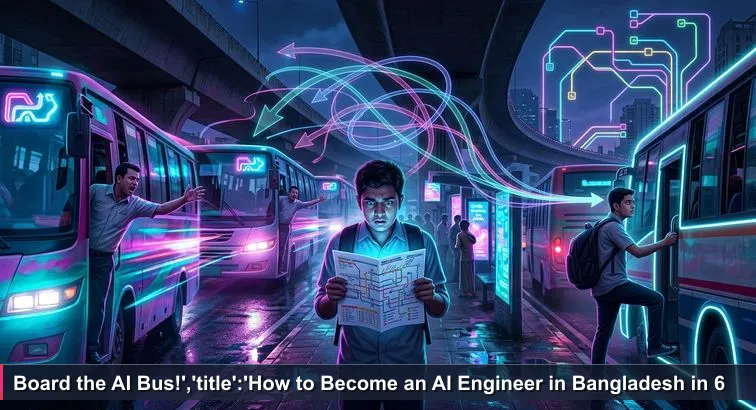
The heat from the buses hits first. At Farmgate, horns overlap into a single roar, conductors lean out yelling “Mirpur, Mirpur!” even though the signboard says something else, and your carefully printed route map starts to curl in the humidity. You can read the arrows, but you still don’t know which bus will actually stop for you.
That’s exactly how the AI world in Dhaka, Chattogram, Rajshahi or Sylhet feels right now. Everyone has a screenshot roadmap - Python → ML → Deep Learning → MLOps - yet many brilliant students are still stuck on the footpath: dozens of completed MOOCs, almost no working systems. Meanwhile, analyses of Bangladesh’s AI/ML infrastructure suggest the local AI market could grow by 25-30% annually through 2030, potentially tripling in size if fintech, healthtech and agri-tech keep adopting AI at the current pace, as outlined in a recent Bangladesh AI/ML infrastructure roadmap.
From printed roadmap to moving bus
Roadmaps are like bus signboards: necessary, but useless if you don’t learn to read the street. In AI, “the street” means three things:
- Picking local-context problems like Bangla NLP, microfinance risk, or crop disease detection
- Shifting from “knowing models” to shipping systems that are deployed, monitored, and improved
- Using the real ecosystem - Dhaka meetups, Hi-Tech Parks, Startup Bangladesh, and affordable bootcamps like Nucamp’s Bangladesh-focused programs - instead of only solo YouTube playlists
“A model in a notebook is a hobby; a model in production is a career.” - Anubhav, AI engineer, in his roadmap on how he would become an AI engineer again
This guide is your folded map in the pocket, not a script you must follow blindly. You’ll see exactly what to learn, in what order, and which Dhaka- or Chattogram-relevant projects you can realistically ship in a month - so you can step off the footpath, listen to the “conductors” of the local tech scene, and jump onto a bus that’s actually moving.
Steps Overview
- Introduction: From Farmgate to an AI engineering roadmap
- Prepare your prerequisites and setup
- Choose your path and commit to a timeline
- Build solid foundations in Python and math
- Learn core machine learning with scikit-learn
- Dive into deep learning and computer vision
- Specialize in Bangla NLP and text systems
- Learn data engineering and MLOps foundations
- Understand LLMs, RAG and system-level AI
- Plug into Dhaka and Chattogram’s AI ecosystem
- Build a coherent portfolio of systems
- Verify, test and troubleshoot common pitfalls
- Common Questions
Students and bootcamp graduates should consult the complete AI career guide for Bangladesh (2026) for salary bands and role mapping.
Prepare your prerequisites and setup
Before you jump onto the AI “bus”, you need the right backpack: a minimum level of math and English, plus a reliable laptop and internet connection. In Dhaka or Chattogram, that often matters more than which fancy course you pick.
You should have at least HSC-level math (comfortable with algebra, functions, a bit of calculus), enough English to read docs and tutorials, and basic computer literacy (installing software, managing files). An analysis of AI readiness in Bangladesh notes that non-CS students can become effective AI users and builders if they first secure this kind of foundational digital literacy, not just tool-specific tricks, as highlighted in coverage of AI in Bangladesh’s education system.
For hardware and connectivity, you don’t need a gaming rig, but you do need to clear this bar:
| Item | Minimum | Recommended | Notes |
|---|---|---|---|
| Laptop CPU | Recent i5 / Ryzen 5 | Newer-gen i5 / Ryzen 5+ | No need for dedicated GPU at start |
| RAM | 8 GB | 16 GB | More RAM = smoother Colab, Docker, VS Code |
| Storage | 256 GB SSD | 512 GB SSD | Datasets and environments grow quickly |
| Internet | Stable 4G or basic broadband | Uncapped broadband | You’ll rely heavily on Colab, Kaggle, and GitHub |
Once your machine is ready, set up your environment in this order:
- Install Python via Anaconda (includes Python 3, Jupyter, and common libraries).
- Install VS Code, add the Python extension, and confirm you can run a simple hello_world.py.
- Install Git, create a GitHub account, and push a test repository.
- Create Kaggle and Google Colab accounts for free GPUs and hosted notebooks.
- Open a trial account on AWS or GCP; note which services common AI roadmaps recommend, like S3 or Vertex AI, as in the self-study guidance from Zero To Mastery’s AI engineer roadmap.
Pro tip: from day one, create a folder such as ~/ai-journey-2026/ and keep all code, datasets, and notes there. Clean structure now will save you hours when you start juggling multiple projects, Docker files, and experiment logs later.
Choose your path and commit to a timeline
Before you cram your week with tutorials, you need one decision: how fast can you realistically move given your life in Dhaka or Chattogram? A roadmap that assumes 40 hours when you only have 8 will leave you back on the Farmgate footpath, clutching a beautiful plan that never matches the traffic.
If you can treat AI like a full-time “session break job”, aim for a 6-month intensive track at around 30-40 hours/week. Your months then stack like this:
- Month 1: Python basics, Git, VS Code, Jupyter, HSC-level math refresh.
- Month 2: Stats + linear algebra, Andrew Ng ML (Weeks 1-3), a Mirpur rent predictor from 100-300 listings.
- Month 3: Core ML (trees, SVM), a Daraz review classifier using 300-500 labelled reviews and Streamlit.
- Month 4: Deep learning & CNNs, crop disease classifier on Colab GPU.
- Month 5: Bangla NLP, fine-tuning a transformer on a Bangla sentiment set like SentNoB.
- Month 6: MLOps basics (Docker, MLflow, CI) and a capstone such as toy bKash-style fraud detection or a Bangla Q&A chatbot.
If you’re a full-time student or already working in Banani or Agrabad, a 12-24 month plan at 8-12 hours/week is saner: you stretch the same skills over longer blocks (e.g., Months 1-3 for Python and math, 4-6 for core ML and your first deployed app, 7-9 for deep learning, 10-12 for NLP, 13-18 for data engineering + MLOps, 19-24 for LLM systems and a serious capstone). This mirrors advice from experienced engineers who break AI learning into phased skill stacks rather than a single sprint, as outlined in one widely shared AI engineer roadmap.
Structured programs can plug into either path. For example, Nucamp’s 16-week Back End, SQL and DevOps with Python bootcamp at about BDT 227,000 builds your engineering base, while the 25-week Solo AI Tech Entrepreneur bootcamp at around BDT 426,000 focuses on LLMs, agents and SaaS. With outcomes like roughly 78% employment and 75% graduation rates plus tuition in the BDT 227,000-426,000 band (far below many BDT 1,000,000+ bootcamps), these can anchor your timeline rather than becoming yet another half-finished course.
Build solid foundations in Python and math
Before transformers, LangChain and MLflow, you need to be dangerous with plain Python and comfortable with the kind of math you saw around HSC. Without that, every AI course feels like Farmgate signboards in Greek - loud, impressive, and mostly useless.
For Python, focus on writing small, working scripts rather than memorising syntax. In your first 4-8 weeks, aim to cover:
- Core syntax: data types, loops, conditionals, functions, modules
- Data work: NumPy arrays and Pandas DataFrames
- Basic plotting: Matplotlib/Seaborn for quick charts
- Virtual environments and installing packages with
piporconda
In parallel, build “operational” math skills, not proof-level theory:
- Linear algebra: vectors, matrices, dot product, matrix multiplication
- Calculus: derivatives and the idea of a gradient (for optimisation intuition)
- Probability & statistics: mean, variance, standard deviation, normal distribution, conditional probability, Bayes’ rule
Turn this into one concrete project: a Dhaka air-quality explorer. Download AQI or weather data as CSV, load it with Pandas, compute daily and weekly averages, and plot comparisons such as Farmgate vs Gulshan. This kind of end-to-end mini-analysis matches the “learn fundamentals → apply on a small project” pattern recommended in self-paced AI paths like the Udacity School of Artificial Intelligence.
Pro tip: write at least one tiny script every day - a 30-line data cleaner, a CSV summariser, a plotting notebook. Warning: don’t get stuck watching math playlists for weeks; rotate between 60-90 minutes of Python coding and 30-45 minutes of focused math so both muscles grow together.
Learn core machine learning with scikit-learn
Once Python and math feel manageable, you’re ready to stop being “just a coder” and start acting like an ML practitioner. This is where you learn how to turn a CSV from a Gulshan startup or a Chattogram logistics firm into a working prediction system using scikit-learn. Many senior engineers explicitly call out scikit-learn, Pandas and NumPy as the core of phase two in a complete roadmap for software engineers to learn AI/ML.
Your goal over 6-8 weeks is to cover the “classical” toolkit:
- Regression: linear and polynomial regression for numeric prediction
- Classification: logistic regression, k-NN, decision trees, random forests, SVM
- Unsupervised: k-means clustering and basic dimensionality reduction (PCA)
- Evaluation: accuracy, precision, recall, F1, ROC-AUC, cross-validation, overfitting vs underfitting
- Engineering: train/validation/test splits and scikit-learn pipelines
Turn those ideas into a mock telecom churn system for a Grameenphone/Robi/Banglalink-style operator:
- Create or download a synthetic dataset of subscribers with usage, complaints, and bill history.
- Use Pandas to clean and encode features; split into train/validation/test.
- Train at least two models (e.g., logistic regression and random forest) with scikit-learn.
- Evaluate with precision, recall and F1, since churn is usually imbalanced.
- Save the best model with
joblib.dump()and expose a simple prediction script.
Next, build a ShopUp-style recommender. For 100-500 users and 100-300 products, simulate past purchases, then implement a basic content-based or collaborative filtering recommender that outputs “Top 3 products” for a user ID. This shows Bangladeshi employers you can work on e-commerce, not just toy datasets.
Pro tip: for every algorithm, write one paragraph in your notes: when it works well, when it fails, and which metric you’d trust in a fintech, health, or telecom setting. Warning: don’t obsess over 99% accuracy on tiny datasets; recruiters in Dhaka care far more that you can build a clean, reproducible pipeline than that you squeezed out another 0.5% on Iris.
Dive into deep learning and computer vision
At some point, scikit-learn will start to feel cramped. To tackle images from rice fields in Bogura or CCTV-style feeds from Mohakhali, you need deep learning and computer vision. Over about 6-8 weeks, your focus shifts from hand-crafted features to neural networks built in frameworks like PyTorch or TensorFlow/Keras, the same tools highlighted in international guides such as Immerse Education’s beginner AI roadmap.
Your conceptual checklist for this phase looks like:
- Neural network basics: layers, weights, activation functions, loss functions
- The training loop: forward pass, backpropagation (intuitively), optimisation with SGD/Adam
- CNNs for vision: convolution, kernels, feature maps, pooling
- Regularisation: dropout, batch normalisation, data augmentation
- Engineering: dataset loaders, checkpoints, and resuming interrupted runs
Turn that into a concrete agriculture project a local employer will understand: a crop disease detector for jute or rice.
- Collect or download an open plant disease dataset; focus on 3-5 classes relevant to Bangladeshi crops.
- Open Google Colab, enable GPU, and mount your dataset from Google Drive.
- Load a pretrained CNN (e.g., ResNet) from PyTorch/TensorFlow and replace the final layer for your classes.
- Train only the last layers first (fine-tuning), log accuracy and loss per epoch, and experiment with basic augmentation.
- Export a saved model and write a script:
python predict.py --image path/to/leaf.jpg→ predicted disease + confidence.
Next, build a Dhaka traffic congestion classifier: label frames as low/medium/high congestion, train a small CNN, and classify new frames grabbed from videos. This can later grow into a real-time system running near Tejgaon or Gabtoli. Pro tip: always save checkpoints to Drive every few epochs so a Colab disconnect doesn’t wipe your work. Warning: don’t waste days training from scratch on tiny datasets; transfer learning is your friend when GPUs and time are limited.
Specialize in Bangla NLP and text systems
Once you’re comfortable with classic ML, specialising in Bangla NLP is one of the highest-leverage moves you can make. Global models barely understand Bangla script or local dialects, yet fintechs, gov portals, and ed-tech platforms all need systems that read complaints, forms, and FAQs in Bangla. A strategic roadmap on AI in Bangladesh stresses that local-language capability is a core bottleneck for digital services, from microfinance to education, not a “nice to have” feature, as discussed in guidance on leveraging AI transformation in Bangladesh.
Over roughly 6-8 weeks, aim to cover:
- NLP fundamentals: tokenisation, stopwords, n-grams, Bag-of-Words, TF-IDF + logistic regression/SVM.
- Modern NLP: word embeddings, the intuition behind transformers, encoder vs decoder models.
- Bangla specifics: Unicode quirks, normalisation, handling mixed Bangla-English text, and exploring pretrained Bangla transformers on Hugging Face.
Turn that theory into a Bangla news topic classifier:
- Scrape or download 1,000-2,000 Bangla news headlines/body texts across 4-6 categories (e.g., politics, sports, business, tech).
- Clean text (remove extra whitespace, normalise characters), then build a TF-IDF + logistic regression baseline.
- Fine-tune a Bangla transformer on the same dataset and compare F1-scores; document where each model fails.
For a second system, build a Bangla form-understanding tool for scholarship or microfinance applications: extract names, locations, and requested amounts from semi-structured Bangla text using a sequence-labelling model (NER). This aligns well with ongoing research in local-language AI at institutions such as the BRAC University Artificial Intelligence research group, which often focuses on Bangla-centric problems.
Pro tip: plan your labelling time; annotating even 1,000 Bangla sentences for topics or entities can take several days. Warning: always inspect a few dozen tokenised examples by hand - Unicode bugs or broken tokenisation can silently ruin an otherwise good model.
Learn data engineering and MLOps foundations
To move from “I have a model in a notebook” to “my model runs reliably for users in Dhaka or Chattogram”, you need data engineering and MLOps basics. Local employers in fintech, telecom, and health don’t just ask if you know CNNs; they ask if you can version data, retrain safely, containerize services, and monitor them - skills that serious AI bootcamps in Bangladesh now emphasise alongside ML, as noted in coverage of top AI bootcamps serving Bangladeshi learners.
Over about 6-8 weeks, aim to cover:
- SQL:
SELECT,JOIN,GROUP BY, aggregates, subqueries. - NoSQL basics: when you’d use a document store like MongoDB instead of relational tables.
- Data pipelines: simple batch jobs with Cron plus an orchestrator such as Prefect or Apache Airflow.
- MLOps: reproducible environments (
requirements.txt), Docker images, Git branching, and CI with GitHub Actions. - Experiment tracking: tools like MLflow or Weights & Biases to log parameters and metrics.
Turn this into a microfinance-style credit scoring pipeline that a BRAC-like institution could understand:
- Create a synthetic applications CSV with income, household size, existing loans, repayment history, and target “default / no default”.
- Write an ETL script: read CSV → clean data → load into PostgreSQL (local Dockerised DB is ideal).
- Write a training script that queries PostgreSQL, trains a classification model, and logs runs to MLflow.
- Wrap the model in a FastAPI service; create a Dockerfile and build/run an image locally.
- Add a GitHub Actions workflow to run tests and
flake8/blackon each push.
As a second system, build a retail sales forecaster for a small Chattogram shop: daily sales data, a simple time-series or regression model, and a scheduled retrain (Cron or workflow tool) once a week. Pro tip: treat every serious project as Docker-first from now on. Warning: skipping experiment tracking means you’ll quickly lose track of which model version is live - unacceptable in any serious Dhaka fintech or telco stack.
Understand LLMs, RAG and system-level AI
By now you can train models, deploy APIs, and track experiments. The next layer is wiring large language models (LLMs) into full systems - chatbots, assistants, and automations that combine prompts, tools, and your own data. Recent AI engineer roadmaps emphasise this “system layer”: RAG pipelines, state machines, and agents, not just fine-tuning models, a trend also reflected in specialised agentic AI engineering training.
Your learning goal over roughly 6-8 weeks is to understand how to treat LLMs as components:
- Concepts: tokens, context windows, attention, and why LLMs hallucinate
- Prompt engineering: system prompts, few-shot examples, and guardrails
- Retrieval-Augmented Generation (RAG): chunking, embeddings, vector search
- Workflows/agents: modelling multi-step tasks as graphs or state machines with tools like LangChain and LangGraph
On the tools side, pick a small, focused stack:
- Open-source or API LLMs for generation
- An embedding model + vector DB (FAISS, ChromaDB, or a hosted option)
- A workflow framework (LangChain/LangGraph) for chaining retrieval, reasoning, and actions
- FastAPI or a similar web layer for serving your system to real users
Turn this into a Bangla university information assistant for DU, BUET, NSU or BRAC students:
- Scrape public notices (exam schedules, holidays, course updates), store them as text chunks with metadata.
- Generate embeddings and index them in a vector DB.
- Build a RAG pipeline: user question in Bangla → retrieve top-k chunks → pass chunks + question to the LLM.
- Serve it via a web UI where students can ask natural questions and see the cited notice excerpts.
As a second system, build a government service FAQ bot for BRTA, passport, or NID processes using only publicly available information. Add a simple evaluation harness: a set of 30-50 common questions with expected answer summaries and a script that scores your bot. Pro tip: track latency and token usage from day one; in Bangladesh’s cost-sensitive market, a system that is fast and cheap to run is far more attractive than a slightly “smarter” but expensive one.
Plug into Dhaka and Chattogram’s AI ecosystem
Learning in isolation is like standing on the Farmgate footpath with noise all around you. To actually move, you need to step into Dhaka and Chattogram’s AI ecosystem: people, programs, and physical spaces that give you deadlines, feedback, and sometimes funding.
A good first move is to plug into local communities. Join Facebook groups like BDDevs or Machine Learning Bangladesh, follow AI events at universities, and look for meetups at places like Janata Tower Software Park or Bangabandhu Hi-Tech City. Treat every hackathon or university AI fair as a deadline to ship a tiny but working system, even if it’s just a weekend prototype.
Next, look at universities and research centres as more than exam centres. BUET, DU, NSU, BRAC and others now host AI/ML labs and seminars; many allow undergrads or external participants to attend talks, read papers with the group, or contribute to small subprojects. Aim to read at least one Bangladeshi AI case study a month - telecom churn, microfinance credit scoring, crop disease detection - so your projects feel closer to what Grameenphone, bKash, BRAC or Praava Health actually need.
Government and startup programs can turn a strong capstone into a funded product. The ICT Division’s iDEA Startup Bangladesh program offers mentoring and grants that can reach around BDT 10 lakh for promising tech ideas, including AI-driven solutions. Hi-Tech Parks under BHTPA are also nurturing export-oriented IT/ITES firms; if you’re building something with global potential - an agri-diagnosis API, a Bangla LLM tool - these parks are where early customers and mentors often sit.
Finally, consider structured mentorship. International bootcamps like Nucamp run live, community-based cohorts with local study circles in Dhaka and Chattogram, helping you turn scattered self-study into a sequence of projects, reviews, and portfolio pieces. Use that kind of structure, plus the local ecosystem, as your “conductor’s shout” to adjust your route - not as a replacement for your own initiative.
Build a coherent portfolio of systems
By this stage, you’ll have a pile of notebooks and scripts. Your next job is to turn those loose files into a coherent portfolio that tells one clear story: “I can take real Bangladeshi problems, design data pipelines, train models, and ship systems.” Recruiters and founders repeatedly say that portfolios showing deployed projects matter more than certificates, echoing advice in guides on how to break into AI engineering.
A strong portfolio isn’t twenty half-finished experiments; it’s 3-5 complete systems that together show breadth, depth, and local relevance. Aim to cover at least one Bangla NLP system, one vision or time-series project, and one LLM/RAG app, all with clear READMEs and simple run commands.
| Project | Domain | Tech Stack | “Story” for Employers |
|---|---|---|---|
| Bangla E-Commerce Sentiment Analyzer | Bangla NLP / E-commerce | Transformers, FastAPI, Streamlit, Docker | Shows you can mine Daraz/Facebook reviews so SMEs prioritise complaints. |
| Crop Disease Classifier | Computer Vision / Agri-tech | PyTorch or Keras, Colab GPU, MLflow | Demonstrates transfer learning on local crops for agri or climate-focused firms. |
| Microfinance Credit Scoring Pipeline | Fintech / Risk | scikit-learn, PostgreSQL, Prefect/Airflow, Docker | Shows end-to-end ETL → training → deployment for BRAC-style lenders. |
| Bangla University Noticeboard Assistant | LLM / RAG | Embeddings, Vector DB, LangChain/LangGraph | Proves you can build a RAG system on messy public data for real users. |
For each project, include a README with problem statement, architecture diagram, setup steps, and screenshots or a short demo video. Keep your GitHub clean: one repo per system, consistent naming, and tags that highlight stacks (e.g., #pytorch, #bangla-nlp). This kind of polish signals you’re ready to work with real teams, not just toy datasets, and aligns with what modern AI roles expect according to industry surveys from platforms like Databricks on data and AI careers.
Verify, test and troubleshoot common pitfalls
Before you sprint toward job posts from bKash, Grameenphone or Samsung R&D Bangladesh, pause for a systems check. This is your moment to step off the Farmgate footpath, look up from the “roadmap” screenshot, and verify that you can actually move with real traffic: messy data, flaky servers, and noisy users.
Start with a skill self-test. You should be able to:
- Write clean Python scripts and small packages, using vectors, matrices and basic probability without freezing.
- Take a raw CSV from a Bangladeshi business (sales, telecom usage, loan history), clean it, try 2-3 models, and explain tradeoffs using the right metrics.
- Fine-tune a vision model on a new image dataset (e.g., local crops) in Colab, control overfitting with augmentation/dropout, and resume from checkpoints.
- Build at least one Bangla NLP system (sentiment, NER, FAQ or OCR) handling Bangla preprocessing and transformer fine-tuning end to end.
Next, run a systems self-test:
- Containerize an app with Docker, define dependencies in
requirements.txt, and set up basic CI with GitHub Actions. - Deploy at least one model behind an API and UI (even on a free tier) and answer “which model version is live?” using an experiment tracker like MLflow.
- Build a simple RAG pipeline (chunk → embed → store → retrieve → generate) and evaluate it with a small test suite of questions and expected answers.
- Explain which Bangladeshi sectors are using AI (fintech, telecom, health, agri, logistics) and how your portfolio projects map to them.
A recent academic study on Bangladesh’s AI readiness warns that the gap between theory-heavy education and industry needs is causing “frustration and stress” for new grads. You avoid that trap by troubleshooting early:
- Pitfall: Tutorial hell (hours of videos, no shipped code). Fix: For every new concept, build a 1-2 day mini-project and push it to GitHub.
- Pitfall: Model obsession (chasing 1% accuracy) instead of systems. Fix: Prioritise data quality, evaluation, Docker, and monitoring.
- Pitfall: Ignoring UX and latency. Fix: Add loading states, time your endpoints, and budget for inference cost before calling a project “done”.
Common Questions
Can I realistically become an AI engineer in Bangladesh within a year without a CS degree?
Yes - if you commit to a focused plan: the accelerated path in the article assumes 30-40 hrs/week for six months, while a part-time route is 12-24 months at 8-12 hrs/week. Employers in Dhaka and Chattogram value shipped systems and portfolios more than degrees, and the local AI market is growing an estimated 25-30% annually through 2030, so practical projects plus deployment matter most.
I can’t afford expensive bootcamps - what low-cost alternatives will still get me job-ready?
You can combine free resources (Coursera, Fast.ai, Hugging Face), Google Colab/Kaggle free GPUs, and focused projects to build a portfolio; community meetups in Dhaka/Chattogram also offer mentorship. If you prefer paid help, Nucamp bootcamps listed cost about BDT 227,000-426,000 which is cheaper than many global alternatives, and government grants like iDEA can offer up to ~BDT 10 lakh for promising startups.
My laptop has 8 GB RAM and no dedicated GPU - can I still learn and train models?
Yes - 8 GB RAM is the minimum and 16 GB is recommended, but you can use Google Colab and Kaggle free GPUs to run most beginner and intermediate experiments; for heavier training consider Colab Pro or short cloud GPU instances on AWS/GCP. Also focus on transfer learning and smaller models to keep costs and runtime manageable.
Which projects will actually get noticed by local employers like bKash, Grameenphone or Samsung R&D BD?
Build 3-5 complete systems that solve local problems - examples: a Dockerized microfinance credit-scoring pipeline, a Bangla sentiment analyzer for e-commerce, a fraud-detection simulator for fintech, or a crop disease classifier for farmers - each with a README, demo video, and deployed API. Employers in Dhaka/Chattogram look for reproducible demos and deployed services, not just notebooks.
What if I’m weak in math or English - can I still become an AI engineer?
Yes - start with practical Python projects while improving math and English in parallel (Khan Academy for math, daily reading for English); many successful Bangladeshi AI engineers began from modest academic backgrounds. The key is to produce working projects and clear documentation that demonstrate applied skills rather than perfect theory or grammar.
Use this comprehensive Cost of Living vs Tech Salaries in Bangladesh in 2026 breakdown to model your take-home after tax and PF.
Our comprehensive Bangladesh tech training funding guide covers Nucamp tuition, bank loans and micro-education loans.
How AI Meetups, Communities, and Networking Events in Bangladesh accelerate careers
Discover the top-ranked Bangladeshi AI startups in 2026 and their vertical use cases.
top ranked women in tech communities and training in Bangladesh

Irene Holden
Operations Manager
Former Microsoft Education and Learning Futures Group team member, Irene now oversees instructors at Nucamp while writing about everything tech - from careers to coding bootcamps.