









How to Pay for Tech Training in Austria in 2026: Scholarships, Grants & Government Programs
By Irene Holden
Last Updated: April 9th 2026
Key Takeaways
Pay for tech training in Austria in 2026 by prioritising public and employer funding - use AMS-approved course funding, the new Weiterbildungsbeihilfe for living costs, regional vouchers like Vienna’s WAFF, Skills Schecks for SMEs and employer co-financing - only turning to private bootcamps or payment plans for remaining gaps. Austria channels about €1.8 billion of RRF money into digital skills, Weiterbildungsbeihilfe pays roughly €40.40 to €67.94 per day, WAFF can cover up to 80 percent of tuition up to about €2,500, Qualifizierungsförderung can fund around 50 percent of course costs up to near €10,000, and affordable bootcamps such as Nucamp cost between €1,950 and €3,660 while letting Vienna learners tap local research centres and employers for stacked support.
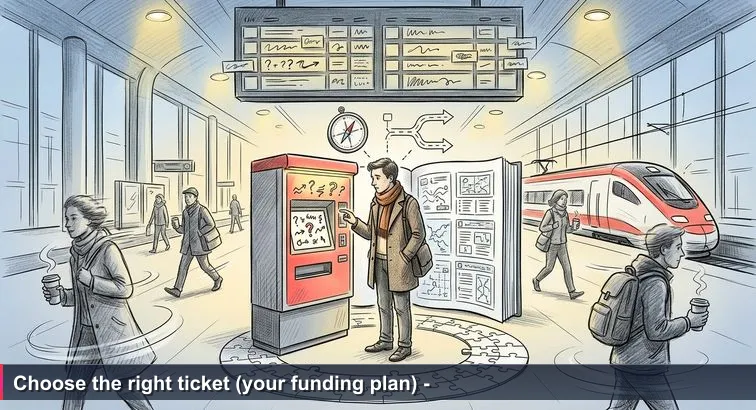
You’re in front of the glowing ÖBB machine at Wien Hauptbahnhof. The countdown is merciless, the Railjet to Salzburg is boarding, and the screen is full of options that all sound vaguely right. Around you, people tap twice and walk away with the “correct” ticket as if they were born knowing the system.
That’s exactly how tech-training funding in Austria feels when you first step into it. You hear fragments on the U1 or at a Heuriger in Grinzing: AMS-Kurs, WAFF, Digi-Winner, the new Weiterbildungsbeihilfe, some ESF+ project your colleague in Floridsdorf used to get a cloud certificate. You know there must be a train out of your current job and into AI, data, or cybersecurity. What you don’t yet see is which ticket combination will actually get you there.
Behind the confusion, there is serious money on the tracks. Austria’s Recovery and Resilience Facility plan channels roughly €1.8 billion into the digital transition, with a clear focus on skills and training according to the EU’s own Digital Skills and Jobs Platform overview of Austrian funding. Those funds flow into AMS courses, WAFF vouchers in Vienna, ESF+-backed projects for women and migrants, and new tools like Skills Schecks 2026 that help SMEs train people in AI and key technologies.
The catch is that, just like at Hauptbahnhof, funding is not one magic “through ticket.” It’s a chain of connections: national income support, regional tuition vouchers, employer programmes, sometimes topped up by EU or scholarship money. The people who really manage to move from an office job in Donaustadt to an AI role in a TU Wien spin-off aren’t just “aware” of these names. They understand which programme covers living costs, which pays tuition, and in what order to validate each ticket so AMS, WAFF and your employer all stamp your journey instead of sending you back to the start.
This guide is your station map: a Vienna- and Austria-specific Fahrplan through that network, so that by the time your personal Railjet into AI is ready to depart, you’re standing on the right platform with the right ticket in hand.
In This Guide
- From Hauptbahnhof to AI: Your Austrian funding map
- Government programmes: your primary funding tracks
- Weiterbildungsbeihilfe: paid time to study in 2026
- Fachkräftestipendium: living costs while you retrain
- Qualifizierungsförderung für Beschäftigte: halve your tuition
- AMS funding and AMS-certified courses for jobseekers
- Länder, municipal & new federal tools: WAFF, Bildungskonto and Skills
- EU programmes: ESF+ and Erasmus+ opportunities
- Scholarships, FemTech and private foundations
- Employer benefits and how to ask (with a sample email)
- Bootcamp financing, Nucamp options and ISAs explained
- Stacking funding, timeline, documentation and common mistakes
- Frequently Asked Questions
Discover real projects and portfolio tips in the comprehensive guide to launching an AI career in Austria (2026).
Government programmes: your primary funding tracks
Before you worry about individual tickets, it helps to see the rail network. In Austria, tech-training money flows through a few main lines, and nearly all other offers connect back into them.
At the core is the AMS, which finances training for jobseekers and co-funds upskilling for people already in work. A comparative review by CEDEFOP on financing adult learning in Austria highlights this AMS role as the backbone of the system. Around it, the Bundesländer run their own schemes - in Vienna, that’s primarily WAFF - while chambers like the Arbeiterkammer add smaller but valuable education vouchers.
On top of these national and regional tracks sit EU and federal innovation programmes. The European Social Fund Plus (ESF+) finances projects that turn into free or heavily subsidised digital-skills courses, often delivered via WAFF, NGOs, or universities. At the same time, key-technology tools like Skills Schecks 2026 support SMEs in training staff for AI, green tech and digitalisation; the research promotion agency FFG describes these as a way to “drive skills development in key technologies” in its announcement on Skills Schecks 2026.
For you, these lines translate into a few primary funding tracks:
- Income support while you study (e.g. Weiterbildungsbeihilfe, Fachkräftestipendium)
- Tuition subsidies from AMS, WAFF or your Bundesland
- Employer co-funding via Qualifizierungsförderung or Skills Schecks
- Targeted EU projects that bundle AI/data courses for specific groups
Vienna’s AI ecosystem - from TU Wien, AIT and IST Austria to Microsoft Austria, IBM, AVL or emerging startups - increasingly taps into this mix to grow talent locally. The rest of this guide walks each line in detail so you can choose the right primary track for your situation and then add connections, instead of guessing at the ticket machine.
Weiterbildungsbeihilfe: paid time to study in 2026
Think of Weiterbildungsbeihilfe as buying time, not a ticket: it pays your living costs so you can step off the S-Bahn of full-time work and onto a long-distance train of structured learning.
Who actually qualifies
The new model applies if you’ve been with your current employer for at least 12 continuous months and commit to building systemrelevante skills - explicitly including AI, cybersecurity and digitalisation. As tax advisors at Moore Salzburg’s overview of Weiterbildungsbeihilfe summarise, it replaces the old Bildungskarenz from 1 January 2026 and comes with tighter conditions and more focus on labour-market need.
How much you’re paid and what counts as “study”
You receive a daily grant of roughly €40.40-€67.94, calculated similarly to unemployment benefit, for the approved duration of your leave. In return, you must prove a serious study load:
- At least 20 hours per week of structured training, or
- At least 20 ECTS per semester at a university/FH
- Reduced to 16 hours/week if you care for a child under 7
For higher earners (around > €3,465 gross/month), your employer is obliged to add a 15 % top-up to your net income, as outlined in analyses of the reform such as VisaHQ’s explainer on the new rules.
Using it strategically for AI careers
This is income support, not tuition money. In practice you combine it with WAFF vouchers, Länder “Bildungskonto” or employer-funded courses. Imagine a 33-year-old office worker near Praterstern who wants to move into data and AI: they plan 6-9 months of learning, mix a structured bootcamp plus self-study to reach 20 hours/week, secure Weiterbildungsbeihilfe to pay rent, and let WAFF or their employer cover most of the course fees. The result is paid time to reskill into Vienna’s AI economy without stepping off the train financially.
Fachkräftestipendium: living costs while you retrain
Where Weiterbildungsbeihilfe buys you a few focused months, the Fachkräftestipendium is more like a long-distance pass: it helps you finance years of full-time retraining into a recognised shortage occupation, many of which sit squarely in IT and digital infrastructure.
According to the official description of the federal skilled worker scholarship on Österreich.gv.at, the programme targets adults who interrupt or reduce employment in order to complete full-time vocational training in a listed shortage occupation. In practice that includes not only classic trades, but also a growing set of tech roles: network administration, certain software and systems specialties, and IT infrastructure profiles that Vienna’s and Linz’s employers struggle to fill.
The financial logic is simple but powerful. The Fachkräftestipendium pays at least €40.40 per day in support, and it can run for up to three years of recognised training. Crucially, this money is designed to cover your living costs while you sit in the classroom or lab. Tuition fees for your Bootcamp, Fachschule or college programme are usually not included, so you’ll combine the stipend with WAFF, a Bildungskonto or employer funding to cover course costs.
Imagine you’ve worked in tourism in Salzburg or at a café in Neubau, but you want to become a network administrator maintaining cloud infrastructure for a Graz or Vienna tech firm. You find an AMS-recognised full-time programme that leads to such a role, apply for the Fachkräftestipendium to secure your rent and groceries for 12-24 months, and then layer on regional subsidies or a modest payment plan to pay the tuition itself.
Used this way, the stipend becomes your financial backbone for a deep career change into system-relevant tech fields, while other programmes handle the actual ticket price of your training.
Qualifizierungsförderung für Beschäftigte: halve your tuition
For many people already in jobs, the fastest way to cut tuition in half is not AMS as a private person, but AMS as a partner to your employer. That’s what Qualifizierungsförderung für Beschäftigte is designed for: it channels public money through companies that commit to upskilling their staff.
The scheme targets employees who either only completed compulsory schooling or an apprenticeship, or are 45+ years old. If your company agrees to support your training, AMS can reimburse up to 50 % of course costs, usually capped at around €10,000 per person. As the Arbeiterkammer explains in its guide to the AMS-Qualifizierungsförderung für Beschäftigte, the subsidy is always paid to the employer, not directly to you.
In practice, that means you and your manager agree on a concrete course plan, the company signs the training contract, and AMS refunds roughly half of the invoice once the criteria are met. Typical requirements include:
- The training must be job-related and improve your position in the labour market
- The provider and course must be recognised (IT, AI and digital skills are explicitly welcome)
- The company keeps you employed for a defined period after training
Consider a 47-year-old in Vienna, working in controlling and earning about €3,000 gross. She wants to move into data roles and chooses a 16-week Back End, SQL & DevOps with Python bootcamp costing €1,950. Her employer applies for Qualifizierungsförderung: AMS reimburses roughly €975, the firm covers the remaining €975, and she studies part-time while keeping her salary. A briefing sheet by Hermes Austria on the programme notes that such co-funding is particularly attractive for SMEs, because it “reduces qualification costs significantly while securing skilled staff” (programme summary, PDF).
For mid-career Viennese who don’t want (or can’t afford) a full study leave, this is often the most realistic way to turn an employer’s vague “we support further education” into a concrete, subsidised AI or coding course.
AMS funding and AMS-certified courses for jobseekers
Once you register with AMS as arbeitslos or as a jobseeker, a different set of tracks opens up. AMS can cover your tuition partly or even fully for the right course, especially in IT and digitalisation. The federal business portal notes that AMS offers “special grants for training measures” for both companies and individuals, including full or partial coverage of course fees where labour-market need is clear (overview of current AMS grants on USP.gv.at).
What “AMS-approved” really means
To access this money, three conditions usually apply: you must be registered with AMS, the course must be AMS-approved, and your advisor must agree that it fits your reintegration plan. In that case, AMS can finance up to 100 % of tuition for intensive IT, coding or cybersecurity courses, something the EU’s Digital Skills and Jobs Platform highlights as part of Austria’s digitalisation offensive. Vienna providers like CodeFactory or UpLeveled often run AMS-certified bootcamps specifically designed for this channel.
How to prepare for your AMS appointment
Approval is not automatic, and user reports describe rejections with arguments like “the industry is too small” or pressure towards generic German or application seminars. In one widely discussed Reddit thread about an AMS course not being approved, commenters emphasise that persistence and preparation matter more than anything else.
- Print 3-5 current job ads in Austria that explicitly require the skills your target course teaches (Python, cloud, data, cybersecurity).
- Bring a short written argument mapping course modules to those job requirements.
- Ask clearly which IT/AI courses and which providers are currently funded and AMS-certified.
- Get written confirmation of funding before signing any contract; retroactive applications are usually impossible.
If you treat the AMS conversation like a project pitch - evidence, clear outcomes, realistic job targets - you massively increase the odds that they stamp your ticket for a fully funded, AMS-approved course into Austria’s AI job market.
Länder, municipal & new federal tools: WAFF, Bildungskonto and Skills
Once you understand AMS and national schemes, the next layer is regional and municipal support. This is where Vienna residents in particular can turn a “nice but expensive” AI or coding course into something that’s mostly paid for, while Upper Austria and Styria offer strong co-funding for tech upskilling as well.
In Vienna, the employment fund WAFF and the Arbeiterkammer combine into a powerful trio: Digi-Winner for digital skills, the general Weiterbildungskonto, and the annual AK Bildungsgutschein. A practical overview from a Viennese language and education institute shows how these typical grants stack up for residents (LOQUI’s grants summary for Vienna).
Other Bundesländer run similar “Bildungskonto” models, usually paying a percentage of recognised course fees. On top of that, the federal government has added business-focused tools like Skills Schecks 2026, while the Digi-Scheck helps apprentices add future-oriented IT training on top of their Lehre. Funding consultants note that combining such regional and federal grants with digitalisation programmes can secure the “highest possible funding” for skills in key technologies like AI and cloud (Stavaks overview of funding for digitalisation).
The table below summarises the most relevant options you’ll encounter as an aspiring AI or data professional in Austria:
| Programme | Region / Target group | What it covers | Typical maximum |
|---|---|---|---|
| WAFF Digi-Winner | Vienna, low-medium earners | Digital skills course fees (AI, coding, cybersecurity) | Up to 80 %, approx. €2,500 |
| WAFF Weiterbildungskonto | Vienna employees | Job-related further training, including IT | Approx. €2,000 |
| AK Wien Bildungsgutschein | AK Wien members | General education voucher | About €120/year |
| Bildungskonto OÖ | Upper Austria residents | Vocational & tech training | Up to 50 %, often max. €2,000 |
| SFG Weiterbildungsbonus | Styria, company employees | Job-related upskilling, focus on tech/innovation | About 50 %, up to €2,500 |
| Skills Schecks 2026 | SMEs across Austria | Training in key technologies (AI, digital, green) | Significant share of course costs per employee |
| Digi-Scheck | Apprentices (Lehrlinge) | Future-oriented extra courses (IT, AI basics, security) | Up to €500/course, max. 3 per year |
For a Viennese aiming at AI skills, this often means letting WAFF and AK pay most of the tuition while national schemes or your employer help with time and income.
EU programmes: ESF+ and Erasmus+ opportunities
Some of the most generous “invisible tickets” in Austria’s training system are financed from Brussels. You never apply to ESF+ or Erasmus+ directly as an individual, but you benefit when a WAFF project, FH, NGO or Fachhochschule uses these programmes to run free or heavily subsidised digital-skills courses.
The European Social Fund Plus (ESF+) is the big one. In Austria, it co-finances projects that tackle skills gaps, support labour-market access and push the green and digital transition. The official ESF+ programme for Austria lists priorities such as upskilling low-qualified workers, supporting young people and migrants, and strengthening digital competence across regions (ESF+ in Austria programme overview). In Vienna, that often translates into free coding or data courses for women returning from Kinderbetreuung, refugees learning cloud basics, or NEETs getting a first entry into IT support roles.
On the national side, the Sozialministerium highlights ESF as a central pillar of labour-market policy, funding projects that “offer solutions to social challenges” including structural unemployment and the need for new qualifications in digitalised workplaces (European Social Fund in Austria). For you, that means that when you see an ESF or ESF+ logo on a flyer in a WAFF office or at a TU Wien outreach event, it’s worth a second look: the course is often either free or massively underpriced compared to the private market.
Erasmus+ plays a different but complementary role. If you’re enrolled at a university or FH - say, doing Data Science at Uni Wien or Informatik at TU Graz - Erasmus+ can fund short-term mobilities: a week-long AI summer school in another EU country, or a block course on cloud infrastructure in cooperation with a partner university. Travel and subsistence are usually covered via your institution’s international office, turning Europe’s AI labs and data centres into realistic short stops on your personal Fahrplan.
Scholarships, FemTech and private foundations
Scholarships are the part of the network that rarely show up on the big departure board, but they can quietly pay for a full semester of AI or data science if you know where to look. In Austria, the central switchboard is the OeAD’s database grants.at, which aggregates hundreds of national and international programmes for everyone from Bachelor students to PhD candidates in Informatik, Data Science and Machine Learning.
On grants.at, the OeAD scholarship database, you can filter by field (“Informatik”, “Artificial Intelligence”), institution (TU Wien, TU Graz, JKU Linz, IST Austria) and level (Bachelor/Master/PhD). Results include classic academic stipends, industry-backed funds for ICT and digital innovation, and regional foundations that quietly sponsor part-time Master’s in Data Science or specialised AI certificates alongside your job in Vienna or Linz.
Alongside these, the Austrian government runs competitive scholarship schemes for international and domestic students. Summaries of the Austrian Government Scholarships underline that they typically combine monthly instalments with health insurance and a travel allowance, making a research stay at a place like IST Austria or AIT much more realistic financially. Even if you’re not moving abroad, this level of support is a good benchmark when you evaluate other foundations and sector-specific grants.
For women in STEM, the FFG’s FemTech initiatives add another track. Companies can receive funding to hire women into R&D roles, often bundling internal AI or data-science training with paid project work. If you identify as a woman and want to break into applied machine learning at a corporate lab or industrial AI team, looking for “FemTech Praktikum” or “FemTech Karriere” in job ads can surface positions where your upskilling is literally written into the project budget.
Beyond that, a scattering of private and regional foundations support tech education where it intersects with social impact: AI for energy, health, public administration or mobility. These often favour underrepresented groups or applicants with strong community engagement. They rarely shout; instead, they sit one click beneath the surface of grants.at, waiting for the person who actually reads the conditions and realises that a €3,000 stipend would cover an entire AI specialisation or bootcamp certificate.
Employer benefits and how to ask (with a sample email)
In Austria’s AI race, your employer is often the most direct funding partner you have. Large players in Vienna and beyond - from Raiffeisen, Erste Group and ÖBB to A1 Telekom, Siemens Austria, Microsoft Austria, IBM Austria, AVL, voestalpine and Red Bull - know that building in-house AI, data and cloud expertise is cheaper and faster than competing for senior talent with Berlin or Zürich. Analysts at accilium’s study on Austria’s digital future argue that domestic innovation in key technologies will only succeed if companies systematically invest in human capital, not just infrastructure.
That pressure turns into concrete benefits you can tap: internal “IT academies” for cloud and cybersecurity, full or partial reimbursement of external AI and coding courses, paid learning days, and co-financing via schemes like Qualifizierungsförderung or Skills Schecks 2026. Trade unions and the Arbeiterkammer have even pushed politically for more support for career changers into digital roles, with the Vorarlberg chamber calling for “more training opportunities for career changes at AMS” to meet demand in future-oriented fields such as IT and healthcare (VOL.AT report on AK’s demands).
To turn this general willingness into your specific AI training, arrive with a plan. Pick a recognised course, gather information on public co-funding (WAFF, Bildungskonto, Qualifizierungsförderung), and show how your new skills will help real projects - automating reports, working with cloud partners, or supporting data initiatives with Microsoft Austria or IBM Austria.
Here is a template you can adapt when writing to your manager:
Subject: Proposal: Co-financing AI / Data Training via AMS & Company Funds
Dear [Manager’s Name],
Over the past months, we’ve seen how important data and AI are becoming for [our department / company]. I would like to build skills in this area so I can contribute more to [specific projects or goals].
I’ve researched a part-time program, [Course Name] from [Provider], which covers [key topics e.g., Python, SQL, cloud, applied AI]. The tuition fee is €[amount] and the course runs from [start date] to [end date].
I’ve checked current funding options:
- The AMS Qualifizierungsförderung für Beschäftigte can reimburse up to 50 % of course costs for eligible employees.
- For Vienna residents, WAFF can cover up to 80 % of digital course fees, up to about €2,500.
I would like to ask whether the company would support this training by:
- Applying for the available public funding, and
- Covering the remaining tuition costs (or a defined share).
In return, I’m happy to:
- Commit to staying with the company for [X] years after the training, and
- Share my new skills with the team (e.g., internal workshop, documentation).
Could we schedule a short meeting to discuss this proposal?
Best regards,
[Your Name]
Approaching the conversation with this level of structure makes it far easier for your manager to say yes - and to route your request through HR, AMS and regional funds so that your AI training arrives heavily subsidised rather than self-financed.
Bootcamp financing, Nucamp options and ISAs explained
When public funding and employer money still leave a gap, private bootcamps and payment plans become the last connection on your route into AI. You need to treat them like choosing between a slow REX and a Railjet: some international providers charge well over €10,000, while others deliberately keep tuition in the low four figures. The EU’s Digital Skills and Jobs Platform overview for Austria notes that bootcamps can be powerful tools in the digital transition, but that cost and financing models vary widely.
Nucamp positions itself firmly at the affordable end. Core programs relevant for AI careers include a 16-week Back End, SQL and DevOps with Python bootcamp at €1,950, a 15-week AI Essentials for Work bootcamp at €3,300, and the 25-week Solo AI Tech Entrepreneur path at €3,660. Longer tracks like the Complete Software Engineering Path run 11 months for €5,200, while shorter options such as Web Development Fundamentals start at €420. All offer flexible monthly payment plans, live workshops and community support in cities like Vienna, Graz, Linz and Salzburg.
| Programme | Duration | Primary focus | Tuition |
|---|---|---|---|
| Back End, SQL and DevOps with Python | 16 weeks | Python, SQL, DevOps, cloud basics | €1,950 |
| AI Essentials for Work | 15 weeks | AI productivity, prompt engineering, workplace tools | €3,300 |
| Solo AI Tech Entrepreneur | 25 weeks | AI products, LLMs, agents, SaaS monetisation | €3,660 |
| Cybersecurity Bootcamp | 15 weeks | Security fundamentals and tools | €1,950 |
For many Austrian learners, that pricing matters more than branding. Outcomes data are solid: about 78 % of graduates report employment according to Course Report, the graduation rate is around 75 %, and Trustpilot reviews average 4.5/5 from roughly 398 learners, with around 80 % awarding five stars. Combined with WAFF or a Bildungskonto, these amounts become manageable monthly outlays instead of a second rent.
Income Share Agreements (ISAs) are a different financing model you’ll sometimes encounter in the DACH bootcamp scene: instead of paying upfront, you commit a percentage of future income to an ISA partner over several years, up to a cap. While this can look attractive, Austrian and EU consumer rules still apply: you should read the effective total obligation carefully, use your 14-day Widerrufsrecht for online contracts if needed, and compare the ISA’s overall cost to simply choosing a more affordable provider plus public subsidies. In many cases, a reasonably priced programme with transparent instalments is the safer Railjet than a complex ISA that hides its true price in fine print.
Stacking funding, timeline, documentation and common mistakes
Stacking funding is like planning a route with two or three well-timed Umstiege. You rarely get one grant that covers rent, tuition and exam fees; instead you combine a living-costs pillar with tuition support and, if you’re lucky, employer time or money.
Smart stacking patterns
Typical combinations look like this:
- Employed in Vienna, going deep into AI: Use Weiterbildungsbeihilfe for income (roughly €40-€60 per day), let WAFF Digi-Winner cover around 80 % of a €3,300 AI course like an “AI Essentials for Work” bootcamp (≈€2,640), add an AK Wien Bildungsgutschein (€120), and either pay or negotiate the remaining ≈€540 via instalments.
- Unemployed in Linz, becoming a developer: Get AMS to fund 100 % of an AMS-certified coding bootcamp, add a Fachkräftestipendium for living costs (from €40.40/day) if it’s full-time towards a shortage occupation, and use your Bildungskonto later for extra cloud or security certificates.
- Apprentice in Graz, levelling up: Combine the federal Digi-Scheck (up to €500 per course, max three per year) with your employer’s time budget and, where possible, regional Weiterbildungsbonus schemes.
Timeline: when to board which train
Work backwards at least three to six months from your course start:
- 3-6 months before: Choose your course, draft a career plan, talk to your employer or AMS advisor.
- 2-3 months before: File major applications (Weiterbildungsbeihilfe, AMS Kursförderung, WAFF/Bildungskonto, scholarships).
- 1-2 months before: Chase written decisions, adjust if something is declined, then sign the training contract and use your 14-day Widerrufsrecht if plans change.
Documentation and classic mistakes
Prepare a digital folder with Meldezettel, employment contract or AMS registration, payslips, certificates, a detailed course offer, CV and a short motivation letter linking your training to real job ads. Many providers that accept Austrian education vouchers, such as those listed by AgileLAB’s overview of Austrian education vouchers, will happily issue the formal cost breakdown your funders expect.
Common errors are applying after the course has started, relying on verbal “should be fine” instead of written approval, and turning up to AMS with vague plans instead of a concrete AI or data role backed by job postings. Treat every application like a mini research project, and you dramatically reduce the risk of missing your train because one stamp was missing.
Frequently Asked Questions
Which funding routes will actually cover living costs and/or tuition for tech training in Austria in 2026?
For living costs consider Weiterbildungsbeihilfe (replacing Bildungskarenz) or the Fachkräftestipendium - both pay about €40.40-€67.94 per day for approved full-time study; for tuition look to WAFF/other Länder vouchers (Vienna’s WAFF Digi-Winner can cover up to 80% or ~€2,500), AMS course funding (can be 100% for jobseekers), and Qualifizierungsförderung (up to 50% of course costs, capped around €10,000 per person).
Am I likely to qualify for the new Weiterbildungsbeihilfe and how much does it pay?
Employees need at least 12 continuous months with the same employer and must commit to at least 20 hours/week of training (16 hours if you have childcare for children under 7); payments are similar to unemployment benefits at roughly €40.40-€67.94 per day, while higher earners (≈> €3,465 gross/month) trigger a roughly 15% employer co-payment.
How can someone in Vienna combine WAFF with national schemes to reduce a bootcamp bill?
A common Vienna stack uses Weiterbildungsbeihilfe for living support plus WAFF Digi-Winner for tuition (WAFF covers up to ~80% / €2,500), and small extras like the AK Wien €120 voucher; for example, a Nucamp AI course at €3,300 with 80% WAFF cover leaves ~€660, minus €120 AK voucher = ~€540 out-of-pocket which you can spread via monthly payments.
What documents and evidence should I bring to AMS or WAFF to improve approval chances?
Bring a clear training plan and course syllabus, 3-5 current Austrian job ads that require the target skills, your CV, employer confirmation (if employed), recent payslips, Meldezettel and ID - and always get written funding approval from AMS/WAFF before you enrol. Well-documented labour-market evidence and a concrete timetable substantially increase approval odds.
If public funding is denied, what affordable private options are realistic for Austria-based learners?
Look first at lower-cost bootcamps with payment plans rather than expensive €10k+ programmes - for example Nucamp’s Back End, SQL & DevOps with Python (~€1,950) or AI Essentials (~€3,300) and spreadable instalments; consider AMS-certified local providers (CodeFactory, UpLeveled) if you can register as a jobseeker, and be cautious with ISAs or loans because of long-term costs and consumer-protection rules.
Top Austrian AI startups for MedTech, industrial AI and privacy (2026)
Top 10 Austrian startups hiring junior developers with AI & deeptech roles
For a comprehensive comparison, read our roundup of the Top 10 AI & Tech Bootcamps in Austria in 2026 to weigh cost, AI focus, and local ties.
Resource: Top 10 Companies Hiring AI Engineers in Austria - Vienna-centric career map and company profiles
Compare salaries and roles in our roundup of the top industries hiring AI talent in Austria in 2026.

Irene Holden
Operations Manager
Former Microsoft Education and Learning Futures Group team member, Irene now oversees instructors at Nucamp while writing about everything tech - from careers to coding bootcamps.