









Is Austria a Good Country for a Tech Career in 2026?
By Irene Holden
Last Updated: April 9th 2026
Quick Explanation
Yes - Austria is a very good country for a tech career in 2026 if you bring the right specialization, are willing to learn German, and pick the right region. The market has over 24,000 unfilled ICT roles, strong public backing for AI with R&D spending around three percent of GDP, and most opportunities cluster in Vienna, which hosts roughly 55 percent of national ICT employment, so specialists in applied AI, MLOps, embedded systems or cloud/DevOps who integrate locally will have the best odds.
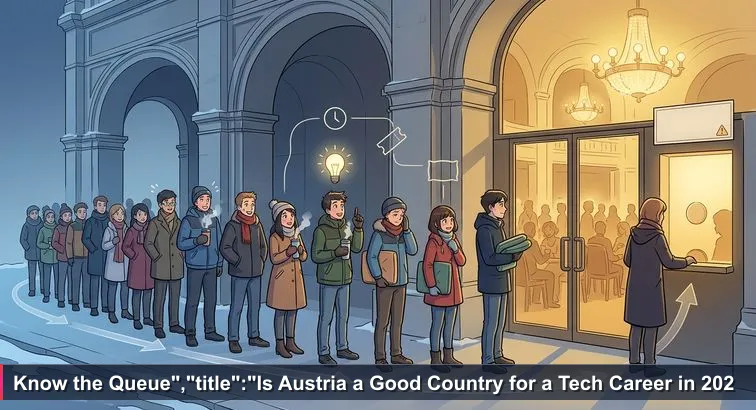
You’re back under the arches of the Wiener Staatsoper, shuffling forward in the Stehplatz line as your toes go numb. Inside, the golden hall is already buzzing; outside, a tiny sign over the ticket window whispers “Ausverkauft möglich” - sold out possible. It feels a lot like scrolling Austrian tech headlines versus actually applying for jobs.
On paper, Austria is wide open: official reports point to a chronic gap of 24,000+ unfilled ICT roles, and initiatives like “Artificial Intelligence Mission Austria 2030” position the country as an ambitious, well-funded player in applied AI and digitalisation. The ICT Mobility & Relocation Intelligence Report for Austria even highlights tech as one of the country’s most strategically supported sectors.
Yet if you read Reddit or talk to junior devs in Vienna coworking spaces, you hear a different soundtrack: job searches stretching past 10 months, entry-level CVs ghosted, and “junior-friendly” postings quietly insisting on fluent German plus 2-3 years of experience. That tension is why some observers describe the market as “stable, polite, slightly deceptive” - calm on the surface, but with sharp filters underneath.
“Austria doesn't have a shortage of jobs. It has a shortage of ready professionals. And that? That's your opportunity.” - thekoshercorporate, labour market commentator, Instagram
So is Austria actually a good place for a tech career? The honest answer is yes - but only if you play by three unwritten rules, much like knowing where to stand in the opera queue:
- Language: treating German as a core skill, not a nice-to-have.
- Specialization: arriving as an applied-AI, data, or infrastructure specialist, not a vague “junior dev.”
- Location: looking beyond Vienna’s hype to hubs like Graz or Linz where industrial tech is hungry for talent.
According to Austrian IT recruiters, those who match these filters often move from months of silence to multiple offers. The rest, like latecomers at the Staatsoper, mostly hear the orchestra through the wall.
What We Cover
- Is Austria a good place for a tech career in 2026?
- What does Austria’s tech ecosystem look like today?
- Why choose Austria for a tech career?
- How does Austria’s tech job market actually work?
- What will you really earn and spend here?
- Who thrives in Austria’s 2026 market - and who struggles?
- Is Austria a good place for AI and ML work?
- How Nucamp and bootcamps fit Austria’s hiring reality
- Relocation basics: visas, German, and fitting in
- How to break into Austria’s tech scene, step by step
- Austria versus other European tech hubs - when to choose it
- What’s the bottom line - do you get in the queue?
- Common Questions
Discover real projects and portfolio tips in the comprehensive guide to launching an AI career in Austria (2026).
What does Austria’s tech ecosystem look like today?
Zoom out from the opera queue and Austria’s tech map is surprisingly dense for a small, alpine country. The ICT sector generates around USD 18-20 billion per year and is projected to grow at roughly 6-9% annually through 2032, according to the Austria ICT market analysis. Instead of a few mega-brands, the landscape is full of industrial “hidden champions” building automotive test systems, rail signalling, energy tech and industrial software that quietly ship worldwide.
The ecosystem is highly regionalised rather than concentrated in one mega-city. Vienna holds about 55% of all ICT employment, with strengths in fintech, SaaS, edtech, govtech and enterprise IT. Graz, branded part of the “Silicon Alps”, leans into automotive software, semiconductors, embedded systems and industrial AI, underpinned by TU Graz and giants like AVL List. Linz and Upper Austria specialise in Industry 4.0, steel and manufacturing tech around voestalpine and JKU Linz, while Salzburg mixes media, tourism tech and manufacturing with names like Red Bull and Palfinger.
Underneath all this sits an unusually research-heavy foundation. Austria invests about 3% of GDP in R&D, placing it among the EU’s top spenders, as outlined in the national Research and Technology Report. A 14% refundable R&D tax premium encourages companies to base labs here, feeding a corridor of institutes like TU Wien, ISTA in Klosterneuburg, and the Austrian Institute of Technology (AIT).
On top of that, the “Artificial Intelligence Mission Austria 2030” channels roughly $350 million in new funding between 2025-2027, especially into applied AI for manufacturing and healthcare. For developers and data scientists, that means fewer social apps and more chances to work on industrial optimisation, mobility, energy systems and other real-world problems.
Why choose Austria for a tech career?
Ask most developers sipping a Melange near Karlsplatz why they’re here, and they’ll rarely start with salary. Austria’s appeal is that you can build a serious tech career and still have a life outside the office - something that’s baked into how work, public services and cities are organised.
Legally, full-time employees typically get around five weeks of paid vacation, on top of public holidays, and working late into the night is seen as a warning sign rather than a badge of honour. Universal health insurance means doctor and hospital visits are effectively free at the point of care, and the country consistently ranks among Europe’s safest places to live. The annual Klimaticket (about €1,095) gives you almost unlimited travel on public transport nationwide, from the U-Bahn in Vienna to regional trains across the Alps, a deal highlighted in the Vienna Region work-life balance overview.
Daily costs are not trivial, but they’re predictable. A central one-bedroom in Vienna usually runs around €1,100-€1,400 per month, while similar flats in Graz or Linz often sit a few hundred euros lower, according to the latest cost-of-living analysis for Austria. Groceries are affordable, and many tech workers simply skip owning a car altogether.
Professionally, the country offers depth rather than flash. You’re sitting on top of a dense research corridor - TU Wien, ISTA in Klosterneuburg, AIT, plus TU Graz and JKU Linz - feeding directly into industry. That means more chances to work on applied AI, industrial automation and critical infrastructure, and fewer late-stage “hype only” startups. Surveys of local engineers regularly show a clear majority reporting satisfaction with their jobs and work-life balance, which matches the lived experience of many teams in Vienna, Graz and Linz.
How does Austria’s tech job market actually work?
Behind the calm headlines, Austria’s tech market behaves more like a carefully managed subscription list than an open-door concert. Official reports talk about large unfilled ICT demand, yet junior engineers in Vienna often describe sending hundreds of applications with little response. Recruiters like Georg Klausner summarise this as a skills crisis rather than a job crisis, with companies struggling to find candidates who match very specific profiles, not just “any developer,” as he notes in his Austrian IT market overview.
The strongest pull is in roles that sit close to business value and infrastructure: applied AI and data for manufacturing and healthcare, cloud and DevOps for enterprise IT, embedded systems and industrial IoT for automotive and machinery, and cybersecurity around critical infrastructure. This lines up with Austria’s wider industrial and AI priorities, where government strategies explicitly push digitalisation, automation and smarter energy systems, according to the US International Trade Administration’s brief on Austria’s AI market growth.
On the other side of the ledger, the market is tight for generic web developers, English-only juniors and unspecialised IT support, especially in Vienna where most international candidates focus their search. Many of these roles are simply oversubscribed, so employers can insist on near-perfect matches in tech stack, domain knowledge and language.
Three informal filters shape who actually gets hired:
- Language: strong or native German is preferred for the majority of roles, especially in SMEs, consulting and leadership.
- Specialisation: profiles in MLOps, industrial AI, embedded C/C++, cloud infrastructure or cybersecurity are far more likely to get callbacks than broad “full-stack” labels.
- Cultural fit: Austrian teams tend to value reliability, low drama and long-term commitment; short job hops or “tourist mentality” can be a quiet red flag.
Region also matters: Vienna offers the biggest volume of postings but the fiercest competition, while industrial hubs in Upper Austria and Styria often have a better job-to-candidate ratio for genuinely specialised engineers.
What will you really earn and spend here?
Understanding Austrian salaries starts with one quirk: most tech workers are paid in 14 instalments a year. You receive 12 regular monthly payments plus a “holiday” and “Christmas” salary, and those 13th and 14th payments are taxed at a much lower rate (around 6%). Combined with progressive income tax and mandatory social insurance, mid- and senior-level engineers typically see roughly 35-45% of their gross income go to taxes and contributions, but the special tax treatment of bonuses lifts your effective net above what a simple 12-month calculation suggests.
For software and related ICT roles in 2025-2026, realistic bands look like this:
| Role | Gross Annual (14x) | Net Monthly Approx. (12x view) | Experience |
|---|---|---|---|
| Junior Developer | €38,000-€48,000 | ~€2,200-€2,700 | 0-2 years |
| Mid-level Engineer | €52,000-€68,000 | ~€2,900-€3,700 | 3-5 years |
| Senior Engineer | €68,000-€90,000 | ~€3,600-€4,700 | 6-10 years |
| Engineering Manager | €88,000-€115,000 | ~€4,500-€5,800 | Lead/manager |
The nationwide median full-time gross salary of €55,678 means many mid-level developers sit slightly above the middle of the income distribution; with around €55k gross, you’re solidly upper-middle class, even if not “rich,” as several Austrian engineers point out in local forums. A breakdown of junior full-stack roles on DEVworkplaces’ Austria salary guide broadly matches these lower bands.
On the spending side, the biggest line item is rent. A one-bedroom in central Vienna typically runs around €1,100-€1,400 per month, while similar flats in Graz or Linz often fall in the €800-€1,100 range. Public transport is intentionally cheap and comprehensive, and many developers skip owning a car altogether. Analyses comparing tech incomes and expenses, like the overview on DevologyX, consistently conclude that although Austrian salaries trail Zurich or London, purchasing power and day-to-day comfort are high once you factor in controlled housing costs and strong public services.
Who thrives in Austria’s 2026 market - and who struggles?
In the Staatsoper queue, you can almost see two lines: one of people who know the system and slip in through side doors, and another of hopefuls who do everything “by the book” and still miss the cut. Austria’s tech market sorts people in a similar way: some profiles are fast-tracked, others are left listening to the muffled orchestra from outside.
The people who tend to thrive here share a few traits:
- They’re mid- or senior-level with a clear niche: MLOps, industrial or applied AI, embedded C/C++ for automotive, cloud infrastructure, data engineering, or cybersecurity.
- They’re happy to work in industrial domains (automotive in Graz, steel and manufacturing around Linz, energy or logistics) as well as in Vienna’s fintech and SaaS scene.
- They either speak solid German already or are visibly on their way to at least B1/B2.
- They’re open to the startup and scaleup ecosystem mapped in the Austrian Startup Monitor, not just the big corporates.
EU citizens and people already based in Europe also have a smoother ride: they skip much of the visa friction, so companies can hire them more quickly for in-demand ICT and engineering roles that feature prominently in long-term outlooks like the Austrian “most in-demand jobs” forecasts. Combined with a specialised skill set, that often means multiple interviews rather than months of silence.
By contrast, certain profiles consistently struggle right now:
- Fresh graduates and juniors with little real-world project experience.
- Generic “web developers” or IT generalists without a strong domain or tech niche.
- Purely English-speaking candidates who don’t plan to learn German.
- Short-term “digital nomad” types signalling they might leave after a year.
Developers on forums like r/cscareerquestionsEU often describe Austria as a “bad time to be a junior,” with long job hunts and few callbacks. For these profiles, it can make sense to gain initial experience in more junior-friendly markets, or to specialise and upskill deliberately, before betting everything on the Vienna queue.
Is Austria a good place for AI and ML work?
When people here talk about AI, it feels less like a Silicon Valley hype trailer and more like a serious rehearsal at the Musikverein: disciplined, well-funded, and tightly scored. Austria has quietly built a dense AI corridor around Vienna and Graz, where research labs sit almost door-to-door with industry and public institutions.
On the academic side, institutes like TU Wien, TU Graz, ISTA in Klosterneuburg, and the Austrian Institute of Technology run strong groups in machine learning, computer vision, robotics and data science. Many of these collaborate under the TU Austria alliance, which coordinates joint research projects and PhD training in areas like AI, autonomous systems and computational science. The national funding agency FFG adds fuel with well over €90 million per year in grants to startups and research consortia working on digital and AI-heavy projects.
Crucially, this research doesn’t live in a vacuum. Austria’s industrial strategy leans hard into automation, smart manufacturing and green mobility, and AI is woven into that agenda. Automotive suppliers in Styria, steel and machinery firms in Upper Austria, energy companies, and logistics providers are all building internal AI teams for things like demand forecasting, route optimisation, anomaly detection on sensor streams and computer-vision-based quality control. By late 2025, dedicated AI oversight bodies and ethical guidelines were fully operational, making Austria an early mover in regulated AI across Europe.
That makes the country a particularly good fit if you’re interested in applied ML rather than just model zoo collecting. Think of roles where you:
- Design predictive maintenance models for factories in Linz or Kapfenberg.
- Work on fraud detection or risk scoring at a Vienna fintech.
- Build human-in-the-loop decision systems for healthcare, energy or public administration.
To plug into this, employers care less about knowing the latest paper and more about whether you can ship robust systems: solid Python and SQL, comfort with cloud platforms, MLOps basics, and practical experience with LLMs and agents integrated into real workflows. That’s why many career changers here pair university or self-study with project-heavy bootcamps such as Nucamp’s European AI and backend programs, whose tuition typically lands between €1,950 and €3,660 and focus on building deployable AI products instead of just passing exams.
How Nucamp and bootcamps fit Austria’s hiring reality
Austrian hiring managers keep repeating the same line: they don’t just need more applicants, they need people who can be productive almost from week one. That’s where focused, project-heavy bootcamps slot neatly into the local “skills crisis” - they compress years of unfocused self-study into a few months of building the exact kind of systems Austrian companies already run in production.
Nucamp is one of the clearest examples for people in Vienna, Graz, Linz or Salzburg. It’s an international online bootcamp built around working adults and career changers: evenings and weekends, small cohorts, and a strong emphasis on community. Programs like the 25-week Solo AI Tech Entrepreneur, the 15-week AI Essentials for Work, and the 16-week Back End, SQL & DevOps with Python are designed less around theory and more around shipping: LLM-powered features, Python backends with databases, CI/CD pipelines and cloud deployment.
- For AI roles in Vienna or Linz, you graduate with concrete LLM and agent projects instead of just a Coursera certificate.
- For data or DevOps roles in Graz’s “Silicon Alps”, you bring working APIs, infrastructure-as-code and monitoring dashboards.
- For product or business roles, AI Essentials teaches you to weave tools like ChatGPT into everyday workflows so you can be “the AI person” on your team.
Because tuition sits in the low four-figure range instead of the €10,000+ some European bootcamps charge, the financial risk is closer to taking a specialised university course than betting a year’s salary. That’s important in a country where you’re optimising for stable, upper-middle-class income plus a high quality of life, not chasing Bay Area pay. Nucamp’s reported outcomes - roughly 78% employment, about 75% graduation, and a 4.5/5 Trustpilot rating with close to 400 reviews - suggest that this mix of affordability and structure works for many.
Just as crucial, Nucamp leans into local context: community-based learning with meetups in major Austrian cities, and career support that focuses on European hiring norms. That means your portfolio, CV and interview prep are tuned for the same startup and scaleup landscape that agencies like Invest in Austria describe in their startup funding guides, rather than only for US recruiters.
Relocation basics: visas, German, and fitting in
Relocating into Austria’s tech scene is less about one big leap and more about quietly ticking three boxes: the right residence permit, workable German, and a feel for how teams operate here. Get those roughly right, and everything from salary negotiations to after-work beers in the 7th district becomes easier.
Visas and work permits in practice
If you hold an EU/EEA or Swiss passport, the process is mostly administrative: register your address, sign an employment contract, and your employer handles social insurance. Non-EU citizens usually come in on the Red-White-Red Card or EU Blue Card, which are designed for qualified workers in shortage occupations like IT and engineering. Austria’s industrial and innovation strategy explicitly leans on international talent to keep its factories, labs and digital projects running, as outlined in the federal government’s Industry 2035 strategy.
German: from “bonus” to baseline
In Vienna’s most international teams you can start in English, but long-term, German shifts from “nice-to-have” to “career limiter” if you ignore it. Aiming for B1-B2 over your first couple of years is realistic if you start early: it’s enough to follow meetings, read internal docs, and handle day-to-day life without stress. Employers don’t expect perfection; they do notice whether you’re investing in the language or treating Austria like a long layover.
Fitting into Austrian work culture
Inside the office, three norms stand out: punctuality, low-drama collaboration, and clear boundaries between work and private life. Colleagues may be friendly but reserved at first; trust builds slowly through reliability, not big talk. One practical on-ramp, especially for younger candidates, is to start with an internship or trainee role through programmes like those catalogued by Piktalent’s Austria internships portal, which combine local experience with structured mentoring.
Think of it as learning the choreography before stepping on stage: the better you understand visas, language, and workplace norms, the less energy you spend on logistics and the more you can pour into your actual tech work.
How to break into Austria’s tech scene, step by step
Breaking into Austria’s tech scene works best when you treat it like a project, not a lottery ticket. Instead of firing off 200 generic applications to Vienna, you design a pipeline: choose a niche, get just enough local signal (German, projects, references), then approach a focused set of employers.
The goal isn’t to be “hireable in theory,” but to look like someone who could join a Vienna, Graz, or Linz team on Monday and start shipping value within weeks.
A practical roadmap into the market
- Pick your hub and industry
Decide whether you’re aiming at Vienna’s fintech/SaaS ecosystem, Graz’s automotive and semiconductor cluster, or Linz’s Industry 4.0 and manufacturing focus. Your projects and learning path should mirror that choice. - Upskill with production-style projects
Use structured programs - for example, Nucamp’s AI and backend bootcamps - to build exactly what Austrian employers run: Python APIs, data pipelines, LLM-powered features, CI/CD and cloud deployments. Aim for 3-5 serious portfolio pieces, not 20 tutorials. - Start German immediately
Even reaching A2-B1 before you land helps. Mention active courses on your CV and LinkedIn; it signals long-term intent and opens more roles once you’re on the ground. - Network like a local
Join meetups in Vienna, Graz, Linz or Salzburg, contribute to open source, and talk to people already working at your target companies. Alumni groups and bootcamp communities are especially powerful here. - Run targeted applications
Shortlist 20-30 employers that fit your niche using resources such as Austria’s top-company rankings on LinkedIn. Tailor each CV and cover letter to their tech stack and domain, and always pair an application with at least one polite, specific message to an engineer or recruiter inside the company.
Executed consistently over a few months, this approach moves you from anonymous CV in a crowded inbox to a recognisable, “ready now” candidate in exactly the corner of the Austrian tech scene you care about.
Austria versus other European tech hubs - when to choose it
Choosing Austria usually means weighing it against the “big three” many Austrians themselves compare to: Berlin, Zurich, and Stockholm. Each offers a different mix of salary, cost, language, and startup energy, and your answer depends less on generic rankings and more on what you personally optimise for.
Big-picture trade-offs
| Hub | Pay Level | Cost of Living | Market Profile |
|---|---|---|---|
| Austria (Vienna etc.) | Competitive in EU, below Zurich | Moderate; housing cheaper than many capitals | Industrial & applied AI, fintech, strong work-life balance |
| Berlin | High for seniors, solid for mids | Moderate-to-high, especially central districts | Large, English-friendly startup scene, more junior roles |
| Zurich | Highest in Europe for many tech roles | Very high; top-tier rents and services | Finance, enterprise, specialised R&D; fewer but elite jobs |
| Stockholm | High, especially in product companies | High, strong social safety net | Mature startup ecosystem, English common in tech |
Comparative analyses of European pay levels, such as the overview by Next Level Jobs EU on the highest-paying tech roles, consistently put Switzerland at the top, with Austria in a mid-to-upper tier where salaries are solid but not explosive.
When Austria is the better choice
Austria tends to win if you care as much about life as about compensation: five weeks of paid vacation, universal healthcare, and easy access to the Alps, combined with serious work in applied AI, manufacturing, energy, and fintech. It’s also a strong option if you want to stay in the German-speaking world without the intensity and price tag of Zurich, and you’re prepared to invest in your German over time.
When another hub may fit better
If you’re an English-only junior chasing your first break, Berlin or Stockholm usually offer more entry points and a larger startup scene. If your priority is simply maximising take-home pay and long-term savings, Zurich’s salary levels are hard to beat, even once you factor in costs, as many senior engineers in regional comparisons on sites like Ohh My Brand’s tech-hub profiles point out. Austria sits in the middle: less adrenaline, more stability.
What’s the bottom line - do you get in the queue?
Standing under the arches of the Staatsoper, the choice is simple: stay in the Stehplatz queue and learn how it works, or head somewhere else for the evening. Austria’s tech scene asks you the same question. The performance inside really is world-class - industrial AI in Styria, fintech in Vienna, research clusters tied into global networks - but it is not a free-for-all. Access depends on learning the house rules.
If you’re ready to treat German as part of your skill stack, specialise instead of staying a generalist, and look beyond the most obvious postcode to places like Graz or Linz, Austria rewards you with steady careers, serious engineering problems and a lifestyle most tech hubs can’t match. The country has deliberately invested in research, green industry and digitalisation, positioning itself as a stable, innovation-focused economy rather than a boom-and-bust playground, as business analysts note in their Austria investment opportunity overviews.
If, on the other hand, you need a wide-open junior market, want to work purely in English, or are chasing the very highest salaries above all else, then it may be wiser to pick a different “theatre” - Berlin, Zurich, Stockholm, or a fully remote role. There’s no shame in choosing a city whose queue and language better match where you are right now.
The real bottom line isn’t “Is Austria good for tech?” but “Is Austria good for your profile, at this moment?” If the answer feels like a cautious yes, your next steps are concrete: pick a niche, build deployable projects, start German today, and plug into local networks that tie universities, startups and “hidden champions” together, which government reports on industry and innovation repeatedly highlight as a key strength of the country’s economy (Austrian Research and Technology factsheets).
Do that, and you’re no longer just waiting in the cold. You’re someone the usher is looking for - the kind of “ready professional” Austria quietly built this whole system around.
Common Questions
Is Austria a good country for a tech career in 2026?
Yes - but selectively. Austria reports a shortage of 24,000+ ICT professionals and strong public R&D funding (around 3% of GDP), yet opportunities skew to candidates with niche skills, some German, or willingness to work outside Vienna.
Do I need German to get hired in Austria's tech sector?
Not always - many Vienna-based international teams operate in English, but recruiters estimate that up to ~80% of job postings (especially in SMEs and outside Vienna) favour German; aim for B1-B2 if you want long-term progression into leadership or client-facing roles.
Which Austrian cities should I target for AI or industrial tech roles?
Target Vienna first (it holds about 55% of Austria’s ICT employment) for fintech, SaaS and research labs, while Graz is strongest for automotive and embedded systems and Linz for Industry 4.0 and manufacturing; Salzburg and Upper Austria host sector-specific employers like Red Bull, AVL and voestalpine.
What can I realistically expect to earn and pay for living in Austria?
Typical gross (14x) salaries in 2026 are roughly: junior €38k-€48k, mid €52k-€68k, senior €68k-€90k, with central Vienna one-bedroom rent around €1,100-€1,400; expect ~35-45% of gross to go to taxes and social contributions, though the 14-salary system and reduced Sonderzahlung tax improve net take-home.
How should I prepare if I want to move into Austria’s AI/ML job market as a career-changer?
Focus on applied projects that match Austrian industry needs (predictive maintenance, anomaly detection, MLOps), start German early (A2-B1 within 1-2 years) and specialise rather than stay a generalist; practical bootcamps like Nucamp (programs €1,950-€3,660) can speed portfolio development and report employment outcomes around ~78%.
Find programs that balance cost and career impact in our feature on the best bootcamps in Austria for AI careers.
Find region-specific opportunities in our analysis of AI talent demand across Austria's top industries (2026).
Read our ranking of the Top 10 tech apprenticeships, internships and entry-level jobs in Austria for 2026 to plan your next move.
Long-read: Best AI engineering jobs in Austria - a Top 10 tasting route (2026)
Top-ranked Austrian tech coworking spaces & incubators for AI/ML in 2026

Irene Holden
Operations Manager
Former Microsoft Education and Learning Futures Group team member, Irene now oversees instructors at Nucamp while writing about everything tech - from careers to coding bootcamps.