









Top 10 Women in Tech Groups and Resources in Bellevue, WA in 2026
By Irene Holden
Last Updated: January 23rd 2026
Too Long; Didn't Read
The top two picks are the Women in Tech Bellevue-Redmond Circle for Eastside-focused networking with Microsoft, Amazon, and local AI startups, and AnitaB.org Seattle for its mentorship that drives real promotion outcomes. AnitaB.org reports 89% of mentorship participants are promoted within two years, WomenTech events consistently earn four- to five-star attendee ratings, and WIT’s 2025 cohort supported 57 protégés - clear signals these groups move careers, not just casual meetups. In the Seattle-Bellevue market where mid-level AI engineers on the Eastside often see $150k-plus base salaries and there’s no state income tax, these communities are the fastest way to get visible to hiring managers and sponsors.
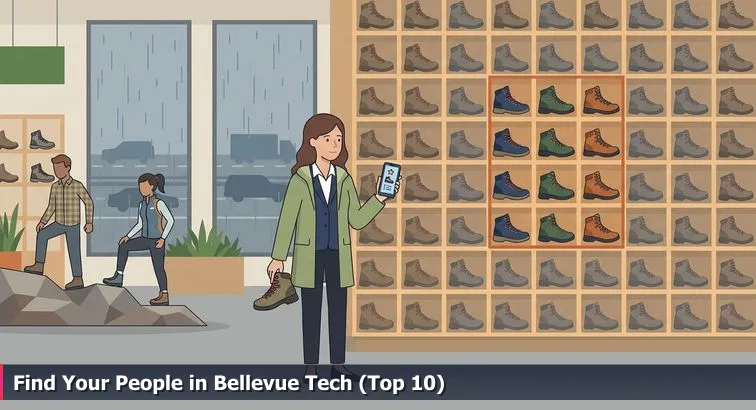
You’re in the Bellevue REI on a Tuesday that can’t decide between drizzle and full-on downpour, staring at a wall of boots that all look fine. Somewhere in your tabs is a “Top 10” guide, but the screen can’t tell you which pair will still feel good ten miles into a muddy Tiger Mountain switchback, or which ones will give you blisters before you hit the second lookout.
That’s exactly what the Seattle-Bellevue tech corridor feels like when you’re a woman in AI/ML trying to find your people. Within a 20-minute drive you’ve got Microsoft in Redmond, Amazon building out towers in downtown Bellevue, and a growing cluster of AI-heavy startups that keep landing on lists of startups to watch in 2026 across the region. The roles are there, the compensation is strong, and the lack of a state income tax quietly sweetens every offer - yet it’s still common to walk into an AI research review, an infra design meeting, or a security standup and be one of the only women in the room.
Why the Eastside can feel like a wall of boots
If you’re based in Bellevue or Redmond, your calendar can fill up fast: Eastside circles, Seattle meetups, global conferences that land at the convention center, mentorship programs, virtual cohorts, Slack communities. Some are optimized for students, some for senior engineers, some for people pivoting into AI from data or product. On paper they all look great; in practice, only a few will match your current terrain - whether that’s your first ML internship or navigating staff-level expectations at a cloud giant.
“Being good isn’t enough... you’ve gotta be visible.” - Kay Malcolm, Tech Leader, quoted in a 2026 women-in-tech speaker series
What this list is actually trying to do
This guide isn’t here to crown a single “best” community, the way a boot review can’t promise you the perfect fit for every trail. It’s a trail map for the Seattle-Bellevue corridor: ten women-in-tech organizations and events that intersect meaningfully with Eastside life, especially if you care about AI and machine learning. For each one, you’ll see the kinds of signals you’d use to evaluate a model - mentorship outcomes, event ratings, cohort sizes - alongside the things metrics miss, like how it feels to walk into the room, or how easy it is to get from a panel conversation to an actual coffee chat at a café near the transit center.
Think of this as a way to move from endlessly scrolling to actually trying things on. Over the next few sections, you’ll meet local circles, regional mentorship programs, global conferences that swing through Seattle, and even remote-friendly communities you can tap from a Bellevue apartment. Your only job is to pick one or two to “break in” this quarter - whether that’s a neighborhood meetup, a structured mentorship cohort, or even a job-search community like the dedicated job search platforms built for women in tech. The real learning, like the real blisters and breakthroughs, happens once you step onto the trail.
Table of Contents
- Introduction: Finding your people in Bellevue tech
- Women in Tech Bellevue-Redmond Circle
- AnitaB.org Seattle Community & Mentorship
- Women in Tech Seattle & Global Conference 2026
- Women in Technology (WIT) Mentor-Protégé Program
- Girls Who Code - Bellevue College Chapter & Pathways
- Bellevue Chamber Women’s Leadership Conference
- Women in Tech Connect Seattle 2026
- Global Security Tour 2026 - Bellevue City Hall
- Women in Tech Seattle - Ongoing Networking Series
- Girl Geek X, Elpha and Artech
- How to Use This List Without Getting Blisters
- Frequently Asked Questions
This guide: starting an AI career in Bellevue WA in 2026 lays out education choices from bootcamps to UW certificates.
Women in Tech Bellevue-Redmond Circle
On a weeknight, if you walk out of the Bellevue Transit Center instead of heading straight home, you can follow the small stream of people cutting past City Hall toward a conference room or coworking space. Laptops in backpacks, blue badges from Redmond and South Lake Union, a couple of folks still on Bluetooth calls about model latency. This is the typical crowd for the Women in Tech Bellevue-Redmond meetups: engineers from Microsoft, applied scientists from Amazon’s Bellevue offices, and a growing mix of AI startup folks comparing notes on everything from LLM guardrails to compensation bands.
What the Bellevue-Redmond Circle actually offers
The Women in Tech Bellevue-Redmond Circle is a localized chapter within the global WomenTech Network, explicitly focused on the Eastside corridor. The group describes itself as a place to talk AI trends, ML career paths, negotiation, and leadership without having to cross the lake every time you want community. Events usually run on a quarterly cadence (often hybrid), with ad-hoc coffee chats in between, and most gatherings are deliberately priced in the $0-$25 range so interns, students, and senior ICs can all show up without expensing it.
“A supportive and inclusive environment where members can connect, grow, and excel.” - WomenTech Network, Women in Tech Bellevue-Redmond Circle overview
Because it’s plugged into the broader WomenTech ecosystem, the circle borrows a lot of structure from the global conferences that attendees consistently rate between 4.0-5.0/5.0 and describe as “well-organized,” “easy to follow,” and full of “authentic speakers” sharing practical suggestions rather than theory. The local version simply shrinks that format down to a room (or Zoom) where you can actually recognize the buildings people point to when they say “my office is over there,” as outlined in the official Women in Tech Bellevue-Redmond Circle description.
Why it works for AI/ML careers on the Eastside
In Bellevue and Redmond, it’s common for mid-level AI/ML engineers to see $150K+ base salaries before stock, especially inside major employers, yet still feel like statistical outliers on their own teams. A hyper-local circle narrows the universe to people living roughly your life: the Azure engineer who just pushed an on-call-heavy ML service to a more sustainable architecture, the Amazon scientist who navigated an internal transfer into a research-heavy role, the startup ML lead who traded some comp certainty for upside in a no-income-tax state. You’re not just swapping LinkedIn URLs; you’re trading tactics that map directly to the companies and org charts you already know.
| Option | Typical Cost | Interaction Depth | Best Use Case |
|---|---|---|---|
| Bellevue-Redmond Circle | $0-$25 per event | Small-group, repeat faces | Building an Eastside AI/ML peer network |
| Big global conferences | Higher ticket + travel | High breadth, low repeat contact | Exposure to trends and many companies at once |
| Online-only communities | Often free or membership-based | Asynchronous, text-heavy | Broad perspectives, remote-friendly advice |
How to plug in without overthinking it
Instead of treating this like another item on an endless boot-review scroll, treat it like actually walking a loop around the store in one pair. Join the circle via the WomenTech page, opt into the email or chat space, and commit to attending exactly one upcoming meetup. During that event, identify two or three people whose work overlaps your own - say, other ML engineers or data scientists - and ask for 30-minute coffee chats in Bellevue or Redmond. If you’re, for example, a Microsoft ML engineer trying to move closer to research, use those coffees to reverse-engineer how others made lateral moves, handled performance reviews, or navigated promotions in similar orgs. The point isn’t to find a forever-community in one night; it’s to gather enough real-world signal to know if this particular “boot” is worth breaking in over the next quarter.
AnitaB.org Seattle Community & Mentorship
Maybe you’ve already done the circuit: a few meetups in South Lake Union, an internal women-in-tech lunch at your Bellevue office, a panel on AI ethics that was more buzzword than roadmap. Helpful, but not exactly the kind of sustained, structured support you need when you’re trying to move from senior to staff engineer, or from data science into applied ML at a place like Microsoft or Amazon. That’s where AnitaB.org starts to feel less like a casual drop-in and more like hiring a guide who knows the promotion trails inside big tech.
What the Seattle community and mentorship actually look like
AnitaB.org is the nonprofit behind the Grace Hopper Celebration, but on the ground here it shows up as a Seattle community that runs regular events - things like “Coffee and Vision Boarding” sessions and community planning calls that surface local speakers and mentors. The community hub on AnitaB.org’s Seattle page lists monthly virtual and in-person gatherings designed to help women in tech connect, share goals, and turn those into concrete next steps.
The real force multiplier is the structured mentorship program. According to AnitaB.org’s own overview of how it’s creating opportunities for tech workers, the global mentorship platform connects participants with experienced technologists and leaders - and 89% of those participants report being promoted within two years. For an AI/ML engineer on the Eastside, that’s not just a feel-good stat; it’s the kind of metric you’d expect from a well-instrumented system: clear inputs (mentorship), measurable outputs (promotion), and enough volume to take seriously.
“Big ideas are meant to be shared, debated, and celebrated.” - AnitaB.org, announcing the Grace Hopper Celebration call for participation
How it fits into a Bellevue AI/ML career
If local circles are where you meet peers, AnitaB.org is where you deliberately engineer visibility. Maybe you’re an applied scientist at Amazon in Bellevue struggling to get your work into the right rooms, or a Redmond-based ML engineer whose promo packets keep stalling a level below where your scope actually sits. The combination of local community events, the massive Grace Hopper ecosystem (with its annual call for participation and thousands of attendees), and a mentorship program with a documented promotion lift is unusually well suited to breaking that pattern. You’re not just improving your skills; you’re getting coached on how to show those skills to the people who make decisions.
Choosing the right AnitaB “trail”
| Option | Scope | Structure | Key Metric |
|---|---|---|---|
| Seattle Community | Local (Seattle-Bellevue) | Monthly meetups & planning sessions | Ongoing access to local mentors & speakers |
| Mentorship Program | Global network | Structured mentor-mentee matching | 89% report promotion within 2 years |
| Grace Hopper Celebration | Global conference | Talks, CFPs, recruiting at scale | Tens of thousands of women technologists reached annually |
The practical play is simple: join the Seattle community, show up to one or two events, and then apply for the next mentorship cohort with a very specific goal - “Move from senior to staff ML engineer in my Bellevue org,” or “Pivot from BI to applied NLP inside 18 months.” Treat the relationship like a real project: recurring 1:1s, clear milestones, and feedback loops on everything from your promo packet to how you present your work to director-level audiences. Instead of browsing yet another list of “top women-in-tech groups,” you’re testing one serious, data-backed path underfoot and seeing how it holds up over the next season of your career.
Women in Tech Seattle & Global Conference 2026
Some nights, crossing the 520 bridge from Redmond into Seattle feels like shifting climates: you leave the orderly Microsoft campus behind, park near South Lake Union, and suddenly you’re in a room packed with engineers from half a dozen companies, name badges reading “ML Engineer,” “Applied Scientist,” “Head of Data.” That’s the vibe of the Women in Tech Seattle community on an average meetup night - and it scales all the way up to the Women in Tech Global Conference when it lands in Seattle, turning the whole downtown core into one big hallway track.
Two layers of the same network
At the local level, Women in Tech Seattle (part of WomenTech Network) runs recurring meetups focused on peer networking, job leads, and practical talks. Product leader Prashanti Pathak of Costco Travel has described the Seattle community as “truly empowering to learn from such incredible women” and emphasizes the value of supporting a “collaborative community,” as highlighted in profiles of the women in tech Seattle ecosystem on sites like Designlab’s roundup of organizations for women in tech. These are the evenings where you can casually compare interview processes for ML roles, or hear how someone actually navigated a level jump inside a FAANG-scale org.
Zoom out a level and you hit the Women in Tech Global Conference 2026, with an in-person stop in Seattle. It’s a multi-day event that brings in speakers and attendees from around the world to talk about everything from AI ethics and LLM ops to leadership and entrepreneurship. Past conferences have been rated in the 4.0-5.0/5.0 range by attendees, according to independent reviews of the Women in Tech Global Conference series on platforms like Eventible’s conference review listings, with participants calling out the strong organization and practical, non-theoretical talks.
“Authentic speakers and very practical suggestions - one of the most useful women-in-tech events I’ve attended.” - Conference attendee review, Women in Tech Global Conference, via Eventible
How the local and global pieces play together for AI/ML
For women in AI and ML based in Bellevue or Redmond, this combination is unusually powerful. The conference is where you can binge on high-density content - keynotes on scaling recommendation systems, panels on AI safety, workshops on ML career paths - while also walking the expo floor to meet hiring managers from companies you might never see at a smaller meetup. The Seattle community is what keeps that energy from evaporating once the badge comes off: it gives you a place to reconnect with people you met at the conference, follow up on conversations about roles, and keep an eye on how the local market is moving.
| Option | Scale | Typical Cost | Best For |
|---|---|---|---|
| Women in Tech Seattle (local) | Dozens to low hundreds per event | Often free or low-cost | Ongoing network, peer support, local job intel |
| Women in Tech Global Conference 2026 | Thousands of attendees | Conference ticket + potential travel | High-density learning, hiring manager exposure, speaking opportunities |
The most effective way to use both is to treat the conference as a concentrated experiment and the Seattle community as your follow-through. Before the conference, pick a short list of goals - meet five women working on applied ML, attend two sessions on AI leadership, get one warm intro at a target company. Afterward, plug into local meetups and smaller gatherings to deepen those connections: coffee chats on the Eastside, follow-up whiteboard sessions, or even mock interviews. Instead of letting another giant event blur into your calendar, you’re deliberately tying the global energy back to the daily reality of building an AI career in a region where the opportunities are big, the competition is real, and the right network can move your trajectory as much as your latest model performance.
Women in Technology (WIT) Mentor-Protégé Program
There’s a moment in a lot of Bellevue and Redmond careers where the problem isn’t “How do I learn this new ML framework?” but “How do I turn the work I’m already doing into a promotion, a bigger scope, or a clean pivot?” That’s usually when casual networking stops being enough. You don’t need another panel; you need someone experienced looking at your promo packet, your roadmap, your options - and staying with you for a full season of your career instead of one coffee.
What the WIT Mentor-Protégé Program actually is
The Women in Technology (WIT) Mentor-Protégé Program is built exactly for that kind of long-haul support. It’s a regional, cohort-based mentorship program serving the greater Seattle area, pairing women in tech with more senior mentors across engineering, data, product, and leadership. In 2025, WIT supported 57 protégés in a single cohort, according to a year-end recap shared on the organization’s official Women in Technology (WIT) DC Instagram reel. That scale is big enough to have real network effects, but still small enough that you’re not getting lost in a massive, anonymous matching algorithm.
“As the new year approaches, we’re reflecting on what we…” - Women in Technology (WIT) DC, Instagram year-in-review
Unlike open-ended communities, WIT’s program is explicitly time-bound and structured: you join a defined cohort, meet with a dedicated mentor over several months, and participate in programming that often culminates in recognition like leadership awards and alum spotlights. It’s designed less like a meetup series and more like a semester-long course in your own career advancement.
Why it matters if you’re in AI/ML on the Eastside
If you’re an ML engineer in Redmond or a data scientist in downtown Bellevue, you’re already in one of the highest-opportunity markets in the country: strong six-figure roles, significant equity upside, and the added boost of no state income tax. The bottleneck usually isn’t opportunity; it’s navigation. You might be the only woman on your team, unsure how others at your level are framing impact, structuring promotion cases, or deciding when to jump from big tech to a startup and back.
A structured mentor-protégé relationship gives you continuity you won’t get from a one-off event. Over the span of a cohort, you can pressure-test decisions like “Do I stay for this next stock vest?” or “Is it time to pivot from data engineering to applied NLP?” against someone who’s seen multiple cycles. That kind of guided pivot is exactly what seasoned leaders on platforms like WeAreTechWomen’s career change features keep emphasizing: ambition is necessary, but strategy and support determine whether the move actually lands.
How WIT compares to other mentorship paths
| Mentorship Path | Structure | Evidence of Impact | Best Fit |
|---|---|---|---|
| WIT Mentor-Protégé Program | Cohort-based, time-bound, regional | 57 protégés in 2025 cohort; ongoing alumni recognition | Mid-career AI/ML pros planning promotion or a strategic pivot |
| Global mentorship programs | Large-scale, often remote and cross-regional | Published promotion and advancement statistics | Those seeking broad perspectives beyond the Seattle-Bellevue market |
| Informal internal mentoring | Ad hoc, depends on manager and org culture | No formal tracking; highly variable | Early exploration or supplementing structured programs |
Using WIT like a mapped trail, not a random shortcut
The move here isn’t to sign up for everything; it’s to treat WIT like a specific, well-marked trail you’re committing to walk for a season. When applications open, be explicit in your goals: “Submit a staff-level ML promo packet within the next cycle,” or “Transition from BI into an applied AI role without taking a pay cut.” Once accepted, block time for every mentor meeting and cohort session the way you’d block production deployment windows. The value isn’t just in the advice; it’s in the accountability and the momentum that come from having a guide and a small pack walking the same steep stretch of career terrain alongside you.
Girls Who Code - Bellevue College Chapter & Pathways
If you cut across the Bellevue College campus between classes on a drizzly afternoon, you’ll see the full spread of tech ambitions in one pass: a couple of students debugging Python on borrowed laptops, someone in a UW hoodie talking about transfer applications, a flyer half-soaked on a bulletin board advertising a coding club meeting. This is where the AI and ML pipeline for the Eastside really starts - long before anyone gets a Microsoft alias or an Amazon badge.
Two local on-ramps into coding and AI
At the college level, the Girls Who Code - Bellevue College Chapter is a student-led organization that creates a peer network for women and non-binary students who want to build technical skills and confidence. Bellevue College lists it among its official student engagement organizations, which means it has a stable home for workshops, study sessions, and leadership roles. For someone eyeing AI or data science, that can translate into project teams, portfolio pieces, and a community that makes it less intimidating to be one of the few women in a CS or stats class.
For high schoolers across Bellevue, Sammamish, and the wider King County area, the Girls Who Code 2026 Pathways Summer Program fills in the rung below that. It’s a FREE, online coding program specifically for high school students, with tracks focused on AI, cybersecurity, and web development. Applications have deadlines in February and April 2026, and because it’s virtual, students can join from anywhere along the I-405 corridor without worrying about buses or rideshares. The structure is cohort-based, which means students don’t just consume content - they move through a shared experience with others who are equally early and equally curious.
“Girls Who Code 2026 Pathways is OPEN! FREE online coding program for high school students…” - Opportunities For Youth, promoting Girls Who Code Pathways
Why this matters for Bellevue’s AI/ML pipeline
In a region where mid-level AI and ML roles routinely hit six figures and no state income tax makes every dollar go further, the real constraint isn’t job count - it’s who gets prepared early enough to step into those roles. Programs like the Bellevue College chapter and Pathways are how you seed that pipeline with students who’ve already shipped small projects, seen some basic AI concepts, and learned to ask questions in technical spaces without apology. A high schooler who builds a tiny ML-backed web app in Pathways can show up at Bellevue College already thinking about internships at Microsoft, Amazon, or one of the Eastside’s AI startups within a year or two.
Picking the right “first trail”
| Program | Primary Audience | Cost | Format & Focus |
|---|---|---|---|
| Girls Who Code - Bellevue College Chapter | College students (Bellevue College) | Typically low or no cost to participate | On-campus club; coding workshops, peer projects, leadership |
| Girls Who Code 2026 Pathways | High school students | FREE online program | Virtual cohort; AI, cybersecurity, and web development tracks |
If you’re a student, the move is to treat one of these like your first real loop trail: commit for a season. Apply to Pathways if you’re in high school, or join the Bellevue College chapter and aim for a leadership role within a year. If you’re already working in AI/ML on the Eastside, this is one of the easiest places to give back in a way that also sharpens your own thinking - guest speaking about your ML internship, mentoring a small project team, or helping students translate a beginner AI project into something that belongs on a resume. Before long, those names on the attendance sheet become the interns and junior engineers you’ll be reviewing pull requests from on the Bellevue and Redmond campuses.
Bellevue Chamber Women’s Leadership Conference
By 8:30 a.m., the lobby at Meydenbauer Center has that specific Bellevue buzz: heels and Allbirds on the same carpet, cold brew in compostable cups, a line of women from tech, finance, healthcare, and city government angling for seats before the first keynote. You catch snippets about Series B rounds, school board races, and one quiet “we’re piloting an AI tool in our claims department” from the row ahead. It doesn’t feel like a typical tech meetup - more like stepping onto a ridge where all the different trails of the Eastside economy briefly intersect.
What you actually get in the room
The Bellevue Chamber Women’s Leadership Conference is the Chamber’s flagship event for women across the region, now in its 6th annual run on February 24, 2026 at Meydenbauer Center. The official listing on the Bellevue Chamber’s 2026 Women’s Leadership Conference page frames the day around professional development and the theme of “Good Leadership” for every career stage, from early-career managers to executives and board members.
“Focusing on professional development and ‘Good Leadership’ across all career stages.” - Bellevue Chamber, 2026 Women’s Leadership Conference
In practice, that translates into keynotes from regional leaders, cross-industry panels, and breakout sessions that mix tech decision-makers with people shaping policy, education, and regional planning. Ticket tiers typically differentiate between Chamber members and non-members, with early-bird pricing that makes it realistic for mid-career professionals to attend without blowing their entire development budget.
Why a cross-industry lens matters for AI/ML
If you spend most of your week inside a Bellevue or Redmond AI org, it’s easy to see your work purely through metrics like latency, accuracy, or cost per inference. This conference pulls you up a level. You hear how hospital systems are evaluating AI for triage, how insurers are thinking about algorithmic bias, how city planners weigh automation against jobs. In a region with high-paying AI roles and no state income tax, leaders on these stages are often the ones shaping which projects get funded, which regulations gain traction, and which technical voices get invited into boardrooms.
How it compares to your usual tech events
Compared to a women-in-tech meetup or an AI-specific conference, the Bellevue Chamber event is less about the details of your latest model architecture and more about the power structures around it: budgets, boards, policy, public perception. That can feel abstract until you realize these are the people who will either champion or quietly stall your next AI initiative.
| Event Type | Primary Focus | Typical Audience Mix | Best Use Case |
|---|---|---|---|
| Bellevue Chamber Women’s Leadership Conference | Leadership & cross-industry strategy | Tech, finance, healthcare, civic leaders | Expanding influence, exploring board and policy-adjacent paths |
| Women-in-tech AI meetup | Technical skills & career tactics | Engineers, data scientists, PMs | Deepening local AI network, swapping implementation details |
| Global tech conference | Trends, recruiting, global networking | International tech professionals | Job hunting, speaking, benchmarking against other markets |
If you decide to go, treat it like a deliberate step onto a new kind of trail rather than a random detour. Ask your manager to cover the ticket as leadership development, then set concrete goals: attend at least one session outside your comfort zone (like civic policy or healthcare), ask a question that connects AI to the topic on stage, and leave with three conversations that go beyond “what do you do?” to “how is your organization really thinking about AI?” The payoff isn’t immediate like a new framework tutorial, but over time these are the rooms that determine which AI projects get sunlight - and who’s trusted to lead them.
Women in Tech Connect Seattle 2026
By the time you step off the light rail in downtown Seattle, you can already spot who’s headed where you are: a small stream of women in blazers and hoodies, juggling laptops and name badges, moving toward the same glass-walled venue. Inside, the noise level spikes fast - pockets of introductions, people waving at old colleagues, someone in the corner explaining a recommender system to a product manager from another city. Women in Tech Connect Seattle 2026 doesn’t feel like a sprawling multi-day conference; it feels like compressing months of networking into one intensely social afternoon.
What kind of event this actually is
Women in Tech Connect Seattle 2026 is a one-day, in-person flagship networking event scheduled for May 14, 2026, part of a broader global Women in Tech conference series. The official listing on Eventbrite’s Women in Tech Connect Seattle 2026 page frames it as a hub for engineers, data scientists, product leaders, and founders to meet, share experiences, and build relationships that outlive the event itself. Instead of spreading sessions over several days, it concentrates keynotes, panels, and open networking into a single, high-energy window.
“A flagship in-person networking event bringing together women across engineering, product, and leadership.” - Women in Tech Connect Seattle 2026 event description, Eventbrite
Why it matters if you live and work on the Eastside
For AI and ML folks based in Bellevue or Redmond, this is the kind of event that justifies crossing the lake on a weeknight. You get high-density exposure to people you’d normally only meet piecemeal: women leading ML teams in other regions, founders building AI-first startups, and technologists from industries where you might not even realize AI skills translate. Because it’s tied into a global series, you’re not just hearing about how Seattle does things - you’re picking up patterns from other markets, including how they’re approaching AI safety, LLM deployment, and hybrid or remote AI roles that you can still do from your Eastside apartment.
| Networking Option | Duration | Intensity | Primary Outcome |
|---|---|---|---|
| Women in Tech Connect Seattle 2026 | Single day | High - many conversations in a short window | New cross-company, cross-city connections |
| Local monthly meetup | Evening or half-day | Moderate - repeat contacts over time | Deeper local relationships, slower burn |
| Multi-day global conference | 2-4 days | Variable - talks, expo, side events | Broad learning, recruiting exposure, potential speaking |
How to treat it like a focused sprint, not a blur
Because it’s a single-day hit, the risk is walking away with a stack of business cards and no real traction. A better approach is to prep like you would for a launch: tighten your LinkedIn headline around your AI/ML niche, set two or three specific goals (for example, “meet women working on applied ML at non-Big-Tech companies” or “find one person who’s landed a remote AI role while staying in Washington”), and cap yourself at a handful of deeper conversations instead of dozens of shallow ones. Within 48 hours, follow up with short, concrete notes - “you mentioned migrating models off a legacy stack; I’d love to trade war stories over a 30-minute virtual coffee” - so the momentum from that one intense day carries back across the bridge into your regular Bellevue or Redmond routine.
Global Security Tour 2026 - Bellevue City Hall
On a gray Saturday at Bellevue City Hall, the council chambers feel different than they do during zoning hearings. There are hoodies under blazers, stickers on laptops, and a cluster of women trading notes about threat models instead of tax codes. Screens that usually show policy decks are flashing diagrams of cloud architectures and attack surfaces. This is the Global Security Tour 2026 stop in Bellevue, and for once, security, AI, and local government are all sharing the same air.
Where security meets AI on home turf
The Global Security Tour 2026 event at Bellevue City Hall is a focused, security-first gathering that still makes room for AI and representation. Scheduled for February 21, 2026, the Bellevue stop features a Microsoft keynote, a dedicated Women in Tech segment, and an associated hackathon. The official listing on Eventbrite’s Global Security Tour 2026 - Bellevue City Hall page highlights the combination of expert talks and hands-on building, which is rare for an event hosted in a civic space rather than on a corporate campus.
Why this matters if you build models for a living
For Bellevue and Redmond AI/ML practitioners, security can feel like a neighboring discipline you only touch when a compliance review appears on your calendar. But more and more, the lines are blurring: anomaly detection systems built on ML, LLMs that can be both tools and attack vectors, identity services that lean on behavioral models. Having Microsoft deliver a keynote in your own city hall is a signal that this isn’t just a niche concern; it’s core to how cloud and AI platforms are evolving. For women in particular, the Women in Tech segment and hackathon are a chance to show up visibly in a space that’s traditionally skewed even more male than ML.
How it compares to your usual tech events
Compared to a generic AI meetup or a big-box security conference in Las Vegas, the Bellevue stop is deliberately small and local, but unusually hands-on. You’re not just hearing about zero trust or AI-driven detection in the abstract; you’re building something with a team, on a weekend, in the same building where city decisions get made.
| Event Type | Primary Focus | Hands-On Component | Best For |
|---|---|---|---|
| Global Security Tour 2026 - Bellevue | Cloud security + Women in Tech | Yes - security-focused hackathon | AI/ML engineers exploring security-adjacent paths |
| AI-focused meetup | Models, tooling, career paths | Sometimes - lightning talks, demos | Deepening ML craft and local AI network |
| Traditional security conference | Broad infosec topics | CTFs, labs (often separate tracks) | Dedicated security professionals, cert-seekers |
The practical move is to treat the Bellevue hackathon less like a weekend diversion and more like a structured project: join a team that’s working with security data or building tooling that could plausibly plug into a cloud environment, document your design decisions, and ship something demoable by the end of the day. That artifact becomes a case study you can talk through in interviews for security-adjacent ML roles or platform teams at Microsoft and other Eastside employers. Instead of just reading yet another think piece about “AI and security,” you’re putting your boots down on a very specific patch of ground where those two worlds already overlap.
Women in Tech Seattle - Ongoing Networking Series
Most months, if you wander into a Women in Tech Seattle meetup at a bar in South Lake Union or a coworking space near Pike Place, the pattern is familiar: a handful of familiar faces from past events, a rotating cast of new people, and at least one conversation that turns into “we should grab coffee and talk about your ML pivot.” It’s not glamorous, but it’s the kind of regular, low-friction contact that quietly shapes careers for women who live on the Eastside and are willing to cross the lake every so often.
What “ongoing” actually looks like
The Women in Tech Seattle networking series shows up as a steady stream of events across the year - happy hours, panel nights, themed discussions - often listed as “Women in Tech Seattle 2025” or “Women in Tech Seattle 2026” on event platforms. Each one is small enough that you can actually talk to people, but frequent enough that you start recognizing names and faces: the applied scientist you met in January, the startup founder you ran into again in April, the recruiter who keeps quietly flagging AI roles between sips of seltzer.
“People really value regular programming and hybrid remote events so you can bring in more speakers and hiring managers.” - Reddit user in r/womenintech, discussing what makes women-in-tech groups work
That rhythm - recurring events plus occasional hybrid or remote options - means you don’t have to treat networking as a once-a-year sprint. You can drop in every 6-8 weeks, catch up on who changed teams, and stay loosely plugged into how the broader Seattle/Bellevue ecosystem is moving.
Why this matters when you’re based in Bellevue
If you live in Bellevue or Redmond, your default network can skew heavily toward your own company campus. Crossing into Seattle for recurring Women in Tech events diversifies your sample: you meet women who are doing AI in healthcare, fintech, civic tech, and early-stage startups, not just cloud giants. Career guides like CareerFoundry’s overview of resources empowering women in tech point out that communities with ongoing engagement - not just one-off summits - are especially valuable for people who are changing roles, re-entering tech, or trying to navigate promotions in male-dominated spaces.
For Eastside AI/ML professionals, that ongoing exposure translates into practical advantages: a more accurate sense of the broader comp landscape, early signal on which teams are spinning up new ML work, and informal mentors who’ve already walked the path you’re eyeing - from data analyst to ML engineer, from IC to manager, from big tech to startup and back.
Consistency versus one-off hits
| Format | Frequency | Typical Connection Depth | Best For |
|---|---|---|---|
| Women in Tech Seattle ongoing series | Every few weeks to monthly | Medium - repeat faces over time | Building a durable cross-company network |
| Large conferences | Once a year per event | Broad but shallow, many new contacts | High-density exposure to trends and hiring managers |
| Internal ERG lunches | Varies by company | Deep, but mostly within one employer | Navigating promotion and politics inside your org |
The way to get value here isn’t to attend everything; it’s to pick a sustainable cadence and stick to it. Commit to one Women in Tech Seattle event every month or two, aim for two or three substantial conversations each time, and send thoughtful follow-ups within 48 hours - especially to anyone whose AI/ML path looks like a version of where you want to go. As one community organizer on r/womenintech noted when soliciting feedback on new groups, the combination of regular programming and flexible formats is what keeps people coming back. Over a year or two, that quiet consistency does more for your career than any single, splashy event.
Girl Geek X, Elpha and Artech
Not every tool that moves your career forward lives on the Eastside. Some of the most useful support I’ve seen Bellevue AI and ML folks lean on is technically “nowhere” and “everywhere” at once: global communities you tap from your couch, between standups, or on the bus back from Redmond. They don’t replace local circles or conferences, but they quietly change what information, role models, and job options you have access to.
Three global communities that travel with you
Girl Geek X shows up as a stream of virtual events, podcasts, and articles featuring women across the tech stack. A feature on organizations championing women in tech describes Girl Geek X as “an outstanding place for events, podcasts, and articles connecting forward-looking women in tech,” underscoring its focus on real-world stories over vague inspiration, as highlighted in the TeamTechSis breakdown of women-in-tech organizations on Medium.
“An outstanding place for events, podcasts, and articles connecting forward-looking women in tech.” - TeamTechSis, writers of “Breaking Barriers: 10 Organizations Championing Girls & Women in Tech” on Medium
Elpha is a hybrid social and professional network built specifically for women in tech, with a community of 35,000+ members according to widely cited career resources. It’s where people go to ask un-Googleable questions: “What’s it really like on X team in Seattle?” “Is this AI offer competitive for Bellevue?” “How do I negotiate remote flexibility without tanking my chances?” Threads often get responses from women who have sat in the exact performance calibrations and hiring loops you’re dealing with.
Artech, meanwhile, operates on the more formal side of the spectrum as one of the largest women-owned IT staffing firms. Its own materials position Artech as a “partner in growth” for both consultants and clients, emphasizing that they don’t just fill roles but try to match technologists to environments where they can progress, as outlined on the official Artech company profile. For Bellevue-based AI and data professionals, that can translate into contract or consulting engagements at companies you’d never stumble across on your own, with a recruiter who understands both the tech and the dynamics women face in interviews and on teams.
How they differ - and where each fits
| Community | Type | Scale / Ownership | Best Use Case from Bellevue |
|---|---|---|---|
| Girl Geek X | Events, podcasts, content | Global audience; speaker lineup spans big tech & startups | Learning from talks and panels to inform your AI/ML career strategy |
| Elpha | Online community & forum | 35,000+ women in tech | Getting candid advice on offers, promotions, and company cultures |
| Artech | Staffing & consulting | One of the largest women-owned IT staffing firms | Finding contract or consulting roles in data/AI with a growth-minded recruiter |
Using global tools in a very local career
The move from Bellevue isn’t to join everything and lurk forever; it’s to use each of these with intent. Show up live to a Girl Geek X talk that overlaps your niche (say, recommender systems or AI leadership) and take notes you can apply to your next review cycle. Ask Elpha for a gut-check on an AI offer that looks good on paper but feels off compared to what you’re seeing at Microsoft, Amazon, or Eastside startups. Talk to Artech when you’re considering a contract role to bridge between teams or companies without losing momentum or compensation. None of them replace walking into local rooms, but together they widen your field of view so the choices you make in Bellevue are informed by more than just the few teams you’ve already worked on.
How to Use This List Without Getting Blisters
You’ve stood in front of enough metaphorical boot walls by now to know the pattern: 10 solid-looking options, lots of glowing blurbs, not a lot of guidance on which ones will actually hold up on your particular trail. The same goes for this list. Every group here is doing real work for women in AI/ML around the Seattle-Bellevue corridor, but the only way to know what fits is to stop scrolling, pick a couple, and see how they feel under real weight.
Step 1: Match the trail to your current terrain
Instead of hunting for a perfect ranking, start with where you’re standing right now and what you need in the next 6-12 months, not forever. A few example matches:
- If you need local Eastside peers in similar roles, lean on hyper-local circles and recurring meetups that keep you close to Bellevue and Redmond.
- If you’re optimizing for promotion and visibility, prioritize structured mentorship programs and communities that publish concrete advancement outcomes.
- If you want high-density networking and learning, layer in time-bound hits like regional leadership conferences and single-day flagship events.
- If you or someone you’re mentoring is early in the journey, look for student-focused pipelines and global communities that welcome beginners.
Treat those categories like a rough map, not a prescription. In a region where AI salaries are strong and there’s no state income tax, your real constraint is usually time and energy, not opportunity - so the more honest you are about your current terrain, the better your choices will age.
Step 2: Limit your experiments and track results
From here, cap yourself: choose one or two groups to “break in” over the next quarter. That might mean a local women-in-tech circle plus a mentorship cohort, or a student club paired with a global online community. Commit to a small, testable set of actions - one event per month, three coffee chats, one application to a mentorship or leadership program - and then track your own metrics the way you would a model rollout: new intros, interview leads, speaking opportunities, or simply how often you leave an event feeling energized instead of drained.
Step 3: Adjust the fit, don’t give up on the hike
Not every community will fit perfectly, and that’s the point. If a space consistently feels misaligned - wrong level, wrong energy, no real follow-through - treat it as a data point, not a failure. Swap it out and test another option rather than opting out entirely. And remember that this list isn’t exhaustive; there are adjacent groups in the region, from tech-focused ERGs to STEM organizations like the Seattle branch of AAUW that “advances gender equity for women and girls through research, education, and advocacy,” as described on the AAUW Seattle STEM mentor program calendar.
“Advancing gender equity for women and girls through research, education, and advocacy.” - AAUW, mission statement
The throughline is simple: in a place like Bellevue, where the demand for technical talent is high and the upside for women in AI/ML is real, community is part of your technical stack. Lists like this are weather reports and trail maps; useful, but incomplete. The real work - and the real payoff - comes from putting a few of these options on your calendar, paying attention to your own metrics, and being willing to change routes as your career climbs from first role to tech lead to whatever “summit” looks like for you.
Frequently Asked Questions
Which women-in-tech group should I join first if I work in Bellevue and focus on AI/ML?
Start with the Women in Tech Bellevue-Redmond Circle for local, Eastside-focused connections and pair it with a mentorship program like AnitaB.org; mid-level AI/ML roles on the Eastside commonly offer $150k+ base, so local networking near Microsoft and Amazon can surface high-quality leads quickly.
I want to move from senior ML engineer to principal - which resource will help the most?
Target AnitaB.org’s Seattle mentorship program (their mentorship cohorts report an 89% promotion rate within two years) and apply to the WIT Mentor-Protégé cohort (WIT supported 57 protégés in 2025) for structured sponsorship and promo-packet guidance.
I’m early in my career or mentoring a student - what should we join?
Use Girls Who Code: join the Bellevue College chapter and encourage students to apply to the free 2026 Pathways program (deadlines in February and April 2026) to build AI projects and a portfolio before college or internships.
Will attending large conferences in Seattle actually help me get Eastside jobs?
Yes - events like the Women in Tech Global Conference and Women in Tech Connect (Seattle) compress hiring managers, speakers, and recruiters into a short window (past conferences score 4.0-5.0/5.0), helping you identify 5-10 target companies and secure warm introductions for Eastside roles.
How do I pick just one or two communities to try this quarter without getting overwhelmed?
Pick one local group (e.g., Bellevue-Redmond Circle or Women in Tech Seattle meetups) and one structured program (e.g., AnitaB.org mentorship or WIT cohort), commit to one event this quarter, then schedule 2-3 follow-up coffees with people you meet to test fit and build momentum.
Use this Bellevue AI networking events 2026: a complete guide to map meetups to your career goals.
Discover the best-paying industries hiring AI talent in Bellevue in 2026 to prioritize your job search.
This how to become an AI engineer in Bellevue, WA - 12-month plan focuses on practical projects and Bellevue-specific tips.
Job-seekers should bookmark the complete Bellevue AI salaries guide - 2026 roles and experience bands.
We ranked the best Bellevue tech companies for pay in 2026 with a focus on AI and ML roles.

Irene Holden
Operations Manager
Former Microsoft Education and Learning Futures Group team member, Irene now oversees instructors at Nucamp while writing about everything tech - from careers to coding bootcamps.