









AI Meetups, Communities, and Networking Events in Bellevue, WA in 2026
By Irene Holden
Last Updated: January 23rd 2026
Key Takeaways
Yes - Bellevue in 2026 is a high-value place for AI meetups and networking because big tech (Amazon, Microsoft, GitHub, Databricks) and a growing Eastside startup scene cluster nearby and Washington’s lack of state income tax makes local raises and equity stretch further. You’ll see 200+ RSVP nights at GitHub Bellevue, builder meetups that fill at 150 developers, citywide events drawing over 500 leaders, and affordable upskilling options like Nucamp programs running around two to four thousand dollars, so the right mix of events can genuinely accelerate your AI/ML career.
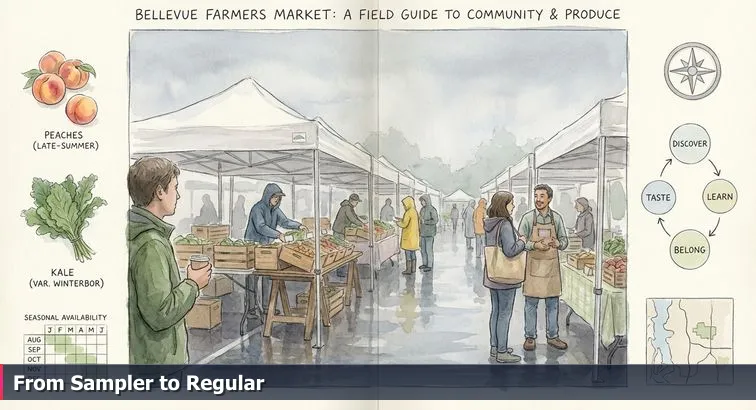
You’re wedged between a honey stand and a mushroom grower at the Bellevue farmers market, coffee in one hand and a paper cup with a peach slice in the other. The pavement’s still damp from last night’s rain, baristas are steaming milk in the background, and the regulars move with this quiet confidence - three quick conversations, a few decisive choices, and they walk away with everything they need for the week.
That’s pretty much how Bellevue’s AI scene feels now. You’ve got meetups at GitHub’s Bellevue space, talks from Amazon and Microsoft engineers a short bus ride away, Databricks staff dropping in from their Eastside office, and founders from YC-backed Seattle startups comparing notes in the corner. According to a regional roundup from Vanguard X on Washington tech events, this corridor between downtown Bellevue and Redmond has become one of the densest pockets of cloud and AI activity in the country.
Most people’s first pass through this “market” looks a lot like wandering the stalls: grab some free pizza at an AICamp night, collect a few stickers at an AI Tinkerers meetup, maybe chat with one or two people, then head home with a backpack full of swag and no real plan. You get exposure, sure, but not ingredients - no projects you’re shipping with someone you met, no hiring manager who knows your name, no concrete next step.
The stakes are higher here than in most places. Within a 20-30 minute radius you’ve got Amazon, Microsoft, Databricks’ Bellevue office, GitHub’s local meetup space, and a growing list of Eastside AI startups, including several Y Combinator-backed companies based in the Seattle metro. Layer on Washington’s no state income tax, and every raise, equity grant, or contract you land through this network is literally worth more in your pocket than it would be in California or New York.
This guide is about treating Bellevue’s AI community like that farmers market you learn to shop well. Instead of drifting from stall to stall, you’ll build a clear “shopping list” of skills, people, and companies you’re targeting. Instead of just sampling talks, you’ll leave with full ingredients: real contacts, collaborations, and portfolio projects that move your career. The goal is simple: help you stop being a tourist in the Bellevue AI scene and start showing up as a regular.
“Bellevue’s deep connection to cloud innovation makes its local summits and meetups a strategic leverage point for any team or individual betting on automation.” - Vanguard X, The Essential Tech Events in Washington for 2026
In This Guide
- Introduction: Bellevue’s AI farmers market moment
- Why Bellevue is uniquely powerful for AI careers
- Know your stalls: the five types of AI events
- Big meetups to watch: Seattle AI Developers Group and AICamp evenings
- Builder communities you should join: AI Tinkerers Seattle
- Eastside-focused groups for consistent local relationships
- Cross-discipline meetups: data, security, and ML communities
- Workshops and bootcamps that actually build skills
- Flagship conferences and summits to schedule for 2026
- Sector-specific gatherings: find niche problems to own
- Nucamp and the education layer of Bellevue’s AI ecosystem
- A 90-day plan to go from sampler to regular
- Playbook for introverts and newcomers
- Turning conversations into internships, jobs, and collaborations
- Final checklist: your Bellevue AI networking game plan
- Frequently Asked Questions
This guide: starting an AI career in Bellevue WA in 2026 lays out education choices from bootcamps to UW certificates.
Why Bellevue is uniquely powerful for AI careers
Big-tech density in a small radius
On the Eastside, you’re effectively commuting inside one giant campus for cloud and AI. Within a 20-30 minute radius of downtown Bellevue, you’ve got Amazon’s massive engineering presence, Microsoft’s Redmond headquarters, GitHub’s Bellevue office that regularly hosts AI meetups, and Databricks teams rotating through their local events listed on the Databricks Data + AI events calendar. That concentration means the people giving talks at meetups are often the same people designing large-scale ML systems, MLOps platforms, and GenAI features you read about on product launch blogs.
Tax and salary math that actually changes your life
Then there’s the part you feel every payday: Washington has no state income tax. If you’re earning a six-figure AI/ML salary at a company like Amazon, Microsoft, or an Eastside startup, your take-home pay in Bellevue is meaningfully higher than it would be in places like San Francisco or New York, where state and city taxes can easily stack into double digits. That makes every promotion, equity grant, or freelance AI consulting contract you land through this local network more valuable without you writing a single extra line of code.
An ecosystem where events and opportunities stack
Because the Seattle-Bellevue corridor is saturated with cloud and AI companies, the event calendar runs like clockwork. Evenings at GitHub Bellevue with the Seattle AI Developers Group routinely see 200+ RSVPs for deep dives into GenAI, LLMs, and agentic systems, while AI Tinkerers nights often cap out with around 150 engaged builders dissecting stacks and demoing tools. On the enterprise side, the Global Security Tour stop at Bellevue City Hall is expected to gather over 500+ leaders from startups and large organizations to talk AI, data, and security in one place. Region-wide, keystone gatherings like the Seattle AI Week Summit are described by the Washington Technology Industry Association as a “key event for the region’s AI community” that brings together local innovators, researchers, and decision makers, underscoring how central this metro has become to the AI conversation on WTIA’s AI Week Summit overview.
“AI professionals come here not just to learn, but to connect with the people actively shaping how AI is researched, built, and governed across the Pacific Northwest.” - Washington Technology Industry Association, Seattle AI Week Summit program
The upside of all this density is that treating Bellevue as a primary AI hub - not a satellite - pays off quickly. If you live here, the most realistic way to convert this ecosystem into job offers and collaborations is to be intentional: show up where Amazon, Microsoft, Databricks, and YC-backed founders are already speaking; make a short list of people and teams you want to meet; and remember that thanks to the tax structure, the same AI role simply goes further in Bellevue than it does in most competing tech hubs.
- Think in terms of a local “target employer” map that includes big cloud players, Eastside AI startups, and policy-shaping organizations.
- Prioritize events where those employers send speakers or sponsors; that’s where informal hiring conversations usually start.
- Factor Washington’s no-income-tax advantage into your long-term career math; it increases the ROI of every hour you invest in this network.
Know your stalls: the five types of AI events
At a real farmers market, you don’t treat every stall the same. You go to one grower for tomatoes, another for coffee beans, and a third for bread you can actually build a meal around. Bellevue’s AI scene works the same way: a Thursday AICamp meetup at GitHub Bellevue is a completely different “stall” than a hands-on automation workshop or a sector-specific summit downtown. If you show up to all of them with the same expectations, you end up wandering, collecting free samples, and wondering why your career pantry still feels empty.
Big meetups: the crowded produce stands
Large, high-energy evenings like the Seattle AI Developers Group and AICamp events are your “what’s in season?” check. Organizers of the AICamp GenAI and agents meetup in Seattle report deep-dive talks on GenAI, LLMs, and agentic AI that pull 200+ RSVPs when hosted at offices like GitHub Bellevue. These nights are noisy and packed, but unbeatable for surface area: you hear what teams at cloud providers, unicorns, and scrappy startups are actually experimenting with, and you meet a broad mix of engineers, PMs, and students in a single pass.
“Frequent meetups at venues like GitHub Bellevue offer ‘deep dive tech talks on AI, GenAI, LLMs, and agentic AI,’ followed by networking with fellow developers.” - Seattle AI Developers Group organizers, event description on AICamp
Builder and specialist groups: the specialty vendors
Builder communities like AI Tinkerers Seattle are more like the mushroom or heirloom pepper stall: smaller, more selective, and focused on people who are actively shipping. Attendance is often capped at around 150 builders, with lightning demos, live stack debates, and dev tools tracks. You don’t just hear about RAG or agents; you see rough edges, late-night hacks, and the real tradeoffs behind choosing one vector database, orchestration framework, or monitoring stack over another.
Local meetups, workshops, and bootcamps: the neighborhood layer
Then you’ve got the Eastside-focused meetups (like Eastside Data and AI), coding groups (like Bellevue Code AI Camp), and structured learning options such as 1-day AI automation workshops or multi-week bootcamps. These are the stalls where you build repeat relationships and actually learn how to cook: the groups are smaller, faces repeat month after month, and you can go from “I heard a talk on MLOps” to “I deployed a small pipeline in my day job” with people you know keeping you accountable.
Conferences and summits: the seasonal harvest
Finally, there are the big seasonal moments: Seattle AI Week, AI Con USA, Global Security Tour at Bellevue City Hall, Red Hat Summit: Connect Bellevue. These are less about weekly groceries and more like buying in bulk when the harvest hits: you compress dozens of conversations, tools, and ideas into a day or two, then spend months back at the smaller stalls turning that surplus into actual meals - projects, job leads, and collaborations.
| Event type | Typical size | Primary goal | Best for |
|---|---|---|---|
| Big meetups (AICamp, Seattle AI Developers) | 200+ RSVPs | Discover | Spotting trends, meeting lots of practitioners fast |
| Builder communities (AI Tinkerers) | ~150 builders, often capped | Deepen | Stack debates, demoing what you’re shipping |
| Local Eastside meetups | Dozens, recurring faces | Deepen | Consistent local relationships, collaborators |
| Workshops & bootcamps | Small cohorts or classes | Ship | Hands-on skills, portfolio projects |
| Conferences & summits | Hundreds to 500+ attendees | Discover & deepen | Macro trends, cross-company networking |
- Before you RSVP, quietly tag each event for yourself as discover, deepen, or ship so you know why you’re going.
- Don’t expect a 30-person Eastside meetup to deliver the same thing as a giant AICamp night; they’re different stalls serving different needs.
- Over a typical month, aim to hit at least one big meetup, one builder or local group, and one skills-focused workshop so you’re not just sampling - you’re leaving with real ingredients.
Big meetups to watch: Seattle AI Developers Group and AICamp evenings
The feel of a big Bellevue AI night
Walk into a Seattle AI Developers Group evening at GitHub’s Bellevue office and it feels like the market just after opening: the room’s already buzzing, pizza boxes half-open, someone from a cloud team is wiring up their laptop to the projector, and clusters of people are swapping war stories about LLM latency and evals. These meetups usually run on a simple rhythm: check-in and food, then 2-3 technical talks on GenAI, LLMs, agents, or ML systems, followed by a block of time that’s explicitly for mingling and questions. According to the organizers’ description on the Seattle AI Developers Group meetup page, they’re designed as “deep dive” sessions with industry speakers rather than just high-level overviews.
What these meetups are really good for
These evenings are your high-volume produce stand: crowded, sometimes chaotic, but unbeatable for seeing what’s “in season” across the region. You’ll usually get talks from engineers and researchers at big-name companies (GitHub, Google, Microsoft, Amazon) walking through real systems they’ve shipped. Topics range from production-scale GenAI and agentic workflows to classic ML pipelines and MLOps. The crowd tends to be in the hundreds, which means you’re not going to have a 45-minute 1:1 with every speaker, but you will hear what tools, architectures, and failure modes keep coming up across teams.
“Our events focus on deep dives into AI and machine learning, with generative models and LLMs front and center, and tech talks by industry experts from companies like GitHub and Google.” - Seattle AI Developers Group, event description on Meetup
Show up with a shopping list, not just a badge
The difference between wandering and actually “shopping” these meetups is all about what you bring with you. Before you walk into an AICamp or Seattle AI Developers Group evening, write down one or two concrete questions you want answered (for example, how teams are handling RAG evals, or what’s working for cost control on LLM-heavy workloads) and one or two types of people you’re hoping to meet (such as MLEs at cloud providers or founders building with agents). Treat the talks as live context for those goals instead of a passive lecture, so that when the projector shuts off you already know who you want to track down and what to ask.
Tactics that turn talks into opportunities
Once the formal content ends, you’re in the part of the evening that actually moves careers. Rather than opening with “Are you hiring?”, walk up to a speaker or attendee and anchor on something specific from the talk: “You mentioned moving off your first vector database - what pushed that decision?” or “I’m building a smaller version of that workflow for an internal tool; can I ask how you handle observability?” Stay until the room thins out; a lot of the “we are hiring for this, actually” comments surface in the last 30-45 minutes when people are more relaxed and the lines at the snack table have died down.
If you consistently leave these big nights having met at least two new people, added them on LinkedIn with a specific follow-up note, and written down one idea to test or prototype, you’re using them the way regulars use the best produce stand: not for random samples, but for ingredients you know exactly how you’ll cook later with your local Bellevue network.
Builder communities you should join: AI Tinkerers Seattle
Why AI Tinkerers feels different the moment you walk in
By the time you find the room for an AI Tinkerers Seattle meetup, it’s obvious you’re not at a general-interest tech talk. Laptops are already open, half the crowd is tweaking code or slides, and conversations sound like “we ripped out that vector store last week” instead of “so, what is an LLM, exactly?” Organizers describe it as a community for people actively building with AI, and the meetups often reach capacity with around 150 developers in the room, which matches how quickly RSVPs disappear on the official AI Tinkerers Seattle events page.
The format: live demos, dev tools, and real tradeoffs
Where big Bellevue meetups optimize for breadth, AI Tinkerers optimizes for depth. The format leans hard into lightning demos, live code walkthroughs, and what they call “Dev Tools Track” sessions where people argue (in a good way) about stacks and frameworks. Instead of a polished, marketing-hardened keynote, you might see a scrappy retrieval-augmented app that barely held together under load, or an internal agent system that solved one problem brilliantly and failed at another. That rawness is the point - it’s where you see what actually happens when an idea leaves the slide deck and hits production or a paying customer.
“Our meetups are built for AI practitioners who want to show what they’re building, debate tools and techniques, and learn from each other in an informal, highly technical setting.” - AI Tinkerers Seattle, community description
What to bring if you want to be more than an observer
To get real value here, treat AI Tinkerers like a stall where you’re expected to bring your own produce. That doesn’t mean a unicorn startup; it can be a simple Streamlit app, a Jupyter notebook exploring a public dataset, or a small agent wired up to an API. The key is to show something you’ve actually built. Conversations land better when you ask, “We tried X for logging and it fell over - how are you handling observability?” instead of, “What should I learn to get into AI?” This is the room to ask stack questions, share implementation scars, and trade tips on the tools that quietly make or break projects.
Using this stall to find collaborators, not just advice
Because the attendance is curated toward builders and founders, AI Tinkerers is also one of the best places on the Eastside to find collaborators. If you show up a few times with incremental progress on the same project, people start to recognize you as “the person building that agent for ops teams” or “the one tuning evals for healthcare data,” and that’s when offers of help or cofounding conversations start to surface. Set yourself a simple rule: within your first three or four meetups, aim to demo something - no matter how small. That shift from passive sampler to active contributor is what turns this community into a career lever instead of just another night of free pizza.
Eastside-focused groups for consistent local relationships
Why the Eastside layer matters
Most weeks, the most important AI conversations you’ll have won’t be in a flashy downtown venue; they’ll be in a conference room a few blocks from Bellevue Transit Center with 20-40 people who live and work where you do. Eastside-focused groups like Eastside Data and AI and the Bellevue Code AI Camp meetup feel less like big-city expos and more like running into the same growers at the Saturday market. You start recognizing faces, picking up conversations where you left off last month, and building the kind of local trust that actually turns into job referrals, cofounders, or side projects.
Anchor communities: Eastside Data and AI & Bellevue Code AI Camp
Eastside Data and AI focuses on topics like machine learning fundamentals, data analytics, and AI ethics, but the real design goal, according to the group’s organizers, is to create a place where practitioners on the Eastside can regularly find each other. The Bellevue Code AI Camp meetup blends general coding workshops with AI content, which makes it a natural on-ramp if you’re still growing your technical depth but want to write code and ship small things with local peers instead of just listening to talks.
“Our events are designed to connect like-minded individuals and potential collaborators around data and AI, especially for those who live or work on the Eastside.” - Eastside Data and AI organizers, group description
| Group | Primary focus | Typical format | Best for |
|---|---|---|---|
| Eastside Data and AI | ML basics, analytics, AI ethics | Talks + structured networking | Building a professional data/AI circle close to home |
| Bellevue Code AI Camp | Coding + applied AI topics | Workshops, hands-on sessions | Pair-programming, practice, and beginner-friendly building |
Why consistent faces beat constant variety
Dropping into a different meetup every week can feel exciting, but it keeps you in tourist mode. When you pick one Eastside group and show up every month for 3-6 months, you start to see the same engineers, analysts, and founders again and again. That’s when the conversations get more specific: instead of “So what do you do?”, you get “How did that RAG prototype you showed us last time turn out?” or “My team is opening a role that sounds exactly like what you’re aiming for.” Those deeper, slower relationships are much harder to build if you’re always crossing the lake for one-off events.
Making the most of your neighborhood stalls
The practical play here is simple: choose one Eastside meetup as your anchor and commit to it, then layer in sector-specific Eastside events a few times a quarter. For example, pairing a recurring coding group with something like the Bellevue Chamber’s Meta Community Accelerator: AI for Small Business gives you both a technical practice ground and a way to meet local operators who have real problems you can help solve. Over time, that combination of consistent peers and nearby domain experts turns the Eastside from “where I happen to live” into a tight, walkable network you can actively grow your AI career inside.
Cross-discipline meetups: data, security, and ML communities
Why cross-discipline rooms matter more than you think
It’s easy to stay in the comfort zone of “pure AI” meetups, where everyone wants to talk about the latest model release or prompt trick. But the systems that actually get deployed at Amazon, Microsoft, or any serious Bellevue startup don’t live in isolation - they sit on top of data platforms, inside security controls, and under compliance rules. That’s why cross-discipline groups like Seattle Data, AI & Security or the Seattle AI and ML Group (also known as Seattle Data Science) can quietly be more career-defining than another general LLM talk: they teach you how AI fits into the rest of the stack.
Where data, AI, and security actually intersect
Seattle Data, AI & Security sits right at that three-way intersection. Sessions jump between data engineering patterns, ML applications, and the security and governance layers that keep all of it from blowing up in production. You’ll meet people thinking about questions like “How do we log model decisions in a way auditors can understand?” or “What happens to our threat model if we plug this foundation model into a customer-facing workflow?” Those are exactly the questions that come up at larger regional events like the Global Security Tour stop at Bellevue City Hall, which explicitly brings together people working on data, AI, and security under one roof, as described in its Global Security Tour 2026 program listing.
“The Global Security Tour brings cybersecurity experts, data leaders, and AI innovators into the same room to tackle how intelligent systems are changing risk, compliance, and defense.” - Global Security Tour organizers, Eventbrite overview
How these groups make you more hireable
Hiring managers in Bellevue aren’t just asking, “Can you fine-tune a model?” They’re asking, “Can you ship something we’re allowed to run in production?” When you can talk fluently about how your model logs decisions, how you handle PII in feature stores, or how you’d respond if an LLM-based system starts exfiltrating sensitive data, you immediately stand out from the pack of people who only think in notebooks. Cross-discipline meetups give you the vocabulary and mental models to have those conversations with data engineers, security architects, and compliance folks.
Working these rooms differently than pure AI meetups
The playbook in these spaces is a little different. Instead of leading with “I’m learning transformers,” you get more mileage from questions like, “What’s the ugliest manual process in your data pipeline right now?” or “Where does AI make your security job harder, not easier?” Those prompts surface real, messy problems you can build projects around - things like access review automation, anomaly detection on logs, or model governance dashboards. Over time, positioning yourself as “the AI person who understands data quality and security constraints” is one of the fastest ways to carve out a durable niche in the Seattle-Bellevue market, especially for roles that sit between ML engineering, platform teams, and risk.
Workshops and bootcamps that actually build skills
Why you need more than talks and pizza
Meetups are great for ideas, but you only really “own” something once you’ve built it end-to-end on your own laptop. That’s where Bellevue’s hands-on layer comes in: 1-day Artificial Intelligence & Automation workshops and multi-week bootcamps give you protected time to move from “I kind of understand RAG” to “Here’s the repo where I implemented it.” Instead of leaving with just another notebook of half-sketched notes, you walk out with a working prototype, a clearer mental model, and usually a couple of classmates you can message when you get stuck later.
One-day AI & automation workshops: intense, practical sprints
The recurring Artificial Intelligence & Automation 1-Day Workshops in Bellevue are designed as focused sprints for people who need traction fast. The organizers emphasize that these sessions prioritize “practical understanding rather than complex theory” and that participants leave with a “basic AI and automation adoption roadmap” they can apply in fields like finance, healthcare, and HR. In one packed day you map a specific business process, choose realistic places to insert automation or AI, and sketch the minimal stack needed to execute it back at the office.
“Participants leave with a basic AI and automation adoption roadmap they can immediately put to work in their own organizations.” - Artificial Intelligence & Automation 1-Day Workshop organizers, Eventbrite program description
Nucamp bootcamps: structured paths from idea to portfolio
If a single day is the appetizer, Nucamp’s bootcamps are the full meal. Programs like Solo AI Tech Entrepreneur (25 weeks, $3,980), AI Essentials for Work (15 weeks, $3,582), and Back End, SQL and DevOps with Python (16 weeks, $2,124) are built to fit around work and family while you level up. Nucamp reports an approximate 78% employment rate, around a 75% graduation rate, and a 4.5/5 rating on about 398 reviews, with roughly 80% five-star feedback, which is unusually strong for a sub-$4K program. The format mixes online content with weekly live workshops, so every week you’re both learning and shipping pieces of real projects you can show at meetups. You can see the full lineup and structure of Nucamp’s AI-focused bootcamps, including details for the Seattle-Bellevue area.
Choosing between a day and a few months
For Bellevue developers and career switchers, the real question isn’t “workshop or bootcamp?” but “what do I need in the next 90 days?” A one-day automation workshop is perfect when you have a specific workflow in mind at your current job and want a concrete adoption plan by Monday. A multi-week bootcamp is better when you’re changing roles or trying to get from “I can script” to “I can build and deploy AI-backed services.” In practice, a lot of locals end up stacking them: use a workshop to spark ideas, then use a bootcamp to build the portfolio projects that make those ideas credible in interviews and at meetups.
| Option | Duration | Cost | Primary outcome |
|---|---|---|---|
| AI & Automation 1-Day Workshop | 1 day | Single event fee | Adoption roadmap for a specific business process |
| Nucamp Solo AI Tech Entrepreneur | 25 weeks | $3,980 | AI-powered MVP and entrepreneurship skills |
| Nucamp AI Essentials for Work | 15 weeks | $3,582 | Practical AI workflows for non-ML roles |
| Nucamp Back End, SQL & DevOps with Python | 16 weeks | $2,124 | Production-ready back-end and data skills |
Plugging structured learning back into the meetup circuit
The magic happens when you don’t treat these workshops and bootcamps as separate from the rest of the Bellevue AI market. Bring your 1-day workshop roadmap to an Eastside Data and AI meetup and ask, “Has anyone automated something like this?” Bring your Nucamp projects to AI Tinkerers and say, “Here’s the stack I chose - what would you change?” That way, every hour you invest in structured learning turns into better conversations, more interesting demos, and a portfolio that’s tightly aligned with what Amazon, Microsoft, and Eastside startups are actually hiring for.
Flagship conferences and summits to schedule for 2026
The seasonal harvest of Bellevue’s AI calendar
If weekly meetups are your regular grocery run, the big conferences and summits around Bellevue are the end-of-summer harvest: everything hits at once, and if you plan it right you can stock your pantry for months. Instead of a single talk and a few quick hallway chats, you get full days where researchers, founders, enterprise leaders, and tool vendors are all in the same building, from downtown Seattle to hotels in downtown Bellevue. The trick is to pick the right events, walk in with a clear “shopping list,” and walk out with enough ideas, contacts, and concrete next steps to fuel an entire season of projects and job moves.
Seattle AI Week Summit: the regional macro view
The Seattle AI Week Summit sits at the center of the Pacific Northwest AI conversation. Hosted by the Washington Technology Industry Association, it’s framed as a key gathering for AI research, industry insight, and policy, pulling together local innovators, researchers, and decision-makers from across the Seattle-Bellevue corridor. This is where you hear how Amazon, Microsoft, and Eastside startups are thinking about regulation, infrastructure, and talent over the next few years, not just the next sprint. Because so many regional players cluster here, it’s also a rare chance to compare how different organizations are actually deploying AI in production, from cloud-scale systems to scrappy startup stacks.
“AI Con USA is designed to move participants from conceptual exploration to applied technical learning, with sessions aimed squarely at professionals running production-grade AI systems.” - AI Con USA organizers, conference overview
AI Con USA and Red Hat Summit: deep dives into production reality
On the more technical side, AI Con USA 2026 is a full week of workshops and talks built for engineers and leaders who already have systems in production. Organizers describe it as moving attendees “from conceptual exploration to applied technical learning,” with tracks dedicated to scaling, reliability, and real-world case studies, as laid out in the AI Con USA conference program. Closer to home, Red Hat Summit: Connect in Bellevue focuses on how enterprises bridge their existing cloud and container investments into AI capabilities, with sessions on platform strategy, open-source tooling, and the organizational changes needed to support intelligent workloads, as outlined on the Red Hat Summit: Connect Bellevue event page.
| Event | Primary focus | Typical value | Who should prioritize it |
|---|---|---|---|
| Seattle AI Week Summit | Regional AI strategy, policy, ecosystem | Macro trends, cross-company connections | Anyone building a long-term AI career in the region |
| AI Con USA 2026 | Production-grade AI engineering | Hands-on techniques, case studies, tooling | MLEs, data scientists, tech leads |
| Red Hat Summit: Connect - Bellevue | Cloud platforms + enterprise AI | Platform strategies, open-source stacks | Platform, DevOps, and infra-focused engineers |
| Global Security Tour 2026 | AI, data, and cybersecurity | Security-centric AI patterns and risks | Security, governance, and AI safety practitioners |
| FutureCast Forum | Cross-industry future tech | Exposure to non-traditional AI applications | Founders and tinkerers hunting for niche ideas |
Global Security Tour and FutureCast: niche lenses with outsized impact
Events like the Global Security Tour 2026 stop at Bellevue City Hall add another dimension: they pull 500+ enterprise and startup leaders into one room to talk about data, AI, and security, with a Microsoft keynote and a Women in Tech hackathon baked in. That combination makes it one of the most efficient places to learn how CISOs, regulators, and AI builders are actually negotiating risk and innovation in real time. Meanwhile, cross-industry gatherings such as FutureCast Forum - promoted in a widely shared 2025 highlight reel - showcase how local innovators are using AI in fields like real estate, climate, and finance, giving you a broader palette of problems to work on than you’ll find in purely developer-focused rooms.
The most effective way to use these “seasonal harvests” is to schedule one or two across the year, walk in with very specific questions and target people, and then spend the next few months back at Bellevue meetups and study groups turning what you learned into code, collaborations, and job conversations. That’s how you convert a few intense days of panels and hallway chats into a full pantry of opportunities you can cook with all year.
Sector-specific gatherings: find niche problems to own
Why niche rooms beat generic buzz
Once you’ve done a few general AI meetups, the conversations start to sound the same: “we’re experimenting with RAG,” “we’re looking at agents,” “we’re thinking about copilots.” The real leverage starts when you walk into a room where everyone shares the same domain and the AI questions get painfully specific. In Bellevue, that looks like QA engineers filling a ballroom at The Westin Bellevue for Innovate QA 2026, or real estate brokers and operators packing the InterContinental Seattle Bellevue for the Accelerate Summit to talk tech and AI. These aren’t “AI conferences” by branding, but they’re exactly where the highest-value, under-served problems live.
Software quality: becoming the “AI for QA” person
At Innovate QA 2026, the agenda is all about the future of software quality, and AI is threaded through that story: automated test generation, intelligent regression detection, flakiness analysis, and smarter release gates. When an entire room of QA leaders and SDETs from across the Seattle-Bellevue metro is swapping horror stories about brittle test suites and slow feedback loops, you’ve basically got a live backlog of AI opportunities. Positioning yourself as the person who can translate those pains into AI-augmented workflows - like LLM-assisted test case design or anomaly detection on CI logs - makes you far more interesting to both product and platform teams than another generic “I like machine learning” pitch.
Real estate and small business: AI where every dollar is felt
The Accelerate Summit at the InterContinental Seattle Bellevue pulls in real estate professionals who care about lead quality, pricing, and deal velocity, not transformer architectures. Panels there focus on leveraging technology and AI for market growth: better market forecasts, smarter CRM workflows, and automation around listings and client follow-up. When you listen with an engineer’s ear, you hear patterns like “we still do this in spreadsheets” or “we’re guessing on which leads to call first.” Those are invitations to build: think property-valuation models tuned to Eastside neighborhoods, LLMs that clean and enrich listing descriptions, or simple scoring models that tell brokers which inbound email to answer before lunch.
Healthcare and other deep domains: AI where stakes are high
Healthcare is another domain where sector-specific gatherings can reshape your roadmap. The Binaytara Foundation, for example, describes how AI is already transforming oncology from genetic discovery to patient monitoring, with models helping clinicians interpret complex genomic data and track patients between visits. In their overview of AI in precision medicine, they highlight how intelligent systems are starting to connect lab results, imaging, and real-world data into more personalized care paths, showing just how deep domain knowledge and AI can intertwine in practice, as outlined by the Binaytara Foundation’s article on AI transforming precision medicine and patient monitoring.
“Artificial intelligence is rapidly transforming precision medicine, from helping researchers discover new genetic markers to monitoring patients in real time between clinic visits.” - Binaytara Foundation, Cancer News, Artificial Intelligence Transforming Precision Medicine
| Gathering | Sector | Primary AI opportunities | Ideal niche to own |
|---|---|---|---|
| Innovate QA 2026 | Software quality & testing | Test generation, flakiness detection, CI insights | “AI for QA engineer” building smarter test tooling |
| Accelerate Summit | Real estate | Lead scoring, pricing models, workflow automation | “AI for real estate ops” improving broker workflows |
| Oncology & precision medicine forums | Healthcare | Genomic analysis, risk prediction, patient monitoring | “AI for precision medicine” bridging data and clinicians |
Whichever stall you choose - QA, real estate, healthcare, or something else - the playbook is similar: show up at the sector events, ask people “What’s the ugliest manual task you still do?”, and write those answers down. Then take one of those problems back to your coding nights or bootcamp projects and build a small, opinionated solution. Over a few cycles, you stop being the person who’s vaguely “into AI” and start becoming the person people in that sector email when they say, “We really need to fix this, can you help?” That’s where local, tax-advantaged Bellevue salaries and equity packages start lining up behind the niche you’ve quietly made your own.
Nucamp and the education layer of Bellevue’s AI ecosystem
How Nucamp fits into Bellevue’s AI “market”
If the big meetups are where you sample what’s possible, Nucamp is the stall where you quietly stock up on the ingredients you’re missing. It’s an online bootcamp with local roots, running cohorts tied into communities in hundreds of U.S. cities, including the Seattle-Bellevue corridor. The draw for most people here isn’t just the curriculum; it’s the combination of structured projects, weekly live workshops, and a price point that’s a fraction of what many traditional AI bootcamps charge. For Bellevue folks trying to pivot into AI without giving up a good Eastside salary or moving away from Amazon/Microsoft territory, that balance of flexibility and affordability is what makes Nucamp a realistic option instead of a fantasy.
Programs that map cleanly onto local roles
Nucamp’s AI-facing offerings line up surprisingly well with the roles you actually see in the Seattle-Bellevue market. The Solo AI Tech Entrepreneur path is aimed at people who want to ship real AI products - think LLM-powered SaaS tools, agents, and niche copilots that you could demo at AI Tinkerers or even turn into a side business. AI Essentials for Work targets professionals who want to stay in their current function - product, marketing, ops, HR - but layer in prompt engineering and AI-assisted workflows so they become “the AI person” on their team. And the Back End, SQL and DevOps with Python track is essentially the soil AI systems grow in here: back-end APIs, databases, and deployment pipelines that let you talk to data and platform engineers at places like Databricks or Microsoft in their own language.
Turning coursework into meetup currency
The real reason Nucamp matters in Bellevue’s ecosystem is what you can do with the outputs. Every module gives you something tangible - an API, a small agent, an automated workflow - that you can bring to local meetups. Instead of introducing yourself with “I’m thinking about getting into AI,” you can say, “I built a small retrieval-augmented chatbot for my team” or “I’ve got an MVP for a vertical SaaS tool; I’d love feedback on pricing and positioning.” That’s a very different conversation at places like AI Tinkerers or Seattle Data, AI & Security, and it’s the kind of conversation that leads to referrals, contract work, or even cofounder chats. You can see how Nucamp structures these portfolio-ready projects across its programs by browsing Nucamp’s AI and coding bootcamp catalog.
Using Nucamp to de-risk a career move
From a Bellevue engineer’s perspective, the calculus is pretty straightforward: you’re in one of the best-compensated AI markets in the country, with no state income tax and a dense cluster of employers. Walking away from that for a full-time, five-figure bootcamp is a hard sell. Being able to keep your current role, plug into an affordable, part-time program, and then bring those new skills straight into conversations at GitHub Bellevue, Eastside Data and AI, or the next Global Security Tour hackathon is a lot more practical. Over six to twelve months, that mix of structured learning plus local networking is often what quietly moves someone from “interested in AI” to “shipping AI-backed features at an Eastside company” without a dramatic reset.
A 90-day plan to go from sampler to regular
Weeks 1-2: Set your baseline
The first two weeks are about moving from “I show up when I see a cool flyer” to “I have a clear map of my Bellevue AI market.” You’re not trying to meet everyone yet; you’re wiring into the channels where events, jobs, and study groups actually get announced so that the rest of your plan isn’t driven by luck or algorithms.
- Join the core groups that meet on the Eastside and in nearby Seattle (Seattle AI Developers Group, Eastside Data and AI, Bellevue Code AI Camp, AI Tinkerers Seattle, and Seattle Data, AI & Security).
- Block one or two evenings per week on your calendar as your “AI time” so meetups and workshops don’t always lose to last-minute plans.
- Pick a single learning track for the next 90 days: either a structured bootcamp, a specific online course sequence, or a defined self-study plan with milestones.
- Create a simple tracking doc or spreadsheet for people you meet, events you attend, and projects you’re building; treat it like a lightweight CRM for your AI career.
Weeks 3-8: Live like a regular with a repeatable month
Once your inputs are set, the next six weeks are about rhythm. You want a pattern that mixes discovery (big meetups), depth (smaller or more technical groups), and shipping (workshops or bootcamp sessions). Think of it as your standard “basket” from the AI market: a bit of everything, but with intention behind each choice.
| Week | Event types | Main goal for the week |
|---|---|---|
| Week 1 | 1x Eastside-focused meetup | Reconnect with locals, schedule 1 coffee chat |
| Week 2 | 1x big AI meetup | Spot new tools/trends, meet 2-3 new practitioners |
| Week 3 | 1x coding night or workshop | Ship a tiny feature or notebook with someone new |
| Week 4 | 1x builder or cross-discipline event | Demo something or ask deeper technical questions |
Overlay this monthly rhythm with one larger event if timing lines up (a 1-day AI workshop, a sector-specific summit, or a big regional conference session). Each time you attend anything, write down one concrete idea to build and one person to follow up with so you always leave with ingredients, not just impressions.
Weeks 9-12: Start contributing and closing loops
By the last month, you should recognize a handful of regulars and have at least one small project you’re not embarrassed to show. Now the goal is to flip from consumer to contributor in visible but low-risk ways so people start to associate your name with something specific.
- Offer a 5-10 minute lightning talk at a smaller Eastside meetup about a tool you tried, a failure you learned from, or a tiny win at work.
- Volunteer to help with check-in, AV, or photos at one of the bigger meetups so organizers and speakers know who you are.
- Share your project repo or a short write-up in the group’s channels and ask for targeted feedback instead of vague validation.
- Follow up with anyone you’ve met at least twice, and suggest a quick virtual or in-person coffee to swap notes more deeply.
To keep yourself honest, define success at the end of 90 days in concrete terms: for example, having 5-10 people in the Seattle-Bellevue AI scene who know your name and what you’re working on, one or two projects you’re comfortable linking on your resume, and a simple system for tracking applications or referrals. Some locals even model their tracking on public resources like the curated New-Grad-2026 job list on GitHub, creating their own private versions for roles, contacts, and follow-ups. That’s the point where you stop feeling like a sampler drifting between stalls and start moving through Bellevue’s AI market the way a regular does: with a plan, a pattern, and people who expect to see you again.
Playbook for introverts and newcomers
Walking into a 200-person AI meetup at GitHub Bellevue can feel a lot like stepping into the farmers market five minutes before closing: it’s loud, crowded, everyone seems to know where they’re going, and you’re just trying not to block the aisle. If you’re introverted or brand new to the scene, that swirl of conversations about agents, evals, and MLOps can make it tempting to grab a slice of pizza, listen to the talks, and bolt the second the Q&A ends.
Before you walk into the room
A little prep makes the whole thing less overwhelming. Start by pre-connecting online: comment on the event page, or DM one or two attendees to say you’re new and would love to say a quick hello in person. Joining lower-stakes online communities can also warm you up; platforms like the women-focused network behind Tech Ladies’ job search community give you practice introducing yourself, talking about your work, and asking for help in spaces specifically designed to be welcoming.
“Tech Ladies is the #1 job search platform for women in tech, connecting our community with roles at companies that care.” - Tech Ladies, company mission
Once you’re at the event
When you arrive, think in terms of one conversation at a time, not “working the room.” Find a stable spot - near the check-in table, snack area, or a wall - and let people come to you between sessions. Have two or three simple openers ready so you’re not improvising under pressure, like asking what brought them to this specific meetup, whether they use AI at work or just for side projects, or what they thought of the last talk. Lean on structure whenever you can: join breakout groups, sit near the same folks during the talks, and ask one prepared question during Q&A so people who share your interest have a reason to approach you afterward.
- Set a modest goal in advance, like having three real conversations instead of meeting “as many people as possible.”
- Take quick notes on your phone after each chat so you remember what you talked about.
- Give yourself permission to step outside for a few minutes if your social battery dips.
After you get home
The quieter follow-up is where introverts often shine. Within 24 hours, send short, specific messages to the people you met - mention the topic you discussed, share a relevant link, or suggest a quick virtual coffee if it feels natural. A simple spreadsheet or notes doc with names, interests, and “next steps” keeps everything from blurring together, and it becomes a personal version of the talent-tracking mindset you see on platforms like eWorker’s AI talent network. Over a few events, you’ll find that returning to the same Bellevue meetups makes conversations easier: faces become familiar, intros get shorter, and you shift from “new person” to “regular” without ever needing to be the loudest voice in the room.
The key is redefining success on your own terms. If you consistently show up, have a handful of genuine conversations, and follow through afterward, you’re doing exactly what the extroverts are doing - just with less small talk and more intentionality. In a market as dense as Bellevue’s, that quiet, steady presence is more than enough to build real relationships and uncover opportunities that never make it to the job boards.
Turning conversations into internships, jobs, and collaborations
In Bellevue, most of the real internships, new-grad roles, and consulting gigs don’t start with an application; they start with “Hey, we’re working on something you’d probably care about.” The difference between a pleasant hallway chat and a lead like that usually comes down to two things: whether you showed up with something concrete you’re building, and whether you left with a clear, shared next step. Everything else - badges, pizza, swag - is just decoration.
A useful rule of thumb is to lead with projects, not potential. Instead of introducing yourself as “trying to break into AI,” anchor your conversations around something you’ve actually shipped: a small RAG chatbot over internal docs, a notebook exploring a public dataset relevant to their domain, or a rough agent that automates one painful workflow. That gives people something specific to react to (“we tried a similar approach, here’s what broke”) and a reason to remember you when their team needs help. It also makes follow-ups easy: “Can I send you a link to the repo and get your feedback on X?” is a concrete, low-friction ask.
- Clarify your angle before each event: “I’m the person working on AI for QA / real estate / internal tools.” It’s easier for others to place you, recommend you, and loop you into opportunities when you’re not just “into AI,” but into a particular slice of it.
- Use the conversation to diagnose needs: ask what’s hardest or most annoying about their current workflow, stack, or hiring process. Listen more than you pitch.
- End with a specific next step: a short code review, a 20-minute Zoom where you walk through your project, or an intro to someone on their team. “Let me know if you hear of anything” almost never works; “Can I show you what I’ve built and get your blunt feedback next week?” often does.
- Follow up within 24-48 hours with a brief, tailored message that references your conversation, includes a link to your work, and proposes one clear action. Most people won’t take the initiative for you - you have to close the loop.
One underrated way to stand out in a city full of smart people is to show you can connect your projects to what local companies are actually researching or deploying. If you’re talking to someone from Amazon’s Bellevue or Seattle offices, for example, you might frame your work in relation to themes in an Amazon Science paper on multi-agent debate and reasoning, then ask how their team thinks about model collaboration versus single-model performance. That kind of question signals you’re not just copying tutorials - you’re paying attention to how real teams push the frontier and you’re eager to plug your skills into that context.
“By allowing multiple agents to explore different reasoning paths and debate their conclusions, we can often achieve stronger performance than any single model acting alone.” - Amazon Science, research on multi-agent debate and reasoning
The last piece is boring but powerful: track everything. Keep a simple spreadsheet of who you met, what you discussed, what you offered, and when you’ll follow up next. Over a few months of Bellevue meetups, workshops, and conferences, that log becomes your personal pipeline of internships, new-grad roles, and collaborations. Combine that with the structural advantages you already have here - proximity to Amazon, Microsoft, Databricks, a growing Eastside startup scene, and no state income tax - and every conversation you deliberately turn into a next step is worth a little more. You’re not just chatting; you’re slowly building a networked career that pays off in real offers, real equity, and real work you care about.
Final checklist: your Bellevue AI networking game plan
By the time you hit the end of this guide, it’s easy to feel like Bellevue’s AI scene is a lot to hold in your head: Amazon and Microsoft up the road, Databricks and startups nearby, AICamp nights, AI Tinkerers demos, workshops, bootcamps, and summits. The point of a checklist is to turn all that from background noise into a simple, repeatable game plan you can actually run for the next 90 days and beyond.
Your core actions for the next 90 days
- Join and show up: Plug into the main groups (Seattle AI Developers Group, AI Tinkerers Seattle, Eastside Data and AI, Bellevue Code AI Camp, Seattle Data, AI & Security) and commit to 1-2 events per month you will attend no matter what.
- Pick one learning lane: Choose a structured path - whether that’s a bootcamp, a specific online course, or your own syllabus - and tie it to projects you can show at local meetups instead of scattering your attention across random tutorials.
- Adopt a monthly rhythm: Aim for one big meetup (discover trends), one Eastside or builder event (deepen relationships), and one workshop/class session (ship something), so every month you’re consistently seeing ideas, people, and progress.
- Target one seasonal event: Block your calendar for a major 2026 summit or conference - Seattle AI Week, AI Con USA sessions, Global Security Tour, or Red Hat Summit: Connect Bellevue - and decide in advance which questions and companies you’ll focus on there.
- Lead with projects, not titles: Keep at least one small, evolving project you can talk about and demo, and update it as your skills grow; use it as your default way to introduce yourself at events and in follow-ups.
How to measure if it’s working
Instead of counting events attended, count outcomes. After three months, aim to have 5-10 people in the Seattle-Bellevue AI ecosystem who know your name and roughly what you’re working on; at least one project you’re comfortable linking on a resume or LinkedIn; and a simple tracking system for conversations, applications, and next steps. That kind of structure mirrors what programs like CNCF’s Kubestronaut journey do for cloud-native skills - turning vague intentions into a clear, staged path you can follow and measure.
“Clear milestones and a structured path help developers stay motivated and track their progress as they advance their skills.” - Cloud Native Computing Foundation, Kubestronaut Program Overview
The final mindset shift is to remember where you’re doing all of this. In Bellevue, every new skill and relationship sits on top of some unique leverage: proximity to cloud giants and serious startups, a dense calendar of AI and data events, and no state income tax amplifying every raise, equity grant, or consulting contract you land. Treat the city like the AI farmers market it has become - visit your favorite stalls regularly, bring a clear shopping list, and leave each time with something you’ll actually use - and over time you stop feeling like a visitor and start moving through the scene like a local who knows exactly where they’re headed.
Frequently Asked Questions
Can Bellevue meetups actually help me advance an AI/ML career in 2026?
Yes - Bellevue sits within a 20-30 minute radius of major employers like Amazon, Microsoft, Databricks and GitHub, and regional meetups routinely draw large crowds (many GitHub Bellevue events report 200+ RSVPs) and conferences (e.g., Global Security Tour brings 500+ leaders), so networking here frequently leads to referrals, pilots, and job leads.
Which local events should I hit first if I’m new to the Eastside AI scene?
Start with one Eastside-focused group (Eastside Data & AI) for repeatable local connections, a big meetup like Seattle AI Developers Group/AICamp at GitHub Bellevue to understand trends (200+ RSVP nights), and Bellevue Code AI Camp for hands-on practice; once comfortable, add AI Tinkerers (often capacity-capped around 150) to demo work and find collaborators.
How often should I attend meetups to move from “sampler” to regular?
Aim for a monthly rhythm - 1 big meetup, 1 builder/specialty event, 1 Eastside-focused meetup and 1 workshop/class - and commit to a 90-day cycle so you reappear consistently; within that period you should aim to have 5-10 people in the region who recognize your name and work.
What’s the best way to turn a meetup conversation into a real job or project?
Lead with concrete projects (a GitHub repo, a tiny agent demo, or a notebook), make one specific ask (e.g., a 20-minute follow-up demo or a pilot), and emphasize local commitment - being a repeat attendee on the Eastside signals reliability to hiring teams at Amazon, Microsoft and startups.
Should I pair a bootcamp like Nucamp with meetup attendance, and is it worth the cost?
Yes - combining meetups with a focused program accelerates what you can talk about; Nucamp AI and related programs range from about $2,124-$3,980, report roughly a 78% employment rate, and provide weekly live workshops that sync well with Bellevue events for building demoable projects.
Compare offers with our Top 10 Companies Hiring AI Engineers in Bellevue, WA in 2026 to see which Bellevue employers match your priorities.
Use the top free tech courses at Bellevue community centers 2026 as a local, cost-free learning plan.
We rounded up the best tech coworking spaces and incubators in Bellevue, WA (2026) so you can compare cost, commute, and community.
Compare the top women-in-tech resources for Bellevue and Redmond in 2026 to find local AI networking opportunities.
Explore our list of best AI tech bootcamps for Bellevue learners and their Eastside connections.

Irene Holden
Operations Manager
Former Microsoft Education and Learning Futures Group team member, Irene now oversees instructors at Nucamp while writing about everything tech - from careers to coding bootcamps.