









The Complete Guide to Using AI in the Education Industry in Philippines in 2025
Last Updated: September 13th 2025
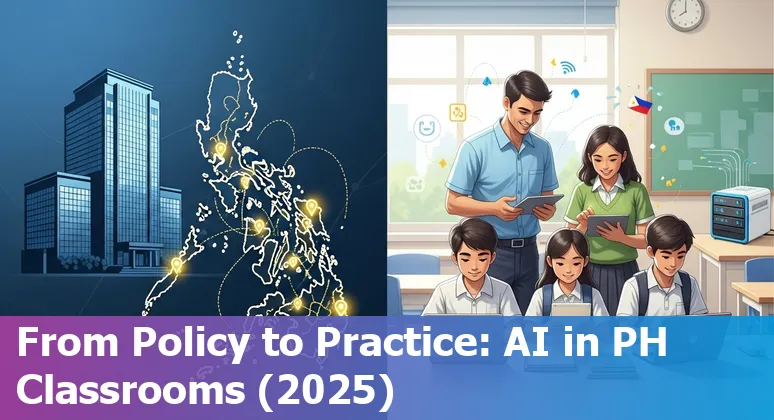
Too Long; Didn't Read:
In 2025 Philippine education, AI shifts from pilots to systems: DepEd's E‑CAIR and scalable tools; Reading Progress cut reading‑assessment from 16 to 2 hours for 14,000+ learners. Market ~$1,025M (2025) with 27.75% CAGR; 97.5M internet users (83.8%), but urban–rural digital divide and teacher training gaps threaten equity.
AI matters for Philippine education in 2025 because the country is moving from experiments to systems: the Department of Education launched the Education Center for AI Research (E‑CAIR) to build tools that help teachers, streamline administration, and map infrastructure needs, while generative AI is already reshaping lessons and assessments nationwide (DepEd announcement: Education Center for AI Research (E‑CAIR) launch and BytePlus review of generative AI in Philippine education).
Practical wins - like AI-powered reading tools that cut assessment time from 16 to 2 hours for over 14,000 students - show how automation can free teachers for coaching and personalized learning; yet the urban–rural digital divide and gaps in teacher training remain real risks.
Schools and education leaders can pair national policy with hands‑on upskilling (for example, Nucamp's Nucamp AI Essentials for Work bootcamp syllabus) and clear, ethics‑forward governance to make AI a tool for inclusion, not exclusion.
| Bootcamp | Length | Early bird cost | Registration |
|---|---|---|---|
| AI Essentials for Work | 15 Weeks | $3,582 | Register for Nucamp AI Essentials for Work bootcamp |
| Solo AI Tech Entrepreneur | 30 Weeks | $4,776 | Register for Nucamp Solo AI Tech Entrepreneur bootcamp |
“Let us champion the use of AI as a tool for empowerment, not replacement. Let us equip our youth with the wisdom to use it responsibly. Together, let us create a future where technology amplifies human potential rather than diminishes it.”
Table of Contents
- What is the status of education in the Philippines in 2025?
- The Philippine AI market and the future of AI in the Philippines (2025 outlook)
- AI strategy roadmap and policy for the Philippines' education sector
- Infrastructure, equity and the digital divide in the Philippines
- Common AI use cases and adoption in Philippine classrooms and institutions (2025)
- What new practical applications of AI are anticipated in the Philippines in 2025?
- Challenges, ethics and stakeholder perceptions in the Philippines
- Practical, step‑by‑step implementation guidance for Philippine schools and educators
- Conclusion and next steps for AI in Philippine education in 2025
- Frequently Asked Questions
Learn practical AI tools and skills from industry experts in Philippines with Nucamp's tailored programs.
What is the status of education in the Philippines in 2025?
(Up)In 2025 the status of education in the Philippines reads as a story of rapid experimentation but uneven rollout: a narrative review of 43 studies finds AI already appearing across teaching tools, student support systems, administrative functions and research, yet with striking gaps - higher education, especially private institutions in urban centers, shows substantially more advanced AI integration while many K‑12 schools lag behind because of infrastructure limits and skills shortages (Artificial intelligence in Philippine education - narrative review (Zenodo)).
Stakeholder views are mixed - students tend to be more positive than faculty - and common barriers include the urban–rural digital divide, scant professional development, ethical worries about academic integrity, and the lack of clear institutional policies; the review recommends national AI education frameworks, rural broadband investment, and systematic teacher training to turn pilots into equitable systems.
Practical, low‑risk wins are already visible - AI chatbots and automated grading can cut response times and free staff for higher‑value coaching - so policy and capacity building must move in lockstep to ensure AI becomes an enabler, not a divider, across Philippine classrooms (AI chatbots for 24/7 student support in the Philippines).
The Philippine AI market and the future of AI in the Philippines (2025 outlook)
(Up)The Philippine AI market is tipping into a new phase in 2025: Statista-backed estimates put local AI revenue at about $1,025 million this year with a blistering CAGR near 27.75% that could swell the market to roughly $3,487 million by 2030, signaling real commercial momentum from chatbots and customer‑service automation to computer vision and generative AI projects (PIDS report State of AI in the Philippines 2025).
Regional forces are pushing this growth too - APAC firms are moving past pilots into core deployments and expect AI to drive innovation and revenue, while global demand for semiconductors and electronics keeps the Philippines strategically relevant in supply chains (Global AI market key statistics 2025).
Yet the runway is uneven: infrastructure gaps, limited AI uptake among MSMEs, and a shortfall in data and compute capacity mean policy steps like expanded broadband, data center investment and practical skilling will determine whether schools and edtechs capture these gains; for educators, that translates into growing demand for scalable tools - from 24/7 AI tutors to automated assessment - that can be adopted responsibly and equitably (AI chatbots for 24/7 student support in the Philippines).
A billion‑dollar market on paper becomes classroom impact only when connectivity, governance and teacher readiness move at the same pace.
| Metric | Value | Source |
|---|---|---|
| Philippine AI market (2025) | $1,025 million | PIDS / Statista |
| CAGR (2025–2030) | 27.75% | PIDS |
| Projected market (2030) | $3,487 million | PIDS |
| Businesses using AI (2021) | 14.9% | PIDS |
AI strategy roadmap and policy for the Philippines' education sector
(Up)Turning pilots into a national system requires a clear AI strategy roadmap that links policy, infrastructure, and people - and the Philippines already has pieces to stitch together: DepEd's launch of the Education Center for AI Research (E‑CAIR) creates a home for scalable tools and data‑driven Adopt‑A‑School mapping to identify infrastructure gaps, while the narrative review of 43 studies highlights the urgent need for national AI education policy frameworks, rural broadband investment, and systematic teacher skilling to close urban–rural divides (DepEd Education Center for AI Research (E‑CAIR) launch; Narrative review of 43 AI in education studies and recommendations).
A practical roadmap for 2025–26 should pair E‑CAIR's tool development with short, measurable milestones - like the APO‑facilitated “100‑day roadmap” exercises used in public agencies - to pilot governance safeguards (data privacy, bias checks, academic‑integrity rules), fund targeted rural connectivity, and scale participatory design so teachers and communities help shape solutions (APO generative AI policy for inclusive education).
The result: not just more tech in classrooms, but accountable, teacher‑ready systems that treat AI as an amplifier of learning rather than a bolt‑on gadget.
“Hindi po tayo makikipagsabayan para lang masabi na ‘tech-savvy' tayo. We are here to use AI as a tool for genuine, enduring reforms. This is the promise of the President's Bagong Pilipinas.” - Education Secretary Sonny Angara
Infrastructure, equity and the digital divide in the Philippines
(Up)Infrastructure and equity are the hinge on which AI's promise in Philippine classrooms will turn: national numbers show strong momentum - 142 million mobile connections (about 122 per 100 people) and 97.5 million internet users for an 83.8% penetration rate - but the headline masks a stubborn rural gap, with 48.8% of Filipinos living in urban centres and 51.2% in rural areas and still some 18.8 million people offline at the start of 2025 (Digital 2025: The Philippines connectivity snapshot).
Near‑universal 4G coverage and growing 5G promise reach, yet the Philippine Institute for Development Studies warns that speeds, affordability and local demand keep many provinces - particularly BARMM and Region VIII - trailing behind, and that policy must pair backbone projects with subsidies, local content and better monitoring to avoid leaving whole classrooms cut off (PIDS: Bridging the digital divide).
Practical wins are arriving too: targeted DICT Free Wi‑Fi and provincial hub projects (for example, the Dinagat Islands MoA) show how place‑based connectivity plus training can turn access into usable, resilient schooling rather than a one‑off connection (Inclusive connectivity: Dinagat Islands MoA).
The upshot for educators is clear: AI tools will scale only when speeds, costs, disaster‑resilient infrastructure and teacher readiness are tackled together - otherwise automation risks amplifying, not closing, existing inequities.
| Metric | 2025 value | Source |
|---|---|---|
| Internet users | 97.5 million (83.8% penetration) | DataReportal |
| Offline population | 18.8 million (16.2%) | DataReportal |
| Mobile connections | 142 million (≈122% of population) | DataReportal |
| Median mobile download speed | 35.56 Mbps | DataReportal (Ookla) |
| 4G/5G coverage | ~99% 4G; 70% 5G | PIDS |
“Access and internet speed fall sharply in rural regions, leaving many communities disconnected from the online world's opportunities.” - PIDS
Common AI use cases and adoption in Philippine classrooms and institutions (2025)
(Up)Across Philippine classrooms in 2025, AI shows up in four familiar, practical ways: personalized and adaptive learning platforms that tailor practice and pace for each student, virtual tutors and chatbots that provide 24/7 help and cut support bottlenecks, automated content and assessment tools that draft lesson plans and rubric‑based feedback to save teacher time, and administrative automation (attendance, scheduling, voucher allocation) that frees staff for higher‑value work - patterns captured in a narrative review of 43 studies and national pilots (Narrative review of AI in Philippine education).
Generative models are already being used to create quizzes, scaffold writing, and build targeted review paths while tools like Microsoft M365 Copilot have been reported to reclaim hours for busy teachers; tangible wins include DepEd pilots (Reading Progress in Bais City) that shrank reading‑assessment time from days to hours for thousands of learners, showing how scaleable efficiencies can translate into more one‑on‑one coaching time in crowded classrooms (Generative AI in Philippine education (BytePlus)).
Adoption is uneven - HEIs and urban private schools lead, K–12 and rural schools trail - so low‑bandwidth chatbots, offline‑first AI features, and clear teacher training on prompt use and academic‑integrity policies are the most practical entry points for schools that want measurable gains without overloading fragile infrastructure (AI assessment and grading tools in Philippine education).
One vivid signal: when an AI reads aloud, timesaving assessment turns into minutes reclaimed for a struggling reader to get a teacher's undivided attention - a small change with outsized impact.
| Common use case | Typical tools / impact | Example / source |
|---|---|---|
| Personalized / adaptive learning | Adaptive platforms, smart tutors - tailored practice and pacing | BytePlus; UP studies |
| Virtual tutors & chatbots | 24/7 Q&A, homework help - faster response, lower staffing costs | Nucamp case pages; BytePlus |
| Automated content & grading | Generative lesson plans, rubric‑based feedback - saves teacher hours | BytePlus; Nucamp assessment guide |
| Administrative automation | Attendance, scheduling, voucher optimization - frees admin time for data stewardship | Narrative review (43 studies) |
What new practical applications of AI are anticipated in the Philippines in 2025?
(Up)What's new and practical for 2025: expect AI to move from pilots into everyday classroom helpers across the Philippines - tools that meet real teacher needs, not techno‑buzz.
Classroom math will increasingly use intelligent tutoring systems and adaptive platforms that deliver step‑by‑step scaffolding and have been linked to measurable score gains in secondary schools, turning routine practice into tailored mastery sessions (Evaluating the Impact of AI on Secondary School Mathematics).
Generative AI will routinely draft lesson plans, quizzes and rubric‑based feedback to reclaim teacher hours (BytePlus reports wide educator uptake and early productivity wins), while 24/7 chatbots and low‑bandwidth, offline‑first LMS prototypes from hackathons promise resilient support during calamities and for remote communities (BytePlus report: Generative AI in Philippine Education; ISEAC 2025 highlights: AI's role in education and cybersecurity).
Special education sees particularly exciting, practical gains: AI speech‑recognition, real‑time captioning and text‑to‑speech conversions can make materials instantly accessible and personalize therapy and practice for learners with disabilities (21K School: AI in Special Education Philippines) - imagine a chapter of a textbook turned into dyslexia‑friendly narrated content in minutes so a teacher can spend that recovered hour on one‑to‑one coaching.
Across all use cases the caveat is the same: these applications deliver only if teacher training, curriculum alignment and equitable connectivity keep pace with the tech.
| Application | Practical impact | Source |
|---|---|---|
| Intelligent tutoring / adaptive learning | Personalized practice, higher math scores | Study: Evaluating AI Impact on Secondary School Mathematics |
| Generative AI for lesson design & grading | Faster lesson prep, automated rubric feedback | BytePlus report: Generative AI in Philippine Education |
| Assistive tech for special education | Text‑to‑speech, speech‑to‑text, personalized therapy | 21K School: AI in Special Education Philippines |
| Low‑bandwidth LMS & local language tools | Resilient learning during outages, localised access | ISEAC 2025: AI's Role in Education and Cybersecurity |
“Humans will never be replaced by AI.” - Dr. Eugene Rex Jalao, ISEAC 2025
Challenges, ethics and stakeholder perceptions in the Philippines
(Up)Challenges, ethics and stakeholder perceptions in the Philippines center on uneven readiness and real worry about how AI changes classroom norms: a nationwide narrative review of 43 studies highlights three core themes - widespread pilot use, students generally more positive than faculty, and major barriers like the urban‑rural digital divide, scarce professional development, ethical worries around academic integrity, and patchy institutional policies (Philippines AI in education narrative review (43 studies)).
Local surveys echo this split: a university study found students and faculty both use tools such as ChatGPT and Grammarly but differ sharply in perceived usefulness, underlining the need for targeted guidance rather than blanket bans (Philippines student and faculty AI attitudes study (JIP)).
At the same time, teacher surveys show that competence, training and attitude strongly predict acceptance - attitude was the single strongest predictor of AI uptake (β = 0.669) - meaning that investment in supportive training and reliable, classroom‑relevant tools can shift resistance into constructive adoption (Teacher competence, training and AI acceptance study (SSRN)).
Ethics work must be practical: clear academic‑integrity rules, data‑privacy safeguards and locally tested prompts and rubrics so AI saves teacher time without eroding assessment standards - otherwise gains risk amplifying existing inequities rather than closing them.
| Metric / finding | Value / note | Source |
|---|---|---|
| Stakeholder attitude split | Students generally more positive than faculty | Philippines AI in education narrative review (43 studies) |
| Sample sizes (attitude study) | 296 students; 56 faculty | Philippines student and faculty AI attitudes study (JIP) |
| Teacher survey means & predictor | Technological competence M=4.12; Training/support M=3.92; Attitude M=4.24; Attitude β=0.669 (strongest predictor) | Teacher competence, training and AI acceptance study (SSRN) |
Practical, step‑by‑step implementation guidance for Philippine schools and educators
(Up)Practical roll‑out starts with policy-to-practice moves that are concrete and low‑risk: adopt clear classroom rules based on UPOU's Guidelines on the Use of AI for Teaching and Learning - declare permitted AI activities on the syllabus, require students to disclose and cite AI‑generated work, and make allowed vs.
disallowed uses explicit so assessment stays fair (UPOU Guidelines on the Use of AI for Teaching and Learning).
Next, map needs before buying tech - align pilots with DepEd's Education Center for AI Research (E‑CAIR) Adopt‑A‑School data so connectivity, power and device gaps are visible and prioritized (DepEd Education Center for AI Research (E‑CAIR) launch and Adopt‑A‑School mapping).
Sequence implementation in three waves: (1) classroom rules, teacher PD and simple OERs so every teacher knows when and how to use AI; (2) lightweight, low‑bandwidth tools (offline‑first LMS features, chatbots for FAQs, rubric‑based draft grading) that free staff time without straining networks; and (3) scaled pilots that include monitoring indicators for learning outcomes, academic integrity incidents, and teacher workload.
Use the narrative review's call for systematic teacher training and policy frameworks as the backbone: set short milestone reviews, fund targeted connectivity where pilots run, and document what works so pilots become repeatable practices across regions (Narrative review of 43 studies on AI in education (Zenodo)).
One vivid, practical win to aim for: a single, visible line in the LMS - “AI use allowed for drafting; cite sources” - that removes ambiguity, protects integrity, and literally reclaims minutes in every lesson for real teacher feedback.
“Hindi po tayo makikipagsabayan para lang masabi na ‘tech‑savvy' tayo. We are here to use AI as a tool for genuine, enduring reforms. This is the promise of the President's Bagong Pilipinas.” - Education Secretary Sonny Angara
Conclusion and next steps for AI in Philippine education in 2025
(Up)AI in Philippine education in 2025 is no longer hypothetical - pilots from DepEd to universities show clear wins (for example, Reading Progress cut assessment time from 16 to 2 hours for thousands of learners) - but the story ahead is about system‑building, not gadgets: scale reliable pilots, close the urban–rural connectivity gap, and make teachers the centrepiece of rollout plans.
Three practical next steps emerge from the evidence: (1) invest targeted funds and public‑private partnerships to expand resilient broadband and campus compute so remote schools can run adaptive tutors and offline‑first LMS features; (2) mandate and fund systematic, short‑cycle professional development so teacher competence and attitude - two strong predictors of adoption highlighted in the narrative review - move in step with new tools; and (3) lock in governance: clear academic‑integrity rules, data‑privacy safeguards and staged pilots that pair DepEd's new Education Center for AI Research (E‑CAIR) with local monitoring and transparent metrics.
Policymakers, school leaders and EdTech partners should treat 2025 as the year to turn pilots into repeatable practice - start with mapped needs, measurable milestones and practical skilling (see the national review of AI in Philippine education and DepEd's E‑CAIR for guidance, and consider hands‑on training like the Nucamp Nucamp AI Essentials for Work bootcamp syllabus to build workplace‑ready skills).
| Priority | Action | Source |
|---|---|---|
| Connectivity & infrastructure | Targeted broadband, disaster‑resilient hubs, satellite/school Wi‑Fi | PIDS report: State of AI in the Philippines (2025) |
| Teacher capacity | Systematic PD, short practical courses, pilot coaching | Narrative review: AI in Philippine education (Zenodo) |
| Governance & scaling | Data‑privacy rules, integrity policies, E‑CAIR‑backed pilots with metrics | DepEd announcement: E‑CAIR launch |
“Let us champion the use of AI as a tool for empowerment, not replacement. Let us equip our youth with the wisdom to use it responsibly. Together, let us create a future where technology amplifies human potential rather than diminishes it.”
Frequently Asked Questions
(Up)What is the status of AI adoption in Philippine education in 2025?
In 2025 AI in Philippine education is moving from pilots to system-level deployments: DepEd launched the Education Center for AI Research (E-CAIR) and a narrative review of 43 studies shows AI appearing across teaching tools, student support, administration and research. Adoption is uneven - higher education and urban private schools lead while many K–12 and rural schools lag due to infrastructure and skills gaps. Students tend to be more positive than faculty, and common barriers include the urban–rural digital divide, limited professional development, ethical worries about academic integrity, and unclear institutional policies.
What measurable impacts and common use cases of AI are already visible in Philippine classrooms?
Practical wins include AI-powered reading tools that reduced assessment time from 16 to 2 hours for thousands of learners (over 14,000 in large pilots). Common use cases in 2025 are personalized/adaptive learning platforms, 24/7 virtual tutors and chatbots, generative AI for lesson planning and rubric-based feedback, and administrative automation (attendance, scheduling, voucher allocation). Assistive technologies (speech recognition, text-to-speech) and low-bandwidth/offline-first LMS features are also growing, especially for special education and disaster-resilient contexts.
How big is the Philippine AI market and what are the connectivity realities that will affect classroom rollout?
Estimated Philippine AI revenue in 2025 is about $1,025 million with a projected CAGR near 27.75% (projected ~$3,487 million by 2030). Connectivity metrics for 2025: 97.5 million internet users (83.8% penetration), about 18.8 million people offline (16.2%), 142 million mobile connections (~122% of population), and a median mobile download speed around 35.56 Mbps. While 4G coverage is near-universal and 5G is expanding, many provinces - particularly BARMM and Region VIII - trail in speed, affordability and local demand, limiting equitable AI adoption.
What are the main ethical and readiness challenges, and how do teacher attitudes affect AI uptake?
Key challenges are uneven readiness, the urban–rural digital divide, scarce professional development, academic-integrity concerns, and patchy institutional policies. Local studies show students use and view AI more positively than faculty. Teacher competence and training predict acceptance, with attitude the single strongest predictor of uptake (reported β = 0.669 in teacher surveys). Practical ethics work should include clear academic-integrity rules, data-privacy safeguards, locally tested prompts and rubrics, and targeted, short-cycle professional development.
What practical roadmap should schools and policymakers follow to scale AI equitably?
A practical 2025–26 roadmap pairs E-CAIR tool development with measurable milestones and three implementation waves: (1) define classroom rules, syllabus policies and short teacher PD plus open educational resources; (2) deploy lightweight, low-bandwidth tools (offline-first LMS features, chatbots, rubric-based draft grading) that free teacher time without straining networks; (3) run scaled pilots with monitoring indicators for learning outcomes, integrity incidents and teacher workload. Parallel priorities are targeted broadband and campus compute investments, systematic PD (including hands-on training options like Nucamp), and governance: data-privacy rules and staged E-CAIR-backed pilots with transparent metrics.
Discover why Upskilling in data literacy and analytics is one of the most practical ways for education staff to future-proof their careers.
Learn how personalized learning engines at scale boost outcomes without proportionally increasing teacher headcount.
Understand how Assessment, Grading and AI Feedback can draft rubric-based scores and revision suggestions while keeping teachers in control.

Ludo Fourrage
Founder and CEO
Ludovic (Ludo) Fourrage is an education industry veteran, named in 2017 as a Learning Technology Leader by Training Magazine. Before founding Nucamp, Ludo spent 18 years at Microsoft where he led innovation in the learning space. As the Senior Director of Digital Learning at this same company, Ludo led the development of the first of its kind 'YouTube for the Enterprise'. More recently, he delivered one of the most successful Corporate MOOC programs in partnership with top business schools and consulting organizations, i.e. INSEAD, Wharton, London Business School, and Accenture, to name a few. With the belief that the right education for everyone is an achievable goal, Ludo leads the nucamp team in the quest to make quality education accessible