









How AI Is Helping Education Companies in Philippines Cut Costs and Improve Efficiency
Last Updated: September 13th 2025
Too Long; Didn't Read:
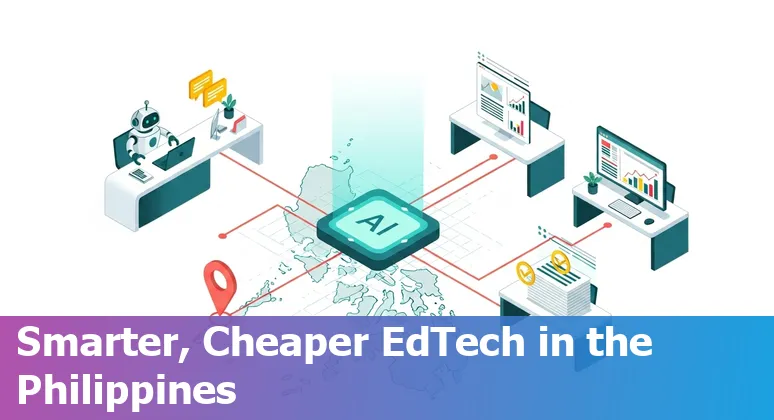
AI helps Philippine education companies cut costs and improve efficiency by automating admin (ERPs, OCR grading), deploying chatbots and virtual tutors for 24/7 Filipino‑language support, using predictive analytics to reduce churn, and upskilling staff - pilotable in 30–60 days; 72‑hour breach reporting.
AI matters for education companies in the Philippines because it promises real cost savings and resilience: automating admin work, powering chatbots and virtual tutors for 24/7 support in Filipino and regional languages, and keeping learning alive when typhoons and outages hit remote islands - a risk XciTech's analysis warns will widen the urban–rural gap unless AI and satellite connectivity scale fast.
Proven efficiency levers from the BPO world - predictive analytics for staffing and NLP chatbots that cut call volumes - show how schools and providers can lower operating costs while improving service quality (Philippines call center industry AI-driven CX report).
Practical reskilling is essential: targeted programs like Nucamp AI Essentials for Work bootcamp teach staff to use AI tools and prompt engineering so savings are realized without long development cycles.
| Bootcamp | Key details |
|---|---|
| AI Essentials for Work | 15 weeks; early-bird $3,582 / regular $3,942; courses: AI at Work: Foundations, Writing AI Prompts, Job-Based Practical AI Skills; Register for Nucamp AI Essentials for Work bootcamp |
Table of Contents
- Automating Administrative Workflows for Philippine Education Providers
- Chatbots and Virtual Assistants: 24/7 Student Support in the Philippines
- Personalized Learning at Scale for Filipino Students
- Automated Grading, OCR and NLP to Speed Assessment in the Philippines
- Predictive Analytics: Reducing Churn and Forecasting Demand in the Philippines
- AI‑Assisted Content Creation and Localization for the Philippines
- Workforce & Organizational Efficiency Gains in Philippine Education
- Practical Implementation Pathways for Philippine Education Companies
- Vendors, Partners and Local Case Examples in the Philippines
- Risk Mitigation, Compliance and Policy for Philippine Education Providers
- Checklist & Roadmap: Next Steps for Education Leaders in the Philippines
- Frequently Asked Questions
Confront the practical safeguards for ethical AI and academic integrity concerns that every Filipino educator should know.
Automating Administrative Workflows for Philippine Education Providers
(Up)Automating administrative workflows is where AI and modern ERPs deliver the fastest, most visible wins for Philippine education providers: cloud‑based student information systems can auto‑record attendance (face, biometric or RFID), streamline online enrollment, run fee collection with automated reminders, and even generate DepEd forms and report cards - freeing registrars and cashiers from repetitive tasks so parents move from long queues to quick online checkout.
Platforms built for the Philippines also tie scheduling, exam management, library and hostel operations into one secure dashboard, add payroll and HR automation, and push updates directly to parents via WhatsApp or mobile apps, improving transparency and cash flow; see AI Edu's Student Information System for Manila for a long feature list and WhatsApp integration.
Independent reviews note how school management software cuts manual errors and saves staff hours every month - HashMicro's roundup shows the same core automation benefits many Philippine schools now expect.
For schools balancing tight budgets and big enrollment drives, centralized ERP automation is the practical lever that reduces paperwork, speeds billing, and gives leaders usable reports to plan ahead.
“Using the school management software has been a game-changer for our institution. It has streamlined our administrative tasks, improved communication between staff, students, and parents, and provided valuable insights through its reporting features.” - Kamalesh, Chalapathi Public School
Chatbots and Virtual Assistants: 24/7 Student Support in the Philippines
(Up)Chatbots and virtual assistants are proving to be one of the most practical AI levers for Philippine education providers because they deliver true 24/7 support across familiar channels: students are already turning to AI chatbots to
summarize readings, suggest ideas, and simplify concepts,
and schools can formalize that habit into reliable services with Viber or Messenger integrations for remedial help and enrollment queries (Philippine students relying on AI chatbots for study support; virtual tutoring and chat-based help via Viber and Messenger integrations).
Beyond convenience, a systematic review finds that chatbots boost homework and study assistance and enable more personalized learning - precisely the sorts of steady, scalable gains that help schools from Manila to Mindanao cut staff time spent on routine queries while keeping students engaged and supported around the clock (systematic review on AI chatbot benefits for education).
By starting with focused pilots - admissions, FAQs, or IT helpdesks - institutions can prove ROI, protect data, and escalate complex cases to humans when empathy or nuance matters most.
Personalized Learning at Scale for Filipino Students
(Up)Personalized learning at scale means Filipino students get the right lesson at the right moment - adaptive platforms continuously measure performance, remediate gaps, and accelerate mastery so learners in Manila or Mindanao don't have to wait for the next class to catch up; research shows adaptive systems can boost retention, reduce dropouts, and speed learning journeys (see UCF's findings on personalized adaptive learning UCF research: Why personalized adaptive learning boosts retention).
Practical vendors now offer mobile-first, gamified paths and analytics that let institutions deliver individualized pathways without rewriting every course - reviews of the top adaptive platforms explain how tools like Realizeit and Acrobatiq create tailored learning flows and reporting for instructors (Top 12 adaptive learning platform reviews, 2025).
For Philippine providers, the pragmatic play is pilot-first - apply adaptive courseware to high‑enrollment gateway subjects, measure impact, then scale - because adaptive learning's promise is simple and memorable: it hands each student a personal tutor the moment they show a gap (think Khan Academy's
10‑in‑a‑row checkpoint
) and makes that support affordable and scalable across schools (AI in Philippine education: 2025 guide for providers).
| Platform | Key features | Cost |
|---|---|---|
| SC Training (EdApp) | Authoring tool, gamification, mobile-first, analytics | Free (up to 10 users) |
| Realizeit | Self-learning engine, 1:1 personalized pathways, content-agnostic | Contact for quote |
| Acrobatiq | Embedded adaptive practice, converts static content to interactive courses | $12 (platform fee noted) |
Automated Grading, OCR and NLP to Speed Assessment in the Philippines
(Up)Automated grading in the Philippines becomes practical the moment paper exams, attendance sheets, and filled answer booklets stop being “stacks on a desk” and become searchable text: OCR tools like Brother Scan to OCR document scanning tool and enterprise engines such as Tungsten OmniPage OCR engine convert scans into editable, searchable files, while ICR and OMR handle handwritten answers and bubble sheets so multiple‑choice scoring can be fully automated; lightweight options - from pocket scanner apps to assistive devices like the C‑Pen Exam Reader 2 assistive scanner - make on‑the‑ground digitization feasible in Manila classrooms and remote Mindanao learning centers.
Paired with simple NLP classifiers and workflow routing, schools can auto‑score objective items, surface suspect answers for human review, and turn exam archives into indexed, auditable records - so a teacher can find a single response by keyword instead of rifling through cardboard folders.
“If you take your OCR scanning seriously - if it's a crucial cog in the machinery of your business - then give OmniPage Ultimate a look. It's packed with features above and beyond what you might expect.” - David Nield, Tech Radar
Predictive Analytics: Reducing Churn and Forecasting Demand in the Philippines
(Up)Predictive analytics is the practical lever Philippine education providers can borrow from Metro Manila BPOs to reduce churn and forecast demand: by mining historical enrolment, attendance and interaction data, schools can flag learners likely to drop out, predict busy windows for admissions or helpdesk volume, and match the best counsellors to high‑risk students - approaches already described in Magellan Solutions' review of predictive analysis in the BPO Philippines scene (Predictive analysis in BPO Philippines (Magellan Solutions)).
Using the right models - classification to score churn risk, time‑series (Prophet or TFT) to forecast seasonal spikes, and clustering to segment learners - lets leaders turn passive reports into interventions that arrive days or weeks earlier, not after a student has disappeared; insightsoftware's primer on models and algorithms explains these options and tradeoffs (Top predictive analytics models and algorithms (insightsoftware)).
Academic work on behavioral predictors shows dynamic, behavior‑based models outperform static factors for churn, so integrating clickstream, call and attendance signals can create one actionable alert - think of a single dashboard light that tells staff which cohort needs outreach today (Behavioral churn prediction study (EPJ Data Science)); that tiny signal can be the difference between a timely call home and an irreversible dropout.
| Model | Education use (Philippines) | Primary benefit |
|---|---|---|
| Classification | Score students for dropout risk | Early intervention & retention |
| Time‑series (Prophet/TFT) | Forecast enrolment and helpdesk volume | Better staffing & resource planning |
| Clustering | Segment learners for targeted support | Personalized outreach at scale |
AI‑Assisted Content Creation and Localization for the Philippines
(Up)AI-assisted content creation and localization is already practical for Philippine education providers because a small toolset - language-aware LLMs for drafting, design engines for slides, transcription services for captions, and native-speaker Tagalog data pipelines - lets teams produce and localize whole lesson bundles fast: draft lesson text with OpenAI Playground or ChatGPT, polish prose with Quillbot or Grammarly, convert lectures to searchable transcripts with Otter.ai, and push those scripts into ready-made templates from Canva or Slidesgo for mobile-first delivery (see the roundup of student AI tools for content creation and tutoring).
For classroom-scale localization, partnering with Tagalog data and annotation specialists ensures conversational tone, regional idioms, and cultural context are captured, not lost in translation - OpenActive's Tagalog services outline how native linguists build training data for conversational AI and TTS. With DepEd's new E‑CAIR pushing AI tools into basic education, the practical payoff is immediate: teachers can turn one English lesson into Tagalog slides, quiz items and a captioned video in the time it used to take to photocopy handouts, making high‑quality, localized materials affordable for schools from Manila to Mindanao (Comprehensive guide to AI tools for students: content creation and tutoring; OpenActive Tagalog AI solutions for localization and TTS; DepEd E‑CAIR AI Center for Education launch announcement).
“Hindi po tayo makikipagsabayan para lang masabi na ‘tech-savvy' tayo. We are here to use AI as a tool for genuine, enduring reforms. This is the promise of the President's Bagong Pilipinas,” Education Secretary Sonny Angara said in his keynote address.
Workforce & Organizational Efficiency Gains in Philippine Education
(Up)Philippine education providers are already seeing workforce and organizational efficiency gains as AI moves routine admin and repetitive student queries into automated systems, freeing staff to do higher‑value work like curriculum design, student coaching, and data‑driven outreach; local offshoring coverage notes this shift lets teams
grow into new roles such as AI trainers and data analysts rather than being replaced - How AI in Offshoring Philippines Is Revolutionizing the Workforce
Lessons from the BPO sector show bots handling simple tickets lets human agents focus on complex cases and quality control, and Philippine call‑centers are already retraining staff for account management and oversight roles (AI in BPO Industry: How PH Call Centers Adapt to Change).
National analyses highlight both risk and opportunity - the same AI exposure that could automate clerical tasks also creates complementarity for professionals if upskilling keeps pace (AI and the Future of Work in the Philippines) - so pragmatic investments in learning pathways, smarter scheduling, and transparent performance tools turn efficiency gains into durable workforce upgrades, not just short‑term cost cuts.
| Emerging role | Why it matters |
|---|---|
| AI Trainer / Supervisor | Ensures models align with local needs and quality standards |
| Data Analyst / Interpreter | Transforms student and operational data into actionable insights |
| Customer Experience Designer | Handles nuanced, high‑value student and parent interactions |
| AI Ethics / Technical Support Specialist | Manages fairness, compliance and tool reliability |
Practical Implementation Pathways for Philippine Education Companies
(Up)Practical implementation for Philippine education companies means moving from pilots to repeatable 30–60 day playbooks: start with system configuration and role definition, run narrow pilots on high‑risk or high‑volume processes (admissions chatbots, OCR for exam grading, voucher distribution), then scale with governance, monitoring and vendor controls - an approach already reflected in government and academe initiatives such as DAP's Unlocking Practical AI training and DepEd's new E‑CAIR AI center, which emphasize hands‑on workshops, participatory design and solutions that map to local policy and school needs.
Protecting students and reputations requires pairing speed with safeguards: adopt automated DPIA workflows and education‑specific privacy templates so a binder of vendor contracts becomes an audit‑ready trail and approvals no longer bottleneck pilots (automated DPIA tools for education).
Prioritize narrow, measurable wins (enrollment processing, helpdesk triage, adaptive practice for gateway courses), measure time and cost saved, and embed upskilling so staff move from firefighting to oversight - turning one successful pilot into a province‑wide improvement instead of a one‑off proof of concept.
| Phase | Timeline | Core activities |
|---|---|---|
| System Configuration | Weeks 1–2 | Define roles, import vendors, set risk criteria, configure templates |
| Pilot Implementation | Weeks 3–4 | Pilot 2–3 high‑risk tools, train stakeholders, test workflows |
| Full Deployment | Weeks 5–6 | Organization rollout, staff training, monitoring and governance |
“Hindi po tayo makikipagsabayan para lang masabi na ‘tech-savvy' tayo. We are here to use AI as a tool for genuine, enduring reforms. This is the promise of the President's Bagong Pilipinas,” Education Secretary Sonny Angara said in his keynote address.
Vendors, Partners and Local Case Examples in the Philippines
(Up)Philippine vendors and partners are a pragmatic fast-track for education companies that want scale without reinventing operations: the market hosts hundreds of BPOs (PEZA reported roughly 788 registered firms) and deep specialist players, so providers can outsource everything from 24/7 learner support to data‑labeling and AI training workflows.
Start by scanning curated lists like the Top 40 BPO Companies in the Philippines to shortlist proven partners (for example, SixEleven runs more than 1,500 seats in Davao), then match capabilities to needs - edtech teams commonly outsource customer support, technical assistance, content development and data analysis, as documented in regional edtech BPO writeups.
Choose partners with ISO/SOC controls, PEZA accreditation and strong case studies; local guides on evaluating vendors walk through reputation, security and trial pilots so contracts don't become surprises.
For practical pilots, booth‑style talent houses and managed‑team providers can spin up remote squads and handle payroll, while niche firms focus on AI ops and annotation - letting schools pilot chatbots, OCR grading and helpdesk triage with measurable cost and time savings.
“Our values align both in business and core principles. Finding a partner that shares and values this alignment was crucial.” - Mick Dovile, Booth & Partners testimonial
Risk Mitigation, Compliance and Policy for Philippine Education Providers
(Up)Mitigating AI risk in Philippine schools means treating data protection as operational: the Data Privacy Act of 2012 and the National Privacy Commission set clear, concrete rules - appoint and register a Data Protection Officer, run Privacy Impact Assessments, embed Privacy‑by‑Design and Privacy‑by‑Default, and enforce access controls and retention policies so student records stay locked down (Philippines Data Privacy Act of 2012 overview).
Take NPC guidance seriously: the NPC's updated security baseline (NPC Circular No. 2023‑06) demands inventories, control frameworks, secure authentication and business continuity plans with a compliance window that closed on 30 March 2025, and breach reporting now flows through the DBNMS with a mandatory 72‑hour notification clock for incidents that risk harm - imagine a literal 72‑hour timer from discovery to notification that forces fast containment and clear communication (NPC Circular No. 2023‑06 security baseline summary).
Practical risk controls include vendor contracts that mandate equivalent protections for cross‑border transfers, routine DPIAs for any new AI tool, staff training, and staged incident playbooks - because fines, enforcement orders and even criminal liability are real, and prevention is far cheaper than remediation (NPC registration rules and thresholds for DPO/DPS in the Philippines).
| Instrument | Key requirement | Deadline/notes |
|---|---|---|
| Data Privacy Act (RA 10173) | DPO, lawful processing, breach notification | 72‑hour breach notification; penalties apply |
| NPC Circular No. 2023‑06 | Minimum security controls, PIAs, privacy‑by‑design | Compliance expected by 30 Mar 2025 |
| NPC registration rules | Register DPO/DPS if 250+ employees or SI of 1,000+ | Register via NPCRS; Certificate valid 1 year |
Checklist & Roadmap: Next Steps for Education Leaders in the Philippines
(Up)Start with narrow, measurable pilots that map to high‑volume pain points - admissions chatbots, OCR grading and adaptive practice for gateway courses - run 30–60 day playbooks, and treat the pilot as a data collection exercise so time, cost and retention gains are clear; pair that with institutional AI use rules and disclosure requirements modeled on the University of the Philippines Open University guidelines for AI in teaching and learning (University of the Philippines Open University AI use guidelines for teaching and learning).
Invest in teacher upskilling and basic infrastructure (the literature shows urban–rural gaps and skills shortfalls remain critical), then use DepEd's new Education Center for AI Research (E‑CAIR) as a scaling partner to move successful pilots into wider programs (DepEd Education Center for AI Research (E‑CAIR) launch announcement).
Embed clear monitoring metrics and a staged vendor review so localization, privacy and cost controls are approved before full rollout; complement institutional training with practical courses like Nucamp's AI Essentials for Work to teach staff prompt engineering and tool use in 15 weeks (Nucamp AI Essentials for Work 15-week bootcamp registration).
Aim for pragmatic wins - what once took a day of photocopying can become a localized, captioned lesson bundle in an hour - and use those wins to build momentum for province‑wide adoption.
| Bootcamp | Length | Early‑bird Cost | Key focus |
|---|---|---|---|
| AI Essentials for Work | 15 Weeks | $3,582 | AI at Work: Foundations, Writing AI Prompts, Job‑Based Practical AI Skills |
“Hindi po tayo makikipagsabayan para lang masabi na ‘tech‑savvy' tayo. We are here to use AI as a tool for genuine, enduring reforms. This is the promise of the President's Bagong Pilipinas,” Education Secretary Sonny Angara said in his keynote address.
Frequently Asked Questions
(Up)How does AI help education companies in the Philippines cut costs and improve efficiency?
AI reduces costs and raises efficiency by automating administrative workflows (cloud student information systems that auto‑record attendance via face/biometric/RFID, streamline online enrolment and fee collection, generate DepEd forms and report cards), powering 24/7 chatbots and virtual tutors in Filipino and regional languages, enabling OCR/NLP grading to speed assessments, and using predictive analytics to forecast demand and flag dropout risk. These levers cut staff hours, reduce manual errors, improve cash flow and allow human staff to focus on higher‑value tasks.
What practical AI tools, platforms and local partners can Philippine schools use?
Schools can adopt Philippine‑ready ERPs and student information systems (examples in the article include AI Edu and HashMicro) with WhatsApp/Viber integrations; mobile‑first adaptive learning tools (EdApp/SC Training, Realizeit, Acrobatiq); OCR and OMR solutions (OmniPage and lighter scanner apps) for exam digitization; and BPO/managed teams for 24/7 learner support and data‑labeling. The local market includes hundreds of BPOs (PEZA reports ~788 registered firms) and specialist vendors with ISO/SOC controls suitable for pilots and managed rollouts.
What is a practical implementation pathway and timeline for Philippine education providers?
Use repeatable 30–60 day playbooks: Weeks 1–2 configure systems and define roles; Weeks 3–4 run narrow pilots (admissions chatbots, OCR grading, voucher distribution); Weeks 5–6 deploy organization‑wide with training, monitoring and governance. Start narrow, measure time/cost/retention gains, protect data and escalate complex cases to humans. Pair pilots with DPIAs, vendor checks and staged scaling to turn proofs of concept into province‑wide improvements.
What workforce changes and reskilling are required to realize AI savings?
Practical reskilling is essential: train staff on AI tool use, prompt engineering and oversight so savings are realized without long development cycles. New roles include AI trainer/supervisor, data analyst/interpreter, customer experience designer and AI ethics/technical support. Short applied programs (for example, Nucamp's AI Essentials for Work: 15 weeks; early‑bird $3,582 / regular $3,942) can teach prompt writing and job‑based AI skills to speed internal adoption.
What compliance and risk controls must Philippine education providers follow when deploying AI?
Treat data protection as operational under the Data Privacy Act (RA 10173) and NPC guidance: appoint and register a Data Protection Officer where required, run Privacy/ Data Protection Impact Assessments, embed Privacy‑by‑Design, and enforce access/retention controls. NPC Circular No. 2023‑06 sets minimum security baselines and required compliance steps (deadline referenced in the article), and breach reporting requires a 72‑hour notification for incidents that risk harm. Practical controls include vendor contracts with equivalent protections for cross‑border transfers, routine DPIAs, staff training and incident playbooks.
Discover how Personalized Lessons for Filipino students can close learning gaps with low-bandwidth, teacher-reviewed AI prompts.
See examples of Co-teaching with AI tools that enhance classroom outcomes and expand opportunities for teacher-led learning experiences.

Ludo Fourrage
Founder and CEO
Ludovic (Ludo) Fourrage is an education industry veteran, named in 2017 as a Learning Technology Leader by Training Magazine. Before founding Nucamp, Ludo spent 18 years at Microsoft where he led innovation in the learning space. As the Senior Director of Digital Learning at this same company, Ludo led the development of the first of its kind 'YouTube for the Enterprise'. More recently, he delivered one of the most successful Corporate MOOC programs in partnership with top business schools and consulting organizations, i.e. INSEAD, Wharton, London Business School, and Accenture, to name a few. With the belief that the right education for everyone is an achievable goal, Ludo leads the nucamp team in the quest to make quality education accessible