









AI Salaries in the Marshall Islands in 2026: What to Expect by Role and Experience
By Irene Holden
Last Updated: April 18th 2026
Key Takeaways
AI salaries in the Marshall Islands in 2026 are sharply divided between local and global markets, with local roles like those in government or MINTA offering up to around $98,000 for senior AI engineers, while remote or international positions can pay over $270,000 for the same experience. Key roles such as data scientists and MLOps engineers see similar gaps, so focusing on skills for system orchestration or domain expertise in areas like fisheries can boost your earning potential in both tracks.
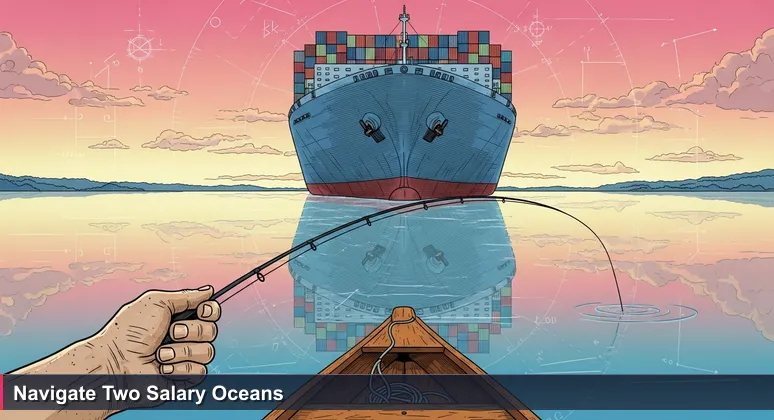
From your canoe on the Majuro lagoon, you look up at the hull of a container ship bound for Singapore. You’re in the same water, under the same sky, but you are navigating two completely different economic currents. This duality defines the AI job market for Marshall Islanders today. Success isn't just about technical skill - it's about understanding which salary ocean you intend to sail: the inland sea of local public service or the deep, global ocean of remote and international work.
On one side, the local economy, anchored by government and statutory roles, offers stability and direct community impact. Monthly gross salaries for general information technology work here range from $1,774 to $6,729, according to local Paylab.com salary surveys. On the other side, the global track, accessible via high-speed internet, offers compensation benchmarked against tech hubs like Silicon Valley. A mid-level Machine Learning Engineer working remotely for a firm like Scale AI can command a base salary starting from $195,000.
This guide is your nautical chart for these waters. We’ll decode the employer tiers, from the Marshall Islands National Telecommunications Authority (MINTA) to the Asian Development Bank (ADB), and provide the definitive salary data for 2026. Your career is no longer just a point on a map of atolls; it is a node in a global network. By understanding these two oceans, you can navigate a course that provides for your family, serves your community, and positions the Marshall Islands as a proactive contributor to the AI-powered future.
In This Guide
- Sailing Two Salary Oceans: An Introduction
- Understanding the Bifurcated Market
- Salary Ranges for Core Technical Roles
- Governance and Emerging AI Roles
- The Four Employer Tiers Shaping Your Offer
- Negotiation Tactics for Local Roles
- Negotiating International and Remote Offers
- Evaluating AI Job Offers: A Realistic Checklist
- Strategic Pathways for a Dual-Value Career
- Positioning the Marshall Islands in the AI Future
- Frequently Asked Questions
This comprehensive guide to AI careers in the Marshall Islands covers everything from skills to salaries.
Understanding the Bifurcated Market
The moment you begin your AI job search in the Marshall Islands, you must choose which economic chart you are reading. Compensation is sharply divided into two tracks: Local Hire and International/Remote Hire. Your salary is determined less by your physical location in Majuro or Ebeye and more by the market your employer benchmarks against.
The Local Track includes roles within the RMI Government, statutory authorities like MINTA, and local enterprises. Salaries follow national pay scales, with AI-specific roles commanding a premium within an established band. For example, a Senior AI Engineer in this tier might cap near $98,000. In contrast, the Global Track encompasses remote roles for international tech firms and "international staff" positions with agencies like the ADB or UN. These salaries are benchmarked against global standards, with the same senior engineer earning a base of $210,000 to $270,000+, as highlighted in global salary reports.
This gap exists because the skills in demand are fundamentally different. Experts note that the high global salaries are for "system orchestration" - managing the uncertainty, context, and integration of AI systems - not just writing code. This skill gap is a primary reason salaries remain elevated. Understanding this bifurcation is not about choosing one ocean over the other, but about learning to navigate both with a clear strategy.
Salary Ranges for Core Technical Roles
The most in-demand AI roles involve building and maintaining the systems that power intelligent applications. For Marshall Islanders, compensation for these positions varies dramatically depending on which market you operate within, as shown in the definitive ranges below.
| Role | Experience Level | Local Statutory/Gov Range (USD) | International/Remote Tier Range (USD) |
|---|---|---|---|
| AI/ML Engineer | Entry (0-3 yrs) | $24,000 - $42,000 | $117,000 - $135,000 |
| Mid (4-9 yrs) | $45,000 - $65,000 | $145,000 - $185,000 | |
| Senior (10+ yrs) | $75,000 - $98,000 | $210,000 - $270,000+ | |
| Data Scientist | Entry/Mid | $30,000 - $55,000 | $95,000 - $135,000 |
| Lead | $65,000 - $90,000 | $160,000 - $220,000 | |
| MLOps Engineer | Mid/Senior | $50,000 - $80,000 | $175,000 - $230,000 |
The local high-end, approximately $95,000-$98,000, is typically for technical leadership at statutory enterprises or specialized project roles. The global tier, however, is benchmarked against hubs like Silicon Valley. For instance, a Machine Learning Engineer at a firm like Scale AI can command total compensation from $195,000.
It's critical to understand that these salaries reflect a demand for system orchestration - managing the integration and uncertainty of AI - not just coding. Furthermore, title inflation is real; a "Senior" role locally may involve basic automation, while the same title globally implies architecting complex machine learning systems. Always scrutinize the job description over the title alone.
Governance and Emerging AI Roles
| Role | Typical Experience | Salary Range (USD) | Primary Employer Tier |
|---|---|---|---|
| AI Governance/Risk Manager | Mid-Senior | $120,000 - $180,000 | Regional NGOs, UN, Large Remote Firms |
| AI Policy Analyst | Mid-Level | $100,000 - $150,000 | ADB, UN, RMI Gov't (Special Projects) |
| Chief AI Officer (CAIO) | Executive (15+ yrs) | $250,000 - $400,000+ | Major International Agencies, Global Tech |
As AI adoption accelerates, so does the need for roles that ensure its ethical and effective deployment. These governance and strategy positions, commanding significant premiums, are almost exclusively found in the global tier but are beginning to appear in advanced local projects funded by international grants. For example, a mid-level AI Policy Analyst working on a special project for the RMI government or a regional body like the Asian Development Bank (ADB) can earn between $100,000 and $150,000.
The highest compensation is reserved for executive leadership. A Chief AI Officer (CAIO) at a major international agency or tech firm can command salaries from $250,000 to over $400,000, reflecting the strategic importance of the role. Reports on AI governance salaries confirm that specializations in risk and ethics are among the most valued in 2026. For Marshall Islanders, combining AI governance knowledge with deep domain expertise in maritime logistics or fisheries data creates a uniquely powerful and valuable dual-specialization.
The Four Employer Tiers Shaping Your Offer
Your potential AI salary in the Marshall Islands is fundamentally dictated by which of four distinct employer tiers you engage with. Each operates on a different compensation philosophy and market benchmark.
Tier 1: Government & Statutory Authorities
This tier includes the RMI National Government, the College of the Marshall Islands (CMI), and entities like the Marshall Islands Ports Authority. Compensation follows fixed civil service pay scales, with AI work often embedded in "IT Specialist" or "Data Analyst" roles focused on public infrastructure and policy. The salary ceiling for domestically funded technical experts is typically under $100,000.
Tier 2: Statutory Enterprises & Telecom
Led by the Marshall Islands National Telecommunications Authority (MINTA), this tier offers the highest on-island cash compensation. Roles here, such as "Network Optimization Engineer," apply AI to manage critical resources like bandwidth across vast ocean distances. A key retention tool is the professional training stipend, with employers often providing $2,000-$5,000 annually for certifications, as noted in industry salary trends.
Tier 3: Regional Multinationals & Development Agencies
This tier includes the Asian Development Bank (ADB), UN agencies, and the World Bank. They offer "International Staff" packages benchmarked globally, not against local RMI rates. Technical staff can earn from roughly $114,500 for junior specialists to over $312,000 for senior leads, according to the official ADB salary structure. These roles often focus on regional challenges like climate modeling and sustainable fisheries.
Tier 4: Remote-First Global Tech Firms
This final tier consists of U.S.-based AI startups and fully distributed tech companies. Compensation is benchmarked against Silicon Valley, featuring high base salaries, annual bonuses, and equity. The Marshall Islands' use of the US dollar and strategic Pacific location make its professionals administratively simple hires for these firms, allowing access to global-tier salaries while living in-community.
Negotiation Tactics for Local Roles
Negotiating an AI salary with a local public-sector or statutory employer requires a specific strategy, as the base pay is often bound by rigid scales. Your leverage lies in negotiating supplementary allowances and benefits that recognize your specialized skills.
First, focus on professional development. Proactively negotiate a defined annual training budget of $3,000 to $5,000. Frame this as a direct investment in keeping the organization's technological capabilities competitive. This stipend can cover critical upskilling, such as an affordable, flexible bootcamp in Python and DevOps, which are foundational for AI work.
Second, negotiate for workplace flexibility stipends. If the role allows for partial remote work, request an allowance for high-speed home internet, a crucial and costly utility in Majuro. For roles deemed critical and hard-to-fill, housing assistance, though rare for local hires, can sometimes be brought to the table.
Finally, discreetly inquire about funding sources. If the position is tied to a specific foreign-aid or Compact-funded project, there may be more budget flexibility for allowances or a higher pay grade. Use localized salary data from sources like Paylab's Marshall Islands surveys to ground your requests in the local market reality for technical talent.
Negotiating International and Remote Offers
When negotiating with international or remote employers, you are operating on a global playing field. Your strategy must shift from seeking allowances to confidently asserting your value against world-market benchmarks.
Arm yourself with data from authoritative sources like Levels.fyi for tech firms and the official ADB International Staff Salary Structure for development roles. For a mid-level AI engineering role, the global benchmark starts at $145,000+. Emphasize that you deliver equivalent value to a Bay Area employee, with the added advantages of the Marshall Islands' US dollar currency and favorable time zone alignment with the US West Coast, making you an administratively simple hire.
Understand the compensation components. For remote private-sector roles, equity (RSUs) is critical; annual grants can average $50,000 to $100,000+ for senior positions. For agencies like the ADB, focus on the base salary, post adjustment, and substantial housing and relocation allowances. You can also negotiate a "location-neutral" digital nomad package, highlighting that a salary supporting a comfortable life in RMI (estimated at $2,500-$3,000 monthly for two) is easily covered by a standard junior AI salary, ensuring you are a stable, long-term asset.
Evaluating AI Job Offers: A Realistic Checklist
When you receive an AI job offer in the Marshall Islands, a systematic evaluation is essential to compare opportunities across the two economic tracks. Use these focused checklists to ensure you're assessing all critical components of compensation and fit.
For an Offer from a Local Employer (e.g., RMI Government or MINTA)
- Base Salary: Does it fall within the $45,000 - $80,000 band for mid-level technical work?
- Training Budget: Is there a formal, annual stipend ($2k+) for certifications or bootcamps?
- Project Stability: Is the role permanent or tied to a short-term project grant?
- Community Impact: Does the work directly address local needs, like improving telecom reliability or port logistics?
For an Offer from an International/Remote Employer (e.g., ADB or a Tech Startup)
- Base Salary: For a mid-level role, is it competitive with $145,000+ for engineers or $114,500+ (ADB TI1) for development roles?
- Equity/RSUs: If applicable, what is the grant value and vesting schedule?
- Allowances: For roles with agencies like the Asian Development Bank, what are the housing, relocation, and post-adjustment benefits?
- Tax Implications: Have you consulted a local advisor on foreign-sourced income? A remote salary must comfortably cover local costs, with a digital nomad budget for two in RMI estimated at $2,500-$3,000 monthly.
Strategic Pathways for a Dual-Value Career
The most sustainable AI career strategy for Marshall Islanders is to build a vessel that sails both salary oceans. This means constructing a dual-value career that leverages local experience for global opportunity, and uses global income to fuel local impact.
Begin by starting local and skilling global. Secure a role with a Tier 1 or 2 employer like MINTA or a government project. Aggressively utilize their training stipends to earn globally recognized certifications. An affordable, focused program like the Back End, SQL and DevOps with Python bootcamp builds the exact foundational skills demanded in AI/ML job descriptions. Use this position to build a portfolio with tangible local impact, such as a predictive model for Majuro port congestion.
Next, leverage your innate domain expertise. Specialize in applying AI to the Pacific's core industries: maritime logistics, sustainable fisheries data, or climate resilience modeling. This dual-specialization makes you uniquely valuable to both the Marshall Islands Marine Resources Authority and international bodies like the ADB or The Nature Conservancy, who pay a premium for this niche, context-rich knowledge.
Finally, pursue strategic remote work. With a strong skillset and portfolio, secure a Tier 4 remote role. This provides global-caliber income and experience. Use this financial stability - where a single salary can comfortably cover a $2,500-$3,000 monthly budget for a family in RMI - to then engage in higher-impact consultancies or roles with regional agencies focused directly on Pacific development, creating a powerful feedback loop between global resources and local service.
Positioning the Marshall Islands in the AI Future
The journey through the two salary oceans culminates not in choosing one, but in mastering the navigation between them. For the Marshall Islands, this isn't just an individual career strategy; it's a national opportunity to transition from being a recipient of technology to a proactive architect of the Pacific's AI-powered future.
Your unique position is your power. The Marshall Islands' strategic Pacific location, use of the US dollar, and deep cultural knowledge of maritime and fisheries industries create an unparalleled foundation. By building a dual-value career, you channel global-caliber resources and expertise directly into local challenges - optimizing the Ship Registry's operations, modeling sustainable tuna stocks, or strengthening climate resilience. This turns the atolls into living labs for solutions with global relevance.
The vessel for this journey is accessible, high-quality education. Affordable and flexible upskilling paths, such as the focused AI and coding bootcamps offered by Nucamp, equip Marshall Islanders with the practical skills to engage confidently in both economic currents. As more professionals chart this course, they create a resilient, homegrown tech ecosystem that attracts further investment and opportunity.
In 2026, success is measured not just by personal salary but by communal advancement. By understanding the distinct charts of local service and global work, you secure a future that provides for your family, serves your community, and firmly positions the Marshall Islands as a vital and innovative node in the world's digital network.
Frequently Asked Questions
What can I expect to earn in an AI role in the Marshall Islands in 2026?
Salaries vary significantly based on employer type. For local roles with entities like the RMI Government or MINTA, you might earn $24,000 to $98,000, while remote or international positions, such as with the ADB or tech firms, can offer $117,000 to over $270,000 for senior AI Engineers.
How big is the salary gap between local and remote AI jobs in the Marshall Islands?
The gap is substantial, reflecting two distinct markets. Local statutory roles cap around $98,000, but international hires, like those with the ADB, start at $114,500 and can exceed $300,000, driven by global benchmarking and the use of USD in RMI.
Which AI roles are most lucrative for someone based in Majuro?
Senior AI Engineers in the global tier top the list at $210,000 to $270,000+, while roles like Chief AI Officer can reach $400,000+. Locally, MLOps Engineers earn up to $80,000, with premiums for niche specializations in maritime or fisheries data.
What should I focus on when negotiating an AI salary in the Marshall Islands?
For local jobs, prioritize allowances like a $3,000-$5,000 training stipend and remote-work support. For remote roles, leverage global benchmarks from sources like Levels.fyi and emphasize your value as a location-neutral hire from RMI's strategic Pacific base.
Are there specific AI career opportunities related to the Marshall Islands' key industries?
Yes, combining AI with domain expertise in fisheries or maritime logistics opens doors. Organizations from the ADB to local authorities pay premiums for roles in climate modeling or port optimization, leveraging RMI's unique Pacific context for impactful work.
This guide covers digital careers in the Pacific islands without a bachelor's degree, focusing on the Marshall Islands.
Discover funding options for AI bootcamps in Majuro in 2026 in this comprehensive guide.
Learn about high-paying tech companies in Marshall Islands for your career growth.
Learn about the top 10 free tech training at libraries and community centers in the Marshall Islands in 2026.
For local insights, learn the steps to become an AI expert in the Marshall Islands with this detailed article.

Irene Holden
Operations Manager
Former Microsoft Education and Learning Futures Group team member, Irene now oversees instructors at Nucamp while writing about everything tech - from careers to coding bootcamps.