









Top 10 AI Prompts and Use Cases and in the Financial Services Industry in Fiji
Last Updated: September 8th 2025
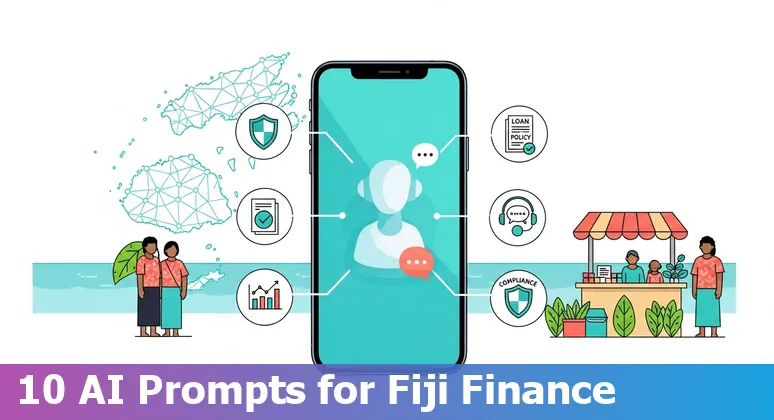
Too Long; Didn't Read:
AI prompts and use cases can modernize Fiji's financial services - fraud stacks scan ~160 billion transactions/year in ~50 ms, credit auto‑decision rates of 60–83%, remittances FJD 871M (to Jun 2022), COiN processing 12,000 contracts in seconds saving ~360,000 hours, and 257 cyber adversaries tracked.
Fiji's financial sector sits at a crossroads: rising cyber-enabled fraud, tightening AML/KYC expectations, and insurance challenges around policy wording and claims mean banks and insurers must modernise fast to protect customers and keep costs down.
AI already offers practical wins for Fiji - from smarter transaction monitoring and anomaly detection that cut false positives to computer-vision tools that speed property-claim verification after extreme events (see Tractable's UN partnership) and to advanced AML analytics that surface hidden money‑laundering patterns (Tranche 2 AML).
Local teams can start small - automating document processing and customer triage - while building human oversight and security. For Fijian managers and compliance officers who need hands-on skills, a focused course like the AI Essentials for Work bootcamp teaches prompt-writing and workplace AI use cases that translate directly into safer, faster financial services (AI Essentials for Work syllabus - Nucamp and Register for AI Essentials for Work - Nucamp).
| Bootcamp | Length | Early bird Cost | Syllabus |
|---|---|---|---|
| AI Essentials for Work | 15 Weeks | $3,582 | AI Essentials for Work syllabus (Nucamp) |
“Generative AI can play a critical role in portfolio management by providing market analysis, risk assessment, portfolio optimisation, scenario analysis and investor communication. It can assist in analysing market trends, evaluating risks, optimising portfolio allocation, simulating scenarios, communicating with investors, addressing behavioural biases and using historical data for predictive modelling.”
Table of Contents
- Methodology: How we selected use cases and crafted prompts
- Denser: Automated Customer Service (Chatbots & Virtual Assistants)
- Mastercard: Fraud Detection & Prevention (Real-time Monitoring)
- Zest AI: Credit Risk Assessment & Alternative Scoring
- BlackRock Aladdin: Algorithmic Trading & FX / Portfolio Recommendations
- Morgan Stanley: Personalized Financial Products & Targeted Marketing
- BloombergGPT: Regulatory Compliance, AML & KYC Automation
- JPMorgan COiN: Underwriting and Document Processing
- Bloomberg: Financial Forecasting & Predictive Analytics (Remittances & Tourism)
- UiPath: Back-office Automation & Workflow Efficiency
- CrowdStrike: Cybersecurity & Threat Detection Summaries
- Conclusion: Practical next steps for Fijian financial institutions
- Frequently Asked Questions
Find out how Intelligent document processing for Fiji's financial firms speeds onboarding and lowers manual compliance costs.
Methodology: How we selected use cases and crafted prompts
(Up)Selection began by mapping practical needs in Fiji - AML/CFT, fraud prevention, lending and portfolio risk - against proven industry categories (see Abrigo's roadmap) and a decision-making matrix that weighs business drivers like employee productivity, cost reduction and customer experience, as recommended in EY's front‑office framework; use cases that scored high on ROI, integration feasibility and regulator-readiness were prioritised for pilots.
Prompts were then crafted not as one-off chat queries but as structured templates that embed data‑readiness checks, privacy-safe retrieval (RAG) steps and explicit guardrails for explainability and human escalation, so outputs can be audited and tied back to policy.
Practical filters - data quality, legacy integration risk, and staff upskilling needs - guided whether a case stayed in the front office (RM augmentation) or moved to back‑office automation; the rule of thumb was simple: pick projects that cut investigator load and surface true positives fast, for example by checking thousands of transactions in a couple of seconds to triage alerts.
Learn more in Abrigo's use‑case list and EY's implementation playbook for front‑office Gen AI.
“When AI is mentioned, it tends to lower emotional trust, which in turn decreases purchase intentions.”
Denser: Automated Customer Service (Chatbots & Virtual Assistants)
(Up)Automated customer service in Fiji is rapidly moving from theory to tangible impact: no-code platforms like Denser.ai no-code chatbot platform let teams build intelligent assistants that train on internal docs, surface source‑backed answers, handle tables and charts, and deploy across web, WhatsApp and live channels without heavy engineering; that capability matters when the Fiji Development Bank has already launched an AI chatbot (with UNCDF and ITGalax) and plans translations into iTaukei and Hindi to reach farmers, market vendors and MSMEs (Fiji Development Bank AI chatbot launch announcement).
Public agencies are matching that momentum - FRCS ran a tender for a GenAI chatbot PoC - so banks can pick use cases that map to Prove's three chatbot brackets (Transactional, Advisory, Informational) and start with high‑value, low‑risk pilots such as onboarding pre-fill, balance queries and authenticated account lookups.
The practical payoff is vivid: a multilingual bot that confirms a loan-document checklist at 2am avoids a weekday branch visit and frees staff for complex cases, while clear escalation paths and live-agent handoffs keep compliance and trust intact (Prove chatbot deployment strategy study).
| Project | Dates | Budget | Implementer |
|---|---|---|---|
| Chatbox – Digitising Customer Service | Oct 2022 – Feb 2023 | $82,000 | IT GALAX (donor: Australia) |
“At Fiji Development Bank, we have always been committed to enhancing the banking experience for our customers. The launch of our Chatbot represents a significant step towards providing convenient, accessible, and immediate support to our valued customers. I am pleased to also announce that the next stage of this project is having translations available in Hindi and iTaukei.”
Mastercard: Fraud Detection & Prevention (Real-time Monitoring)
(Up)Mastercard's real‑time fraud stack - built around its Decision Intelligence risk‑scoring - is a practical template Fiji's banks can study: the system scans hundreds of millions of data points per transaction and, MasterCard says, analyzes roughly 160 billion transactions a year to assign instant risk scores and act in about 50 milliseconds, cutting false positives while stopping scams almost as they happen (Mastercard Decision Intelligence real-time fraud detection overview - Business Insider).
The approach combines adaptive machine‑learning (it learns new fraud patterns without manual retraining), behavioral biometrics and collaborative threat signals, plus targeted products like First‑Party Trust and Scam Protect to surface suspicious chargebacks and online scams; Mastercard has also publicised expansions of its market‑ready AI for banks to block scams in real time (Mastercard expands AI technology to help banks block scams in real time - Mastercard press release).
For Fiji, the “so what” is immediate: faster authorisations that keep tourists and remitters spending, fewer needless declines that frustrate merchants, and an auditable hybrid model that pairs machine speed with human review to manage fairness and regulatory concerns.
“AI enables real-time detection of suspicious transactions by identifying patterns and anomalies impossible for human analysts to spot at scale.” - Daryl Lim, Center for Socially Responsible Artificial Intelligence
Zest AI: Credit Risk Assessment & Alternative Scoring
(Up)Zest AI offers a practical path for Fiji's banks and credit unions to make lending smarter, faster and fairer: its AI‑automated underwriting can score borrowers using many more data points than legacy models, raise approvals without adding risk, and embed bias‑reducing controls that regulators value.
Local lenders can use Zest's modular approach - rapid proofs of concept and fast integrations - to automate a large share of routine decisions, surface fraud signals, and free underwriters for complex cases; Zest's product page documents claims like lifting approvals while reducing risk and delivering up to 80% auto‑decisions, and its recent Temenos integration shows how decisioning and fraud detection can ship as a turnkey capability (Zest AI automated underwriting product page, Zest AI and Temenos integration announcement).
The operational payoff is tangible - testimonial evidence notes loans that once took six hours to decision are now processed exponentially faster - which in Fiji could mean quicker access to working capital for MSMEs, fewer manual reviews for small‑branch teams, and clearer audit trails for fair‑lending checks.
| Metric | Reported figure |
|---|---|
| Auto‑decision rate | 60–83% (reported ranges) |
| Approval lift | 25–30% (without added risk) |
| Risk / charge‑off reduction | ~20%+ |
| Time & resource savings | Up to 60% faster processes |
| POC → Integration | POC 2 weeks; integrate in ~4 weeks (reported) |
“Zest AI's underwriting technology is a game changer for financial institutions. The ability to serve more members, make consistent decisions, and manage risk has been incredibly beneficial to our credit union. With an auto‑decisioning rate of 70‑83%, we're able to serve more members and have a bigger impact on our community.” - Jaynel Christensen, Chief Growth Officer
BlackRock Aladdin: Algorithmic Trading & FX / Portfolio Recommendations
(Up)BlackRock's Aladdin brings a powerful, practical model for Fiji's banks, insurers and reserve managers who need tighter control over FX exposure, portfolio recommendations and real‑time risk - it unifies trading, accounting and risk so teams stop wrestling a “spaghetti bowl” of siloed systems and instead see one consistent picture of positions and drivers.
Aladdin's factor decomposition helps explain why two funds with the same headline volatility can behave very differently, which is exactly the insight a Fijian asset manager needs when hedging currency or stress‑testing allocations; read how Aladdin breaks risk into market, sector, rates and FX layers in BlackRock's risk decomposition notes (BlackRock Aladdin risk layers overview) and why stress tests and scenario analysis matter for reserve management in Central Banking's review of Aladdin Risk (Central Banking review of Aladdin Risk stress testing and scenario analysis).
The upshot for Fiji: a single data language for portfolio decisions, clearer adviser conversations, and the ability to run credible stress scenarios without cobbling together nightly spreadsheets - a tangible step toward faster, auditable FX and allocation decisions.
| Capability | Why it matters |
|---|---|
| Unified portfolio & risk view | Single, real‑time picture across public and private assets |
| Risk decomposition | Shows which factors (market, sector, FX, rates) drive volatility |
| Stress testing & scenario analysis | Assesses portfolio resilience under macro shocks |
| ESG & climate modelling | Integrated analytics for transparency and reporting |
“What it means to unify your investment process on the Aladdin platform and take it from the front office through to trading, accounting and reporting is really about creating a surface for that data to flow, and really solving for as much of the consistency across the investment experience for clients.” - David Schneid, Aladdin
Morgan Stanley: Personalized Financial Products & Targeted Marketing
(Up)Morgan Stanley's playbook for personalisation - built around OpenAI-powered tools such as the AI @ Morgan Stanley Debrief that auto-summarises client meetings, surfaces action items and drafts follow-up emails - is a practical template for Fiji's banks and wealth advisers who want to scale tailored products without ballooning headcount; by connecting meeting notes to CRMs and research, teams can turn conversation cues into segmented offers, timely outreach to remitters and tourists, or bespoke MSME lending pitches that are both auditable and source‑backed (Morgan Stanley AI Debrief press release, CNBC report on Morgan Stanley AI advisor adoption).
The “so what” is clear: reclaiming 30+ minutes per meeting can turn admin into advice - imagine a Suva adviser sending a compliance‑logged, personalised next‑steps email before the overnight ferry - improving client stickiness and enabling more precise, timely marketing while keeping human judgement central.
“AI @ Morgan Stanley Debrief has revolutionized the way I work. It's saving me about half an hour per meeting just by handling all the notetaking. This has really freed up my time to concentrate on making decisions during client meetings. It's been a total game-changer.” - Don Whitehead
BloombergGPT: Regulatory Compliance, AML & KYC Automation
(Up)BloombergGPT's arrival matters for Fiji because a finance‑tuned LLM - trained on proprietary market and textual data - can make regulatory compliance, AML and KYC automation materially more practical: think source‑backed summaries of onboarding files, automated extraction from invoices and contracts, and NLP that outperforms general models on finance tasks (BloombergGPT custom large language model for finance).
That promise comes with the usual caveats from fintech analysis: finance remains conservative (yes, many legacy stacks still run on COBOL), data privacy and explainability are non‑negotiable, and real value is delivered when LLMs are wrapped in human‑in‑the‑loop workflows and tightly governed pipelines rather than left to hallucinate on their own (Next generation fintech automation and LLM deployment best practices).
For Fijian banks and insurers, the practical play is to pilot document‑processing and AML augmentation with clear audit trails, on‑premise or privacy‑protected deployments where required, and escalation rules so analysts keep the final sign‑off - turning tedious compliance stacks into searchable, source‑anchored assistants that free investigators for higher‑value work.
JPMorgan COiN: Underwriting and Document Processing
(Up)JPMorgan's COiN (Contract Intelligence) is a clear blueprint for Fiji's banks and insurers looking to slash manual underwriting and onboarding friction: the platform uses NLP and machine‑learning to extract clauses, flag risks and standardise review, reportedly processing some 12,000 commercial credit agreements in seconds and saving roughly 360,000 hours a year - an outcome described in industry case studies as cutting weeks of legal review to minutes with a near‑zero error rate (JPMorgan COiN automated underwriting case study (ProductMonk), JPMorgan COiN 360,000‑hours savings case study (DigitalDefynd)).
For Fiji, the practical payoff is immediate: faster loan decisions, searchable audit trails for KYC/AML checks, and smaller branches freed from paper bottlenecks - think an SME in Suva getting an underwritten, compliance‑logged credit decision days faster while risk teams focus on exceptions.
Implemented with secure cloud or private‑hosting patterns, COiN‑style intelligent document processing is a realistic pilot that converts tedious review work into auditable, repeatable automation.
“New employees come in, can ask questions and get answers, and it's a really great example of how we're thinking about day to day productivity with the tooling that we've started with LLM Suite...” - Katie Hainsey
Bloomberg: Financial Forecasting & Predictive Analytics (Remittances & Tourism)
(Up)Forecasting remittances and tourism - two of Fiji's economic lifelines - is where finance-tuned predictive analytics deliver a fast, practical win: ANZ's review warns tourism's bounce-back may be losing steam while remittances rose sharply (total private flows were reported at FJD 871 million in the year to June 2022), so banks that pair time-series models with near‑real‑time transaction signals can spot appetite shifts before balance sheets do (ANZ analysis: Fiji tourism recovery outlook).
Simple, explainable models that ingest remittance inflow ratios (remittances were about 7.77% of GDP in recent World Bank data) help treasurers and retail teams anticipate FX demand and liquidity needs rather than react to them (World Bank / Trading Economics: Fiji remittance inflows to GDP data).
The payoff is tangible: a predictive alert that flags falling tourist spend could prompt a targeted, compliance‑logged cash management offer for a Suva MSME the week before a slow season, keeping tills full and credit lines safer; for implementation guidance, start with governance-first pilots and link models to existing AML and anomaly pipelines (Nucamp AI Essentials for Work syllabus - Using AI in Fiji's financial services).
| Metric | Value | Source |
|---|---|---|
| Remittance private flows (year to Jun 2022) | FJD 871 million | ANZ (2025) |
| Remittances to GDP | 7.7694% (2020) | World Bank / Trading Economics |
UiPath: Back-office Automation & Workflow Efficiency
(Up)UiPath is a practical backbone for Fiji's back office: its low‑code RPA handles high‑volume, sensitive tasks while new GenAI features let banks add safe, explainable intelligence without losing control.
In practice that means combining deterministic UI automation for mission‑critical flows (the reliable robots that run in‑country firewalls) with LLM‑powered steps for unstructured documents, email mining and human‑in‑the‑loop checks - exactly the pattern shown in the LangGraph + UiPath playbook where Action Apps expose review points so staff validate and amend LLM reasoning before automation continues (LangGraph meets UiPath tutorial: simplifying enterprise LLM integration with UiPath).
UiPath's recent release of DocPATH/CommPATH and Context Grounding makes those LLM steps business‑specific and auditable, so document extraction for KYC or loan files can be accurate and privacy‑aware (UiPath unveils new family of LLMs and Context Grounding for enterprise GenAI).
The “so what” for Fiji: reconciliations, exception queues and onboarding that once swamped small finance teams can be cut dramatically - Assetsoft's UiPath bank‑reconciliation worknotes reductions of up to ~85% show how automation frees staff for higher‑value investigative work (Transforming bank reconciliation with UiPath RPA - Assetsoft case study).
| UiPath capability | Relevance for Fiji |
|---|---|
| UI & API automation | Secure, high‑accuracy automation for mission‑critical processes |
| DocPATH / CommPATH | Task‑tuned LLMs for document and communications extraction |
| Context Grounding | Injects business data for more accurate, auditable responses |
| Human‑in‑the‑loop Action Apps | Attended validation for compliance and explainability |
| Bank reconciliation case | Up to ~85% faster reconciliations (Assetsoft case) |
“Businesses need an assortment of AI models, the best in class for every task, to achieve their full potential. Our new family of UiPath LLMs, along with Context Grounding to optimize GenAI models with business specific data, provide accuracy, consistency, predictability, time to value, and empower customers to transform their business environments with the latest GenAI capabilities on the market.” - Graham Sheldon, Chief Product Officer, UiPath
CrowdStrike: Cybersecurity & Threat Detection Summaries
(Up)CrowdStrike's threat intelligence should be front‑of‑mind for Fiji's banks and insurers: their 2025 Global Threat Report documents an “enterprising adversary” landscape - 257 named adversaries, a breathtaking 51‑second fastest eCrime breakout time, and 79% of detections now malware‑free - meaning social engineering and cloud intrusions can outpace traditional antivirus and slogging manual defences (CrowdStrike 2025 Global Threat Report).
Equally important for Fijian teams is the operational lesson from the July 2024 Falcon sensor outage: a single vendor update can cascade into service outages that disrupt payments and teller operations, so local firms must stress‑test vendor change management, map third‑party dependencies and practise phased rollouts to protect crucial services (FCA guidance: CrowdStrike outage lessons for operational resilience).
The “so what” is immediate: combine threat hunting and identity controls with vendor‑risk playbooks so a tourist's card payment or an SME payroll run doesn't become collateral damage when adversaries move in seconds.
| Metric | Figure |
|---|---|
| Named adversaries tracked | 257 |
| Fastest eCrime breakout time | 51 seconds |
| Detections that were malware‑free | 79% |
“We're deeply sorry for the impact that we've caused to customers, travelers, and anyone affected by this, including our companies.” - George Kurtz
Conclusion: Practical next steps for Fijian financial institutions
(Up)Practical next steps for Fiji's financial institutions are straightforward: stop running isolated demos and start deploying a short list of high‑value, measurable pilots - transactional fraud scoring, AML alert triage and intelligent document processing - that map directly to day‑to‑day workflows and KPI targets (false‑positive reduction, time‑to‑decision, investigator hours saved).
Learn from the MIT finding that most generative AI projects stall because they don't bridge the “learning gap”: design pilots with frontline owners, vendor accountability and clear success metrics so a pilot becomes a live capability rather than a shelf project (MIT study: why most AI pilots never take flight - BankInfoSecurity).
Choose deployment models that balance privacy and agility - Adnovum's cloud vs on‑prem guidance is useful when deciding whether sensitive KYC pipelines stay local or move to hybrid cloud - and bake governance, DPIA checks and human‑in‑the‑loop gates into every rollout (Adnovum guidance on cloud vs on‑prem AI deployment for banks).
Finally, invest in practical upskilling so staff know how to write prompts, test outputs and supervise models; short, outcome‑oriented courses like Nucamp's AI Essentials for Work give compliance teams and line managers the tools to convert pilots into production with confidence (Nucamp AI Essentials for Work syllabus) - because a bot that dazzles in a demo but forgets customer context the next day won't protect customers or scale the business.
| Bootcamp | Length | Early bird Cost | Registration |
|---|---|---|---|
| AI Essentials for Work | 15 Weeks | $3,582 | Register for Nucamp AI Essentials for Work (15-week bootcamp) |
“Generative AI pilots may not adequately test an AI system's effectiveness in the real world. They may perform well in controlled demonstrations, but those conditions often differ in subtle ways from live deployment environments.”
Frequently Asked Questions
(Up)What are the top AI use cases for the financial services industry in Fiji?
Priority AI use cases for Fiji include real‑time fraud detection and transaction monitoring, AML/CFT alert triage and KYC automation, intelligent document processing for underwriting and claims, multilingual customer chatbots (onboarding, balance queries, authenticated lookups), credit risk & alternative scoring, portfolio/FX risk and stress testing, predictive analytics for remittances and tourism, back‑office RPA with LLM steps, and cybersecurity threat detection and summaries.
Which vendors or products are practical templates for Fijian banks and insurers, and what measurable benefits do they show?
Representative, production‑grade examples cited include Mastercard (real‑time fraud scoring scanning ~160 billion transactions/year and sub‑50 ms actions), Zest AI (auto‑decision rates reported 60–83%, approval lift 25–30%, ~20%+ risk reduction and up to 60% faster processes; POC in ~2 weeks), BlackRock Aladdin (unified portfolio/risk view and stress testing), BloombergGPT (finance‑tuned LLM for compliance/AML/KYC automation), JPMorgan COiN (contract intelligence processing thousands of agreements in seconds), UiPath (RPA + GenAI with up to ~85% faster reconciliations), and CrowdStrike (threat telemetry: 257 named adversaries, 51‑second fastest breakout, 79% malware‑free detections). These tools illustrate reduced false positives, faster time‑to‑decision and large investigator‑hour savings when deployed with governance.
How should Fijian institutions choose and run pilots so projects scale from demo to production?
Use a decision matrix that weights ROI, integration feasibility and regulator‑readiness; prioritise high‑value, low‑risk pilots such as transactional fraud scoring, AML alert triage and document processing. Design pilots with frontline owners, clear success metrics (false‑positive reduction, time‑to‑decision, investigator hours saved), vendor accountability, DPIA and governance checks, human‑in‑the‑loop escalation, and privacy‑safe retrieval (RAG) so outputs are source‑anchored and auditable. Start small, measure impact, then expand.
What operational and compliance controls are essential when deploying AI in Fiji's financial sector?
Essential controls include data quality filters, vendor and legacy‑integration risk mapping, on‑premise or hybrid deployments for sensitive KYC pipelines, explicit explainability guardrails, human oversight and escalation paths, DPIA and governance frameworks, auditable source‑backing for LLM outputs, and phased rollouts with vendor change‑management testing to avoid service outages. These measures reduce hallucination risk, preserve customer trust and meet tightening AML/KYC expectations.
How can Fijian teams build practical AI skills and what training options are recommended?
Practical upskilling should focus on prompt‑writing, workplace AI use cases, human‑in‑the‑loop supervision and testing outputs. Short, outcome‑oriented courses such as the AI Essentials for Work bootcamp (15 weeks; early bird cost cited $3,582) teach prompt templates, RAG patterns and governance practices so compliance officers and line managers can convert pilots into production with confidence.
Practical adaptation starts with short courses in RPA and data literacy that frontline staff can complete while working.
Mitigate risk with a focus on data governance, security and compliance in Fiji that ensures safe, ethical AI deployments.

Ludo Fourrage
Founder and CEO
Ludovic (Ludo) Fourrage is an education industry veteran, named in 2017 as a Learning Technology Leader by Training Magazine. Before founding Nucamp, Ludo spent 18 years at Microsoft where he led innovation in the learning space. As the Senior Director of Digital Learning at this same company, Ludo led the development of the first of its kind 'YouTube for the Enterprise'. More recently, he delivered one of the most successful Corporate MOOC programs in partnership with top business schools and consulting organizations, i.e. INSEAD, Wharton, London Business School, and Accenture, to name a few. With the belief that the right education for everyone is an achievable goal, Ludo leads the nucamp team in the quest to make quality education accessible