









Top 10 Companies Hiring AI Engineers in Denmark in 2026
By Irene Holden
Last Updated: April 12th 2026
Too Long; Didn't Read
Novo Nordisk and Microsoft Denmark lead the 2026 list - Novo for industry-leading AI in drug discovery, clinical optimisation and smart manufacturing where senior roles commonly top one million DKK, and Microsoft for platform-scale AI and MLOps with senior/principal pay among the highest in Denmark. Danish firms now lead the EU in real-world AI deployment and AI-skilled professionals earn up to 56% more, making Copenhagen’s high quality of life, strong welfare and proximity to employers like Maersk, Vestas and Netcompany a powerful draw for building an AI career.
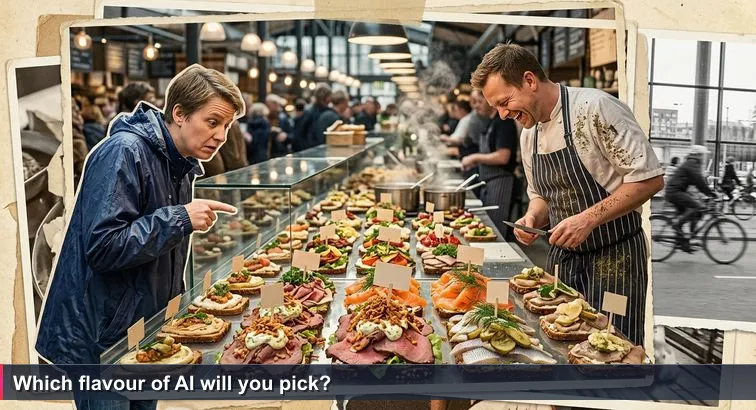
The tourist in front of you at Torvehallerne has been frozen for a full minute, eyes flicking between forty numbered pieces of smørrebrød. Steam curls from the open kitchen, bikes blur past Nørreport outside, and the queue behind starts to shuffle. At last they blurt: “Which is the best one? Just give me your top three.” The chef, apron flecked with herbs, laughs over his knife. “Best for who?” The glass counter is an interface between overwhelming choice and one plate.
AI engineers in Denmark hit Google with the same energy: “best AI company Copenhagen”, “top AI jobs Aarhus”. It makes sense - visas, salaries and your future bike commute are on the line. But a flat “Top 10” hides the fact that Danish firms now lead the EU in actual use of AI, embedded in turbines, pumps, shipping routes and hospital workflows, not just adtech. Employers know this: Onward Search finds professionals with AI skills can command up to 56% higher pay than similar roles without AI in the mix.
From rankings to flavours
So this list is not a scoreboard; it is a tasting menu. Shipping models that tune insulin production in Bagsværd tastes very different from ones optimising containers on Esplanaden or bidding wind power into the Nordic grid. The real question is: what real-world system do you want your models to quietly run in the background of?
Preparing your palate with Nucamp
If you are still building your skills, Nucamp offers an accessible way into this ecosystem. Its Solo AI Tech Entrepreneur Bootcamp runs 25 weeks at around 27,500 DKK, while AI Essentials for Work is 15 weeks at roughly 24,700 DKK, and Back End, SQL and DevOps with Python spans 16 weeks for about 14,700 DKK - among the most affordable AI paths in Denmark, with programs from roughly 14,700-27,500 DKK. Outcomes are solid for career changers: an employment rate near 78%, graduation around 75%, and a Trustpilot score of about 4.5/5 from ~398 reviews, with roughly 80% five-star.
Around these AI tracks sit web and security options - from Web Development Fundamentals (4 weeks, ~3,160 DKK) and Front End Web and Mobile Development (17 weeks, ~14,700 DKK) to Full Stack Web and Mobile (22 weeks, ~18,000 DKK), Cybersecurity (15 weeks, ~14,700 DKK), and the Complete Software Engineering Path (11 months, ~38,900 DKK). With flexible payments, Copenhagen and Aarhus meetups, and coaching tuned to Danish sectors like life sciences, maritime logistics, cleantech and fintech, it lets you “train your palate” before picking an employer.
Back at the counter, the tourist eventually stops asking for “the best” and starts asking, “What’s good if I like herring?” Use this Top 10 the same way: first choose your flavour - health, shipping, green energy, digital play, finance or public infrastructure - then filter by stack, salary band and whether you want your everyday life to orbit Copenhagen’s metro, Aarhus’ startup streets or a quieter Jutland town. In a welfare state where healthcare and work-life balance are baseline, the winning choice is not the highest-ranked logo, but the role that actually tastes right in your day-to-day.
Table of Contents
- From Smørrebrød Counters to AI Careers
- Novo Nordisk
- Microsoft Denmark
- A.P. Moller - Maersk
- Danske Bank
- LEGO Group
- Ørsted
- Vestas
- Netcompany
- Grundfos
- Carlsberg Group
- How to Choose Your AI Career in Denmark
- Frequently Asked Questions
For practical steps, check out the Complete Guide to Starting an AI Career in Denmark in 2026 to plan your next 12 months.
Novo Nordisk
From its campus outside Bagsværd to satellite offices around greater Copenhagen, Novo Nordisk is where Denmark’s deep-tech AI story meets global health. Rather than ad targeting or ride-hailing, most models here sit inside pipelines that touch insulin production, obesity treatments and therapies for rare diseases, making it arguably the country’s single most influential AI employer if you care about clinical impact.
What they actually build with AI
AI work sits both in the central “Digital, Data & IT” (DD&IT) unit and in embedded teams across R&D and manufacturing. As an engineer, you are likely to contribute to:
- Drug discovery models: molecular modelling, protein structure prediction, and generative models for new compounds using Python, R, PyTorch and TensorFlow.
- Clinical optimisation: ML systems to refine trial design, patient stratification and outcome prediction under strict validation requirements.
- Smart manufacturing: computer vision for quality control and predictive maintenance across highly automated production lines, primarily on Azure and Databricks.
Everyday engineering experience
Day to day, you rarely sit in a pure “tech bubble”. Squads mix ML engineers, data scientists, bioinformaticians and domain experts like chemists and clinicians, so model design sessions quickly turn into joint experiments. Deployment is cautious but continuous: every production model must satisfy GxP rules and satisfy both internal quality teams and external regulators.
Salaries, growth and culture
Compensation reflects both the domain expertise required and intense competition for AI talent. Typical bands for AI and ML engineering roles in Denmark hover around 500k-650k DKK for juniors, 650k-800k DKK mid-level, 800k-1,000k+ DKK for seniors, and 1.1M DKK+ for leads, according to independent salary snapshots.
The culture rewards scientific rigour and long-term thinking: conference travel, part-time PhDs with KU or DTU, and participation in Innovation Fund Denmark collaborations are common. For a Copenhagen-based engineer who wants to bike to work, enjoy universal healthcare and still have their models inform how millions of patients manage chronic disease, Novo Nordisk offers a uniquely Danish combination of impact, stability and technical depth.
Microsoft Denmark
A short S-train ride north from central Copenhagen, Microsoft’s campus in Kongens Lyngby is where Danish work-life balance meets global-scale AI infrastructure. Unlike many local employers who apply cloud tools, teams here help build the Azure AI and Copilot capabilities that the rest of Denmark then relies on.
What you work on
AI engineers in Denmark typically plug into product teams responsible for:
- Azure AI and MLOps tooling used by enterprises worldwide.
- Copilot and other generative-AI features inside Dynamics 365 and Microsoft 365, integrating large language models with enterprise-grade governance.
- Search, recommendation and analytics services that ship as part of the Azure and business-app stack.
The dominant toolkit is the full Azure AI stack, plus Python and C#, with heavy use of automated build, test and deployment pipelines. As Glassdoor’s rankings of Copenhagen engineering employers show, Microsoft consistently appears among the most sought-after destinations for cloud-focused talent.
Day-to-day engineering
Work feels like classic “big tech”: small, product-aligned teams, strong engineering management, mandatory code reviews and clearly defined promotion criteria. Much of your collaboration is global - pairing with colleagues in Dublin, Redmond or Hyderabad on the same codebase - so you get exposure to large-scale experimentation, telemetry and responsible-AI frameworks.
Compensation and career trajectory
Pay sits at the high end of the Danish market: juniors around 600k-750k DKK per year, mid-level engineers roughly 800k-1.0M DKK, seniors in the 1.1M-1.4M DKK range, and principals often at 1.5M DKK+. In return for a more structured, performance-driven culture than many local firms, you gain the chance to influence the very platforms that startups in Copenhagen, Aarhus and the wider Nordic region will build on for years.
A.P. Moller - Maersk
Down by Esplanaden, overlooking the harbour where container ships slide in and out, A.P. Moller - Maersk turns global trade into an applied-AI playground. Instead of optimising clicks, your models can influence how physical containers, trucks and vessels move through a network that spans almost every major port on the planet.
What they build with AI
Maersk runs AI/ML Centres of Excellence in Copenhagen and other hubs, plus “forward-deployed” teams embedded directly with business units. Typical engineering work includes:
- Route and network optimisation to minimise fuel, emissions and delays across one of the world’s largest container fleets.
- Demand forecasting and dynamic pricing for shipping, inland logistics and warehousing.
- Port and warehouse automation that fuses IoT sensor data with predictive models.
- NLP systems for customer service, document understanding and contract analytics.
The stack centres on Python, Java/Spring Boot, SQL, Azure, Kubernetes and specialised MLOps tooling. According to a detailed Maersk interview write-up, candidates are often grilled on system design and data-intensive backend patterns, reflecting the scale of these systems.
Everyday engineering experience
AI engineers often act as translators between operations and algorithms. A typical week might start with mapping bottlenecks on a Gothenburg-Aarhus trade lane with operations managers in Copenhagen, then turning that into an optimisation model and running controlled experiments on specific routes. Because shipping delays can cost millions, deployment is pragmatic and data-driven: robust CI/CD pipelines, close monitoring and constant trade-offs between theoretical optimality and operational reality.
Salaries and culture
Estimated annual compensation for Denmark-based AI talent runs around 480k-600k DKK for junior roles, 600k-800k DKK mid-level, 850k-1.1M DKK for seniors, and 1.2M DKK+ for leads. Culturally, you get a blend of Danish flat hierarchy - first-name terms even with senior leaders - and the seriousness of a company underpinning global trade. For engineers who want their models to touch warehouses in Taulov, ports across the world and supply chains felt on supermarket shelves in Copenhagen, Maersk offers a distinctly “real world” flavour of AI.
Danske Bank
If you like your impact measured in basis points, risk curves and capital buffers, Danske Bank is where applied AI meets the sharp end of Nordic finance. From its Copenhagen headquarters, the bank runs some of the region’s most mature machine-learning deployments in core banking, not just in innovation labs.
Where the models live
A central Advanced Analytics hub supports embedded teams across Fraud, Compliance, Corporate and Personal Banking. As an AI engineer, your work is likely to power:
- AML and fraud detection using graph models and anomaly detection on transactional data.
- Credit risk and portfolio models deeply integrated with Model Risk Management (MRM) tooling.
- Personalised banking journeys, from savings nudges to mortgage recommendations.
- Internal LLM-based assistants that help staff navigate policies, documentation and customer queries.
Governance-heavy daily work
The stack is mostly Python, SQL, Hadoop/Spark and Azure, wrapped in strict governance. Every model has an owner, documentation trail and validation pack prepared for both internal model committees and external supervisors. This fits a broader pattern noted in PwC’s AI predictions for regulated industries, where banks are pushed toward enterprise-wide, well-controlled AI deployments rather than isolated experiments.
Teams are cross-functional and cross-Nordic: you might review feature drift with risk officers in Copenhagen in the morning, then sync with product managers in Helsinki or Vilnius after lunch. The work oscillates between pure modelling and careful explanation - being able to justify decisions to auditors is as important as optimising AUC.
Compensation and fit
In return for heavy process and regulation, the bank offers some of Denmark’s strongest pay for applied AI. Typical annual ranges are around 520k-650k DKK for juniors, 680k-850k DKK mid-level, 900k-1.2M DKK for seniors and 1.3M DKK+ for leads. For engineers who enjoy mathematical rigour, explainable models and the comfort of biking home along Søerne before rush hour, Danske Bank is a compelling flavour of high-stakes AI.
LEGO Group
Far from just colourful bricks, LEGO’s digital hubs in Copenhagen and Billund have become magnets for AI talent who want their models wrapped around play, creativity and global retail rather than ad clicks. In Denmark’s deep-tech ecosystem, LEGO sits in the consumer corner of the map, but still features prominently among leading Danish machine-learning employers.
What AI powers inside LEGO
AI engineers typically sit in multi-disciplinary product squads or a central ML platform team, working on:
- Personalisation and recommendation engines for LEGO.com and digital games.
- Demand forecasting across global retail and e-commerce networks.
- NLP systems for moderating kid-safe communities and customer support.
- Computer vision for retail analytics and in-store experiences.
The core stack combines Python, TypeScript, AWS, PyTorch and React, keeping you close to modern web and ML tooling while still embedded in a tangible, family-known brand.
How the work feels
Squads mix ML engineers, backend/frontend developers, UX researchers and product managers. “What does safe, creative play look like in algorithmic terms?” is a real design question, especially under child-safety regulations and LEGO’s strict brand values. Release cycles are product-driven and fast by Danish enterprise standards, with extensive A/B testing and telemetry on digital platforms.
Salaries, interviews and culture
Compensation is competitive: juniors typically around 500k-620k DKK per year, mid-level roles at 650k-780k DKK, seniors earning roughly 800k-950k DKK, and leads at 1.0M DKK+. Interview processes often include a virtual screen, a technical discussion rooted in your past experience, and a short take-home assignment or case that you later present to senior stakeholders, mirroring the collaborative nature of the work.
With a reputation for positive culture, international teams and strong work-life balance, LEGO suits engineers in Copenhagen or Jutland who want to stay close to modern ML systems while shipping features that children (and AFOLs) across the world interact with every day.
Ørsted
Ørsted sits at the meeting point of offshore wind, power trading and national-scale grids - exactly where AI can make or break the green transition. From Copenhagen and coastal hubs around Denmark, its models help decide when turbines spin, how electrons flow and how green power is priced in the Nordic markets.
Where AI fits into Ørsted
A central Data Science & AI team supports both offshore operations and power trading, with engineers working on:
- Power price forecasting and load prediction using time-series and hybrid ML-physics models.
- Wind farm layout optimisation, simulating turbine placement and control strategies.
- Real-time trading automation and decision-support tools for intraday markets.
- Predictive maintenance and anomaly detection across turbines and grid components.
The typical stack is Python, Azure, Databricks and SQL, glued to proprietary trading and SCADA systems that must run reliably 24/7.
Daily work at the energy-AI edge
As an AI engineer, you move constantly between code and domain. One day you are pairing with meteorologists to improve wind forecasts; the next, you are sitting on the trading floor validating a new intraday price model against live positions. Trading-adjacent work moves at high speed, with models updated and re-calibrated intraday, while offshore operations demand slower, safety-first rollouts and extensive backtesting.
Pay, progression and lifestyle fit
Total compensation is broadly in line with other green-energy giants like Vestas, with senior roles often reaching around 900k-1.1M DKK per year once trading-related bonuses are included. The sustained hiring of energy-focused AI and data engineers in Denmark - highlighted by specialist recruiters such as Navartis’ AI Software Engineer listings - underlines how core these skills have become.
If you studied at DTU, Aalborg University or Aarhus University in areas like control systems or energy engineering, Ørsted lets you keep one foot in engineering physics and the other in modern ML, all while enjoying a Copenhagen or coastal lifestyle where the nearest offshore wind farm is often visible from your bike route home.
Vestas
On the drive into Aarhus from the west, you pass row after row of turbines that might well be running on code shipped from Vestas’ own engineering teams. Where Ørsted leans into trading and grid optimisation, Vestas is about putting machine learning inside the hardware of the global wind industry, from nacelle sensors to drone inspections.
What the models do
Within Digital Solutions and R&D, AI engineers work hand in glove with control and mechanical engineers on:
- Predictive maintenance for gearboxes, generators and blades using high-frequency time-series sensor data.
- Energy-yield optimisation models that continuously adjust turbine control parameters to wind conditions.
- Computer vision systems that assess blade damage from drone or ground-based imagery.
- Fleet-wide analytics to benchmark performance across thousands of turbines worldwide.
The stack centres on Python, Spark, Azure and specialised IoT/edge frameworks; production work often involves distilling big models into lightweight versions that can run reliably in harsh offshore or upland environments.
How engineering actually works
Prototyping usually starts in the cloud, where you have the freedom to experiment with large datasets and complex architectures. Once a model looks promising, you pair with embedded and control engineers to translate it into something that can live on constrained hardware in a nacelle. Deployment is cautious but continuous: changes are rolled out across test turbines and then fleets, with extensive regression testing and safety checks.
Pay and the Jutland lifestyle
Estimated annual pay bands in Denmark sit around 480k-580k DKK for juniors, 600k-750k DKK mid-level, 800k-980k DKK for seniors, and 1.1M DKK+ for lead roles. Job boards such as Wellfound’s AI engineer listings in Denmark show continuing demand for profiles that blend ML with industrial and IoT experience. For engineers based in Aarhus or along the Jutland industrial belt who want their models to move actual megawatts, Vestas offers a uniquely Danish blend of green mission and hardcore engineering.
Netcompany
Walk into almost any Danish ministry, municipality or healthcare agency and chances are high that some core system carries Netcompany’s fingerprints. For AI engineers, this consultancy is less about one product and more about wiring intelligence into the digital plumbing that makes Denmark’s welfare state actually function.
Where AI shows up in their projects
As a systems integrator, Netcompany’s AI work stretches across public and private clients. Project rotations often involve:
- AI-augmented case-handling platforms for public administration, from benefits to permits.
- Routing, logistics and planning systems for large private-sector firms.
- NLP and document-understanding pipelines to process vast archives of legal and administrative text.
The tech stack is deliberately broad: multi-cloud (Azure, AWS, GCP), Python, Java, .NET and standard ML frameworks, chosen to match each client’s constraints. In contrast to product companies, success is measured not just in model metrics, but in whether caseworkers or planners actually adopt the tools.
Day-to-day as an AI consultant
Work is project-based and client-facing. One year you might modernise a legacy case system for a ministry in Copenhagen, the next you are optimising last-mile delivery for an Aarhus logistics client. That reality demands “consultant-readiness”: explaining model behaviour to non-technical stakeholders, running workshops on what AI can and cannot do, and documenting systems to a level that public auditors can live with.
Compensation, progression and fit
Estimated annual salary ranges in Denmark are around 450k-550k DKK for junior roles, 600k-750k DKK for mid-level, 800k-1.0M DKK for seniors and roughly 1.1M DKK+ for principal consultants. Independent rankings of top IT consultancies in Denmark consistently place Netcompany among the leading digital transformation partners, reflecting both its scale and project diversity.
If you want a panoramic view of how AI is woven into everyday Danish life - from citizen portals and e-health to private logistics platforms - Netcompany offers breadth over narrow specialisation, plus the chance to see your models land directly in front of caseworkers, citizens and customers.
Grundfos
Drive inland from Aarhus toward Viborg and you leave harbours and metro lines behind for fields, rivers and the quiet campus of Grundfos in Bjerringbro. Here, applied AI is less about dashboards and more about how water moves through pipes, pumps and treatment systems in cities from Silkeborg to Singapore.
What they build with AI
Within Digital Solutions and R&D labs, Grundfos’ AI teams focus on:
- Demand forecasting and adaptive control for municipal and industrial water distribution.
- Energy-efficient pump operation, where ML controllers continuously tweak set points to cut electricity use.
- Predictive maintenance on pumps deployed across buildings, factories and utilities worldwide.
The stack blends Python for modelling, C++ for edge implementations and cloud services on Azure, wrapped around IoT-focused ML libraries tuned for noisy sensor data and constrained hardware.
Engineering in the deep-tech belt
Day to day, you sit firmly in Denmark’s industrial “deep-tech belt”. Collaboration with mechanical and electrical engineers, control specialists and field technicians is constant. Models are prototyped on historical sensor streams, then migrated onto embedded controllers that might sit in a basement pump room or remote treatment plant. Deployment cycles often involve lab testing in Jutland, pilots with partner municipalities, then carefully staged global roll-outs.
Salaries, lifestyle and why it matters
Estimated annual salaries for Denmark-based AI engineers run around 480k-580k DKK at junior level, 600k-780k DKK mid-level and 800k-1.0M DKK for senior roles, comparable to other industrial employers in the region. Broader mappings of the ecosystem, such as Seedtable’s overview of Danish AI companies, highlight just how central water, energy and manufacturing have become to the country’s AI identity.
If Copenhagen’s harbour baths and metro are your thing, Grundfos means a longer train ride. But for engineers who prefer short commutes, easy access to nature and the satisfaction of reducing both water waste and energy use at global scale, Bjerringbro offers a compelling alternative flavour of Danish AI work.
Carlsberg Group
Carlsberg is more than a beer logo on stadiums and kiosks; it is also a historic scientific institution. The Carlsberg Research Laboratory helped give the world the pH scale, and that same mindset now underpins a very modern AI program in Copenhagen, where models influence everything from flavour profiles to crate movements across Europe.
What AI actually powers
Within the Integrated Information Technology (IIT) unit and adjacent R&D, AI engineers support a mix of brewing science and FMCG logistics, including:
- Global demand forecasting and inventory optimisation for beverages across markets and channels.
- “Beer fingerprinting”: using sensor and chemical data to profile taste and quality, with ML models guiding flavour development and consistency.
- Computer vision for production-line monitoring, bottle inspection and recycling logistics.
The stack leans on Python, Azure, Databricks and vision-centric ML frameworks, keeping you close to mainstream data tooling while solving very domain-specific problems in brewing and packaging.
Everyday engineering
Most roles are based in the Copenhagen area, collaborating with supply-chain experts, brewers, marketers and sustainability teams. A typical sprint might involve refining a demand model for a Southern European heatwave, then pairing with process engineers to deploy a new vision model that spots micro-cracks in bottles before they hit pallets. Occasional visits to breweries or logistics hubs make it unusually easy to see your models reflected in stainless-steel tanks and loading bays rather than just dashboards.
Salaries, brand and market context
Estimated annual ranges for AI and ML engineers run around 460k-560k DKK for juniors, 580k-750k DKK mid-level and roughly 800k-950k DKK for seniors. Wider market data, such as Onward Search’s analysis of AI salary premiums, suggests that FMCG players increasingly pay above comparable non-AI roles to secure this talent.
Carlsberg is a strong fit if you want a recognisable consumer brand on your CV, enjoy combining hard data with sensory science, and like the idea of leaving the office, grabbing the metro or bike, and occasionally tasting the products your models just helped forecast.
How to Choose Your AI Career in Denmark
Back at the Torvehallerne counter, the real breakthrough comes when the tourist stops asking, “Which is the best?” and starts asking, “What’s good if I like herring?” Choosing your AI career in Denmark works the same way. With mature employers from insulin and turbines to shipping and toys, the question is less “Who is #1?” and more “Which flavour fits my brain, my values and my everyday life?”
Start with flavour, not logo
Think in domains first. If you are drawn to health and biology, Novo Nordisk feels very different from the containers-and-ports world of Maersk, even if both pay well. Likewise, Ørsted and Vestas both do green energy, but one leans into trading and grids while the other embeds ML into turbine hardware. Denmark’s “deep tech” tilt means many roles touch physical systems - pumps, wind farms, ships - rather than just screens, so be honest about whether that excites you.
| Flavour | Example companies | Primary impact | Typical location |
|---|---|---|---|
| Health & life sciences | Novo Nordisk | Drugs, trials, patient outcomes | Copenhagen area |
| Global trade & logistics | Maersk, Netcompany | Supply chains, public systems | Copenhagen, Aarhus |
| Green energy & industry | Ørsted, Vestas, Grundfos | Power, turbines, water | Copenhagen, Jutland belt |
| Consumer & digital play | LEGO, Carlsberg, Microsoft | Retail, software, experiences | Copenhagen, Billund |
Layer in city, salary and risk profile
Once you know the flavour, add practical filters: Do you want Copenhagen’s metro and harbour baths, or a shorter commute in Jutland? Are you optimising for maximum salary growth, or for mission and stability? Do you prefer regulated environments like banking and healthcare, or fast-moving product work? Platforms such as Danish machine-learning job boards can help you sanity-check which profiles are actually in demand.
Use education to pivot intentionally
If you are still early or transitioning - say from a non-tech job in Copenhagen - targeted training can help you “tune” your profile to the flavour you want. Generalist AI bootcamps and Python/SQL programs give you enough breadth to be employable across sectors; from there, side projects, internships or thesis collaborations with local employers can steer you into life sciences, shipping, cleantech or public digital infrastructure. Like choosing smørrebrød, the goal is not to sample everything forever, but to pick the plate - company, city, domain - where your everyday work will actually taste right.
Frequently Asked Questions
Which companies on this list are actually hiring the most AI engineers in Denmark right now?
The biggest active hubs in 2026 are Novo Nordisk, Microsoft Denmark and Maersk - each runs central AI units or platform teams with ongoing roles across Copenhagen and nearby hubs. These firms also drive the highest pay bands (senior roles commonly reach 900k-1.5M+ DKK) as Danish employers scale real-world AI.
Which company should I pick if I want to work on AI for health and drug discovery?
Novo Nordisk is the clear choice for drug-discovery and clinical AI, with embedded teams across R&D and manufacturing and senior AI roles typically in the 800k-1.1M+ DKK range. You’ll work closely with clinicians and bioinformaticians, and projects are production-focused with strict regulatory validation.
How did you pick and rank these Top 10 companies - what were the selection criteria?
We prioritised real-world AI adoption (not just pilots), scale of impact, ongoing hiring activity in Denmark, MLOps maturity, domain breadth (health, energy, shipping, finance) and Copenhagen/Aarhus presence. This mirrors wider trends: by 2026 Danish firms lead the EU in actual AI use, and AI-skilled engineers command up to a ~56% pay premium.
Which employer is best if I want fast product cycles and global platform experience?
Microsoft Denmark fits best for platform-scale AI and rapid, A/B-driven releases, while Maersk offers global-scale applied problems with quicker operational experiments in logistics. Both provide exposure to large distributed teams and high-impact production systems, with senior compensation among the top market bands (often 1.1M DKK+).
I want to live in Copenhagen and keep strong work-life balance - which companies are most Copenhagen-friendly?
Novo Nordisk, LEGO, Maersk and Microsoft all have major hubs in or near Copenhagen and tend to offer the city-area benefits of flexible hours, parental leave and good healthcare. Mid-level AI roles at these firms commonly range from ~650k-1.0M DKK, letting you enjoy Copenhagen’s high quality of life while working on production AI.
Read our AI engineer step-by-step guide for Denmark (2026) to align your portfolio with Copenhagen employers.
Read our concise Is Denmark a Good Country for a Tech Career in 2026? explained for international developers.
For a deep dive into compensation, read our detailed AI salaries in Denmark in 2026 guide.
Compare pay and competitiveness in our 2026 list of top tech apprenticeships and graduate programmes in Denmark.

Irene Holden
Operations Manager
Former Microsoft Education and Learning Futures Group team member, Irene now oversees instructors at Nucamp while writing about everything tech - from careers to coding bootcamps.