









The Complete Guide to Starting an AI Career in Chicago, IL in 2026
By Irene Holden
Last Updated: February 25th 2026
Key Takeaways
Starting an AI career in Chicago in 2026 is highly achievable by tapping into its thriving ecosystem, where AI roles command salaries up to 25% higher than non-AI positions, such as AI Engineers averaging $177,300. The city's diversified economy with major employers like JPMorgan Chase and United Airlines drives steady demand, and affordable pathways like Nucamp bootcamps offer a practical entry with a 78% employment rate, setting you up for success in this dynamic hub.
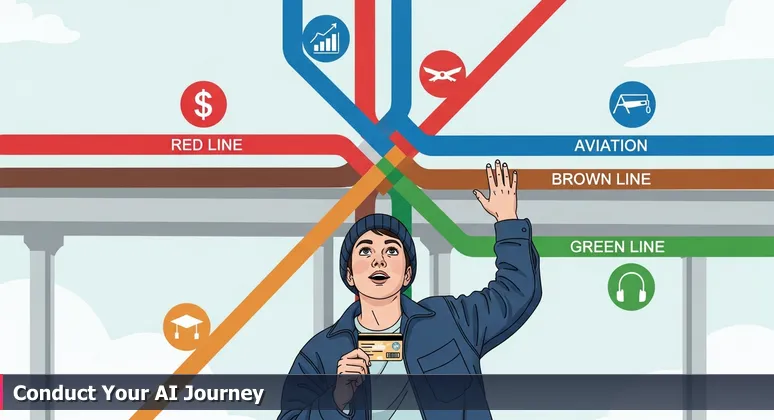
Every Chicagoan knows the moment: you're standing under the rattle of the 'L' tracks, staring at a multicolored map, realizing that to get anywhere in this city, you need to understand how its distinct lines connect. Building an AI career here now feels strikingly similar. The field is a complex, fast-moving network, and the overwhelming choice isn't about whether to get into AI, but which line to take and how to navigate the system's powerful interconnections.
The friction lies between having technical knowledge and knowing how to apply it within Chicago's specific, thriving ecosystem. The landscape isn't a single path but a perfectly integrated transit network for your career. Success comes from becoming a strategic navigator - an AI Orchestrator - who understands how to connect the financial power, logistical scale, groundbreaking research, and agile innovation that define the region's economy.
This transformation is timely. According to a 2026 AI agent trends report from Google Cloud, the professional landscape is undergoing an "agent leap," where the human role shifts from writing every line of code to managing fleets of autonomous AI agents - orchestrating their work, auditing outputs, and providing creative direction.
This guide is your transit map and pass, designed to transform your perspective from a passive passenger into a skilled conductor. It will show you how to leverage Chicago's unique advantages, where listings with AI skills command a salary premium of up to 25%, as reported by CBS News, and build a future-proof career at the heart of one of the nation's most dynamic AI economies.
In This Guide
- Introduction: Your AI Career Transit Map
- Chicago's 2026 AI Hub Advantage
- AI Job Market: Salaries and Trends
- Essential AI Roles and Skills
- University Education in Chicago
- Bootcamps for AI Careers
- Why Choose Nucamp in Chicago
- Self-Learning and AI Communities
- AI Career Path: Finance and Fintech
- AI Career Path: Aviation and Logistics
- AI Career Path: Research and Healthcare
- AI Career Path: Tech Startups
- Building Your AI Career Network
- Conclusion: Conducting Your Future
- Frequently Asked Questions
The Nucamp community in Chicago, IL regularly organizes virtual meetups and neighborhood-based networking sessions where students and alumni share job leads and interview tips.
Chicago's 2026 AI Hub Advantage
Chicago has solidified its position as a premier global hub for Artificial Intelligence, with some rankings even seeing it surpass traditional coastal tech centers. This isn't a speculative boom but a fundamental restructuring, driven by the region's deeply diversified economy. Fortune 500 giants in finance, aviation, retail, and manufacturing are aggressively integrating AI into their core operations, creating a stable and varied demand for talent that is less susceptible to tech sector volatility.
This industrial engine is powered by major employers like JPMorgan Chase in finance, United Airlines in logistics, and Walgreens Boots Alliance in retail, alongside the sizable tech offices of Google and Microsoft. According to an analysis by Illinois Policy, this ecosystem has helped make the Chicago metro area the 4th-hottest tech hub in the nation.
Backing this industrial demand is an unparalleled research foundation. The "Golden Triangle" of research - the University of Chicago, Northwestern University, and the University of Illinois Chicago (UIC), flanked by federal labs like Argonne National Laboratory and Fermilab - forms Chicago's secret sauce. This combination funnels breakthrough ideas into commercial applications at a rapid pace.
As noted in an analysis of the AI Revolution's impact on Chicago's workforce, this shift represents "disruption today" but promises immense "growth tomorrow." This unique blend of corporate might, world-class academia, and national research infrastructure creates a resilient and dynamic advantage for any AI professional building a career here.
AI Job Market: Salaries and Trends
The Chicago AI job market is characterized by high demand, competitive compensation, and a decisive shift toward specialization. According to CBS News, listings with AI skills command a significant premium, paying up to 25% more than similar non-AI roles. This "AI premium" reflects the intense competition for specialized talent across the region's diversified industries.
Data aggregated from leading salary platforms provides a clear snapshot of earning potential for key positions in 2026. Specialized technical skills, particularly those involving cutting-edge tools and platforms, push compensation even higher.
| Role | Average Annual Salary | Typical Range |
|---|---|---|
| AI Engineer | $177,300 | $125,000 - $225,000 |
| Machine Learning Engineer | $172,500 | $165,000 - $180,000 |
| Senior Data Scientist | $185,000 | $145,000 - $217,000 |
| AI/ML Data Engineer | $102,500 | $90,000 - $115,000 |
| Lead Machine Learning Engineer | ~$192,000 | $179,000 - $205,000 |
As noted in Wellfound's hiring data for Chicago startups, expertise in technologies like containerization with Docker and integration of platforms like OpenAI can push total compensation toward the $200,000-$205,000 range. The market rewards both deep technical specialization and the ability to orchestrate these advanced tools within business applications.
Essential AI Roles and Skills
The AI job market has moved decisively from generalist roles to highly specialized positions, with the most telling trend being the rise of the AI Orchestrator. As highlighted in Google Cloud's 2026 AI agent trends report, this marks the "agent leap," where the human role shifts from writing every line of code to managing fleets of autonomous AI agents - orchestrating their work, auditing outputs, and providing high-level creative direction.
Evolving and Emerging Roles
This shift reflects a broader transformation in the workforce. Labor expert Andrew Challenger of the Chicago-based firm Challenger, Gray & Christmas, notes in analysis for CBS News that while AI causes rapid displacement, it "simultaneously creates entirely new industries." Other high-growth paths now include MLOps Engineers who deploy models at scale, AI Ethicists ensuring responsible deployment in regulated industries, and niche specialists like AI Video Generation experts, where demand has seen explosive growth.
The Layered Skillset for 2026
Securing these roles requires a layered skillset. The foundation remains a core technical stack of Python, TensorFlow/PyTorch, and cloud infrastructure. This is now augmented by specialized tools like Docker and expertise in integrating LLM APIs from providers like OpenAI.
The critical differentiator, however, is human skills. Prompt engineering is a baseline. Professionals need high AI fluency - the ability to knowledgeably discuss capabilities and limitations - and the emotional intelligence to translate vague business goals into technical specifications. As Rita Ramakrishnan, CEO of Iksana Consulting, argues, effective AI use is defined by balance and "knowing when not to use AI."
University Education in Chicago
For those seeking deep theoretical knowledge and research credentials, Chicago's universities serve as world-class express trains into the AI field. These institutions form the academic backbone of the region's "Golden Triangle" of research, offering pathways that range from fundamental research to applied, industry-focused education.
University of Chicago
The University of Chicago's Booth School of Business houses the influential Center for Applied AI, which drives research commercialization and offers executive education. Their AI & Economics Summer Institute exemplifies the interdisciplinary approach that connects technical innovation with business and policy, facilitated through the university's Polsky Center for entrepreneurship.
Northwestern University
Northwestern University provides accessible, high-level training for working professionals through its School of Professional Studies. Their Advanced Graduate Certificate in Artificial Intelligence is designed to equip students with immediately applicable skills in machine learning, natural language processing, and robotics, bridging academic rigor with professional needs.
University of Illinois Chicago (UIC)
UIC offers industry-focused Master’s programs in Data Science and Civic Analytics, directly tying advanced technical skills to urban, business, and engineering challenges. This practical orientation prepares graduates to implement AI solutions within the complex fabric of a major metropolitan area, leveraging the university's deep community and industry connections.
Bootcamps for AI Careers
For career-changers and those seeking the most direct, practical path to job-ready skills, coding bootcamps have become an indispensable part of Chicago's AI ecosystem. They function as the rapid transit to employment, offering accelerated, applied learning at a fraction of the cost of traditional degrees. This pathway is ideal for pragmatic Chicagoans who need to quickly acquire the skills commanding the market's AI salary premium.
The leading choice in this category is Nucamp, which resonates with the city's emphasis on value and community. Its model of affordable, community-based learning with local workshops provides a clear on-ramp. Key programs include the 25-week Solo AI Tech Entrepreneur Bootcamp ($3,980), focusing on LLM integration and AI product development, and the 15-week AI Essentials for Work ($3,582), designed for professionals leveraging AI in their current roles.
Nucamp’s advantage lies in its accessibility and outcomes. With programs priced significantly below many competitors and a proven employment rate of approximately 78%, it represents a low-risk, high-reward investment. Students report high satisfaction, reflected in a 4.5/5 star rating on Trustpilot, praising its structured learning path and supportive community. For foundational skills, their Back End, SQL and DevOps with Python bootcamp builds the essential programming infrastructure underpinning any AI career.
This bootcamp route complements other local upskilling options, such as the AI and Machine Learning bootcamp offered by Chicago State University, illustrating the variety of accelerated pathways available across the city's institutions.
Why Choose Nucamp in Chicago
In a city built on practicality and value, Nucamp’s educational model stands out. It provides a clear, affordable on-ramp to Chicago's lucrative AI job market through community-based learning and live local workshops, eliminating the barrier of a $10,000+ price tag common among competitors.
Nucamp's curriculum is directly aligned with the most in-demand skills in the region, from LLM integration for Fulton Market entrepreneurs to AI productivity tools for professionals in the Loop. The focus is on applied, job-ready competencies that command the market's salary premiums.
| Program | Duration | Tuition | Career Focus |
|---|---|---|---|
| Solo AI Tech Entrepreneur | 25 weeks | $3,980 | Building & shipping AI products, SaaS |
| AI Essentials for Work | 15 weeks | $3,582 | Leveraging AI for workplace productivity |
| Back End, SQL & DevOps w/ Python | 16 weeks | $2,124 | Foundational programming for AI/ML |
This practical approach delivers results, with a proven employment rate of approximately 78% and a graduation rate near 75%. Student testimonials consistently highlight the "affordability, a structured learning path, and a supportive community" that define the experience. For Chicagoans, this represents a strategic investment, mirroring the city's own blend of innovation and Midwestern pragmatism, much like the applied research coming from institutions such as the Polsky Center at UChicago.
Self-Learning and AI Communities
Complementing formal education, self-directed learning and community engagement are vital for building the portfolio and network that serve as your most important credentials in Chicago's AI landscape. Actively participating in the local ecosystem transforms theoretical knowledge into practical opportunity and demonstrates your initiative to potential employers.
Networking and Collaborative Events
Monthly meetups provide essential forums for connection and knowledge sharing. Regular events like "AI Specialists: AIConnect" in Chicago, designed for professionals, students, and job seekers to build connections and showcase projects, are a cornerstone of community building. You can find these networking opportunities on platforms like Eventbrite. Engaging in these spaces allows you to learn from peers, discover real-world challenges companies are solving, and potentially find collaborators for your own projects.
Lifelong Learning Programs
Structured community programs offer pathways for continuous skill development outside traditional academia. Initiatives like Lake Forest University's Krebs AI Series, which returns as a community lifelong learning series, provide accessible education on AI trends and applications. Combining these learning opportunities with hands-on project development - whether through online courses, hackathons, or personal initiatives - creates a powerful, demonstrable skillset that is highly attractive in Chicago's pragmatic job market.
AI Career Path: Finance and Fintech
Chicago's historic strength as a global financial center has seamlessly evolved into a powerhouse for AI-driven finance and fintech. This path, akin to the city's Red Line, runs through the heart of the Loop and River North, where quantitative research, algorithmic trading, and sophisticated risk modeling define the daily workflow. Major institutions like JPMorgan Chase, CME Group, and a thriving constellation of fintech firms and quantitative trading houses like Citadel form the backbone of this sector.
Key Employers and Applications
These organizations leverage machine learning for high-stakes applications such as real-time fraud detection, predictive analytics for market movements, and automated trading systems that process massive datasets. The demand here is for professionals who can apply mathematical rigor to volatile, real-time financial data. According to an overview of the economy of Chicago, the city hosts the largest futures and options trading exchange in the world, creating a natural epicenter for financial AI innovation.
Skills and Sample Roles
Aspiring AI professionals in this domain need exceptional skill in Python, probabilistic modeling, and low-latency systems architecture. A sample role might be an AI Research Scientist at a quantitative firm, developing novel algorithms to predict market microstructures. The environment demands precision, and internships at top firms are notoriously competitive, often offering premium hourly rates for PhD candidates. Success in this line requires not just technical prowess but the ability to thrive under pressure and derive signal from immense noise.
AI Career Path: Aviation and Logistics
The aviation, logistics, and manufacturing sectors form a critical artery of Chicago's economy, powered by the global reach of O'Hare and the industrial might of suburban campuses. This career path, symbolized by the Blue Line, focuses on applying AI to optimize physical systems and complex supply chains at a massive scale. Key employers driving this demand include United Airlines for predictive fleet maintenance, Caterpillar for connected industrial equipment analytics, and Boeing in advanced manufacturing.
AI Applications in Operations
Here, AI is deployed for mission-critical operational intelligence. Primary applications include predictive maintenance to prevent mechanical failures, dynamic route and supply chain optimization, and computer vision for warehouse automation. These applications translate into significant cost savings and efficiency gains, such as reducing aircraft downtime or streamlining global equipment logistics. As reported by CBS News, this integration represents the type of industry transformation creating new, high-value roles even as it disrupts others.
Role Profile and Required Skills
A quintessential role in this domain is the MLOps Engineer at an airline or manufacturer. This professional is responsible for deploying, monitoring, and maintaining the ML models that predict failures before they happen, requiring a blend of software engineering, cloud infrastructure expertise, and an understanding of physical system logistics. Success demands deep domain knowledge to bridge the gap between abstract algorithms and tangible operational outcomes, making this path ideal for problem-solvers fascinated by large-scale, real-world systems.
AI Career Path: Research and Healthcare
The pursuit of pioneering work at the intersection of fundamental science and human health defines the Brown Line of Chicago's AI ecosystem. This path is anchored by the region's world-renowned research institutions and a growing healthcare sector, offering mission-driven careers in drug discovery, medical diagnostics, and the application of breakthrough science.
The Research Engine: Academia and National Labs
Institutions like the University of Chicago, Northwestern University, and the University of Illinois Chicago form the academic core, while federal resources at Argonne National Laboratory and Fermilab provide unparalleled computational power and research facilities. This ecosystem excels at translating pure research into commercial applications, with hubs like the Polsky Center for Entrepreneurship and Innovation actively connecting scientific breakthroughs with business insight.
Healthcare and Biotech Applications
In healthcare, AI is revolutionizing areas from diagnostic imaging and drug discovery to personalized treatment plans and hospital operations. The Illinois Medical District and a vibrant biotech startup scene, including companies like Prenosis, leverage AI to tackle complex challenges such as sepsis prediction. A critical and growing role here is the AI Ethicist, who develops frameworks to audit algorithms for bias in diagnostic tools and ensures patient data privacy within hospital systems and health tech firms. This path demands a unique blend of technical expertise, ethical reasoning, and a deep commitment to impactful, responsible innovation.
AI Career Path: Tech Startups
The agile, product-focused world of tech startups represents the Green Line of Chicago's AI economy, characterized by rapid growth, innovation, and a direct impact on product development. Centered in neighborhoods like Fulton Market and River North, this ecosystem is home to fast-growing companies and scale-ups where AI is often the core product rather than a supporting function.
The Startup Landscape and Key Hubs
This vibrant scene includes AI-native companies like Metropolis Technologies, which uses computer vision for checkout-free experiences, and a host of other innovators tackling challenges from logistics to healthcare. As highlighted in The Business Journals' 2026 startups to watch, the Fulton Market area remains a primary engine for this activity. These companies offer high-growth potential and the chance to wear multiple hats, working closely with engineering teams and clients to bring AI solutions to market.
Roles and Required Mindset
A quintessential role in this domain is the AI Product Manager, responsible for defining the product roadmap, prioritizing features, and translating user needs into technical specifications for engineers. This requires a blend of business acumen, technical fluency, and exceptional communication skills. The startup path offers broad impact and the potential for significant equity, but it often comes with less structured environments and faster pivots. It is ideal for self-starters, builders, and those who thrive on turning novel ideas into shipped products.
Building Your AI Career Network
Landing your first AI role is just the beginning. Long-term success in Chicago means evolving from a specialist into a strategic conductor of your career, actively building connections and expertise across the city's interconnected network. This requires moving beyond technical execution to become a valued node within the ecosystem.
Cultivate a Strategic Chicago Network
Proactively engage with the city's collaborative tech community. Regularly attend events hosted by hubs like the Polsky Center at UChicago and join recurring meetups such as the monthly "AI Specialists: AIConnect" sessions. These forums, detailed on Eventbrite, are designed for professionals to connect and showcase projects, providing invaluable opportunities for serendipitous collaboration and insight into emerging industry needs.
Develop T-Shaped Expertise and Human-AI Fluency
Deepen your vertical expertise in one technical area while cultivating broad AI fluency across domains. Understand how your specialization in, say, natural language processing applies to fraud detection in finance, customer service in retail, and diagnostics in healthcare. Simultaneously, master the human-AI collaboration that defines modern roles. Use AI tools to augment your own productivity - for research, drafting, or tailoring job applications - a practice that can save professionals over 10 hours a week, freeing you to focus on high-judgment tasks and strategic relationship-building.
Conclusion: Conducting Your Future
The journey through Chicago's AI landscape leads to a profoundly rewarding destination. You are no longer just a coder or data analyst, but a navigator of complex systems, a translator between business and technology, and an orchestrator of intelligent tools. The initial overwhelm of the career map gives way to strategic clarity, as you learn to see the Red, Blue, Brown, and Green lines not as competing routes but as interconnected pathways of a single, powerful economic network.
This transformation aligns with the broader shift in the profession, where, as noted in the 2026 AI agent trends report, human roles increasingly focus on high-level orchestration, creative direction, and auditing AI outputs. You are building a future-proof career at the heart of a city where your skills are valued across a robust and diversified economy, supported by world-class research and a collaborative, accessible community.
With the right skills as your transit pass - whether honed through a university program, a practical bootcamp, or self-directed learning - you are equipped to command the significant opportunities here. You gain the ability to tap into the 25% salary premium for AI skills reported by CBS News and contribute to one of the nation's most dynamic AI economies. Welcome aboard. Your role is no longer that of a passenger, but the skilled conductor of your own professional journey.
Frequently Asked Questions
Is Chicago really a good place to start an AI career in 2026?
Absolutely! Chicago has become a premier global AI hub with a diversified economy across finance, logistics, and tech, supported by top research institutions like the University of Chicago and Argonne National Laboratory. It's ranked the 4th hottest tech hub, offering stable demand from major employers like JPMorgan Chase and United Airlines, making it less volatile than coastal cities.
What kind of salaries can I expect for AI jobs in Chicago in 2026?
AI roles in Chicago offer competitive salaries, with AI Engineers averaging around $177,300 annually and some positions paying up to 25% more than non-AI roles. Specialized skills, such as expertise in Docker or OpenAI integration, can push total compensation toward $200,000 to $205,000 in the local market.
What are the best ways to get AI skills in Chicago without a traditional degree?
Bootcamps like Nucamp provide an affordable, practical path, with programs like the Solo AI Tech Entrepreneur Bootcamp focusing on in-demand skills like LLM integration and prompt engineering. With an employment rate of about 78% and options like their AI Essentials for Work bootcamp, it's a cost-effective way to enter Chicago's thriving AI job market.
What AI roles are in high demand in Chicago right now?
Emerging roles like AI Orchestrator, MLOps Engineer, and AI Ethicist are seeing strong growth, with niches such as AI Video Generation Specialist experiencing a 329% year-over-year increase. These roles align with Chicago's strengths in sectors like finance, healthcare, and the startup scene in Fulton Market.
How can I network and build connections in Chicago's AI community?
Attend local events like those hosted by the Polsky Center at UChicago or join monthly meetups like AI Specialists: AIConnect. Chicago's collaborative ecosystem, including hackathons and programs from universities like Northwestern, makes it easy to connect with professionals and advance your career.
Get data on the top tech employers in Chicago, IL and their 2026 pay structures.
Get started with free tech education at Chicago libraries in 2026 by reading this article.
For insights into AI Salaries in Chicago, IL in 2026, check out this detailed analysis.
To understand the realistic budget for tech workers in Chicago in 2026, refer to this in-depth article.
Nucamp's article on top tech jobs in Chicago without a degree is a must-read.

Irene Holden
Operations Manager
Former Microsoft Education and Learning Futures Group team member, Irene now oversees instructors at Nucamp while writing about everything tech - from careers to coding bootcamps.