









How to Become an AI Engineer in the Bahamas in 2026
By Irene Holden
Last Updated: April 9th 2026
Quick Summary
You can become an AI engineer in the Bahamas by following a Bahamas-specific, step-by-step roadmap: pick a domain (fintech, tourism, telecom, or climate), master Python and core ML, build and deploy two end-to-end projects with MLOps and LLM skills, and specialise - done intensively this takes about a year and done part-time up to two years. Expect to invest modestly in training, with bootcamps like Nucamp running between BSD 2,124 and BSD 3,980, and reap high local value since Nassau’s no personal income tax and employers like Atlantis, BTC, local banks and Sand Dollar initiatives are hiring AI engineers who often earn between BSD 80,000 and BSD 120,000.
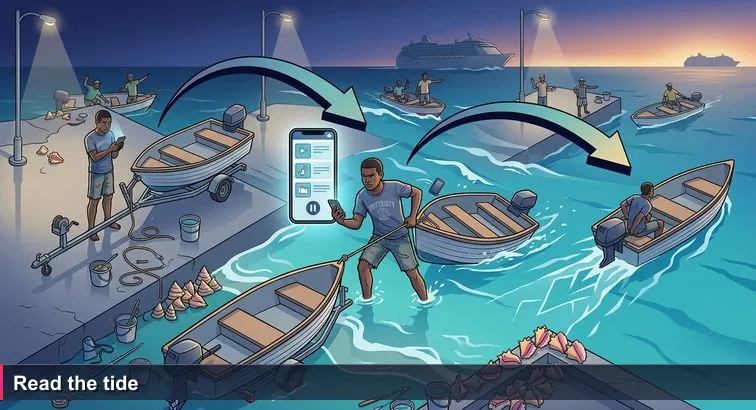
Standing at that Montagu ramp with a “5 easy steps” video on your phone is exactly what it feels like scrolling through Silicon Valley AI roadmaps from Nassau. The steps are fine in theory, but our water is moving: BTC hiccups, Sand Dollar rollouts, cruise-ship tourism cycles, and a cost of living that means you might be juggling a shift at Atlantis or RBC while you learn.
Here, AI isn’t an abstract research dream; it’s being pulled into the country’s real engines. The Central Bank’s Sand Dollar - the world’s first retail CBDC - is driving demand for fraud analytics, compliance automation, and digital-wallet intelligence across banks and regulators. Government forums like “Learning to Survive in a World of AI” make it clear that policy makers see AI as core to productivity, not a side project.
On the ground, big employers are quietly experimenting. Resorts such as Atlantis and Baha Mar explore chatbots and dynamic pricing; BTC, Cable Bahamas and Flow look at churn prediction and network optimisation; and local branches of RBC, Scotiabank, and FirstCaribbean need people who can both build models and explain them to non-technical managers. When the University of The Bahamas graduated 20 students from an AI micro-course - several earning international scholarships - it signalled that the talent pipeline is already forming, not hypothetical, as highlighted by the Office of the Attorney General’s coverage of UB students using AI skills to build a resilient Bahamas.
At the same time, Nassau has unique upside. With no personal income tax, a remote AI role paying BSD 80,000-120,000+ goes further than in many tech hubs, and community-driven options like Nucamp’s bootcamps (ranging from BSD 2,124-3,980 versus BSD 10,000+ overseas) make reskilling realistic even if you’re working full-time.
“These strategies encapsulate my vision for a future where The Bahamas not only thrives through AI innovation but also leads by example in its ethical and sustainable use.” - John Laramore, MBA Global Business
Steps Overview
- Understand the Nassau AI landscape
- Prepare prerequisites and setup
- Choose your Bahamian AI path
- Build your coding and math foundation
- Learn software engineering and data basics
- Master core machine learning
- Explore deep learning and LLMs
- Implement data engineering and MLOps essentials
- Specialise in a Bahamian domain
- Follow a 12-24 month skill roadmap
- Plug into the Bahamian and regional AI ecosystem
- Verify your AI engineer readiness
- Troubleshoot common Bahamian hurdles
- Bring it back to Montagu: adapt and launch
- Common Questions
See role breakdowns and salary ranges in our complete guide to AI careers in the Bahamas (2026).
Prepare prerequisites and setup
Before you worry about transformers and agents, you need a few basics in place here in Nassau. Think of this as checking your fuel, battery, and lines before you reverse down the Montagu ramp: skills, hardware, internet workarounds, and a realistic plan for your time and budget.
On the skills side, you don’t need a foreign degree. You do need to be comfortable with high-school algebra, functions, and basic statistics; able to write and speak clearly to non-technical teams at places like BTC, Atlantis, RBC, or Scotiabank; and confident installing software and troubleshooting your own laptop. Global AI guides, like the ones summarised by Data Science Parichay’s bootcamp overview, all agree that these foundations matter more than fancy math at the start.
Your hardware and connectivity checklist should look like this:
- Laptop: at least 8 GB RAM (16 GB ideal), a recent Windows/macOS/Linux install, and 256 GB or more of storage.
- Internet plan: stable enough for video and downloads, even if BTC/Flow/Cable Bahamas wobble at peak times.
- Workarounds: do most coding locally, download datasets and libraries in advance, and use cloud credits for heavy training when you can.
Many Bahamians feel the gap between AI ambition and connectivity; during coverage of the country’s largest AI forum, one community member summed it up on Eyewitness News Bahamas:
“We can’t have stable internet service and we talking about AI.” - Nicholas Smith, community commenter
Finally, be honest about your time and money. For an intensive path, plan on 20-25 hours/week over 6-12 months; for a part-time route while working at Atlantis, BTC, or a bank, aim for 8-12 hours/week over 18-24 months. Expect to spend BSD 0-500 on books and small courses, and BSD 2,000-4,000 on larger programs. Nucamp’s AI-related bootcamps fall between BSD 2,124-3,980, compared with BSD 10,000+ at many overseas schools, and initiatives like Upskill Bahamas can cover some foundational learning for free.
Choose your Bahamian AI path
Choosing your path is like deciding whether you’re heading to Rose Island, Potter’s Cay, or over to Paradise Island before you even launch at Montagu. “AI engineer” sounds like one job, but in Nassau it usually means specialising in applied problems in fintech, tourism, telecom, or climate. Global guides, like this overview of AI engineer roles and skills, all stress that you need a clear direction instead of chasing every buzzword.
Start by picking one primary focus for the next 12-24 months. Each path below lines up with real Bahamian employers and problems:
| AI Path | Typical Nassau Use Cases | Core Tools & Skills | Likely Employers |
|---|---|---|---|
| Fintech AI Engineer | Sand Dollar fraud detection, credit scoring, KYC/AML analytics | Python, SQL, scikit-learn, gradient boosting, basic blockchain analytics | Central Bank, RBC, Scotiabank, FirstCaribbean, fintech startups |
| Tourism & Hospitality AI Specialist | Dynamic pricing, occupancy forecasting, guest chatbots, recommendation engines | pandas, time-series models, recommender systems, LLM APIs | Atlantis, Baha Mar, Sandals, Ministry of Tourism, tour operators |
| Telecom & Customer Analytics | Churn prediction, network anomaly detection, call-routing bots | Supervised ML, anomaly detection, LLM-powered support tools | BTC, Cable Bahamas/Flow, regional telecom partners |
| Climate & Blue Economy AI | Hurricane impact models, flood risk mapping, coral monitoring | GIS, computer vision, simulation and forecasting models | Government ministries, insurers, NGOs, regional climate projects |
Once you’ve chosen, write a one-page “AI mission statement”: which path you picked, why it matters to The Bahamas, and one concrete goal, like using AI to cut food waste in a Cable Beach resort kitchen by 10% or improve small-boat hurricane risk alerts.
Then align your learning. If you want to build products - for example, a SaaS tool around Sand Dollar analytics or resort chatbots - Nucamp’s Solo AI Tech Entrepreneur bootcamp (25 weeks, BSD 3,980) is designed for shipping real AI apps. If you’re already at Atlantis, BTC, or a bank and just want to become “the AI person” on your team, the 15-week AI Essentials for Work program at BSD 3,582 fits better. Round this out with UB events and local masterclasses (OWN Foundation, ILCares, Kemis Academy) so you’re tracking the problems Bahamian leaders actually want solved.
Build your coding and math foundation
To make AI feel less like magic and more like engineering, you need two solid anchors: Python and math. Industry guides consistently list Python mastery plus comfort with linear algebra, calculus, probability, and statistics as non-negotiable for AI engineers; Squadery’s breakdown of AI engineer skills is one of many confirming this.
Over your first 1-3 months, give yourself a clear syllabus:
- Python basics: variables, loops, functions, lists/dicts, then classes.
- Tools: install Python 3, VS Code, and Jupyter or Google Colab; run
python --versionandpip install numpy pandas matplotlibto confirm setup. - Core libraries: NumPy for vectors/matrices, pandas for dataframes and CSVs, matplotlib/seaborn for charts.
- Math refresh: vectors and dot products, derivatives and gradients (intuitively), probability distributions, mean/variance, correlation.
If you want structure, Nucamp’s Back End, SQL & DevOps with Python bootcamp runs 16 weeks at about BSD 2,124, giving you Python plus deployment skills that feed directly into AI work. At the same time, the University of The Bahamas’ Computer Information Systems department offers degree and introductory programming courses that many local practitioners use as their starting point, as highlighted on UB’s CIS programme pages and reinforced by its growing AI micro-course initiatives.
By the end of Month 3, build a tiny “Nassau Taxi Fare Estimator” to lock in skills:
- Create a CSV with columns like
distance_km,time_of_day,traffic_factor. - Load it with pandas, compute a fare (e.g., base + per-km * distance * traffic).
- Plot a histogram of fares and a scatter of distance vs fare using matplotlib.
- Wrap the calculation in a function so you can reuse it on new data.
Pro tip: code every day, even 30 minutes after a shift at Atlantis, BTC, or a bank. Warning: skipping the math because “the library handles it” will hurt later - understanding gradients, loss, and probability at a gut level is what lets you debug real models instead of guessing.
Learn software engineering and data basics
Once you can write small Python scripts, the next upgrade is learning to build real software around them. Modern AI engineering is often described as “software engineering with a new superpower”, and in Nassau that means you must be able to ship APIs, work with databases, and collaborate via Git if you want roles at BTC, Cable Bahamas, Atlantis, or the banks.
Over roughly Months 2-6, layer in these foundations:
- Version control: install Git, create a GitHub account, and practise
git init,git add .,git commit -m "message",git pushon every project. - Python environments: use
python -m venv .venvandpip install -r requirements.txtso projects stay clean and reproducible. - APIs: learn HTTP methods (GET, POST, PUT, DELETE) and build a small REST API with FastAPI or Flask, running it with
uvicorn main:app --reload. - Databases & SQL: practise
SELECT,JOIN,GROUP BYon PostgreSQL/MySQL or SQLite; connect from Python. - Testing: write basic unit tests using
pytest.
Structured programs help here. Nucamp’s Back End, SQL & DevOps with Python bootcamp covers APIs, SQL, and cloud deployment, and its outcomes are competitive, with an employment rate around 78%, a graduation rate near 75%, and a 4.5/5 Trustpilot rating from about 398 reviews with 80% five-star. UB’s Continuing Education (CELEARN) also offers short web and database courses that fit around full-time work, while free resources like ML Zoomcamp from DataTalks.Club show how these skills connect to production ML.
Turn this into something concrete with a “Conch Stand Inventory Tracker API”:
- Define models: item name, quantity, unit price.
- Create a SQLite or PostgreSQL database and a table for inventory.
- Build endpoints to add items (POST), list items (GET), update quantity/price (PUT), and get a daily summary (GET).
- Test endpoints with curl or Postman and commit all changes to GitHub.
Pro tip: treat notebooks as scratch pads, not your final product. Employers in Nassau want reliable services - an API with logging and tests that a team at BTC or RBC can run on a server - not a one-off Jupyter file on your laptop.
Master core machine learning
Once your Python and math feel steady, it’s time to move from “playing with data” to actually teaching models. Almost every serious AI roadmap stresses that you must first master classical machine learning - regression, classification, clustering, evaluation - before diving deep into LLMs; guides like Muthu Selvam’s AI learning path on LinkedIn echo this over and over.
Over roughly Months 4-9, focus on:
- Core algorithms in scikit-learn: Linear/Logistic Regression, Decision Trees, Random Forests, Gradient Boosting, k-Means clustering.
- Evaluation: train/test splits, cross-validation, accuracy, precision, recall, F1, ROC-AUC, confusion matrices.
- Feature engineering: handling missing values, one-hot encoding for categories, scaling/normalising numeric features.
- Experimentation: start with a simple baseline, then try more complex models and basic hyperparameter tuning.
Turn this theory into muscle memory with a consistent workflow:
- Load a dataset with pandas (CSV of tourism bookings, synthetic bank customers, or BTC-style usage data).
- Split into train/test sets using
train_test_split. - Fit at least two models (e.g., Logistic Regression vs Random Forest) and compare metrics.
- Plot feature importances or coefficients and write 3-5 sentences explaining what the model “thinks” matters.
For Bahamian-flavoured practice, build a small “Tourism Occupancy Predictor” that forecasts next week’s occupancy for a guest house based on day of week, month, and recent bookings, and a “Simple Credit Risk Scorer” using synthetic income, debt, and employment data similar to what a local bank might see. Focus on whether the model is useful for decisions, not just its accuracy number.
Pro tip: always benchmark against a naive baseline (like predicting the average or majority class). If your fancy model can’t beat that, you’ve learned something important about the data. Warning: do not deploy credit or hiring models on real people until you deeply understand fairness, bias, and regulation; keep early experiments strictly synthetic and educational.
Explore deep learning and LLMs
After you’re comfortable with classical ML, the next jump is into deep learning and large language models. Globally, generative AI roadmaps now emphasise skills like transformers, prompt engineering, and RAG as core for AI engineers, not extras; a recent beginner’s roadmap for generative AI highlights exactly this shift.
Pick your deep learning stack
| Area | What to Learn | Key Tools | Nassau Use Cases |
|---|---|---|---|
| Neural Network Basics | Feedforward nets, loss functions, backpropagation | TensorFlow/Keras or PyTorch | Tabular risk models for banks and insurers |
| Computer Vision | CNNs, data augmentation, transfer learning | torchvision, Keras applications | Coral reef health, shoreline and flood mapping |
| Sequence Modelling | RNN/LSTM concepts, attention | PyTorch/TensorFlow sequence APIs | Time-series for tourism or power demand forecasting |
| Transformers & LLMs | Self-attention, embeddings, RAG patterns | Hugging Face, LLM APIs, vector DBs | Tourism chatbots, Sand Dollar policy Q&A |
Over Months 6-12, aim to:
- Choose one framework (TensorFlow/Keras or PyTorch) and build at least one CNN and one simple sequence model.
- Use pre-trained models for transfer learning instead of training from scratch.
- Learn to call hosted LLM APIs and then add retrieval-augmented generation with a vector database.
Use programs that fit our region
If your goal is to ship AI products - for example, a SaaS tourism chatbot or Sand Dollar analytics dashboard - Nucamp’s Solo AI Tech Entrepreneur bootcamp (about 25 weeks, roughly BSD 3,980) focuses on LLM integration, prompt engineering, agents, and monetisation. If you want a more academic regional angle, UWI’s Sagicor Cave Hill School of Business offers an Applied AI and Data Science programme that connects deep learning concepts to Caribbean use cases like logistics, finance, and climate resilience.
Build Bahamian deep-learning projects
To make this real, implement at least two local projects:
- Coral Reef Health Classifier: fine-tune a CNN on open coral imagery to label patches as healthy or bleached, tying into work by local environmental groups.
- Resort Q&A Bot: use an LLM plus RAG over hotel manuals, FAQs, and nearby attraction info to answer guest questions about check-in, amenities, excursions, and Sand Dollar payments.
Pro tip: start with hosted APIs and small pre-trained models. Training big models from scratch on Nassau laptops - or even cloud GPUs over shaky connections - is like trying to race a mailboat with a skiff against the tide. Use the big models wisely instead of trying to become OpenAI overnight.
Implement data engineering and MLOps essentials
Once you can train models in a notebook, the next challenge is making them survive real Bahamian conditions: flaky BTC internet, power blips, and business users who need reliable systems, not fragile demos. Employers increasingly pay for AI engineers who can handle reliability, scalability, and maintenance, not just clever models; career guides like Snappify’s AI engineering roadmap call this out as a core expectation.
- Data engineering basics: understand ETL/ELT, batch vs streaming, and build scripts that clean and validate raw CSVs or database tables before training.
- Containerisation: learn Docker; write a
Dockerfile, build withdocker build -t my-model ., run withdocker run -p 8000:8000 my-model. - CI/CD: use GitHub Actions (or similar) so tests run automatically on every push.
- Experiment tracking: use tools like MLflow or a simple spreadsheet to log parameters, metrics, and dataset versions.
- Cloud fundamentals: get comfortable with object storage (e.g., S3/Blob), small compute instances, and managed databases on AWS or Azure.
Turn this into an end-to-end “Sand Dollar Fraud Detection” pipeline using synthetic data:
- Create a fake transaction dataset with columns like
amount,merchant_type,island,timestamp,device_id,label_fraud. - Write an ETL script that loads raw CSV, cleans categories, handles missing values, and writes to a database table.
- Train a classification model in scikit-learn, log metrics and parameters, and save the model artifact.
- Expose the model via a FastAPI endpoint inside a Docker container.
- Add basic logging so every prediction (without PII) is stored for later analysis.
You can learn many of these skills free via national initiatives: Upskill Bahamas, launched by the Office of the Prime Minister, gives citizens access to online tech courses from global universities, including cloud and data topics relevant to AI, as outlined in the Upskill Bahamas announcement.
Pro tip: practise deploying locally first. If your Dockerised API can recover cleanly when you toggle your laptop’s Wi-Fi off and on - simulating a BTC glitch - you’re already thinking like an MLOps engineer. Warning: resist the temptation to spin up Kubernetes for a single small model; focus on simple, robust pipelines before you chase complex tooling.
Specialise in a Bahamian domain
After you’ve tasted a bit of everything, the real leverage comes from going deep in one Bahamian domain. In Nassau, employers rarely hire “generic AI people” - they want someone who understands tourism seasonality, Sand Dollar regulations, or how BTC actually serves customers. Global travel bodies like the WTTC already note that AI is set to reshape how tourism businesses price, personalise, and operate, a trend highlighted in analysis on AI’s role in the future of travel and tourism; the same pressure is quietly building along Cable Beach and Paradise Island.
A practical way to specialise over Months 10-18 is to commit to 2-3 serious portfolio projects in your chosen path:
- Tourism: a dynamic pricing model for a boutique hotel; an excursion recommender for Junkanoo Beach vs Exuma tours; an LLM concierge answering FAQs about check-in, amenities, and local food spots.
- Fintech: a synthetic credit scoring engine; a Sand Dollar analytics dashboard showing adoption by island and merchant; an AML alert-ranking tool.
- Telecom: BTC-style churn prediction; a network anomaly detector; a call-routing assistant using an LLM.
- Climate & blue economy: hurricane impact simulations for different islands; flood-risk heatmaps; coral-reef health monitoring with computer vision.
For each project, aim to ship an end-to-end system, not just a notebook: ingestion script, database, model, API or web app, logging, and a short “for managers” explanation. That one-pager should be written so a supervisor at Atlantis, RBC, or a government department can understand what the system does, why it matters, and its limits.
Use local training and events to stay grounded. UB’s AI micro-courses and forums keep surfacing real public-sector and business challenges, while providers like Kemis Academy’s AI for Beginners programme and MacSkills’ AI offerings lean into Caribbean-flavoured case studies. Combine these with your own curiosity: talk to small hotel owners, taxi drivers, compliance officers, or environmental NGOs, and turn their headaches into clearly defined AI projects.
By the time you have three polished, Bahamian-rooted systems running - with code on GitHub and demos you can show on a laptop even if the Wi-Fi dies - you’re no longer just “learning AI”. You’re the person who can read this country’s currents and build technology that actually fits our water.
Follow a 12-24 month skill roadmap
Roadmaps only help if they fit your reality. In Nassau, that usually means choosing between an intensive 12-month sprint or a steadier 24-month jog around shifts at Atlantis, BTC, or a bank. Globally, career paths like Zero To Mastery’s ML engineer roadmap show similar timelines: roughly 6-12 months full-time, or 1-2 years part-time.
For an intensive track (~12 months, 20-25 hours/week), your months might look like this:
- Month 1: Choose your path, install Python/VS Code/Git, start Python basics, and code 30-60 minutes daily.
- Month 2: Add classes, NumPy, pandas, and refresh algebra/stats; build the taxi fare mini-project.
- Month 3: Finish Python, learn matplotlib/seaborn, start Git/GitHub, enrol in a structured course or bootcamp.
- Month 4: Learn SQL (SELECT, JOIN), build your first FastAPI/Flask REST API, start scikit-learn with linear/logistic regression, ship the conch-stand API.
- Month 5: Add trees, random forests, evaluation metrics, a tourism occupancy predictor, and basic Docker.
- Month 6: Explore clustering/anomaly detection, deploy one model behind a FastAPI+Docker service, and set up automated tests.
- Month 7: Pick TensorFlow/Keras or PyTorch; build a feedforward net and a CNN; read about transformers/attention.
- Month 8: Start an LLM/AI course, use small Hugging Face models, and launch Domain Project 1 (e.g., fintech credit model).
- Month 9: Implement RAG with a vector database, learn MLflow or similar, and begin using cloud storage (S3/Blob).
- Month 10: Build Domain Project 2 (excursion recommender or Sand Dollar analytics), containerise everything, and learn CI with GitHub Actions.
- Month 11: Harden one LLM app with guardrails, logging, evaluation, plus auth and basic security.
- Month 12: Polish 2-3 projects (code, README, screenshots, demos) and review weak fundamentals.
For a part-time track (~24 months, 8-12 hours/week), stretch this sequence to 18 months, then spend Months 19-21 deepening one specialty (tourism, fintech, telecom, or climate) and adding light orchestration tools like Airflow/Prefect. Use Months 22-24 to build a single capstone: an end-to-end system (ingestion → training → deployment → monitoring) such as tourism revenue optimisation, Sand Dollar fraud detection, or predictive maintenance for mail boats using synthetic sensor data.
Keep checking your plan against a simple test: each quarter, are you adding one major skill (e.g., SQL, Docker, RAG) and one Bahamian-relevant project? If yes, you’re reading the water correctly, not just staring at someone else’s checklist.
Plug into the Bahamian and regional AI ecosystem
Learning AI alone in your room in Nassau can feel like launching at Montagu with nobody on the ramp to shout, “Watch that tide!” Plugging into the local and regional ecosystem gives you those extra eyes and hands: mentors who’ve done it before, classmates to debug with, and decision-makers who can tell you what problems actually matter at Atlantis, BTC, the banks, or in government.
Start with the hubs already leaning into AI. Nucamp doesn’t just deliver online content; its community model includes live workshops, peer groups, and meetups across the Bahamas and wider Caribbean, so you’re not learning Python or LLMs in isolation. The University of The Bahamas runs public forums and short courses through Continuing Education and Lifelong Learning (CELEARN), and its CIS department is steadily weaving AI into local degree programmes, as outlined on the UB Continuing Education site. On top of that, initiatives like Upskill Bahamas, OWN Foundation and ILCares masterclasses, Kemis Academy, MacSkills, and UWI’s AI centres connect you with regional experts and case studies from across the Caribbean.
- Join at least one structured pathway (UB course, Nucamp bootcamp, Upskill Bahamas track) so you have deadlines and peers.
- Show small demos regularly: a hotel chatbot prototype, a synthetic Sand Dollar fraud dashboard, or a simple BTC-style churn model at meetups or internal brown-bags at work.
- Offer to collaborate with classmates or colleagues on mini-projects, especially if they work in tourism, finance, telecom, or government.
- Use online regional communities (Caribbean tech groups, AI-focused Discords) to get code reviews and feedback on your portfolio.
Think of each connection as another channel marker in Nassau Harbour. Someone at a resort can tell you why your pricing model is missing key costs; a banker can explain real KYC pain points; an NGO can highlight climate data you didn’t know existed. That context turns generic AI skills into Bahamian leverage.
Just avoid the trap of endless panels and webinars. For every talk you attend, aim to ship something: a new feature on your tourism model, a cleaner ETL script, or a better report for non-technical stakeholders. Networks matter most when they’re tied to real systems you’ve built, not just names in your LinkedIn list.
Verify your AI engineer readiness
At some point you have to stop asking “Am I learning the right thing?” and start asking “Can I actually do the work a team at Atlantis, BTC, or RBC would expect?” Competency-based programs, like the AI Engineer path described by OpenClassrooms’ industry-aligned curriculum, judge readiness by what you can build and explain, not how many videos you’ve watched. You can borrow that mindset in Nassau with a brutally honest checklist.
First, look at your technical foundations and software skills. You’re on track if:
- You’ve written non-trivial Python codebases of 1,000+ lines spread across multiple modules, using functions, classes, and basic tests.
- You use Git and GitHub on every project with meaningful commits and branches, not just “final.ipynb”.
- You can build and document a REST API (FastAPI/Flask) and query relational data with joins and aggregations in SQL.
Next, test your AI “superpower” itself:
- You can train, evaluate, and interpret classical ML models in scikit-learn and clearly explain overfitting, regularisation, and cross-validation.
- You’ve built at least one deep-learning model (for example, a CNN for images) in TensorFlow or PyTorch.
- You’ve shipped at least one working LLM application (such as a chatbot or Q&A tool) using an LLM API and ideally RAG with a vector store.
- You can containerise a model service with Docker, run it locally, and deploy a basic API to a cloud or hosting platform with logs you can inspect.
Finally, check your Bahamian impact and communication:
- You have at least two end-to-end projects tied to local needs - for example, tourism pricing/occupancy, Sand Dollar-style analytics or fraud detection with synthetic data, hurricane or flood risk, or telecom churn/support - each with a GitHub repo, README, and (where possible) a small demo you can run even if the Wi-Fi cuts out.
- You’ve written a one-page, non-technical summary for each project that a manager at a resort, bank, telco, or ministry could understand and challenge.
- You can talk through privacy, fairness, and bias issues for financial and government data, and suggest practical guardrails instead of hand-waving.
If you can honestly tick most of those boxes, you’ve moved beyond “following a roadmap”. You’re the person who can stand at the ramp, read Nassau’s tides, and still get the AI “skiff” into the water for real organisations here at home.
Troubleshoot common Bahamian hurdles
Some days, trying to build an AI career from Nassau feels less like a smooth launch and more like fighting cross-tides at Montagu: BTC drops right as your model is training, the GPU prices look like US rent, and you’re squeezing study time between shifts at Atlantis, Baha Mar, BTC, or a bank. The obstacles are real, but they’re also predictable enough that you can engineer around them.
Connectivity and hardware are usually the first wave. You don’t need a gaming rig and fibre to get started, but you do need a plan:
- Favour local development and CPU-friendly models early on; keep big downloads (datasets, Docker images) for off-peak hours.
- Use cloud notebooks for bursts of GPU power instead of owning one; design your training scripts to resume from checkpoints if the connection dies.
- Keep offline docs (PDFs, local copies of tutorials) so a BTC or Cable Bahamas wobble doesn’t kill your study session.
Pro tip: treat unreliable internet as a feature to design around. If your app only works on a perfect connection, it probably won’t survive in the field here either.
Time and energy are the next constraints. If you’re working full-time, assume you have 8-12 hours/week, not 40. Make that explicit:
- Block out 30-60 minute “non-negotiable” study slots around your roster.
- Align projects with your job: a guest-complaint classifier if you’re at a resort, a small fraud-scoring demo if you’re in banking.
- Choose asynchronous programmes (like Nucamp’s bootcamps with evening and weekend work) or UB CELEARN courses that respect shift work.
Money is the third big hurdle. Overseas AI bootcamps easily run BSD 10,000+, which is unrealistic for many Bahamians. Instead, stack more affordable options: Nucamp’s AI-related bootcamps cost roughly BSD 2,124-3,980 with monthly payment plans, national initiatives like Upskill Bahamas open free access to high-quality online courses, and regional universities are increasingly offering short professional certificates rather than full degrees. Local coverage has stressed that AI is “more of an opportunity than threat” for our economy, which is why government and private partners are funding reskilling; see, for example, Eyewitness News’ report on how AI can boost Bahamian productivity and jobs on AI’s opportunity for the Bahamian economy.
The final hurdle is isolation. It’s easy to feel like you’re the only one in Nassau trying to learn PyTorch after a long shift. Counter that by joining structured communities (Nucamp cohorts, UB forums, local meetups), pairing up with at least one accountability partner, and contributing to open-source or regional projects so your work is visible beyond New Providence. Warning: don’t wait for the “perfect” local AI job posting before you act. Build Bahamian-relevant projects now; they’re your best argument when you walk into a room at Atlantis, BTC, or the Central Bank and say, “I can help.”
Bring it back to Montagu: adapt and launch
On your second launch at Montagu, you’re not staring at the “5 easy steps” video anymore. You’re watching the tide slide past the pilings, timing the cruise-ship wake, lining up with the channel markers, and maybe nodding to a fisherman for a quick push. The steps didn’t change; you did. You learned to read this harbour, not some stock-photo marina overseas.
Your AI path in Nassau works the same way. You’ve seen the global roadmaps, but you’ve now tuned them to our water: BTC-level connectivity, Sand Dollar regulations, Atlantis and Baha Mar’s occupancy cycles, the way UB and local banks think about risk and jobs. Regional thinkers are already framing AI as a practical productivity tool for the Bahamian workforce rather than a gimmick, as outlined in Plato Alpha’s analysis of AI and the future of work in The Bahamas. Your job is to turn that into working systems.
To actually “leave the ramp”, set up one short launch sequence:
- Choose one concrete project to finish in the next 4-6 weeks (tourism pricing tool, Sand Dollar analytics demo, BTC-style churn model, or hurricane-risk dashboard).
- Pick one real audience: a manager at Atlantis, BTC, a local bank, UB, or a government unit that would care about that problem.
- Ship a small but working version: code on GitHub, a README, screenshots, and a demo you can run from your laptop.
- Schedule one conversation to show it, ask for feedback, and listen more than you pitch.
From there, keep iterating in 3-month sprints: another project, another skill, another local partner. Use structured paths like Nucamp’s Python and AI bootcamps or UB’s short courses when you need scaffolding; use your own curiosity and community when you’re ready to improvise. Between our proximity to major employers in the Nassau metro, the emerging fintech and AI ecosystem around digital payments, and a tax regime that lets remote-tech income go further, you’re not just competing with global talent - you have room to build something uniquely Bahamian.
When you can stand at that ramp - whether it’s Montagu, Potter’s Cay, or a meeting room at a resort or bank - look at the conditions, adjust the plan, and still launch an AI system that helps real people here, you’ve done it. You’re not following someone else’s checklist anymore. You’re navigating.
Common Questions
Can I realistically become an AI engineer in the Bahamas by 2026?
Yes - with a focused plan you can be job-ready in an intensive 12 months (20-25 hrs/week) or a part-time 18-24 month track (8-12 hrs/week). Local demand from Sand Dollar projects, tourism AI and employers like Atlantis, BTC and local banks plus no personal income tax make applied AI roles realistic and potentially lucrative (senior remote roles often align with BSD 80,000-120,000+).
How much will training cost and what should I budget in BSD?
Expect BSD 0-500 for books and small courses, and BSD 2,000-4,000 for structured bootcamps - Nucamp programs commonly run between BSD 2,124-3,980. Also budget for a decent laptop (8 GB RAM minimum; 16 GB ideal, 256 GB+ storage) and occasional cloud credits for heavier training.
Which AI path should I pick first if I live in Nassau?
Choose one domain tied to local needs - fintech (Sand Dollar fraud/credit scoring), tourism (occupancy forecasting/chatbots), telecom (churn/Network analytics), or climate/blue-economy modelling - and commit to 12-24 months of projects in that area. Specialising early makes you far more hireable for employers like Atlantis, BTC, RBC or government agencies.
Where will I realistically find AI jobs in Nassau and what do they look like?
Target employers such as Atlantis/Baha Mar, BTC/Cable Bahamas/Flow, local banks (RBC, Scotiabank, FirstCaribbean), insurers, Central Bank projects and UB research; roles are typically applied AI, MLOps or analytics rather than pure research. Senior remote-aligned roles can match BSD 80,000-120,000+ while local mid-level roles may pay less but are advantaged by no personal income tax and growing fintech initiatives.
What if my internet or hardware can’t handle big model training - how do I work around it?
Build locally with lightweight models (8-16 GB RAM laptops) and use cloud credits or managed APIs (OpenAI/Azure/Anthropic) for heavy compute or LLMs; download datasets and dependencies before outages. Containerise and test services locally, use RAG/vector stores to avoid training large models, and schedule cloud training during off-peak hours to minimise disruption from BTC/Flow issues.
See the Top 10 free tech training programs ranked by walk-in ease and AI career relevance.
A Bahamas-focused ranking of the Top 10 AI startups to watch and what they mean for Nassau talent.
Comprehensive Bahamas AI meetups & networking events guide for 2026
Our guide to Cost of Living vs Tech Salaries in the Bahamas shows how Sand Dollar, BTC jobs, and Atlantis roles factor into pay.

Irene Holden
Operations Manager
Former Microsoft Education and Learning Futures Group team member, Irene now oversees instructors at Nucamp while writing about everything tech - from careers to coding bootcamps.