









Top 10 Industries Hiring AI Talent in the Cayman Islands Beyond Big Tech in 2026
By Irene Holden
Last Updated: April 11th 2026
Too Long; Didn't Read
Banking and financial services are the top industry hiring AI talent in the Cayman Islands in 2026 - roles grew 13 percent in the six months to March as banks now treat AI as baseline, with 98 percent of institutions using it and 71 percent applying it to fraud detection, and those positions commonly pay about KYD 110,000 to KYD 180,000 or more. Close behind is education and edtech, where Nucamp’s bootcamps act as the primary local pipeline with roughly a 78 percent employment rate and practical programs that help career changers move into AI-aware roles paying around KYD 60,000 to KYD 105,000, all while you benefit from Cayman’s no direct income tax and proximity to employers like Maples Group, Walkers, the Big Four and Cayman Enterprise City.
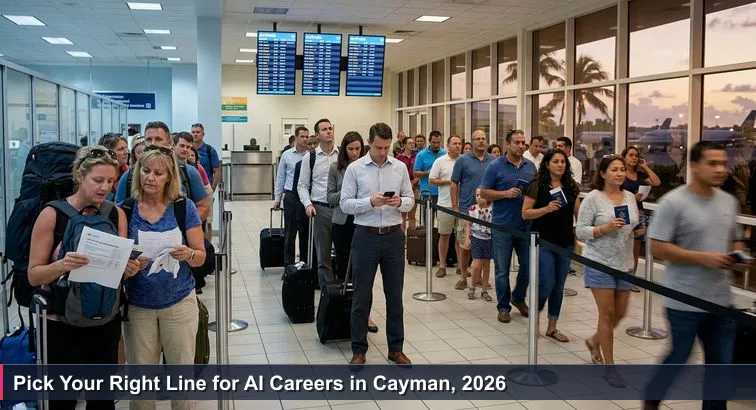
The first thing you notice isn’t the arrivals board; it’s the three immigration lines at Owen Roberts. One looks shortest, clogged with visitors clutching paper landing cards. Another is business travellers in polos and carry-ons. The longest - returning residents with blue passports - somehow moves fastest. You pick a line on instinct, then watch it stall as one family digs for a missing document.
From visible queues to hidden rules
This is how many Caymanians are still choosing an AI career: scanning for the “shortest” visible queues - Big Tech logos in Miami or remote roles in Panama City - without seeing the rules underneath. Globally, 98% of financial institutions now treat AI as baseline infrastructure, and 71% use it for fraud detection alone. Cayman mirrors that shift, but the action is in banks, law firms, captives and utilities, not in consumer apps.
As one analysis of AI adoption in Cayman put it, the point isn’t rushing into every tool; it’s understanding how AI is already reshaping risk and competition. Sperto Consulting’s review of the RF Cayman Economic Outlook argues that local businesses must treat AI as a strategic risk-and-opportunity lens, especially in regulated sectors.
Why Cayman’s “lines” look different
Here, the fastest-moving queues are often the least obvious: AML teams at Butterfield and Cayman National, captive managers on the waterfront, legal innovation units at Maples and Walkers, and fintech startups in Cayman Enterprise City. AI-specific roles in banking alone grew 13% in just six months to March 2026, while Cayman’s captives formed more new vehicles in early 2025 than in all of 2024, driving demand for AI-driven risk models.
Reading the arrivals board for your career
Think of the Top 10 industries that follow as the airport arrivals board for your AI journey. They’re ranked by opportunity, pay, stability, and ecosystem impact, but the real job is to match each “line” to your passport - your skills, appetite for regulation, and tolerance for volatility. With no direct income tax and a finance-heavy economy, the winning move in Cayman isn’t chasing the flashiest queue; it’s choosing the one where AI plus domain expertise will compound for you year after year.
Table of Contents
- Picking the Right Line for Your AI Career in Cayman
- Banking and Financial Services
- Education and EdTech
- Captive Insurance and Insurtech
- Legal and Trust Services
- Healthcare and Diagnostics
- Energy and Utilities
- Real Estate and PropTech
- Government and Public Sector
- Retail and E-commerce
- Maritime, Shipping and Logistics
- How to Choose Your Line in Cayman
- Frequently Asked Questions
For Cayman-focused advice, check the complete guide to starting an AI career that maps skills to Maples, Walkers, and CEC opportunities.
Banking and Financial Services
Walk into any lobby in George Town and you’ll feel it: in Cayman, banking and asset management is the primary AI hiring engine. Globally, a recent State of AI in Financial Services study found that 98% of institutions now treat AI as standard infrastructure, with around 71% using it for fraud detection alone - trends that map directly onto our own financial centre (State of AI in Financial Services report).
What problems AI is solving
Day to day, AI in Cayman’s banks and fund shops is less about flashy apps and more about regulated plumbing:
- AML/KYC and onboarding - models flag anomalous investor behaviour to satisfy CIMA, FATF and OECD standards.
- Fraud detection - real-time anomaly and graph analysis across cards, wires and fund flows.
- Quant research and trading - ML-driven pricing, execution and portfolio optimisation for hedge funds.
- Client servicing - copilot-style tools preparing briefings for UHNW clients in London, Hong Kong and New York.
Local employers, pay and the tax edge
The biggest queues form around names you already know: Cayman National, Butterfield, Apex Group, Citco, and Big Four advisory teams servicing global banks from here. AI-aligned roles - AI Compliance Specialist, Quant Researcher, Fraud Data Scientist - typically sit around KYD 110,000-180,000+, usually with performance bonuses. In Miami or New York, similar roles face high effective tax; here, that comp is tax-free in your pocket, a difference global recruiters flag in their 2026 banking hiring outlook (financial services hiring trends analysis).
Why Cayman banking AI is different
You’re not just cleaning credit-card data. Models must understand offshore fund structures - SPVs, master-feeder funds, multi-jurisdiction flows - and withstand scrutiny from internal audit, external regulators and institutional investors. That regulatory intensity makes model governance, explainability and audit trails as important as ROC curves. With AI-specific banking roles in Cayman growing about 13% in just six months to March 2026, competition is real, but so is career velocity.
Who this line suits
This is a powerful queue if you’re an ex-banker, risk officer or fund accountant moving into AI product work, or a strong Python/SQL developer ready to learn AML/KYC, Basel and fund ops. The tradeoff: pure “labs” research roles are rare; most work is applied, regulation-heavy AI. But if you want top-tier compensation, global exposure and Cayman quality of life, this is the line that currently moves fastest.
Education and EdTech
In Cayman, education and edtech is the quiet engine behind every other AI hiring line. Boards and HR teams know that technical talent is scarce, so they’re upskilling their own people. A survey of 500 executives found that 68% of leaders expect more entry-level roles as juniors “partner with AI” rather than get replaced by it, reshaping how organisations think about training and early careers (executive AI hiring expectations).
Locally, UCCI, private schools, and professional institutes are all experimenting with AI-enhanced curricula, while the Cayman Islands Government reviews how AI literacy should fit into national education policy. Coverage in the Cayman Compass on upcoming AI legislation makes clear that skills and education are central to government thinking, not an afterthought. On the ground, AI-aware curriculum designers, edtech product managers and learning-analytics specialists typically earn around KYD 60,000-105,000, with higher upside in leadership roles.
Nucamp sits in the middle of this ecosystem as a practical, affordable bridge into AI work. With bootcamps delivered online but anchored by community meetups in Grand Cayman, it offers structured paths into AI without leaving your day job. Programs such as the Solo AI Tech Entrepreneur (25 weeks, ~KYD 3,317) and AI Essentials for Work (15 weeks, ~KYD 2,985) mean most Caymanians can access AI training in the KYD 1,770-3,317 band instead of paying US or UK tuition. Outcomes matter too: Nucamp reports about 78% employment, ~75% graduation and a 4.5/5 rating from roughly 398 reviews.
Nucamp AI pathways at a glance
| Program | Duration (weeks) | Tuition (KYD ~) | Primary focus |
|---|---|---|---|
| Solo AI Tech Entrepreneur | 25 | 3,317 | LLMs, AI agents, SaaS monetisation |
| AI Essentials for Work | 15 | 2,985 | Practical AI at work, prompt engineering |
| Back End, SQL & DevOps with Python | 16 | 1,770 | Python, databases, cloud foundations |
For Caymanians in teaching, tourism, administration or support roles, this line is often the most realistic on-ramp. You keep your income, build AI literacy that every sector now values, and position yourself to step later into higher-paying queues in finance, law or fintech without taking on overseas debt.
Captive Insurance and Insurtech
In the shadow of the big banks, Cayman’s captive insurance sector has become one of the most interesting “AI + risk” laboratories on the island. A leading domicile for medical malpractice, healthcare and corporate captives, Cayman has been on a tear: one industry review notes that the jurisdiction formed more captives in early 2025 than in all of 2024, a surge now fuelling demand for data science and automation skills in 2026 (captive insurance trends to watch).
What problems AI is solving
In captives, AI is less about selling policies and more about understanding deep, specialised risk:
- Predictive underwriting for medical malpractice, workers’ comp and employee benefits, using ML to estimate claim frequency and severity.
- Claims automation via NLP that reads medical reports, legal correspondence and policy wording to speed up adjudication.
- Portfolio risk modelling that stress-tests how regulatory shifts, pandemics or climate events affect reserves and solvency.
Employers, roles and pay
The main queues form around global captive managers like Aon, Marsh and Global Captive Management, plus specialist actuarial and risk consultancies. Recruitment firms such as CML Offshore’s captive practice now advertise multiple roles where SQL, Python and analytics are listed alongside actuarial exams. Typical AI-aligned titles include Predictive Underwriter, AI Risk Modeler and Insurtech Product Manager, with compensation usually in the KYD 95,000-160,000 range, plus bonuses and relocation support for senior hires.
Why this line is different
Cayman captives offer three things you rarely get together elsewhere: niche datasets (hospital systems, shipping fleets, Fortune 500 benefit plans), a regulatory regime that’s both rigorous and relatively agile, and proximity to decision-makers where your models feed straight into board-level risk and capital decisions. It’s an excellent line if you’re an actuary, underwriter or accountant who likes statistics, or a data scientist who wants smaller teams and clear business impact. The tradeoff is sector specificity: you’ll become a world-class expert in insurance risk rather than a generalist, but in this market, that depth is exactly what commands a premium.
Legal and Trust Services
From the glass towers on Elgin Avenue to trust companies tucked just off the waterfront, legal and fiduciary work is one of Cayman’s most AI-intensive “hidden” queues. Our core exports are structures and opinions: fund documents, trust deeds, financing agreements, regulatory filings. That makes the sector a natural fit for tools that can read, summarise and draft at scale while still respecting Cayman’s tightly regulated environment.
Where AI is already embedded
Local firms are quietly weaving AI into the heart of their workflows. Large language models support AI-enhanced Legal Researcher roles, triaging case law and regulatory material; drafting tools assemble first-cut fund documents; monitoring systems track cross-border rule changes in the EU, US and UK. Niche products like the Cayman Legal Counsel Assistant apply these capabilities directly to Cayman statutes and regulations, offering research and drafting support tailored to offshore practice (AI-powered Cayman legal research example).
- Document review and drafting for funds, finance and M&A
- Real-time regulatory tracking across multiple jurisdictions
- Fiduciary risk analytics for directors, trustees and fund boards
Roles, pay and career upside
Top-tier firms like Maples Group, Walkers and Conyers now hire specifically for hybrid roles: Legal Prompt Engineer, AI Disclosure or Data Privacy Counsel, Knowledge Engineer, and Fiduciary Risk Analyst inside trust companies. Compensation typically falls in the KYD 100,000-220,000 range, with the upper end aligned to partnership-track or senior counsel positions. Offshore recruitment guides such as the ultimate guide to legal jobs in the Cayman Islands consistently rank Cayman among the most lucrative legal markets globally, especially for mid-career lawyers.
Why this queue is different
AI in Cayman’s legal and trust sector must reflect not only local Companies Act and Trusts Law, but also GDPR/DPA rules, US securities law and UK sanctions. That cross-border, fiduciary-heavy context makes domain mastery and promptcraft more valuable than writing your own model architecture. Oversight bodies such as the Cayman Legal Services Supervisory Authority are already examining how AI fits into professional conduct, so explainability and audit trails are non-negotiable. This queue is best suited to lawyers, paralegals and compliance officers ready to become AI super-users, and to technologists who enjoy dense regulation and text-heavy work rather than consumer apps.
Healthcare and Diagnostics
On the surface, Cayman’s healthcare system still looks like clinicians, stethoscopes and lab reports. Underneath, hospitals such as Health City Cayman Islands and Doctors Hospital are steadily weaving AI into diagnosis and operations, turning the islands into a regional testbed for data-driven medicine. The Cayman Islands Government’s 2026 AI policy explicitly names healthcare as a priority area, signalling that regulators expect AI to become part of baseline infrastructure rather than a side experiment.
Where AI is showing up in Cayman care
- Diagnostic decision support - models help interpret imaging, ECGs and lab results, offering second opinions for radiology, cardiology and oncology.
- Operational efficiency - predictive tools optimise theatre scheduling, bed management and staffing, crucial on a small island with finite capacity.
- Population health analytics - data pipelines track chronic conditions across a small but diverse population, guiding prevention and outreach.
Analyses of AI diffusion in Cayman note that healthcare is one of several regulated sectors where models and infrastructure are now maturing at the same time, reshaping both frontline work and back-office planning (AI diffusion overview from Cayman Independent).
Roles, salaries and who fits this line
AI-aligned roles include Clinical Data Scientist, Bioinformatics Specialist, Healthcare AI Policy Advisor and Digital Health Product Manager. In Cayman, these typically fall in the KYD 85,000-145,000 range, with the upper end reserved for clinicians layering AI skills onto existing credentials. Demand is rising for nurses, technicians and administrators who can work comfortably with dashboards, models and data-governance rules, not just traditional records.
Why Cayman health AI is different
Healthcare AI here must thread several needles at once. Systems need to align with HIPAA-like privacy expectations and UK-style data norms while Cayman crafts its own legislation. They also have to serve both residents and medical tourists, meaning models must factor in seasonality, case mix and international insurance. Global discussions on the future of work in AI repeatedly highlight healthcare as a sector where human expertise and machine support must be tightly integrated, with cross-disciplinary teams at the core (World Economic Forum perspectives on AI and jobs). For Caymanians who want visible patient impact rather than just profit metrics, this is a demanding but deeply meaningful queue.
Energy and Utilities
When storms are brewing south of Jamaica and everyone is watching the radar, Cayman’s most mission-critical AI systems are often running inside the control rooms at Caribbean Utilities Company (CUC) and newer renewables firms like GreenTech. As hurricanes strengthen and sustainability pressure grows, energy and utilities has become a specialised “AI + resilience” line that quietly underpins every other sector on the island.
- Grid optimisation - ML models forecast load, manage peak demand and balance diesel generation with solar, helping avoid blackouts on a small, isolated grid.
- Hurricane resilience - hi-tech weather and impact models predict damage, restoration times and safe operating windows so crews can be pre-positioned before landfall.
- Smart metering and demand response - AI analyses interval meter data to design tariffs, detect anomalies and shape energy-saving programmes for residential and commercial customers.
Local coverage of Cayman’s AI revolution has highlighted utilities and infrastructure as prime candidates for advanced forecasting and digital twins, particularly to protect critical assets against severe weather and rising temperatures. A Cayman Compass deep-dive on AI disruption points to high-resolution weather modelling as a key opportunity for CUC and government planners.
On the hiring side, AI-aligned titles such as Renewables Optimisation Engineer, Grid Analyst and Smart Meter Data Scientist typically command around KYD 85,000-150,000. That’s competitive with many white-collar roles here, especially considering the sector’s small size and outsized impact on national resilience.
What makes this queue different is consequence and visibility. There is no neighbouring state to lean on if the grid fails; your models sit between Cayman and darkness. Tariff decisions and outage explanations are politically sensitive in a community of this scale, so model robustness, transparency and communication matter as much as accuracy. This path fits electrical and civil engineers, environmental scientists and data professionals who want their AI work measured in lights on, hospitals powered and shelters cooled during the next big storm.
Real Estate and PropTech
Stand on West Bay Road and look from Camana Bay across to Seven Mile Beach, and you’re essentially staring at a live real-estate dataset: tourism flows, luxury condos, mixed-use developments, new office inventory. Cayman’s developers, agencies and property managers are quietly turning that data into an AI playground, even if the tools don’t make the headlines like banking or captives.
- Valuation models blend historic sales, construction costs, tourism metrics and macro trends to estimate fair value and future yields.
- Dynamic pricing and marketing use recommendation engines to personalise listings for high-net-worth buyers, long-stay renters and digital nomads.
- Asset and facilities management apply predictive maintenance models to HVAC, elevators and utilities, cutting downtime in high-end buildings.
On island, the main queues form around large developers like Dart and international investors backing mixed-use projects, plus agencies such as Sotheby’s International Realty Cayman and property management firms linked to fund structures. Roles with an AI angle - Real Estate Data Scientist, Proptech Solutions Architect, AI Marketing Manager - typically sit in the KYD 75,000-125,000 band, with upside where compensation is tied to deal performance or AUM.
Globally, analysts have noted that AI hiring is no longer confined to Silicon Valley-style tech hubs; real estate and construction are now prominent AI adopters as investors use models to pressure-test deals and optimise property use cases. Recruitment research on AI jobs by industry shows property and infrastructure among the sectors quietly scaling data teams, a pattern that maps neatly onto Cayman’s development pipeline.
What makes Cayman’s proptech line different is its dual market. You’re modelling both local demand and international capital parking wealth in luxury property or fund-backed developments, all heavily influenced by tourism seasonality, airlift and cruise capacity. Planning rules, environmental protections and strata laws add another layer of complexity. This queue suits agents, surveyors and analysts who enjoy client-facing work and Excel as much as open houses, and technologists who want to see their models show up in rents, occupancy and skyline changes rather than app-store charts.
Government and Public Sector
When Caymanians talk about AI, we often picture banks or law firms first. But in the background, the Cayman Islands Government (CIG) and regulators like CIMA are quietly modernising how the state itself works, from immigration queries to how we supervise trillions in assets booked through the jurisdiction. For policy-minded technologists, this is one of the most leveraged queues you can join.
Across ministries and authorities, AI is starting to show up in three main ways:
- Service delivery - chatbots for immigration, licensing and benefits queries; automated routing of forms and permits; analytics for budgeting and programme design.
- Policy and regulation - modelling how AI changes risks in finance, healthcare and education; drafting rules and guidance ahead of the government’s targeted 2027 AI legislation.
- Open data and transparency - dashboards on crime, development approvals and revenue that make policy outcomes easier to scrutinise.
Roles emerging from this push include AI Policy Officer, Public Sector Data Strategist and GovTech Project Manager. Pay typically falls in the KYD 70,000-135,000 range, with strong pensions and benefits partially offsetting the fact that base salaries are usually below top-tier private sector packages. As PwC Cayman’s 2026 Global Trust Insights report notes, governments in financial centres like ours are under pressure to strengthen digital trust and cyber resilience as they digitise services and oversight.
What makes Cayman’s public-sector AI work distinctive is scale and footprint. You operate in a small community where systems are still being built, yet the rules you help design affect global banks, funds and captives. There is real “blank slate” opportunity in departments moving from spreadsheets to integrated data platforms, often for the first time.
This queue fits policy analysts, economists and civil servants who want to become AI translators, as well as technologists who care more about hurricane readiness, social outcomes and regulatory integrity than ad-click optimisation. The tradeoff is slower hiring cycles and more process, but the upside is shaping how AI touches almost every other industry line in Cayman.
Retail and E-commerce
If banking is where most of the money flows, retail is where Cayman feels AI on a daily basis. From Kirk Market and Foster’s to duty-free downtown and hotel boutiques, stores are learning to navigate cruise surges, weekend stock-outs and container delays with models rather than guesswork. For Caymanians who understand shelves, stockrooms and spreadsheets, this is an increasingly attractive AI line.
Most of the work centres on three problems:
- Demand forecasting that accounts for tourism seasonality, cruise schedules and public holidays to keep inventory tight without running out.
- Personalisation and loyalty using recommendation systems and segmentation so residents, stay-over visitors and cruise passengers see different offers.
- Supply-chain planning tuned to Cayman’s import dependence, juggling shipping lead times, customs processes and FX risk.
Globally, analysts tracking AI hiring note that sectors like retail and e-commerce are now major consumers of AI skills, particularly around “demand sensing” and hyper-personalised marketing, not just pure software firms. Overviews of top AI roles in demand consistently highlight data-driven merchandising, recommendation engines and pricing science as growth areas.
Here at home, AI-aligned roles include E-commerce Personalisation Specialist, Demand Forecasting Analyst, AI Inventory Manager and Digital Merchandising Analyst. Typical compensation runs around KYD 65,000-110,000, with higher pay where bonuses are tied directly to sales or margin uplift. That can be particularly attractive at regional retail groups or vertically integrated distributors supplying multiple islands.
This queue is a strong fit if you’re coming from store operations, merchandising or logistics and already comfortable with numbers, or if you’re a data analyst who likes mixing customer behaviour, marketing and operations. The tradeoff: salary ceilings are below law or finance, but you gain versatile skills in experimentation, A/B testing and customer analytics that can later translate into fintech, SaaS or product management roles across Cayman’s wider tech ecosystem.
Maritime, Shipping and Logistics
From the cruise tenders off George Town to the superyachts flying Cayman flags in the Med, maritime and logistics is one of our most specialised AI frontiers. It doesn’t have the volume of banking, but the data - vessel movements, port calls, cargo flows, underwater imagery - is rich and uniquely Caymanian.
Where AI plugs into the maritime chain
- Port and logistics optimisation - models forecast vessel arrivals, berth allocation and cargo or vehicle flows to reduce congestion and turnaround times at the Port Authority.
- Environmental monitoring - underwater drones and sensor networks generate data to track reef health, anchor damage and sediment, feeding into marine-park management.
- Flag-state analytics - the Maritime Authority of the Cayman Islands uses safety, inspection and incident data across its registered fleet to identify compliance risks early.
Globally, logistics and transport is one of the non-tech sectors where AI skills are starting to appear in job ads alongside traditional operations experience. Platforms listing remote and hybrid AI jobs in Cayman already show roles that blend data, optimisation and cross-border operations.
Employers, roles and pay
Locally, the main employers are the Cayman Islands Port Authority, the Maritime Authority of the Cayman Islands, shipping agents and regional logistics firms coordinating cargo across the Caribbean. AI-adjacent titles include Maritime Data Analyst, Smart Logistics Manager and Environmental Impact Modeler, typically paying in the KYD 80,000-130,000 range, depending on seniority and regulatory exposure.
Why this queue is different
Unlike generic data roles, this work sits at the junction of geospatial data, sensors and regulation. You’re optimising not just for speed and cost, but also for marine conservation rules, cruise-tourism constraints and safety obligations as a leading flag state. The sector is small, so openings are limited and specialised, but for marine engineers, naval officers and data scientists who enjoy maps, time-series and environmental impact questions, it’s a uniquely Cayman line worth considering.
How to Choose Your Line in Cayman
By now, the arrivals-board feeling should be familiar. Ten different queues, each promising tax-free salaries and “AI exposure,” all moving at different speeds. The temptation is to ask which line is objectively best. The more useful question in Cayman is simpler: which one moves fastest for your passport - your skills, risk tolerance and the life you want on-island?
Match your background to the right queue
If you already speak the language of balance sheets, audits or compliance, industries like banking, captives and legal will compound your experience fastest. Educators, civil servants and healthcare workers usually find smoother transitions via edtech, government or hospital data roles. If you care most about climate resilience, coastal infrastructure or our reefs, energy and maritime put AI directly in service of national survival, not just margins.
Add “AI + X” skills, not AI in isolation
Local recruiters emphasise that Cayman employers rarely hire for AI in a vacuum; they hire for AI plus a domain. An overview of IT and tech careers in Cayman stresses how developers and analysts who understand regulated industries out-earn generalists. That’s where targeted upskilling comes in. Multi-month Nucamp bootcamps focused on AI product building, workplace AI, or back end Python and DevOps let you bolt practical AI onto existing careers, while shorter options like a four-week web fundamentals course (around KYD 382) or an 11-month software engineering path (~KYD 4,703) give you room to either test the waters or go all-in.
A quick checklist before you commit
- Which industries use knowledge you already have (finance, law, teaching, health, logistics)?
- Do you prefer steady regulation-heavy work, or faster-moving, higher-volatility environments?
- Is your first goal income, impact, or long-term optionality to move between sectors?
- What concrete skill gap (Python, data, AI literacy) must you close in the next 6-12 months?
Back at Owen Roberts, the people who reach the warm night air first aren’t always in the shortest line; they’re in the one whose hidden rules they understand. In a zero-income-tax, finance-heavy hub like Cayman, choosing your AI path works the same way: read the system, pick the queue that compounds your strengths, then move with intent.
Frequently Asked Questions
Which industry in the Cayman Islands hires the most AI talent outside of Big Tech?
Banking and asset management lead the pack - AI roles in Cayman’s financial sector grew about 13% in the six months to March 2026, with common AI-aligned salaries in the KYD 110,000-180,000+ range and employers like Cayman National, Butterfield, Apex and the Big Four actively hiring.
How can I pivot into AI roles in Cayman if I don’t come from a traditional tech background?
Start with domain-plus-AI training: education, healthcare, or government roles are smoother on-ramps and programs like Nucamp’s AI bootcamps (e.g., Solo AI Tech Entrepreneur ~KYD 3,317; AI Essentials ~KYD 2,985) report ~78% employment outcomes and build practical skills employers want.
What specific AI skills are Cayman employers asking for in 2026?
Employers want strong Python/SQL, ML basics (time-series, classification), NLP/prompt engineering, and model governance/explainability for regulated use cases - reflecting the fact that 98% of financial institutions now treat AI as standard and 71% use it for fraud detection.
Are AI jobs in Cayman competitive on pay compared with US tech hubs?
Yes - many Cayman AI roles (e.g., finance and legal) sit in KYD 95,000-220,000 bands and are tax-free, which often yields comparable or superior take-home pay versus similar US salaries after local tax equivalents are applied.
Where should I look locally for AI vacancies and networking in Cayman?
Target employers clustered around Cayman Enterprise City and professional services - Maples Group, Walkers, the Big Four, banks, CML Offshore and government agencies - and use local channels like recruitment firms, Nucamp meetups, and industry events to tap into hidden roles as AI regulation and public projects ramp up toward the 2027 legislation timeline.
Explore which top Cayman companies are hiring AI engineers and what they pay in a tax-free jurisdiction.
For a no-nonsense take, see Understanding Cayman Islands tech careers in 2026 with local data and relocation tips.
Recruiters often reference the top Cayman tech employers by total compensation when advising candidates on relocation offers.
Comprehensive guide: Can you actually afford the Cayman Islands on a tech salary in 2026?
Explore the top AI bootcamps for Cayman learners in 2026 to find programmes that fit local employers like Maples and Walkers.

Irene Holden
Operations Manager
Former Microsoft Education and Learning Futures Group team member, Irene now oversees instructors at Nucamp while writing about everything tech - from careers to coding bootcamps.