









Top 10 AI Startups to Watch in Yuma, AZ in 2026
By Irene Holden
Last Updated: April 2nd 2026
Too Long; Didn't Read
Desert Ag AI is the top AI startup to watch in Yuma, AZ in 2026, as it's deeply integrated with local agricultural research to detect crop diseases early using computer vision. DesertData AI also stands out for its sensor fusion platform that helps farmers save up to 40% on water use, showcasing how these startups solve Yuma's pressing agricultural challenges. Together, they highlight Yuma's emergence as a tech hub where AI innovation thrives in the desert.
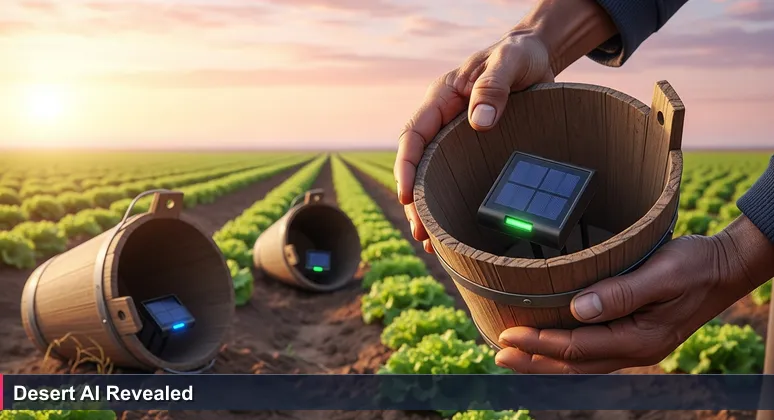
The most advanced tool in a Yuma farmer's shed might look, at first glance, like a simple wooden bucket. Splashed with desert soil, it's a timeless image. But peeking over its rim is a sleek, solar-powered IoT sensor, its LED blinking green against the dawn - a perfect symbol of how Yuma is grafting sophisticated AI onto its deep-rooted agricultural and logistical heritage.
Here, innovation isn't born from abundance but from acute necessity. As the nation's winter lettuce capital, Yuma faces existential pressures: water scarcity in the Colorado River Basin, labor shortages, and the logistical ballet of moving perishable goods. These challenges are forging a distinct tech ecosystem, fueled by initiatives like Yuma Tech Week 2026 to bridge local talent with high-demand tech careers. This isn't about importing Silicon Valley; it's about cultivating solutions in local soil.
"Yuma is specifically excited to share advancements in ag tech as part of our state-wide tech ascension," - Governor Katie Hobbs, on Arizona's decentralized innovation model.
The region's unique advantages - its 10G wireless "Smart Farm" research infrastructure and partnerships with the University of Arizona's Yuma Center of Excellence for Desert Agriculture - are creating a fertile testbed. The startups emerging aren't ranked by hype, but by their rootedness: their precise ability to turn Yuma's constraints into scalable, intelligent solutions. This is the quiet dawn of Desert AI.
Table of Contents
- The Dawn of Desert AI in Yuma
- FarmFlow Logistics
- PestSpotter AI
- SoilLens
- YieldEdge
- AgRovers Tech
- Imperial Precision Farming
- Alynea
- AquaNet Technologies
- DesertData AI
- Desert Ag AI
- The Future of Desert AI
- Frequently Asked Questions
Get the latest on AI job markets and salaries in Yuma, Arizona in 2026 from this comprehensive resource.
FarmFlow Logistics
FarmFlow Logistics targets the most urgent bottleneck in Yuma's economy: the high-velocity export of perishable goods. Every day, millions of heads of lettuce must move from field to retailer with clockwork precision, where even minor delays at a shipping yard or border crossing can destroy value through spoilage.
Their solution is a predictive AI platform that synchronizes the entire cold chain. Instead of simply finding available trucks, FarmFlow's models analyze a complex web of real-time data - harvest timing, trucking availability, border wait times, and fluctuating retailer demand - to generate dynamic, optimal routing. This creates a resilient, AI-powered nervous system for the region's agricultural exports, a critical capability highlighted during events like Yuma Tech Week 2026.
As a pure B2B software play, FarmFlow’s success hinges on deep integration with local brokerages and logistics yards. This focus on a hyper-local problem with global implications makes it a prime acquisition target for major logistics platforms or agricultural conglomerates seeking to lock in efficiency gains along this vital geographic corridor between Mexico, Arizona, and California markets.
PestSpotter AI
Pesticide overuse represents a costly triple threat in Yuma County: it damages the environment, strains thin profit margins, and faces increasing regulatory scrutiny. Manual pest scouting across thousands of desert acres is painfully slow and imprecise, often leading to blanket chemical applications.
PestSpotter AI deploys a network of smart, image-capturing traps across fields. Its proprietary computer vision model, trained on millions of images of local insect populations, identifies and maps specific pest outbreaks with over 95% accuracy. Crucially, it can distinguish harmful pests like aphids from beneficial insects, enabling truly targeted, precision application and supporting the broader AI for sustainability movement.
The company operates on a “trap-as-a-service” model with integrated AI analytics. As water and chemical use face tighter regulations, this technology for prescriptive pest management transitions from a nice-to-have to a compliance must-have. This regulatory tailwind positions PestSpotter for rapid adoption across the Southwest and makes it a standout in Yuma's AgTech ecosystem, poised for growth funding focused on geographic expansion.
SoilLens
Operating from just across the California border in El Centro, SoilLens tackles one of desert agriculture's chronic issues: soil salinity and inconsistent nutrient levels. These invisible problems lead to reduced yields and wasted fertilizer, while traditional soil sampling provides only slow, sparse data points.
The startup's innovative approach uses drone-mounted hyperspectral cameras to create high-resolution, real-time maps of soil health. Its machine learning algorithms are trained to correlate specific spectral signatures with precise nutrient content and moisture levels, allowing growers to see variability within a single field. This enables surgical precision in applying soil amendments, a critical advancement for AI-driven sustainable farming.
SoilLens exemplifies the growth of the binational Yuma-Imperial Valley tech corridor. Its initial traction solving salinity issues in the Imperial Valley provides a direct entry point into the identical challenges faced just miles away in Yuma County. This cross-border applicability makes the startup a compelling candidate for strategic investment from large agricultural input companies seeking to digitize their product offerings and solidify their presence in this specialized crop region.
YieldEdge
For Yuma's agricultural producers, deciding when to sell a crop is as critical as deciding how to grow it. Operating on razor-thin margins in a volatile market, they are often price-takers, with timing making the difference between profit and loss.
YieldEdge moves AI from the field directly into the front office. It leverages generative AI for predictive market intelligence, ingesting a complex array of data streams. This includes satellite imagery, local microclimate data from Yuma's advanced research infrastructure, historical commodity pricing, and even global shipping news. Its models synthesize this information to forecast future yield quality and market prices for specific high-value crops like leafy greens, providing actionable "sell" recommendations.
This startup's success is measured by its adoption by regional agricultural brokers and large farming operations. If its predictive models prove consistently more accurate than human intuition, YieldEdge could evolve from a decision-support tool into a core platform for agricultural finance and trading, marking it as a promising venture in the predictive analytics space. Its focus on the financial outcome completes the loop of data-driven desert agriculture.
AgRovers Tech
The punishing combination of high heat and abrasive dust in the Yuma desert puts immense strain on expensive farming machinery. An unplanned breakdown of a harvester or irrigation pump during a critical, narrow harvest window can cost a producer hundreds of thousands of dollars in lost yield, making equipment reliability an existential concern.
AgRovers Tech provides an indispensable MLOps and IoT platform for predictive maintenance. By installing sensors on critical machinery and applying AI to analyze vibration, thermal, and hydraulic data streams, it can diagnose issues like bearing wear or impending pump failure days or weeks before a catastrophic breakdown. They've built a seamless service loop through key partnerships with local repair shops in San Luis and Somerton, creating a responsive local network that is a hallmark of Yuma's innovation ecosystem.
AgRovers has a clear path to becoming the essential operational technology (OT) layer for large farming enterprises. Its asset-agnostic platform, proven in extreme conditions, could easily expand beyond agriculture into the region's other heavy industries, like logistics centers and warehousing. This horizontal expansion potential into broader industrial IoT applications makes it a compelling candidate for venture capital looking for durable, real-world tech plays.
Imperial Precision Farming
Scarce and expensive manual labor for tasks like weeding and precise irrigation is a fundamental constraint for desert agriculture. Broadcast herbicide use is increasingly untenable, creating a pressing need for automation that can operate in high-density plantings of delicate crops like lettuce and carrots.
Imperial Precision Farming, operating from the heart of the Imperial Valley, is building the hardware-software hybrid to meet this challenge. Their flagship system uses a drone equipped with computer vision to scan fields, identifying individual weeds. This data then directs autonomous tractors to perform automated, mechanical weeding or to spot-apply water with surgical precision. Their AI models are specifically trained to distinguish crops from weeds in the complex visual environment of a producing field, a technical feat highlighted in discussions about AI's role in modern agriculture.
As a capital-intensive venture tackling the physical automation of labor, the startup's trajectory depends on pilot programs scaling into full commercial contracts with large growing collectives in the Imperial and Yuma Valleys. Success here could trigger a wave of agricultural robotics innovation in the region, positioning it among other high-potential hardware startups seeking transformative ROI.
Alynea
Alynea is pioneering the application of AI in the public sector, tackling the slow, paper-based municipal processes that can stifle local economic development. Their work began with a landmark project right in their hometown: developing Arizona’s First AI-Powered Permitting Pilot Program for the City of Yuma.
Using generative AI and natural language processing, their platform guides applicants through complex forms, auto-fills repetitive information, and pre-screens submissions for completeness. This dramatically accelerates approval times, transforming a source of frustration into a smooth experience for businesses and residents. Such practical applications of AI for civic efficiency are a cornerstone of the broader movement showcased during Yuma Tech Week 2026.
Alynea’s model grants it a powerful first-mover advantage in the massive, underserved market of small to mid-sized city governments. If the Yuma pilot proves successful in cutting processing times and boosting satisfaction, the platform is perfectly structured for replication. This positions Alynea as a prime "govtech" acquisition target or as the foundation for a scalable platform for civic engagement across the Sun Belt, where digital transformation is a growing priority.
AquaNet Technologies
In the Colorado River Basin, water is not merely a resource; it is the single most critical and constrained input for survival. Inefficient irrigation directly threatens the sustainability of the entire desert agricultural industry, making conservation a matter of economic existence.
AquaNet Technologies builds smart AI controllers designed to act as the intelligent "brain" for entire irrigation systems. The technology fuses real-time data from soil moisture probes, hyper-local weather forecasts, and evapotranspiration models. Its AI then makes autonomous decisions to open and close valves across a farm, delivering water only where and when crops need it. The results from field tests are staggering, achieving a demonstrated 40% reduction in water use.
As water rights become inextricably linked to economic viability, AquaNet’s technology transitions from an efficiency tool to an existential necessity. The startup is perfectly positioned for growth funding from impact investors and conservation grants. Its potential extends far beyond farm fields into municipal water management and large-scale landscaping across the arid West, emblematic of the practical, problem-solving innovation defining Yuma's tech ascent.
DesertData AI
Farmers in Yuma's advanced agricultural landscape face a new challenge: data overload. With information streaming in from soil probes, weather stations, drones, and IoT sensors, the problem is no longer a lack of data but the inability to synthesize it into a single, actionable command for water and nutrient management.
DesertData AI's platform positions itself as the essential central nervous system for the connected farm. It specializes in sophisticated sensor fusion AI, ingesting disparate, real-time data streams from across a farm and from region-wide resources like the 10G wireless "Smart Farm" research infrastructure. Its models go beyond reporting to prescribe exact, automated actions - such as commanding "irrigate Zone B-12 for 8 minutes at 3 PM" - optimizing for both maximum yield and resource conservation.
The startup is effectively building the operating system for desert agriculture. Its defensibility lies not in generic algorithms, but in complex, location-specific AI models trained exclusively on Yuma's unique conditions of soil, heat, and crop varieties. This deep vertical integration and specialized knowledge make it a prime candidate for strategic partnership or acquisition by a major agricultural technology corporation seeking a definitive foothold in the Southwest's high-value specialty crop market, a key node in the broader Yuma innovation ecosystem.
Desert Ag AI
Desert farming is a perpetual high-stakes gamble against heat and pathogens. A threat like Fusarium wilt in a lettuce field, identified just a day too late, can wipe out an entire season's investment. This extreme risk environment demands the earliest possible detection, often before the human eye can see any symptoms.
Founded by former University of Arizona researchers, Desert Ag AI represents the most deeply integrated startup in Yuma's ecosystem. It is a lead developer at the cutting-edge 10G wireless "Smart Farm" at the Yuma Agricultural Center. Its core technology uses computer vision and predictive analytics, but its unique advantage is that its models are trained specifically on the sandy, high-heat environment of the region, as seen in field demonstrations showcasing AI in Yuma agriculture.
This collaboration with growers and researchers provides an unassailable data moat. With seed funding already secured from ag-specialized VCs, the startup is on a clear trajectory to become the essential digital agronomy partner for every major producer in the region. It’s not just another startup to watch; it is the foundational layer upon which Yuma's future as a high-tech agricultural leader is being built, embodying the kind of promising, vertically-focused innovation that defines the new era of Desert AI.
The Future of Desert AI
The narrative of technological innovation is decisively shifting, no longer confined to coastal enclaves of capital and talent. In Yuma, the future of AI is being cultivated in the specific, demanding soil of necessity. Under the desert's dawn light, what reveals itself is not just endless rows of lettuce, but a growing latticework of data, autonomy, and predictive intelligence.
These startups, from AquaNet's water-saving brains to Desert Ag AI's prescient crop vision, prove that the most transformative technologies are those that speak intimately to the character of their place. They turn acute local challenges - water scarcity, logistical friction, labor constraints - into robust, globally scalable solutions. This is the powerful model emerging from the Colorado River Basin.
"Yuma’s broadband infrastructure and partnerships with industry leaders are creating a connected ecosystem for startups focused on AI in agriculture," - Experts from the University of Arizona’s Yuma Center of Excellence for Desert Agriculture.
Fueled by a lower cost of living, unique research partnerships, and a pragmatic culture, Yuma's ecosystem demonstrates that rootedness is the new competitive advantage. The quiet revelation of Desert AI is that the next great wave of innovation may well rise from the very places with the most to gain from solving their existential problems, redefining what a tech hub looks like under the relentless and illuminating sun.
Frequently Asked Questions
How did you choose and rank the top 10 AI startups in Yuma for 2026?
The startups are ranked based on 'rootedness' - their ability to solve Yuma's specific challenges like water scarcity and agricultural inefficiencies, not just their technology. This approach highlights innovations that are locally impactful, such as those addressing logistics bottlenecks or defense needs, with potential for global scalability.
Are these AI startups all focused on agriculture?
No, while many leverage Yuma's agricultural backbone, the list includes diverse sectors. For example, Alynea targets public sector AI for city permits, and FarmFlow Logistics optimizes cold chains, reflecting Yuma's broader economy in logistics, defense, and tech-adjacent fields.
Why is Yuma, AZ emerging as a hotspot for AI innovation?
Yuma's lower cost of living compared to West Coast metros, year-round sunny climate, and key industries like agriculture and defense drive AI growth. Initiatives like Yuma Tech Week 2026 and partnerships with Arizona Western College foster a vibrant ecosystem, making it attractive for startups solving local problems.
What are some impressive achievements from these startups?
Startups like AquaNet Technologies have achieved a 40% reduction in water use in field tests, while PestSpotter AI boasts over 95% accuracy in pest identification. These data points show how AI is delivering tangible benefits in Yuma's resource-constrained environment.
How can someone interested in AI careers get involved in Yuma's tech scene?
Engage by attending events like Yuma Tech Week, exploring roles at major employers such as Yuma Proving Ground or remote-work opportunities, and leveraging educational programs at Arizona Western College. The area's growing ecosystem offers pathways for AI professionals to contribute and grow.
To navigate the tech landscape, read about the best women in tech resources in Yuma, AZ for 2026.
Answer the question: can you afford Yuma on a tech salary in 2026? with this detailed guide.
For insights into AI salaries in Yuma, AZ 2026, this article provides a detailed breakdown.
Find insights on health information management tech jobs in Yuma without a degree and certification options here.
This article provides insights on building a career in AI through Yuma's networking channels.

Irene Holden
Operations Manager
Former Microsoft Education and Learning Futures Group team member, Irene now oversees instructors at Nucamp while writing about everything tech - from careers to coding bootcamps.