









The Complete Guide to Using AI in the Education Industry in Uruguay in 2025
Last Updated: September 14th 2025
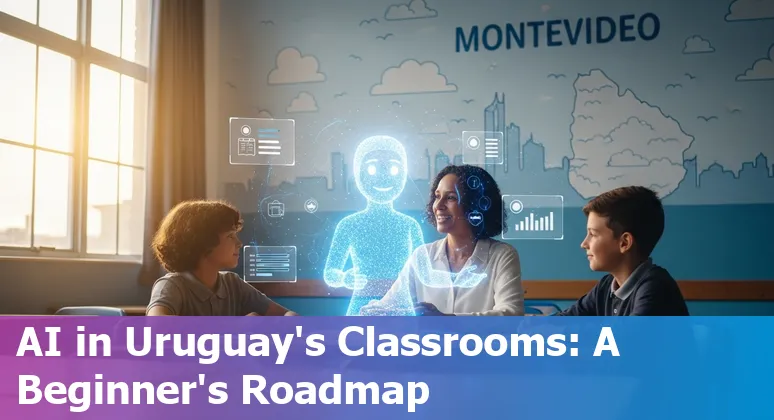
Too Long; Didn't Read:
Uruguay 2025 must adopt AI in education with teacher training, data‑safe deployments, and equity‑first pilots. Key data: 21.3% global rise in legislative AI mentions, Ceibal supports ~700,000 learners, PISA math 409 (−91 vs OECD), and 15‑week practical courses available.
Uruguay sits at a practical crossroads: global signals - from the Stanford HAI Stanford 2025 AI Index Report, which notes a 21.3% jump in legislative mentions of AI across 75 countries, to HolonIQ's HolonIQ 2025 education trends snapshot on AI skills and workforce pathways showing AI's shift from experiment to implementation - mean schools and universities can no longer treat AI as optional.
With students and teachers worldwide rapidly adopting tools that boost personalization and reduce admin burden, Uruguay's priorities should be teacher training, data‑safe deployments, and aligning curricula to workforce needs; practical training paths like Nucamp's AI Essentials for Work bootcamp (15 weeks) offer a bite‑size route to prompt skills and workplace AI literacy.
The question for Uruguayan educators isn't if AI matters, but how to harness it responsibly to improve equity, cut educators' paperwork, and tailor learning at scale.
| Bootcamp | Length | Early bird cost | Register |
|---|---|---|---|
| AI Essentials for Work | 15 Weeks | $3,582 | Register for AI Essentials for Work |
| Solo AI Tech Entrepreneur | 30 Weeks | $4,776 | Register for Solo AI Tech Entrepreneur |
| Web Development Fundamentals | 4 Weeks | $458 | Register for Web Development Fundamentals |
| Cybersecurity Fundamentals | 15 Weeks | $2,124 | Register for Cybersecurity Fundamentals |
| Full Stack Web + Mobile | 22 Weeks | $2,604 | Register for Full Stack Web + Mobile |
Table of Contents
- Global leaders and lessons: Which country is leading AI and introducing it to education - implications for Uruguay
- What are the problems with education in Uruguay in 2025?
- What is the ranking of Uruguay's education system in 2025?
- How is AI used in education: Practical applications for Uruguay
- Benefits of AI for students and teachers in Uruguay
- Challenges and risks of implementing AI in Uruguay's education sector
- Regulation, ethics, and data privacy for AI in Uruguay's education system
- A practical roadmap for schools and universities in Uruguay to adopt AI in 2025
- Conclusion and future outlook for AI in Uruguay's education - next steps for beginners
- Frequently Asked Questions
Uruguay residents: jumpstart your AI journey and workplace relevance with Nucamp's bootcamp.
Global leaders and lessons: Which country is leading AI and introducing it to education - implications for Uruguay
(Up)Global leaders offer two very different roadmaps Uruguay can borrow from: the United States shows how a decentralized, partnership-driven model leverages massive corporate pledges and federal guidance - see the White House's roundup of commitments from Google, Microsoft, NVIDIA and more - to rapidly seed tools, teacher PD, and apprenticeships; by contrast China's move to make AI training mandatory in Beijing starting in 2025 illustrates how a top‑down, standardized curriculum can scale basic AI literacy quickly but risks stiffer central control over content and rollout.
Practical lessons for Uruguay: build national coordination for teacher training and data‑safe procurement (the U.S. Executive Order and task force model aim for that), pilot state‑style programs so schools can test models before wider adoption (echoing U.S. K–12 pilots tracked by ECS), and design equity guardrails up front - U.S. research warns that early AI uptake often favors wealthier districts, a cautionary detail worth treating as a red flag rather than an afterthought.
A hybrid approach - national standards for teacher preparation plus local pilots and public‑private partnerships to bring hardware, cloud credits, and curriculum - can help Uruguay avoid widening the digital divide while getting AI into classrooms with speedy, practical impact.
| Dimension | China | United States |
|---|---|---|
| Curriculum consistency | Uniform, mandatory (Beijing, 2025) | Variable by state/district |
| Teacher preparedness | Centralized certification | Voluntary PD, growing federal support |
| Equity of access | Higher in urban areas, variable elsewhere | Disparities - advantaged districts often lead |
| Implementation model | Top‑down rollout | Public‑private partnerships and pilots |
“As AI reshapes how people learn, work, and communicate, the Trump Administration is committed to ensuring that Americans are equipped to lead the world in harnessing this technology.” - Michael Kratsios, White House Office of Science and Technology Policy
What are the problems with education in Uruguay in 2025?
(Up)Despite Uruguay's reputation for forward-looking digital policy, the classroom picture in 2025 still shows stubborn gaps: UNICEF documents that child poverty - especially among children of African descent and those with disabilities - and a persistent digital divide leave many students without equitable learning opportunities, with over 150,000 children living in households unable to cover basic needs and more than 40% of young adults not finishing upper secondary education; critically, children from the poorest areas reach minimum proficiency in reading, math and science at only about 25%.
Attendance and retention are also weak - students lose the equivalent of a year of instruction out of every six in primary school - while rural schools and specialized services for disabilities lag behind urban centers.
Visiting education leaders noted these implementation frictions firsthand during a Spring 2025 exchange in Montevideo, where Digital Promise highlighted both the promise and the operational puzzles of scaling country‑wide transformation.
The good news: pilots that convert textbooks into accessible formats and targeted AI use cases - like generating anonymized student personas to focus interventions - show how technology can help, but only if Uruguay pairs innovation with deliberate equity safeguards, teacher support, and strong local rollout plans so access doesn't become yet another source of disadvantage (Digital Promise reflections on Uruguay's digital transformation and education, UNICEF report on child poverty and education challenges in Uruguay, Universidad de la República anonymized student personas and AI use cases).
What is the ranking of Uruguay's education system in 2025?
(Up)Where Uruguay stands on the global scoreboard matters for any AI strategy: the country's PISA 2022 line in the table shows an overall composite of 1,274 with domain scores of Math 409, Science 435 and Reading 430, well under OECD domain averages (500) and far below top performers like Singapore (overall 1,679) - a gap that's not abstract, since PISA interpreters note each ~40‑point difference equals roughly one year of schooling, so Uruguay's math score is about 91 points below the OECD average (more than two years of learning).
That placement explains why the World Bank and regional analyses frame Latin America's results as a “learning crisis,” and it clarifies priorities for Uruguay: targeted remediation, teacher upskilling, and carefully piloted AI tutoring that closes gaps instead of widening them.
For the raw numbers and methodology behind these comparisons see the PISA 2022 table compilation - World Population Review and the explainer on PISA scoring and averages at PISA scoring and averages explainer - DataPandas.
| Country | Overall Score 2022 | Math 2022 | Science 2022 | Reading 2022 |
|---|---|---|---|---|
| Uruguay | 1,274 | 409 | 435 | 430 |
How is AI used in education: Practical applications for Uruguay
(Up)Practical AI in Uruguay's classrooms is already less theory and more day‑to‑day tools: Plan Ceibal's nationwide platform and one‑laptop‑per‑child foundation create the plumbing for AI to run at scale, while a new partnership to deploy PowerSchool Connected Intelligence K‑12 and the AI tutor PowerBuddy plugs predictive analytics and an assistant directly into the LMS, surfacing students who stop logging in, flagging engagement dips, and helping teachers prioritize support for nearly 700,000 learners (Plan Ceibal official website, PowerSchool Connected Intelligence K‑12 and PowerBuddy AI tutor announcement).
Other practical cases already in country include adaptive reading platforms - ODILO's content and personalization engines reach thousands of public schools and hundreds of thousands of students - while localized workflows such as generating anonymized student personas help target remediation without exposing identities (ODILO adaptive reading technology deployment in Uruguay, Nucamp examples).
“So what” is simple: when dashboards turn millions of activity logs into an early‑warning that a student is falling behind, interventions move from guesswork to timely, measurable action, freeing teachers to teach rather than chase paperwork.
| AI Application | Uruguay example | Impact |
|---|---|---|
| Data modernization & predictive analytics | PowerSchool Connected Intelligence K‑12 (Ceibal) | Centralizes data, flags disengagement; supports ~700,000 students |
| AI teaching assistant & personalization | PowerBuddy + Schoology LMS | Personalized learning at scale; reduces teacher admin (Schoology widely used) |
| Adaptive reading & digital content | ODILO via Plan Ceibal | Deployed in ~3,000 schools, serving 600,000+ students with adaptive content |
| Anonymized student personas for interventions | Universidad de la República / Nucamp use‑case | Targets remediation while preserving privacy and counseling workflows |
Benefits of AI for students and teachers in Uruguay
(Up)AI is already delivering concrete wins for Uruguayan classrooms by making learning more responsive and teachers' work more focused: PowerSchool's Connected Intelligence K‑12 lets Ceibal centralize engagement data for almost 700,000 students so educators spot who's stopped logging in or who needs extra practice, turning millions of activity logs into a prioritized to‑do list rather than an endless spreadsheet, while integration with Schoology shows how a familiar LMS (used by over 93% of students and 94% of teachers during the pandemic) can host AI tutors and personalized pathways; see the PowerSchool announcement on Connected Intelligence and PowerBuddy and Ceibal's role as the national innovation hub for education technology.
For students, that translates into adaptive practice, 24/7 tutoring support, and content that meets individual pace and needs (boosting engagement and inclusion); for teachers, AI trims routine tasks - lesson drafting, basic grading, and progress monitoring - so more class time can go to small‑group coaching or creative, project‑based assessment.
The net effect is practical: faster interventions, fewer missed learners, and more human teaching where it matters most (PowerSchool Connected Intelligence K‑12 and PowerBuddy announcement, Ceibal national digital innovation center for education technology).
“Once implemented, PowerSchool Connected Intelligence K-12 would allow us to make data-driven decisions at scale in a timely manner, which could be a huge change for Ceibal,” said Martin Anza, Information Technology Manager, Ceibal.
Challenges and risks of implementing AI in Uruguay's education sector
(Up)Introducing AI in Uruguay's schools brings real promise, but also a clear checklist of risks that policymakers and school leaders must manage: national capacity‑building and trustworthy frameworks are still works in progress, as Oxford Insights notes in its spotlight on Uruguay's efforts around AI readiness and ethics, so teacher training and ethical procurement can't be an afterthought; assessment integrity is already under strain - Uruguayan faculty have reported students achieving perfect scores in minutes using generative tools, a wake‑up call that virtual tests designed during the pandemic may be especially vulnerable (MercoPress report on Uruguayan students obtaining perfect scores with AI assistance) - which in turn pushes institutions to redesign evaluations toward projects, oral exams, and authenticity checks that penalize rote prompting rather than real understanding (see practical adaptation strategies like switching to project-based assessment strategies for AI-era education); other hazards include data privacy, the potential for biased models to replicate inequities, and displacement of routine roles unless upskilling is prioritized.
Tackling these challenges means pairing legal and ethical guardrails with fast, practical teacher PD and new assessment design - otherwise a single misplaced exam or poorly governed model could turn a classroom triumph into a credibility crisis overnight.
“I am not surprised because artificial intelligence is, let's say, challenging us every day. It was not a scenario that was not possible because today it challenges everything, everything, and education as well. And what should be done in these cases to avoid this? Well, you have to work with guarantees for the students, technical guarantees, and that what is done is indeed genuine, but it is challenging you because it has changed the axes, the truth,” said Education Minister José Carlos Mahía.
Regulation, ethics, and data privacy for AI in Uruguay's education system
(Up)Uruguay's Personal Data Protection Law (PDPL, Law No. 18.331) creates a practical, legally binding framework schools and EdTech vendors must treat as a foundation for any AI rollout: controllers must register and regularly update databases, obtain prior informed consent for most uses, and limit processing to lawful purposes, while the national regulator (URCDP) enforces security, breach reporting, and sanctions; for details see the legal overview at DLA Piper and the PDPL explainer at Clym.
Key operational rules that matter for classrooms and LMS integrations: appointment and URCDP approval of a Data Protection Officer is mandatory for public bodies, large‑scale processors or those handling sensitive data, cross‑border transfers are allowed only to adequate jurisdictions or under explicit safeguards, and confirmed breaches must be notified to the regulator within 72 hours and to affected data subjects as soon as practicable.
The enforcement toolbox is tangible - fines (up to 500,000 UI, roughly USD 60k), suspension or closure of non‑compliant databases - and that makes privacy-by‑design, anonymization (e.g., student personas), and documented impact assessments non‑negotiable steps before deploying AI tutors or analytics in Uruguay's schools, especially where minors' data and national adequacy with the EU are in play.
“large scale” defined in Decree 64/2020
| Topic | Requirement (summary) |
|---|---|
| Law & regulations | PDPL (Law 18.331) + Decrees 414/009, 64/2020; updates in 2022 |
| Regulator | URCDP (Regulatory and Personal Data Control Unit) |
| Data Protection Officer | Mandatory for public entities, large‑scale or sensitive processing; URCDP approval required |
| Breach notification | Notify URCDP within 72 hours; inform data subjects promptly |
| International transfers | Only to adequate countries or under safeguards (consent, clauses, URCDP authorization) |
| Penalties | Fines up to 500,000 UI (~USD 60,000), suspension/closure of databases |
A practical roadmap for schools and universities in Uruguay to adopt AI in 2025
(Up)Start with the plumbing that already exists: build any AI rollout on Ceibal's one‑laptop‑per‑child foundation and national connectivity, then add clear, staged steps so schools and universities can move from pilots to scale without breaking classroom routines.
A practical roadmap begins by modernizing data infrastructure (one centralized data lake and role‑based access makes integration manageable), pairing that with strict privacy and impact reviews, and selecting focused pilot use cases such as AI tutors or early‑warning analytics that flag students who stop engaging so interventions arrive before disengagement compounds; PowerSchool Connected Intelligence K-12 and PowerBuddy announcement (Uruguay).
Invest in rapid teacher and leader development - short, practical PD and peer study tours hosted by Ceibal help translate tools into pedagogy (Digital Promise Montevideo tech-enabled learning study tour) - and codify equity checkpoints from day one, drawing on lessons in the World Bank's Ceibal brief about access, content, and teacher training (World Bank Ceibal case study: Transforming education in Uruguay through technology).
Close the loop with evaluation: run short randomized or phased pilots, collect learning‑outcome and access metrics, redesign assessments to resist misuse, then scale the wins while protecting student data and instructional time.
“Once implemented, PowerSchool Connected Intelligence K-12 would allow us to make data-driven decisions at scale in a timely manner, which could be a huge change for Ceibal,” said Martin Anza, Information Technology Manager, Ceibal.
Conclusion and future outlook for AI in Uruguay's education - next steps for beginners
(Up)The practical road ahead for beginners in Uruguay is refreshingly straightforward: build on Ceibal's proven platform, start with small, equity‑first pilots, and pair every new tool with teacher training and privacy checks so technology widens - not widens - the gap; the World Bank brief: Ceibal's transformation in Uruguay and Digital Promise's study‑tour reflections make this clear - real change comes from connecting devices, pedagogy, and safeguards.
Begin by learning to prompt and apply AI in real workflows (short, hands‑on courses help), run a phased pilot that prioritizes rural and low‑income schools, redesign assessments to emphasize projects and oral work, and require data impact reviews before any rollout.
For absolute beginners who want a practical starting point, a focused course that teaches prompt craft, AI tools for classrooms, and workplace applications offers a fast way to move from curiosity to classroom practice - think of it as a teacher's pocket toolbelt of prompts, checks, and privacy templates that turns Ceibal's infrastructure into purposeful instruction rather than just more screens; explore a practical entry like the AI Essentials for Work syllabus or register for the AI Essentials for Work bootcamp to get started.
Keep measurement simple: baseline access, teacher readiness, and a short list of learning outcomes, then scale what demonstrably improves equity and learning.
| Bootcamp | Length | Early bird cost | Register |
|---|---|---|---|
| AI Essentials for Work | 15 Weeks | $3,582 | Register for AI Essentials for Work |
| Web Development Fundamentals | 4 Weeks | $458 | Register for Web Development Fundamentals |
Frequently Asked Questions
(Up)Why should Uruguayan schools and universities adopt AI in 2025?
AI has shifted from experiment to implementation globally and offers practical benefits for Uruguay: personalization at scale, faster early‑warning of disengagement, and reduced teacher administrative burden. Building on national assets like Plan Ceibal (one‑laptop‑per‑child and connectivity), AI pilots can target remediation, free teachers for higher‑value instruction, and help close learning gaps - provided rollouts pair tools with teacher training, equity guardrails, and data‑safe practices.
How is AI currently being used in Uruguay and what are the measurable examples?
Practical deployments in 2025 include PowerSchool Connected Intelligence K‑12 integrated with Ceibal to centralize engagement data and flag students who stop logging in (supporting roughly 700,000 learners), adaptive reading and content personalization via ODILO through Plan Ceibal (deployed in ~3,000 schools and reaching ~600,000+ students), and localized workflows such as anonymized student personas used for targeted remediation. These use cases focus on analytics, AI tutors, adaptive content and teacher assistance to convert activity logs into timely interventions.
What are the main risks and regulatory requirements for deploying AI in Uruguay's education system?
Key risks include student privacy breaches, biased models that amplify inequities, assessment misuse (e.g., generative tools undermining test integrity), and insufficient teacher capacity. Legally, deployments must follow Uruguay's Personal Data Protection Law (PDPL, Law No. 18.331) and related decrees; the regulator is URCDP. Operational requirements include registering/updating databases, appointing a URCDP‑approved Data Protection Officer for public or large‑scale processors, notifying the regulator within 72 hours of confirmed breaches, limiting cross‑border transfers to adequate jurisdictions or safeguards, and facing penalties up to 500,000 UI (roughly USD 60,000) or suspension for non‑compliance. Privacy‑by‑design, anonymization (e.g., student personas), and documented impact assessments are non‑negotiable.
What practical roadmap should schools and universities follow to adopt AI responsibly in 2025?
Start with existing infrastructure (Ceibal and national connectivity). Sequence work: 1) modernize data plumbing (centralized data lake, role‑based access), 2) run focused equity‑first pilots (AI tutors, early‑warning analytics) with short randomized or phased evaluations, 3) require privacy & impact assessments and URCDP compliance before scaling, 4) invest in rapid, practical teacher PD (short courses and peer study tours - e.g., compact AI upskilling paths), and 5) redesign assessments toward projects, oral exams and authenticity checks to reduce misuse. Measure access, teacher readiness and targeted learning outcomes, then scale proven interventions.
How can AI help address Uruguay's learning gaps shown by PISA and other indicators?
PISA 2022 places Uruguay at an overall 1,274 with domain scores Math 409, Science 435 and Reading 430 - well below OECD averages (≈500 per domain), a gap that equates to multiple years of learning in math. AI can support targeted remediation (adaptive practice and tutoring), prioritize resource allocation via predictive analytics, and free teachers to deliver small‑group instruction. To avoid widening inequities, AI must be paired with prioritized access for low‑income and rural schools, teacher upskilling, and measurement of actual learning gains rather than just technology adoption.
See how personalized tutoring with ChatGPT can give every Uruguayan student on-demand help tailored to their curriculum and language.
From automated grading to lecture summarization, UdelaR university professors must integrate AI into their workflow to stay relevant.
See how Connected Intelligence K‑12 analytics turn fragmented school data into real-time dashboards that save administrators time and money.

Ludo Fourrage
Founder and CEO
Ludovic (Ludo) Fourrage is an education industry veteran, named in 2017 as a Learning Technology Leader by Training Magazine. Before founding Nucamp, Ludo spent 18 years at Microsoft where he led innovation in the learning space. As the Senior Director of Digital Learning at this same company, Ludo led the development of the first of its kind 'YouTube for the Enterprise'. More recently, he delivered one of the most successful Corporate MOOC programs in partnership with top business schools and consulting organizations, i.e. INSEAD, Wharton, London Business School, and Accenture, to name a few. With the belief that the right education for everyone is an achievable goal, Ludo leads the nucamp team in the quest to make quality education accessible