









How to Become an AI Engineer in Uganda in 2026
By Irene Holden
Last Updated: April 26th 2026
Quick Summary
Becoming an AI engineer in Uganda in 2026 takes about 12 months of focused learning through online courses and affordable bootcamps like Nucamp (starting at UGX 8.1M), but the key is deploying at least one live model and building projects in fintech or agritech - mid-level engineers in Kampala earn up to UGX 36.5M annually. Without a portfolio that solves local problems like mobile money fraud or crop yield prediction, even the best certificates won't land you a job at MTN, Airtel, or local startups.
Set Up Your Learning Environment
Before you write a single line of code, get your tools right. You need a laptop with at least 8GB RAM - a refurbished ThinkPad from Wandegeya market will work fine. For internet, budget for at least 20GB/month on MTN or Airtel data bundles (roughly UGX 50,000). Your primary environment will be Google Colab for its free GPU access, with Anaconda as a local fallback when the network drops - and it will drop.
Python + Mathematics = Your Engine
Python is non-negotiable. Master NumPy for numerical operations, Pandas for data wrangling, and Matplotlib/Seaborn for visualisation. These three libraries handle 80% of real-world data work in Uganda - from cleaning mobile-money transaction logs to plotting crop yield trends. Alongside Python, you need conceptual fluency in linear algebra (vectors, matrices), calculus (gradients for optimisation), and probability/statistics (Bayes’ theorem, hypothesis testing). You don’t need a maths degree - you need to understand how gradient descent moves a model toward the right answer.
Git, Version Control, and the Two-Month Rule
Learn basic Git commands (add, commit, push) and create your first GitHub repository. This is your professional footprint - employers at MTN MoMo and Airtel Money will check it. Set a hard two-month deadline for foundations. Many learners stall here, buying course after course and never reaching machine learning. The trap is perfectionism. Cover each maths topic in one week using free resources like 3Blue1Brown on YouTube, then move on. You will revisit the theory when you hit real datasets - and you will understand it better in context.
Steps Overview
- Master the Foundations
- Learn Machine Learning Fundamentals
- Dive into Deep Learning
- Master Model Deployment and MLOps
- Build a Portfolio with Uganda-Relevant Projects
- Engage with Uganda's AI Community
- How to Know You're an AI Engineer
- Common Questions
Access a comprehensive resource for AI careers in Uganda covering education, jobs, and tips.
Learn Machine Learning Fundamentals
From Foundations to Predictions
Now that your Python and maths foundations are solid, it is time to teach machines to find patterns. In Uganda, the most common ML applications are classification (is this mobile-money transaction fraudulent?) and regression (predicting maize yield from soil data). The core algorithms you need are linear/logistic regression, decision trees, random forests, support vector machines, and k-means clustering. Master these before touching neural networks - over 70% of production AI systems in Uganda still use XGBoost or random forests because they are interpretable and run on modest hardware.
The Machine Learning Workflow
Every ML project follows the same sequence. Internalise it until it becomes reflex:
- Data collection from APIs, CSVs, or database queries - Ugandan datasets are notoriously messy with null values and mixed languages
- Data cleaning - handle missing values, outliers, and duplicate rows
- Exploratory data analysis (EDA) - visualise distributions and correlations
- Feature engineering - create new columns that make patterns obvious
- Train/test split - never evaluate on the same data you trained on
- Model training - fit your chosen algorithm
- Evaluation - accuracy, precision, recall, F1-score, confusion matrix
- Hyperparameter tuning - improve performance by adjusting settings
Your First Practical Project
Build a Mobile Money Transaction Classification model using a synthetic dataset that simulates mobile-money transfers. The deliverable is a Jupyter notebook with data loading, cleaning, at least three visualisations, a trained random forest model, and a classification report showing precision and recall. Programs like Mak-AI's bootcamp emphasise exactly this kind of project because mobile-money fraud costs Ugandans billions of shillings annually. Fintech employers like MTN MoMo and Airtel Money actively hire engineers who can demonstrate fraud-detection expertise. Type every line of code yourself - debugging your own errors teaches more than running perfect notebooks.
Dive into Deep Learning
Why Deep Learning Matters in Uganda
Classical machine learning hits a ceiling with complex data like images, audio, and sequences of text. Neural networks unlock more ambitious applications, and in Uganda this means local-language NLP (Luganda speech-to-text), medical image diagnosis at referral hospitals, and crop disease detection from smartphone photos. The DeepLearning.AI Deep Learning Specialization on Coursera is the gold-standard starting point. You will need either TensorFlow or PyTorch - choose PyTorch for research flexibility, TensorFlow for production.
What You Must Learn
- Neural network basics: perceptrons, activation functions (ReLU, sigmoid), forward/backpropagation, loss functions, and optimisers (SGD, Adam)
- Convolutional Neural Networks (CNNs): convolution, pooling, padding, and transfer learning with pre-trained models (ResNet, EfficientNet) - crucial because Uganda rarely has enough labelled data to train from scratch
- RNNs and Transformers: LSTMs for sequence data, the attention mechanism, and fine-tuning pre-trained language models like BERT for local-language tasks
Build a Luganda Sentiment Analyzer
Scrape public Facebook comments from Ugandan news pages or use an open Luganda corpus. Your goal: classify posts as positive, negative, or neutral. Fine-tune a small Transformer model (DistilBERT) and wrap it in a Gradio web app demo. Mak-AI’s bootcamp emphasises exactly this kind of local-language project because it directly serves Uganda’s underserved communities. Use Google Colab’s free GPU (T4 or K80) - a typical fine-tuning session runs 2-4 hours. Save checkpoints to Google Drive; Colab may disconnect.
Critical warning: Deep learning demands significant compute and data. If you have fewer than 500 labelled examples, use transfer learning with data augmentation. Do not attempt to train a large model from scratch on a laptop. Start with small models and iterate - the road to mastery is paved with crashed notebooks and rebuilt architectures.
Master Model Deployment and MLOps
Why Deployment Is the Real Differentiator
A model in a Jupyter notebook is a science project. A model served through a REST API that a mobile app can call is a product. In Kampala's tech market, over 90% of local employers prioritise deployment experience over certificates. They want evidence you can ship. The AI Engineer Learning Path by OneRoadmap emphasises that deployment is where theory meets revenue.
Build Your API Endpoint
- Implement your trained fraud-detection model as a Python class
- Write a FastAPI POST endpoint that accepts JSON (transaction amount, time, location) and returns a fraud probability
- Handle errors gracefully - what happens when the caller sends malformed data?
- Create a
/healthendpoint that returns HTTP 200
Containerise and Deploy
Write a Dockerfile that installs dependencies and serves the API. Test locally, push to Docker Hub, then deploy to Render's free tier. Render spins down after 15 minutes of inactivity - fine for a portfolio, but production would need a paid tier (~$7-$15/month). Karpagam Academy's AI Engineering skills guide highlights containerisation and cloud deployment as essential for job readiness.
Basic MLOps That Dazzles Hiring Managers
- Model versioning: save models with timestamps in cloud storage (AWS S3 or Google Cloud Storage)
- Monitoring: log API response times and model predictions; detect data drift when real-world data differs from training data
- Deliverable: a live API running on Render, demonstrated with a 2-minute video using Postman or an HTML form
Start simple. No authentication, retry logic, or Kubernetes in the first version. Get something live first. Fintech employers like MTN MoMo and Airtel Money hire engineers who can show they understand the full pipeline from training to production.
Build a Portfolio with Uganda-Relevant Projects
Why Your Portfolio Must Speak Ugandan
Atuhumuza Asenanth of Africa's Talking Uganda landed her role without a formal tech degree. Her secret? She built solutions that matched the market, not certificates that proved she could follow tutorials. Your portfolio is the evidence that you can read Kampala's tech road: low-resource languages, mobile-first users, and datasets that never come clean. Select two projects from the options below or create equivalents that solve problems you see daily.
| Project | Domain | Data Source | Deliverable |
|---|---|---|---|
| Crop Yield Predictor | Agritech | FAO soil database + UNMA weather data | XGBoost regression model with Streamlit map dashboard |
| SMS Triage Assistant | Healthtech | CDC symptom datasets adapted for malaria, typhoid | Fine-tuned BERT + Twilio API endpoint + demo video |
| Ayiko Luganda Chatbot | Local-language NLP | 200+ Q&A pairs from URSB and URA websites | RAG system with Llama 3 + Gradio web UI |
Why These Projects Win
Agriculture employs 68% of Ugandans - a crop yield predictor directly serves agritech startups like Umati Capital and Peg Africa that need AI for credit scoring. The SMS triage assistant tackles Uganda's doctor-to-patient ratio of 1:10,000 in rural areas, a problem the AI in Health Africa Conference addresses annually in Kampala. The Luganda chatbot bridges the language gap that excludes most citizens from government services - a pain point Makerere University's Mak-AI research centre prioritises through its "AI for Societal Good" mission.
Portfolio Presentation Rules
GitHub repo with a clear README for each project. One 3-5 minute walkthrough video (screen recording, voiceover). A live demo hosted on Render's free tier - even if it sleeps after 15 minutes, a link that works proves you shipped. Write a short blog post on LinkedIn explaining your approach. Quality over quantity: two well-executed, deployed projects beat five incomplete notebooks. Employers at MTN Uganda, Airtel, SafeBoda, and Jumia Uganda are looking for depth.
Engage with Uganda's AI Community
Why Community Is Your Shortcut
The best engineers in Kampala don't learn in isolation. They share failures at Hive Colab, collaborate on open-source projects at The Innovation Village, and hear about job openings in the AI Studio Uganda WhatsApp community before they hit LinkedIn. As the research notes, Ugandan startups leading the AI revolution often recruit through these networks rather than formal channels. The roadmap ends where the community begins.
| Opportunity | Details | Investment |
|---|---|---|
| Mak-AI Innovation Academy | 2-month bootcamp building real-world AI/ML solutions for Ugandan challenges, with local mentors | Periodic applications; check Mak-AI website |
| Nucamp Solo AI Tech Entrepreneur Bootcamp | 25 weeks covering LLM integration, AI agents, SaaS monetization - career services for East Africa | ~UGX 15.1M (monthly payments available) |
| Hive Colab (Kampala) | Co-working and regular workshops on AI, blockchain, entrepreneurship | ~UGX 100,000/month |
| AI Studio Uganda | WhatsApp/Slack community with 1,200+ members sharing jobs, projects, and problem-solving | Free |
Formalise Without Over-certifying
One structured credential plus a strong portfolio beats five certificates and zero deployed projects. The Mak-AI Innovation Academy and Nucamp's program are built for Uganda's market - they connect you directly with employers at MTN, Airtel, SafeBoda, and Jumia. For a formal degree, Uganda Christian University offers the country's only accredited MSc in Data Science and Analytics.
Never Stop Building
Attend the annual AI in Health Africa Conference hosted in Kampala. Contribute to open-source projects tagged "#africa" or "#low-resource-languages" on GitHub. The engineers earning UGX 36,500,000/year at mid-level or chasing remote salaries of $100k/year all say the same thing: they learned most through projects, not courses. Collect one certification, not ten. Make sure every credential you earn passes the "Can I build something with this?" test.
How to Know You're an AI Engineer
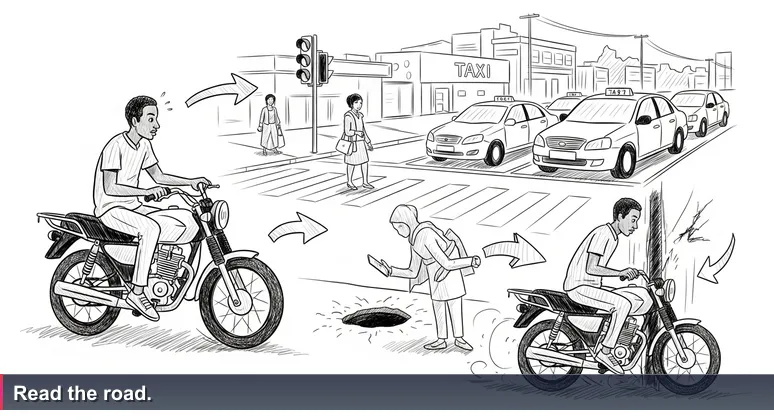
The boda boda rider doesn't ask for a certificate when you hand him the fare. He reads the road and moves. This is your final test: can you answer "yes" to all six of these checks? If so, you are an AI engineer in Uganda's market - not on paper, but in practice. The roadmap ends here, but your journey on Kampala Road begins.
- One live API serving a model's predictions - not perfect, but deployed and explainable
- One messy Ugandan dataset transformed into a trained model with documented F1-score above 85% - mobile-money logs, soil samples, or Luganda text
- One Uganda-relevant project in fintech, agritech, healthtech, or local-language NLP - shows you understand the problem beyond the algorithm
- One explanation of a neural network to a non-technical stakeholder - a bank manager who needs to trust your fraud-detection output
- One credential from a structured program - Mak-AI Academy, Nucamp, UCU MSc, or an IABAC certification - proving you can commit to a learning arc
- One local community connection - you can name three other AI engineers in Kampala who would recognise your work
The salary data backs this up: entry-level AI specialists earn ~UGX 16.8M/year, mid-level engineers ~UGX 36.5M, and those who ship products for remote roles can hit $100,000/year. But the real prize is the fluency that no certification teaches - knowing when to swerve from the textbook, when to accelerate through a messy dataset, when to take a dirt path that others missed. The roadmap gets you started. The messy, Ugandan reality makes you an engineer. Now go build something that works on Kampala Road.
Common Questions
Do I need a university degree to become an AI engineer in Uganda?
No, a degree isn't mandatory. Employers in Kampala prioritize deployed projects and practical skills over formal education. Many successful AI engineers, like Atuhumuza Asenanth of Africa's Talking, built their careers through project-based learning and community engagement.
How much can I earn as an AI engineer in Uganda?
Mid-level AI engineers in Kampala can earn around UGX 36,500,000 per year, and those with remote roles may earn $100k+ annually. Salaries vary by experience and employer, with fintechs and telcos like MTN and Airtel offering competitive packages.
What's the fastest way to get hired as an AI engineer in Uganda?
The fastest path is building a portfolio with two Uganda-relevant deployed projects (e.g., mobile money fraud detection or Luganda chatbot) and networking at local hubs like Hive Colab or The Innovation Village. Over 90% of local employers value deployment experience over certificates.
Can I learn AI engineering without a powerful computer or stable internet?
Yes, you can start with a refurbished laptop (8GB RAM) and use Google Colab for GPU access. For internet, MTN or Airtel bundles of 20GB/month are sufficient for most online courses and cloud-based training.
Is it worth spending UGX 15M on a bootcamp like Nucamp's Solo AI Tech Entrepreneur?
If you need structured learning, career support, and a network in East Africa, it's a solid investment. The bootcamp covers LLM integration and deployment, which are in high demand. However, you can also use free resources like Coursera's deep learning specialization and build projects independently.
Our article on Uganda tech jobs in 2026 for non-graduates ranks them by salary.
For a data-driven answer to “Should I build a tech career in Uganda?”, this article uses real salary surveys and living wage benchmarks.
Our team relied on the top incubators in Uganda to find sector-specific labs and corporate connections.
Find free tech training in Uganda 2026 at your nearest library or community centre with our top 10 list.
Our guide to Uganda AI industry jobs lists the 10 best companies to join in 2026.

Irene Holden
Operations Manager
Former Microsoft Education and Learning Futures Group team member, Irene now oversees instructors at Nucamp while writing about everything tech - from careers to coding bootcamps.