









The Complete Guide to Using AI in the Education Industry in South Korea in 2025
Last Updated: September 10th 2025
Too Long; Didn't Read:
South Korea's 2025 AI education push - AI‑supported digital textbooks and infrastructure - pairs strict Basic AI Act rules (promulgated Jan 21, 2025; effective Jan 22, 2026) and $65B investment, but under 30% elementary adoption (Daegu ~98% vs Sejong ~8%), 98.5% teachers unprepared, 56,505 signatures.
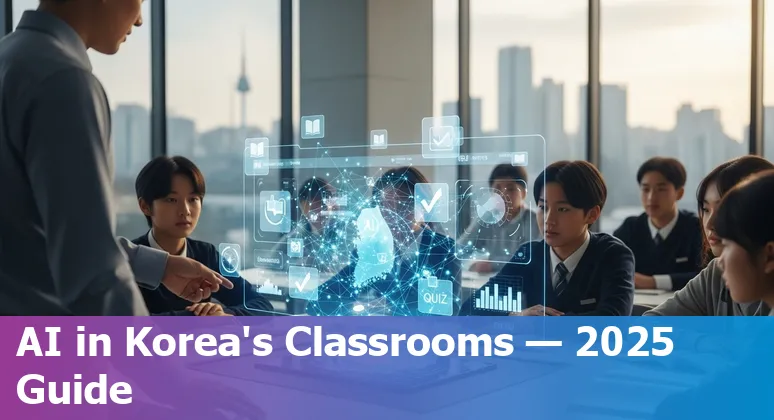
South Korea's 2025 experiment with AI in schools is both urgent and ambivalent: government plans to introduce AI‑supported digital textbooks in subjects like math, English and computer science promised real‑time personalization and a step toward reducing costly Hakwons, yet rollout was uneven - fewer than 30% of elementary schools used the new materials by March 2025 and regional uptake ranged from Daegu's 98% to Sejong's 8% - while teachers and parents raised privacy, screen‑time and training concerns and a petition gathered 56,505 signatures.
At the same time the Basic AI Act (promulgated January 2025) creates new transparency, impact‑assessment and domestic‑representative rules that edtech vendors and schools must navigate; practical, policy‑aware upskilling (for example Nucamp's Nucamp AI Essentials for Work syllabus) plus close reading of the law and rollout reporting - see the CSET translation of the South Korea Basic AI Act (January 2025) and reporting on slowed adoption and reclassification of AI textbooks - are now critical for educators, publishers, and foreign providers trying to turn promise into equitable classroom practice.
| Bootcamp | Length | Early bird cost | Registration |
|---|---|---|---|
| AI Essentials for Work | 15 Weeks | $3,582 | Register for Nucamp AI Essentials for Work (15-week bootcamp) |
| Solo AI Tech Entrepreneur | 30 Weeks | $4,776 | Register for Solo AI Tech Entrepreneur (30-week bootcamp) |
| Cybersecurity Fundamentals | 15 Weeks | $2,124 | Register for Cybersecurity Fundamentals (15-week bootcamp) |
“liven up classrooms”
Table of Contents
- Understanding South Korea's AI policy landscape (Basic AI Act & governance)
- National infrastructure and funding for AI education in South Korea
- AI-supported digital textbooks in South Korea: pilots, adoption and political shifts
- Higher education and workforce development for AI in South Korea
- Classroom realities in South Korea: teachers, parents and equity concerns
- Compliance and operational steps for edtech and foreign providers in South Korea
- Practical classroom best practices for using AI in South Korea schools
- Opportunities and risks for AI in South Korea's education sector
- Conclusion & a South Korea-specific checklist for beginners
- Frequently Asked Questions
Find a supportive learning environment for future-focused professionals at Nucamp's South Korea bootcamp.
Understanding South Korea's AI policy landscape (Basic AI Act & governance)
(Up)South Korea's new Basic AI Act creates a single, risk‑based governance layer that every edtech vendor and school leader must understand: promulgated January 21, 2025 and set to take effect January 22, 2026, the law defines AI and carves out
high‑impact AI
uses (notably including student assessment in early childhood, elementary and secondary education), requires transparency for generative AI, and gives regulators teeth to inspect and enforce compliance.
The Act reaches extraterritorial providers and can force foreign firms to name a Korean domestic representative, while computational thresholds will trigger mandatory risk‑management systems and lifecycle documentation; agencies led by the Ministry of Science and ICT (MSIT) and related bodies will issue the implementing rules that fill in details like thresholds and reporting.
For a clear English translation of the statute and its classroom‑critical definitions, see CSET English translation of the Basic AI Act, and for a practical policy breakdown of obligations and timelines consult the Future of Privacy Forum explainer on compliance timelines and obligations.
That combination - explicit schooling use‑cases, extraterritorial reach, and relatively modest fines (up to KRW 30 million) - means developers, publishers and districts must pair pedagogical plans with legal checklists before deploying AI tools that touch students' assessments or rights.
| Item | Key point |
|---|---|
| Promulgation | January 21, 2025 |
| Effective date | January 22, 2026 |
| Scope | Extraterritorial - applies to acts affecting Korean users/market |
| High‑impact AI | Includes student assessment; triggers impact assessments & safeguards |
| Enforcement | MSIT investigative powers; fines up to KRW 30 million |
National infrastructure and funding for AI education in South Korea
(Up)South Korea's national infrastructure push for AI education is unmistakable: a headline $65 billion build‑out (public and private) aims to seed massive GPU capacity, regional hyperscale data centers and tighter industry partnerships that can supply schools, universities and research labs with model‑training horsepower - see the reporting on the country's South Korea $65 billion AI infrastructure investment and planned 15,000‑GPU deployments.
At the policy level the Ministry of Science and ICT is standing up a public‑private National AI Computing Center (via an SPC) to give academia and industry prioritized access to advanced processors, while a concurrent KRW 403.1 billion K‑Cloud R&D program is funding domestic AI semiconductors and cloud stacks to reduce dependence on foreign chips.
That momentum is real, but uneven: local projects such as the Gwangju AI data center have been operating at roughly 50% capacity after a budgeting shortfall, a sharp reminder that procurement targets and classroom benefits (hands‑on GPU time for students and researchers) depend on timely funding and operational follow‑through; education leaders should therefore watch both the big procurement timelines and local utilization reports when planning AI curriculum or vendor contracts.
For pragmatic planning, pair national timelines with school‑level needs - what network upgrades, teacher training, and reserved GPU quotas will be required when the National AI Computing Center and regional data centers reach initial service stages.
| Item | Key figure |
|---|---|
| Headline investment | $65 billion committed through 2027 (public‑private) |
| National AI Computing Center | Planned SPC model; objectives include ~15,000 advanced GPUs / exaflop‑scale capacity |
| K‑Cloud R&D Project (MSIT) | KRW 403.1 billion total; government funding KRW 342.6 billion (2025–2030) |
| Gwangju AI data center utilization | Operating at ~50% capacity after funding shortfall |
“Just as broadband networks served as the foundation for Korea's emergence as an ICT powerhouse, AI computing infrastructure will be a core national asset that supports innovation and growth in the AI transformation era.”
AI-supported digital textbooks in South Korea: pilots, adoption and political shifts
(Up)The much‑touted AI‑supported digital textbooks that began pilots in March 2025 - targeting grades 3, 4, 7 and 10 in subjects such as math, English and informatics - quickly exposed the gap between promise and practice: fewer than 30% of elementary schools were using the new materials by March, with adoption wildly uneven (Daegu at about 98% versus Sejong near 8%), teachers and parents raising privacy, screen‑time and training alarms, and unions calling existing training inadequate; for a concise rollout summary see the World Bank's coverage of teachers driving the AI experiment in Korean classrooms World Bank: Teachers Driving an AI Revolution in Korean Classrooms.
Political winds then shifted from a planned nationwide mandate to a voluntary, school‑by‑school model and ultimately a parliamentary move that reclassified AI textbooks as supplementary materials - stripping their legal “textbook” status and leaving schools and publishers without the financial backbone for subscriptions and contracts - reported coverage of the bill and industry fallout is collected in AACRAO's report on South Korea pulling the plug on AI textbooks AACRAO: South Korea Pulls Plug on AI Textbooks - Funding and Industry Fallout.
The result is a fragile middle ground: pockets of spirited experimentation and a vivid lesson that technology pilots need stable funding, clear legal status, and heavy investment in teacher readiness if AI is to reduce reliance on costly Hakwons rather than deepen regional inequality and bankrupt fledgling edtech firms.
“Don't use AI like a Google search bar,” says Jeremy Utley.
Higher education and workforce development for AI in South Korea
(Up)Higher education is the engine room for South Korea's AI workforce push, where KAIST's intensive industry ties and new international partnerships are shaping both curriculum and careers: the government and universities aim to scale training (including a high‑profile target to train 200,000 advanced software and AI professionals by 2027) while research‑heavy programs add ethics, data‑privacy and generative‑AI coursework to graduate syllabi to prepare students for real‑world constraints; for a detailed account of these university‑industry dynamics see the University World News article on KAIST generative AI university‑industry partnerships and national training plans University World News article on KAIST generative AI university‑industry partnerships.
KAIST's practical strategy - pairing students and researchers with corporate compute and data - shows up in partnerships from Naver's LLM collaborations to a March 2025 edge‑AI R&D agreement with Blaize that includes personnel exchanges, joint workshops and prototype co‑development Blaize press release on KAIST–Blaize edge‑AI R&D partnership.
International moves such as talks with King Saud University to create a joint open‑AI research centre and dual degrees illustrate how Korea is exporting talent pathways even as it builds domestic capacity Koreajoongang Daily coverage of the KAIST–King Saud University AI partnership.
A vivid classroom‑to‑market detail: roughly a hundred KAIST graduate students are embedded inside industry labs to work on LLM projects, a hands‑on pipeline that translates university learning into employer‑ready skills and signals the kinds of apprenticeship models districts and bootcamps should mirror.
| Item | Key point |
|---|---|
| Workforce target | Train 200,000 advanced AI/software professionals by 2027 |
| Government funding | KRW 563 billion announced for AI industries & software development |
| Notable partnerships | KAIST–Naver (LLMs), KAIST–Blaize (edge AI), KAIST–King Saud University (open AI joint centre) |
“We need to have our own LLMs, trained using more Korean language knowledge and Korean knowledge. But in addition, it will be useful worldwide.”
Classroom realities in South Korea: teachers, parents and equity concerns
(Up)Classroom realities in South Korea have exposed a painful gap between national ambition and day‑to‑day practice: teachers and parents are wary rather than celebratory, citing rising screen time, data‑privacy worries, and an avalanche of extra work that came without adequate training - surveys found alarmingly high numbers (98.5% of 2,626 teachers called prior training insufficient, and another poll reported 87.4% felt unprepared).
A petition of 56,505 signatures amplified parents' and educators' concerns, and when the National Assembly reclassified AI textbooks as supplementary materials it stripped away the legal and funding scaffolding many schools and publishers were counting on, leaving principals to decide (and pay) for subscriptions.
Those dynamics have produced uneven uptake - pockets of intense use alongside regions with almost no adoption - and a clear lesson: effective AI in classrooms requires predictable financing, sustained professional learning, and rigorous evaluation before scale.
For reporting on teacher sentiment and slowed rollout see the Friedrich Naumann Foundation's coverage of the slowdown and the AACRAO account of the textbook reclassification and funding fallout.
| Measure | Figure |
|---|---|
| Teachers reporting training insufficient | 98.5% (2,626 teachers) |
| Alternative teacher survey (KFTA) | 87.4% reported lack of preparation |
| Petition signatures | 56,505 |
| Elementary school AI textbook usage (Mar 2025) | <30% |
| Regional uptake examples | Daegu ~98% • Sejong ~8% |
“When it comes to education, the AI just isn't good enough to replace teachers yet. And it's a bad bet as a school… if you're a parent, do you really want to experiment on your kid?”
Compliance and operational steps for edtech and foreign providers in South Korea
(Up)Edtech vendors and foreign providers preparing to enter or expand in South Korea should treat the Basic/Framework Act like both a product‑safety manual and a market access checklist: during the one‑year transition (effective 22 Jan 2026) inventory every AI system, classify which tools may count as “high‑impact,” and run risk and impact assessments before deployment; the Ministry of Science and ICT can confirm classifications and conduct on‑site inspections, and failures (including missing required disclosures or a domestic representative) carry administrative fines up to KRW 30 million.
Practical operational steps include naming a Korea‑based domestic representative if thresholds apply, documenting lifecycle risk‑management plans and “model card” explanations, adding obvious user notices and labels for generative outputs, building continuous monitoring and incident response, and aligning data practices with the PIPC's evolving privacy guidance - details and timelines are summarized in the FPF explainer on the AI Framework Act and Securiti's operational overview of the Basic Act.
Vendor contracts should mandate notification of AI updates, reserved audit access for MSIT/PIPC inspectors, and regular compliance reporting; a simple, well‑versioned documentation repository plus a designated AI compliance officer will dramatically reduce friction during ministerial reviews and procurement decisions, and convert regulatory obligations into reliable procurement assets rather than last‑minute liabilities.
| Item | Key point |
|---|---|
| Effective date | January 22, 2026 (one‑year transition period) |
| Domestic representative | Required for certain foreign providers meeting user/revenue thresholds |
| Core obligations | Risk management, impact assessments for high‑impact AI, transparency for generative AI, documentation of safety/reliability |
| Enforcement | MSIT investigations, on‑site inspections; fines up to KRW 30 million |
| Agencies to monitor | Ministry of Science & ICT (MSIT) and Personal Information Protection Commission (PIPC) |
Practical classroom best practices for using AI in South Korea schools
(Up)Practical classroom best practices in South Korea start with designing AI use around teachers, not as a replacement - embrace the teacher-led, AI-enabled model highlighted by the World Bank and make teachers the drivers of lesson design, feedback loops and ethical oversight (World Bank report: Teacher-led AI revolution in Korean classrooms).
Begin with small, well-instrumented pilots (the national rollout begins March 2025 for select grades) that collect real-time performance data and feed clear, actionable reports to instructors; pair every pilot school with a digital tutor and a local tech center to handle device management and troubleshooting, and commit to the one device per student and upgraded network targets the Ministry envisions so teachers aren't battling connectivity during class.
Invest heavily in sustained professional learning - Korea has fronted roughly $0.74 billion for teacher training through 2026 - so classroom teams can move from troubleshooting to designing adaptive lessons, using scaffolded examples like Nucamp's three-track middle-school English unit to support remedial, on-level, and enrichment learners within the same plan (Nucamp three-track middle-school English unit - adaptive learning example).
Finally, require pre-defined impact evaluations and transparent data practices before scaling: rigorous monitoring and iterative teacher feedback turn pilot insights into classroom improvements rather than one-off experiments.
Opportunities and risks for AI in South Korea's education sector
(Up)South Korea's AI moment in education offers a rare mix of tangible opportunity and real-world risk: AI‑enabled personalization can help teachers tailor lessons and free time for richer, human‑led instruction - an approach the World Bank analysis of teacher‑led, AI‑enabled classrooms in Korea profiles as teacher‑led, AI‑enabled - and proponents argue it could shrink dependence on expensive Hakwons and lift weaker students; but the rollout so far exposes acute dangers, from uneven uptake (under 30% of elementary schools using AI textbooks by March 2025) and striking regional gaps (Daegu ~98% vs Sejong ~8%) to frontline resistance (98.5% of teachers said training was insufficient) and a 56,505‑signature petition, all of which culminated in parliament stripping AI textbooks of official “textbook” status and leaving schools to foot subscription bills - coverage of that policy reversal and industry fallout is collected by AACRAO report on South Korea pulling funding for AI textbooks.
The net: promising adaptive tutors and administrative savings exist alongside threats to equity, privacy, screen‑time balance and financial sustainability, so pragmatic pilots, long‑term teacher development and stable funding must guide any scale‑up rather than technocratic timelines alone - otherwise the gulf between a classroom transformed and one abandoned for private tutoring will be painfully visible on the map.
| Measure | Figure / Finding |
|---|---|
| Elementary school AI textbook usage (Mar 2025) | <30% |
| Teachers reporting training insufficient | 98.5% (2,626 teachers) |
| Petition signatures opposing AI textbooks | 56,505 |
| Regional uptake examples | Daegu ~98% • Sejong ~8% |
"When it comes to education, the AI just isn't good enough to replace teachers yet. And it's a bad bet as a school… if you're a parent, do you really want to experiment on your kid?"
Conclusion & a South Korea-specific checklist for beginners
(Up)Conclusion: South Korea's 2025 AI moment demands a cautious, checklist‑driven approach - start by treating the Basic AI Act as the operating manual (promulgated Jan 21, 2025; effective Jan 22, 2026) and get familiar with its high‑impact definitions that explicitly include student assessment; see the CSET translation of the South Korea Basic AI Act (full text and classroom provisions) CSET translation of South Korea Basic AI Act (full text and classroom provisions).
Next, plan compliance steps now: classify tools for “high‑impact” review, build lifecycle risk‑management and transparency labels for generative outputs, and if operating from abroad, be ready to name a Korean domestic representative as required by the law - practical implementation notes and timelines are usefully summarized in Securiti's overview of the Act Securiti overview of the South Korea Basic AI Act (practical implementation notes and timelines).
Pair legal preparation with teacher‑led pilots and heavy investment in professional learning - remember fewer than 30% of elementary schools had adopted AI textbooks by March 2025, so teacher readiness and predictable funding will make or break scale.
For professionals and school leaders wanting hands‑on upskilling tied to classroom and workplace use, consider a focused program like Nucamp's AI Essentials for Work to build practical prompt, tool and governance skills before deployment Nucamp AI Essentials for Work syllabus (course details and enrollment); the net advantage is simple: legal checklists plus teacher ownership turn regulatory risk into reliable classroom value.
| Checklist item | Why it matters (source) |
|---|---|
| Confirm Basic AI Act dates & scope | Promulgated Jan 21, 2025; effective Jan 22, 2026 (CSET, FPF) |
| Classify high‑impact AI (student assessment included) | Triggers impact assessments and safety requirements (CSET) |
| Appoint a Korean domestic representative if foreign | Required when thresholds met; responsible for compliance (CSET, Securiti) |
| Build risk management, explainability & labeling | Transparency rules for generative/high‑impact AI (Securiti, FPF) |
| Run teacher‑led pilots + invest in sustained training | Pilot uptake low (<30% elementary schools by Mar 2025); teacher readiness essential (Freiheit / reporting) |
Frequently Asked Questions
(Up)What does South Korea's Basic AI Act require for education tools and when does it take effect?
The Basic AI Act was promulgated on January 21, 2025 and takes effect January 22, 2026 (one‑year transition). It creates a risk‑based governance layer that explicitly treats some schooling uses - notably student assessment at early childhood, elementary and secondary levels - as high‑impact AI, triggering mandatory impact assessments, lifecycle risk‑management, transparency for generative outputs and documentation (model cards). The law has extraterritorial reach, can require foreign providers to appoint a Korean domestic representative, and gives MSIT and other agencies inspection and enforcement powers with administrative fines up to KRW 30 million.
How broadly were AI‑supported digital textbooks adopted in the 2025 rollout and what political changes followed?
By March 2025 fewer than 30% of elementary schools were using the AI‑supported digital textbooks. Adoption was highly uneven (example regional figures: Daegu ~98% vs Sejong ~8%). After teacher and parent pushback, political debate shifted rollout from a planned nationwide mandate to voluntary school‑by‑school use and parliament later reclassified AI textbooks as supplementary materials, stripping official "textbook" status and removing the legal/funding backbone for subscriptions and contracts.
What were teachers' and parents' main concerns and what do the surveys show?
Teachers and parents raised privacy, screen‑time, training and equity concerns. Key figures from reporting and surveys: 98.5% of 2,626 teachers said prior training was insufficient; an alternative KFTA survey found 87.4% felt unprepared. A parent/educator petition gathered 56,505 signatures. These concerns contributed to slowed adoption and demands for more sustained professional learning and clear evaluation before scale‑up.
What national infrastructure and funding support is in place for AI education?
The government and private sector committed a headline $65 billion build‑out through 2027 to expand GPU capacity, regional data centers and industry partnerships. MSIT is establishing a National AI Computing Center (SPC model) targeting roughly ~15,000 advanced GPUs/exaflop‑scale capacity; the K‑Cloud R&D program totals KRW 403.1 billion (government funding KRW 342.6 billion for 2025–2030). Local projects show uneven execution (for example the Gwangju AI data center was operating at about 50% capacity after a funding shortfall).
What practical compliance and operational steps should edtech vendors, foreign providers and schools take now?
Begin by inventorying AI systems, classifying which tools could be "high‑impact" (student assessment included) and running documented risk and impact assessments. Prepare lifecycle risk‑management plans and model cards, add clear user notices/labels for generative outputs, implement continuous monitoring and incident response, and align data practices with PIPC guidance. Foreign firms should be ready to appoint a Korean domestic representative if thresholds apply. Vendor contracts should include update notifications, audit access for MSIT/PIPC, and versioned compliance documentation. Following these steps reduces inspection friction and converts regulatory requirements into procurement assets.
Investing in teacher training and upskilling accelerates adoption and multiplies efficiency gains across school networks.
Read a pragmatic 30-school district pilot evaluation plan with clear KPIs, timelines, and decision gates for phased scale-up.
As automated scoring becomes mainstream, districts will hire assessment auditor roles to ensure fairness, validity, and cultural fit of AI evaluations.

Ludo Fourrage
Founder and CEO
Ludovic (Ludo) Fourrage is an education industry veteran, named in 2017 as a Learning Technology Leader by Training Magazine. Before founding Nucamp, Ludo spent 18 years at Microsoft where he led innovation in the learning space. As the Senior Director of Digital Learning at this same company, Ludo led the development of the first of its kind 'YouTube for the Enterprise'. More recently, he delivered one of the most successful Corporate MOOC programs in partnership with top business schools and consulting organizations, i.e. INSEAD, Wharton, London Business School, and Accenture, to name a few. With the belief that the right education for everyone is an achievable goal, Ludo leads the nucamp team in the quest to make quality education accessible