









The Complete Guide to Using AI in the Hospitality Industry in South Korea in 2025
Last Updated: September 10th 2025
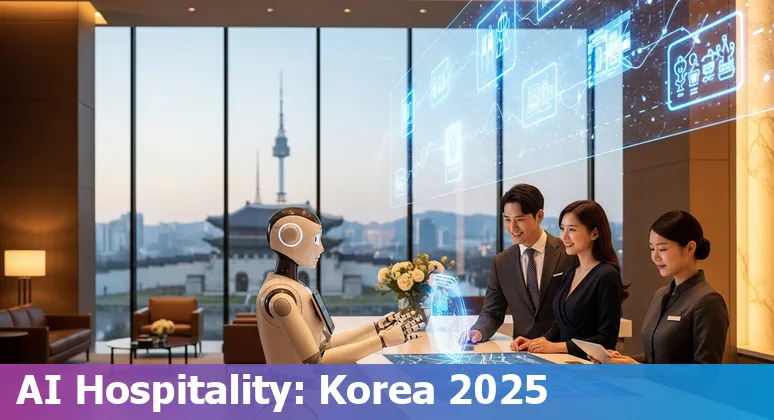
Too Long; Didn't Read:
South Korea's 2025 hospitality AI surge pairs ₩100+ trillion funding and ₩16T GPU expansion with the AI Basic Act (effective Jan 22, 2026). Chatbots, personalization and dynamic pricing will boost RevPAR as generative-AI hospitality rises $24.08B→$34.22B (2024→2025).
South Korea's hospitality sector is at a tipping point: global reports show AI in hotels and restaurants exploding - from a global market jump from $0.15B in 2024 to $0.23B in 2025 - and Seoul operators can't ignore chatbots, personalization engines and ML-driven dynamic pricing that boost RevPAR and cut operating costs; see the industry forecast in the AI in Hospitality market forecast - The Business Research Company.
Locally, South Korea ranks among the top five AI research nations and already posts rapid conversational-AI adoption (IMARC estimates a strong conversational AI market), so expect richer multilingual guest support and 24/7 virtual concierges to scale quickly - especially as tourism rebounds (Invest KOREA projects global arrivals up 3–5% in 2025), creating demand spikes that AI can smooth with predictive analytics and real-time pricing.
For hospitality leaders, the question is no longer whether to adopt AI but how fast to operationalize trustworthy, compliant systems that deliver measurable guest lift.
| Bootcamp | Highlights |
|---|---|
| AI Essentials for Work | 15 weeks; learn AI tools, prompt writing, job-based skills; early-bird $3,582 ($3,942 after); 18 monthly payments; syllabus: AI Essentials for Work syllabus; register: AI Essentials for Work registration page. |
Table of Contents
- South Korea's AI Strategy and National Commitments (2025)
- Regulatory and Legal Landscape for AI in South Korea
- AI Infrastructure, Semiconductors and Data Center Expansion in South Korea
- Local AI Products, R&D and Platforms Hospitality Can Use in South Korea
- How AI Is Used in the Hospitality Industry in South Korea
- Compliance, Procurement and Corporate Implications for Hospitality in South Korea
- Which Occupations Are in High Demand in South Korea in 2025?
- AI Industry Outlook and Opportunities for Hospitality in South Korea (2025)
- Conclusion & Practical Next Steps for Hospitality Firms in South Korea
- Frequently Asked Questions
Transform your career and master workplace AI tools with Nucamp in South Korea.
South Korea's AI Strategy and National Commitments (2025)
(Up)South Korea's 2025 playbook pairs a human‑centered trust push with massive industrial muscle: the Ministry of Science and ICT's “realize trustworthy artificial intelligence for everyone” plan organizes policy around the three pillars of technology, system and ethics and feeds into the broader national effort to scale compute, talent and sovereign models; read MSIT's strategy MSIT trustworthy artificial intelligence strategy (2025).
At the same time the government launched a ₩100 trillion AI initiative to finance 30 flagship projects - backing GPU and data‑center expansion (targeting roughly 15× compute growth by 2030), five “sovereign” foundation‑model teams and talent programs to train 200,000 AI professionals - details summarized in the South Korea ₩100 Trillion AI Initiative 2025 report.
Legal guardrails are moving in parallel: the AI Framework/Basic Act (passed in late 2024) creates a risk‑based regime with transparency and user‑notification duties for generative and high‑impact systems and a one‑year transition to full implementation (Jan 2026), so hospitality operators should plan both for new procurement and compliance steps; see analysis of the Framework Act FPF analysis of South Korea AI Framework Act.
The result is practical: faster access to public AI compute and procurement incentives, plus mandatory impact assessments and labeling that make trust a competitive asset - think measurable guest personalization powered by government‑backed data centers, not just experimental pilots.
| Commitment | 2025 Snapshot |
|---|---|
| National fund | ₩100+ trillion National Growth Fund for 30 flagship projects |
| Infrastructure | ₩16T for GPUs/data; National AI Computing Center (expanded GPU capacity 15× by 2030) |
| Law & timeline | AI Basic/Framework Act passed Dec 2024; implementation begins Jan 2026 (risk‑based, generative AI labeling) |
| Targets | 5 sovereign models (₩530B), 200,000 AI experts by 2030, 70% industry / 95% public sector adoption goals |
“Advanced technologies like artificial intelligence (AI) are national power, economic strength, and ultimately, a pillar of security.” - President Lee Jae‑myung
Regulatory and Legal Landscape for AI in South Korea
(Up)South Korea's legal landscape for AI has shifted from scattershot rules to a single, risk‑based framework that hospitality operators must budget for and operationalize before the Act takes effect on 22 January 2026: the AI Basic/Framework Act imposes transparency duties for generative systems (think: clear labels when outputs - images, voices or videos - are hard to tell from reality), targeted safety, risk‑management and human‑oversight requirements for “high‑impact” AI, and broad extraterritorial reach that pulls foreign providers into Korean compliance if they affect local users or markets; see the detailed FPF analysis of the Framework Act for implementation timing and obligations in the FPF analysis of South Korea's AI Framework Act FPF analysis of South Korea's AI Framework Act.
Practical rules include advance user notification, mandatory impact assessments for systems affecting fundamental rights, documentation and explainability plans, a domestic‑representative requirement for large foreign operators, and relatively modest fines (up to KRW 30 million) - but enforcement powers rest with MSIT and will intersect with PIPC data‑protection oversight, so procurement, audit trails and privacy controls must be redesigned now; OneTrust lays out concrete preparation steps for organizations facing these transparency, governance and reporting demands in OneTrust guidance on preparing for South Korea AI law compliance OneTrust guidance on preparing for South Korea AI law compliance.
For hoteliers and restaurateurs, the “so what” is simple: even a useful guest‑facing chatbot or automated pricing engine can trigger pre‑deployment impact checks, labeling and domestic‑representation duties - turn compliance into a trust advantage rather than an afterthought.
“the international community must work together to ensure that artificial intelligence and digital technology contribute to world peace and prosperity.” - President Yoon Suk Yeol
AI Infrastructure, Semiconductors and Data Center Expansion in South Korea
(Up)South Korea is scaling the physical backbone that will let hospitality firms run low‑latency, privacy‑aware AI services locally: Fir Hills (Stock Farm Road) has proposed a staggering 3GW AI data‑centre in Jeollanam‑do with at least $10 billion (and up to $35 billion) of investment, construction slated to start winter 2025 and finish by 2028, promising advanced cooling, renewable integration and the ability to absorb sudden energy spikes that large‑scale model training demands - see the Fir Hills 3GW AI data-center plan on Data Center Dynamics for project details.
That mega‑site is part of a broader national push - Jeollanam‑do's “AI Supercluster Hub” links massive AI compute with grid upgrades, ESS and R&D to attract hyperscalers and innovators, a development hospitality IT teams should watch closely if they plan to deploy on‑prem private models or GPU‑heavy personalization and dynamic pricing stacks (read the Jeollanam-do AI Supercluster Hub announcement for scope).
Meanwhile, local industry moves - SK Group's cloud collaboration with AWS, SK Telecom's GPUaaS rollout and new Equinix/Digital Realty capacity in Seoul - are creating more proximate options for hotels and restaurants that need GPU access without long egress times; together these projects mean Korean operators can expect not just cheaper, greener compute but also faster pathing from pilot to production for voice assistants, real‑time translation and RevPAR optimization engines.
| Item | Snapshot |
|---|---|
| Project | Fir Hills / Stock Farm Road 3GW AI data centre (Jeollanam-do) |
| Investment | At least $10B; potential up to $35B |
| Timeline | Construction starts Winter 2025; completion targeted 2028 |
| Jobs | 10,000+ across energy, R&D, manufacturing |
| Key features | Advanced cooling, renewable integration, energy‑to‑intelligence (e2i²), large fibre bandwidth |
“This is more than just a technological milestone; it's a strategic leap forward for Korea's global technological leadership.” - Dr. Amin Badr‑El‑Din
Local AI Products, R&D and Platforms Hospitality Can Use in South Korea
(Up)South Korea's local AI stack puts practical, Korea‑native capabilities within reach for hotels and restaurants: NAVER's HyperCLOVA X family, built to understand Korean cultural nuance (trained on roughly 6,500× more Korean data than GPT‑4) and optimized tokenization for faster, cheaper inference, can power everything from multilingual guest chat to image‑aware assistants and tone‑sensitive copy for marketing - explore HyperCLOVA X's features and enterprise APIs on NAVER's site NAVER HyperCLOVA X enterprise APIs and features.
The inference‑focused HyperCLOVA X Think shows top Korean‑language benchmark scores and practical multimodal skills that make it well suited for concierge agents and real‑time translation in guest interactions (Coverage of HyperCLOVA X Think inference and benchmarks).
For operators this means low‑code/no‑code routes (CLOVA Studio), light‑weight DASH models for on‑device chat, and more capable SEED variants for visual menus or document Q&A - so the next memorable guest moment might come from an AI that reads a menu photo, recommends pairings in the correct honorifics, and writes the reply in fluent Korean tone, all with production‑grade efficiency and local language accuracy.
| Model | Best for hospitality use |
|---|---|
| HyperCLOVA X THINK | Multimodal reasoning; complex guest queries and agent workflows |
| SEED 14B / SEED 3B | Visual and video understanding (menus, room photos) and regional context |
| SEED 1.5B / 0.5B | Compact translation and conversational interfaces for mobile/edge |
| DASH | Lightweight, fast inference for cost‑sensitive customer‑facing features |
How AI Is Used in the Hospitality Industry in South Korea
(Up)Across Korea's hotels and restaurants, practical AI use is already shifting day‑to‑day work from repetitive tasks to richer guest moments: AI‑powered chatbots deliver 24/7 multilingual support and handle routine bookings and FAQs so staff can focus on upselling and hospitality, while guest‑facing virtual concierges such as RENAI‑style services blend AI suggestions with human curation to serve locally relevant recommendations and boost engagement (see the RENai case study on DigitalDefynd).
These conversational systems also create a “treasure trove” of behavioral data - perfect for tailored offers - while on-device translation and OCR tools (examples like Waygo on-device translation and OCR tools) melt language barriers for inbound travelers.
Back‑office ML powers dynamic pricing and RevPAR optimization to lift revenue without manual guesswork, and delivery robotics (see Robotis House Ant delivery robotics examples) free attendants for personalization rather than routine runs.
To keep those systems trustworthy, Korean operators should pair guest agents and pricing engines with runtime protections - fraud and prompt‑injection defenses - and clear audit trails so AI becomes a measurable service differentiator, not a compliance headache; imagine a bot that reads a menu photo, recommends pairings in the correct honorifics, and books a table without waking a single human agent.
Learn more about how chatbots are transforming travel on Kore.ai chatbot solutions for travel and explore practical pricing tactics in the Nucamp AI Essentials for Work syllabus: practical dynamic pricing guide.
Compliance, Procurement and Corporate Implications for Hospitality in South Korea
(Up)Compliance, procurement and corporate strategy for hospitality operators in South Korea must move from checklist to boardroom priority: the AI Basic/Framework Act (effective Jan 22, 2026) reaches extraterritorially, forces advance classification of high‑impact systems, mandates user notification and generative‑AI labeling, and carries modest but material fines (up to KRW 30 million), so even a front‑desk chatbot or dynamic pricing engine can trigger impact assessments, documentation and domestic‑representative duties - turning compliance into a commercial filter for vendors and a trust signal to guests.
Practical actions for hotels and restaurant groups include cataloging AI assets, running pre‑deployment impact assessments and computational‑threshold checks, requiring suppliers to provide explainability docs and audit trails, and building contractual clauses for domestic representation and MSIT/PIPC cooperation; these steps are spelled out in the legal summaries and readiness guides such as the FPF analysis: South Korea AI Framework Act overview and implications for businesses and tactical preparation advice from OneTrust guide: Preparing organizations for South Korea AI law compliance.
Procurement teams should also prefer vendors with completed impact assessments - public procurement incentives exist for assessed products - and insist on runtime protections (fraud/prompt‑injection defenses) and data governance controls described in compliance overviews like the Securiti summary: South Korea Basic Act on the Development of AI compliance overview; the payoff is concrete: a well‑documented, auditable AI deployment becomes a measurable guest‑trust and revenue advantage rather than a regulatory risk.
Which Occupations Are in High Demand in South Korea in 2025?
(Up)As South Korea's AI market accelerates - valued at roughly USD 1,185.9M in 2024 with strong growth ahead - hospitality employers should be hiring for a mix of technical and hybrid roles that turn infrastructure and models into guest value: AI/ML engineers and data scientists to build personalization and RevPAR models (market growth and AI engineering demand are detailed in the South Korea artificial intelligence market report 2024 and the global AI engineering market report); cloud, GPU and data‑center engineers as local compute and hyperscaler capacity expands; semiconductor and chip designers given Korea's major chip investments; MLOps and AI‑ops specialists to keep production systems stable; NLP and multilingual specialists for Korean/foreign‑language guest chat and translation; and cybersecurity/compliance professionals to address runtime defenses and the new AI Framework Act requirements (see Nucamp guidance on Nucamp AI Essentials for Work syllabus - fraud & prompt-injection defenses).
On the operations side, revenue managers and data analysts who can pair ML pricing signals with on‑the‑ground strategy - and robotics/fleet technicians as delivery automation scales - will be particularly valuable; think of a small team tuning GPUs and models so a multilingual virtual concierge answers a booking in fluent honorifics, instantly.
| Occupation | Why in demand (2025) |
|---|---|
| AI/ML Engineers & Data Scientists | Market growth & enterprise AI adoption driving model development (South Korea artificial intelligence market report 2024) |
| Cloud/GPU & Data‑Center Engineers | Local data‑centre and GPU expansion requires ops and integration skills |
| Semiconductor/Chip Engineers | Domestic chip investments and production needs support hardware roadmap |
| MLOps / AI‑ops | Productionizing models, reliability and runtime monitoring (AI engineering trends) |
| NLP / Multilingual Specialists | Conversational AI and translation for inbound tourism |
| Cybersecurity & Compliance Experts | Prompt‑injection defenses, privacy, and new regulatory duties (Nucamp AI Essentials for Work syllabus - fraud & prompt-injection defenses) |
| Revenue Managers & Data Analysts | Dynamic pricing and RevPAR optimization to capture demand spikes |
| Robotics / Fleet Technicians | Automation (delivery/room service) frees staff for personalization |
AI Industry Outlook and Opportunities for Hospitality in South Korea (2025)
(Up)South Korea's hospitality sector sits squarely in a fast‑moving global wave: generative AI for hotels and restaurants vaulted from about $24.08B in 2024 to $34.22B in 2025 and is forecast to keep accelerating, with Asia‑Pacific flagged as the fastest‑growing region - meaning Korean operators can realistically expect more capable virtual concierges, automated content generation and smarter RevPAR engines to reach production sooner than before (Generative AI in Hospitality Global Market Report 2025 – The Business Research Company).
Complementary market studies show the wider AI‑in‑hospitality segment climbing from roughly $0.15B to $0.23B in 2025, driven by chatbots, personalization engines, demand forecasting and voice assistants - all practical levers for hotels and restaurants to boost guest satisfaction and operational efficiency (AI in Hospitality Market Forecast 2025 – The Business Research Company).
With UN/Invest KOREA projections of rising arrivals in 2025, the upside is clear: turn AI from experiments into audited, labeled, and compliant services that deliver tangible cross‑sell lifts - picture a multilingual bot that recommends the perfect dinner pairing in fluent honorifics and books the table while dynamic pricing captures the uptick in demand (Invest KOREA 2025 tourism outlook).
| Metric | Value (2024 → 2025) | Source |
|---|---|---|
| Generative AI in Hospitality (Global) | $24.08B → $34.22B | The Business Research Company (TBR) 2025 report |
| AI in Hospitality (Market snapshot) | $0.15B → $0.23B | The Business Research Company (TBR) 2025 report |
Conclusion & Practical Next Steps for Hospitality Firms in South Korea
(Up)Practical next steps for South Korea's hospitality operators boil down to three clear moves: inventory and classify every AI touchpoint (even a front‑desk chatbot), run pre‑deployment impact assessments and build audit trails so generative outputs are labeled and human‑overseeable under the AI Basic Act (effective Jan 22, 2026), and lock procurement around explainability and vendor due diligence to avoid extraterritorial exposure and fines (up to KRW 30 million) - start with OneTrust's step‑by‑step compliance checklist for the AI Basic Act to map obligations and risk controls and read OneTrust's preparation guide for concrete actions (assess systems, establish transparency, build risk management and oversight).
Operationally, add runtime protections (fraud/prompt‑injection defenses), a tested incident‑response playbook and a domestic representative where required; these controls turn regulatory cost into a trust advantage that guests notice.
For teams that need practical skills fast, the Nucamp AI Essentials for Work bootcamp teaches prompt craft, tool usage and fraud/defense basics to make compliant, guest‑facing AI reliable and revenue‑positive - think a multilingual concierge that books a table in correct honorifics while every step is auditable and compliant.
| Bootcamp | Length | Cost (early bird) | Syllabus / Register |
|---|---|---|---|
| AI Essentials for Work | 15 Weeks | $3,582 | AI Essentials for Work syllabus · Enroll in AI Essentials for Work |
Frequently Asked Questions
(Up)What is the market outlook for AI in hospitality globally and in South Korea for 2024–2025?
Generative AI for hotels and restaurants jumped from about $24.08B in 2024 to $34.22B in 2025, and the narrower hospitality AI market moved from roughly $0.15B to $0.23B over the same period. South Korea's broader AI market was estimated at about USD 1,185.9M in 2024. With Invest KOREA projecting global arrivals up about 3–5% in 2025, demand spikes plus faster model and compute availability mean more capable virtual concierges, personalization engines and dynamic pricing systems will reach production in 2025.
What legal and compliance requirements should South Korean hotels and restaurants prepare for?
South Korea's AI Basic/Framework Act passed in December 2024 and begins full implementation on January 22, 2026. Key duties for operators include advance user notification and generative‑AI labeling, mandatory impact assessments and documentation for systems that affect fundamental rights or are high‑impact, explainability plans, and domestic‑representative requirements for large foreign providers. The law has extraterritorial reach and modest fines (up to KRW 30 million). Enforcement will involve MSIT and intersect with the Personal Information Protection Commission, so procurement, audit trails, privacy controls and pre‑deployment impact checks must be operationalized now.
Which AI applications and local platforms are most useful for hospitality operators in Korea?
Practical, production‑ready uses include 24/7 multilingual chatbots and virtual concierges, ML‑driven dynamic pricing and RevPAR optimization, OCR and on‑device translation for inbound guests, automated content generation for marketing, and delivery/room‑service robotics. Local platforms and offerings well suited to Korean language and context include NAVER's HyperCLOVA X family (HyperCLOVA X THINK for multimodal reasoning, SEED variants for visual tasks, DASH for lightweight inference) and CLOVA Studio for low‑code integration. Hyperscaler partnerships and services (SK + AWS, SK Telecom GPUaaS, Equinix/Digital Realty) also provide lower‑latency GPU access useful for real‑time translation, voice assistants and personalization.
What infrastructure investments and timelines will affect AI deployments in 2025–2030?
South Korea has national commitments including a ₩100+ trillion AI fund and ~₩16T for GPUs/data infrastructure. A major project is the proposed Fir Hills (Stock Farm Road) 3GW AI data center in Jeollanam‑do with at least $10B (up to $35B) in investment, construction slated to start winter 2025 and target completion by 2028. The government is targeting roughly 15× GPU/compute growth by 2030 via expanded national AI computing centers and sovereign model programs. These investments mean faster, cheaper, greener local compute and shorter pilot‑to‑production paths for hospitality AI stacks.
What operational actions and hiring priorities should hospitality firms take now to succeed with AI?
Operationally, inventory and classify every AI touchpoint, run pre‑deployment impact assessments, build auditable documentation and labeling, require vendor explainability and domestic‑representation clauses, and add runtime protections (fraud and prompt‑injection defenses) plus an incident‑response playbook. Hiring priorities include AI/ML engineers and data scientists, cloud/GPU and data‑center engineers, MLOps/AI‑ops specialists, NLP/multilingual experts, cybersecurity and compliance professionals, revenue managers/data analysts for dynamic pricing, and robotics/fleet technicians. For upskilling, short programs (for example a 15‑week AI Essentials bootcamp) can teach prompt craft, tool usage and defense basics to make guest‑facing AI compliant and revenue‑positive.
Unlock seamless travel for international visitors with a Multilingual guest concierge that provides instant translations, local tips, and transit directions tailored to Seoul's neighborhoods.
Stories of Robotis House Ant deliveries demonstrate how delivery automation frees staff for personalization and fleet management work.
Explore the savings unlocked by predictive maintenance for HVAC and elevators, which prevents downtime and expensive emergency repairs at South Korea properties.

Ludo Fourrage
Founder and CEO
Ludovic (Ludo) Fourrage is an education industry veteran, named in 2017 as a Learning Technology Leader by Training Magazine. Before founding Nucamp, Ludo spent 18 years at Microsoft where he led innovation in the learning space. As the Senior Director of Digital Learning at this same company, Ludo led the development of the first of its kind 'YouTube for the Enterprise'. More recently, he delivered one of the most successful Corporate MOOC programs in partnership with top business schools and consulting organizations, i.e. INSEAD, Wharton, London Business School, and Accenture, to name a few. With the belief that the right education for everyone is an achievable goal, Ludo leads the nucamp team in the quest to make quality education accessible