









How AI Is Helping Education Companies in South Korea Cut Costs and Improve Efficiency
Last Updated: September 10th 2025
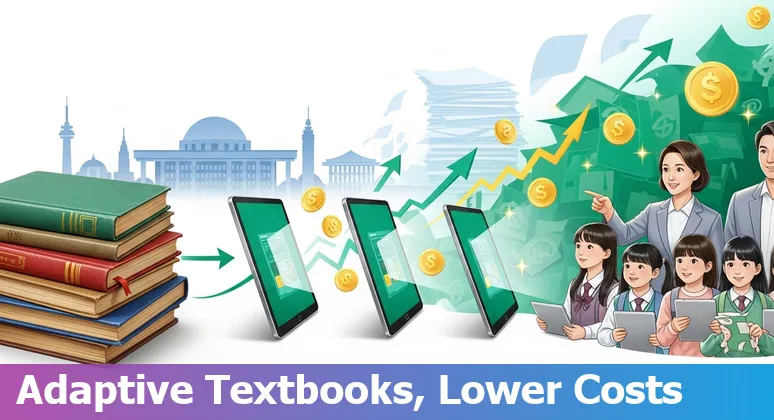
Too Long; Didn't Read:
AI helps South Korean education companies cut costs and improve efficiency by automating admin work, personalizing learning and reducing hagwon reliance; national adoption was ~30% (spring 2025) with Daegu ~98% vs Sejong ~8%, while private education spending hit 29.2 trillion won (2024).
South Korea's education market is a high-stakes proving ground for AI: the Ministry planned to phase in AI-driven digital textbooks in math, English and informatics beginning in 2025, yet adoption and funding have been volatile - fewer than 30% of elementary schools used them by March 2025 and regional uptake ranged from Daegu at about 98% to Sejong near 8%.
That policy turbulence, plus teacher overload and parental skepticism, means education companies must build transparent, low-friction products that prove quick ROI and comply with Korea's new risk-based AI Framework Act.
Upskilling school leaders and edtech teams is equally critical: practical programs like Nucamp's AI Essentials for Work bootcamp teach prompt-writing and applied AI for workplace use, a fast way to move pilots toward scalable, teacher-friendly deployments that can cut costs and curb reliance on private tutoring.
| Program | Length | Early-bird Cost | Registration |
|---|---|---|---|
| AI Essentials for Work | 15 weeks | $3,582 | Register for the AI Essentials for Work bootcamp |
Lee Juho promised the AI textbooks would “liven up classrooms” and motivate students; school dropouts could be prevented.
Table of Contents
- South Korea's AI and education landscape: policy, funding, and rollout
- Adaptive digital textbooks as scalable products in South Korea
- Reducing dependence on private tutoring (hakwons) in South Korea
- Efficiency gains for schools and teachers in South Korea
- Business models and procurement realities in South Korea
- Regional uptake and go-to-market strategy in South Korea
- Barriers that affect ROI and adoption speed in South Korea
- Practical steps for education companies entering South Korea
- Conclusion: The future of AI in education companies in South Korea
- Frequently Asked Questions
See how higher education AI programs are aligning universities and industry to meet national talent targets.
South Korea's AI and education landscape: policy, funding, and rollout
(Up)South Korea's AI push is now a full-court effort: the Ministry of Science & ICT's KRW 6.8 trillion 2025 plan channels large-scale R&D into AI among 12 critical tech areas, while a broader national infrastructure campaign - roughly a $65 billion commitment through 2027 - builds cloud, GPUs and data centers that education companies can tap for scalable, low-latency services (MSIT 2025 AI R&D Plan (KRW 6.8 trillion), South Korea $65B AI Infrastructure Investment Report).
The government is also accelerating budget support - a reported 8% spending rise for 2026 with KRW 10.1 trillion earmarked for direct AI investment and procurement including additional GPUs - which, together with plans for a National AI Computing Center and a 3GW regional data-center buildout, makes on‑demand compute and a “sovereign AI” trained on Korean language and culture much more attainable for local edtechs (South Korea 2026 AI Budget Increase and GPU Investment, South Korea Sovereign AI Plan Built on Korean Data).
The practical upshot for education companies is simple but striking: access to national-grade compute and policy incentives could turn pilots - like adaptive digital textbooks - into citywide deployments, as real as a 15,000‑GPU center coming online within a few years and as tangible as a 3‑GW campus that could host tens of thousands of accelerators.
| Commitment | Headline Detail |
|---|---|
| KRW 6.8 trillion (2025) | R&D for 12 critical and emerging technologies (MSIT) |
| ~$65 billion (through 2027) | National AI infrastructure, data centers, GPUs |
| KRW 10.1 trillion (2026 pledge) | Direct AI investment; 15,000 additional GPUs planned |
“In the current trend of AI transition and accelerating technological competition, securing critical technologies is the only way to ensure a nation's survival both in terms of economy and security.” - Ryu Kwang‑Jun, MSIT
Adaptive digital textbooks as scalable products in South Korea
(Up)Adaptive digital textbooks promised a quick route to personalized, data-driven learning - math, English and informatics editions were slated to roll out from March 2025 - but their path to scale in South Korea has been anything but smooth: by spring 2025 adoption hovered near 30% overall, concentrated in some cities while others barely started (Daegu reported about 98% uptake for at least one subject versus Sejong near 8%), and a summer 2025 parliamentary move reclassified AI-powered textbooks as optional “education materials,” shifting purchase decisions and subscription costs onto individual schools (South Korea removes legal status of AI digital textbooks - The Legal Wire, AI digital textbook adoption in South Korea: 30% of schools (Nikkei Asia)).
That mix of political rollback, uneven regional rollout and teacher unease means adaptive offerings can scale only where procurement, training and local budgets align - so the clearest, most immediate wins are in districts already comfortable with classroom tech and committed to funding subscriptions, while other areas may treat AI textbooks as optional supplements rather than the core curriculum.
| Scope | Adoption / Note |
|---|---|
| National (spring 2025) | ~30% of schools using AI textbooks |
| Daegu | ~98% (at least one subject) |
| Sejong | ~8% |
| South Jeolla | ~9% |
| Gwangju | ~12% |
Lee Juho promised the AI textbooks would “liven up classrooms” and motivate students; school dropouts could be prevented.
Reducing dependence on private tutoring (hakwons) in South Korea
(Up)Reducing Korea's dependence on hagwons is both an economic and educational imperative: households spent a record 29.2 trillion won on private education in 2024, with roughly 80% of students taking extra lessons and Seoul averages near 673,000 won per child per month, even as the student population shrinks (Korea JoongAng Daily report on private education spending).
Those sticker shocks - like an English hagwon raising beginner tuition to 240,000 won per month - make scalable AI alternatives attractive: adaptive digital textbooks and personalized learning platforms can deliver tailored practice, feedback and remediation at lower marginal cost, reducing the need for multiple cram-school enrollments in different subjects.
Practical playbooks and use cases show how district-aligned AI can replace repetitive drill work while preserving teacher-led enrichment (see a practical guide to personalized learning with AI), and ethics/compliance templates help schools adopt tools without breaching the new AI rules.
The “so what” is simple: when edtechs prove they can match hagwon outcomes for a fraction of the monthly bill, parents and districts start to shift spending from private tutors to school‑based, AI‑assisted solutions.
| Metric | 2024 / Example |
|---|---|
| Total private education spending | 29.2 trillion won (2024) |
| Share of students receiving private lessons | ~80% |
| Monthly per-student cost (by level) | Elementary 442,000 won; Middle 490,000 won; High 520,000 won |
| Regional example | Seoul avg ~673,000 won/month; South Jeolla ~320,000 won |
| Hagwon price example | English beginner class raised to 240,000 won/month |
“It's too expensive”
Efficiency gains for schools and teachers in South Korea
(Up)Efficiency gains from AI in South Korean classrooms are already surfacing where technology is used to cut administrative drag and amplify teacher impact: Korea is leaning into teacher-led, AI-enabled models that automate routine tasks like drafting lesson scaffolds, generating differentiated practice, and speeding formative feedback so teachers can concentrate on higher-value instruction (see the World Bank's piece on teachers leading an AI revolution in Korean classrooms).
International experience also shows the value of training AI on high-quality, curriculum-aligned content - one U.K. initiative reported model accuracy rising from 67% to 92% when developers used an approved content bank - so Korean districts that pair reliable datasets with staff training stand to convert pilot projects into measurable classroom time saved (read about tools to reduce teacher workloads).
Practical upskilling - for example, prompt engineering for teachers - makes those efficiency gains real and sustainable by turning brittle AI experiments into dependable classroom assistants that preserve teacher authority while reclaiming time for one-on-one instruction and deeper student support.
“The time saved allows school staff to focus on what matters most, interacting with students and providing individualised feedback and support,” Goodall said.
Business models and procurement realities in South Korea
(Up)Business models and procurement realities in South Korea tilted sharply when the National Assembly stripped AI‑powered digital textbooks of their legal “textbook” status and reclassified them as ordinary educational materials, a move that immediately removed the legal and financial footing for centrally funded subscriptions and handed buying decisions back to individual schools and management committees; the practical upshot is a shift from a government‑backed, centrally procured textbook model to a fragmented, school‑level purchase market with subscription economics and unclear data standards (Strait Times report on South Korea reclassifying AI digital textbooks, The Legal Wire legal analysis of South Korea removing AI digital textbooks' legal status).
Adoption already hovered near 30% before the rollback, and commentators warn usage could fall further as schools lose subsidy support; publishers that poured roughly 800 billion won into development now face protests, layoffs and business model stress, especially because the subscription model (about 5,000 won per subject per month reported) replaces one-time textbook procurement and fragments data collection and standards - weakening the centralized dataset that policymakers hoped would feed Korea's “sovereign AI” ambitions (Korea JoongAng Daily analysis on subscription costs and risks to Korea's sovereign AI), so vendors and districts must now negotiate procurement, pricing and compliance on a school‑by‑school basis rather than under a single textbook regime.
| Item | Reported detail |
|---|---|
| Legal status change | AI textbooks reclassified as educational materials (effective immediately) |
| Adoption (spring 2025) | ~30% of schools using AI textbooks |
| Estimated industry investment at risk | ~800 billion won |
| Subscription pricing example | ~5,000 won per subject per month |
| Procurement shift | Decisions moved to school management committees; subsidies removed |
“Unless the textbooks retain their legal status, we won't be able to receive the necessary funding. It's now almost impossible to use them in class.”
Regional uptake and go-to-market strategy in South Korea
(Up)Regional uptake is the single biggest clue to a smart go‑to‑market strategy in Korea: with roughly 30% national use but extremes - Daegu at about 98% versus Sejong near 8% - edtechs should treat the market as a set of distinct launch zones rather than one uniform country (see Korea Herald's March 2025 adoption data).
Target citywide rollouts and district partnerships where local budgets, tech comfort and training exist, while piloting lighter, low‑friction offerings in cautious regions; partner with local compute and innovation hubs (for example, Gwangju's AI complex and regional data centers) to promise low‑latency demos and stronger privacy controls.
Segment outreach using adopter profiles - finding the “Enthusiastic” and “Confident” publics who will pilot and evangelize - while embedding fast teacher upskilling because surveys flagged training shortfalls as a major barrier.
The practical playbook: win a visible district, measure clear gains in teacher time and student practice, then use that evidence to persuade neighboring schools and management committees to subscribe.
| Region | Adoption (March 2025) |
|---|---|
| National (elementary schools) | ~30% (3,870 of 11,932 schools using at least one subject) |
| Daegu | ~98% |
| Sejong | ~8% |
| South Jeolla | ~9% |
| Gwangju | ~12% |
| North Gyeongsang | ~45% |
| North Jeolla | ~21% |
Lee Juho promised the AI textbooks would “liven up classrooms” and motivate students; school dropouts could be prevented.
Barriers that affect ROI and adoption speed in South Korea
(Up)A cluster of practical barriers is slowing ROI and adoption in Korea: teachers report they weren't prepared - surveys found overwhelming training shortfalls (98.5% in one teacher union poll and similar figures reported elsewhere) - so classroom pilots often stall or add to teacher workload rather than save time, and parents remain skeptical about screen time, privacy and holistic learning (a petition drew 56,505 signatures).
Political and legal churn has been equally disruptive: the National Assembly's reclassification of AI textbooks stripped central funding and left decisions - and costs - to individual schools, putting roughly 800 billion won of publisher investment at risk and turning a once‑coordinated rollout into a fragmented, school‑by‑school sales challenge.
Regional extremes (Daegu near 98% adoption versus Sejong about 8%) expose the digital‑divide problem: districts with weak infrastructure or thin training budgets can't realize the compute or curriculum gains that make AI cost‑effective.
Addressing these obstacles - longer pilots, funded teacher professional learning, clear data safeguards and equitable infrastructure - remains the precondition for predictable ROI and faster, fairer adoption across South Korea (South Korea AI teacher training shortfalls and parental petition, South Korea AI textbook legal rollback and funding impact).
| Barrier | Reported figure / note |
|---|---|
| Teacher training insufficient | 98.5% reported inadequate preparation |
| National adoption (spring 2025) | ~30% of schools using AI textbooks |
| Publisher investment at risk | ~800 billion won |
| Public petition | 56,505 signatures opposing rollout |
“Unless the textbooks retain their legal status, we won't be able to receive the necessary funding. It's now almost impossible to use them in class.”
Practical steps for education companies entering South Korea
(Up)Enter South Korea with a playbook that matches its speed and structure: start by aligning products to national curriculum and Korean-language delivery while proving short, measurable wins in pilot districts that already invest in classroom tech; lean on the Ministry‑backed playbooks and teacher‑training model described in the IDB's roadmap for scaling AIDT to secure trust and funding (IDB report: Implementing EdTech at Scale - Lessons from Korea for Digital Transformation).
Invest upfront in teacher on‑ramps - master‑teacher networks and peer coaching - as Korea's model shows (targeting 300,000 trained teachers, including 34,000 “Leading Teachers”), and design flexible procurement options because legal and subsidy shifts have moved many purchases to school committees.
Build local partnerships via the EdTech Soft Lab and PPP channels, localize UX and content, and prepare a clear ethics/compliance pack for Korea's AI rules; the country's fast, innovation‑driven culture rewards partners who move quickly but respectfully (EdTech Austria: South Korea - Technology, Culture, and the Courage to Innovate in Education).
Finally, map local capital and accelerators early - Korea's active edtech VC scene can turn a successful district pilot into rapid national scale (Analysis of Top EdTech VC Funds in South Korea).
| Practical Step | Supported figure / note |
|---|---|
| Teacher training | Train 300,000 teachers by 2026; 34,000 Leading Teachers (IDB) |
| Connectivity investment | US$70M for high‑speed internet distribution cited (IDB) |
| AIDT funding | US$1 billion Ministry investment in AI Digital Textbook (IDB) |
“Koreans always want to be first. Their motto is: ppalli, ppalli – fast, fast.”
Conclusion: The future of AI in education companies in South Korea
(Up)The future of AI for education companies in South Korea will be decided less by raw compute or product demos and more by practical politics and people: a high‑profile parliamentary rollback and strong teacher and parent pushback showed in blunt terms that technology rolled out without deep professional learning or transparent governance will stumble (see Business Insider's coverage of the textbook rollback).
Where Korea succeeds, it's because districts pair strong infrastructure with sustained teacher training and measured pilots - lessons captured in the IDB's review of Korea's digital transformation - so vendors should focus on short, measurable wins, flexible school‑level procurement, clear data/privacy playbooks, and fast upskilling paths for educators.
The market's extremes - cities like Daegu approaching universal use while others like Sejong barely started - mean go‑to‑market plays should be regional, evidence‑driven and teacher‑centred.
Practical courses that teach prompt engineering and applied workplace AI, such as Nucamp AI Essentials for Work bootcamp, are the kind of upskilling that helps districts turn brittle pilots into dependable classroom tools.
In short: keep teachers in the lead, run honest pilots that measure time and learning gains, and match technical ambition with clinician‑grade training and safeguards - only then can AI cut costs and truly improve efficiency at scale in Korea.
| Metric | Reported figure |
|---|---|
| National adoption (spring 2025) | ~30% of schools |
| Daegu | ~98% adoption (at least one subject) |
| Sejong | ~8% adoption |
| Teacher training shortfall | 98.5% reported inadequate preparation |
| Publisher investment at risk | ~800 billion won |
“Humans have revolted against the machine in South Korea - and, in this battle, they've won.”
Frequently Asked Questions
(Up)How is AI helping education companies in South Korea cut costs and improve efficiency?
AI reduces costs and improves efficiency by automating routine teacher tasks (lesson scaffolds, differentiated practice, formative feedback), enabling adaptive digital textbooks and personalized learning that scale at low marginal cost, and cutting reliance on expensive private tutoring. Practical gains come from measurable teacher time saved and reduced need for multiple hagwon enrollments when edtech products match learning outcomes. Key infrastructure and policy support (national compute and GPU buildouts) also make low‑latency, scalable services more affordable for vendors.
What is the current adoption level and regional variation of AI‑powered digital textbooks in South Korea?
Adoption was roughly 30% of elementary schools in spring 2025 (about 3,870 of 11,932 schools). Regional extremes include Daegu at about 98% (at least one subject) and Sejong near 8%; other examples: North Gyeongsang ~45%, North Jeolla ~21%, Gwangju ~12%, South Jeolla ~9%. A parliamentary reclassification that made AI textbooks ordinary “educational materials” shifted purchase decisions to individual schools and weakened centrally funded subscriptions, which affects future uptake.
What major barriers are slowing ROI and wider adoption of AI in Korean schools?
Major barriers include severe teacher training shortfalls (one union poll reported 98.5% felt inadequately prepared), parental skepticism and petitions (a petition drew 56,505 signatures), legal and political churn (reclassification removed central subsidies and put about ₩800 billion of publisher investment at risk), fragmented procurement (decisions moved to school management committees), and regional infrastructure gaps. Addressing these requires funded professional learning, clear data/privacy safeguards, longer pilots and equitable infrastructure.
Can AI actually reduce South Korea's dependence on private tutoring (hagwons) and household spending?
Yes - if edtechs can demonstrate that adaptive platforms match hagwon outcomes at a fraction of the cost. Households spent a record ₩29.2 trillion on private education in 2024 and roughly 80% of students took extra lessons; regional monthly per‑student costs range (example: Seoul average ~₩673,000/month). Subscription models (reported example ~₩5,000 per subject per month) and scalable adaptive practice can undercut hagwon prices (example: an English beginner class raised to ₩240,000/month) and shift spending back to school‑based AI‑assisted solutions when evidence shows comparable learning gains.
What practical steps should education companies take to enter and scale in South Korea?
Start with regionally targeted pilots in districts that already fund classroom tech, align products to the national curriculum and Korean language/culture, invest in teacher on‑ramps (master‑teacher networks, prompt‑engineering upskilling), prepare clear ethics/compliance and data‑privacy packs, and build local partnerships (PPP channels, local compute/data centers). Use evidence from pilot districts to expand. Helpful context: national AI commitments include KRW 6.8 trillion for R&D (2025), a broader ~US$65 billion infrastructure push through 2027, and a KRW 10.1 trillion pledge for 2026; practical upskilling courses (example: AI Essentials for Work - 15 weeks, early‑bird cost cited at $3,582) speed teacher readiness and move pilots toward scalable deployments.
With adaptive platforms rising, standardized-test prep tutors can thrive by specializing in metacognitive coaching and exam-strategy mentoring.
Unpack an automated formative assessment for STEM and robotics that provides instant feedback while protecting student telemetry through anonymization.

Ludo Fourrage
Founder and CEO
Ludovic (Ludo) Fourrage is an education industry veteran, named in 2017 as a Learning Technology Leader by Training Magazine. Before founding Nucamp, Ludo spent 18 years at Microsoft where he led innovation in the learning space. As the Senior Director of Digital Learning at this same company, Ludo led the development of the first of its kind 'YouTube for the Enterprise'. More recently, he delivered one of the most successful Corporate MOOC programs in partnership with top business schools and consulting organizations, i.e. INSEAD, Wharton, London Business School, and Accenture, to name a few. With the belief that the right education for everyone is an achievable goal, Ludo leads the nucamp team in the quest to make quality education accessible