









How to Become an AI Engineer in Samoa in 2026
By Irene Holden
Last Updated: April 26th 2026
Quick Summary
To become an AI engineer in Samoa by 2026, follow a 24-month roadmap focused on building locally relevant projects like crop yield predictors or Samoan-language chatbots, dedicating 15-20 hours per week to master Python, machine learning, and deployment. Leverage affordable local courses at NUS and USP alongside bootcamps like Nucamp's 25-week Solo AI Tech Entrepreneur to gain hands-on skills that employers like Digicel, SamoaTel, and regional banks demand.
Start with a reliable internet connection. While the arrival of new undersea cables and expanding broadband has dramatically improved access across Apia and the outer islands, occasional disruptions during heavy weather remain a reality. The Samoa Digital Training Hub was launched specifically to help bridge the digital divide, but it pays to download heavy resources like cloud-based development environments or course materials ahead of time.
You will need roughly 15-20 hours per week for structured learning and practice. Treat this like a part-time apprenticeship - show up daily, even if only for 30 minutes. On the hardware side, you do not need an expensive GPU to start. A standard laptop with 8GB RAM and 256GB storage is sufficient for your first year of Python and basic machine learning. When you eventually need more compute for deep learning, free cloud services can handle the heavy lifting without draining your savings.
The most critical prerequisite, however, is a willingness to build things that serve your community. The University of the South Pacific's Bachelor of Artificial Intelligence programme was explicitly designed around Pacific contexts like climate resilience and sustainable agriculture - not generic Silicon Valley problems. Your ability to look at a local challenge and think, "I can solve this with a model," is far more valuable than memorising the most algorithms. Your motivation matters more than your starting point.
Steps Overview
- What You Need Before You Start
- The 2026 Samoan AI Scene
- Months 1-3: Python and Math Foundations
- Months 3-6: Core Machine Learning
- Months 6-12: Deep Learning and LLMs
- Months 12-18: Local Deployment and Ethics
- Months 18-24: Portfolio and Mentorship
- How to Measure Your Success
- The Umu is Ready
- Common Questions
Learn how to start an AI career from Samoa with this complete guide for 2026.
The 2026 Samoan AI Scene
Every online roadmap assumes you live where bandwidth is unlimited and datasets for local crops already exist. In Samoa, the conditions are different - and that difference is your hidden advantage. The Pacific region faces distinct challenges that global AI talent overlooks: climate resilience, ocean resource management, low-bandwidth deployment, and preserving indigenous languages. As the UNDP notes in its analysis of Samoa in the age of AI, these are precisely the problems that local engineers are best positioned to solve.
Employers across Apia are shifting their expectations accordingly:
- Digicel Samoa and SamoaTel seek engineers who can build automated customer support chatbots and network-optimisation models that function in low-bandwidth environments.
- Regional banks like BSP prioritise fraud detection models and ethical AI use in financial services.
- The Government of Samoa increasingly emphasises "digital sovereignty" - the ability to manage and protect local data while using AI to improve public service delivery.
- Pacific Tech startups like SkyEye Pacific value "builders" who can take an AI model and integrate it into a functional mobile or web app, not someone who only wrote a Jupyter notebook in isolation.
Professor Sharma of the University of the South Pacific has highlighted that students are already engaging in AI research focused on "sustainable economies, ocean and land resource management, and renewable energy storage." The Devpolicy Blog's analysis of Pacific agency in the AI era reinforces this: the region's energy and capacity for innovation can lead the future of AI through local collaboration. Your learning path must answer one question: "How do I build AI systems that work when the internet drops, the dataset is sparse, and the user speaks Gagana Samoa?" That question is your competitive edge.
Months 1-3: Python and Math Foundations
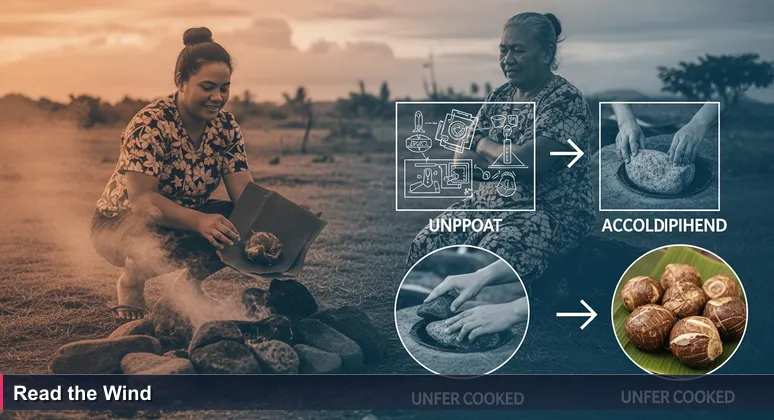
You would not build an umu with cold stones, and you cannot build reliable AI without heating your mathematical foundations first. The first three months are about mastering Python programming and the core mathematics that fuel every neural network: linear algebra, statistics, probability, and calculus. These are not optional - they are the grammar that lets you debug a model that converges slowly due to a poorly set learning rate, something no chatbot can fix for you.
Your Python focus should be on data structures, object-oriented programming, and the three workhorse libraries: NumPy for numerical operations, Pandas for data manipulation, and Matplotlib for visualisation. The National University of Samoa's Computer Science offerings include CSC 448 - Python for AI, which provides structured learning with local peers and instructor support for approximately WST 492 per course. This is the most cost-effective local option if you can register for one or two courses per semester alongside work.
The mathematics you need breaks into three distinct areas:
- Linear algebra: matrices, vectors, eigenvalues - the language of neural networks and every hidden layer you will build.
- Statistics and probability: distributions, hypothesis testing, Bayes' theorem - essential for evaluating model performance and handling data uncertainty.
- Calculus: partial derivatives and gradients - the backpropagation algorithm that trains deep learning models from scratch.
After three months, you should be able to load a CSV file of Apia's daily rainfall data, clean it, and produce a meaningful visualisation. If you cannot do this without Googling every step, you need more practice. Avoid the common mistake of skipping the mathematics because "ChatGPT can write code for me" - it cannot debug a converging model. Walk before you run.
Months 3-6: Core Machine Learning
Now you transition from manipulating data to writing code that learns from it. This is where supervised learning enters: linear and logistic regression, decision trees, random forests, and support vector machines. You will also explore unsupervised techniques like K-means clustering and PCA for dimensionality reduction. The critical skill here is knowing when to use each model and how to evaluate it using accuracy, precision, recall, and F1 score. Aishwarya Srinivasan's 6-month roadmap video provides a condensed visual guide to exactly these skills.
The University of the South Pacific's Bachelor of Computer Science courses can deliver structured coverage of these topics for approximately WST 1,670 per course, with blended online and face-to-face delivery at the Alafua or Mulinu'u campuses in Apia. Alternatively, Nucamp's Back End, SQL and DevOps with Python bootcamp (16 weeks, WST 5,735) covers the complementary skills of Python programming, SQL databases, and foundational DevOps that prepare you for deployment later.
"You must learn evaluations, test suites, and system-level reliability. Don't fall into 'vibes-based' development - just looking at model output and deciding it looks good." - Industry experts cited in the 2026 AI Engineering Roadmap
By the end of Month 6, your portfolio should demonstrate you can build real-world systems using Pacific data:
- A crop yield predictor for taro using historical data from the Samoan Ministry of Agriculture or FAO databases, applying linear regression or a random forest based on rainfall and temperature.
- A telco customer churn model using synthetic data from Kaggle to predict which customers might leave Digicel or SamoaTel - a directly relevant local business problem.
- A sentiment analysis model trained on public tourism reviews of Samoan resorts, classifying feedback as positive, negative, or neutral using a simple Naive Bayes classifier.
A common mistake at this stage is skipping the mathematics in favour of copy-pasting code from tutorials. Without understanding train/test splits, cross-validation, and the bias-variance tradeoff, you will not be able to diagnose why a model fails. The 2026 AI Engineering roadmap from the Data Science Collective emphasises that foundational evaluation skills separate professionals from amateurs. Use actual Pacific weather data, not US corn data - this makes your portfolio stand out to regional employers and shows you understand the local environment.
Months 6-12: Deep Learning and LLMs
This is where you move from simple models to the systems that define 2026's AI landscape: deep neural networks, large language models, and agentic systems that can plan and execute multi-step tasks independently. You will learn the backpropagation algorithm that trains deep networks, plus CNNs for image tasks and RNNs for sequence data. The real focus, however, is Retrieval-Augmented Generation (RAG) - a technique that lets an LLM pull relevant documents from a database before answering, dramatically reducing hallucinations. Mastering chunking strategies and prompt engineering is non-negotiable.
For structured learning, the Nucamp Solo AI Tech Entrepreneur Bootcamp (25 weeks, WST 10,746) is specifically designed for this stage, focusing on AI-powered products, LLM integration, and SaaS monetisation. The CSL Digital Training Centre, launched in partnership with the Ministry of Communication and Information Technology, offers SQA-accredited practical ICT modules that complement deep learning study.
"Participating in industry-led AI hackathons provided rare exposure to industry-level problem solving and boosted my confidence in applying theory to real-world Pacific challenges." - Trishaal Datt, student, University of the South Pacific
By Month 12, your portfolio must include three production-ready projects:
- A Pacific Language Translator - a small-scale NLP or RAG system that translates Samoan phrases to English, demonstrating you can handle underrepresented languages.
- A Climate Impact Visualiser using computer vision or regression on regional flood risk and coastal erosion datasets to map Apia's coastline.
- A Telco Chatbot integrating a pre-trained LLM with RAG that answers customer queries about Digicel or SamoaTel plans, hosted on a simple website.
Optimise every project for low bandwidth using smaller models like Phi-3 or Gemini Nano that run on a phone without constant cloud connectivity. According to the 2026 AI Engineering roadmap by Data with Baraa, the ability to deploy, not just experiment, is what separates junior developers from trusted engineers. Do not skip the systems layer - containerisation with Docker, API design, and monitoring are what make a model production-ready.
Months 12-18: Local Deployment and Ethics
Technical skills alone will not make you a trusted AI engineer in Samoa. The critical difference is the ability to adapt models to the local environment - infrastructure constraints, data governance requirements, and cultural context. The Government of Samoa increasingly emphasises digital sovereignty, meaning the capacity to manage and protect local data while using AI to improve public service delivery. USAID and UNDP have hosted data governance workshops in Apia to build this technical expertise, as documented by the U.S. Embassy in Samoa.
Ethical AI takes on unique dimensions in small island populations. A model trained only on Apia data may not work for Savai'i, and biased datasets can amplify existing inequalities. You must learn fairness metrics and inclusive data collection practices that respect cultural contexts. The University of the South Pacific's call for responsible AI in the Pacific underscores that ethical frameworks must be locally developed, not imported from Silicon Valley.
Low-bandwidth deployment is the practical skill that separates competent developers from engineers employers actually hire. Master model quantisation to reduce file sizes, edge deployment so models run directly on phones, and progressive web apps that function offline. SamoaTel and Digicel specifically seek engineers who can build networks that work when connectivity drops.
"There is an urgent need for a Pacific Islands AI Technical Assistance Facility to build a talent pipeline and bridge the digital divide." - AI Asia Pacific Institute, press release
Your portfolio during this phase should include a fisheries data model using Pacific Community (SPC) data to predict fish stocks or illegal fishing activity, directly serving the blue economy. Consider also a data governance dashboard that shows citizens what information the government collects and how it is used - a transparency tool aligned with digital sovereignty goals. Participate in USP's industry-led AI hackathons, which provide rare exposure to Pacific-specific problem solving. Watch for announcements on the USP Samoa Campus Facebook page - these events happen regularly in Apia and connect you directly with regional employers.
Months 18-24: Portfolio and Mentorship
The final stage transforms you from learner to contributor. Your job now is to build projects that serve your community, document them publicly on GitHub with clear READMEs explaining the Pacific problem you solved, and begin mentoring others. The Pacific Digital Economy Programme, managed by UNCDF and UNDP, actively sponsors projects that close the digital divide in Samoa and seeks local tech talent to lead these initiatives.
By Month 24, you must produce one end-to-end production system that a local employer could deploy today. Examples that align with Samoan priorities include:
- A fraud detection model for BSP Samoa banks, deployed as an API that banking apps call in real-time
- A Samoan-language speech-to-text system for government services that serves rural communities
- A supply chain optimizer for the Ministry of Agriculture that predicts optimal shipping routes for taro to overseas markets
The Google AI Professional Certificate offers 20+ hands-on projects that can supplement your portfolio during this period. However, the most valuable credential is shipping software that real users rely on.
Mentorship closes the loop. The talent gap in the Pacific is acute, and by teaching even one person what you have learned, you strengthen the entire ecosystem. Consider volunteering at the Samoa Digital Training Hub or the CSL Digital Training Centre. Apply for the Pacific Digital Economy Programme's project sponsorships. Share your work on LinkedIn, in USP forums, and at local tech meetups. The Samoan tech ecosystem is small - reputation travels quickly, and being known as someone who ships functional, locally relevant AI systems is your best job application.
The umu analogy holds here too: you have learned to read the wind and adjust the stones. Now you show others how to build their own fires.
How to Measure Your Success
You cannot measure success by finishing a course. You measure it by what you can actually do with the tools you have mastered. The Syracuse University iSchool's guide to becoming an AI engineer emphasises that hands-on project experience, not certificates, is what employers actually evaluate. These verification checkpoints will tell you whether you are truly progressing or just going through the motions.
- Month 3 checkpoint: Open a Python notebook, load a local CSV file, clean it, and produce a meaningful visualisation. If you cannot do this without Googling every step, you need more practice.
- Month 6 checkpoint: Train a machine learning model on a real dataset, evaluate its performance using accuracy or RMSE, and explain to a friend why your choice of model was appropriate.
- Month 12 checkpoint: Deploy a simple AI application to a free cloud service (Render, Railway, or Vercel) and share the link. If you have not shipped a single deployment, you are still a student, not an engineer.
- Month 18 checkpoint: Build a project using Retrieval-Augmented Generation and deploy it with Docker. You can explain to a non-technical stakeholder how your model handles data privacy for Samoan users.
- Month 24 checkpoint: Ship at least one production AI system that real users rely on - whether at Digicel, a government ministry, a startup, or as a freelance project. You are also mentoring at least one person who is 6 months behind you.
The fastest online AI degree programs can accelerate your theoretical knowledge, but deployment is the only metric that matters in Samoa's job market. Pacific tech startups and telcos hire engineers who can take a model from a Jupyter notebook into a functional mobile app that works when the internet drops. If your projects never leave your laptop, you have not succeeded yet.
The umu analogy holds one final time: you know the taro is cooked not by reading a timer, but by pressing it with your fingers. Apply the same test to your skills. Do not trust the roadmap alone - verify at every milestone that you can actually build, deploy, and ship. That is how you know the fire was hot enough all along.
The Umu is Ready
The stones have been heating for nearly two years. The banana leaves are layered with local context. And you have learned to read the wind - the infrastructure constraints, the sparse datasets, the specific problems your community needs solved. The difference between following a roadmap and becoming an AI engineer in Samoa is the same as the difference between reciting a recipe and building an umu that feeds your family.
Whether you choose Nucamp's Solo AI Tech Entrepreneur Bootcamp for its 25-week project-focused curriculum at WST 10,746 with monthly payment plans, enrol in USP's Bachelor of AI for its Pacific-specific degree, or take a self-directed route using the resources outlined here - the key is to start, stay consistent, and always ask yourself: "Is this project feeding my community, or just copying Silicon Valley's menu?"
Major local employers including Digicel Samoa, SamoaTel, government ministries, and regional banks actively seek engineers who can ship production systems, not just experiment in notebooks. The Samoa Digital Training Hub exists to bridge the skill gaps that hold the ecosystem back. Remote work opportunities with international employers are also increasingly accessible to Pacific-based engineers who can demonstrate end-to-end deployment capability.
The roadmap is a starting point. The craft comes from adapting it to your local conditions - undercooked taro teaches more than a perfect textbook. Your portfolio of locally relevant projects, your participation in USP hackathons, and your willingness to mentor others will define your reputation far more than any certificate. The Samoan tech ecosystem is small; being known as someone who ships functional, culturally aware AI systems is your best career asset.
The taro will cook. The fire is waiting. The next move is yours.
Common Questions
I don't have a degree in computer science. Can I still become an AI engineer in Samoa?
Yes, absolutely. The roadmap is designed for self-taught learners, and many successful AI engineers in the Pacific come from diverse backgrounds. Focus on building a strong portfolio of projects that solve local problems, like a crop yield predictor using taro data, to demonstrate your skills to employers like Digicel or BSP.
How much time do I need to commit each week to follow your 24-month roadmap?
The 24-month track requires about 10-15 hours per week, while the 6-month track is near full-time at 30+ hours. Consistency is key - treat it like a part-time job, even if you only do 30 minutes daily. Most learners in Apia balance this with work by studying evenings and weekends.
Are there local scholarships or funding options for AI training in Samoa?
Yes, check the Samoa Public Service Commission's scholarship page for international opportunities in ICT and AI, and the University of the South Pacific offers blended courses at around WST 1,670 per course. Nucamp also offers monthly payment plans for its bootcamps, making them accessible without upfront costs.
What kind of salary can I expect as an AI engineer in Apia in 2026?
Entry-level AI engineers at Digicel or government agencies can expect around WST 40,000-60,000 per year, while experienced roles with deployment skills can reach WST 80,000+. Freelancers working on Pacific-focused projects often earn more due to the niche demand for low-bandwidth and language models.
Do I need a powerful laptop or can I use cloud services like Google Colab?
For the first year, a standard laptop with 8GB RAM is enough. When you move to deep learning, use free cloud services like Google Colab or Kaggle Notebooks. The article emphasizes that you don't need a GPU; what matters is your ability to build models that work in low-bandwidth environments for Samoa.
A ranking of top paying tech employers in the Pacific.
Learn what certifications you need for cybersecurity roles in Samoa.
Learn about Samoa's emerging tech ecosystem and junior hiring.
Uncover top tech jobs in Samoa for 2026 that don't need a college degree.
Discover the best women in tech resources in Samoa in 2026, from NUS Cisco Academy to SITA cyber internships.

Irene Holden
Operations Manager
Former Microsoft Education and Learning Futures Group team member, Irene now oversees instructors at Nucamp while writing about everything tech - from careers to coding bootcamps.