









Top 10 AI Tools Every Legal Professional in Nigeria Should Know in 2025
Last Updated: September 10th 2025
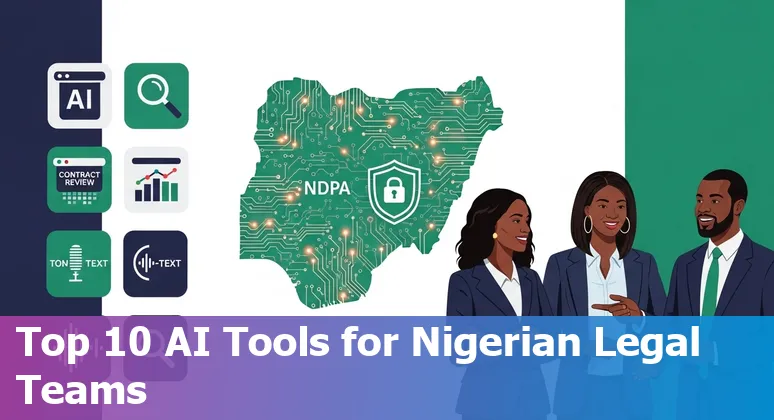
Too Long; Didn't Read:
Top AI tools for Nigerian legal professionals in 2025 can cut research hours to minutes, produce simple contracts in under 60 seconds, use models trained on 60+ years of Nigerian law, help firms mitigate risks amid 86% cyber breaches, and deliver 50–90% time savings.
Nigeria's courts and clinics of law are entering an AI-powered chapter: by 2025, generative tools promise to cut hours of legal research to minutes, surface Nigeria‑specific authorities in a single click, and even let a client generate a simple contract or get legal guidance in under 60 seconds.
Local legaltech - highlighted in LawPavilion's look at “LegalTech in Nigeria: What to Expect by 2025” - shows how legal‑specific GPTs and case managers can reduce backlog and tighten research accuracy, while startups like Case Radar are building ecosystems to democratize access to lawyers and documents across the country.
For practitioners, the choice is pragmatic: adopt jurisdiction‑aware AI to protect clients and measure in‑house value, or risk falling behind in a market where speed and accessibility increasingly define quality legal service.
| Bootcamp | Length | Early Bird Cost | Registration |
|---|---|---|---|
| AI Essentials for Work | 15 Weeks | $3,582 | Register for the AI Essentials for Work bootcamp |
"When you can afford a lawyer, you're protected. When you can't, you're vulnerable," - Agbo Obinnaya; and Case Radar aims to "democratize legal knowledge" for Nigerians.
Table of Contents
- Methodology: How we chose these 10 AI tools
- LawPavilionGPT (PrimsolGPT / PrimeGPT) - Nigeria-first drafting and research assistant
- Lexis+ AI - Enterprise research and cross-jurisdictional support
- CoCounsel (Casetext) - Fast drafting, summaries and contract analysis
- Harvey AI - Firm-fine‑tuning and workflow automation for teams
- Spellbook - Contract drafting inside Microsoft Word
- Westlaw Edge - AI research, brief analysis and litigation analytics
- Diligen - Automated contract review and extraction
- Juro - End-to-end CLM with embedded AI assistant
- OpenAI ChatGPT - Accessible drafting, brainstorming and admin support
- LawDroid - Client intake, chatbots and document automation
- Conclusion: Choosing and using AI tools responsibly in Nigeria
- Frequently Asked Questions
Explore practical tips for Designing low-bandwidth AI workflows for Nigeria that work with MTN, Airtel and limited internet infrastructure.
Methodology: How we chose these 10 AI tools
(Up)Selection began with a practical, Nigeria‑first filter: tools had to support compliance with the Nigeria Data Protection Act (NDPA) and the Nigerian Bar Association (NBA) AI guidance, offer clear audit trails for human oversight (the NDPA requires meaningful human intervention in automated decisions), and provide strong data‑security controls given that 86% of Nigerian businesses suffer cybersecurity breaches - so breach‑notification workflows and incident logs were non‑negotiable.
Tools were scored for jurisdictional awareness, breach‑response features (NDPA's 72‑hour notification window and Cybercrimes Act reporting obligations), vendor transparency on training data and model risk, and fit for common Nigerian workflows from solo practices to mid‑size firms.
Special weight went to solutions that simplify necessary compliance steps - DPIAs, records of processing, and secure client intake - while remaining affordable and easy to pilot for SMEs.
Ongoing regulatory tracking - per White & Case's AI Watch: Global regulatory tracker - Nigeria - also informed choices, as did practical cyber guidance from the Cybersecurity Legal Toolkit for Businesses in Nigeria and local prompts that produce jurisdiction‑aware outputs for Nigerian courts and statutes.
LawPavilionGPT (PrimsolGPT / PrimeGPT) - Nigeria-first drafting and research assistant
(Up)LawPavilionGPT is the Nigeria‑first drafting and research assistant built into LawPavilion's Prime/Primsol platforms, trained on over 60 years of Nigerian case law to surface verified authorities and stitch them into compliant, court‑ready drafts; the platform's step‑by‑step guide shows how a Statement of Claim or Defence that once ate a lawyer's day can now be generated in minutes, with device‑friendly workflows and an evidence page that feeds the AI the facts it needs.
As an add‑on feature (PrimeGPT/PrimsolGPT) it emphasises local legal intelligence - automatic precedent integration, procedural checks, and review feedback - so firms reduce citation errors and procedural risks while keeping human oversight central; LawPavilion's walkthrough explains the subscription and four‑step drafting flow in practical detail.
For Nigerian practitioners weighing speed against accuracy, LawPavilionGPT promises the memorable payoff of turning a day‑long slog into a polished pleading in minutes without
“hallucinated” authorities
, making it a pragmatic tool for busy courts and clients alike (see LawPavilion AI legal drafting guide and the LawPavilionGPT feature overview).
Lexis+ AI - Enterprise research and cross-jurisdictional support
(Up)Lexis+ AI is a strong option for Nigerian firms that need reliable, cross‑border legal research without sacrificing client privacy: its Protégé assistant runs in a private workspace, lets users set a
default jurisdiction
(so Nigeria can be pre‑selected), and combines authoritative LexisNexis content with firm documents to draft, summarise and analyse with linked citations.
Recent RAG and Shepard's Knowledge Graph improvements mean the system surfaces case relationships and treatment summaries that make citation checking far faster, while Protégé Vault and DMS integrations (iManage, SharePoint) let teams upload matter files for contextual drafting and timelines.
The platform's multi‑model approach (GPT‑4o/GPT‑5, Claude Sonnet, fine‑tuned Mistral) and privacy‑by‑design controls - backed by Azure and AWS Bedrock infrastructure - aim to keep sensitive client data segregated and auditable.
For cross‑jurisdictional work that must balance speed, accuracy and compliance, see Lexis+ AI's product overview and the July 2024 RAG enhancements write‑up for technical detail and examples.
| Feature | What it does |
|---|---|
| Protégé | Personalized AI assistant for drafting, summarization and conversational research |
| Shepard's Knowledge Graph / GraphRAG | Improves citation verification and case‑relationship retrieval |
| Protégé Vault | Secure document vault for AI tasks (timelines, drafting) using uploaded matter files |
| DMS Integration | Connects iManage, SharePoint and firm docs for jurisdiction‑aware outputs |
| Multi‑model LLMs & Security | Uses multiple LLMs with privacy‑by‑design and cloud security on Azure/AWS |
CoCounsel (Casetext) - Fast drafting, summaries and contract analysis
(Up)CoCounsel (formerly Casetext) is a fast, all‑in‑one assistant that pairs GPT‑powered drafting with trusted Westlaw and Practical Law content to cut research and document review time - a useful fit for Nigerian firms juggling high volumes of contracts, discovery or cross‑border matters that demand verifiable authorities and auditable workflows; its Deep Research and agentic workflows produce multistep research plans, while Word integration and contract‑extraction tools let teams redline, compare and summarise long agreements without leaving the document.
For practices that must balance speed with reliability, CoCounsel's emphasis on authoritative sources and end‑to‑end document analysis makes it a pragmatic way to shift routine work to the assistant and keep lawyers focused on judgment calls (see the CoCounsel Legal product page - Casetext and the Casetext CoCounsel user guide for feature details and demos).
“A task that would previously have taken an hour was completed in five minutes or less.” - Jarret Colemen, General Counsel at Century Communities
Harvey AI - Firm-fine‑tuning and workflow automation for teams
(Up)Harvey AI is increasingly the firm‑grade option Nigerian teams should watch: already adopted by leading African and global firms and rolled out in Nigeria by Olaniwun Ajayi, it combines legal‑specific training with enterprise controls to speed tasks lawyers still must sign off on.
The platform's KnowledgeVault secure workspaces, agentic workflows and firm‑fine‑tuning let teams upload templates and matter files so Harvey produces context‑aware drafting, due diligence summaries and contract analysis that slot into existing DMS and research stacks (Harvey also integrates with Thomson Reuters, Westlaw and LexisNexis).
For Nigerian firms juggling high‑volume transactional work or cross‑border matters, that means less time on repetitive redlines and more time advising clients - provided robust governance, audit trails and human review are in place; see Olaniwun Ajayi's announcement and Harvey's product overview for how firms are implementing secure, workflow‑first AI today.
“By streamlining workflows, enhancing collaboration, and accelerating the depth and pace of analysis, Harvey enables us to deliver faster and more tailored solutions to our clients.”
Spellbook - Contract drafting inside Microsoft Word
(Up)Spellbook brings AI-powered contract drafting and review directly into Microsoft Word, letting lawyers generate clause suggestions, run risk‑flag reviews, and propose alternate language without leaving the editor - an approach that cuts context‑switching and keeps negotiation notes and tracked changes where they matter.
Founded by attorneys and backed by Y Combinator, Spellbook fine‑tunes large language models for contracting to produce tailored clauses, plain‑language rewrites, and intelligent recommendations that improve readability and consistency; its Word add‑in is the core convenience, combining drafting, redlining and clause libraries in a single workflow.
For firms weighing practical adoption, compare feature sets and Word integration in the Spellbook overview and the Genie AI vs Spellbook comparison to see how clause suggestions, contract analysis, and Word‑native collaboration stack up for your practice.
Westlaw Edge - AI research, brief analysis and litigation analytics
(Up)For Nigerian firms that juggle local litigation with international clients, Westlaw Edge is a powerful AI‑assisted research partner - best used alongside a Nigeria‑first service for domestic authority.
Its AI‑Assisted Research and WestSearch Plus synthesize trusted content and give direct links to cases and statutes, while Quick Check and the Brief Analyzer help spot missing authorities or contradictory treatment before a filing becomes a courtroom problem; AI Jurisdictional Surveys and KeyCite flags surface cross‑border developments and over‑ruling risk so teams can prepare confident, citation‑checked arguments.
The platform's litigation analytics and Statutes/Regulations Compare are especially useful for firms handling multijurisdictional disputes or regulatory work, but Nigerian practitioners should pair these global insights with local databases - see LawPavilion's roundup of tools used by Nigerian firms - to ensure procedural and citation fitness at home.
In short, Westlaw Edge brings speed and strategic signals for international work;
the “so what” is simple: it reduces the surprise of unseen precedent, but it performs best when combined with a jurisdiction‑aware stack.
| Feature | How it helps |
|---|---|
| Westlaw Edge WestSearch Plus AI‑Assisted Research (Thomson Reuters) | Synthesizes trusted authority and returns linked citations for verification |
| Quick Check / Brief Analyzer | Identifies gaps in briefs and suggests authorities that may have been missed |
| AI Jurisdictional Surveys / KeyCite | Builds tailored jurisdictional overviews and flags overruling risk |
| Litigation Analytics / Statutes Compare | Delivers data‑driven insights on judges, trends and differences between statutes |
Diligen - Automated contract review and extraction
(Up)Diligen and similar automated contract‑review platforms turn dense agreements into searchable data that matters for Nigerian practices: AI‑powered clause extraction, OCR and NLP locate parties, dates, renewal terms, indemnities and data‑processing clauses in seconds so teams stop hunting for “the paragraph that matters” and start acting on it; ContractPodAi's guide shows how modern extraction can cut manual review time by up to 50% while surfacing consistent, auditable fields that feed CLM, ERP or due‑diligence workflows, and Gatekeeper's coverage of clause extraction highlights how playbooks and guided redlines keep first‑pass reviews policy‑aligned.
The practical payoff for firms and in‑house teams is concrete - fewer missed renewals and obligations (poor contract management can cost organisations ~9% of revenue), faster M&A and procurement due diligence, and a human‑in‑the‑loop validation layer so exceptions are routed to counsel rather than buried in spreadsheets; in short, Diligen‑style tools make contracts a strategic data asset instead of a legal backlog, provided deployment focuses on clear fields, governance and integration with existing systems (see ContractPodAi's extraction guide and Gatekeeper's CLM write‑up for implementation tips).
| Benefit | Why it matters for Nigerian firms |
|---|---|
| Speed & Scalability | Processes thousands of contracts in hours instead of weeks |
| Accuracy & Consistency | Reduces costly human errors and standardises clause detection |
| Risk Flagging | Automatically surfaces renewals, indemnities and non‑standard clauses |
| Integration & Workflows | Feeds CLM/ERP for obligation tracking and audit trails |
Juro - End-to-end CLM with embedded AI assistant
(Up)Juro positions itself as an end‑to‑end, browser‑native CLM that can help Nigerian legal teams stop chasing versions and start managing contracts proactively: native e‑signature, automated templates and real‑time redlining keep negotiation in one place, while granular access controls and a data‑rich repository surface milestones and obligations for in‑house counsel, HR and commercial teams.
Its embedded AI assistant and template automation accelerate creation - Callum Hamlett notes a sales team can generate and approve a contract in four clicks - and independent writeups highlight a dramatic cut in turnaround (Juro's AI assistant is credited with up to a 90% reduction in some accounts).
Integrations with CRMs and collaboration tools make it practical for firms that need to link deal data to contracts, and TrustRadius reviews show strong usability and rapid onboarding for teams ready to move off spreadsheets; see Juro's CLM requirements guide and detailed user reviews for feature and pricing context.
| Feature | Practical benefit for Nigerian firms |
|---|---|
| Automated templates & guided logic | Faster, consistent contract creation and fewer manual drafting errors |
| Native eSignature & audit trail | Secure execution and clear evidence of signatory actions |
| Embedded AI assistant | Quicker first drafts and metadata extraction to speed review |
| Integrations (CRM, Slack, Google Drive) | Keeps contract data in sync with sales, HR and ops systems |
“It takes the sales team four clicks to generate and approve a contract in Juro.” - Callum Hamlett, Senior Rev Ops Analyst, Paddle
OpenAI ChatGPT - Accessible drafting, brainstorming and admin support
(Up)OpenAI's ChatGPT is a practical first step for Nigerian lawyers who need fast drafting, brainstorming and admin support - turning a list of contract requirements into a tidy draft in seconds, summarising discovery, transcribing recordings or generating client emails - so long as outputs are treated as drafts and carefully checked.
Practical prompting matters: Clio's “ChatGPT prompts for lawyers” shows role‑assignment, context and follow‑ups that improve results and even points to a legal‑specific “AI for Lawyers GPT” for safer starts, while MyCase's guide lays out common use cases and reminds firms that roughly one in four practices have already tested legal GAI and why ethical caution is still essential.
Crucial warnings for Nigeria: scrub client or confidential facts before pasting prompts, verify citations to avoid “hallucinated” authorities, and build human review into workflows; for higher‑stakes work, Debevoise's model guide explains how different OpenAI models (from GPT‑4o to the o3 family) fit different tasks so firms can match model choice to risk and complexity.
Use ChatGPT to speed routine work and free time for legal judgment - but pair it with firm policies, prompt hygiene, and verification routines to protect clients and professional obligations (see Clio's prompt library, MyCase's practitioner guide, and Debevoise's model rundown for implementation ideas).
| Model | Best for |
|---|---|
| Debevoise guide - GPT‑4o (recommended for everyday legal drafting) | Everyday drafting, summaries and fast queries |
| Debevoise guide - o3 / o3‑pro (for complex multi‑step legal analysis) | Complex, multi‑step legal analysis and deep research |
| Debevoise guide - GPT‑4.1 / 4.5 (for large document summaries and creative drafting) | Large document summaries, creative drafting and longer context jobs |
“The opposing party wastes time and money in exposing the deception. The court's time is taken from other important endeavors. The client may be deprived of arguments based on authentic judicial precedents. It promotes cynicism about the legal profession and the American judicial system.”
LawDroid - Client intake, chatbots and document automation
(Up)LawDroid brings client intake, chatbot triage and document automation into one lawyer‑friendly toolkit that's especially practical for Nigerian firms wanting faster, more reliable first‑contact workflows: its no‑code Builder and Copilot let teams deploy client‑facing chatbots that capture facts, schedule consultations, pre‑fill forms and generate routine documents without heavy IT lift, and integrations with Calendly, Acuity and popular CMS platforms keep intake synced with existing calendars and websites; Clio's practitioner guide highlights LawDroid as a simple, Clio‑friendly option for firms that need secure 24/7 screening and live‑handoff when matters require human counsel, while vendor roundups note Copilot's focus on research, brainstorming and document summarisation.
For busy practices, the memorable payoff is practical - a prospective client can be reliably screened and booked outside office hours, so intake no longer depends on someone answering the phone.
Learn more about LawDroid in the Juro chatbot roundup and Clio's chatbots guide for lawyers.
| Product / Tier | What it includes |
|---|---|
| LawDroid Copilot | AI assistance for document automation, research and summarisation (from $15/user/month) |
| LawDroid Builder | No‑code chatbot builder for client intake, scheduling and integrations (from $99/user/month) |
| LawDroid Ultra / Enterprise | Expanded Builder features and enterprise integrations / custom pricing |
Conclusion: Choosing and using AI tools responsibly in Nigeria
(Up)Choosing and using AI in Nigerian practice means balancing speed with safeguards: pick jurisdiction‑aware systems that surface Nigerian precedents (for example, LawPavilion's Nigeria‑first tools) and pair them with strict data‑security checks and human‑in‑the‑loop review so automated drafts and predictions never become blind spots; practical advice and compliance alerts are now built into vendor offerings, which help firms stay current with statute and case updates and receive tailored compliance checklists (see a practical roundup of how AI is changing research and compliance).
Vet vendors for audit trails, pilot tools on low‑risk work, define KPIs for turnaround and accuracy, and invest in staff training so teams can write better prompts and validate outputs - practical courses like Nucamp AI Essentials for Work bootcamp can speed that transition.
Above all, treat AI as an assistant that extends legal judgment, not a substitute, and document governance decisions so clients and regulators can see why a tool was trusted for each task.
| Bootcamp | Length | Early Bird Cost | Registration |
|---|---|---|---|
| AI Essentials for Work | 15 Weeks | $3,582 | Register for the Nucamp AI Essentials for Work bootcamp |
“In one word, AI is cool. It has a lot of facilities that can enable you to do your legal research easily. More like a human being, it guides you with accurate insight and data” - Augustine E. Legal Practitioner.
Frequently Asked Questions
(Up)Which AI tools should Nigerian legal professionals know in 2025 and what are their primary uses?
Key tools highlighted for Nigerian practice in 2025 include: LawPavilionGPT (Nigeria‑first drafting and research assistant tuned to local case law); Lexis+ AI (enterprise research with cross‑jurisdictional support and private workspaces); CoCounsel/Casetext (fast drafting, contract analysis and Deep Research workflows); Harvey AI (firm‑level fine‑tuning, KnowledgeVault workspaces and workflow automation); Spellbook (AI contract drafting inside Microsoft Word); Westlaw Edge (AI research, brief analysis and litigation analytics); Diligen (automated contract review and clause extraction); Juro (end‑to‑end CLM with embedded AI assistant); OpenAI ChatGPT (accessible drafting, brainstorming and admin support for lower‑risk tasks); and LawDroid (client intake chatbots and document automation). Each tool serves different needs - local precedent and court‑ready drafts (LawPavilionGPT), cross‑border research (Lexis+/Westlaw), contract drafting/review (Spellbook/Diligen/Juro), workflow automation and firm governance (Harvey, CoCounsel), and intake/triage (LawDroid, ChatGPT for routine drafting).
How were the top 10 tools selected and what security or regulatory criteria matter for Nigerian firms?
Selection used a Nigeria‑first filter: tools had to demonstrate jurisdictional awareness (ability to surface Nigerian statutes and case law), provide clear audit trails and human‑in‑the‑loop controls (the NDPA and local guidance emphasise meaningful human oversight), and offer strong data‑security and breach‑response features (incident logs, breach‑notification workflows). Vendors were scored on training‑data transparency, model risk disclosures, RAG/verification capabilities, and practical fit for solo to mid‑size firms. Given that about 86% of Nigerian businesses face cybersecurity breaches, breach‑response, DPIA support and vendor transparency were non‑negotiable selection factors.
What are practical best practices for adopting AI safely and ethically in Nigerian legal practice?
Adopt AI incrementally and defensibly: pilot tools on low‑risk work, require human review for legal outputs, document governance decisions and vendor due diligence, and set KPIs for turnaround and accuracy. Enforce prompt hygiene and scrub confidential client data before using general‑purpose models (or use private/workspace features where available). Vet vendors for audit trails, DPIA and breach‑notification support, data residency controls, and model‑training transparency. Train staff on effective prompting, verification workflows and when to escalate exceptions to counsel. Treat AI as an assistant that extends legal judgment - not a substitute - and retain records showing why and how a tool was used for each task to satisfy clients and regulators.
Where can Nigerian legal professionals get practical training to use these AI tools and what are typical time and cost commitments?
Practical upskilling can come from vendor product resources, vendor demos and practical guides, in‑house pilots, and formal courses. One example from the article is the "AI Essentials for Work" bootcamp: a 15‑week course with an early‑bird cost noted at $3,582. Firms should combine structured training (courses/bootcamps) with hands‑on pilots on everyday matters so teams learn prompt design, verification routines and governance. Vendor sandboxes and free trials are useful to test integrations and refine workflows before broader roll‑out.
Validate impact and governance by running a controlled 30–60 day pilot focused on hours saved and citation accuracy.
See how NDPA 2023 obligations for lawyers affect AI deployment in Nigerian practices.

Ludo Fourrage
Founder and CEO
Ludovic (Ludo) Fourrage is an education industry veteran, named in 2017 as a Learning Technology Leader by Training Magazine. Before founding Nucamp, Ludo spent 18 years at Microsoft where he led innovation in the learning space. As the Senior Director of Digital Learning at this same company, Ludo led the development of the first of its kind 'YouTube for the Enterprise'. More recently, he delivered one of the most successful Corporate MOOC programs in partnership with top business schools and consulting organizations, i.e. INSEAD, Wharton, London Business School, and Accenture, to name a few. With the belief that the right education for everyone is an achievable goal, Ludo leads the nucamp team in the quest to make quality education accessible