









Top 10 AI Prompts and Use Cases and in the Retail Industry in Nepal
Last Updated: September 13th 2025
Too Long; Didn't Read:
AI prompts power Nepal retail - Kathmandu and Pokhara stores use personalization, conversational agents, demand forecasting and visual search to boost results: inventory down up to 12.5%, forecast accuracy +20%, visual‑search GMV +20% and AOV +11%, dynamic pricing raises earnings ~25%.
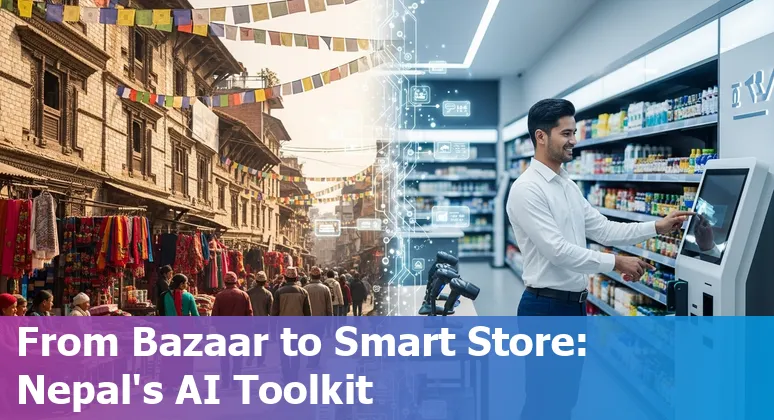
AI is quietly reshaping retail in Kathmandu and Pokhara, turning street-side shops and lakeside cafés into data-savvy businesses that use personalization, real-time analytics, and predictive stocking to win customers.
Tools like Lacspace's ScanSewa bring AI-driven dashboards to small vendors - helping a Pokhara café optimize staffing for peak hours or a Bhaktapur handicraft stall target tourists - while digital-marketing AI is powering hyper-personalized ads and SEO for Nepal's fast-growing online shoppers.
To capture this shift responsibly, workforce upskilling matters: Nucamp AI Essentials for Work bootcamp registration teaches practical prompt-writing and workplace AI skills so retail teams can deploy these tools without a technical degree.
| Bootcamp | AI Essentials for Work |
|---|---|
| Length | 15 Weeks |
| Courses | AI at Work: Foundations; Writing AI Prompts; Job Based Practical AI Skills |
| Cost (early bird) | $3,582 |
| Syllabus / Register | AI Essentials for Work syllabus | Register for AI Essentials for Work |
“At Lacspace, we believe data is Nepal's untapped resource. Through ScanSewa, we're empowering businesses to harness AI, make informed decisions, and thrive in a global market. Join us to transform Nepal's economy, one insight at a time, and build a future where every business shines!”
Table of Contents
- Methodology - Research Approach and Practical Examples (Nucamp Bootcamp)
- Personalized Product Recommendations - Kathmandu Fashion Store Recommender
- Localized Conversational Agent - Nepali Retail Assistant (WhatsApp & Viber)
- Sentiment Analysis & Social Listening - Instagram & Facebook for Brand X (Nepal)
- Demand Forecasting & Inventory Optimization - Thamel Store SKU 5678 Forecast
- Dynamic Pricing & Promotion Optimization - Kathmandu Winter Jacket Campaign
- Visual Search & Automated Image Tagging - Shoe Visual Search (Nepal Inventory)
- Automated Returns & Dispute Triage - Damaged Blouse Classifier
- Fraud Detection & Payments Risk Scoring - Nepal Transaction Risk Engine
- Store Layout & Planogram Optimization - Lalitpur Store Floor Plan
- Marketing Copy & Localized Content Generation - Nepali Back-to-School Campaign
- Conclusion - Responsible AI Adoption & Governance for Nepal Retail (Nucamp Bootcamp Recommendations)
- Frequently Asked Questions
Learn why mobile-first commerce in Nepal makes AI-powered personalization and frictionless payments essential in 2025.
Methodology - Research Approach and Practical Examples (Nucamp Bootcamp)
(Up)The methodology pairs Nepal-focused prompt libraries with proven retail playbooks to turn ideas into run-ready pilots: start by harvesting Nepal-specific prompts and practical agent blueprints (see the Best Nepal AI prompts collection on Docsbot: Best Nepal AI prompts collection (Docsbot)), then apply Spatial's “25 AI prompts for retail site selection” to convert local foot‑traffic, vendor routes and tourist-season patterns into concrete location simulations and shortlist candidates for a small-scale pilot (Spatial: 25 AI prompts for retail site selection).
From there, iterate with human‑in‑the‑loop testing, bias audits and privacy checks (a key recommendation across the generative-AI use‑case literature) while instrumenting success metrics - A/B lift, inventory accuracy and customer-resolution rates - for each Nepal pilot (supermarket agents, chat assistants, visual search and demand forecasting).
Practical examples drawn from the research include tailored AI agents for Nepalese supermarket chains, plug‑and‑play site‑selection prompts for urban kiosks, and generative content workflows that speed catalog production; workforce readiness is embedded through Nucamp's AI Essentials pathway so retail teams learn prompt engineering and prompt‑based ops before wide rollout (AI Essentials for Work bootcamp registration (Nucamp)).
The approach favors fast, measurable pilots in Kathmandu and Pokhara, careful governance, and staged scaling once KPIs and fairness checks validate impact.
| Bootcamp | AI Essentials for Work |
|---|---|
| Length | 15 Weeks |
| Courses | AI at Work: Foundations; Writing AI Prompts; Job Based Practical AI Skills |
| Cost (early bird) | $3,582 |
| Syllabus / Register | AI Essentials for Work bootcamp syllabus (Nucamp) | Register for AI Essentials for Work bootcamp (Nucamp) |
“We're no longer just predicting what customers may like. We are forming whole new combinations and suggestions of products that our human merchandisers would never have thought of.”
Personalized Product Recommendations - Kathmandu Fashion Store Recommender
(Up)A Kathmandu fashion store recommender works best when it combines smart segmentation, real‑time behavior signals and easy progressive identification: start by grouping anonymous visitors into behaviorally defined segments (so homepage carousels and email flows feel relevant from the first page view), then use lightweight value exchanges - style quizzes or fit finders - to convert browsers into known customers and finally deliver true 1:1 recommendations from purchase history and explicit preferences; this three‑stage approach is laid out in Nacelle's personalization playbook, the Three‑Stage Framework for personalized product recommendations (Nacelle personalization playbook: Three‑Stage Framework).
For Kathmandu, that means blending local signals (geo‑aware displays for seasonal clothing and weather‑appropriate items) with behavioral features like recent views and cart activity to boost AOV and repeat buys, a tactic supported by Opensend's fashion personalization guide (Opensend guide: Marketing personalization strategies for fashion).
Teams building recommenders at scale can also learn from benchmarks and tooling in the H&M dataset playbook - practical tips for handling implicit feedback, cold starts and sequential trends that transfer well to smaller, inventory‑constrained shops in Nepal (H&M dataset playbook for personalized fashion recommendations); implemented thoughtfully, recommendations become a shop's best sales associate, surfacing the right complementary piece at precisely the moment a customer is deciding.
“Opensend has helped us grow our sales month over month ever since we started using their platform. The best part is that it's very easy to integrate with your Shopify and Klaviyo account!” Josh Colley, Co Founder, Track Barn
Localized Conversational Agent - Nepali Retail Assistant (WhatsApp & Viber)
(Up)A localized conversational agent for Nepali retail - running on Viber and WhatsApp - lets shops in Kathmandu and Pokhara meet customers where they already chat: verified business profiles and the searchable Business Inbox make brand messages easy to find, while chatbots, rich‑media cards and end‑to‑end encryption keep conversations fast, secure and familiar for shoppers (promotions, order updates and support) as described in the Viber marketing brief for Nepal; smart integrations tie those conversations into CRM, order systems and analytics so a single “blue‑tick” business account can send targeted offers, transactional receipts and even interactive surveys without breaking customer trust (Viber Business Messaging in Nepal).
For retailers that need multi‑channel consistency, orchestration platforms can route the same chatbot and campaign across SMS, Viber and WhatsApp, turning one campaign into a coordinated, measurable funnel - think a winter‑jacket push that triggers abandoned‑cart reminders, live chat sizing help and a promo sticker or coupon that connects an in‑store flyer to a Viber message, a bridge between offline and online that has driven dramatic lift in other markets (Telerivet's Viber for Business guide).
The result is a local assistant that feels conversational, protects data, and scales from a single kiosk to a small chain.
“Security is the DNA of Viber.” - Berina Tanovic
Sentiment Analysis & Social Listening - Instagram & Facebook for Brand X (Nepal)
(Up)For a Nepal-focused Brand X, Instagram and Facebook are not just channels but real‑time barometers of customer feeling, and social listening that understands Nepali language is essential: tools like Meltwater's roundup of the “Top 20 Sentiment Analysis Tools” help teams monitor mentions and surface trends, while Nepali‑specific solutions (see Lingvanex's Nepali Sentiment Analysis) explain why lexicon, machine‑learning and deep‑learning approaches are needed to classify comments, reviews and colloquial posts on local pages; combining those language models with platforms that flag risk in real time (Talkwalker's AI can even detect basic sarcasm) gives Kathmandu and Pokhara retailers a fighting chance to respond before a small complaint becomes a reputational problem.
Practical wins for Brand X include setting keyword and hashtag queries for seasonal campaigns, routing negative alerts into a fast‑response queue, and using dashboards to compare product sentiment across Instagram stories and Facebook comments - because social sentiment can swing within hours, having Nepali‑trained NLP and clear alerts turns noisy feeds into actionable customer intelligence.
| Resource | Why it matters |
|---|---|
| Meltwater: Top 20 Sentiment Analysis Tools for Brand Monitoring | Catalog of monitoring tools to track and understand brand sentiment |
| Lingvanex Nepali Sentiment Analysis for E-commerce and Social Media | Nepali language models and approaches for e‑commerce and social media |
| Talkwalker Real-time Sentiment Analysis with Sarcasm Detection | Real‑time alerts and basic sarcasm detection to spot high‑risk posts early |
"A good reputation takes years to build and seconds to destroy"
Demand Forecasting & Inventory Optimization - Thamel Store SKU 5678 Forecast
(Up)For a Thamel shop tracking “SKU 5678,” ML-driven demand forecasting turns guesswork into tight, actionable reorder points by blending store sales history with local signals - tourist-season spikes, festival calendars and even daily weather - and can free up working capital tied to slow movers while keeping shelves reliably stocked, a balance SoftServe shows can cut inventory needs by up to 12.5% and boost forecast accuracy by about 20% compared with static models (SoftServe predictive demand forecasts for retail inventory optimization).
Small Kathmandu retailers can prototype on realistic practice data before rollout using synthetic retail datasets to validate models and test replenishment rules (Kaggle retail store inventory forecasting dataset), then apply proven inventory strategies - SKU rationalization, safety‑stock tuning and automated replenishment - from resources like Toolio to operationalize forecasts into purchase orders and shelf plans (Toolio key strategies for retail inventory optimization).
The upshot: a Thamel storefront that stops overstocking souvenir scarves in low season and instead keeps the right items ready when festival crowds flood the streets.
| Metric | Impact (from research) |
|---|---|
| Inventory reduction | Up to 12.5% |
| Forecast accuracy improvement | ~20% vs. statistical models |
| Forecast horizon | Up to 3 months |
Dynamic Pricing & Promotion Optimization - Kathmandu Winter Jacket Campaign
(Up)A Kathmandu winter‑jacket campaign can move beyond fixed markdowns by using AI‑driven dynamic pricing that reacts to real‑time demand, competitor moves, weather and festival spikes: algorithms can raise prices as colder weather increases demand and lower them during warm spells or post‑season clearance to protect margins and clear stock without blanket discounts (as shown in Nimble's primer on Nimble primer on dynamic pricing for retail and the regional playbook for Nimble guide to real‑time regional pricing for retail).
Practical benefits include smarter inventory turns, fewer unnecessary markdowns and capture of short, high‑value windows - researchers note AI pricing can boost earnings materially (up to ~25% in some analyses) when paired with careful transparency and loyalty protections (dynamic pricing market impact analysis).
For Kathmandu retailers, the “so what?” is simple: a weather‑aware engine that nudges a jacket's price as the city cools can convert a seasonal rush into higher margin sales while staged, data‑backed promotions preserve customer trust.
Visual Search & Automated Image Tagging - Shoe Visual Search (Nepal Inventory)
(Up)Visual search and automated image tagging turn a shoe catalogue into a visual treasure map: shoppers snap or upload a photo and the engine finds exact or closely matching sneakers, sandals or boots in seconds, shortening the path from inspiration to checkout and cutting the “scroll‑forever” bounce that plagues small e‑shops; platforms that add image search often see immediate KPI lifts (case studies report GMV up ~20%, AOV +11%) and fewer returns because results match what customers actually saw (see Miros.ai's primer on AI‑powered visual search).
For Nepalese footwear sellers - whether managing a Thamel rack or a mobile-first Pokhara storefront - automated tagging reduces manual tagging work, surfaces out‑of‑stock alternatives, and powers mobile “snap‑to‑shop” experiences proven to fuel impulse buys (Shoes.com's snap‑to‑shop rollout is a useful model).
Simple next steps for local teams are: audit product photos for quality, add rich metadata so visual engines can index inventory, and pilot a mobile visual‑search widget or Pinterest/Google Lens integration to bridge street inspiration with in‑catalog availability (Shopify's visual search guide has practical tips).
The payoff is immediate: a customer can go from spotting a pair they love to buying a matching style in less time than it takes to tie a shoelace - an online shopping moment that feels magical and measurable.
“Visual search technology is about giving customers a convenient and engaging means of discovering great new shoes based on what inspires them online and in the streets,” said Roger Hardy, co‑founder and CEO of Shoes.com
Automated Returns & Dispute Triage - Damaged Blouse Classifier
(Up)An automated “damaged blouse” classifier uses AI-powered image processing to turn customer photos into structured triage decisions - segmentation and object‑detection models spot tears, stains or broken buttons, classify severity, and flag likely refunds or repair estimates so simple returns can be approved automatically while borderline cases route to a human adjuster; this workflow reduces the typical days‑long back‑and‑forth to minutes and slashes dispute handling costs, exactly the productivity gains described in the Inaza primer on AI image analysis for faster claims triage (Inaza AI image analysis for faster claims triage).
For Nepalese retailers - whether a Thamel boutique or a Pokhara lakeside shop - pairing the classifier with clear policy prompts and staff training helps preserve customer trust and prevents automation from becoming a customer-facing surprise; practical implementation guidance and workforce upskilling resources for Nepalese teams are available in Nucamp's materials on Nucamp AI Essentials for Work workforce upskilling materials, ensuring the tech reduces disputes without sidelining essential human judgment.
Fraud Detection & Payments Risk Scoring - Nepal Transaction Risk Engine
(Up)A Nepal Transaction Risk Engine blends local regulatory reality with modern fraud scoring: with FIU‑Nepal receiving roughly 1.7 million TTRs but only ~7,338 STRs in FY 2023/24, the challenge is not lack of data but separating signal from noise so high‑risk payments don't drown in routine filings - RegTech and ML can pre‑filter thresholds (for example NPR 1M cash or cross‑border reports, NPR 500k for currency exchange) and surface true anomalies for analyst review, while preserving mandatory timelines and goAML submission rules described in ZIGRAM's deep dive on Nepal's STR/TTR system (ZIGRAM deep dive: Nepal STR and TTR reporting system).
Transaction‑level risk APIs (see Ekata's Transaction Risk API) supply identity and device signals, IP distance and network flags to produce actionable risk scores that let merchants accept low‑risk shoppers instantly and quarantine or enrich high‑risk payments for manual review (Ekata Transaction Risk API - identity & device risk signals).
Best practice mixes whitebox rules with adaptive ML and behavioral baselines so Kathmandu and Pokhara retailers can stop promo abuse, reduce chargebacks, and keep checkout friction low - tools like SEON show how scoring engines turn dozens of signals into a single decisioning score for fast, scalable protection (SEON guide to fraud scoring and decisioning engines).
The “so what” is stark: a weather‑aware shop in Thamel can use risk scoring to approve a tourist's quick purchase while blocking a coordinated bot attack, preserving revenue and reputation at the point of sale.
| Metric / Threshold | Value (from research) |
|---|---|
| Total TTRs (FY 2023/24) | 1,697,712 |
| Total STRs (FY 2023/24) | 7,338 |
| Common reporting thresholds | NPR 1,000,000 (cash deposits/withdrawals & cross‑border); NPR 500,000 (currency exchange) |
“AI‑based tools reduce false positives by up to 30%, helping us focus on the alerts that really matter.” – Fraud Analytics Lead, Top 10 US Bank (quoted in Protecht)
Store Layout & Planogram Optimization - Lalitpur Store Floor Plan
(Up)Optimizing a Lalitpur store floor plan starts with treating each shop as unique: automated, store-specific planograms use local demand forecasts to fit shelf space to real buying patterns, cutting overstocks and keeping fast‑sellers front and center so replenishment becomes a one‑touch task rather than a back‑room scramble - RELEX finds this can lift sales and reduce waste while saving planner time (RELEX planogram optimization for retail).
Add 3D validation and simple shopper‑lab tests to preview layouts before committing staff hours on the shop floor, a method that tightens execution and improves training outcomes (InContext 3D planogram validation and execution).
For smaller Nepalese teams, lightweight tools that push planograms and photo‑reporting to store managers make compliance realistic; services like PlanoHero show how AR, mobile execution and heat‑maps turn a planogram from a PDF into a living floor plan that adapts to seasonality and festival footfall (PlanoHero merchandising and planogramming strategies 2024).
The bottom line for Lalitpur retailers: localized planograms mean fewer empty shelves, less waste, faster restocks, and a shop that looks tailored to its customers instead of averaged across the chain.
| Metric | Impact (from research) |
|---|---|
| Sales uplift | Up to 3% |
| Inventory reduction | 2–10% |
| Fresh‑product waste reduction | Up to 10% |
| Replenishment labor cost reduction | 5–10% |
| Planner time saved via automation | Up to 25% |
Marketing Copy & Localized Content Generation - Nepali Back-to-School Campaign
(Up)For a Nepali back‑to‑school campaign, local resonance beats generic slogans: lean into scenes that matter - children marching with “Welcome to school” banners in Gotihawa or a class taking place under a giant mango tree - to craft copy and social creatives that feel unmistakably Nepali and purposeful.
Start by mapping Lotame's back‑to‑school audiences (K‑12 parents, families buying shoes, deal seekers, comparison shoppers and sustainable buyers) and write tight, persona‑specific headlines and CTAs that speak to each group's priorities - durability and learning outcomes for parents, value bundles for deal seekers, and eco‑credentials for sustainable shoppers (Lotame: Marketer's Guide to Back‑to‑School Campaigns).
Use on‑the‑ground proof points from Nepal - UNICEF's “Welcome to school” drive and local door‑to‑door teaching efforts - to fuel storytelling, user testimonials and community images that reduce distrust and lift enrollment (and sales) by grounding promotions in social impact (UNICEF/UNifeed: Nepal Back to School).
Practical formats: short WhatsApp video edits of invitation cards being handed out, geo‑targeted mobile banners timed to school re‑opening windows, and A/B tests of Nepali vs.
bilingual copy to find the tone that drives both trust and conversion - the result is marketing that moves hearts and carts in equal measure.
“This is a good thing for our children. They learn about so many things at school. They learn about sanitation and hygiene besides learning to read and write.” - Parvati, Mother (UNICEF/UNifeed)
Conclusion - Responsible AI Adoption & Governance for Nepal Retail (Nucamp Bootcamp Recommendations)
(Up)Responsible AI adoption in Nepal's retail sector needs to be practical, locally grounded and governed before it scales: start with a clear “North Star” strategy and the eight rightsizing questions that help teams balance rapid innovation with ethics and accountability (Rightsize Responsible AI Governance: 8 Questions), then operationalize that vision with a structured framework - Perficient's PACE model (Policies, Advocacy, Controls, Enablement) is a useful template for policies, oversight and employee enablement (Perficient PACE Framework for Responsible AI (Policies, Advocacy, Controls, Enablement)).
Practical steps for Kathmandu and Pokhara retailers include data minimization, Privacy Impact Assessments, bias audits, human-in-the-loop checkpoints, incident-response playbooks and continuous monitoring; pair those controls with workforce reskilling so staff keep customers' trust (training that Nucamp's Nucamp AI Essentials for Work bootcamp is designed to provide).
The payoff is concrete: AI that boosts sales and operational efficiency without trading away fairness, legal compliance or the customer relationships that make Nepali shops unique - think systems that help a Thamel vendor stock the right scarves for festival crowds while protecting shopper data and giving managers transparent, auditable decisions.
| Bootcamp | AI Essentials for Work |
|---|---|
| Length | 15 Weeks |
| Courses | AI at Work: Foundations; Writing AI Prompts; Job Based Practical AI Skills |
| Cost (early bird) | $3,582 |
| Syllabus / Register | AI Essentials for Work syllabus | Register for AI Essentials for Work bootcamp |
Frequently Asked Questions
(Up)What are the top AI use cases for the retail industry in Nepal?
Key use cases include: personalized product recommendations (Kathmandu fashion recommender), localized conversational agents on WhatsApp/Viber for orders and support, sentiment analysis and social listening for Nepali language, demand forecasting and inventory optimization (Thamel SKU forecasts), dynamic pricing and promotion optimization (seasonal jacket campaigns), visual search and automated image tagging (shoe visual search), automated returns and dispute triage (damaged‑item classifiers), fraud detection and payments risk scoring (Nepal transaction risk engine), store layout and planogram optimization (Lalitpur floor plans), and localized marketing/content generation for campaigns like back‑to‑school. Practical tools and pilots mentioned include ScanSewa, local prompt libraries, and plug‑and‑play agent blueprints for Kathmandu and Pokhara.
What measurable benefits and benchmarks can Nepalese retailers expect from these AI pilots?
Measured impacts from research and case studies include: inventory reduction up to 12.5% and forecast accuracy improvement ~20% versus static models (forecast horizon up to 3 months); visual search lifts (GMV ~+20%, AOV ~+11%); planogram-driven sales uplift up to 3%, inventory reduction 2–10%, fresh‑product waste reduction up to 10%, and planner time saved up to 25%; dynamic pricing analyses show potential earnings uplifts up to ~25% when paired with transparency and loyalty protections; fraud/false‑positive reductions up to ~30%. Contextual risk metrics for Nepal: FY 2023/24 total TTRs 1,697,712 and STRs 7,338, with common reporting thresholds NPR 1,000,000 and NPR 500,000.
How should Nepal retailers pilot and govern AI responsibly?
Recommended approach: run fast, small, measurable pilots in Kathmandu and Pokhara using Nepal‑focused prompt libraries and retail playbooks; instrument KPIs such as A/B lift, inventory accuracy and customer‑resolution rate; include human‑in‑the‑loop testing, bias audits, privacy impact assessments and continuous monitoring before scaling. Governance best practices follow structured frameworks (e.g., PACE: Policies, Advocacy, Controls, Enablement), data minimization, clear incident‑response playbooks, and staged rollouts with workforce reskilling to preserve trust and fairness.
What workforce training does Nucamp Bootcamp offer to help retail teams adopt AI?
Nucamp's 'AI Essentials for Work' bootcamp is a 15‑week program that includes courses: AI at Work: Foundations; Writing AI Prompts; and Job‑Based Practical AI Skills. The curriculum emphasizes practical prompt writing, prompt‑based operations and human‑in‑the‑loop skills so retail staff without technical degrees can deploy and govern AI. Early‑bird cost listed: $3,582.
How do localized conversational agents and visual search tools work for Nepalese shops and what are the implementation tips?
Localized agents run on platforms Nepali shoppers use (WhatsApp, Viber) with verified business profiles, rich media cards, secure messaging and CRM/order system integration to send offers, receipts and support. Visual search lets customers snap or upload photos to find matching inventory, reducing browsing time and returns. Implementation tips: audit and standardize product photos, add rich metadata for indexing, pilot a mobile visual‑search widget, integrate chatbots across channels for consistent funnels, perform bias and privacy checks, and train staff on new workflows and customer policies.
Learn how inventory optimization and reduced stockouts translate to measurable savings for stores across Nepal.
As Nepal's stores adopt kiosks and wallets, the self-checkout and mobile payments threat to cashiers is becoming an urgent concern for frontline workers.

Ludo Fourrage
Founder and CEO
Ludovic (Ludo) Fourrage is an education industry veteran, named in 2017 as a Learning Technology Leader by Training Magazine. Before founding Nucamp, Ludo spent 18 years at Microsoft where he led innovation in the learning space. As the Senior Director of Digital Learning at this same company, Ludo led the development of the first of its kind 'YouTube for the Enterprise'. More recently, he delivered one of the most successful Corporate MOOC programs in partnership with top business schools and consulting organizations, i.e. INSEAD, Wharton, London Business School, and Accenture, to name a few. With the belief that the right education for everyone is an achievable goal, Ludo leads the nucamp team in the quest to make quality education accessible