









The Complete Guide to Using AI in the Government Industry in Nepal in 2025
Last Updated: September 13th 2025
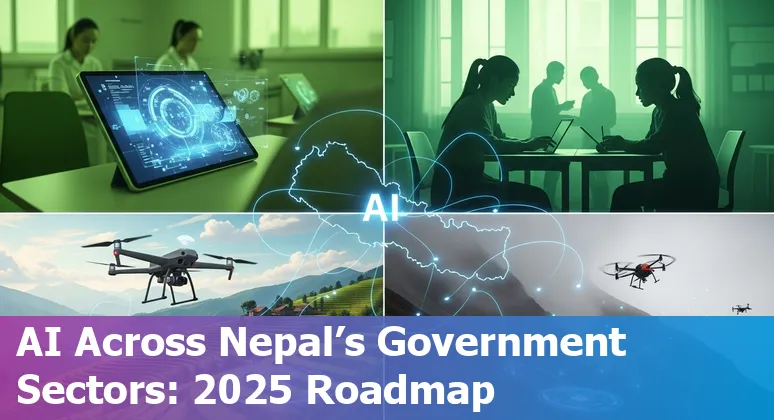
Too Long; Didn't Read:
Approved in August 2025, Nepal's National AI Policy 2082 establishes an AI Regulation Council and National AI Center, commits to training 5,000 AI professionals, targets health/education/agriculture/disaster prediction, and leverages >75% internet penetration with climate‑aware data centers.
Nepal's August 2025 approval of the National AI Policy 2082 is a practical pivot for public services and governance: the policy lays out ethical, transparent AI governance and human-capital goals that aim to modernize health, education, agriculture, disaster prediction and public administration while protecting citizens' rights - read the full National AI Policy 2082 full text (AI Association Nepal).
The government's agenda even includes an explicit commitment to prepare at least 5,000 AI professionals and set up an AI regulation council and center to monitor deployment and risks like misinformation and deepfakes (Nepal AI policy summary on Nepalytix), and proposals such as green data centers in high-hill regions underscore the local, climate-aware angle of Nepal's plan.
For civil servants and public-sector managers looking to move from strategy to skills, practical courses like the Nucamp AI Essentials for Work bootcamp syllabus teach prompt-writing and tool use needed to implement human-plus-AI services without a technical background.
| Attribute | Information |
|---|---|
| Program | AI Essentials for Work bootcamp |
| Length | 15 Weeks |
| Courses included | AI at Work: Foundations; Writing AI Prompts; Job Based Practical AI Skills |
| Cost (early bird) | $3,582 |
| Syllabus | AI Essentials for Work syllabus (Nucamp) |
| Register | AI Essentials for Work registration (Nucamp) |
Table of Contents
- What is the AI strategy in Nepal? A beginner's summary
- What is the National AI Policy 2025 in Nepal?
- Which organisation declared 2025 as the year of Artificial Intelligence in Nepal?
- Institutional architecture for AI governance in Nepal
- Policy pillars and sector applications of AI in Nepal
- Infrastructure, data governance and security needs in Nepal
- Workforce development: education, training and bootcamps in Nepal
- Challenges, gaps and policy recommendations for Nepal
- Conclusion: The future of AI in Nepal and steps for government beginners
- Frequently Asked Questions
Nucamp's Nepal community brings AI and tech education right to your doorstep.
What is the AI strategy in Nepal? A beginner's summary
(Up)The AI strategy in Nepal is a practical, phased roadmap that moves from basics - rules and infrastructure - to sector-ready projects and people, and it reads like a playbook for public managers: a technical committee's framework urges an urgent policy and legal backbone (an AI Act, data-protection rules and cybersecurity standards), a national AI policy to set ethical and operational standards, and an integrated portal to share research and tools (see the committee's roadmap Nepal AI Roadmap: Strategic Framework for Innovation and Development).
Priorities include investing in R&D and cloud/data infrastructure, piloting national and sectoral projects in health, education, agriculture, finance and government services, and building human capital through targeted training and industry partnerships.
The strategy also emphasizes ethics, transparency and international best-practice benchmarking so that AI adoption - whether for precision farming, adaptive learning or smarter citizen services - happens safely under the newly approved Nepal National Artificial Intelligence Policy 2082 (full policy), with clear steps for regulation, data governance and skills development.
What is the National AI Policy 2025 in Nepal?
(Up)The National AI Policy 2082, approved by Cabinet in August 2025, turns Nepal's broad AI ambitions into a concrete roadmap for responsible, inclusive adoption: it establishes core pillars - AI governance, human-capacity building, research and innovation, economic and social integration across health, education, agriculture and public administration, plus public–private partnerships and citizen-rights protections - and it flags practical needs like stronger data governance, more digital infrastructure and even data centres in the Himalayan region to keep services local (see the full policy at the AI Association Nepal official policy).
The policy builds on earlier digital frameworks and seeks to grow a domestic AI ecosystem - supporting startups, sector pilots and skills pipelines - while embedding safeguards against misuse (deepfakes, fraud) and stressing periodic oversight; officials expect new laws, standards and institutions to follow so implementation is not just aspirational but enforceable (read coverage of the Cabinet endorsement in The Himalayan Times).
For public managers, the “so what?” is clear: the policy creates both the guardrails and the growth levers needed to move from experimental pilots to scaled, ethical AI services that reduce costs, improve service delivery and protect citizens' rights - imagine government chatbots and predictive tools running from data centres humming at altitude in the foothills, backed by legal and technical checks that get reviewed on a regular cycle.
“It envisions new laws, standards, and institutions to ensure secure and sustainable AI governance,” - Aadesh Khadka, Joint Secretary, IT Division
Which organisation declared 2025 as the year of Artificial Intelligence in Nepal?
(Up)The organisation that effectively marked 2025 as Nepal's year of Artificial Intelligence was the Government of Nepal itself - more precisely the Cabinet acting on a policy package prepared by the Ministry of Communication and Information Technology - when it endorsed the National Artificial Intelligence Policy 2082 in August 2025; that Cabinet decision (announced August 11) turned a policy blueprint into an official national roadmap that sets up an AI Regulation Council, a National AI Centre and sector plans for health, education, agriculture and public services (see the National Artificial Intelligence Policy 2082 (Nepal) - full text and reporting on the Cabinet endorsement in the Himalayan Times coverage of the Cabinet endorsement).
The move signals more than words on paper: it launches implementation steps - new institutions, legal work and even plans for climate-smart data centres in Nepal's high hills - so 2025 reads as the year when AI moved from concept to government action.
“It envisions new laws, standards, and institutions to ensure secure and sustainable AI governance,” - Aadesh Khadka, Joint Secretary, IT Division
Institutional architecture for AI governance in Nepal
(Up)Nepal's institutional architecture for AI governance is built to be both broad and interlocking: the National AI Policy and draft frameworks propose a 14‑member AI Regulatory Council - chaired by the communications minister and designed to include secretaries from key ministries, the Governor of Nepal Rastra Bank, the telecom regulator and private‑sector and expert representatives - tasked with issuing ethical guidelines and standards (Nepal AI Regulatory Council composition 2025 - Ekantipur); a National AI Center under the Ministry of Communications and Information Technology to act as the central body for research, quality standards and enforcement; and complementary bodies such as AI Excellence Centers, an AI Incubation Hub and provincial/local coordination units to decentralize research and deployment (Nepal National AI Center and supporting institutions overview - ICTFrame).
Coverage and commentary also highlight the policy's proposal for an AI Supervision Council and an AI Regulatory Authority to strengthen oversight, even as analysts warn that real impact will hinge on funding, enforcement capacity and clear mandates (Nepal AI policy analysis and enforcement concerns - Annapurna Express).
The practical takeaway for public managers: the architecture aims to merge technical stewardship, cross‑sector representation and regional coordination, creating a single governance spine - a multi‑stakeholder council and a staffed national centre - that can translate rules into vetted pilots rather than leaving decisions scattered across ministries.
| Institution | Primary role |
|---|---|
| AI Regulatory Council | Set ethical standards, oversight; 14 members including ministry secretaries and experts |
| National AI Center | Main authority for AI research, standards and national coordination |
| AI Excellence Centers | University and research hubs for advanced R&D |
| AI Incubation Hub | Support startups, PPPs and commercialization |
| Provincial/Local Coordination Units | Integrate AI initiatives across federal, provincial and local levels |
Policy pillars and sector applications of AI in Nepal
(Up)Nepal's National AI Policy 2082 groups action into clear, usable pillars - AI governance, human‑capital development, research & innovation, economic and social integration, public–private partnerships and protection of citizen rights - and then ties each pillar to tangible sector work so public managers can see immediate use cases rather than abstract goals; the policy text itself maps governance and legal scaffolding while flagging sector pilots in health, education, agriculture, energy and tourism (Nepal National AI Policy 2082 - full text (AI Association Nepal)).
Practically this means things like AI chatbots to handle routine citizen requests and free overworked staff for complex cases, predictive analytics to extend healthcare into remote districts, and precision ag tools - automated irrigation, pest management and climate monitoring - to boost yields and resilience, all of which commentators warn will need funding and enforcement to scale (Annapurna Express analysis of Nepal AI policy and scaling challenges).
For hands‑on, near‑term experimentation, simple toolkits such as citizen‑service chatbots are already being piloted and taught in practical courses to speed uptake (Nucamp AI Essentials for Work bootcamp syllabus - citizen-service chatbots in Nepal).
The “so what?”: the policy turns a menu of principles into sector roadmaps - imagine AI models running from climate‑aware data centres in hill districts to keep services local while university labs and PPPs pilot apps that directly reduce costs and improve access for ordinary Nepalis.
| Policy Pillar | Sector Applications / Examples |
|---|---|
| AI Governance | Regulatory frameworks, oversight councils, standards |
| Human Capital Development | AI curricula, bootcamps, workforce upskilling |
| Research & Innovation | AI Excellence Centers, R&D, HPC and data centres |
| Economic & Social Integration | Health, education, agriculture, public administration pilots |
| Public‑Private Partnerships | PPP for infrastructure, commercialization, incubators |
| Protection of Citizen Rights | Data privacy, ethical safeguards, accountability mechanisms |
“AI education will be incorporated into the national curriculum at various academic levels to cultivate a sustainable AI workforce.”
Infrastructure, data governance and security needs in Nepal
(Up)Building trustworthy AI services in Nepal depends first on plumbing and policy: reliable internet and cloud access (internet penetration is now reported above 75%) plus local hosting options make cloud-first government projects feasible, whether using Nepal's Government Cloud at the GIDC or cloud hosting partners - for example cloud hosting providers such as BISUP cloud hosting provider in Nepal and regional AWS partners - to run AI/ML toolchains without massive capital outlay.
Practical infrastructure requirements include redundant fiber paths and multi‑ISP peering to avoid single‑point failures (connections through India and growing links via China are already in place), robust power architectures with N+1 or 2N redundancy and UPS/generator backup sized for long outages, and precision cooling tailored to Nepal's varied climate (mountain‑air and free‑cooling designs can cut energy use dramatically).
Equally critical are clear registration and licensing steps, Tier classification and security audits from the NTA, and data‑sovereignty rules that require critical government and personal datasets to be stored domestically - details covered in investor and setup guides for AI servers and data centres in Nepal.
The “so what?” is tangible: imagine secure government chatbots and prediction tools running from hydro‑powered data centres in mid‑hill sites, cooled by crisp mountain air and governed by enforceable localization and uptime rules - that mix of green power, diverse connectivity and legal clarity is what will turn pilots into reliable public services (AI server and data center establishment guide Nepal, AWS cloud services in Nepal overview).
| Priority | Key requirement |
|---|---|
| Connectivity | Redundant fiber, multi‑ISP, peering (India/China links) |
| Power & Resilience | N+1/2N redundancy, UPS + 72‑hour generator plans, preferential tariffs |
| Cooling | Free/mountain‑air cooling, precision CRAC, PUE optimization |
| Regulation & Security | NTA certification, data localization for critical datasets, security audits |
| Cloud & Hosting | Use of Nepal‑optimized cloud providers and government GIDC for data sovereignty |
Workforce development: education, training and bootcamps in Nepal
(Up)Building Nepal's AI workforce means stitching together university courses, teacher training, industry fellowships and short, practical bootcamps so government teams can move from theory to delivery: universities are already adding dedicated AI and ML modules and programs (see Fuse Insights on the evolving landscape of AI education in Nepal), schools and makerspaces are introducing hands‑on STEM and personalized AI tools to prepare younger cohorts for tech careers (read Edusanjal's review of innovation and AI in Nepal's education system), and targeted upskilling - intensive, job‑focused programs and bootcamps - give civil servants the prompt‑writing, data‑handling and service‑design skills needed to run human‑plus‑AI services (examples and practical bootcamp syllabi are discussed in local training guides like the Nucamp AI Essentials for Work bootcamp syllabus).
The challenge is clear: without more teacher training, reliable connectivity and dedicated R&D labs, adoption stalls; the payoff is tangible, though - picture a provincially run clinic where a bootcamp‑trained analyst deploys a local chatbot and a simple predictive model that routes urgent cases faster, freeing nurses for hands‑on care and making AI a visible public service benefit rather than an abstract promise.
Challenges, gaps and policy recommendations for Nepal
(Up)Practical rollout of Nepal's National AI Policy faces a tight knot of real-world gaps: fragile and uneven digital infrastructure, unclear financing for HPC and data centres, a thin domestic talent pool and rising cyber‑risk that together could turn promise into paperwork.
Reporting warns that the policy names needed institutions but omits a dedicated budget or clear investor incentives, leaving public–private partnerships and funding models vague (Annapurna Express analysis of Nepal's National AI Policy readiness); cybersecurity experts add that AI will only help if basic hygiene improves - too many routers still ship with default passwords and outdated firmware, widening the attack surface (ICTFrame analysis of AI and cybersecurity in Nepal).
Other concrete risks include sharp increases in cybercrime and high‑profile breaches that strain trust and capacity, while observers urge alignment with international standards and stronger enforcement to avoid bias, surveillance misuse and deepfake‑driven misinformation (Fiscal Nepal report on the National AI Policy endorsement and readiness concerns).
Priority policy fixes are straightforward and urgent: ring‑fenced funding, clear PPP incentives, immediate upskilling (bootcamps and targeted fellowships), accelerated passage and enforcement of data‑protection rules, national router‑hardening and audit programs, plus a transparent roadmap for the AI Council so citizens see measurable pilots, not paper promises.
| Challenge | Evidence / Metric |
|---|---|
| Digital infrastructure | High national penetration but persistent rural gaps; past outages and connectivity vulnerabilities |
| Cybersecurity | 19,730 FIRs recorded (five‑year rise); major breaches and thefts (e.g., Rs 34.2M incident) |
| Funding & implementation | No dedicated budget for HPC/data centres; PPP incentives unclear |
| Workforce | Shortage of AI professionals; risk of brain drain without domestic opportunities |
| Device hygiene | Routers with default passwords and outdated firmware increase attack surface |
“AI can be a game-changer for Nepal's healthcare and agriculture, but without strict ethical controls, it risks becoming another tool of exploitation and inequality,” - a Kathmandu-based ICT researcher
Conclusion: The future of AI in Nepal and steps for government beginners
(Up)Nepal's National AI Policy 2082 is a clear opening move - it sets governance, human‑capital, R&D and citizen‑rights pillars and asks governments to move from promises to pilots - so beginners should start with three practical steps: (1) lock in ring‑fenced funding and simple PPP rules so a national plan becomes pay‑for‑able, (2) launch measurable, sector pilots (for example a citizen‑service chatbot or a province‑level triage tool in health) that prove value quickly and build public trust, and (3) pair those pilots with rapid upskilling and data‑governance basics so staff can operate and audit models safely.
Read the full National AI Policy 2082 to align projects with official goals and legal guardrails via the AI Association Nepal policy page, and use technical reviews such as ICTFrame's policy analysis for practical recommendations on ethics, data privacy and implementation priorities.
Fast, low‑risk wins require tightened cyber hygiene, clearly defined data‑localization rules, and a commitment to transparency and monitoring - while workforce programs like the Nucamp AI Essentials for Work bootcamp offer a hands‑on route for civil servants to learn prompt‑writing, tool workflows and job‑based AI skills so government teams can deploy “human‑plus‑AI” services without deep technical hires.
In short: start small, fund clearly, protect citizens with data rules, measure outcomes, and scale what works - that sequence turns policy intent into visible services Nepalis can trust and use.
| Program | Key details |
|---|---|
| AI Essentials for Work (Nucamp) | 15 weeks; courses: AI at Work: Foundations, Writing AI Prompts, Job Based Practical AI Skills; early bird $3,582; syllabus: AI Essentials for Work syllabus; register: AI Essentials for Work registration |
“The process of AI policy-making should be open, transparent, consultative and participatory. The government should ensure the participation of ...”
Frequently Asked Questions
(Up)What is Nepal's AI strategy and what are its main priorities?
Nepal's AI strategy is a phased, practical roadmap that moves from legal and infrastructure foundations to sector-ready projects and workforce development. Core priorities are: (1) AI governance and ethics (new laws, standards, oversight), (2) human-capacity building and targeted training, (3) research & innovation including HPC/data centres, (4) economic and social integration across health, education, agriculture, energy and public administration, and (5) public–private partnerships to commercialize solutions. The strategy emphasizes piloting measurable projects (e.g., citizen-service chatbots, predictive health tools, precision agriculture) and aligning projects with international best practices and data-governance rules.
What is the National AI Policy 2082 (approved August 2025) and what does it commit to?
The National AI Policy 2082, approved by Cabinet in August 2025 (announcement on August 11), formalizes Nepal's approach to responsible, inclusive AI adoption. It sets core pillars - AI governance, human-capacity development, research & innovation, economic/social integration, public–private partnerships, and protection of citizen rights - and commits to tangible actions such as creating an AI Regulation Council and a National AI Center, supporting sector pilots in health/education/agriculture, strengthening data governance and cybersecurity, and preparing at least 5,000 AI professionals. The policy also proposes climate-aware infrastructure measures like green data centres in high-hill regions and anticipates follow-on laws and standards to make implementation enforceable.
What institutional architecture will govern AI in Nepal?
The policy proposes an interlocking governance structure centered on a 14‑member AI Regulatory Council (chaired by the communications minister, including ministry secretaries, the Governor of Nepal Rastra Bank, the telecom regulator and expert/private-sector representatives) to set ethical standards and oversight, plus a National AI Center under the Ministry of Communications and Information Technology for research, standards and coordination. Complementary institutions include AI Excellence Centers (university/research hubs), an AI Incubation Hub for startups/PPPs, provincial/local coordination units, and proposed supervisory/regulatory authorities to strengthen enforcement.
What infrastructure, data governance and security requirements are needed to run government AI services in Nepal?
Key technical and policy requirements are: robust connectivity (redundant fiber, multi‑ISP peering including India/China routes), reliable power with N+1 or 2N redundancy and UPS/generator backup, precision cooling and PUE optimization (with free/mountain-air designs for hill data centres), and Nepal‑based cloud/hosting options (Government GIDC and local/regional providers) to satisfy data‑sovereignty rules. On governance and security, the policy calls for NTA certification, tiered registration/licensing, security audits, enforced data-localization for critical datasets, and national router‑hardening and audit programs to reduce cyber risk (noting current challenges such as rising FIRs and past breaches). Internet penetration is reported above 75%, but rural gaps and outage risk remain priorities to address.
How can government teams build AI skills quickly and what training options exist (including Nucamp)?
Workforce development combines university curricula, teacher training, fellowships and short practical bootcamps so civil servants can operate and audit AI services. Fast, job‑focused options teach prompt writing, tool workflows and simple model deployment for “human‑plus‑AI” services. Example: Nucamp's AI Essentials for Work bootcamp is a 15‑week program (courses: AI at Work: Foundations; Writing AI Prompts; Job Based Practical AI Skills) with an early-bird cost listed at $3,582. Beginners are advised to pair rapid upskilling with ring‑fenced funding, small measurable pilots (e.g., a citizen chatbot or provincial triage tool), tightened cyber hygiene, clear data‑governance rules, and ongoing monitoring so pilots prove value and can scale.
See how the Vendor Similarity & Due Diligence Finder benchmarks suppliers and flags supply‑chain risks before you commit.
Explore the benefits of chatbots for citizen services in Nepal that resolve routine queries and free staff for complex tasks.
Find out why paralegals who learn e-discovery and legal-tech can transition into a Legal‑Technology Specialist role as AI takes on document review.

Ludo Fourrage
Founder and CEO
Ludovic (Ludo) Fourrage is an education industry veteran, named in 2017 as a Learning Technology Leader by Training Magazine. Before founding Nucamp, Ludo spent 18 years at Microsoft where he led innovation in the learning space. As the Senior Director of Digital Learning at this same company, Ludo led the development of the first of its kind 'YouTube for the Enterprise'. More recently, he delivered one of the most successful Corporate MOOC programs in partnership with top business schools and consulting organizations, i.e. INSEAD, Wharton, London Business School, and Accenture, to name a few. With the belief that the right education for everyone is an achievable goal, Ludo leads the nucamp team in the quest to make quality education accessible