









The Complete Guide to Starting an AI Career in Fremont, CA in 2026
By Irene Holden
Last Updated: March 5th 2026
Key Takeaways
To launch an AI career in Fremont, CA in 2026, capitalize on its status as a nexus for hardware and software AI, fueled by proximity to Tesla's factory and Silicon Valley tech giants, with in-demand roles like Machine Learning Engineers earning median compensations of $198,500. Focus on mastering skills like Python, PyTorch, and LLMs, and explore affordable, targeted training through options like Nucamp's bootcamps, which cost from $2,124 and have a 78% employment rate for bridging into Fremont's competitive job market.
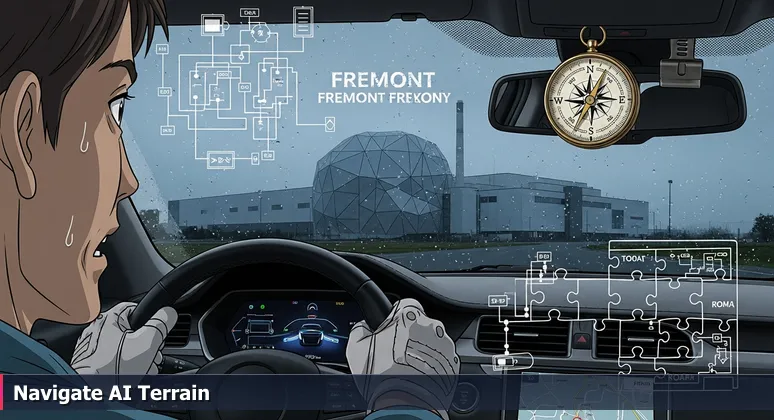
That moment of frustrated anticipation - the glowing GPS screen, the massive Tesla Fremont Factory looming just beyond a dead-end service road - perfectly captures the disconnect many face when launching an AI career here. You have the job titles and salary data, the coordinates. But in 2026, success demands understanding the terrain: the unique convergence of foundational research, applied robotics, and venture capital that defines this region.
This isn't a generic tech hub. The Bay Area alone accounts for nearly 15% of all U.S. AI-related job postings, a concentration of ambition and opportunity that makes Fremont a critical node in the global AI ecosystem. The landscape is split between the physical world of the Gigafactory and the algorithmic realms of nearby tech giants, creating a complex but rewarding career map.
The classic entry-level path has transformed. As industry analysis notes, the market has recalibrated, with companies leveraging AI tools to augment senior talent. Your goal is no longer a generic "entry-level AI job" but a role where you can add immediate value as a problem-solver. This requires moving beyond following a preset route to developing an internal map - one that navigates the hidden bridges between Stanford's theoretical papers, Tesla's real-world robotics, and the startup forge of Sand Hill Road.
In This Guide
- Your AI Career Map for Fremont in 2026
- Why Fremont is AI's Ground Zero
- Top AI Roles and Fremont Salaries
- Essential Skills for AI Success
- Education Pathways to AI Careers
- Custom Steps for Your AI Journey
- From Application to Offer
- Launching Your AI Career in Fremont
- Frequently Asked Questions
Many Bay Area professionals balance learning with full-time jobs through part-time coding programs in Fremont's Nucamp community that deliver evening and weekend online classes.
Why Fremont is AI's Ground Zero
Fremont's identity is uniquely split, creating a powerful local alchemy that fuels relentless AI demand. It's home to the Tesla Fremont Factory, one of the world's most advanced manufacturing hubs for both electric vehicles and humanoid robotics like Optimus. This anchors a massive need for AI talent specializing in real-world, physical applications - computer vision for autonomous systems, reinforcement learning for robotic motion, and simulation-to-real AI.
Simultaneously, the city sits within a 25-mile radius of the headquarters of Google, Apple, Meta, and NVIDIA, making it a prime residential hub for talent working on the next generation of LLMs, generative AI, and AI hardware. This proximity creates what Aparna Chennapragada, Microsoft's CPO for AI, calls the era of "true collaboration" between technology and people. It’s not just about task automation; it’s about building symbiotic systems where human and artificial intelligence co-evolve.
"AI isn’t just coming for your job - it’s creating massive new opportunities if you know where to look. AI proficiency now commands a ~28% salary premium," - Industry analysis for 2026.
The result is a job market that is both incredibly rewarding and fiercely competitive, where success requires more than just technical skill - it requires ecosystem fluency. The broader tech market may recalibrate, but ML-related roles are projected to grow by 31% through 2030, with Fremont at the epicenter. This convergence of cutting-edge software research and hard-tech manufacturing makes the city a non-negotiable ground zero for AI ambition.
Top AI Roles and Fremont Salaries
The AI field has stratified into specialized tracks that define Fremont's competitive market. Understanding these paths is the critical first step in moving from a generic job seeker to a targeted candidate who can navigate the local terrain.
Core Technical Roles: The Builders
Machine Learning Engineer remains the backbone role, focusing on designing, training, and deploying models into production. In Fremont, this role commands a median total compensation of $198,500, with senior engineers at top firms reaching $314,000+. For specialized roles like those at the Tesla Fremont Factory, total compensation can approach $360,000 with equity. The MLOps Engineer represents a rapidly exploding field, blending software engineering and DevOps to manage the CI/CD pipelines and infrastructure needed to move models from lab to scale.
Research and Specialized Applications
AI/ML Research Scientists, often requiring a PhD, focus on advancing fundamental algorithms in areas like NLP and computer vision. Senior research roles in the Bay Area show a wide range, typically from $220,000 to $265,000+ in total compensation. Fremont's hardware-software convergence creates exceptional demand for Robotics & Computer Vision Engineers. These roles demand deep knowledge of sensors, perception, and motion planning, directly serving the autonomous vehicle and advanced manufacturing sectors.
Strategic and Emerging Roles
The non-technical bridge is embodied by the AI Product/Project Manager, a role seeing soaring demand as every company becomes an AI company. Furthermore, with increasing regulatory scrutiny, AI Ethicist & Governance Specialist has emerged as a critical new role focused on auditing models and developing ethical frameworks.
The actionable takeaway is clear: success requires specialization. As industry trends indicate, your entire upskilling path depends on choosing whether to build core models (ML Engineer), advance the science (Research Scientist), deploy at scale (MLOps), integrate AI into physical systems (Robotics), or steer strategic direction (Product Manager).
Essential Skills for AI Success
The baseline for technical competency has risen significantly. Mastery of Python is now assumed, as is fluency in a core deep learning framework like PyTorch (dominant in research) or TensorFlow (prevalent in large-scale production). Proficiency with SQL for data wrangling and Git for version control are considered basic professional requirements, forming the non-negotiable foundation for any technical role.
The new essentials revolve around Large Language Models (LLMs) and Generative AI. Understanding transformer architectures, fine-tuning pre-trained models, and expertise in prompt engineering and Retrieval-Augmented Generation (RAG) systems are no longer niche but expected. According to industry guides, expertise in these areas commands a significant salary premium and is critical for roles at companies integrating AI into core products.
The Fremont Edge: Hardware-Meets-Software Skills
Given the local emphasis on robotics and advanced manufacturing, skills in computer vision libraries (OpenCV), robotics middleware (ROS 2), and simulation platforms are highly valued. These competencies differentiate candidates for roles at Tesla, Lam Research, and the burgeoning number of "Deep Tech" startups focused on physical AI applications, creating a tangible advantage in the Fremont job market.
The Indispensable Human Skill
Beyond code, AI fluency - the ability to discuss capabilities, limitations, and strategic implications with both technical and non-technical audiences - is critical. A 2026 Indeed Hiring Lab report notes that while broader hiring may fluctuate, jobs mentioning AI in descriptions are growing, and 70% of hiring managers now expect this fluency from new hires. Success is as much about communication and strategic thinking as it is about technical execution.
Education Pathways to AI Careers
With the map and required skills in hand, the critical question becomes how to build your bridge into the industry. The education pathway has diversified significantly, offering multiple routes tailored to different starting points and resources.
| Pathway | Key Institutions/Options | Typical Cost | Best For |
|---|---|---|---|
| University Route | Stanford, UC Berkeley, San Jose State University (SJSU) | $60,000+ for graduate programs; more affordable at state schools | Those seeking high-end research roles, PhD tracks, or comprehensive theoretical foundations with strong alumni networks. |
| Bootcamp Route | Nucamp's AI bootcamps (Solo AI Tech Entrepreneur, AI Essentials for Work) | $2,124 to $3,980 | Career changers, upskillers, and entrepreneurs seeking hands-on, affordable, and accelerated paths focused on building deployable products. |
| Portfolio Route | Self-directed projects, open-source contributions, detailed technical blogs | Time investment vs. tuition | Exceptional, self-motivated talent who can demonstrate production-ready work and deep practical understanding without formal credentials. |
The university route, through institutions like Stanford and UC Berkeley, remains the premier feeder for research and leadership roles, offering unparalleled access to cutting-edge work. However, for a more direct and cost-effective path, bootcamps have evolved. Programs like Nucamp's are designed with the local Fremont ecosystem in mind, simulating the product development cycle of a Silicon Valley startup and reporting a 78% employment rate. Meanwhile, the portfolio route demands a stellar showcase of projects, such as a deployed web app using a fine-tuned LLM or contributions to major open-source AI projects.
Custom Steps for Your AI Journey
Navigating the Fremont AI landscape requires a personalized approach. The bridge you build depends entirely on your starting point - whether you're a new graduate, a career switcher, or an experienced engineer. Each path leverages different assets and requires specific, actionable steps.
For the Recent Graduate or Career Starter
Your most critical step is to pursue an internship relentlessly. Apply for positions like the Applied AI Intern at Fremont-based Lam Research or similar roles at Tesla and AI startups, as these are the primary pipelines for full-time offers. Use academic projects or specialized bootcamp modules to dive deep into a niche like computer vision or MLOps early on, and actively network at local tech meetups in San Jose or Fremont to convert conversations into opportunities.
For the Career Switcher or Bootcamper
Your previous domain expertise in fields like healthcare or finance is a unique asset when applying to AI companies in those verticals. Focus on building a production-ready portfolio with clean, documented, and deployed projects to demonstrate practical skill. Crucially, utilize structured career services fully; programs like Nucamp's bootcamps provide resume reviews, mock interviews tuned for Bay Area companies, and job board access specifically designed to navigate this competitive local market.
For the Experienced Software Engineer
Your most natural and in-demand transition is into MLOps. Your existing skills in DevOps, infrastructure, and software architecture are desperately needed to scale AI models. In interviews, lead with systems thinking - focus on how you would design a model-serving architecture, improve pipeline efficiency, or manage CI/CD for machine learning. This positions you not as a novice but as an enabler who can industrialize AI efforts.
From Application to Offer
The terrain of the hiring process itself has shifted in 2026, requiring new navigation tactics. The most significant change is the recalibration of the entry-level market. While AI job growth remains strong, pure "entry-level" openings have decreased as companies leverage AI tools to augment senior staff. Your goal must be to demonstrate immediate value, framing yourself as a problem-solver from the first interview.
Mastering the modern, hybrid interview is essential. Expect a multi-stage gauntlet: a coding screen (often LeetCode-style with a data twist), a take-home project or case study that's increasingly common, and onsite interviews covering machine learning theory, system design for ML, and behavioral fit. Preparation means practicing not just algorithms but articulating your approach to model deployment and scaling.
Decoding compensation is critical in a high-cost region. When evaluating an offer, you must look at total compensation (TC): base salary + annual bonus + equity/stock grants. For senior roles at top firms, equity can constitute the majority of the package. Use resources like Levels.fyi to benchmark, but remember that Fremont salaries, while high, come with a significant cost of living. Finally, embrace the hybrid reality. While approximately 30-40% of AI roles in the Bay Area utilize hybrid models, hardware-integrated roles at Tesla or robotics companies typically require mandatory on-site presence in Fremont, connecting your daily work back to the physical hub of innovation.
Launching Your AI Career in Fremont
Starting your AI career in Fremont is not about blindly following GPS coordinates to a corporate address. It's about learning to read the landscape - understanding that the bridge from a Stanford theory paper to a Tesla robot's neural network is built with pragmatic MLOps skills, and that the venture capital fueling a startup in nearby Menlo Park seeks founders who can ship products. The terrain is complex and the competition is real, but for those who successfully navigate it, Fremont offers a front-row seat to building the future.
The journey may begin on that metaphorical dead-end road, but the destination is within reach. Look to local success stories like Fremont native Lucy Guo, who became the world's youngest self-made female billionaire by solving AI's data challenges, or Neha Konakalla, who launched an AI venture straight out of high school. Their paths underscore that in this ecosystem, execution and innovation trump pedigree alone.
Whether you choose the university spire, the focused intensity of a bootcamp, or the entrepreneurial forge of your own portfolio, the key is to start building your bridge today. Develop the specialized skills, cultivate ecosystem fluency, and embrace the unique convergence of hardware and software that defines this ground-zero city. Your map is now complete; the navigation is yours to begin.
Frequently Asked Questions
Why should I consider starting my AI career in Fremont, CA in 2026?
Fremont is a critical node in the global AI ecosystem, combining Tesla's advanced manufacturing with proximity to giants like Google and Apple. The Bay Area accounts for nearly 15% of U.S. AI job postings, offering unparalleled opportunities for roles in both hardware-integrated and software-driven AI.
What types of AI jobs are most available in Fremont, and what do they pay?
Machine Learning Engineers are in high demand, with a median salary of $198,500 in Fremont, and senior roles at companies like Tesla can reach over $314,000. Robotics and computer vision engineers are also sought after, especially given the local focus on autonomous systems and manufacturing.
What technical skills are essential to succeed in Fremont's AI job market?
Mastery of Python and deep learning frameworks like PyTorch is non-negotiable, and expertise in Large Language Models and generative AI is now standard. For Fremont's robotics scene, skills in computer vision libraries such as OpenCV can give you a significant advantage over pure-software candidates.
Is a traditional university degree necessary, or can I use a bootcamp to enter the AI field in Fremont?
While universities like Stanford offer strong pathways, bootcamps like Nucamp provide an affordable and practical alternative, with programs priced from $2,124 to $3,980 and a 78% employment rate. They focus on hands-on skills tailored to the Bay Area's startup and tech employer needs.
How has the AI job market in Fremont changed, and what should I prepare for in the hiring process?
Pure entry-level roles have decreased, so aim to showcase immediate value through projects or domain expertise. Expect hybrid interviews with coding screens and case studies, and note that about 30-40% of AI roles in the area use hybrid work models, with hardware-focused jobs often requiring on-site presence in Fremont.
Discover Fremont's cybersecurity job market forecast for 2026 in this complete resource.
Learn about the AI engineer journey in Fremont, CA for 2026 through this article that details prerequisites, deep learning frameworks, and production-ready systems.
Startups can find the best tech coworking spaces in Fremont tailored for AI, robotics, and cleantech in this guide.
This article provides a blueprint for financing AI and ML education in 2026.
Get insights into robotics and advanced manufacturing opportunities in Fremont from our report.

Irene Holden
Operations Manager
Former Microsoft Education and Learning Futures Group team member, Irene now oversees instructors at Nucamp while writing about everything tech - from careers to coding bootcamps.