









How to Become an AI Engineer in Wichita, KS in 2026
By Irene Holden
Last Updated: April 1st 2026
Quick Summary
You can become an AI engineer in Wichita, KS in 2026 by committing to a 12-month structured plan that builds skills in Python, SQL, and machine learning through local programs like Butler Community College's AI Edge. Wichita's lower cost of living and access to major employers such as Koch Industries and Spirit AeroSystems offer hands-on project opportunities in domains like predictive maintenance and supply chain optimization, helping you land a job-ready role by the end of the year.
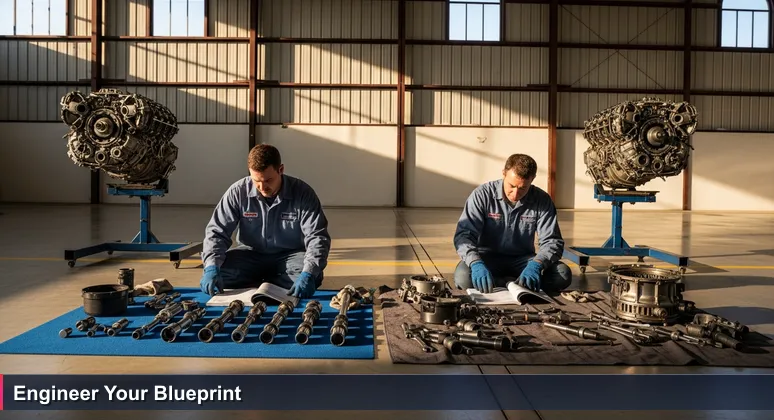
In Wichita's hangars, having the correct manual is less important than knowing how to build with it. Your journey starts by auditing your toolkit with the same practical rigor. You need a reliable computer and internet, but your most critical asset is a builder's mindset. As Wichita State University's Cody Farlow emphasizes, professionals must master practical AI tool usage to provide real value, moving beyond passive learning to immediate application.
Required materials are straightforward, but the skill prerequisites demand honest assessment. Before touching advanced frameworks, solidify your foundation:
- Basic Programming Logic: Variables, loops, conditionals, and functions in Python.
- High School-Level Mathematics: Comfort with algebra as a launchpad for the necessary calculus and linear algebra.
If these are gaps, dedicate 2-4 weeks to an introductory course. This groundwork is non-negotiable; attempting to assemble complex AI systems without it is like trying to rebuild a jet engine without understanding its basic components. For structured local support, explore foundational programs like the AI Edge hub at Butler Community College or the Essentials of AI Part-Time Training Program through KANSASWORKS, which prepares you for industry-recognized certifications.
Steps Overview
- Gear Up: Your AI Engineering Starter Kit
- Lay the Groundwork: Wichita's Essential Tech Stack
- Ignite Intelligence: Core Machine Learning Skills
- Power Up: Deep Learning and Specializations
- Ship It: Deployment and Portfolio Building
- Flight Check: Are You Ready for Wichita AI Jobs?
- Common Questions
For a detailed blueprint on AI engineering in Wichita, refer to this in-depth article.
Lay the Groundwork: Wichita's Essential Tech Stack
With your mindset calibrated, the first assembly phase begins: mastering the three technical pillars that form Wichita's industrial AI blueprint. This isn't about generic theory; it's about learning the specific tools that turn local data into business intelligence.
Master Core Python Programming
Python is the mandatory standard. Move beyond syntax to fluency in structures that scale within large enterprises. Focus on data structures (lists, dictionaries, sets), object-oriented programming for building robust applications, and the essential libraries NumPy and Pandas. This skill is non-negotiable, as seen in posts for an AI Model Engineer in Wichita, which list Python proficiency as a core requirement.
Conquer Data & SQL
AI is built on data, and in Wichita's manufacturing heart, that data lives in relational databases. Learn to write SELECT, JOIN, and GROUP BY statements. Your ability to extract and prepare sensor data from production lines or supply chain logs is a fundamental expectation at firms like Spirit AeroSystems and Koch Industries, where operations run on SQL databases.
Establish Your Math Foundation
Concurrently, dedicate weekly time to the mathematics that power machine learning: linear algebra (vectors, matrices), calculus (derivatives, gradients), and probability. The goal is intuitive literacy, not academic mastery. Resources like Khan Academy can build this understanding, which is essential for grasping how models optimize - a skill that commands a 4.1% higher salary increase for AI specialists compared to general IT roles.
Ignite Intelligence: Core Machine Learning Skills
Now you move from tool sharpening to assembly, implementing the core machine learning workflow that turns prepared data into actionable predictions. This phase is where abstract concepts become tangible systems, and the most effective practice is building projects that mirror Wichita's industrial needs.
Learn the End-to-End Workflow
Master the complete process from data cleaning and exploration to model selection, training, and evaluation. Use the scikit-learn library to implement foundational algorithms like Linear Regression, Random Forests, and Support Vector Machines. This hands-on application is critical; as industry experts note, AI roles are among the fastest-growing, but employers demand practical competency over theoretical knowledge alone.
Build a Local-Focused Project
Apply your skills to a problem rooted in the Plains economy. A powerful starter project is a Predictive Maintenance Simulator using public sensor data to forecast equipment failure. This directly mirrors the work prioritized by Wichita's aerospace sector, where firms like Spirit AeroSystems and Textron Aviation leverage AI for manufacturing efficiency and operational reliability.
Formalize with Local Training
To solidify your knowledge and gain credentials, consider enrolling in a structured local program. Options include intensive AI+ Engineer Certification courses in Wichita that cover neural networks and deployment, providing a fast-track, hands-on environment that connects learning directly to the professional landscape.
Power Up: Deep Learning and Specializations
This phase is where you transition from traditional algorithms to the neural network architectures powering modern AI. Specialization becomes key, as you choose a primary framework and dive into high-demand areas like Natural Language Processing (NLP), which are increasingly critical for Wichita's tech landscape.
Choose and Master a Deep Learning Framework
Commit to either TensorFlow or PyTorch and learn to construct, train, and evaluate neural networks. Start with feedforward networks before advancing to Convolutional Neural Networks for image data and Recurrent Neural Networks for sequences like time-series sensor data. This deep technical skill aligns with the shift toward practical "AI orchestration" that local experts emphasize, moving models from experimentation to integrated systems.
Dive into Natural Language Processing
NLP is a vital specialization. Learn tokenization, word embeddings, and how to leverage pre-trained transformer models via libraries like Hugging Face. A compelling local project is building a Retrieval-Augmented Generation (RAG) application that answers questions from specific datasets, such as aircraft maintenance manuals - a directly applicable skill for Wichita's engineering teams.
Engage with the Local AI Community
Begin connecting your technical work to the professional ecosystem. Actively participate in the forums and workshops launched by the Wichita State University Responsible AI@ICT initiative, a working group that brings together researchers and professionals. As noted in industry analyses, AI engineering is the fastest-growing skill in the job market, and engaging locally provides unmatched networking and contextual learning. For structured, hands-on training in these advanced topics, consider the focused AI Engineer courses available in Wichita that cover deployment pipelines and LLMs.
Ship It: Deployment and Portfolio Building
The final assembly transforms your models from experiments into shipped products. This phase focuses on MLOps - the practices and tools that deploy, monitor, and maintain AI systems in production, a skillset explicitly demanded in Wichita's job market.
Learn MLOps and Deployment Fundamentals
Master containerization with Docker to package your model environment. Understand cloud AI platforms (like Azure ML or AWS SageMaker) and model-serving frameworks such as FastAPI. Explore vector databases like Qdrant for building advanced applications, a technical requirement listed for roles like the AI Model Engineer in Wichita. This operational competency is what separates a prototype from a business asset.
Build Your Capstone Portfolio Project
Create a comprehensive application demonstrating full-stack AI engineering. A robust blueprint is a Supply Chain Optimization Dashboard that ingests data, retrains a forecasting model, and displays insights. This showcases the "AI orchestration" vital to a conglomerate like Koch Industries, focusing on integrating intelligence into business systems for planning and optimization.
Contribute and Refine
Host your projects on GitHub with professional documentation. Write a brief case study explaining your architecture and business impact. Consider contributing to an open-source AI project. This demonstrates communication skills and proactive learning, rounding out a portfolio that proves you can build systems ready for integration into the Air Capital's economy.
Flight Check: Are You Ready for Wichita AI Jobs?
Before you taxi onto the runway of Wichita's job market, conduct a final systems check. Success isn't just technical proficiency; it's the ability to demonstrate value to local employers like Koch, Spirit, and the region's growing tech startups. Verify you meet these mission-critical criteria.
Your public portfolio must feature at least three projects, including one with clear relevance to the Plains, such as predictive maintenance or supply chain optimization. You should be fluent in explaining an ML project's full lifecycle, from business problem to deployed model monitoring. Technically, proficiency in Python, SQL, and one major deep learning framework (TensorFlow or PyTorch) is mandatory, alongside hands-on experience with Git, Docker, and a cloud platform.
Crucially, you must be able to discuss your work in terms of business impact. For example, "My model reduced simulated prediction error by X%, potentially translating to fewer unplanned downtimes in a manufacturing setting." This applied perspective is what local firms, integrating AI into massive enterprise systems, truly value. Furthermore, engagement with the local ecosystem - through a certificate from a provider like NetCom Learning or attendance at Wichita State's Responsible AI@ICT forums - signals serious commitment.
When you clear these checks, you're ready. The investment pays: AI specialists command premium salaries, with local roles offering ranges competitive with national markets, such as the $89,000 to $182,000 seen for AI platform engineers in the region. Your education is no longer generic - it's a custom-built system, engineered for integration and ready for its test flight in the Air Capital.
Common Questions
Do I need a computer science degree to become an AI engineer in Wichita?
No, a formal degree isn't required. The article emphasizes a self-taught path, and local programs like Butler Community College's AI Edge provide affordable, targeted training to build skills for Wichita's job market, where employers value practical experience over credentials.
How long will it take to be job-ready for AI roles in Wichita by 2026?
With consistent effort, you can follow a 12-month plan outlined in the article to prepare for entry-level positions. Engaging with local initiatives like Wichita State University's Responsible AI@ICT forums starting in April 2026 can accelerate your learning and networking in the Air Capital.
What are the key technical skills I should focus on for AI jobs in Wichita?
Master Python, SQL, and a deep learning framework like TensorFlow or PyTorch. These are explicitly required in local job posts, such as for AI Model Engineers, and are essential for handling data at major employers like Koch Industries and Spirit AeroSystems in Wichita's industrial landscape.
Are there affordable training options in Wichita for aspiring AI engineers?
Yes, programs like KANSASWORKS Essentials of AI Part-Time Training and Butler CC's AI Edge offer cost-effective, structured learning. Wichita's lower cost of living, about 20% below the national average, makes it easier to invest in these resources without financial strain.
What kind of portfolio projects are most valued by employers in Wichita?
Build projects relevant to local industries, such as a predictive maintenance simulator for aerospace or a supply chain optimization dashboard. These demonstrate applied AI skills that companies like Textron Aviation prioritize, showcasing your ability to solve real-world problems in the Plains tech ecosystem.
For a detailed look at AI job opportunities in Wichita in 2026, refer to this comprehensive guide.
This article ranks the best AI startups to watch in Wichita, KS based on market traction.
The top-rated tech spaces in Wichita are detailed in this article.
This resource highlights the best tech jobs in Wichita for non-degree holders based on local salary data and employer demand.
Explore the top 10 tech startups hiring junior developers in Wichita, KS in 2026 for career opportunities.

Irene Holden
Operations Manager
Former Microsoft Education and Learning Futures Group team member, Irene now oversees instructors at Nucamp while writing about everything tech - from careers to coding bootcamps.