









Work Smarter, Not Harder: Top 5 AI Prompts Every Finance Professional in Tonga Should Use in 2025
Last Updated: September 14th 2025
Too Long; Didn't Read:
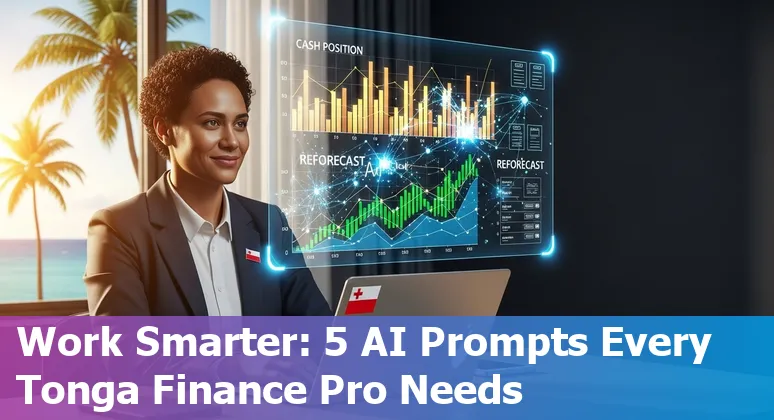
Five AI prompts finance professionals in Tonga should use in 2025: real-time cash by entity/currency, 13-week reforecast, AR-aging prioritization, GL anomaly detection, and runway-extension scenarios - designed to protect liquidity in a remittance-driven economy (squash/vanilla/fish) with ~40% internet penetration.
Finance teams in Tonga operate in a tight, import‑dependent island economy where agricultural exports (squash, vanilla, fish) and overseas remittances drive much of the hard currency flow, and the Ministry of Finance publishes frequent monthly and quarterly reports to keep policy makers informed - so speed and clarity matter.
Smart AI prompts let small teams turn those public reports into up‑to‑date cash‑position snapshots, run rapid 13‑week reforecasts against remittance shocks, or prioritize collections to protect liquidity in a market with roughly 40% internet penetration; see Tonga's economic indicators for context and the Ministry's Citizens Budget Guide for the latest fiscal priorities.
For teams ready to learn practical prompt design and deploy low‑risk automations, targeted training like Nucamp's AI Essentials for Work can bridge the skills gap and focus efforts on the few signals that move the paʻanga.
| Bootcamp | Length | Early bird cost | Register |
|---|---|---|---|
| AI Essentials for Work | 15 Weeks | $3,582 |
AI Essentials for Work bootcamp registration AI Essentials for Work bootcamp syllabus |
Table of Contents
- Methodology: How we picked these Top 5 AI Prompts
- Real-time Cash Position by Entity and Currency
- Short-Term Liquidity Reforecast (13-week) Using AR/AP Activity
- High-Risk Overdue Receivables & Collection Priorities (AR Aging)
- GL Anomaly Detection & Quick Audit Prep
- Runway Extension Scenarios via Targeted Cost Levers
- Conclusion: Getting Started - Tools, Security and Next Steps
- Frequently Asked Questions
Streamline operations and cut processing times by learning how AP automation in Tonga transforms invoice handling from manual to near-instant.
Methodology: How we picked these Top 5 AI Prompts
(Up)Selection concentrated on impact, repeatability, and safety: prioritize prompts that move cash and liquidity (real‑time cash by entity/currency, 13‑week reforecasts from AR/AP flows, AR‑aging collection priorities, GL anomaly checks and runway‑extension levers), are easy to run against existing ERPs, and produce auditable outputs for controllers and auditors.
Sources that guided the cut included Concourse's practical list of high‑impact finance prompts and Glean's prompt templates for forecasting and scenario planning, while Ramp's applied AI best practices (CSI/FBI and SPARK‑style framing) shaped how each prompt was written - clear context, explicit task, defined format, and an invitation to iterate.
Prompts were also screened for vendor and security considerations (audit trails, role controls, non‑training of customer data) so they can be piloted with minimal IT friction; the result is five concise, repeatable prompts designed to surface the few signals that actually move the paʻanga in Tonga.
See Concourse's 30 high‑impact finance prompts, Glean's 30 AI prompts for finance professionals, and Ramp's Applied AI in Finance guidance for the underlying frameworks and examples.
| Technique | Parameter updates | Cost & resources | Degree of specialization | Typical use case |
|---|---|---|---|---|
| In‑Context Learning (ICL) | None | Low, quick | Moderate | Rapid customization for general tasks |
| Full Fine‑Tuning | All parameters | High, intensive | High | Precision in domain‑specific tasks |
| PEFT (e.g., LoRA) | Limited parameters | Moderate, efficient | High | Specialized tasks with reduced resource needs |
| RAG (Retrieval‑Augmented) | None (uses external retrieval) | Moderate, infra needed | High relevance | Real‑time integration of external data |
“Don't choose the one you think is the most fun or where somebody tells you, ‘Oh, this is the best,'” Boucher said.
Real-time Cash Position by Entity and Currency
(Up)A reliable real‑time cash position by entity and currency turns fragmented bank balances into an operational command center for Tonga's finance teams: because the paʻanga is managed against a currency basket, local treasurers must track not just totals but the FX exposure and the effect of rate moves on each entity's balances (see the IMF's technical note on Tonga's exchange arrangements).
That means translating each subsidiary's cash in its functional currency and showing the “effect of exchange rate changes” as a separate reconciling line per accounting guidance, so auditors and regulators understand the movement (PwC guidance on cash & liquidity and foreign currency cash flows (IFRS)).
Practical AI prompts feed bank APIs and TMS data into a single dashboard, automate real‑time reconciliation and flag currency mismatches before payroll or supplier runs are at risk - no more logging into multiple portals or chasing stale EOD reports (Nilus glossary: real-time cash position definition).
Build the prompt to output per‑entity, per‑currency balances, conversion rates used, and a short variance explanation so decision‑makers see one clean number and the why behind it.
Short-Term Liquidity Reforecast (13-week) Using AR/AP Activity
(Up)For Tonga's lean finance teams, a short‑term 13‑week reforecast driven by live AR/AP activity turns guesswork into an operational habit: pull bank, ERP, AR and AP ledgers into a rolling direct‑method model, update it weekly (many teams treat Monday morning as the ritual to reconcile beginning cash), and use the result to spot liquidity gaps, time supplier payments, and prioritize collections before a payroll or remittance window arrives.
Practical how‑tos from GTreasury explain why the 13‑week horizon balances accuracy and actionability, while GrowthLab's step‑by‑step checklist shows how to map stakeholders, bucket receipts/payments, and mark vendors A/B/C so pay decisions are intervention-ready; automation and API feeds reduce manual error and let small teams spend less time on spreadsheets and more on negotiating short‑term funding or payment terms.
Add simple scenario rows (best/expected/worst) and a weekly Actual v Forecast review to make the forecast a decision engine rather than a report - giving executives a clear 13‑week runway and time to act.
“I need to understand exactly what the f*ck has happened here.”
High-Risk Overdue Receivables & Collection Priorities (AR Aging)
(Up)High‑risk overdue receivables are where small Tongan finance teams can turn a scramble into a plan: use AI to score accounts by ADD/behavior, automate early reminders and simplify payments so the low‑hanging cash flows in, then route the highest‑risk accounts to a human collector for an immediate phone call - studies and practitioners still stress that a timely call or personalized outreach often beats a late fee for recovery.
Build prompts that tag accounts by aging bucket, historical payment patterns and strategic value, then output a ranked collection list with suggested actions (soft reminder, phone follow‑up, payment plan, or escalation).
Combine Gaviti's playbook for AI‑driven prioritization with practical tactics from City National Bank - offer early‑pay discounts where margin allows, enforce clear late‑fee rules, and document deposit or credit‑limit changes to avoid surprises.
For receivables past 90 days, prepare to deploy stronger levers (factoring, collections, or trade‑credit insurance) so liquidity decisions are data‑driven and auditable - one clear aging view can stop a payroll panic before it starts.
| Aging bucket | Priority action |
|---|---|
| 0–30 days | Automated reminders + easy online payments |
| 31–60 days | Phone follow‑up & segmented dunning (AI‑ranked) |
| 61–90 days | Payment plans, hold credit, enforce penalties |
| >90 days | Escalate: collections, factoring, or credit insurance |
“There are many different things that go into a successful business, but cash flow is what keeps it running," said Aaron Dyer.
GL Anomaly Detection & Quick Audit Prep
(Up)GL anomaly detection turns a messy general ledger into an audit‑ready playbook for Tongan finance teams: AI can surface high‑risk journal entries, duplicate payments, or patterns that suggest unrecorded liabilities so controllers can bundle supporting docs before external auditors arrive.
Techniques range from simple statistical thresholds to unsupervised models like Isolation Forests (great for transaction data) and density methods such as LOF, up to autoencoders and LSTM networks for complex or time‑series behaviors - MindBridge's practical overview walks through these tradeoffs and how risk scores speed review.
For explainability, pairing scores with SHAP‑style explanations (see Unit8's Isolation Forest + SHAP guide) helps reviewers understand why an entry was flagged, turning a long manual hunt into a short, prioritized checklist; EY's work on GL anomaly tools shows how auditors use visual maps and rationale to target samples.
For a small treasury where one suspicious entry can trigger a payroll scramble, ranked risk scores plus explainable flags make quick audit prep realistic and repeatable.
| Technique | Best for | Why it helps |
|---|---|---|
| Statistical methods (z‑score, IQR) | Small datasets, simple outliers | Easy to interpret and tune |
| Isolation Forest | Transaction anomaly detection (unsupervised) | Scales to large GLs; yields continuous anomaly scores |
| LOF / Clustering | Local/contextual outliers | Detects anomalies relative to neighbors |
| Autoencoders / LSTM | Complex, high‑dimensional or time‑series patterns | Captures nonlinear and sequential anomalies |
| SHAP / explanation models | Audit & controller review | Provides feature‑level rationale for flagged entries |
MindBridge anomaly detection techniques for financial risk and data integrity | Unit8 guide: Building a financial transaction anomaly detector with Isolation Forest and SHAP | EY: How AI applications help auditors detect fraud in general ledgers
Runway Extension Scenarios via Targeted Cost Levers
(Up)Stretching cash runway in Tonga is a practical exercise, not a guessing game: run lightweight scenario rows that test targeted cost levers (pause discretionary spend, rephase non‑essential capex, or renegotiate supplier terms) against a rolling 13‑week projection so leaders see the precise weeks of breathing room and the tradeoffs involved - FasterCapital's guide to the financial implications of runway‑extension tactics is a handy primer for estimating costs and modeling impacts.
Pair those scenarios with operational moves that directly free up paʻanga: accelerate receivables with AR automation (pilot tools such as HighRadius to slash DSO) and pilot small automations first so teams reduce manual churn without adding risk.
Keep each scenario auditable - show assumed savings, timing, and sensitivity to remittance shocks - so a single clear table answers the urgent question everyone fears: will this stop a payroll scramble? Embedding these scenario prompts into weekly forecasting turns “what if” into “here's what to do,” and gives finance teams a repeatable playbook to trade off speed, cost, and confidence when liquidity is tight.
“The work to update last year's Frontier Economics cost-benefit analysis in the light of the impact of the Covid-19 pandemic on air travel is ongoing and nearing completion.”
Conclusion: Getting Started - Tools, Security and Next Steps
(Up)Bring the five prompts home with a pragmatic rollout: start small, prove value, and lock in controls before scaling - exactly the progression Nominal outlines in its four‑phase roadmap from Foundation to Innovation (Nominal AI implementation roadmap for enterprise finance), and echoing the “land‑and‑expand” advice to deploy single‑task agents for measurable wins (AI Business roadmap for financial success for finance teams).
For Tonga's lean treasuries the practical next steps are simple and auditable: pick one high‑impact prompt (real‑time cash or a 13‑week reforecast), run it as a guarded pilot with shadow mode and human‑in‑the‑loop review, measure time and cash impact, then harden data access, logs and approval gates before wider rollout - turning a payroll panic into a Monday‑morning routine rather than a gamble.
Upskilling the team matters: consider a structured program like Nucamp's AI Essentials for Work to learn prompt design, safe deployment and change management so automation becomes a repeatable capability, not a one‑off experiment (Nucamp AI Essentials for Work bootcamp registration).
| Bootcamp | Length | Early bird cost | Register |
|---|---|---|---|
| AI Essentials for Work | 15 Weeks | $3,582 | Register for Nucamp AI Essentials for Work bootcamp | AI Essentials for Work syllabus and course outline |
Frequently Asked Questions
(Up)What are the top 5 AI prompts every finance professional in Tonga should use in 2025?
The five high‑impact prompts recommended are: 1) Real‑time cash position by entity and currency - consolidate bank/TMS balances, show per‑entity per‑currency balances, conversion rates used and a short variance explanation to reveal FX exposure to the paʻanga basket; 2) Short‑term 13‑week liquidity reforecast using AR/AP activity - a rolling direct‑method model updated weekly (best/expected/worst) to spot gaps and prioritize actions; 3) High‑risk overdue receivables & collection priorities (AR‑aging) - AI‑rank accounts by aging, payment behavior and strategic value with suggested collection actions; 4) GL anomaly detection & quick audit prep - surface risky journal entries/duplicate payments and provide explainable flags (risk scores + SHAP‑style explanations) to speed controller and auditor reviews; 5) Runway‑extension scenarios via targeted cost levers - model precise weeks of runway gained by pausing discretionary spend, rephasing capex, renegotiating terms, or accelerating AR, with auditable assumptions and sensitivity to remittance shocks.
How were these prompts selected and what safety or audit controls were considered?
Selection prioritized tangible impact on cash and liquidity, repeatability, and low‑risk deployment: prompts that move paʻanga (real‑time cash, 13‑week reforecast, AR prioritization, GL checks, runway levers), are easy to run against existing ERPs/APIs, and produce auditable outputs for controllers and auditors. Frameworks and practical templates from Concourse, Glean and Ramp informed prompt structure (clear context, explicit task, defined format, iterate). Vendor/security screening included audit trails, role controls, non‑training of customer data, and human‑in‑the‑loop shadow pilots to minimize IT friction and regulatory risk.
What are the practical first steps for a small Tongan finance team to implement these prompts safely and quickly?
Start small and prove value: pick one high‑impact prompt (real‑time cash or 13‑week reforecast), run a guarded pilot in shadow mode with human‑in‑the‑loop review, measure time saved and cash impact, then harden data access, logging and approval gates before scaling. Use API feeds from banks, ERP and AR/AP ledgers, restrict model training on customer data, keep audit trails, and maintain clear reconciliation outputs (per‑entity balances, conversion rates, variance notes). Given Tonga's small teams and ~40% internet penetration, prioritize lightweight automations that reduce manual churn without adding operational risk, and prepare simple escalation playbooks (phone calls for high‑risk AR) where personal outreach beats automated dunning.
Which data sources, AI techniques and tools are typically needed to run these prompts?
Core data: bank/TMS balances, ERP GL and AR/AP ledgers, remittance and export receipts, FX rates and ministry fiscal reports (for context). Techniques: In‑Context Learning (ICL) or RAG for retrieval of policies/reports, PEFT/LoRA or fine‑tuning for specialized models when needed, and statistical/unsupervised models (z‑score, Isolation Forest, LOF, autoencoders/LSTM) for GL anomaly detection with explainability (SHAP). Tools/feeds: bank APIs, ERP/TMS connectors, a dashboard for per‑entity per‑currency views, versioned audit logs, and guarded automation (shadow mode). Keep vendor controls: role‑based access, non‑training of sensitive data, and clear approval gates for actions that move cash.
How should teams measure impact and build the skills to sustain these automations?
Measure metrics tied to liquidity and efficiency: change in runway weeks from 13‑week reforecasts, reduction in DSO from AR prioritization, time saved on reconciliation/audit prep, number of prevented payroll scrambles, and error reduction from automated feeds. Use short pilots with weekly Actual v Forecast reviews and scenario sensitivity to quantify cash effects. For skills, pursue focused training in prompt design, safe deployment and change management - for example, structured programs like Nucamp's AI Essentials for Work (15 weeks; early‑bird cost listed in the article) to close the skills gap so automation becomes repeatable and auditable rather than one‑off experiments.
Protect Tonga's growing digital payment systems by deploying Darktrace cybersecurity for finance to detect and respond to threats in real time.
Use the practical 7‑step action plan for finance leaders to prioritize tasks, govern AI use, and redeploy capacity to planning.

Ludo Fourrage
Founder and CEO
Ludovic (Ludo) Fourrage is an education industry veteran, named in 2017 as a Learning Technology Leader by Training Magazine. Before founding Nucamp, Ludo spent 18 years at Microsoft where he led innovation in the learning space. As the Senior Director of Digital Learning at this same company, Ludo led the development of the first of its kind 'YouTube for the Enterprise'. More recently, he delivered one of the most successful Corporate MOOC programs in partnership with top business schools and consulting organizations, i.e. INSEAD, Wharton, London Business School, and Accenture, to name a few. With the belief that the right education for everyone is an achievable goal, Ludo leads the nucamp team in the quest to make quality education accessible