









Will AI Replace Finance Jobs in Tonga? Here’s What to Do in 2025
Last Updated: September 14th 2025
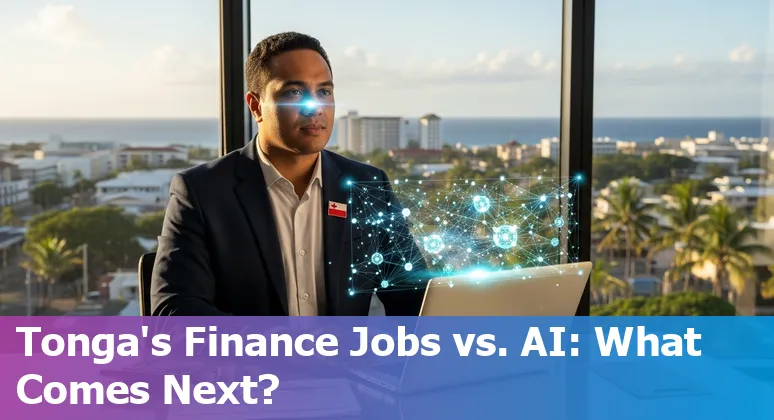
Too Long; Didn't Read:
AI is automating routine finance jobs and tasks in Tonga - invoice processing, reconciliations and AR - yielding case gains (8,000 monthly invoices processed with a 70% speed increase). Run 1–2 island-sized pilots, prioritize upskilling, human‑in‑the‑loop controls and explainability amid $45B AI spend and $7.2T embedded‑finance growth by 2030.
Tonga's finance teams are living the 2025 shift: repetitive tasks like invoice processing, reconciliations and data entry are increasingly handled by AI tools that deliver near‑perfect accuracy and real‑time forecasts, so small teams can spend less time on ledgers and more on strategy - a change Workday calls fundamental to corporate finance transformation (Workday analysis of AI-driven corporate finance transformation (2025)).
At the same time, the World Economic Forum flags real risks to entry‑level roles as AI automates routine work (World Economic Forum report on AI's impact on entry-level jobs (2025)), so Tonga's leaders should pair automation with targeted upskilling - practical training like Nucamp AI Essentials for Work bootcamp registration can teach prompt writing and real‑world AI use that preserves career ladders while boosting small‑island financial resilience.
| Bootcamp | AI Essentials for Work |
|---|---|
| Length | 15 Weeks |
| Courses | AI at Work: Foundations; Writing AI Prompts; Job Based Practical AI Skills |
| Cost (early bird / after) | $3,582 / $3,942 |
| Syllabus | AI Essentials for Work syllabus (Nucamp) |
| Register | Register for Nucamp AI Essentials for Work |
“AI and ML free accounting teams from manual tasks and support finance's effort to become value creators.” - Kainos Group Head of Finance Matt McManus
Table of Contents
- What's changing in Tonga's finance roles in 2025
- Why finance jobs won't vanish entirely in Tonga
- Practical implications for Tonga's small‑island, data‑limited context
- Concise action plan for Tonga finance leaders in 2025
- Quick 12‑month tactical checklist for Tonga
- Skills and tools to prioritize in Tonga in 2025
- How to reframe junior finance roles in Tonga (practical steps)
- Evidence, case studies and data points relevant to Tonga
- Putting it together: roadmap and next steps for finance teams in Tonga
- Frequently Asked Questions
Streamline operations and cut processing times by learning how AP automation in Tonga transforms invoice handling from manual to near-instant.
What's changing in Tonga's finance roles in 2025
(Up)What's changing in Tonga's finance roles in 2025 is practical and fast-moving: routine work - invoice matching, cash application, payroll runs and basic bookkeeping - is increasingly done by AI so teams can shift toward exceptions, forecasting and governance; analysts even point to large-scale exposure for white‑collar tasks (PwC's mid‑2030s automatable estimates and related job forecasts are summarised in this review of AI's labour impact) Nexford analysis of AI's impact on jobs.
Accounts receivable is a clear local priority - AI now automates collection prioritisation, cash application, deduction triage and e‑invoice presentment, which directly helps small finance teams manage remote suppliers and seasonal cash swings Forrester report on accounts receivable AI automation.
Real-world results matter: an AI-enabled AP rollout cut processing time dramatically in a recent vendor case - 8,000 monthly invoices handled with a 70% speed gain - showing how automation can expand capacity without adding headcount (useful for Tonga's compact operations) Esker vendor case study on AI-enabled accounts payable.
As the technology advances toward agentic bots, local leaders must reframe roles: humans will design processes, manage exceptions and enforce trust and explainability rather than punch keys, so pairing targeted upskilling with clear AI governance will preserve career paths while unlocking efficiency.
“Think of the future as managing bots instead of paperwork.” - StarHub's Lei
Why finance jobs won't vanish entirely in Tonga
(Up)Automation will reshape roles in Tonga, but it won't make finance teams disappear: regulators, auditors and customers all demand explainability, human oversight and fair, privacy‑safe decisioning that machines alone can't provide, so staff will move from keystrokes to governance, model vetting and exception handling.
Policy and supervisory pressure - highlighted in recent industry coverage calling for clear data‑privacy standards, disclosure of algorithmic reasons and human‑in‑the‑loop checks - means lenders must keep accountable people who can justify a credit decision or correct a biased outcome (AI in Financial Services: Regulatory Challenges - Consumer Finance Monitor (2025)).
Global regulatory mapping also shows countries prioritizing AI risk frameworks, explainability and supervisory guidance rather than a free‑for‑all, so even small island finance teams will be needed to implement controls, document models and translate tech outputs into locally relevant, compliant actions (Key Regulatory Developments for AI in Finance - CGAP).
The result: roles evolve - not vanish - into skilled stewards who make AI reliable, fair and fit for Tonga's finance landscape, with humans still required when a machine's answer becomes a real person's future.
Practical implications for Tonga's small‑island, data‑limited context
(Up)In Tonga's small‑island, data‑limited context the practical move is modest, deliberate adoption rather than wholesale replacement: the UNCDF survey on digital and financial literacy flags gaps in basic competencies and access, so any AI plan must start with training and realistic pilots (UNCDF survey: Assessing digital and financial literacy in Tonga).
Begin by running constrained pilots on local datasets - for example, testing credit models like Zest AI against historical loans to spot bias and tune thresholds before scaling (Zest AI credit underwriting pilot test on historical loan data).
Pair those pilots with simple, audit‑ready prompts and checklists that can turn a shoebox of receipts into a prioritized exceptions list in minutes, giving compact teams immediate wins while preserving human oversight (AI audit-ready prompt checklists for finance teams in Tonga).
Prioritize explainability, documentation and human‑in‑the‑loop controls so models support responsible lending and align with local governance - and scale only as literacy, data quality and monitoring improve.
Concise action plan for Tonga finance leaders in 2025
(Up)Keep the first moves small, measurable and locally focused: identify 1–2 high‑value pilots (AR collections, cash forecasting or credit models) and run them on Tonga's historic datasets to reveal bias and tune thresholds - test credit underwriting with tools like Zest AI on past loans before scaling (Zest AI credit underwriting pilot); design each pilot around clear integration and team readiness checklists so tech fits existing workflows rather than replaces them (practical adoption lessons are well documented in CCH Tagetik's AI use‑case guidance) (Practical AI use cases and integration considerations).
Pair fast wins - an audit‑ready prompt that turns a shoebox of receipts into a prioritized exceptions list in minutes - with mandatory human‑in‑the‑loop controls, explainability and documentation so regulators, auditors and customers can follow decisions.
Finally, treat banks and fintechs as partners to simplify legacy fragmentation, deploy intelligent treasury features and co‑create services that improve real‑time cash visibility and operational resilience (Capgemini: a call to action for banks in the AI age); phase, monitor and scale only as literacy, data quality and governance mature.
Quick 12‑month tactical checklist for Tonga
(Up)Quick, practical and island‑sized: adopt a disciplined 12‑month checklist that fits Tonga's compact teams - Phase 1 (Months 1–2) - Foundation & Strategy: map pain points, audit data quality, pick 1–2 high‑value pilots and get leadership buy‑in (see Preferred CFO's suggested roadmap for finance teams) Preferred CFO 12‑Month AI Roadmap for Finance Teams; Phase 2 (Months 3–6) - Quick wins & pilots: run low‑risk pilots (invoice OCR, AR collection prioritisation, basic cash‑flow ML), measure time saved and error reduction, and upskill staff with short courses and prompt checklists so a shoebox of receipts becomes a prioritized exceptions list in minutes (Audit‑ready AI prompt examples for Tonga finance professionals); Phase 3 (Months 6–12) - Scale & Integrate: roll out proven pilots, integrate with ERP/treasury where possible, embed human‑in‑the‑loop controls, and set governance, KPIs and ROI dashboards.
Track adoption readiness and data quality continuously, and remember finance teams are being tapped for agentic AI roles - many leaders plan to expand agentic tools in the next 12 months, so document wins and hire where needed to sustain growth.
| Phase | Months | Key focus |
|---|---|---|
| Foundation & Strategy | 1–2 | Assess readiness, select pilots, governance |
| Quick Wins & Pilots | 3–6 | Invoice OCR, AR/CF pilots, upskill, measure KPIs |
| Scale & Integrate | 6–12 | ERP integration, human‑in‑loop, governance, ROI |
“At Wolters Kluwer, we are committed to continuous innovation for the office of the CFO. … Agentic AI represents an evolutionary leap in how finance leaders operate.”
Skills and tools to prioritize in Tonga in 2025
(Up)Skills and tools to prioritise in Tonga in 2025 should be pragmatic, island‑sized, and focused on making small teams into reliable AI stewards: raise data literacy and basic data‑engineering skills so local datasets can feed safe models, train prompt‑writing and copilot workflows to speed reporting and reconciliation, and hire or partner for one or two specialists who can vet models, manage human‑in‑the‑loop checks and maintain explainability and cybersecurity controls.
Start with low‑risk, high‑value tech - OCR and reconciliation assistants, AR collection prioritisation and a GenAI copilot for variance narratives - and test credit models like Zest AI against historical loans before scaling to spot bias and tune thresholds (see practical testing guidance for Zest AI).
Pair pilots with clear governance, documentation and monitoring so outputs are auditable; CGAP's inclusion guidance stresses investing in connectivity and literacy to make AI benefits stick for underserved customers.
Finally, adopt the AICPA's “start small” playbook: disciplined pilots, cross‑functional collaboration and mandatory verification routines turn generative AI from a risky novelty into an everyday productivity multiplier that can, for example, turn a shoebox of receipts into a prioritized exceptions list in minutes while keeping humans responsible for the decisions (AICPA: How finance can get started with gen AI, CGAP: AI's Promise for Financial Inclusion, Zest AI credit underwriting (Nucamp guide)).
“Most CFOs and finance executives understand that generative AI is something that they need to embrace.” - Paul Parks, CPA, CGMA
How to reframe junior finance roles in Tonga (practical steps)
(Up)Reframe junior finance roles in Tonga by shifting the emphasis from manual entry to analyst‑in‑the‑loop stewardship: preserve the core skills highlighted in standard Junior Financial Analyst descriptions - data compilation, KPI dashboards, variance analysis and report prep - while formally adding responsibilities for exception management, reconciliation oversight and model‑check routines (Junior Financial Analyst job description and core skills).
Treat data‑entry tasks as an on‑ramp, not a dead end: document and standardise them using clear templates and training (sample data‑entry job templates help set expectations and quality checks) (Data entry operator job description and quality controls), then upskill juniors on prompt‑writing, OCR verification and audit‑ready prompts so one practical outcome is immediate - turning a shoebox of receipts into a prioritised exceptions list in minutes.
Pair each role change with simple controls (checklists, human‑in‑the‑loop signoffs and explainability notes) and a short rotation so juniors gain exposure to forecasting, AR prioritisation and model testing - practical steps and prompts for these tasks are illustrated in Nucamp's finance AI guides (Nucamp AI Essentials for Work: audit‑ready AI prompts for finance professionals in Tonga (2025)), creating clear career pathways from entry work to trusted AI stewards.
Evidence, case studies and data points relevant to Tonga
(Up)Evidence from global thought leaders shows how Tonga can pragmatically benefit from AI without oversized risk: the World Economic Forum highlights that AI lets emerging markets “leapfrog” legacy finance - turning mobile behaviours and alternative data into usable financial identities rather than waiting for full bank infrastructure (WEF: How emerging markets are rewriting the future of finance with AI), and embedded‑finance research predicts a $7.2 trillion market by 2030 that can make services available inside apps Tongans already use, not only inside banks (WEF: Embedded finance).
Practical signals matter: the Forum's AI in Financial Services work flags $45B of sector AI spending in 2024 and a big push on governance and workforce reskilling, while LinkedIn/WEF data show many SMBs already seeing double‑digit revenue lifts after adopting generative AI - small, measured pilots could therefore yield outsized gains for Tonga's compact finance teams.
A vivid, practical test: use audit‑ready prompts to compile variance lists and sample transactions in minutes, then validate credit models on local loans before wider rollout (see Nucamp's prompt and tool guides for Tonga) (audit‑ready AI prompts for Tonga).
| Metric | Figure / Source |
|---|---|
| Adults without basic financial services | 1.4 billion - WEF |
| Projected embedded finance market (2030) | $7.2 trillion - WEF |
| AI spend in financial sector (2024) | $45 billion - WEF initiative |
| Fintech revenue forecast (2030) | $1.5 trillion - BCG & QED (cited by WEF) |
“AI enables markets to bypass legacy infrastructure entirely, leapfrogging traditional financial infrastructure.” - World Economic Forum
Putting it together: roadmap and next steps for finance teams in Tonga
(Up)Putting it together for Tonga means a tightly sequenced roadmap: link national policy momentum (the Prime Minister's recent CROP dialogue is a timely signal for coordination) with 1–2 island‑sized pilots (AR prioritisation, cash forecasting or a constrained credit model) that run on local data, prove explainability and keep humans in the loop; follow the OneStream playbook of being a fast follower - build governed agents for repeatable FP&A tasks, lean on a single source of truth for forecasting, and phase agentic functions only after pilot validation (Tonga Prime Minister joins CROP dialogue on 2050 RCA implementation, OneStream roadmap for AI and agents).
Pair those pilots with practical, short courses so staff learn prompt writing, audit‑ready checks and model‑vetting: a ready option is the Nucamp AI Essentials for Work bootcamp that teaches foundations, prompts and job‑based AI skills to turn everyday piles - think a shoebox of receipts - into prioritised exceptions lists in minutes (Register for the Nucamp AI Essentials for Work bootcamp).
Measure outcomes (time saved, bias tests, explainability logs), publish simple governance templates, and scale only as data quality, literacy and regulatory alignment improve - this keeps finance teams as trusted stewards rather than sidelined operators.
| Bootcamp | AI Essentials for Work |
|---|---|
| Length | 15 Weeks |
| Courses | AI at Work: Foundations; Writing AI Prompts; Job Based Practical AI Skills |
| Cost (early bird / after) | $3,582 / $3,942 |
| Syllabus | Nucamp AI Essentials for Work syllabus |
| Register | Register for Nucamp AI Essentials for Work |
“Skate to where the puck is going, not where it has been.” - Wayne Gretzky
Frequently Asked Questions
(Up)Will AI replace finance jobs in Tonga in 2025?
No - AI will reshape and automate routine tasks but not eliminate finance teams. Machines take over repetitive work (invoice matching, data entry, basic bookkeeping) while humans remain necessary for explainability, governance, regulatory compliance and exception handling. Global reports flag risk to entry-level routine roles, so the practical outcome in Tonga is role evolution into skilled stewards who manage bots, vet models and enforce human‑in‑the‑loop controls.
Which finance tasks in Tonga are most likely to be automated first?
High‑volume, rule-based tasks are first: invoice processing/OCR, cash application, reconciliations, payroll runs, AR collection prioritisation and basic credit triage. Real-world rollouts show major time gains - e.g. a vendor case processed 8,000 monthly invoices with a ~70% speed improvement - making these ideal island-sized pilots for Tonga's compact teams.
What should Tonga finance leaders do in 2025 to prepare and protect jobs?
Start small and measurable: pick 1–2 high-value pilots (AR collections, cash forecasting or a constrained credit model) and run them on Tonga's historical data to reveal bias and tune thresholds. Follow a 12‑month phased playbook: Months 1–2 foundation and strategy; Months 3–6 quick wins and pilots; Months 6–12 scale, integrate with ERP/treasury and embed human‑in‑the‑loop controls. Always pair pilots with governance, explainability, staff upskilling and partnerships with banks/fintechs.
Which skills and tools should finance teams prioritise for 2025?
Prioritise practical, island‑sized capabilities: basic data literacy and data engineering, prompt writing and copilot workflows, OCR and reconciliation assistants, AR prioritisation tools and one or two specialists to vet models and manage human‑in‑the‑loop checks. Training options include targeted bootcamps such as Nucamp's AI Essentials for Work (15 weeks; courses: AI at Work: Foundations; Writing AI Prompts; Job-Based Practical AI Skills; early bird cost $3,582, after $3,942).
How can small Tonga teams run safe, effective AI pilots given limited data and literacy?
Use constrained pilots on local datasets, run bias and back‑testing (e.g. test Zest AI or similar credit models on historical loans), and deploy audit‑ready prompts and checklists to create immediate wins (turn a shoebox of receipts into a prioritised exceptions list). Require documentation, explainability logs and mandatory human signoffs; track KPIs such as time saved, error reduction and bias test results before any scale‑up. Pair technical pilots with short practical training to raise digital and financial literacy.
Speed month-end close cycles and create auditable trails for public sector finance teams using the BlackLine financial close platform to automate reconciliations.
See how a real-time cash position dashboard can turn daily uncertainty into immediate, actionable clarity for finance teams in Tonga.

Ludo Fourrage
Founder and CEO
Ludovic (Ludo) Fourrage is an education industry veteran, named in 2017 as a Learning Technology Leader by Training Magazine. Before founding Nucamp, Ludo spent 18 years at Microsoft where he led innovation in the learning space. As the Senior Director of Digital Learning at this same company, Ludo led the development of the first of its kind 'YouTube for the Enterprise'. More recently, he delivered one of the most successful Corporate MOOC programs in partnership with top business schools and consulting organizations, i.e. INSEAD, Wharton, London Business School, and Accenture, to name a few. With the belief that the right education for everyone is an achievable goal, Ludo leads the nucamp team in the quest to make quality education accessible