









The Complete Guide to Using AI as a Legal Professional in Switzerland in 2025
Last Updated: September 5th 2025
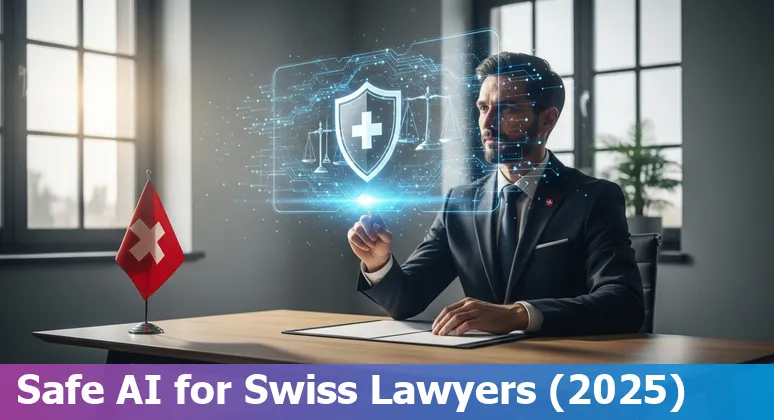
Too Long; Didn't Read:
Swiss legal professionals must balance innovation and compliance: Federal Council signed the Council of Europe AI Convention in 2025, with draft sector rules due by end‑2026; apply FADP (Art. 21), run DPIAs, keep inventories, tighten vendor contracts and require human review. Bootcamp: 15 weeks, $3,582.
Swiss legal professionals cannot afford to treat AI as a passing trend: in 2025 the Federal Council signed the Council of Europe's AI Convention and set a sector‑specific, risk‑based path that will see a draft bill and non‑binding measures prepared by end of 2026, so lawyers must balance innovation with duties under the FADP (including Article 21 on automated decisions) and strict professional‑secrecy rules; see the Federal Council's regulatory overview Federal Council regulatory overview - AI Watch: Switzerland.
Copyright and training‑data questions remain unsettled - whether scraping training sets or claiming authorship of AI output will trigger CopA changes is under active debate (Switzerland AI copyright debate and legal developments).
Practical safeguards - inventories, human review of outputs, clear vendor contracts and staff AI literacy - are essential, and short, applied courses like Nucamp's Nucamp AI Essentials for Work bootcamp (AI at Work: Foundations, Writing AI Prompts, Job Based Practical AI Skills) teach prompt design, verification and governance skills lawyers need now to reduce the risk that a single unchecked prompt becomes a courtroom problem.
A machine-based system that, for explicit or implicit objectives, infers, from the input it receives, how to generate outputs such as predictions, content, recommendations or decisions that may influence physical or virtual environments.
| Bootcamp | Length | Early bird cost |
|---|---|---|
| AI Essentials for Work (Nucamp) | 15 Weeks | $3,582 |
Table of Contents
- Swiss AI regulatory landscape in 2025: federal approach and key laws
- Regulators and guidance bodies in Switzerland: who to watch
- Data protection & generative AI in Switzerland: applying the FADP and Article 21
- Liability when using AI in Switzerland: civil, employer and criminal risks
- Intellectual property and AI outputs in Switzerland: patents, copyright and datasets
- Practical safeguards for Swiss law firms using generative AI in 2025
- AI governance, compliance and procurement best practices for Swiss organisations
- Sector highlights for Switzerland: finance, healthcare, transport and public administration
- Conclusion & actionable checklist for Swiss legal professionals in 2025
- Frequently Asked Questions
Nucamp's Switzerland community brings AI and tech education right to your doorstep.
Swiss AI regulatory landscape in 2025: federal approach and key laws
(Up)Switzerland's 2025 playbook for AI is intentionally pragmatic: the Federal Council opted to ratify the Council of Europe's AI Convention and to stitch AI rules into existing, sector‑specific laws rather than create a single “Swiss AI Act,” so lawyers should expect a mix of targeted legislative tweaks and non‑binding measures (self‑regulation, guidance) drafted by the FDJP, DETEC and FDFA for consultation by end‑2026; see the Federal Council regulatory overview in the White & Case tracker for Switzerland and BAKOM's official Artificial Intelligence overview for the government's three‑fold goals of boosting innovation, protecting fundamental rights and building public trust.
In practice this means continued reliance on the revised FADP for automated‑decision risks, FINMA and sectoral supervisors pressing firms on governance and inventories, and Swiss companies that sell into the EU still needing to map EU obligations (the EU AI Act) onto the Swiss patchwork - a recipe that rewards early, practical safeguards (clear vendor contracts, inventories, explainability checks) and penalises complacency: regulatory change is slow but the compliance landscape will harden as sector rules and non‑binding codes emerge.
Keep an eye on the consultation timetable and regulators' guidance: the next 18 months are the quiet window to convert AI practices into defensible firm policy.
"A machine-based system that, for explicit or implicit objectives, infers, from the input it receives, how to generate outputs such as predictions, content, recommendations or decisions that may influence physical or virtual environments. Different artificial intelligence systems vary in their levels of autonomy and adaptiveness after deployment."
Regulators and guidance bodies in Switzerland: who to watch
(Up)Swiss lawyers should watch a compact cast of authorities that will shape everyday AI choices: the Federal Data Protection and Information Commissioner (FDPIC) sits at the centre - reiterating that the revised Federal Act on Data Protection (FADP) already applies to AI, insisting on transparency - including the right to know when a user is
talking to a machine
- and triggering DPIAs for high‑risk AI - so treat the FDPIC as the privacy watchtower for client data (FDPIC guidance on AI and the FADP); OFCOM and the federal Competence Network for Artificial Intelligence (CNAI) supply technical gloss and common terminology across the administration; FINMA is the enforcer for banks and insurers (see FINMA Guidance 08/2024) and will expect inventories, explainability checks and model‑risk controls; and the FDJP together with DETEC and the FDFA are drafting the sectoral roadmap that must be followed (consultation draft due end‑2026) - in short, compliance will come from a chorus, not a single conductor, so keep inventories, DPIAs and vendor contracts up to date and remember: a single unchecked chatbot prompt can cascade into a regulatory investigation as quickly as a spilled espresso ruins a court brief (Chambers - Artificial Intelligence 2025: Switzerland).
Data protection & generative AI in Switzerland: applying the FADP and Article 21
(Up)For Swiss legal teams the takeaway is simple and practical: the revised Federal Act on Data Protection (FADP), in force since 1 September 2023, already governs AI‑supported processing and brings concrete obligations - transparency, data‑minimisation, and digital self‑determination - so firms cannot wait for new sector rules before acting (FDPIC guidance on AI and the revised FADP).
Article 21's protections are key for generative systems: individuals can object to automated processing and request human review of automated individual decisions, and operators must disclose when an “intelligent language model” is talking to a user and whether inputs are used to improve self‑learning systems (as underscored in recent summaries of FDPIC AI guidance).
High‑risk AI remains allowed in principle, but only with appropriate safeguards such as a DPIA; by contrast, uses that undermine informational self‑determination (comprehensive real‑time facial recognition or “social scoring”) are prohibited.
Practical steps lawyers should insist on now include vendor clauses on training‑data use, clear user notices that a chat is with a machine, and DPIAs for high‑risk deployments - small measures that prevent a single unchecked prompt from becoming a reputational or regulatory problem (detailed guidance and further context on AI under the FADP).
Liability when using AI in Switzerland: civil, employer and criminal risks
(Up)Liability for lawyers and firms using AI in Switzerland rests on familiar pillars rather than a new AI code: Swiss courts will apply contractual rules (Art. 97 CO) when a mandate is breached, ordinary tort law (Art.
41 CO) for non‑contractual harms, and the Federal Product Liability Act (SPLA) for defective products - so software or AI tools that cause physical injury or property damage can trigger strict product liability rather than a negligence claim; see Pestalozzi analysis of Swiss AI legislation and regulatory approach Pestalozzi analysis of Swiss AI legislation and regulatory approach and the ICLG guide to product liability laws in Switzerland ICLG guide to product liability laws in Switzerland.
Professional and employer risks are layered: agents and lawyers face strict duties of care, loyalty and confidentiality under agency law (Art. 398(2) CO) and can be contractually or disciplinarily liable for failures to supervise AI outputs, while employers must watch employment and data‑protection limits when deploying monitoring or automated decision‑making (employment and criminal sanctions may follow from sectoral statutes).
Insurance and careful allocation of contractual liability - vendor clauses, warranties and clear indemnities - will be essential risk‑management tools, because Swiss courts currently expect existing doctrines to adapt to AI rather than invent new regimes (and insurers are already designing AI coverages); treat inventories, DPIAs and human review as routine precautions so that a single unchecked chatbot prompt doesn't unravel a client file or become a courtroom spectacle like a loose thread pulling apart a tailored suit - expensive, visible and avoidable.
For profession‑specific duty rules and limitation nuances, see the professional‑liability primers collected by leading Swiss commentators Lexology overview of regulation of liability for key professions in Switzerland.
Intellectual property and AI outputs in Switzerland: patents, copyright and datasets
(Up)Intellectual‑property rules in Switzerland treat AI as a powerful tool, not a rights‑holder: the Federal Administrative Court's DABUS decision (B‑2532/2024, 26 June 2025) confirmed that only a natural person can be named as inventor, while also making clear that a human who trains the model, supplies data and recognises an AI output as patentable may qualify as the inventor - in short, AI can spark invention, but a person must do the legal signing.
For further reading see the Novagraaf summary of the Swiss DABUS decision Novagraaf summary of the Swiss DABUS decision and the Swiss IPI's primer on inventor rights Swiss IPI primer on inventor rights: Who has what rights to the invention.
Practically, this means two concrete imperatives for lawyers and in‑house teams in 2025: document human contribution (problem definition, data curation, prompting, selection and recognition of outputs) and ensure inventor declarations, employment‑assignment clauses and filing steps are airtight - the IPI will refuse applications that lack a proper inventor designation and courts will assess inventorship case‑by‑case.
Treat AI like a brilliant lab assistant that can't sign the deed: careful records, clear assignment language and prompt‑level provenance turn an AI‑generated insight into a defensible Swiss patent rather than a procedural dead end.
“patent applications must name a natural person as the inventor. A person who contributes substantially to the AI data treatment process, recognises its outcome as a patentable invention, and applies for patent protection also qualifies as an inventor.”
Practical safeguards for Swiss law firms using generative AI in 2025
(Up)Practical safeguards for Swiss law firms using generative AI are straightforward, concrete and immediately actionable: maintain a living AI inventory and classify use‑cases by risk so you know which systems trigger DPIAs under the FADP and Article 21 (inform and offer human review for automated individual decisions); carve strict vendor contracts with express clauses on training‑data use, security, subcontractors and audit rights; forbid input of client secrets into public models unless you have clear client consent or a compliant on‑prem/cloud setup in line with the Swiss Bar Association (SBA) guidelines and cantonal fact sheets; require human‑in‑the‑loop review and source‑checking for any legal advice, plus versioned documentation (purpose, data sources, prompts, validation tests and fallback plans) to meet FINMA governance expectations for material systems; train fee‑earners in prompt hygiene and IP/data risks so staff stop using AI like an unchecked research assistant; and embed incident and breach playbooks that map reporting duties to the FDPIC guidance on artificial intelligence and, where relevant, FINMA.
These measures - inventory, DPIA, vetted contracts, human review, training and incident drills - turn fuzzy promise into defensible practice and prevent “a single unchecked prompt” from cascading into a reputational or regulatory crisis (or a malpractice claim).
For practical reading, see the FDPIC guidance on artificial intelligence, the Swiss Federal Act on Data Protection (FADP), the SBA AI guidelines and cantonal fact sheets, and sector summaries of supervisory expectations for Swiss firms.
"A machine-based system that, for explicit or implicit objectives, infers, from the input it receives, how to generate outputs such as predictions, content, recommendations or decisions that may influence physical or virtual environments. Different artificial intelligence systems vary in their levels of autonomy and adaptiveness after deployment."
AI governance, compliance and procurement best practices for Swiss organisations
(Up)For Swiss organisations the shortest path from AI promise to regulatory pain is a clear, risk‑based governance programme: start with an up‑to‑date inventory (a ROAIA) and map each use case to risk tiers so high‑risk systems trigger DPIAs, human‑in‑the‑loop controls and stricter procurement checks; align policies with ISO/IEC 42001 and embed AI rules into existing data‑governance and security processes rather than creating siloed “AI only” rules (see practical guidance on AI governance and ISO alignment from datenrecht.ch).
Assign accountability - point to a central contact (often the DPO or a cross‑functional AI oversight team), ensure management and the board own oversight, and operational owners run day‑to‑day compliance while an ethics or oversight committee handles strategic choices (Vischer's recommended AI governance mix of a central contact point, business owners and an oversight body is a useful template).
In procurement demand express contractual terms on training‑data use, audit and subcontractor rights, model‑performance SLAs and indemnities, stress‑test D&O and cyber cover with brokers, and require supplier evidence of testing and monitoring; a weak vendor clause is the kind of small omission that can mushroom into a public, expensive headache.
Finally, operationalise governance with role‑specific training, continuous monitoring, incident playbooks and periodic independent audits so compliance stays practical, iterative and defensible in Switzerland's sector‑driven regulatory patchwork.
"We are seeing an increase in AI-related lawsuits since 2024," says Laura Parris, executive director of Management Liability, Gallagher.
Sector highlights for Switzerland: finance, healthcare, transport and public administration
(Up)Sector-by-sector, the message for Swiss legal teams is pragmatic: finance is the current focal point - FINMA's Guidance 08/2024 pushes banks and insurers to build inventories, a clear governance framework, rigorous testing and continuous monitoring of models, and to treat third‑party and data quality risks as first‑order issues (FINMA Guidance 08/2024 on AI governance and risk management); healthcare, transport and public administration should mirror that risk‑based playbook by prioritising DPIAs, provenance for training data, robust vendor clauses and human‑in‑the‑loop controls even where sectoral supervisors have not yet published bespoke rules, because Switzerland's sector‑specific approach means the practical expectations in finance will ripple into other regulated fields (Pestalozzi analysis of FINMA AI guidance and its wider implications for Swiss legal teams).
In short: treat AI like a high‑value vault - inventories, explainability checks and contractual locks keep risks visible and manageable across sectors; a single unchecked model can cascade from a quiet pilot into a public compliance headache faster than a filing error becomes a court day disaster.
“We need to maximise the stability and resilience of the Swiss financial centre in an environment with heightened risks.”
Conclusion & actionable checklist for Swiss legal professionals in 2025
(Up)Conclusion: Swiss legal teams should treat 2025 as the moment to turn AI risk into routine controls - start with an up‑to‑date AI inventory and risk map, run DPIAs on high‑risk systems, and document purpose, data sources and prompt provenance so every model decision can be explained; ensure client notices and human‑review rights comply with Article 21 of the Swiss Federal Act on Data Protection (FADP) - duty to provide information (Article 21, Swiss FADP – duty to provide information) and the FDPIC's transparency expectations (FDPIC guidance on duty to provide information), carve vendor clauses that limit training‑data reuse and grant audit rights, require human‑in‑the‑loop checks for legal advice, embed incident playbooks and insurance procurement into matter intake, and train fee‑earners in prompt hygiene and verification so one unchecked chatbot reply doesn't unravel a client file as quickly as a spilled espresso ruins a court brief; for hands‑on upskilling, short practical courses such as Nucamp's Nucamp AI Essentials for Work bootcamp syllabus teach prompt design, validation and governance steps that translate policy into defensible practice - your immediate checklist: inventory, DPIA, clear client notices, airtight vendor contracts, human review, versioned records and role‑specific training.
| Bootcamp | Length | Early bird cost |
|---|---|---|
| Nucamp AI Essentials for Work bootcamp syllabus | 15 Weeks | $3,582 |
Art. 21 Duty to provide information in the case of an automated individual decision. The controller shall inform the data subject about any decision that is ...
Frequently Asked Questions
(Up)What is Switzerland's AI regulatory approach in 2025 and what should legal professionals watch for?
In 2025 the Federal Council ratified the Council of Europe's AI Convention and adopted a sector‑specific, risk‑based path rather than a single Swiss AI Act. The government (FDJP, DETEC, FDFA) will prepare a draft bill and non‑binding measures for consultation by end‑2026. Practically, expect the revised FADP to govern many AI uses, FINMA and other sectoral supervisors to demand inventories and governance for regulated firms, and multiple authorities (FDPIC, OFCOM, CNAI, FINMA) to issue guidance. Lawyers should monitor consultation timetables and regulators' guidance and treat the next 18 months as a window to convert AI practices into defensible firm policy.
How does the revised Federal Act on Data Protection (FADP) and Article 21 apply to generative AI?
The revised FADP (in force since 1 Sept 2023) already applies to AI. Key obligations include transparency, data‑minimisation and digital self‑determination. Article 21 gives data subjects the right to object to automated individual decisions and to request human review; operators must disclose when users are interacting with an "intelligent language model" and whether inputs are used to improve self‑learning systems. High‑risk AI is permitted with appropriate safeguards such as a DPIA; uses that undermine informational self‑determination (eg. pervasive real‑time biometric profiling or social scoring) are prohibited. Practical lawyer actions: run DPIAs for high‑risk cases, add client notices that chats may be with machines, and include vendor clauses limiting training‑data reuse.
What liability and professional‑duty risks arise from using AI and how can firms mitigate them?
Swiss courts will apply existing doctrines: contractual liability (Art. 97 CO) for mandate breaches, tort (Art. 41 CO) for non‑contractual harm, and the Federal Product Liability Act (SPLA) for defective products that cause injury or damage. Lawyers also face duties of care, loyalty and confidentiality (eg. Art. 398(2) CO) and can be contractually, disciplinarily or criminally liable for failures to supervise AI outputs. Mitigations include: clear vendor contracts with warranties and indemnities, AI inventories and risk classification, DPIAs, human‑in‑the‑loop review for legal advice, versioned documentation of prompts and data provenance, tailored insurance and incident playbooks mapped to reporting duties.
How are intellectual‑property and inventorship issues treated for AI‑assisted inventions in Switzerland?
Swiss practice treats AI as a tool, not a rights‑holder. The Federal Administrative Court's DABUS decision (B‑2532/2024, 26 June 2025) confirms only a natural person can be named inventor; a human who substantially contributed to data treatment, recognised an AI output as an invention and applied may qualify as inventor. Practical steps: document human contribution (problem definition, data curation, prompting, selection), ensure inventor declarations and employment assignment clauses are airtight, and keep prompt‑level provenance to support filings - IPI may refuse applications lacking a proper natural‑person inventor designation.
What immediate safeguards and training should Swiss law firms adopt (and what upskilling options are practical)?
Immediate safeguards: maintain a living AI inventory and risk map; run DPIAs for high‑risk uses; insert vendor clauses on training‑data use, security, subcontractors and audit rights; prohibit entering client secrets into public models absent consent or compliant infrastructure; require human review and source‑checking for legal outputs; keep versioned records (purpose, data sources, prompts, validation tests); embed incident and breach playbooks; and procure appropriate insurance. Upskilling: short, applied courses that teach prompt design, verification and governance are effective. Example: Nucamp's practical course model that focuses on prompt hygiene, verification and governance - bootcamp durations and costs vary; a representative offering in the market is a 15‑week applied programme with an early‑bird cost of approximately $3,582, but firms should confirm current schedules and pricing with providers.
For fast first drafts and client-friendly summaries, consider the ChatGPT for rapid drafting workflow - only on enterprise or private deployments for confidential work.
Protect clients by Performing DPIAs for AI systems in legal practice before you deploy any LLM workflow.
Build litigation strategy faster by running the Non-compete precedent synthesis prompt to extract cantonal and federal trends from 2015–2025.

Ludo Fourrage
Founder and CEO
Ludovic (Ludo) Fourrage is an education industry veteran, named in 2017 as a Learning Technology Leader by Training Magazine. Before founding Nucamp, Ludo spent 18 years at Microsoft where he led innovation in the learning space. As the Senior Director of Digital Learning at this same company, Ludo led the development of the first of its kind 'YouTube for the Enterprise'. More recently, he delivered one of the most successful Corporate MOOC programs in partnership with top business schools and consulting organizations, i.e. INSEAD, Wharton, London Business School, and Accenture, to name a few. With the belief that the right education for everyone is an achievable goal, Ludo leads the nucamp team in the quest to make quality education accessible