









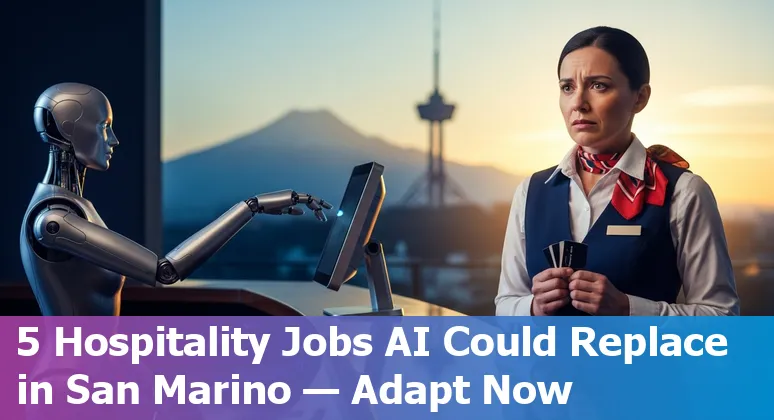
Top 5 Jobs in Hospitality That Are Most at Risk from AI in San Marino - And How to Adapt
Last Updated: September 14th 2025
Too Long; Didn't Read:
San Marino hospitality faces AI risk for front‑desk receptionists, housekeepers, concierges, servers, and reservation agents; AI market grows from $0.15B (2024) to $1.44B (2029) with ~57.6% CAGR. Adapt via selective automation, reskilling and 15‑week AI training ($3,582 early bird).
San Marino's hospitality scene - from family-run pensioni to small boutique hotels - is already feeling the push and pull of AI: global trends show AI and robotics boosting personalised stays and automating routine tasks, so local properties that adopt smart pricing and predictive tools can protect rates during events and squeeze inefficiencies out of operations (AI and robotics trends in hospitality (United Robotics)).
Practical wins for microstate operators include dynamic pricing and RevPAR optimisation for event weeks and kitchen food‑waste reduction through demand forecasting (dynamic pricing and RevPAR optimisation for San Marino properties), while staff reskilling matters: Nucamp's 15‑week AI Essentials for Work program teaches nontechnical teams to use AI tools and write effective prompts to keep the human touch central (Nucamp AI Essentials for Work course page).
| Attribute | Information |
|---|---|
| Program | AI Essentials for Work |
| Length | 15 Weeks |
| Courses | AI at Work: Foundations; Writing AI Prompts; Job Based Practical AI Skills |
| Cost (early bird) | $3,582 |
| Syllabus | AI Essentials for Work syllabus (Nucamp) |
| Registration | AI Essentials for Work registration (Nucamp) |
Table of Contents
- Methodology - How We Identified the Top 5 Jobs
- Front Desk Receptionist
- Hotel Housekeeper
- Concierge
- Food & Beverage Server
- Reservation Agent
- Conclusion - Staying Resilient in San Marino's Hospitality Workforce
- Frequently Asked Questions
Learn why Dynamic pricing and revenue management powered by machine learning is essential for maximizing RevPAR around events like MotoGP.
Methodology - How We Identified the Top 5 Jobs
(Up)Methodology focused on three practical signals: market momentum, documented AI use cases, and how common a task is across San Marino's small hotels and pensioni - roles heavy in repeatable, data-driven work scored highest for automation risk.
Macro forecasts from The Business Research Company (AI in hospitality rising from $0.15B in 2024 toward $1.44B by 2029) defined the scale of change (AI in Hospitality Market Forecast - The Business Research Company), while detailed use‑case mapping - chatbots and automated check‑in, dynamic pricing, predictive housekeeping, robot cleaners and waste‑reduction algorithms - came from industry playbooks and practitioner guides (AI in Hospitality Advantages and Use Cases - NetSuite).
Each occupation was rated by (1) technical feasibility of automation, (2) prevalence of the task in small San Marino properties, and (3) economic impact if automated; higher scores indicated greater short‑to‑medium risk.
The approach keeps the human touch central by flagging routine back‑of‑house and straightforward front‑desk tasks as the most vulnerable, while directing reskilling toward roles where empathy and judgment remain decisive - imagine a robot cleaner running a midnight shift so staff can focus on the memorable guest moments that machines can't create.
| Metric | Value |
|---|---|
| Market size (2024) | $0.15 billion |
| Market size (2025) | $0.23 billion |
| Forecast (2029) | $1.44 billion |
| CAGR (reported) | ~57.6% (2025–2034) |
“We are entering into a hospitality economy” - Will Guidara
Front Desk Receptionist
(Up)Front desk receptionists in San Marino are the human hinge between a guest's first hello and a stay that feels effortless, handling check‑in/out, reservations, payments and coordination with housekeeping and maintenance - tasks laid out clearly in a practical job template for front desk roles (hotel front desk receptionist job description).
Because so much of the role is routine data entry and scripted customer contacts, it's among the clearest targets for chatbots, automated check‑in systems and 24/7 virtual assistance, tools EHL flags as ways to streamline admin so teams can focus on guest experience (EHL guide: transforming hotel front desk guest experience).
In a microstate where small pensioni and boutique hotels compete on warmth and local knowledge, the smartest adaptation is to use automation for bookings and billing while training reception teams to sell local experiences, handle tricky guest recoveries, and speak another language - a single welcoming conversation that turns a one‑night stay into a souvenir story.
For managers hiring or reskilling staff, local job listings and boards can help fill gaps quickly (post hotel receptionist jobs in San Marino).
Hotel Housekeeper
(Up)Housekeepers in San Marino shoulder the hands‑on work that makes a guest feel at home - cleaning, changing sheets, laundry and restocking toiletries - so standards hinge on speed, care and consistency (see the practical housekeeper job description and duties).
Those repeatable, physical tasks are prime candidates for automation: think predictive housekeeping that sequences room turns around arrivals and departures, or robot cleaners that run a midnight shift so staff can focus on guest requests and touch‑point recovery rather than repetitive scrubbing (predictive housekeeping and energy optimization in hospitality).
Adaptation in small pensioni means blending tech with training - use AI to optimise schedules and reduce waste, while growing skills in inspection, guest communication and supervisory duties through local apprenticeships and career pathways highlighted in the UK profile for housekeepers - measures that protect jobs by shifting emphasis from manual repetition to guest satisfaction and quality control (UK hotel housekeeper job profile and career pathways).
The goal: keep rooms spotless and complaints low, but reclaim the human moments that turn stays into stories.
| Attribute | Detail |
|---|---|
| Typical hours | 37–40 per week |
| Salary (typical) | £19,000 (starter) to £28,000 (experienced) |
| Core duties | Cleaning, laundry, sheet changing, restocking toiletries, reporting damage |
| Key skills | Attention to detail, customer service, physical fitness, flexibility |
Concierge
(Up)In San Marino's small hotels and pensioni the concierge remains the human shortcut to a better stay: an expert who books the best table, arranges transport, and turns local insight into memorable experiences that guests can't find on a search results page.
Concierges do more than tick boxes - they leverage local contacts to secure sold‑out tickets or even extraordinary experiences (think a vintage race car pit‑stop or last‑minute show access), then stitch those moments into a guest's visit so the property earns rave reviews and repeat bookings.
For microstate operators, that means two practical moves: train front‑of‑house staff in core concierge skills and use lightweight guest‑management tools to free up time for high‑value tasks; Little Hotelier's guide shows how small hotels can deliver concierge‑level service without a full desk, while feature stories explain the range of creative requests concierges handle and why emotional intelligence still wins where automation can't (Little Hotelier guide to concierge-level service for small hotels, AFAR magazine article on what top hotel concierges can do for guests).
The goal in San Marino: use tech to handle bookings and messages, then let people craft the local stories guests remember.
“You have a friend already in the city - lean upon them, don't wait.”
Food & Beverage Server
(Up)Food & beverage servers in San Marino's small hotel restaurants face real pressure from AI that can automate ordering, speed table turns and reduce errors - think AI phone answering, voice ordering and even delivery robots showcased in industry coverage - so the risk is highest for routine, transactional tasks that don't require local knowledge or charm.
Yet these same tools can be a pragmatic ally: using AI to take repeated orders, manage inventory and reduce food‑waste frees servers to do what machines can't - read a guest's mood, recommend a local trattoria or pair a dish with a glass of regional wine, turning a hurried dinner into a memorable story.
Practical pilots - kiosks for simple orders and predictive scheduling to ease staffing gaps - can cut friction while protecting the smiling, attentive service that makes stays in San Marino special; industry guides show restaurants using automation to boost accuracy and free staff for higher‑value guest care (AI in restaurants: 9 ways AI is shaping the food industry (Popmenu), Balancing AI and the human touch in hospitality (HotelsMag)).
For small properties, the smart move is selective automation - let tech handle the predictable, so people can deliver the unexpected.
| Metric | Value |
|---|---|
| Hoteliers who expect major AI impact | 73% (HotelsMag) |
| Customers who leave after voicemail reached | 83% (Popmenu) |
| AI in hospitality market size (2024) | $0.15 billion (The Business Research Company) |
“Hospitality professionals now have a valuable resource to help them make key decisions about AI technology.”
Reservation Agent
(Up)Reservation agents are the booking backbone for San Marino's hotels and pensioni, turning enquiries into confirmed stays by answering calls and emails, recommending room types and packages, and handling tricky situations like overbooking or special requests; the COMO Metropolitan reservations role stresses a warm, sales‑focused approach and the need to
“convert enquiries to achieve targets,”
with clear expectations to reply to email enquiries within 24 hours and to use reservation systems such as Opera PMS (COMO Metropolitan reservations agent job listing).
Much of the work is routine - data entry, confirmations and policy checks - so selective automation of confirmations and simple queries can free agents to do what machines can't: sell upgrades, craft local itineraries, and rescue a booking with timely empathy.
Practical hiring and training in San Marino should emphasise persuasive selling, flawless data entry, and multi‑channel etiquette (phone, email, online), as shown in common job templates and industry guides (Reservation agent job description template), while local employers such as the Grand Hotel San Marino Group list openings and CV submission pathways for candidates ready to adapt (Grand Hotel San Marino Group careers and job openings).
Core duty - Why it matters
Handle enquiries (phone/email/online) - First impression; converts leads to revenue
Accurate reservation entry (PMS like Opera) - Prevents errors, supports occupancy planning
Upsell & promote packages - Drives RevPAR and guest satisfaction
Email response standard - Reply within 24 hours (COMO guideline)
Conclusion - Staying Resilient in San Marino's Hospitality Workforce
(Up)San Marino's hospitality sector can avoid a pessimistic future by treating AI as a tool to sharpen service, not a replacement for it: research warns that poor communication around automation can create “robot‑phobia” which raises job insecurity and turnover, so managers should pair selective automation (think predictive housekeeping and smart pricing) with clear explanation, role redesign and targeted reskilling programs to keep talent local and motivated (study on robot‑phobia among hospitality workers).
Practical steps for small pensioni and boutique hotels include: automate routine confirmations and inventory to free staff for high‑value guest moments, run apprenticeship‑style upskilling so older and frontline workers aren't left behind, and adopt human‑centred rollout practices that reduce technostress - measures echoed in recent reviews of AI and job security.
For teams ready to build workplace AI skills quickly, Nucamp's 15‑week AI Essentials for Work offers hands‑on training in prompts, productivity workflows and job‑based AI skills that help frontline staff use tools safely and confidently (Nucamp AI Essentials for Work syllabus (15‑week bootcamp)); the goal is simple: keep San Marino's warm hospitality distinctive while using AI to cut waste and protect livelihoods.
| Attribute | Information |
|---|---|
| Program | AI Essentials for Work |
| Length | 15 Weeks |
| Courses included | AI at Work: Foundations; Writing AI Prompts; Job Based Practical AI Skills |
| Cost (early bird) | $3,582 |
| Registration | Register for Nucamp AI Essentials for Work (15‑week) |
“robot-phobia - specifically the fear that robots and technology will take human jobs - increased workers' job insecurity and stress, leading to greater intentions to leave their jobs.”
Frequently Asked Questions
(Up)Which five hospitality jobs in San Marino are most at risk from AI and why?
The article identifies the top five roles at short‑to‑medium risk: Front Desk Receptionist, Hotel Housekeeper, Concierge, Food & Beverage Server, and Reservation Agent. These roles are vulnerable because they contain high volumes of repeatable, data‑driven or scripted tasks (check‑in/out, confirmations, routine guest queries, scheduling, ordering and simple inventory), making them prime targets for chatbots, automated check‑in, dynamic pricing engines, predictive housekeeping and robot cleaners. Roles that require empathy, local knowledge or complex judgment (e.g., upselling, guest recovery, curated local experiences) remain less automatable.
How were those jobs identified and what market signals support the risk assessment?
Methodology combined three practical signals: market momentum (size and growth of AI in hospitality), documented AI use cases (chatbots, dynamic pricing, predictive housekeeping, robot cleaners, waste‑reduction algorithms) and how commonly each task appears across small San Marino pensioni and boutique hotels. Each occupation was scored by (1) technical feasibility of automation, (2) prevalence in local properties, and (3) economic impact if automated. Supporting market metrics cited include an AI in hospitality market size of $0.15 billion in 2024, $0.23 billion in 2025, a 2029 forecast of $1.44 billion, and an implied CAGR of ~57.6% (2025–2034).
Which specific AI tools and use cases are replacing tasks - and which can hotels adopt to protect revenue and reduce waste?
Key risk tools/use cases: chatbots and automated check‑in for front desk queries; dynamic pricing and RevPAR optimisation for event weeks; predictive housekeeping scheduling and robot cleaners to handle room turns and nights shifts; voice ordering, kiosks and automated phone handling in food & beverage; and demand forecasting/waste‑reduction algorithms for kitchen inventory. Hotels can adopt the same tech selectively - e.g., smart pricing to protect rates during events, predictive forecasts to cut food waste, and automated confirmations to free staff for high‑value guest interactions.
How can hospitality workers in San Marino adapt and reskill - are there practical training options?
Adaptation focuses on shifting workers from repetitive tasks to roles that require empathy, local knowledge and judgment: upselling, guest recovery, inspection/supervision, multilingual service, and curated concierge experiences. Practical steps include selective automation of routine work, apprenticeship‑style upskilling, clear role redesign and human‑centred rollouts. Nucamp's AI Essentials for Work is cited as a practical option: a 15‑week program (courses: AI at Work: Foundations; Writing AI Prompts; Job Based Practical AI Skills) with an early bird cost of $3,582, designed to teach nontechnical teams how to use AI tools and write effective prompts to keep the human touch central.
What are recommended steps for small pensioni and boutique hotels to implement AI without harming staff morale or jobs?
Recommended steps: adopt selective automation (automate confirmations, routine billing, inventory and predictive scheduling) while preserving guest‑facing, high‑value work for staff; run small pilots (kiosks, predictive housekeeping) and measure outcomes (waste reduction, RevPAR improvement); communicate transparently to reduce 'robot‑phobia'; redesign roles to emphasize supervision, guest relationships and sales; and invest in targeted reskilling (local apprenticeships, on‑the‑job AI prompts and productivity training). Use local hiring boards to fill gaps and keep talent in the microstate.
Find out how an OTA listing and localized content generator improves search visibility and conversion across Booking.com and Airbnb with SEO-ready multilingual descriptions.
Discover practical examples of F&B demand forecasting and waste reduction that protect margins in San Marino restaurants.

Ludo Fourrage
Founder and CEO
Ludovic (Ludo) Fourrage is an education industry veteran, named in 2017 as a Learning Technology Leader by Training Magazine. Before founding Nucamp, Ludo spent 18 years at Microsoft where he led innovation in the learning space. As the Senior Director of Digital Learning at this same company, Ludo led the development of the first of its kind 'YouTube for the Enterprise'. More recently, he delivered one of the most successful Corporate MOOC programs in partnership with top business schools and consulting organizations, i.e. INSEAD, Wharton, London Business School, and Accenture, to name a few. With the belief that the right education for everyone is an achievable goal, Ludo leads the nucamp team in the quest to make quality education accessible