









Top 5 Jobs in Retail That Are Most at Risk from AI in Puerto Rico - And How to Adapt
Last Updated: September 13th 2025
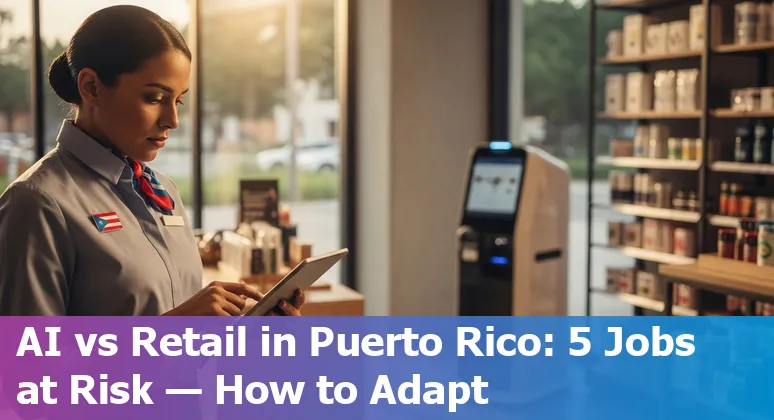
Too Long; Didn't Read:
Puerto Rico's top 5 retail roles - cashiers, sales associates, inventory/warehouse clerks, customer‑service reps and assistant managers - face AI risk as 84% of local firms use AI and 3 in 5 consumers want AI shopping; reskilling (15‑week programs) and scheduling can save 5–15%.
Puerto Rico's retail jobs are at a turning point: local research found 84% of island organizations have adopted AI in at least one business function, and many residents already use AI tools regularly, so retailers face pressure to automate routine tasks and meet shoppers' rising expectations for fast, personalized service - 3 in 5 consumers say they'd like to use AI while they shop.
At the same time global analyses warn a large share of occupations are exposed to automation, and Puerto Rico's Department of Labor is already piloting AI hiring tools like the PERFIL platform to match workers to new roles.
That mix - high local adoption, hungry consumers, and proactive public programs - means cashiers, stock clerks and tiered customer‑service roles on the island may be reshaped sooner rather than later; reskilling into AI‑aware, customer‑facing specialties offers a practical path forward.
Learn more in the island's AI survey and reporting from local experts.
| Attribute | Information |
|---|---|
| Description | Gain practical AI skills for any workplace; learn AI tools, prompt writing, and apply AI across business functions (no technical background required). |
| Length | 15 Weeks |
| Courses included | AI at Work: Foundations; Writing AI Prompts; Job Based Practical AI Skills |
| Cost | $3,582 (early bird); $3,942 afterwards. Paid in 18 monthly payments, first payment due at registration. |
| Syllabus | AI Essentials for Work syllabus |
| Registration | Register for AI Essentials for Work |
“There's a talent shortage everywhere, particularly for software developers and AI, and Puerto Rico is a good source of AI talent.” - Carlos Meléndez, Wovenware
Table of Contents
- Methodology - How We Identified Risk and Recommendations
- Cashiers / Checkout Clerks - Why they're vulnerable and practical pivots
- Retail Sales Associates - From routine selling to consultative specialists
- Inventory / Stock Clerks & Warehouse Workers - Automation on the back end
- Customer Service Representatives - AI chatbots and tiered support models
- Assistant Store Managers / Junior Retail Managers - From admin tasks to leadership
- Conclusion - Clear steps for workers, employers and policymakers in Puerto Rico
- Frequently Asked Questions
Consider starting with Robotics, autonomous systems, and simulation pilots to automate repetitive in-store and warehouse tasks safely and affordably.
Methodology - How We Identified Risk and Recommendations
(Up)Methodology blended Puerto Rico‑specific reporting with industry studies to pinpoint which retail roles face the fastest AI exposure: local coverage and expert interviews in News is My Business guided the ground truth on infrastructure, talent and nearshoring pressures, while a companion piece on Puerto Rico's AI‑disrupted job market summarized broader displacement and reskilling signals that informed our exposure criteria; findings were then benchmarked against sector research - including Amperity's 2025 State of AI in Retail and industry surveys on executive readiness - to score roles by task‑automation risk, customer‑facing importance, and re‑skilling potential.
Practical filters emphasized on‑island constraints (intermittent power and scarce data‑center capacity), employer adoption patterns, and clear opportunity areas (inventory, checkout and tiered customer service).
Recommendations were generated where high vulnerability met clear pivot paths - training, CDP and workflow automation adoption, and vendor partnerships - so a small grocery's frontline worker has a tangible retraining route rather than a vague warning; sources and expert quotes were used throughout to keep advice realistic and rooted in Puerto Rico's current tech and labour landscape.
Sources: Puerto Rico faces hurdles adopting agentic AI - News is My Business, Puerto Rico tackles AI‑disrupted job market - News is My Business, Amperity 2025 State of AI in Retail report.
“There's a talent shortage everywhere, particularly for software developers and AI, and Puerto Rico is a good source of AI talent.” - Carlos Meléndez, Wovenware
Cashiers / Checkout Clerks - Why they're vulnerable and practical pivots
(Up)Cashiers and checkout clerks on Puerto Rico's retail floors are among the most exposed to rapid AI-driven change because self‑checkout is spreading fast and often shifts paid work onto customers - creating new, stressful duties for a single attendant and opening lanes for theft and understaffing; worker reporting and industry analyses document higher “shrink” at unmanned lanes and more customer conflict, the very conditions already seen across U.S. stores and likely to surface on the island as chains expand kiosks.
That vulnerability isn't just theoretical: front‑line stories and studies describe one worker juggling multiple kiosks at once and being forced into unpaid tech‑support and loss‑prevention roles, while trade analyses warn self‑checkout often produces “fauxtomation” rather than true labor‑reducing automation.
Practical pivots for Puerto Rico's cashiers include training into dedicated self‑checkout support and in‑store tech‑troubleshooter roles, shifting to customer‑experience or personal‑shopping specialties, and learning lightweight AI tools for fraud detection and queue management; retailers and workers can speed those moves with short, bilingual upskilling plans and targeted vendor partnerships to protect jobs and improve safety.
For context and practical examples, see Prism report on self-checkout headaches and worker impacts and Supermarket News analysis of fauxtomation in self-checkout, and explore bilingual staff training and AI fraud-detection use cases tailored for Puerto Rico retail.
“It's like I'm one person working six check stands.” - Milton Holland, supermarket employee (Prism)
Retail Sales Associates - From routine selling to consultative specialists
(Up)In Puerto Rico's stores, retail sales associates can move from repetitive transaction work to high-value consultative specialists by learning to use AI as an on‑the‑job assistant: chatbots and virtual assistants already handle routine queries and can free staff to focus on advice and upsells (see APU's overview of AI in retail), while generative‑AI “copilots” promise to equip associates with instant product knowledge, localized inventory insights, and personalized recommendations at the counter (read Oliver Wyman's generative AI in stores research).
That shift matters on the island where bilingual customer service is essential - short, role‑play training and a Gemini‑powered bilingual staff plan can turn a cashier into a confident product consultant who uses AI to surface the right size, price and cross‑sell in the moment.
Employers that pair AI tools with targeted reskilling (and tools for loss prevention and fraud detection) create roles that customers prefer and that protect frontline jobs by raising the bar from routine selling to relationship‑driven service; the result is a retail floor where human empathy and AI speed combine to make shopping feel faster and more personal.
“The future of sales doesn't belong to AI. It belongs to the salespeople who know how to use AI better than anyone else.”
Inventory / Stock Clerks & Warehouse Workers - Automation on the back end
(Up)Back‑room retail roles - inventory clerks, stock pickers and warehouse crews - are already being reshaped by AS/RS, AMRs, cobots and goods‑to‑person systems that promise fewer aches, faster picks and far fewer costly errors; Puerto Rico's long history of factory automation and its push to attract reshoring make the island a natural place for these systems to appear, but uneven power and infrastructure risks mean implementations must be smart and staged (Puerto Rico automation and energy challenges report).
Robotics can close labor gaps and improve safety while creating higher‑skill roles - maintenance, intralogistics software and WMS operators - that preserve careers instead of cutting them, a point underscored by industry playbooks on bridging labor shortages (Bastian Solutions warehouse automation and workforce upskilling).
Practical advice for Puerto Rico stores: start with targeted, bilingual training and phased pilots tied to clear ROI, prioritize human‑safe cobots and G2P workstations, and remember the surprising scale economies - some cube storage systems use “10 robots [that] use as little energy as a vacuum cleaner,” making automation less daunting if paired with local resilience planning (AutoStore warehouse robotics energy-efficient cube storage overview).
“Now we can see people are very proud of working in an AutoStore environment, which is very clean and technology-driven,” Liske remarks.
Customer Service Representatives - AI chatbots and tiered support models
(Up)Customer service reps in Puerto Rico are already living the hybrid future: with 84% of local organizations applying AI and service operations among the top adopters, chatbots are the front line for routine questions, freeing humans for complex issues and relationship work while also creating new escalation and scheduling demands (see the Puerto Rico AI adoption survey 2024).
Well‑designed tiered support models pair 24/7 AI agents that handle FAQs, order status and basic troubleshooting with seamless handoffs to bilingual specialists - tools proven useful for San Juan SMBs and often integrated with workforce schedulers so the right technician is ready when a bot escalates (read about local deployments at AI chatbot customer support solutions for San Juan SMBs).
But adoption gaps matter: 59% of Puerto Rican organizations cite lack of in‑house expertise and under half of agents report adequate AI training, so short, role‑play bilingual upskilling (for example a Gemini‑powered bilingual staff training plan) is key.
Done right, bots stop the midnight panic over simple returns; done poorly, they create PR and security headaches - so human oversight, clear escalation paths and privacy safeguards are non‑negotiable.
“A significant 84% of local organizations report having applied AI in at least one business function. More importantly, results suggest that AI is starting to deliver value to Puerto Rican organizations.”
Assistant Store Managers / Junior Retail Managers - From admin tasks to leadership
(Up)Assistant store managers and junior retail managers in Puerto Rico can shift from paperwork pilots to floor leaders by leaning on smarter scheduling, AI forecasting and focused bilingual upskilling - especially where tourism swings and intermittent power make staffing a daily puzzle.
Practical moves include adopting city‑aware scheduling that can cut labor costs 5–15% and save managers hours a week (see Shyft's Ponce scheduling guide), pairing that with AI‑driven, minute‑by‑minute forecasting and task‑based execution so shifts aren't guesses but precise plans (Logile's platform shows how stores sync forecasts, schedules and tasks).
The human payoff is clear: instead of burning midnight hours rewriting rosters, a junior manager becomes the person who deploys the right bilingual associate to a sudden cruise‑ship rush or reassigns trained staff during a power blip - like turning a chaotic corkboard into a calm command center.
Fast, role‑play bilingual training (for example a Gemini‑powered staff plan) completes the loop, giving managers the coaching tools they need to mentor, enforce compliance and build career pathways on the island.
Conclusion - Clear steps for workers, employers and policymakers in Puerto Rico
(Up)Puerto Rico can turn fast-moving disruption into a practical roadmap: workers should prioritize short, bilingual reskilling that teaches AI fluency and customer-facing skills (role‑play, fraud‑detection prompts and self‑checkout support), employers should phase pilots, pair bots with clear human escalation and fund on‑site training, and policymakers must back apprenticeships, wraparound supports and transparent hiring tools so transitions don't deepen inequality - Anita's story in local reporting is a reminder that automation can erase not just hours but community ties.
Concrete first moves include employer‑sponsored microcourses, partnerships with nonprofits and community colleges for stipends and childcare, and using targeted hiring platforms the government is already piloting to match displaced workers to new roles.
For stores and chains, start with focused ROI pilots (inventory, fraud detection, tiered chatbots) and bilingual, role‑play coaching so associates become “AI‑aware” consultants, not displaced clerks; for workers, a 15‑week, job‑focused program can rapidly build workplace AI skills and prompt craft.
See local reporting from Tech Day Puerto Rico on at‑risk roles and Nucamp's AI Essentials for Work syllabus for a practical reskilling path.
| Attribute | Information |
|---|---|
| Description | Gain practical AI skills for any workplace; learn AI tools, prompt writing, and apply AI across business functions (no technical background needed). |
| Length | 15 Weeks |
| Courses included | AI at Work: Foundations; Writing AI Prompts; Job Based Practical AI Skills |
| Cost | $3,582 (early bird); $3,942 afterwards. Paid in 18 monthly payments. |
| Syllabus | AI Essentials for Work syllabus - Nucamp AI Essentials for Work course details |
| Registration | Register for AI Essentials for Work - Nucamp AI Essentials registration page |
“In five years, we'll see jobs that are unimaginable right now due to AI.” - Jaime Sanabria, Tech Day Puerto Rico
Frequently Asked Questions
(Up)Which five retail jobs in Puerto Rico are most at risk from AI and why?
The article identifies five high‑risk retail roles: (1) Cashiers / Checkout Clerks - exposed as self‑checkout and kiosk models expand, increasing unpaid tech support and loss‑prevention duties; (2) Retail Sales Associates - routine selling is prone to automation by chatbots and virtual assistants unless upskilled into consultative, AI‑assisted specialists; (3) Inventory / Stock Clerks & Warehouse Workers - back‑room automation (AMRs, cobots, AS/RS) can replace repetitive picking but create higher‑skill maintenance and WMS roles; (4) Customer Service Representatives - chatbots will handle FAQs and basic troubleshooting, shifting humans to complex, bilingual escalations; (5) Assistant Store Managers / Junior Retail Managers - administrative forecasting and scheduling tasks can be automated, freeing managers to focus on leadership if they adopt AI forecasting and smart scheduling. These risks are amplified locally by high AI adoption (84% of Puerto Rican organizations report applying AI in at least one function) and rising consumer demand for AI shopping experiences (about 3 in 5 consumers want to use AI while shopping).
How did you identify which roles are most exposed and what criteria were used?
Methodology blended Puerto Rico‑specific reporting and expert interviews with sector research (e.g., industry AI in retail studies). Roles were scored by task‑automation risk, customer‑facing importance, and re‑skilling potential. Practical filters emphasized on‑island constraints (intermittent power, limited data‑center capacity), employer adoption patterns, and clear opportunity areas like inventory, checkout, and tiered customer service. Recommendations were prioritized where high vulnerability met clear, actionable pivot paths.
What practical pivots and reskilling routes can affected retail workers take?
Practical pivots include: Cashiers - train as dedicated self‑checkout support/tech troubleshooters, learn lightweight AI fraud detection and queue management; Retail Sales Associates - become consultative specialists using AI copilots for instant product knowledge and personalized recommendations; Inventory / Warehouse Workers - transition to cobot maintenance, intralogistics and WMS operator roles via technical upskilling; Customer Service Reps - move into bilingual tiered‑support specialists overseeing AI bots and handling escalations; Assistant Managers - adopt AI forecasting, minute‑by‑minute scheduling and task execution to become floor leaders. Short, bilingual role‑play upskilling and vendor partnerships speed these moves. Nucamp's recommended pathway is a 15‑week, job‑focused AI Essentials program (courses: AI at Work: Foundations; Writing AI Prompts; Job Based Practical AI Skills) with an early bird cost of $3,582 and $3,942 afterwards, payable in 18 monthly payments (first payment due at registration).
What should employers and policymakers in Puerto Rico do to ease transition and protect workers?
Employers should run phased, ROI‑focused pilots (inventory automation, fraud detection, tiered chatbots), pair bots with clear human escalation and privacy safeguards, fund bilingual, role‑play on‑site training, and form vendor partnerships for targeted upskilling. Policymakers should support apprenticeships, stipends and wraparound services (childcare, transportation), deploy transparent hiring tools already being piloted (for example PERFIL) to match displaced workers to new roles, and prioritize infrastructure resilience so automation pilots are staged around power and data constraints. Human oversight, measurable ROI and bilingual training are key to fair, durable transitions.
How quickly should workers act and what are recommended first steps?
Workers should act now: start with short bilingual microcourses that teach AI fluency, prompt craft, fraud‑detection basics and self‑checkout support. Employers and community partners can sponsor microcredentials, partner with nonprofits and community colleges for stipends, and use targeted hiring platforms for role matches. A focused 15‑week program can rapidly build workplace AI skills; practical first moves for stores include piloting inventory and fraud detection tools, instituting bilingual role‑play coaching, and mapping clear internal career pathways from frontline roles into higher‑skill positions.
Protect customer data with a Lexis+ AI bilingual regulatory clauses draft that cites Puerto Rico and federal privacy law.
In-store shrinkage drops when retailers use computer vision for loss prevention to detect theft and risky behavior in real time.

Ludo Fourrage
Founder and CEO
Ludovic (Ludo) Fourrage is an education industry veteran, named in 2017 as a Learning Technology Leader by Training Magazine. Before founding Nucamp, Ludo spent 18 years at Microsoft where he led innovation in the learning space. As the Senior Director of Digital Learning at this same company, Ludo led the development of the first of its kind 'YouTube for the Enterprise'. More recently, he delivered one of the most successful Corporate MOOC programs in partnership with top business schools and consulting organizations, i.e. INSEAD, Wharton, London Business School, and Accenture, to name a few. With the belief that the right education for everyone is an achievable goal, Ludo leads the nucamp team in the quest to make quality education accessible