









Top 5 Jobs in Retail That Are Most at Risk from AI in Pearland - And How to Adapt
Last Updated: August 24th 2025
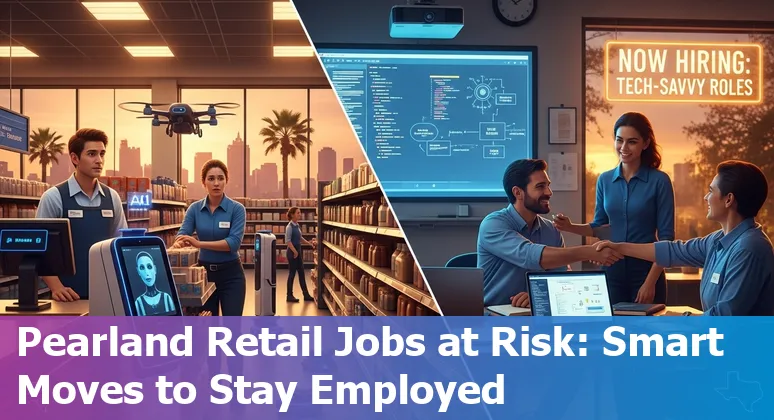
Too Long; Didn't Read:
Pearland retail faces automation risk: cashiers, customer-service reps, inventory clerks, sales associates, and scheduling clerks exposed by self-checkout, chatbots, RFID, AR, and smart replenishment. Studies show 30% U.S. job automation by 2030; chatbots cut response time 22% and reduce agent lag 70%.
Introduction: Why AI Matters for Pearland Retail Workers - Rapid advances in retail AI are reshaping tasks young and old cashiers, stock clerks, and floor staff perform every day: from AI-powered chatbots that 73% of consumers welcome for customer service to demand-forecasting and cashier-less checkout systems that contribute to broader automation trends (studies project up to 30% of U.S. jobs could be automated by 2030).
For Pearland's retail workforce, that means routine tasks are most exposed while customer-facing judgment, empathy, and tech-savvy skills gain value; think of a familiar store aisle where a smart shelf flags low stock seconds before the phone rings - a small moment that can determine a shift's priorities.
Resources exist to bridge the gap: practical training like the Nucamp AI Essentials for Work bootcamp and industry overviews on AI in retail and national job-impact research help Pearland workers prepare, reskill, and turn disruption into opportunity.
| Attribute | Information |
|---|---|
| Description | Gain practical AI skills for any workplace. Learn AI tools, write prompts, and apply AI across business functions; no technical background needed. |
| Length | 15 Weeks |
| Courses included | AI at Work: Foundations; Writing AI Prompts; Job Based Practical AI Skills |
| Cost | $3,582 early bird; $3,942 afterwards. Paid in 18 monthly payments, first payment due at registration. |
| Syllabus | Nucamp AI Essentials for Work bootcamp syllabus |
| Registration | Register for Nucamp AI Essentials for Work bootcamp |
AI in Retail use cases and trends from NeonTri and national AI job impact statistics from Nu.edu provide additional context and data for Pearland retail workers exploring reskilling options.
Table of Contents
- Methodology: How We Chose the Top 5 Jobs
- Cashiers
- Customer Service Representatives
- Inventory Clerks
- Sales Associates (Basic Floor Staff)
- Scheduling & Stock Replenishment Clerks
- Conclusion: Next Steps for Pearland Retail Workers
- Frequently Asked Questions
Find out how NLP for customer support speeds up responses and personalizes help for Pearland shoppers.
Methodology: How We Chose the Top 5 Jobs
(Up)To choose the top five retail roles most at risk in Pearland, the team used a task‑level approach: prioritize jobs dominated by repetitive, rule‑based work (self‑checkout, basic ticketing, data entry), cross‑check employer tech adoption (mobile pay, smart shelves, cashier‑less checkouts), and weigh local vulnerability - where nationwide studies show big exposure.
National analysis estimates 6–7.5 million U.S. retail jobs could be automated away, with retail cashiers singled out as highest risk and women holding 73% of those roles, so prevalence and worker demographics shaped the ranking (see the detailed risk estimate).
We also factored in employer intent and market signals - research finding that 41% of companies plan workforce reductions tied to AI informed how we ranked customer‑facing support and basic clerical roles - and then matched each risk pathway to practical local responses: upskilling routes, tech‑adjacent shifts, and Pearland‑specific AI use cases.
That blended lens - task exposure, employer adoption, demographic impact, and clear reskilling paths - helps highlight which jobs need the most urgent planning and which can be preserved or evolved via training like localized AI use‑case programs for Pearland retailers.
"This in-depth examination of retail automation gives investors insights as they consider investment risks and opportunities... The shrinking of retail jobs threatens to mirror the decline in manufacturing in the U.S. Workers at risk are disproportionately working poor, potentially stressing social safety nets and local tax revenues."
Cashiers
(Up)Cashiers in Pearland are squarely in the crosshairs of two opposite trends: rapid self‑checkout adoption that can route roughly 40% of transactions to kiosks (some Texas Born Stores hit 60%) and a growing retailer rethink after theft and customer friction surfaced, which has prompted experiments and even reversals in staffed lanes across Texas chains.
Local pilots - from H‑E‑B's “Fast Scan” machines in Schertz to convenience chains that now run five points of transaction (three self‑checkouts plus two staffed lanes) - show how technology can speed lines and free employees for higher‑value tasks, but national context matters too: large grocers and analysts are trimming or reworking self‑checkout where shrink and service complaints rise.
That means Pearland cashiers face real risk, yet also a chance to move into exception‑handling, customer experience, and in‑store tech support roles as stores reallocate labor to restocking, loss‑prevention, and the human interactions machines can't replace.
For quick local background, see the Texas Born Stores self‑checkout case study and reporting on retailer shifts in self‑checkout policy.
transaction speed is extremely important.
- Kevin Smartt, CEO, Texas Born Stores
Customer Service Representatives
(Up)Customer service reps in Pearland are at a crossroads: AI chatbots can speed answers, scale 24/7 service, and lift measurable performance, but they won't replace the human touch that matters for tricky or emotional calls.
A Harvard Business School field experiment found AI suggestions cut overall response times by about 22% and - most striking for Texas retailers who hire many entry-level staff - cut response time for less‑experienced agents by roughly 70%, while boosting customer sentiment sharply for those same agents; that means a new hire can sound and act like a seasoned rep far sooner, turning awkward hold music minutes into swift, calm resolutions.
At the same time, research and industry guides stress that chatbots work best as complements (triage, FAQ handling, and overnight coverage) rather than one‑size‑fits‑all fixes, and investors reward smart, staged rollouts that emphasize customer experience.
Pearland stores can start small - use NLP for routine returns and local pickup questions and route tough cases to trained staff - so the tech improves speed without losing the empathy that keeps shoppers coming back.
For the study details, see the Harvard Business School field experiment on AI suggestions and our NLP for customer support in Pearland guide.
| Metric | Improvement with AI |
|---|---|
| Overall response time | 22% reduction |
| Customer sentiment (overall) | +0.45 points |
| Response time for less-experienced agents | 70% reduction |
| Customer sentiment for less-experienced agents | +1.63 points |
“You should not use AI as a one-size-fits-all solution in your business, even when you are thinking about a very specific context such as customer service.” - Shunyuan Zhang
Inventory Clerks
(Up)Inventory clerks in Pearland are seeing their job descriptions rewritten by automation and AI: barcode scanners, RFID tags, smart shelves, and real‑time inventory software are turning manual counts and frantic end‑of‑day reconciliations into continuous, data‑driven workflows, so a low‑stock alert can ping a manager the moment shelves thin out rather than waiting for a human to notice.
Automated systems speed replenishment and reduce miscounts - boosting order fulfillment and cutting wasted labor - but they also shift work toward tech‑heavy tasks like order picking for micro‑fulfillment, scanning for multi‑channel sales, and responding to system‑generated exceptions, which can mean more surveillance and tighter pacing on the sales floor.
Pearland retailers that use AI for demand forecasting and analytics can keep the right SKUs in stores during Texas sales spikes, yet clerks will need training in RFID, POS integrations, and inventory analytics to move up the value chain.
Practical primers on automation in inventory systems and how AI improves forecasting are useful starting points for stores and workers alike - from implementation steps to best practices in training and auditing (see the role of automation guide and the AI inventory transformation overview for details).
Sales Associates (Basic Floor Staff)
(Up)Sales associates on the Pearland sales floor are less threatened by clever chatbots than by a shrinking role that's purely transactional - yet the same shift opens a path to higher‑value work if stores invest in experiential selling and real‑time enablement: think on‑floor experts who use iPad POS and AR demos to turn browsing into education, run pop‑up workshops, and shepherd omnichannel orders to curbside pickup.
Modern “integrated frontline enablement” programs train associates to be confident product advisors, improve retention, and lift productivity (see Rallyware's look at integrated enablement), while experiential retail plays like immersive displays, events, and floor‑level technology give small Texas stores ways to compete with online convenience (Lightspeed's experiential retail guide shows how stores can create memorable, shareable moments).
For Pearland floor staff, the key is moving from ringing up sales to curating experiences, running live demos, and managing phygital fulfillment - skills that make an associate the reason customers choose the store, not just the place they buy from.
“We're not competitor obsessed; we're customer obsessed. We start with what the customer needs, and we work backward.” - Jeff Bezos
Scheduling & Stock Replenishment Clerks
(Up)Scheduling and stock‑replenishment clerks in Pearland are where AI meets the daily grind: smart systems can turn frantic end‑of‑day ordering into quiet, continuous flows that ping when a shelf dips below its reorder point, freeing staff from manual PO churn and letting them focus on exception handling and same‑day fixes during busy Texas weekends.
Automatic replenishment tools - from simple min/max triggers to forecast‑based and vendor‑managed models - analyze sales, lead times, and POS signals to auto‑create orders, speed up replenishment from weeks to days, and shrink out‑of‑stocks dramatically; industry guides show automated approaches can cut stockouts by 30–60% and slash reorder admin time (in some cases up to ~95%), but they require clean data, POS/WMS integration, and staff training to avoid costly glitches.
Pearland stores can pilot a single category, pair smart forecasting with a reliable delivery partner, and move clerks into oversight, analytics, and supplier coordination roles - practical steps that turn a vulnerable job into a higher‑value, tech‑adjacent career path (see a full primer on automatic replenishment system overview, RELEX's work on RELEX forecasting and replenishment case study, and Dropoff's notes on retail replenishment strategies guide).
| Benefit | Typical Impact |
|---|---|
| Reduced out‑of‑stocks | 30–60% fewer stockouts |
| Labor on reorder/admin | Up to ~95% reduction in manual work |
| Replenishment speed | Lead times cut from weeks to days |
“The right technology helps you meet your goals no matter what curveballs your supply chain throws your way.”
Conclusion: Next Steps for Pearland Retail Workers
(Up)Pearland workers can turn disruption into opportunity by acting on three practical steps: pilot small, learn fast, and lean into local demand. Start with a tight, measurable pilot - one category for smart forecasting or a chatbot for routine returns - so a store can prove wins without risky rollouts, echoing broader 2025 retail trends that urge “start small” pilots for AI investments (see Retail Disruption Trends 2025).
Pair that with targeted upskilling: practical programs like the Nucamp AI Essentials for Work teach prompt writing, workplace AI tools, and job‑based skills in 15 weeks, so cashiers, clerks, and floor staff can shift into exception‑handling, scheduling oversight, or experiential selling roles that Pearland shoppers value (local stores such as Ashley in Pearland show how knowledgeable associates keep customers coming back).
Finally, watch local signals - new retail zoning along Pearland Parkway and major Texas rollouts like Walmart Health centers - so job seekers and managers can time reskilling to real hiring and store modernization timelines; a few weeks of focused training can be the difference between being displaced and being the person the neighborhood relies on when tech needs a human touch.
| Attribute | Information |
|---|---|
| Description | Gain practical AI skills for any workplace. Learn AI tools, write prompts, and apply AI across business functions; no technical background needed. |
| Length | 15 Weeks |
| Courses included | AI at Work: Foundations; Writing AI Prompts; Job Based Practical AI Skills |
| Cost | $3,582 early bird; $3,942 afterwards. Paid in 18 monthly payments. |
| Syllabus / Registration | AI Essentials for Work syllabus • Register for AI Essentials for Work |
“We are excited to deepen Walmart Health's presence in Texas beginning in April in Houston and Dallas-Fort Worth.” - Dr. David Carmouche, SVP of Healthcare Delivery at Walmart
Frequently Asked Questions
(Up)Which retail jobs in Pearland are most at risk from AI and automation?
The article identifies five Pearland retail roles most at risk: Cashiers, Customer Service Representatives, Inventory Clerks, Sales Associates (basic floor staff), and Scheduling & Stock Replenishment Clerks. These roles are vulnerable because they involve repetitive, rule‑based tasks (self‑checkout, routine returns, manual counts, transactional selling, and PO/reorder admin) that AI, RFID/smart shelves, chatbots, and automated replenishment systems can largely automate.
How severe is the automation risk and which local or national data points matter for Pearland workers?
National studies project up to 30% of U.S. jobs could be automated by 2030 and estimate 6–7.5 million U.S. retail jobs may be affected. Specific data points relevant to Pearland include: 73% of consumers are comfortable with AI chatbots for customer service; self‑checkout can route roughly 40% of transactions (some local stores hit 60%); women hold 73% of cashier roles nationally; 41% of companies plan workforce reductions tied to AI. Local pilot cases in Texas (e.g., Texas Born Stores, H‑E‑B Fast Scan) show both adoption and reconsideration of self‑checkout, so local tech choices will shape outcomes.
What practical steps can Pearland retail workers take to adapt or reskill?
The article recommends three practical steps: 1) Pilot small, learn fast - encourage stores to trial a focused AI use case (one category for smart forecasting or a chatbot for routine returns) to demonstrate wins. 2) Targeted upskilling - enroll in focused programs like Nucamp's AI Essentials for Work (15 weeks) to learn prompt writing, workplace AI tools, and job‑based practical AI skills. 3) Lean into local demand - watch Pearland signals (store modernizations, new retail zoning, local rollouts) and pivot into higher‑value, tech‑adjacent roles such as exception handling, in‑store tech support, experiential selling, scheduling oversight, and analytics.
What specific skills and training will help retail workers move into safer, higher‑value roles?
Skills that raise resilience include: AI tool fluency (prompt writing, using chatbots and workplace AI), RFID/POS/WMS integrations, inventory analytics and demand‑forecasting basics, exception handling and loss‑prevention techniques, in‑store tech support, and experiential selling (product demos, omnichannel fulfillment). The article highlights Nucamp's AI Essentials for Work (15 weeks; courses: AI at Work: Foundations, Writing AI Prompts, Job Based Practical AI Skills) as a practical entry point for non‑technical workers.
How can Pearland employers and stores implement AI in ways that protect jobs or create new opportunities?
Employers should adopt staged, customer‑first pilots that complement staff rather than fully replace them - examples: use NLP/chatbots to triage routine returns and route complex cases to humans; pilot smart forecasting for a single category and scale when clean data and integrations are proven; reassign staff from transactional lanes to exception handling, customer experience, and phygital fulfillment. The article notes measurable benefits (e.g., AI can reduce response times by ~22%, improve customer sentiment, reduce stockouts by 30–60%, and cut reorder admin work by up to ~95%) but stresses the need for training, clean data, and careful rollout to avoid service or shrink issues.
Learn how SMS and WhatsApp curbside chatbots streamline pickup workflows and cut wait times at Pearland locations.
Learn why AI-powered fraud detection is critical for reducing losses and ensuring compliance.

Ludo Fourrage
Founder and CEO
Ludovic (Ludo) Fourrage is an education industry veteran, named in 2017 as a Learning Technology Leader by Training Magazine. Before founding Nucamp, Ludo spent 18 years at Microsoft where he led innovation in the learning space. As the Senior Director of Digital Learning at this same company, Ludo led the development of the first of its kind 'YouTube for the Enterprise'. More recently, he delivered one of the most successful Corporate MOOC programs in partnership with top business schools and consulting organizations, i.e. INSEAD, Wharton, London Business School, and Accenture, to name a few. With the belief that the right education for everyone is an achievable goal, Ludo leads the nucamp team in the quest to make quality education accessible