









How to Become an AI Engineer in Papua New Guinea in 2026
By Irene Holden
Last Updated: April 22nd 2026
Quick Summary
To become an AI engineer in PNG by 2026, follow a 24-month roadmap starting with Python, SQL, and statistics using local data like crop yields or mobile money transactions, then progress to ML, deep learning, and deployment. The Sovereign AI Data Centre and employers like Digicel and BSP are hiring, but your success hinges on solving real PNG problems - clean data and a portfolio of locally relevant projects matter more than certificates.
Three things matter more than any textbook before you write your first line of code. A reliable internet connection tops the list - Port Moresby's fibre backbone is expanding, but expect outages, so keep a USB modem from Digicel or Telikom as backup. The Sovereign AI Data Centre launched in March 2026 improves local hosting, but your home connection remains your lifeline. Your laptop needs at least 8GB RAM - you won't need a GPU until deep learning, and Google Colab's free tier works from PNG if your connection holds.
- Internet: Download materials when you can. Keep backup options ready.
- Hardware: 8GB RAM minimum. Google Colab for deep learning.
- Purpose: A PNG problem that matters to you.
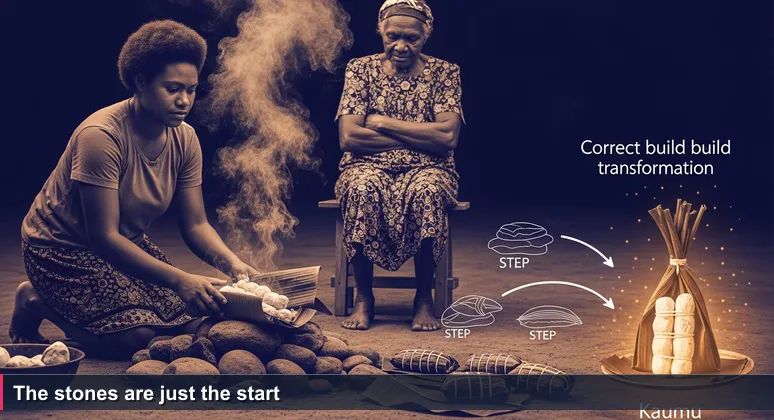
The last item is non-negotiable. The failed mumu teaches us: you can follow every step and still miss the point if you don't understand the fire beneath the stones. Pick a PNG problem - crop disease in the Highlands, mobile money churn for Digicel, equipment failure at a Santos site - and let it pull you through the hard months. As Louis Ronald, IS Auditor at the Bank of PNG, warns: "Without clean data, clear processes, and consistent systems, even the best technology will struggle."
Start with the stones, not the algorithms. The foundations carry the heat.
Steps Overview
- Prerequisites: What You Need Before You Start
- Lay the Foundations: Months 0-6
- Master Core AI & Machine Learning: Months 6-12
- Go Deep with Specialized AI: Months 12-18
- Deploy, Package, and Build Your Portfolio: Months 18-24
- How to Verify You've Succeeded
- Common Questions
Read our complete guide to starting an AI career in Papua New Guinea in 2026 for detailed salary data and employer insights.
Lay the Foundations: Months 0-6
Six months to build the base that most aspiring engineers skip. Month one demands Python fluency with NumPy and Pandas - you need to wrangle messy data by week three, not six months in. Enrol in a structured program like Nucamp's Back End, SQL and DevOps with Python bootcamp (16 weeks, roughly K7,650) or the PNG University of Technology's Bachelor of Science in Computer Science. Your first PNG-specific project: download public rainfall and crop yield data, clean it with Pandas, and discover why missing values in Tok Pisin columns are a skill employers at BSP and Kina Bank will pay for.
Month two covers SQL - SELECT, JOIN, GROUP BY - the language of Digicel transaction logs and mining sensor streams. Month three brings statistics that matter: not abstract theory, but the p-values that tell a mining engineer whether a sensor anomaly is real. "Statistics is where most people quit," the roadmap warns. "Think of it as measuring the heat of your mumu stones." Months four and five introduce Git, Jupyter Notebooks, and your first machine learning models using Scikit-Learn - supervised and unsupervised learning on synthetic data that mirrors the 70-80% of PNG citizens outside the formal financial system.
Month six caps the foundation with a capstone project: predict crop disease risk for a PNG province using real environmental data. Deploy it as a simple API with Flask. Push it to GitHub. The milestone that matters: can you explain your model's logic to your uncle in the village? As Louis Ronald, IS Auditor at Bank of PNG, puts it: "Without clean data, clear processes, and consistent systems, even the best technology will struggle."
Master Core AI & Machine Learning: Months 6-12
Months seven through twelve shift from knowing the alphabet to writing sentences. Feature engineering transforms raw Digicel call records into churn predictors. Model evaluation with SHAP tells a Telikom product manager why a customer is leaving. Tree-based ensembles like XGBoost handle the tabular data that mining companies and banks actually use. Time series forecasting helps plan tower capacity in Lae. Unsupervised learning clusters provinces by mobile money adoption, revealing where the 70-80% of unbanked citizens Steven Matainaho highlights are concentrated.
Each month demands a PNG-specific project that employers at BSP, Santos, and Digicel will recognise immediately:
- Build a churn classifier for Digicel using synthetic transaction data with call duration trends and top-up frequency.
- Predict equipment failure for Santos sensors using temperature, vibration, and pressure readings with a seven-day prediction window.
- Forecast mobile data traffic for Telikom in Mount Hagen using Prophet with confidence intervals.
- Cluster provinces by mobile money adoption patterns to guide BSP and Kina Bank's financial inclusion strategy.
Month twelve ties everything together into a full-stack ML pipeline: data ingestion, model training, and a REST API deployed on Render or Railway. The verification milestone matters more than any certificate - show your deployed API to a friend. If they can send data and get a prediction back, you've graduated from theory to practice. As AI Summit 2026 at The Stanley Hotel demonstrated, PNG employers want engineers who can ship working solutions, not just run notebooks.
Go Deep with Specialized AI: Months 12-18
The second year demands depth over breadth. Choose one specialization based on PNG's biggest opportunities: deep learning fundamentals (months 12-13), computer vision for industry (months 14-15), or natural language processing for PNG's languages (months 16-17). Each path builds toward a capstone that solves a real local problem end-to-end.
- Deep learning: Master neural networks with PyTorch or TensorFlow. Build a classifier for crop pests affecting PNG staples - sweet potato weevil, coffee borer, cocoa pod borer - using transfer learning with ResNet. The Solo AI Tech Entrepreneur bootcamp from Nucamp (25 weeks, ~K14,330) covers LLM integration and AI agents for exactly these applications.
- Computer vision: Train YOLO to count vehicles at Jackson's International Airport roundabout using public webcam feeds. This data helps NCD traffic planning and proves you can work with imperfect real-world imagery.
- NLP for Tok Pisin: Scrape public Facebook comments about Digicel promotions and train a sentiment classifier. English NLP tools fail on Tok Pisin's grammar - you'll need to collect and label your own data, which is the real work. The Pacific Artificial Intelligence Consortium is already building solutions in Tok Pisin and Hiri Motu for health and education.
Month 18 delivers the specialization capstone: a mobile app that identifies crop diseases from leaf images and speaks results in Tok Pisin, combining computer vision, NLP, and edge deployment. As Sentheyval from the International Training Institute noted: "We are developing locally tailored AI courses to meet PNG's unique industry needs." Your model must work on real-world PNG data, not clean benchmarks. Publish it on GitHub with a 3-minute video explaining the problem and approach. If a stranger understands your project in three minutes, you've succeeded.
Deploy, Package, and Build Your Portfolio: Months 18-24
The final six months transform you from an experimenter into an engineer who ships. Docker containerizes your crop disease classifier so it runs anywhere. Cloud deployment on AWS or GCP makes it accessible to users. Basic MLOps - model versioning, monitoring, CI/CD pipelines - ensures accuracy doesn't degrade in production. As Prime Minister Marape declared, 2026 marks the transition to AI-driven government, and employers at BSP, Santos, and Telikom need engineers who can deploy, not just experiment.
Months 21-22 tackle PNG's infrastructure constraints directly. Model quantization and pruning shrink your models to run on mid-range Android phones using TensorFlow Lite. This matters when internet is intermittent in rural areas - your crop disease detector must work offline. Test it in a village setting and document the trade-offs between accuracy, speed, and battery life. The Zero To Mastery AI Engineer course emphasises that 2026's engineers must "stitch together end-to-end GenAI apps" rather than just code in isolation.
- Agriculture: Crop yield predictor using satellite and rainfall data.
- Mining: Equipment failure forecaster for Santos sensor streams.
- Telecom: Churn model for Digicel with SHAP explanations.
- Banking: Fraud detection system for BSP transaction logs.
Months 23-24 are about community and visibility. Build a professional portfolio website on GitHub Pages showcasing these four projects with clear problem statements, methodology, and live demos where possible. Attend the AI Summit 2026 at The Stanley Hotel - the premier networking event for aspiring PNG AI engineers. Join the PNG ICT Facebook group and share your work early. The best engineers in Port Moresby and Lae learned by showing half-baked models and letting the community critique them. Your portfolio landing page should explain how your solutions apply across four industries, with a live demo link for each.
How to Verify You've Succeeded
Open your laptop. Ask yourself four questions that determine whether the roadmap became real or remained a recipe you followed without understanding the fire beneath the stones.
- Can you build a model from scratch using PNG data? Not a clean CSV from Kaggle - real, messy data with missing values and inconsistent date formats from the Department of Agriculture. Yes? You've passed the foundation.
- Can you deploy that model so someone can actually use it? An API, a web app, a mobile demo that works when the internet flickers. Yes? You've mastered core AI.
- Can you explain why your model works and when it will fail? Not "accuracy is 90%", but "it fails on images taken in low light because the training data was mostly daylight photos." Yes? You've gone deep.
- Can you show someone your work and they immediately see the value for PNG? A BSP manager looks at your fraud detection model and says, "We need this." Yes? You've become an AI engineer.
These questions mirror the lesson of the failed mumu. Following steps isn't enough - you must read the conditions, feel the heat, know when to wait. As AI adoption discussions in PNG emphasise, the technology is ready, but the local context determines success. The Sovereign AI Data Centre is live, the government is transitioning to AI-driven systems, and employers are hiring. The only missing ingredient is you.
Now go build something that matters. The roadmap was just the stones. Your community, your data chaos, your infrastructure constraints - that's the fire.
Common Questions
I don't have a computer science degree. Can I still become an AI engineer in PNG?
Yes, absolutely. The article outlines a self-taught path using bootcamps like Nucamp's Back End, SQL and DevOps with Python (K7,650, 16 weeks) and AI Essentials for Work (K12,900, 15 weeks). Employers like Digicel and BSP care more about your portfolio and ability to solve local problems than a formal degree.
How much does it cost to get the necessary training in PNG?
You can start with free resources like LinkedIn Learning and Kaggle, but structured bootcamps cost roughly K7,650 to K14,330. For example, Nucamp's Solo AI Tech Entrepreneur bootcamp is K14,330 over 25 weeks. University degrees at Unitech or UPNG are more expensive and take 4 years.
What kind of AI jobs are actually available in PNG right now?
Major employers like Digicel PNG, BSP, Kina Bank, Santos, and Newcrest are hiring for roles in fraud detection, predictive maintenance, customer churn analysis, and crop disease classification. The Sovereign AI Data Centre launched in March 2026 and the government's AI-driven transition are creating new positions.
I live in Lae or Mount Hagen, not Port Moresby. Can I still follow this roadmap?
Yes, the roadmap is designed for remote learning. You'll need a reliable internet connection and a laptop with 8GB RAM. Form study groups at Haus Win in Lae or join the PNG ICT Facebook group. The article includes projects using local data like crop yields from the Highlands.
How long will it take to become job-ready as an AI engineer in PNG?
The article outlines a 24-month roadmap: 6 months for foundations, 6 months for core ML, 6 months for deep learning specialization, and 6 months for deployment and portfolio building. Many students land entry-level roles after 12-18 months by building a strong GitHub portfolio with PNG-specific projects.
View the top 10 tech jobs in PNG that pay well and don't require a degree.
The article on free tech training at PNG libraries in 2026 is essential reading.
Check out our guide to the best tech apprenticeships in Papua New Guinea for 2026.
Our article on best coworking spaces in PNG highlights key amenities and pricing.
This comparison of AI tech bootcamps in Papua New Guinea covers affordability.

Irene Holden
Operations Manager
Former Microsoft Education and Learning Futures Group team member, Irene now oversees instructors at Nucamp while writing about everything tech - from careers to coding bootcamps.